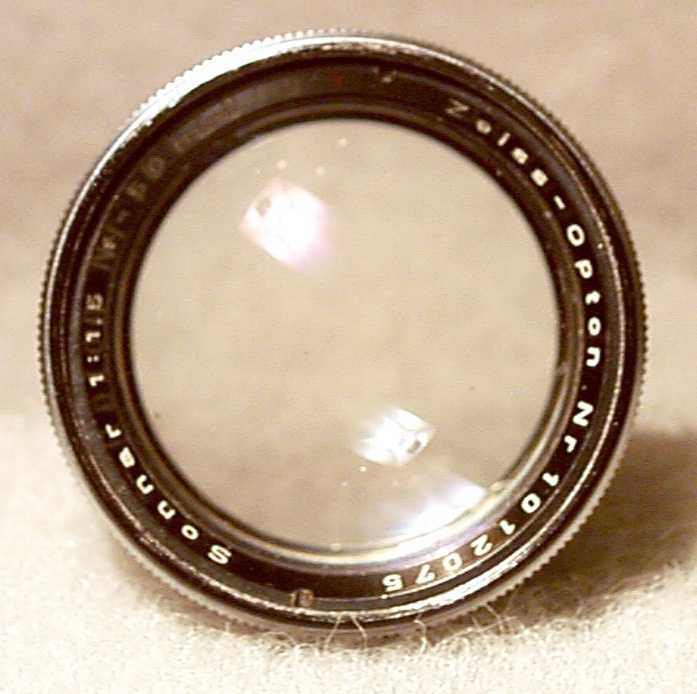
This is a view through a serviced lens that had fungus, cement separation problems in the triplet element, and bad threads on the triplet holder.
Servicing is available for just about any
Zeiss lens, and not only for those made for the Zeiss Ikon Cameras.
If your lens is not listed here, please inquire.
This is to announce that years of difficult and expensive experiments have resulted in the successful development of a process that permanently corrects the most common Zeiss lens problem. The following two pictures show before and after views of the same center triplet element from a Carl Zeiss Sonnar 50 mm f1.5 Lens with cement separation.
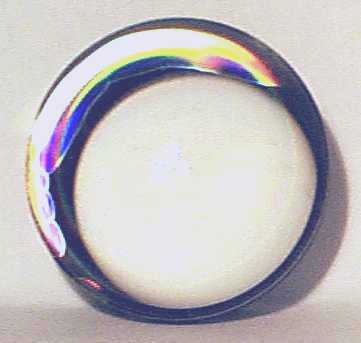
The process does not affect the coatings, lens centering, element alignment or any other optical attribute of the lens other than the separation. The procedure is permanent and does not use oil of any kind.
If your Contax, Contarex, or other Zeiss lens has this problem and you want it to be corrected please write to me.
If you want to know all there is to know about lens and camera fungus use this link: Fungus
If you want to read a warning about tricked up separated lenses being sold recently use this link:
1. LENS SERVICING: per listed lens:
The service consists of:a. Complete disassembly and hand/ultrasonic cleaning of all mechanical components.
b. Removal and cleaning of all lens optical elements. Special laboratory grade solvents are used to clean them. These evaporate without leaving a trace.
Note that fungus removal is automatically included with lens element cleaning. If the problem is determined to be cemented lens element separation or lens separation, repair of this problem is priced in the LENS REPAIR section.
c. Black edge painting on individual lens elements is touched up as required.
d. Lubricants in the aperture and iris mechanism are removed completely using ultrasonic cleaning with pure solvents. Replacement lubricant is teflon based synthetic grease which will not deteriorate and migrate.
e. Aperture/Focus Engraving paint is touched up as required.
f. Lens aperture calibration is tested on a test camera body using a Precision Camera Tester.
g. The lens is mounted on a test camera and the final focus adjustment is taken to perfection using a ZTS Precision Focus Tester.
Lens servicing results are always best when performed on the camera that the lens will be used on.
This is a picture of a set of aperture blades from a Zeiss-Opton 50mm f1.5 Sonnar lens. They have been ruined by rust and staining of the bluing. This lens was purchased by a customer who could not see this damage because it was obscured by a thick coat of oil on the blades. The oil that comes from deteriorated grease does not protect against rusting and can accelerate it by trapping moisture. This oil can also make it very difficult to see damage.
For years there have been a lot of discussions about the proper way to safetly clean a lens. Zeiss has ended all arguments by producing its own brank of lens cleaning cloths. Just follow the directions provided on the side of the box and you cannot go wrong. I highly recommend that you exclusively use genuine Zeiss lens cleaning cloths on your fine pre and post war Zeiss Lenses. If your lens needs cleaning there's no point in risking a scratch by using anything else. Packages of 50 individually sealed pre moistened 6" x 5" cloths (not paper) are available here.
Prices
The following lenses are accepted for regular overhaul service at the stipulated prices (Price when performed with camera body overhaul):
50mm f 1.5 Sonnars:
a. Rigid 50 mm f1.5 Sonnar (Pre-War)...............................$135.00 ($85.00)
a. Contaflex TLR 50mm 1.5 Sonnar...................................$245.00 ($185.00)
a. Coated Rigid 50 mm f1.5 Sonnar (Pre-War)...................$135.00 ($85.00)
a. Zeiss-Opton 50 mm f1.5 Sonnar.......................................$135.00 ($85.00)
a. Carl Zeiss 50mm f1.5 Sonnar (Post-War)........................$135.00 ($85.00)
a. Leica Screwmount 50 mm f1.5 Sonnar.............................$130.00 ($85.00)
a. Russian Made Copy of 50 mm f1.5 Sonnar.....................$135.00 ($85.00)
a. 50mm f1.4 Nikor...............................................................$155.00 (105.00)50mm f 2.0 Sonnars:
b. Rigid Uncoated Pre-War Carl Zeiss Jena........................$135.00 ($85.00)
b. Rigid Coated Pre-War Carl Zeiss Jena............................$135.00 ($85.00)
b. Rigid Zeiss-Opton T...........................................................$135.00 ($85.00)
b. Rigid Carl Zeiss (Post War)...............................................$135.00 ($85.00)
b. Collapsable Uncoated Pre-War Carl Zeiss Jena...............$135.00 ($85.00)
b. Collapsable Coated Pre-War Carl Zeiss Jena..................$135.00 ($85.00)
b. Collapsable Zeiss-Opton T.................................................$135.00 ($85.00)
b. Russian Made Copy of 50mm f 2.0 Sonnar.......................$135.00 ($85.00)50mm f 2.0 Planar for Contarex:
b. Silver....................................................................................$135.00 ($85.00)
b. Black Blitz............................................................................$135.00 ($85.00)50mm f 1.4 Planar for Contarex:
b. Silver...................................................................................$175.00 ($115.00)
b. Black Blitz...........................................................................$175.00 ($115.00)
50mm Tessars:
c. 50 mm f 3.5 Carl Zeiss Jena (Pre-War)..............................$155.00
c. 50 mm f 3.5 Carl Zeiss Jena Coated (Pre-War).................$155.00
c. 50mm f 2.9 Carl Zeiss Jena Coated (Pre-War)..................$155.00
c. 50 mm f 3.5 Zeiss-Opton (Post-War)..................................$155.00
c. 50 mm f 3.5 Carl Zeiss (Post-War).....................................$155.00Leica Screwmount Lenses:
d. 50 mm f 2.0 Sonnar............................................................$225.00
d. 50 mm f 1.5 Sonnar............................................................$225.00
d. 85 mm f 2.0 Sonnar............................................................$195.00
d. 135 mm f 4.0 Sonnar...........................................................$195.00
d. 35 mm f 3.5 Biogon............................................................$195.00
d. 35 mm f 2.8 Biogon............................................................$195.00
d. Russian Copy of above lenses marked Jupiter or Zeiss...... SameTelephoto Lenses:
e. 85 mm f 2.0 Sonnar Pre-War Carl Zeiss Jena.......................$185.00
e. 85 mm f 2.0 Zeiss-Opton Post War........................................$185.00
e. 85 mm f 2.0 Carl Zeiss Post War...........................................$185.00
e. 85mm f 4.0 Carl Zeiss Post War............................................$185.00
e. 85mm f 4.0 Carl Zeiss Pre War..............................................$185.00
e. 85 mm f 2.0 Russian Lens......................................................$235.00
e. 105 mm Nikor..........................................................................$195.00
e. 135 mm f 4.0 Sonnar Pre-War Carl Zeiss Jena.....................$155.00
e. 135 mm f 4.0 Zeiss-Opton Post War......................................$155.00
e. 135 mm f 4.0 Carl Zeiss Post War.........................................$155.00
e. 180 mm f 6.8 Carl Zeiss Jena (Pre-War)...............................$235.00
e. 180 mm f 6.6 Schneider Tele Xenar.......................................$235.00
e. 180 mm f 2.8 Carl Zeiss Jena for Flektoscope......................$325.00
e. 250 mm f4.0 Sonnar Contarex................................................$275.00
e. 300 mm f 2.8 Carl Zeiss Jena for Flektoscope......................$375.00
e. 500 mm f 8.0 Carl Zeiss Jena for Flektoscope......................$400.00Wide Angle Lenses
f. 28 mm f 8.0 Tessar Uncoated Carl Zeiss Jena (Pre-War)... ..$175.00
f. 35 mm f 3.5 Biogon Uncoated Carl Zeiss Jena (Pre-War ......$175.00
f. 35 mm f 3.5 Biogon T Coated Carl Zeis Jena (Pre-War.........$225.00
f. 35 mm f 3.5 Biogon Zeiss-Opton (Post-War)...........................$165.00
f. 35 mm f 3.5 Biogon Carl Zeiss (Post-War)..............................$165.00
f. 35 mm f 2.8 Biogon Zeiss-Opton (Post-War)...........................$165.00
f. 35 mm f 2.8 Biogon Carl Zeiss Jena (Pre-War).......................$165.00
f. 35 mm f 2.8 Biogon Coated Carl Zeiss Jena (Pre-War)..........$225.00
f. 35 mm f 2.5 Nikor......................................................................$185.00
f. 35 mm f3.5 Planar......................................................................$185.00
f. 35 mm f3.5 Biometar..................................................................$185.00
f. 35 mm f2.8 T Biotar....................................................................$185.00
f. 35 mm f4.5 Orthometar..............................................................$185.00
f. 25 mm Topogon..........................................................................$285.00
f. 21 mm Biogon.............................................................................$215.00
f. 21 mm Biogon for Contarex.......................................................$235.00
f. Russian 35mm Lens...................................................................$195.00Contax Mount Nikon Lenses
g. 135 mm Nikor............................................................................$155.00
g. 35 mm Nikor..............................................................................$155.00Contarex Lenses
h. 50 mm f2.0 Planar.........................................................$155.00 ($95.00)
h. 50 mm f2.8 Tessar........................................................$155.00 ($95.00)
h. 55 mm f1.5 Planar.........................................................$175.00 (115.00)
h. 135 mm 4.0 Sonnar.....................................................................$155.00
h. 135 mm f2.8 Sonnar....................................................................$155.00
h. 180 mm f2.8 Sonnar....................................................................$250.00
h. 250 mm f4.0 Sonnar....................................................................$250.00
h. 250 mm f4.0 Sonnar Manual Aperture......................................$250.00
h. Vario Sonnar Zoom Lenses.....................................$375.00 to $500.00
Depends upon condition.
h. 35 mm f4.0 Distagon....................................................................$175.00
h. 35 mm f2.0 Distagon....................................................................$200.00
h. 21 mm f4.5 Biogon.......................................................................$225.00
Special Lenses:2. LENS REPAIRS:There are a variety of extremely rare lenses made in Contax mount. Servicing for these special lenses is available. Please inquire if your lens is not listed above.
Difficult Lenses:
If you have sent your lens to other shops and have had it returned with the explaination that it is not economical for repair, or if you lens has been badly damaged, or if you have been told it is impossible to repair send it here. There has not yet been one lens that has come here and had not been completely restored.
Notes:
1. Servicing depends upon the ability to disassemble the lens without damage. Experience has demonstrated that some lenses may be frozen together and be unserviceable. Unserviceable lenses will be returned without charge other than for shipping and the estimate charge.
2. Damage to the filter thread ring or other lens parts may affect the ability to service the lens. If this is a problem, you will be advised of available repairs. If servicing is not possible due to thread damage or other damage, the lens will be returned to you at no charge other than for shipping and the estimation charge.
Full machine shop services are available to replace missing or damaged components. Each damaged lens is different. Repaired lenses are precision aligned using an Auto-Collimator to ensure original factory performance. Repair costs are in addition to the stipulated servicing cost provided above.There is a lot of confusion about lens and camera fungus. It's really not all that complicated. The first thing to understand is that fungus cannot grow without food. In cameras food ususally consists of old grease, oil from old deteriorated grease, rubber seals, mirror damping and body sealing foam, and oil from photographer's sweat.Prices for typical repairs are as follows:
a. Filter Ring Straightening: $35.00 This service includes careful bending of the filter ring using a variety of tools specific to this purpose to obtain the best possible appearance and smoothest possible filter attachment. The exterior of the filter ring is cleaned and repainted.
b. Filter Ring Replacement: $95.00 Many lenses have separate filter rings. Replacement rings can be made of brass or aluminum that are indistinguishable from the original. These replacements are painted with hard baked enamel.
c. Other parts as necessary. Price depends upon availability and/or the necessity to custom fabricate. Please inquire.
c. Lens Element Re cementing: $85.00 This price is for the separation, cleaning and precision re-cementing of the triplet in the Zeiss Opton 50 mm f1.5 Sonnar. This is the most complicated element. Other elements are less.
d. Zeiss Opton Sonnar 50 mm f1.5 Triplet Holder Repair: $50.00. This model lens utilizes a brass frame/aluminum bezel threaded holder to encase the triplet and hold it in position. In some lenses the threads on the aluminum bezel are improperly cut. The result is that the aluminum bezel cannot be fully threaded onto the frame. This defect was handled at the factory through the application of additional black paint to "glue" the element in place. Over time this paint shrinks, and the element becomes loose, and the element can move out of proper position due to normal bumps from normal usage. Due to the high curvature of the front of the triplet this problem can only be diagnosed by examination with the front element removed.
e. Lens Recoating. Lens element re coating services are available. Please inquire.
There are basically two types of mold, oxygen loving and non-oxygen loving. Oxygen loving mold typicall exudes carbon dioxide as it lives and is relatively harmless to lenses and coatings. But it does exhale water which can cause rust. It generally will not consume plastic, rubber or foam. Mold that thrives in an oxygen deprived environment exudes a very powerful acid. This acid is responsible for coating damage and lens etching. It also dissolves rubber, some plastics and foam. Determining which type of mold inhabits a particular lens or camera is amost impossible for anyone but an expert to do based upon appearance. Mold is like mushrooms and can have a variety of appearances based upon what stage of life it is in. It's usually best to just assume its the worst kind.
Cameras and lenses that are stored in carefully sealed containers can develop both kinds of mold in sequence. First the oxygen loving mold gets to work and uses up the oxygen in the camera or lens and then the low oxygen loving mold will get to work. Even if a camera or lens is sealed tightly in a plastic bag with fresh dessicant mold will grow given the right temperature, atmosphere and food conditions.
To prevent mold the best thing to do is to keep the camera or lens in a proper humidity environment of 40 degrees of relative humidity, temperature at about 72 degrees Farenheit, and to exercise it regularly to keep the internal lens or camera atmosphere well oxygenated.
Getting back to the matter of mold food it is important to realize that petroleum based lubricants and mold have grown up together over many millions of years. There is nothing strange about mold eating petroleum based aperture damping or camera lubricating grease. It's a normal thing. The simple fact of the matter is the longer a camera or lens has been in existence the more likely it is that the grease inside it has become innoculated with one or more species of mold who are just wating for some optimum condition to occur so that they can grow.
The one and only way to ensure that your camera or lens cannot become a victim of mold is to ensure that it is cleaned completely of the old lubricant and then all parts must be thorougly cleaned to remove all traces of the oil that has leaked from the grease over time. Then it must be properly lubricated with modern synthetic grease that is not petroleum based.
Keep in mind that just because a shop says it is using modern synthetic
grease and oils doesn't mean they are. If you are unsure just give
your camera or lens the smell test after it has been serviced. If
it smells like "machine oil" or has a slightly sulfurous odor then the
lubricants are not modern synthetic ones. Modern synthetic oils and
greases have very large molecules. These molecules are so large they
do not get released into the air and so they have no smell.
There is a lot of confusion about lens and camear grease and oil. Here's how it is. All petroleum based greases consist of three parts. These are a soap, oil(s), and stabilizers. Typically the soap component is a soap made with lead or lithium metal and which is not water solluble. Soap made for the home is typically made with sodium and is water solluble. When one uses household soap to wash the hands, the soap dissolves in the water and the petroleum component of the soap attaches to the the oil on the skin and carries it away down the drain. In camera grease the soap holds the oil to keep it in one place and to keep it from running away. The stabilizer is used to slow down the attack of oxygen on the soap which tends to break it up and reduce its effectiveness in holding the oil. Over a long time, as the soap breaks down, the oil is released to migrate into the camera or lens. All petroleum based grease deteriorates over time. Based upon the quality and purity of the products this process can be either long or short.Lens and Camera Grease
Once a petroleum based grease has completely deteriorated and released all of its oil the remaining soap will tend to harden and become sticky and then will form a hard deposit. Once grease looses its oil it is no longer a lubricant. It is more like an adhesive.
In the 1960's manufacturer's started to use a new type of grease called "molybdinum disulfide" (MD) grease. MD is a powdery solid lubricant like graphite but better. MD grease is basically all the same. Today you usually come across it when it used in the wheel bearings of automobiles. The problem with MD grease is that there is no soap in it to contain its oil. The result is the oil gets released from the grease quickly and the sold MD remains making the camera or lens sluggish or sticky.
It is possible today to substitute modern synthetic greases for the
old ones in many applications. It is also possible to have these
hand made to be analogues of the older greases that used MD. Some
applications require the older grease. These are typically
lenses with aluminum helicals using sliding pads or lenses made right after
the war that use primitive aluminum alloys. These lenses require
a grease that has the property of preventing self welding. Greases
that prevent self welding typically are proprietary and are available only
in Germany, and are petroleum based.
When there is visible oil on the aperture blades there is oil on the lens element surfaces inside the lens assembly. Lenses work on a basic priciple of physics that says the degree to which a ray of light is bent is proportional to the hardness difference between the surfaces through which the light travels. When a manufacturer assembles a lens at the factory great care is taken to ensure the lens elements are clean and free of any trace of oil. When a lens becomes coated with oil the oil acts as a secondary surface which bends the light itself. The oil films on the various elements in effect becomes a number of thin lenses that have become introduced into the lens design and the results are never good.Why Aperture Blade Oil is So Bad
If you have an old camera or lens and there is oil on the aperture blades there is absolutely no point in judging the performance of the lens. It is only when the lens has been properly cleaned that the true performance of the lens will be revealed. Old lenses with oil films on them will generally produce disapointing results when the results are copared to lenses which are freshly manufactured, even fresh ones that are intrinsically vastly inferior.
When one looks inside an old lens what is actually seen is an optical illusion. This optical illusion is caused by all of the possible partial reflections of all of the inner surfaces of all of the lens elements. Shining a flashlight through an old lens with oil films on the elements is effectively turning the lens into a special form of kalleidoscope. It's no way to judge the potential "Bokeh" of and sharpness that the lens can produce when it is brought back to the originally manufactured state of cleanliness.
Keep in mind that a lens in which the original damping grease has released all of its oil can show no oil on the aperture blades. In lenses that are very old, or which have been kept in hot environments, it is possible that all the oil released from all of the grease has migrated away from the blades and into inner recesses of the lens. The best rule of thumb is that if a lens is 20 to 25 years old or more, and it has not been thorougly cleaned, its best to assume the inner lens elements have an oil film on them.
It's not simple to clean a lens coated with oil released from deteriorated aperture grease. Typically a number of cleanings using different solvents are required to get it all out of the lens and off the lens surfaces. The reason for this is that grease manufacturers would typically use a mixture of specially prepared oils whose properties would help each other stay with the grease base soap longer. These oils are typically solluble in solvents which are chemically different from each other in a fundamental ways and the chemical terms for these differences are "polarity" and "chirality". To get every trace of all of the oils out of the lens it is necessary to use solvents whose basic chemical properties match those of the oils.