<h1>Leider kann Ihr Browser keine Frames darstellen!</h1>
<p>Verwenden Sie in diesem Fall die Noframes-Home-Seite für die Navigation. Den Link finden Sie auch am Ende jeder aufgerufenen Seite wieder.</p>
<hr>
<a href="/noframes_home/noframes_home.html">Zur Noframes-Home-Seite</a><br>
<hr>
|
|
 |
|
|
The image shows three versions of the Biometar 2.8/80. On the left is the newer version with MC coating, in the middle with simple SC coating, and on the right an older version for the Praktisix.
|
|
|
|
|
The Primotar E 3.5/80 from Meyer-Optik Görlitz (all in aluminum look) and the Jena Tessar 2.8/80 are not recommended (they originally belonged to the Praktisix of the first years).
The Carl Zeiss Jena lenses were optimized for the ORWO films commonly used in East Germany (which correspond to the earlier AGFA films). This means that the slightly pinkish color rendition of these films is compensated for by the lens's higher blue rendition. Therefore, using a film with a slightly bluer cast (e.g., Kodak) can sometimes result in a slightly more pronounced blue tone in the photos. Conversely, films that are typically reddish (AGFA) will exhibit very neutral and vibrant colors. Of course, these are always subjective assessments, and you'll have to find the right film for yourself. Films that you would prefer with a modern 35mm camera might produce unusual results with the Six.
In some cases, brand new or like-new Zeiss Jena lenses and new third-party lenses for Kiev or Exakta are still offered in the photo mail-order business [ www.brenner-fotoversand.de ], [ www.baierfoto.de ] or at photo fairs.
Interestingly, the automatic aperture function sometimes malfunctions with Kiev lenses on the Pentacon Six, while Pentacon lenses work perfectly on the Kiev. Slight variations in the bayonet dimensions of the Kiev lenses could be the cause.
|
|
|
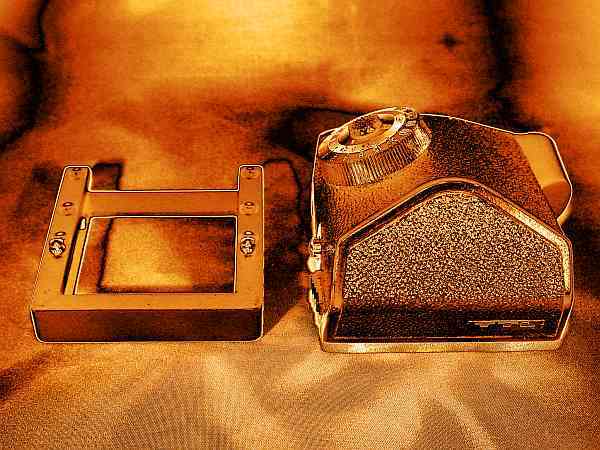
3. TTL prisms
Since the prisms are at least 30 years old, the reliability of the measurements may leave something to be desired. If you only need a prism attachment for the Pentacon Six, you can also buy the "simple" prism. However, both original prisms for the camera are relatively dark and do not show the entire ground glass image.
A genuine alternative until now was the Kiev TTL prism, formerly offered brand new by Baier-Fototechnik [ www.baierfoto.de ] for the Pentacon six and the Exakta 66. This prism displays 100% of the viewfinder image and, especially in combination with the Rollei field lens (see 4.), provides a bright, high-contrast viewfinder image. Exposure is indicated by two LEDs at the top of the field of view.
Unfortunately, one now has to resort to used Kiev TTL prisms, as new ones are no longer supplied. It should be noted, however, that there are no service centers for these prisms in Germany.
The necessary adapters for using the Kiev 60 prism on the Pentacon six are still currently offered by Baierfoto.
|
|
|
|
|
|
Pentacon six with Kiev 60 TTL prism attachment
|
|
|
|
Following the adoption of EU Directive 98/101/EC, the environmentally hazardous mercury oxide batteries used in numerous light meters and cameras can no longer be manufactured. Unfortunately, this also includes the V625PX and PX13 batteries for Pentacon TTL prisms. Sooner or later, this will lead to a shortage. While suitable alkaline-manganese equivalents exist for some of the affected battery types, the problem runs deeper. CdS-based light meters rely on a consistent voltage output, but unlike mercury oxide cells, the voltage in alkaline cells drops continuously. Therefore, the exposure readings become inaccurate. Some manufacturers can recalibrate the cameras (Rollei), and others supply voltage adapters for use with silver oxide batteries (Gossen). The zinc-air batteries (e.g., MRB 625), which were originally intended as replacements for mercury oxide cells, have a significant disadvantage for amateur photographers. Shortly before use, these cells are activated by removing a protective film. After activation, the electrolyte dries out within a few weeks, and the battery must be replaced.
However, for Pentacon Six users, this doesn't mean saying goodbye to their old prism. Thanks to the bridge circuit used, the new 1.5-volt PX625 alkaline batteries can be used without any problems.
When purchasing a new one, however, the brighter Kiev prism (only available used) with SR44 silver oxide cells is recommended.
In any case, the prisms (and also the handheld light meter) should be calibrated with the camera. To do this, measure an object of medium contrast and medium brightness and take a photograph (on slide film!) using the determined values. Then take several photographs with the aperture reduced by half a stop and several photographs with the aperture increased by half a stop, carefully noting all the settings. After developing, compare the best photograph with the first and then adjust the film speed setting on the prism or light meter accordingly. (Best photograph with a half-stop smaller aperture = in the future, increase the setting by 1.5 DIN; for ASA, this means increasing the ASA by half, e.g., 150 instead of 100, 300 instead of 200.)
4. Field lenses
There are seven different original image field lenses available for the Six. It's important to note that the glass lenses are flatter at the rear than at the front. The plastic lenses, such as the Fresnel lens, have the same height at both the front and back. This means that anyone wanting to replace a glass lens with a plastic lens will absolutely need new mounting brackets and retaining rings.
With a Fresnel lens, due to its uniform height at the front and back, only the area in the center of the lens is in focus. It is not possible to focus on the entire viewfinder image!
It is recommended to have the camera converted to the image field lens of the Exakta 66/3 (Rollei 6008) at Pentacon GmbH (see illustration).
This focusing screen features a measuring wedge with a micro-grid ring and a grid, and is significantly brighter than the original lenses.
|
|
|
|
|
|
Pentacon six, converted to Rollei-6008 focusing disc with measuring wedge, micro-grid ring and grid
|
|
|
|
|
|
|
|
5. Image step error/ Function of the measuring roller
The film transport mechanism of the Pentacon Six is the most critical part of the system. Careful work is essential here. The section of the instruction manual regarding film loading must be followed precisely, otherwise frame inconsistencies can easily occur. It is crucial to return the rapid-wind lever to its starting position with your thumb after each shot ; this significantly reduces the risk of film transport errors.
The camera's film metering roller ensures that the film is not advanced too far after the shot; however, if too little film is transported per frame for any reason, this cannot be influenced by the metering roller and overlaps will occur.
If a camera frequently experiences image overlaps on the film, it can also be equipped with a film transport control: Baier-Fototechnik [ www.baierfoto.de ].
6. Shaking due to mirror movement
When releasing the shutter, vibrations of the camera body can occur at exposure times of 1/15s to 1/30s due to the mirror flipping up. Even using a lightweight tripod does not alleviate this. However, the problem can be reduced by using a heavier tripod or shorter exposure times. One solution would be to install a mirror lock-up function (albeit a somewhat complicated one) from Pentacon in Dresden or the Baier version, which offers several advantages over the Pentacon version.
7. Use of filters, lens hoods and resulting vignetting
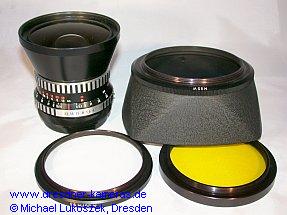
The 80mm Biometar has a filter diameter of 58mm and can generally be used with all filters. The situation is more critical with the 50mm Flektogon, which has a standard 86mm filter thread. M86 filters can cause vignetting (especially polarizing filters with a thick mount), so the standard M86/M95 adapter ring should be used to avoid vignetting with a 95mm filter. However, using M86-W filters (see below) instead of the adapter ring is preferable. The corresponding lens hood has a 95mm thread and can only be attached via the aforementioned adapter or an M86-W filter. Despite this sensible approach, vignetting sometimes occurs due to the shape of the Flektogon lens hood. The 180mm Sonnar retains the same system (86mm screw thread + M86/M95 adapter + 95mm lens hood), even though vignetting is impossible with an 86mm filter. This allows the use of the same filters as with the Flektogon. A cost-effective option, although with these very large diameters, "cost-effective" is hardly the right word anymore. A linear polarizing filter from B+W (M86), for example, already costs more than a used Flektogon 4.0/50.
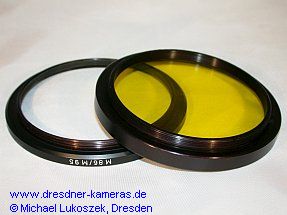
In East Germany, filters for the Pentacon Six lenses (50mm and 180mm) were offered in a special "modified" M86-W version (see illustration). The filters had an M86 thread, but the outer surface of the filter was fitted with an M95 thread. This was intended to allow the aforementioned adapter ring of the lens hood to be replaced by the M86-W filter without vignetting. Unfortunately, vignetting sometimes still occurs with the 50mm Flektogon lens due to the lens hood.
|
|
|
 |
|
 |
|
|
|
|
|
|
|
|
|
|
|
8. Shutter speed test
In the book ?Pentaconsix Praxis? by WG Heyde, a simple test of the camera's exposure times is described:
?If you ever have doubts about whether the shutter speeds on your camera are still correct, try the following test. Test object: a billboard or a large map; lighting: evenly overcast sky; exposure from a tripod: go through the common shutter speeds and aperture values of the series with metered exposure. For example: 20 DIN film, 1/250 s, aperture f/8, then expose at 1/1000 s at f/4; 1/500 s at f/5.6; 1/250 s at f/8; 1/125 s at f/11; 1/60 s at f/16; and 1/30 s at f/22. Any deviations will be clearly visible on the negatives of the normally developed film, which should all have the same density: A denser negative indicates that the exposure time is too long relative to the others, and vice versa.?
Note: The described test is more accurate when using reversal film; furthermore, a slide is easier to assess than a negative.
|
|
|
|
9. Stray light through the lens
Some time ago, I occasionally experienced severe overexposure in some of my photos. At first glance, it seemed to be due to stray light. I placed the loaded camera in various positions directly under a bright fluorescent light and then had the film developed, to no avail. I drove every camera shop in Dresden crazy with this problem. Only by chance did I discover the real cause. It must be the lenses. In my case, it was the Flektogon and also the Biometar with MC coating! In any case, it's stray light getting into the image. I only realized this when, on a day when the sun was struggling to penetrate the light high fog in the sky, I took several photos with the Canon Six and the Canon EOS. With the Six, numerous images showed strong overexposure in the upper part of the frame, especially when skylight filtered through the trees or when parts of the sky were included. This problem didn't occur at all in shots where the camera was pointed downwards. I'd never experienced anything like this with the EOS before, but on this particular day, some of the images were also overexposed, though less so than with the Six. This suggests that the Pentacon lenses, without a lens hood, are probably extremely sensitive to diffuse stray light. You only notice this when it happens with a significantly less sensitive full-frame camera.
|
|
|
|
10. Reflections inside the camera body
Another explanation for the described overexposure in the images, according to Rolf-Dieter Baier [ www.baierfoto.de ], could be reflections within the camera body. Later Pentacon Six models have quite good matte finishes, while older ones tend to have strong reflections. He explains that with the shutter open, one can see from the back of the camera how light from the front, especially from above, is reflected off the bottom of the camera (what appears as "bottom" in the image is then "top"). An effective anti-reflection kit for affected cameras is available on his website.
|
|
|
 |
|
 |
|
|
|
 |
|
|
|
|
|
This website and all associated pages are protected by copyright. No content from these pages may be used in other electronic or printed publications without the express written consent of the respective authors.
This page and all dependent pages are copyrighted. No contents of these pages may be reproduced in whole or in part without the express written permission of the copyright holders.
|
|
|
.
|
|
|