<h1>Leider kann Ihr Browser keine Frames darstellen!</h1>
<p>Verwenden Sie in diesem Fall die Noframes-Home-Seite für die Navigation. Den Link finden Sie auch am Ende jeder aufgerufenen Seite wieder.</p>
<hr>
<a href="../../noframes_home/noframes_home.html">Zur Noframes-Home-Seite</a><br>
<hr>
|
|
|
 |
|
 |
|
|
|
 |
|
|
|
|
 |
|
|
|
|
|
|
|
|
1. Half-frame cameras for police departments as perpetrator cameras
|
|
|
|
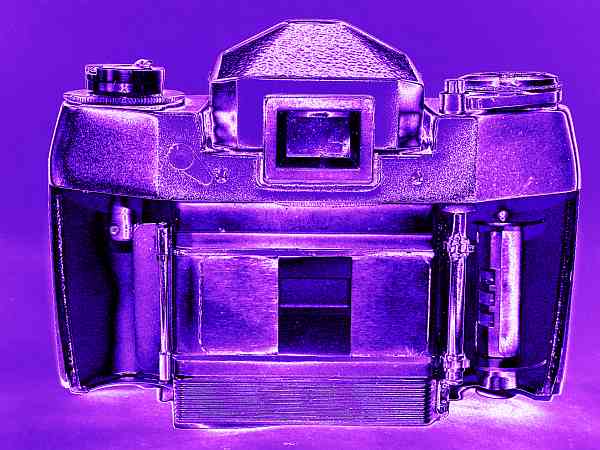
The first 500 half-frame Exa cameras were manufactured at the Ihagee camera factory as early as 1952.
These 18x24mm cameras were needed by the East German People's Police, who wanted to use them to take photographs of perpetrators in the economical half-frame format. The Exa-(0) camera bodies were masked with metal plates directly in the image window and below the viewfinder; the film transport mechanism was modified accordingly.
|
|
|
|
The Royal Canadian Mounted Police (RCMP) also ordered Exa Ia cameras with the reduced image format. Klaus Wichmann, in his book "Exa - The Affordable 35mm SLR," mentions a production run of 200 cameras . These were used with the waist-level viewfinder, which was equipped with a lens featuring marked image boundaries. Masking was again performed using the original image window.
|
|
|
|
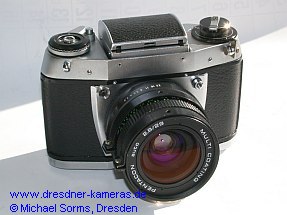
Within the Exa 1b series, 18x24mm half-frame cameras also existed as
perpetrator cameras for police departments.
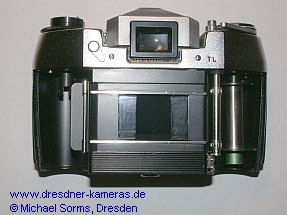
The film transport mechanism was internally modified so that the film advances by only 4 instead of 8 perforations. Consequently, the film advance lever can only swing out 110° instead of 130°. However, the film transport roller next to the film gate remained unchanged; both standard production cameras and the half-frame models always have 4 teeth on each side.
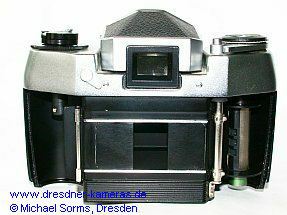
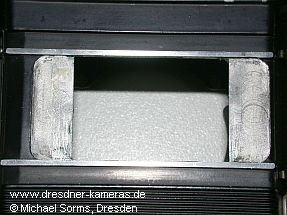
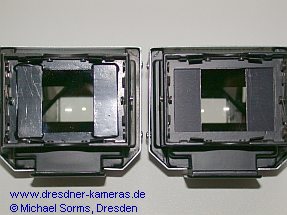
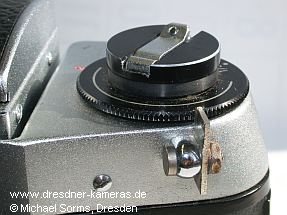
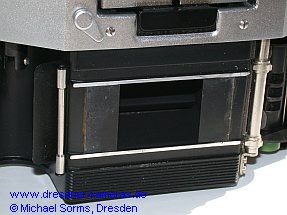
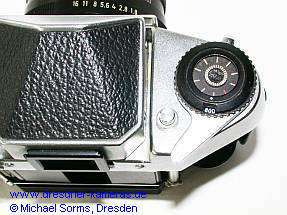
The film gate was reduced to 18x24mm. While early conversions (Exa (0) to Exa Ia and early Exa 1b) involved masking directly in the 24x36mm film gate, later Exa 1b cameras typically masked the outside of the gate, over the old film gate (this transition occurred between serial numbers 6493XX and 6496XX for Exa 1b cameras; however, some individual examples with the old masking method exist in the 7229XX series, but this practice ceased from serial number 7231XX onwards). In the Exa (0) to Exa Ia / early 1b series, metal sheets (brass or aluminum) were consistently used to manufacture the masks, while in later cameras, plastic plates were glued into the previously milled recess of the gate. The
masked prism inserts common in these cameras also show a shift from metal plates to plastic or even pieces of imitation leather as masking material.
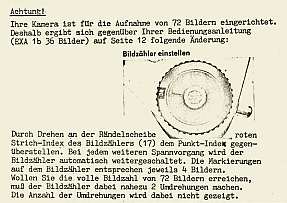
The counter modification on the Exa 1b was not carried out uniformly; in most cases, the counter disc was replaced with one featuring 10 line markings. One section corresponds to 4 images, requiring almost two rotations for 72 shots. However, some cameras retain the standard counter disc with line and dot markings, as well as numbers up to 36.
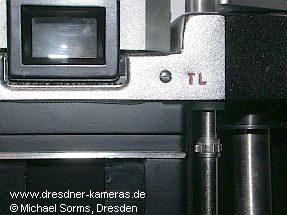
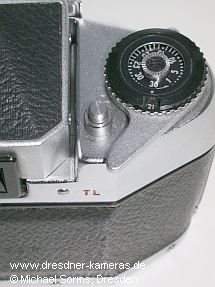
Some camera bodies (both Exa 1a and Exa 1b) also bear a TL marking (TL for Täterlichtbildkamera, or perpetrator's photographic camera), which was stamped into the body caps using letter punches and filled with red ink. It is interesting to discover the various modification variations.
|
|
|
|
Richard Hummel gibt in seinem Buch ?Spiegelreflexkameras aus Dresden? an, dass die Exa (0)
18x24 von 1952 (etwa 500 Stück) die einzige offizielle Halbformat-Kameraproduktion der Ihagee war. Alle folgenden Umbauten erfolgten nur nach Einlieferung von Kameras durch die jeweiligen Auftraggeber (Post und
Polizei). Es fanden nach seinen Angaben folgende Umbauaktionen statt: 1965 30-50 Stück, 1983 30-50 Stück und 1989 400 Stück.
Diese Zahlen sollten nicht unkommentiert bleiben, da sie nicht vollständig und
teilweise unkorrekt zu sein scheinen. Es ist beispielsweise schwer vorstellbar, dass z.B. die Kanadische RCMP (Royal Canadian Mounted Police) Exa Ia-Kameras wieder nach Dresden geliefert hat, um diese dann im
Ihagee-Kamerawerk umbauen zu lassen. Also zumindest bei der Exa Ia für die RCMP (1970er Jahre) dürfte es sich um eine weitere offizielle Halbformatfertigung und keine Aktion an eingelieferten Kameras handeln.
Die nachweisbare Halbformat-Exa des Modells 1961 wird von ihm nicht aufgeführt.
Im Jahr 1989 wären wohl auch keine Exa 1b mit schwarzem Frontschild (Produktionsende 1985), sondern eher Exa 1c-Modelle
(Produktionsende 1987) umgebaut worden. Es existieren jedoch keine umgebauten Exa 1c. Diese Aktion dürfte also eher um 1985 stattgefunden haben, zudem lassen sich auch die modifizierten Exa 1b-Kameras durchaus
bestimmten Seriennummernkreisen zuordnen.
|
|
|
|
|
|
Kameramodell
|
bekannte Seriennummernkreise der Halbformatkameras
|
|
Exa (0)
|
211XXX, 221XXX
|
|
Exa Modell 1961
|
565XXX
|
|
Exa Ia
|
404XXX, 424XXX, 434XXX, 518XXX, 551XXX
|
|
Exa 1b (Frontplatte chrom)
|
636XXX, 649XXX, 678XXX, 679XXX, 721XXX, 722XXX, 723XXX,
724XXX,764XXX, 789XXX
|
|
Exa 1b (Frontplatte schwarz)
|
C833XXX, C835XXX, C836XXX, C876XXX
|
|
|
|
|
 |
|
|
Exa 1b #723240 - Halbformatversion 18x24 als Täterlichtbildkamera,
geänderter Filmaufzug und modifiziertes Zählwerk
|
|
|
|
|
|
|
|
Exa 1b #649323 - Halbformatversion 18x24 als Täterlichtbildkamera
mit nicht geänderter Zählwerkscheibe
|
|
|
|
|
|
|
|
|
|
|
|
|
 |
|
|
|
3. sonstige im Bildformat reduzierte Kameras
|
|
|
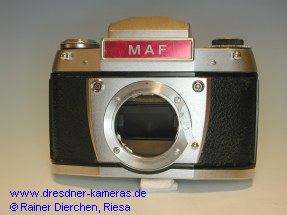
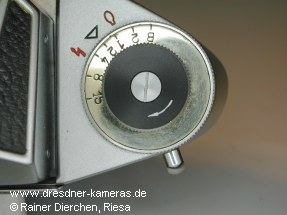
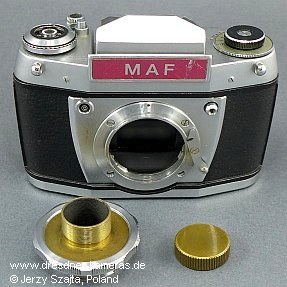
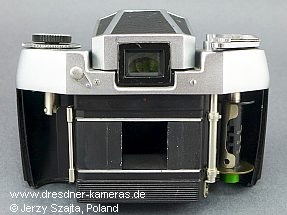
Eine interessante Modifikation ist die MAF, eine Exa Ia mit Langzeitenwerk (B - 2 - 1 - 1/2 -
1/4 - 1/8 - 1/15s) und reduziertem Bildformat 22x24 mm zur Nutzung am Mikroskop. Die Kameras sind intern mit einem Teil der Seriennummer versehen, daher handelt es sich um keine Einzelumbauten. Die Ausführung der
mechanischen Änderungen ist professionell. Nachdem eine einzelne MAF-Kamera schon länger bekannt war, wurde 2014 vom Mitautor des Buches ?Exakta. Krótka historia doskonałości - Exakta. A Short
History of Perfection? Jerzy Szajta eine weitere Kamera vorgestellt. Beide nunmehr bekannten MAF-Mikroskop-Exas (#252033, #272258) wurden also in Polen gefunden, daher liegt die Vermutung nahe, dass die
Apparate auch dort umgebaut wurden.
|
|
|
|
 |
|
 |
|
|
|
MAF (Exa Ia -
Ser.-Nr. 252033) mit Langzeitenwerk (B - 2 - 1 - 1/2 - 1/4 - 1/8 - 1/15s) und reduziertem Bildformat 22x24 mm zur Nutzung am Mikroskop
|
|
|
|
 |
|
 |
|
|
|
|
|
MAF (Exa Ia -
Ser.-Nr. 272258) mit Langzeitenwerk (B - 2 - 1 - 1/2 - 1/4 - 1/8 - 1/15s) und reduziertem Bildformat 22x24 mm zur Nutzung am Mikroskop
|
|
|
|
|
|
|
4. ergänzende Literaturhinweise
- Cullen, Gary; Rademaker, Klaus: Exakta Obscurities, Seltsames und Seltenes. Gary Cullen 2001, ISBN 0-9689868-1-1
- Heimbach, Peter: Exa-Varianten für Post und Volkspolizei. PhotoDeal II/1999
- Hummel, Richard: Spiegelreflexkameras aus Dresden. Edition Reintzsch Leipzig 1995, ISBN 3-930846-01-2 oder
3-89506-127-1
- Nattenberg, Olaf: Exa - die kleine Schwester der Exakta. PhotoDeal I/2009
- Nattenberg, Olaf: Exa-Post. Exakta Times No. 69, Winter 2007
- Wichmann, Klaus: EXA - die preiswerte Kleinbildreflex. Lindemanns Verlag 1997, ISBN 3-89506-165-4
|
|
|
|
|

|
Hier noch eine persönliche, aber natürlich rein subjektive Empfehlung von Sammler zu
Sammler, für das aus meiner Sicht beste deutschsprachige Magazin für Photographica und Fotogeschichte, die PhotoDeal.
|
|
|
|
|
|
Diese Internetseite und alle zugehörigen Seiten unterliegen dem Urheberrecht. Keine Inhalte dieser Seiten dürfen ohne ausdrückliche schriftliche Zustimmung der
entsprechenden Autoren in anderen elektronischen oder gedruckten Publikationen verwendet werden.
This page and all dependent pages are copyrighted. No contents of these pages may be reproduced in whole or in part without the express written permission of the copyright holders.
|
|
|
.
|
|
|