<h1>Leider kann Ihr Browser keine Frames darstellen!</h1>
<p>Verwenden Sie in diesem Fall die Noframes-Home-Seite für die Navigation. Den Link finden Sie auch am Ende jeder aufgerufenen Seite wieder.</p>
<hr>
<a href="../../noframes_home/noframes_home.html">Zur Noframes-Home-Seite</a><br>
<hr>
 |
|
|
|

|
|
Parts of the following section are available as a PDF file
in the download area .
|
|
|
|
|
|
|
|
1. Description
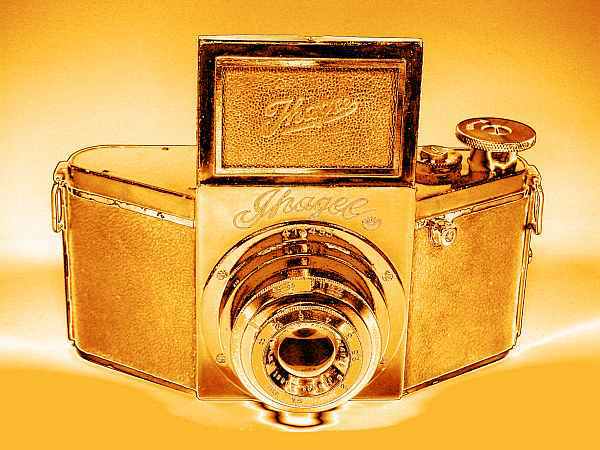
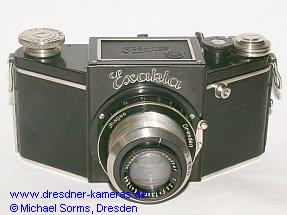
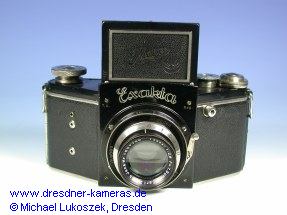
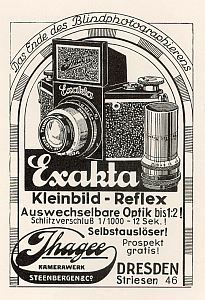
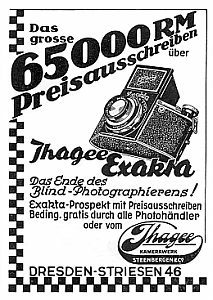
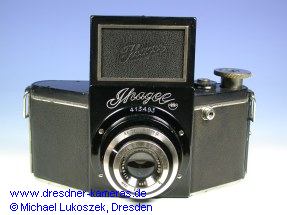
The Ihagee Standard-Exakta, also known as the Vest-Pocket-Exakta or VP-Exakta, is a single-lens reflex camera for 4 x 6.5 cm (127) roll film. It was developed at the Ihagee camera factory in Dresden starting in 1930 and manufactured from 1933 to 1939. Designed by Karl Nüchterlein, and equipped with a horizontally traveling cloth focal-plane shutter, waist-level viewfinder with frame viewfinder, interchangeable lenses, and later a vacuum flash connection, this camera can be considered a precursor to the later Kine-Exakta.
The basic model was initially introduced in 1933 with shutter speeds of 1/25, 1/50, 1/100, 1/200, 1/300, 1/600, 1/1000 s, B, and Z. The name Exakta was used for the first time, derived from the precise image area seen in the viewfinder of the single-lens reflex camera. Due to the camera's strong sales, different equipment variants were planned. Thus, starting with the first production run in 1934, three differently equipped models were available:
- The Exakta A was the model without a long exposure function, with exposure times of 1/25, 1/50, 1/100, 1/200, 1/300, 1/600, 1/1000 s, B and Z (similar to the basic model from 1933).
- The Exakta B was equipped with a long-exposure timer for the additional exposure times from 1/10 to 12 seconds.
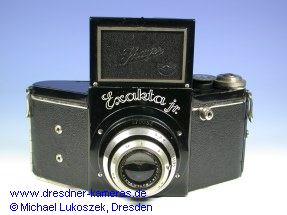
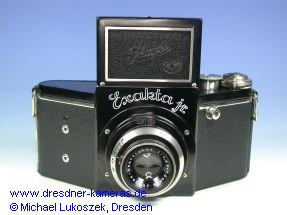
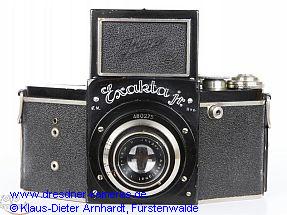
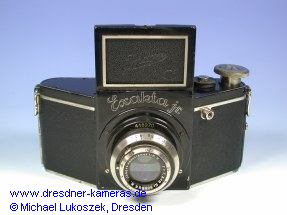
- The inexpensive entry-level model with fixed lenses and front lens adjustment, without a long-exposure mechanism, for the following shutter speeds: 1/25, 1/50, 1/100, 1/200, 1/300, 1/400, 1/500 s, was the Exakta Junior. At the beginning of production, the camera was still called the Ihagee Junior.
|
|
|
 |
|
 |
|
|
|
|
|
|
|
2. The model series
The differences between the 1934 Series 1
and the basic model, besides the aforementioned variations in features, included a winding knob enlarged to 26 mm in diameter and a modified lens mount thread. The mount dimensions are given as 39.5 mm x 0.5 for the basic model and 39.8 mm x 0.75 for subsequent series (Aguila & Rouah: ?Exakta-Collection? 2003). However, references such as M40 for all series can also be found in the literature (Lutton, Thomas Ralph: Luttons List. 1992) or M39 (unknown author: article p. 35).
In the 1935 Series 2,
the previous winding knob was replaced by a lever, the lens release lever was now located on the left side (in the direction of exposure) of the lens, and the red rear window was fitted with a sliding cover. The Ihagee trademark (crescent moon and sun) was now additionally embossed into the leather of the viewfinder cover on all models. For the first time, models A and B were also available as
the Night Exakta, featuring lenses with a higher aperture and an enlarged lens mount. On the Night Exakta variants, the serial number was located on the upper edge of the viewfinder cover, while on the other models, the serial number was engraved on the lens mount ring.
Relatively quickly, in 1935, the Series 3 followed
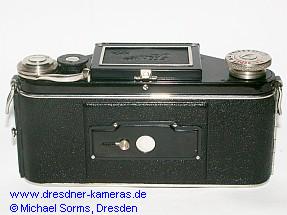
, featuring sockets for the vacuum flash unit and a 1/25 s flash synchronization (M). Models A and B were available with a plate back as an optional extra
. Existing cameras could also be retrofitted at the factory. The so-called Exakta C is therefore simply a back option for the Exakta models A and B. The plate back necessitated a shortened lens mount, which, when using roll film, required the use of a camera-specific extension ring. These rings each bore the camera's serial number. The waist-level viewfinder was not suitable for plate photography; focusing was achieved using the ground glass screen on the back. Night-vision Exakta models could not be equipped with the plate back.
From 1937 onward, the previous front plate was replaced by one with a rounded top. The camera was chrome-plated, but could also be delivered with the previous black enamel finish upon customer request.
This was followed in the 1938 model series 4.
A threaded socket was introduced above the flash connection for attaching the vacuum flash unit. The option of chrome plating or black lacquering for the body remained. Sales of the Kine-Exakta had developed well since 1936, allowing it to capture market share from the Standard-Exakta. Production ceased in 1939.
The Standard-Exakta series has a serial number range of approximately 400,000 to 600,000.
From the start of production, emphasis was placed on a good range of accessories. Gradually, supplementary lenses, extension tubes for close-up work, waist-level extensions with and without focusing magnifiers, microscope connectors, small and large vacuum flash units, a repro stand, and an Exakta Lumimax repro unit were introduced.
|
|
|
 |
|
 |
|
|
|
|
3. The lenses (selection)
Normal lenses for the Exakta:
Ihagee Exaktar 3.5/7 cm; 3.5/7.5 cm
Meyer Primotar 3.5/7.5 cm
Meyer Makro-Plasmat 2.7/7.5 cm
Zeiss Tessar 3.5/7 cm; 3.5/7.5cm; 2.8/7.5 cm
Schneider Xenar 3.5/7.5 cm; 2.9/7.5cm; 2.8/7.5 cm
Steinheil Cassar 3.5/7 cm; 2.9/7.5cm
Wide-angle lenses:
Meyer wide-angle double Anastigmat 6.8/5.6 cm,
Zeiss wide-angle Tessar 8/5.5 cm
Long-distance lenses:
Ihagee-Anastigmat 4.5/10.5 cm
Zeiss Tele-Tessar 6.3/12 cm
Zeiss Tele-Tessar 6.3/18 cm
Zeiss Tele-Tessar 6.3/25 cm
Meyer Tele-Megor 5.5/15 cm
Meyer Tele-Megor 5.5/18 cm
Meyer Tele-Megor 5.5/25 cm
Standard lenses for the Night Exakta:
Schneider Xenon 2.0/8 cm,
Meyer Primoplan 1.9/8 cm,
Zeiss Biotar 2.0/8 cm
Other manufacturers offered optics for the Exakta and Night Exakta models.
Das Auflagemaß, der Abstand zwischen der Auflage des Schraubgewindes und der Filmebene beträgt bei
der Standard-Exakta etwa 71,5 mm (Lutton, Thomas Ralph: Luttons List. 1992).
Aus der Preisliste von 1939 stammt folgende Textpassage: ?Spezialobjektive der Standard-Exakta:...Die Preise verstehen sich
einschließlich Anpassen im Werk. Für die Anpassung muss die Kamera eingesandt werden. Wir bringen eine genaue Einstellskala für das zweite Objektiv an, legen den Unendlichkeitsanschlag mit dem des normalen optischen
Systems zusammen und liefern außerdem noch für die Teleobjektive eine Einlage für den Rahmensucher der Exakta.?
Das heißt, ein einfacher Wechsel, wie später bei der Kine-Exakta, war ohne vorherige
Anpassung des Objektivs an die spezielle Kamera nicht möglich. Das Auflagemaß wies also bei jeder Kamera geringfügige Abweichungen auf, die durch die Einstellung des Unendlichanschlages am Objektiv wieder korrigiert
werden mussten.
Fest eingebaute Optiken mit Frontlinseneinstellung in der Exakta Junior:
Ihagee Anastigmat 4,5/7,5 cm
Ihagee Anastigmat 3,5/7,5 cm
Boyer Topaz 3,5/7,5 cm
Steinheil Cassar 2,9/7,5 cm
4. Preise der Standard-Exakta-Modelle
Die Preise unterschieden sich nach Modell und Objektivausstattung, bei den
Kameras der 3. und 4. Baureihe (Tabelle: Preise 1939) ist der Preis für die verchromte Ausführung angegeben, die schwarze Lackierung war 10 RM günstiger. Die Plattenrückwand ließ sich nicht mit jedem Objektiv
kombinieren (z. B. nicht mit Meyer Makro-Plasmat). Für diese Rückwand waren bei Lieferung ab Werk die unten angegebenen Preise gültig, bei nachträglicher Umrüstung mussten 21 RM zzgl. Montage im Werk bezahlt werden.
Zum Vergleich sind in der folgenden Tabelle auch die Preise für die Kine-Exakta, Nacht-Kine-Exakta, Exakta 6x6 und Nacht-Exakta 6x6 angegeben.
|
|
|
|
|
Modell
|
Preis 1933
|
Preis 1934
|
Preis 1939
|
|
Exakta A
|
120-190 RM
|
120-190 RM
|
130-240 RM
|
|
Exakta B
|
-
|
150-220 RM
|
160-270 RM
|
|
Nacht-Exakta A
|
-
|
280-345 RM
|
290-355 RM
|
|
Nacht-Exakta B
|
-
|
310-375 RM
|
320-385 RM
|
|
Exakta A,
Platten-Rückwand
|
-
|
-
|
151-211 RM
|
|
Exakta B,
Platten-Rückwand
|
-
|
-
|
181-241 RM
|
|
Exakta Junior
|
-
|
90-100 RM
|
100-110 RM
|
|
Kine-Exakta
|
-
|
-
|
200-270 RM
|
|
Nacht-Kine-Exakta
|
-
|
-
|
320-365 RM
|
|
Exakta 6x6
|
-
|
-
|
225-390 RM
|
|
Nacht-Exakta 6x6
|
-
|
-
|
460-600 RM
|
|
|
|
|
|
5. Literatur
Für weiterführende Informationen gibt es zahlreiche Literaturquellen:
Aguila, Clement; Rouah, Michel: Exakta Cameras 1933-1978. Hoove Foto Books 1989, ISBN 0-906447-38-0
Aguila, Clement; Rouah, Michel: Exakta Collection 1933-1987. DDP-Image-Editions Saint Amans Soult
2003, ISBN 2-9519891-0-5
Blumtritt, Herbert: Die Geschichte der Dresdner Fotoindustrie. Lindemanns Verlag 2000, ISBN
3-89506-212-X
Cullen, Gary; Rademaker, Klaus: Exakta Obscurities, Seltsames und Seltenes.
Gary Cullen 2001, ISBN 0-9689868-1-1
Hummel, Richard: Spiegelreflexkameras aus Dresden. Edition Reintzsch Leipzig, 1995, ISBN
3-930846-01-2 oder 3-89506-127-1
Kadlubek, G.: Kadlubeks Kamera Katalog. Edition PHOTODeal 2000
Kadlubek, G.; Hillebrand, R.: Kadlubeks Objektiv Katalog. Edition PHOTODeal 2000
Lutton, Thomas Ralph: Luttons List. 1992
|
|
|
6. Anhang
Die folgenden Tabellen sind der Versuch, die unterschiedlichen Sichtweisen
bezüglich der Varianten der Standard-Exakta etwas zu beleuchten und miteinander in Zusammenhang zu bringen.
Die Tabelle 1 stellt eine Klassifizierung aus Herstellersicht nach Richard Hummel (Spiegelreflexkameras
aus Dresden, 1995) dar, es wird auf "Übergangsvarianten" im Überschneidungsbereich der einzelnen Baureihen nicht eingegangen. Die Klassifizierung von Aguila & Rouah (Exakta Collection, 2003) (Tabelle
2) berücksichtigt solche Baureihen-Überschneidungen. Es werden auch Unterschiede in Farbgebung etc. herausgestellt, die aus Herstellersicht keine eigenständigen Modellvarianten sind. Die beiden Klassifizierungen
sollten nur im Zusammenhang verwendet werden, beide sind nicht fehlerfrei!
Bei späteren Umbauten wurden häufig die Merkmale vermischt. So existieren beispielsweise Exakta der Baureihe 2 mit abgerundeter
Frontplatte, Exakta Junior mit 1/1000 s oder mit Plattenrückwand aber auch Nacht-Exakta ohne Seriennummer, diese wurde beim Umbau mit dem alten Objektivanschlussring entfernt.
|
|
|
|
|
|
|
|
|
|

|
Hier noch eine persönliche, aber natürlich rein subjektive Empfehlung von Sammler zu
Sammler, für das aus meiner Sicht beste deutschsprachige Magazin für Photographica und Fotogeschichte, die PhotoDeal.
|
|
|
|
|
|
This website and all associated pages are protected by copyright. No content from these pages may be used in other electronic or printed publications without the express written consent of the respective authors.
This page and all dependent pages are copyrighted. No contents of these pages may be reproduced in whole or in part without the express written permission of the copyright holders.
|
|
|
.
|
|
|