Mike Novak, a Fort Dodge, Iowa-based photographer and film enthusiast, spent the months leading up to the 2020 Iowa Caucus documenting town hall events for various presidential candidates, drawn by the unusual intimacy and access these grassroots gatherings afford. He frames Iowa's caucus tradition as a kind of political "Brigadoon"—a place seemingly frozen in time that briefly reappears every four years—and treats his project less as political commentary than as a personal photographic exploration of a significant historical moment, capturing both candidates and crowd reactions.
Novak initially used a Sony Alpha a7 II with modern autofocus zooms and later a Voigtländer 15mm Heliar for digital shots, including one of Joe Biden at Iowa Central Community College, chosen to illustrate his close access. However, his real interest lay in film photography using vintage cameras and lenses, and he experimented with pushing film stocks for different effects across four venues. For Kamala Harris at a local brew pub, he used a Minolta X700 with a Rokkor 85mm f/2 lens and Tri-X pushed to 3200 (developed in Rodinal), yielding a grainy newspaper look, though poor lighting limited good shots of Harris herself. For Biden, Pete Buttigieg, and Bernie Sanders events, he switched to a Canon VL rangefinder with a Nikkor PC 85mm f/2 lens: fresh Ilford HP5+ rated at 800 (developed in FA1027) for Biden, producing sharp, modern photojournalistic images (one of which ran in the local newspaper); Tri-X rated at 1600 and pushed further for Buttigieg, creating a Film Noir/Chiaroscuro effect suited to restricted access and crowd-focused shots; and HP5+ again at 800 for a chaotic, tightly secured Sanders event featuring Michael Moore and Alexandria Ocasio-Cortez, where he focused on capturing the claustrophobic crowd atmosphere from an obstructed vantage point.
Novak's takeaway is that shooting on vintage film gear gave him creative freedom—without commercial pressure—to experiment with mood and process, offering a perspective on grassroots politics different from typical digital press coverage. He reflects that the caucus process, while flawed and unrepresentative of America's demographics, still holds value in allowing voters to meet candidates personally, and given the chaotic vote-counting aftermath of the 2020 caucus, he worries this may be the tradition's last appearance, bidding a wistful farewell to his "Brigadoon."
AI-generated summary. May not capture every detail — read the full article below for the complete picture.
 Mike Novak is a Fort Dodge based photographer, camera collector, and film enthusiast who lives in Fort Dodge, Iowa. For the past several months, Mike attended several town hall events for a number of candidates prior to the Iowa Caucus and brought with him a selection of film cameras, vintage lenses, and his Sony Alpha a7 II digital mirrorless to see what he could capture.
This is not a political post. It’s not about the candidates, it’s about photography and shooting something important. This is about Mike.
Farewell, Brigadoon
In the 1947 musical “Brigadoon”, by Alan Jay Lerner and Frederick Loewe, the magical village of Brigadoon in the Scottish highlands appears to the world for only one day every 200 years. It is a place where culture and custom has been preserved at a simpler time, unsullied by by the taint of modern politics, progress and technology. Ever since George McGovern realized in 1972 the importance of Iowa’s quaint method of selecting delegates for the Presidential nomination by caucus, and it’s position as the first place in the nation in the primary election process, Iowa has emerged like Brigadoon every four years upon the American political landscape. In many ways, rural Iowa, much like the fantastical Brigadoon, is a place that has become unstuck in time. The electorate is mostly white, and much like the Jeffersonian ideal, we have an agricultural economy with many small farms that have been in the same family for many generations. Once you travel a few miles from the population centers, you might as well have traveled back in time several generations. Time moves slowly out on the farm.
But in a Presidential election year, everything changes. Like locusts upon a harvest, Presidential candidates major and minor swoop down upon our small communities, they invade our diners, our churches, and our high-school gymnasiums and stages usually reserved for local musicians and community theater, taking over every place where more than a handful of people can gather. On one day early in the election season (which begins a full year before the caucus), there were three candidates at different establishments within one block of each other at the same time in my small home city of Fort Dodge. The joke here during caucus season is that you cannot cross the street without tripping over a candidate, but this is really not far from the truth. And with these candidates come their staff, including door knockers who brave the most bitter weather of the Iowa winter to engage voters on a personal level, as well as press, both local and national. It really is a remarkable example of grass-roots politics that is unmatched anywhere.
Being an amateur photographer, this past year, I took the opportunity to document some of the town hall events, which are surprisingly intimate affairs allowing nearly unencumbered access to the potential candidates, and possibly more importantly, to capture the reactions of the crowds at these events. Early on in this process, primarily being a street photographer who usually works in daylight and being unused to indoor photography, I used a Sony digital camera with a modern auto focus zoom. While I was quite pleased with the results, my love is with film photography using classic lenses on black and white film, so for the last four venues I took the opportunity to expand my horizon, and experiment a bit with pushing films for effect. I tried to get a different look for each situation.
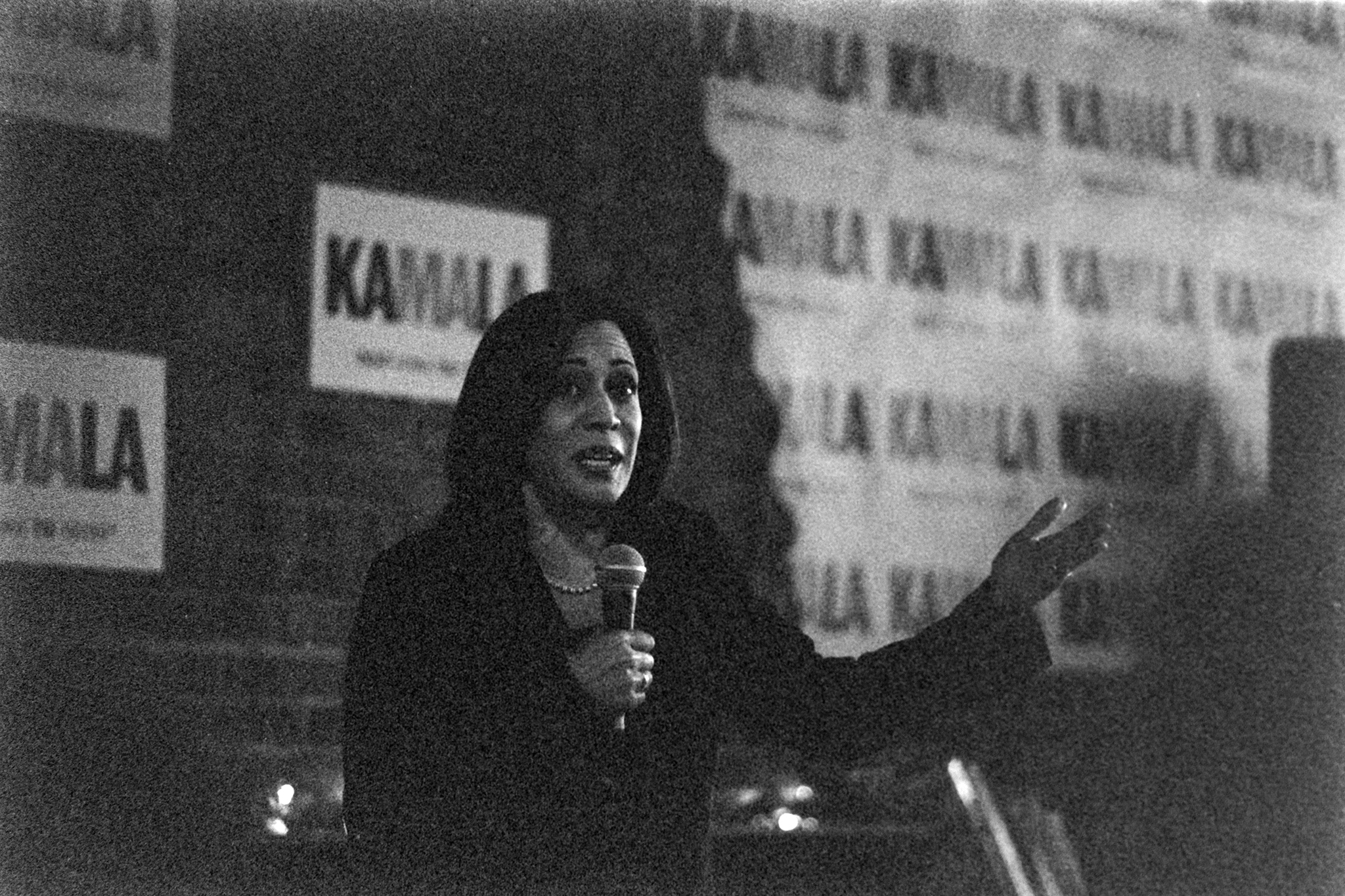
Kamala Harris appeared at one of our two local brew pubs. For this event, I chose my trusty Minolta X700 with a Rokkor 85mm f/2 lens, and used Tri X film pushed to 3200 and developed in Rodinal. This gave my photos a grainy, old-school newspaper feel. The lighting at the pub was less than optimal, particularly for the candidate, and I got few decent shots of Senator Harris, but some side lighting from the street-side window provided some dramatic lighting for the crowd, and I was able to get some effective photos. Still, I wish that I had one more stop of exposure here.
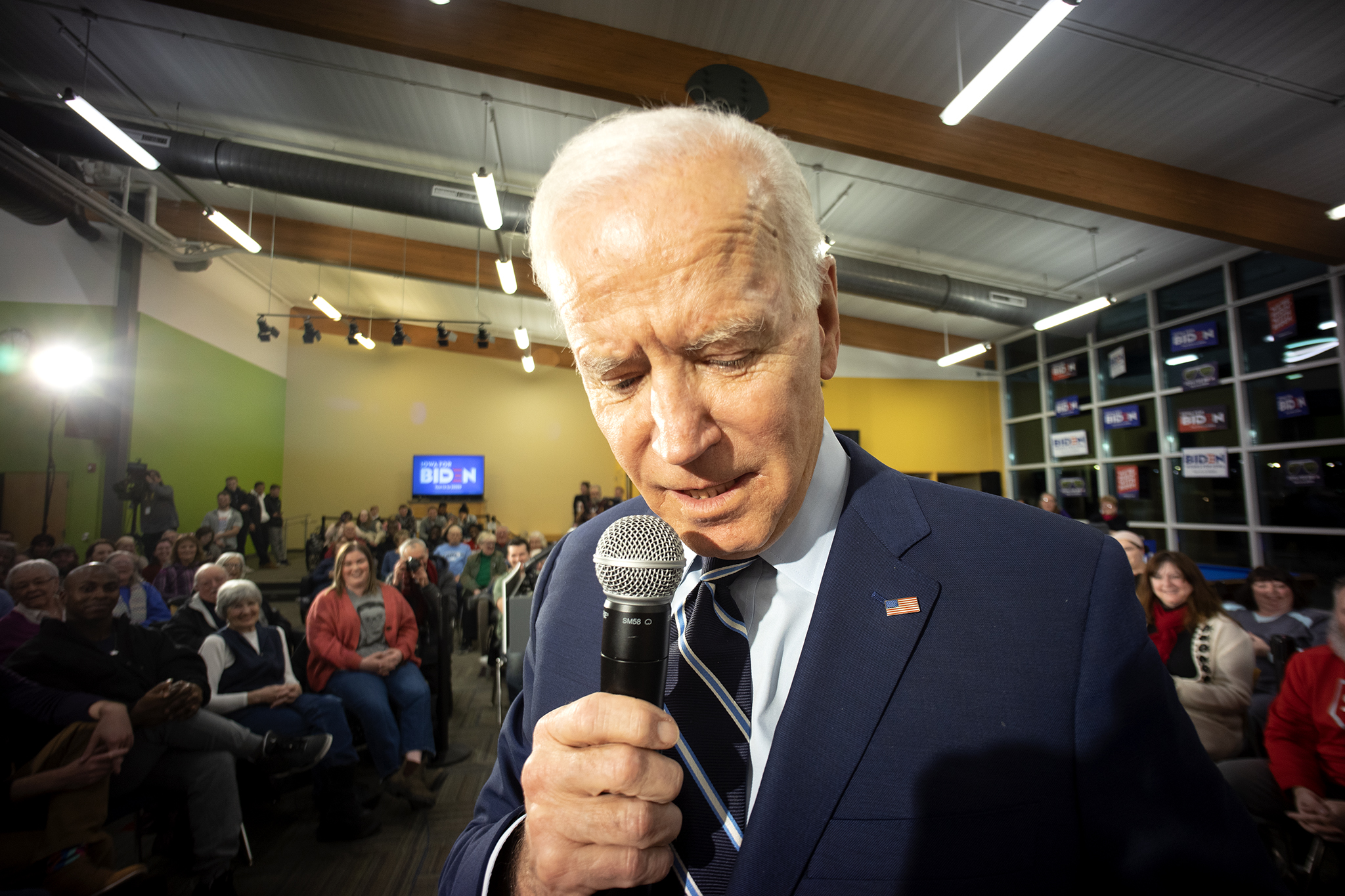
My wife and I saw Joe Biden at the multi-purpose event center at Iowa Central Community College. This was a good open venue with excellent lighting, and the way the event was seated gave a largely unobstructed view of the candidate. While this is an article primarily about film photography, I will bend the rules a bit and include one digital photo made using a Voigtländer 15mm Heliar on a Sony A7ii that will show just how unrestricted my access to Vice President Biden was.
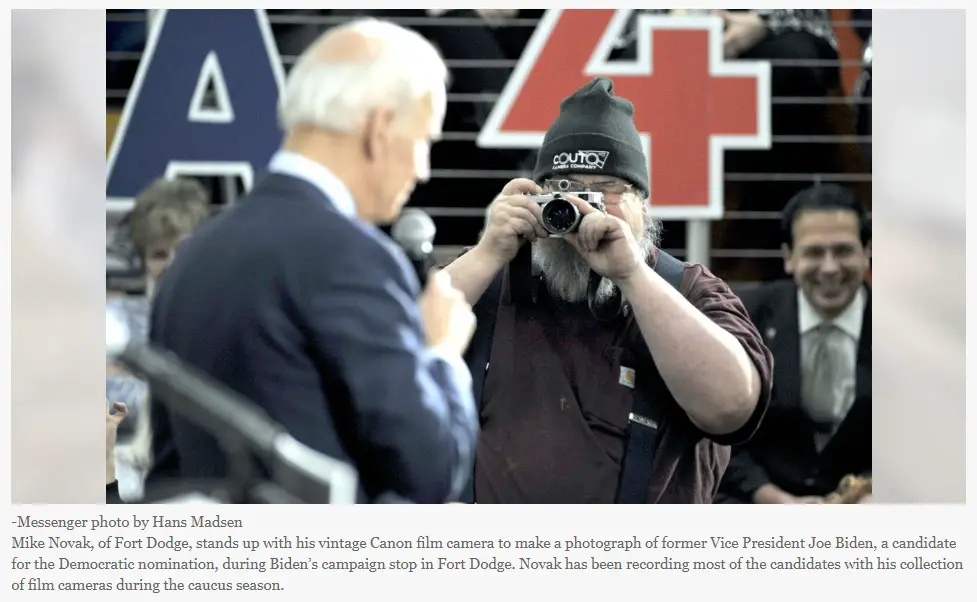
After studying up on how to get good focus on a rangefinder camera with a longer lens even in less than perfect light, my camera choice was a Canon VL rangefinder with the fantastic Nikkor PC 85mm f/2 lens. I used the same camera and lens for the events that followed this one. Here, I used fresh Ilford HP5+ film rated at 800, and developed in FA1027 developer, which delivered sharp grain and a bright, crisp image for a more modern photojournalistic look. I got some excellent photos of the candidate here, and a photo of me taking Mr. Biden’s photo mas published in our local newspaper.


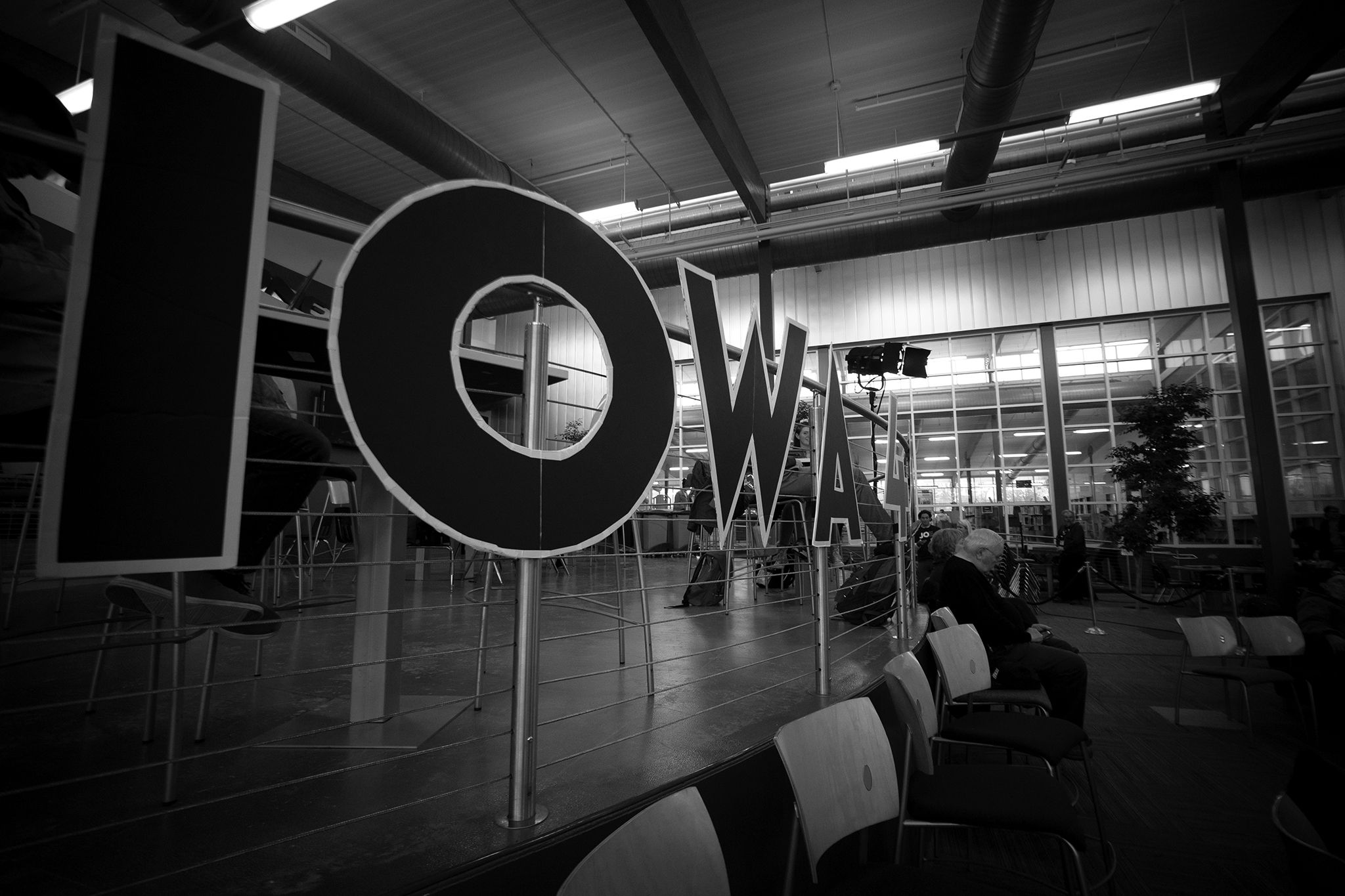
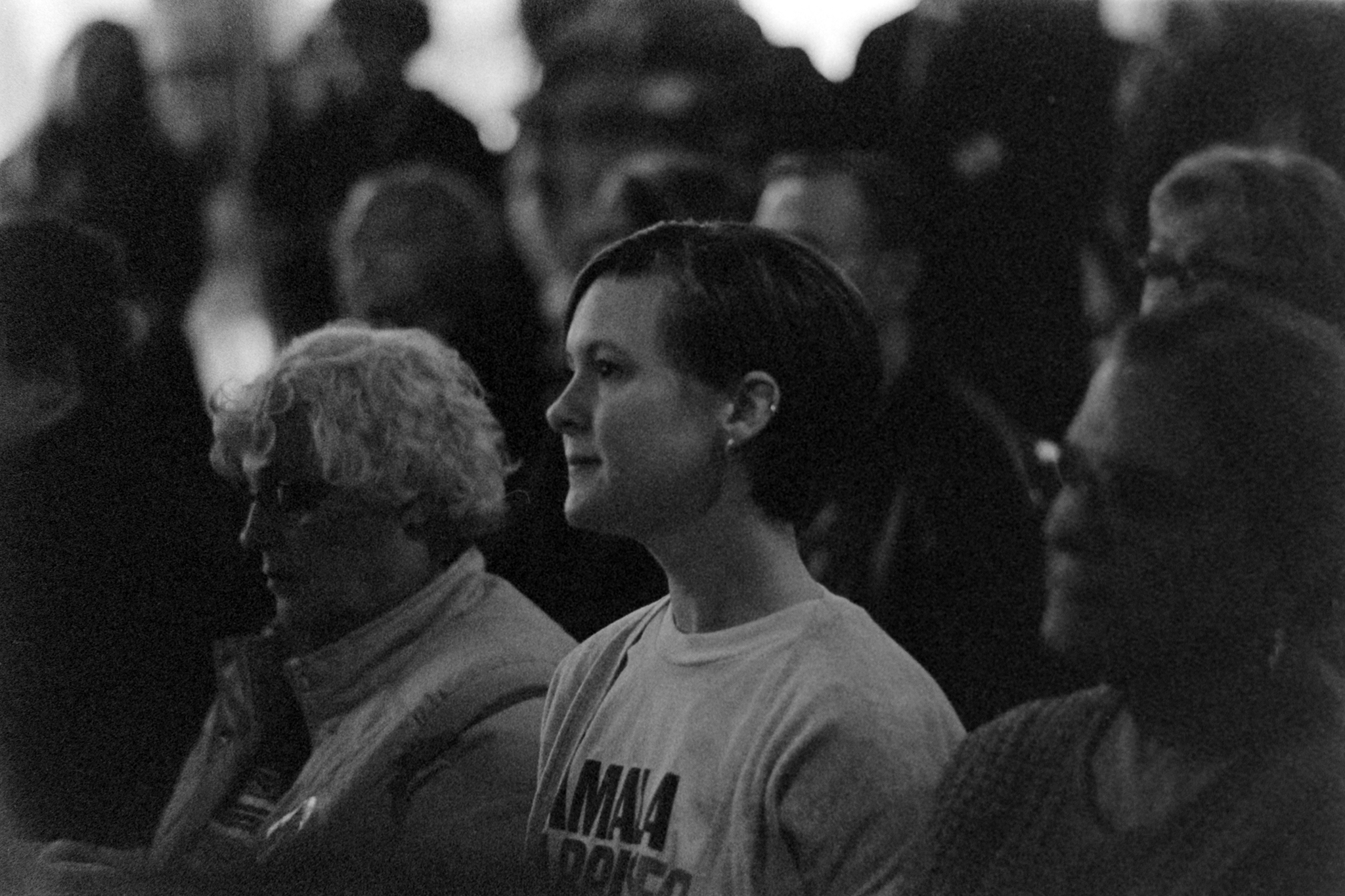
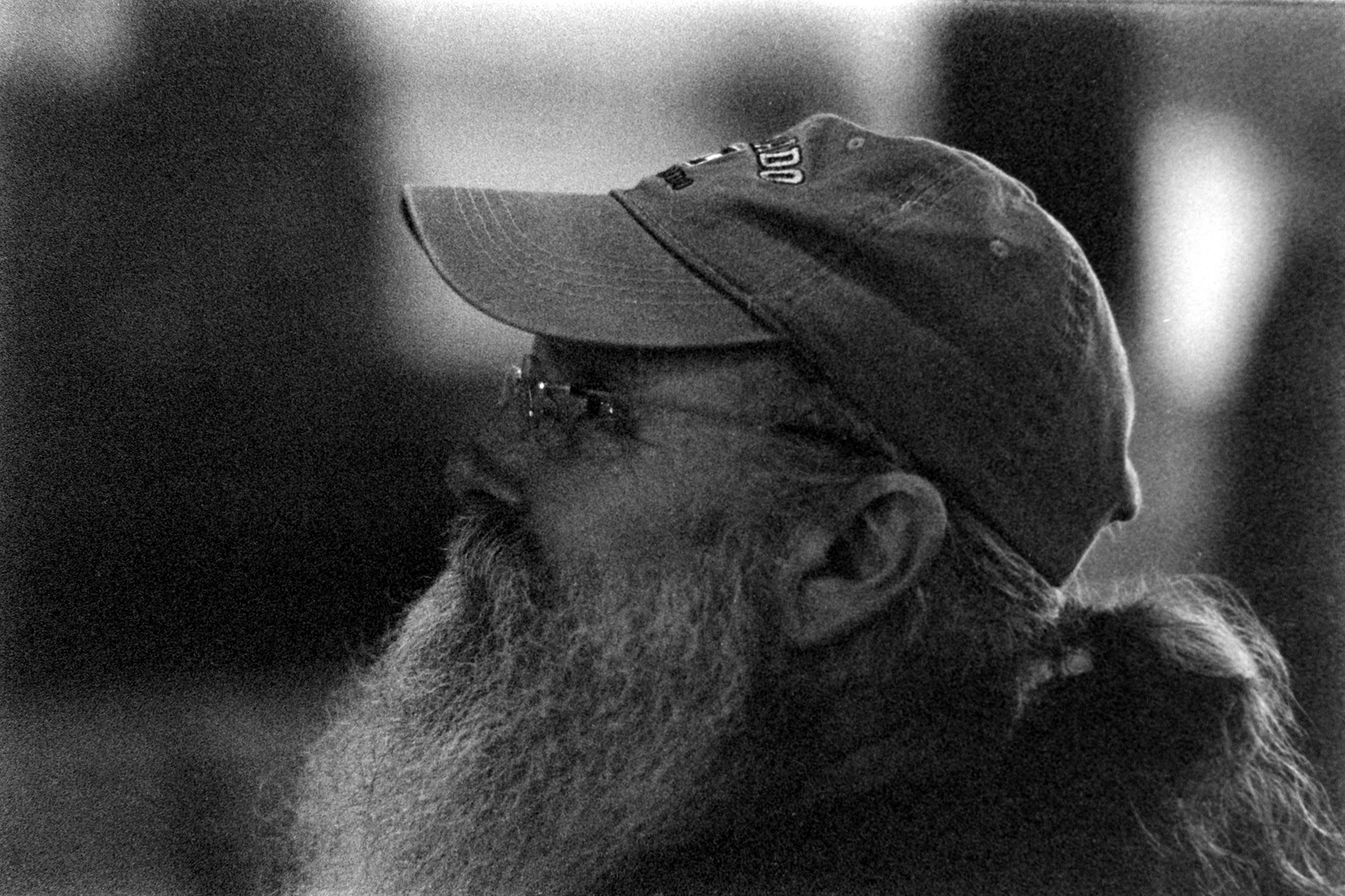
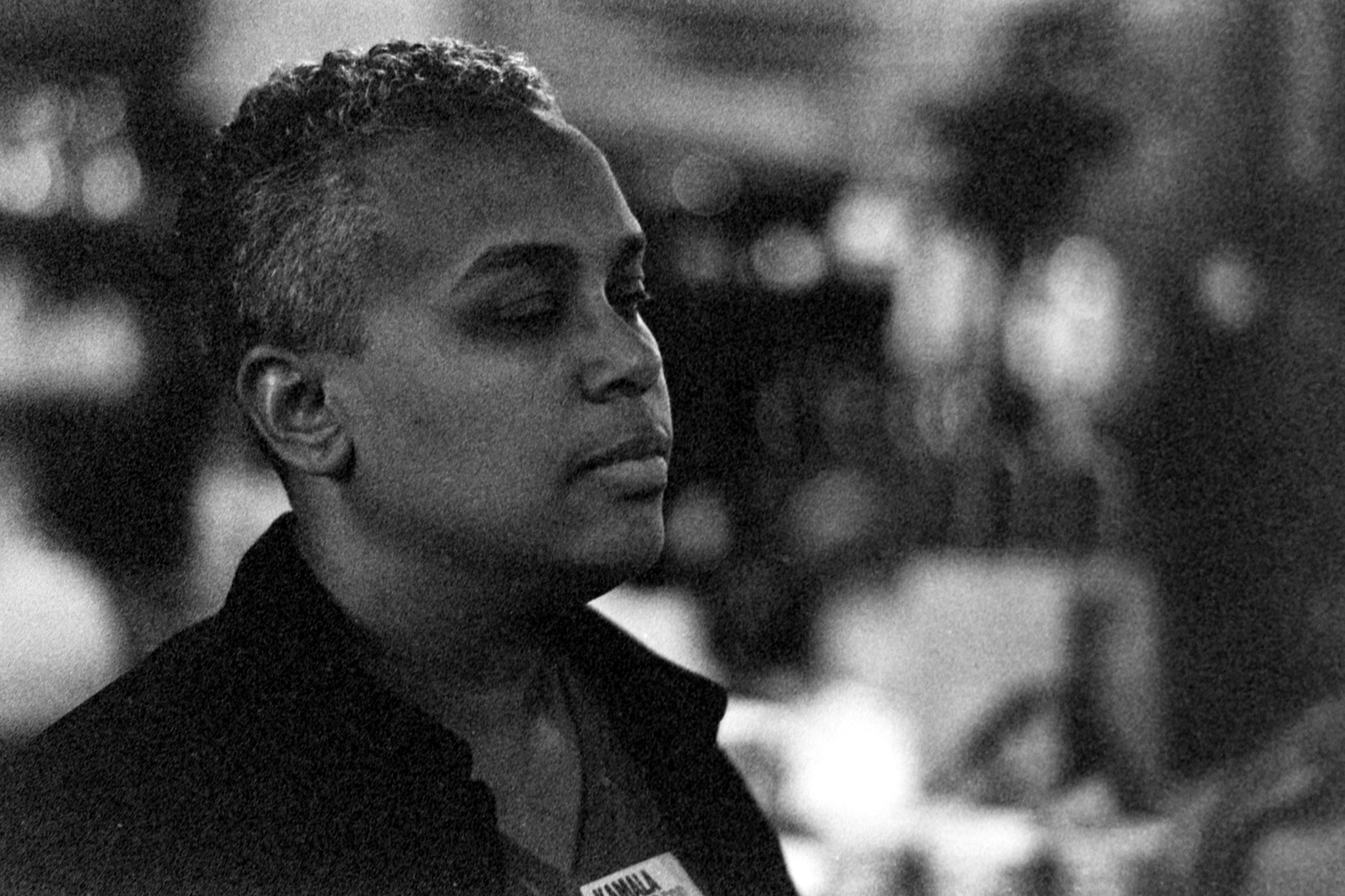
Next up was Pete Buttigieg, at the Fort Museum Opera House, located on the Museum grounds adjacent to the Community College. Here, due to an unfortunate incident at Mayor Pete’s prior appearance in our city, photographer’s access to Mayor Pete was restricted, and he pretty much stayed in one place, so instead of taking the same photo over and over again, I concentrated on the crowd more than at the other events. While the light was better here than at the Harris event, I decided to rate fresh Tri X at 1600, and I pushed it one stop further in development. This gave the illusion of more darkness than there really was, and the added contrast produced a Film Noir or Chiaroscuro effect that I think was quite effective in adding gravity to the photographs.


The final event was an adhoc event for Bernie Sanders that was put together on-the-fly during a break in the impeachment hearings. Unable to book a more suitable venue on short notice, this was presented in a suite of offices used by the local Sanders campaign staff. Only by convincing the staff that I was a freelance photographer doing an article for a popular film photography website was I able to even secure a spot with a view of the speakers. Probably due to the controversial nature of guest speakers Michael Moore and Alexandria Ocasio-Cortez, security was quite tight here, including being scanned for weapons. Even with my “prime” spot, all except a few photos that I made early before the room filled where from the same spot, and my view of the primaries was obstructed. So I used this as an opportunity to make photos of the crowd in my immediate vicinity from angles that I would not otherwise have thought of. I think that these have captured some of the hectic and claustrophobic feeling of the day. The film this time was once again HP5+, pushed to 800 and developed in FA1027.


My journey through the Iowa caucus experience as seen through the classic lens, and captured on cameras that my father might have used, was like traveling back in time, like visiting my own spiritual Brigadoon. And I hope that my old-school methods provide an interesting perspective on grass-roots politics that might never have been seen by generations younger than mine, something other than the images produced by spraying and praying with a digital camera provided by today’s press. Having no pressure to produce a salable product allowed me space for experimentation, to create, I hope, moods that matched the experience, and to learn methods and processes that I will find helpful in bettering my day to day photography.
As most of you are probably aware of, counting the votes after the caucus proved to be quite the debacle, so much so that it is my fear that this political Brigadoon has made it’s final appearance upon this fair Earth. While I agree that the caucus process is antiquated and flawed, and that Iowa in no way represents the demographic makeup of the American process, I will be sad to see it go. I think that there is still a need for grass-roots politics, and Iowa, as America’s last whistle stop, provided a unique way for the American public to meet, and become familiar with, the full range of Presidential candidates on a personal level, and that should have some value in helping voters make an informed decision further down the road.
So, goodbye for now, fair Brigadoon. I hope for your return one day.
For More Information: If you would like to see more of Mike’s work, these photos and more can be found in the following Flickr galleries:
https://www.flickr.com/photos/greyscale3/albums/72157712787174202
https://www.flickr.com/photos/greyscale3/albums/72157713308745546
https://www.flickr.com/photos/greyscale3/albums/72157713310178782
https://www.flickr.com/photos/greyscale3/albums/7215771330988018
Mike can also be contacted through his Instagram page, and the Vintage Film Shooters Facebook group.
Mr. Novak – Remarkable to me just how lax Biden’s security seems to have been. Your access was remarkable. Your images of the Sanders and Mayor Pete events have a very 1960s look about them – if that was your intent, you knocked it out of the park. Thanks for sharing this idea and your results.
I used 40 of Mike’s images in this post, but there’s a lot more on his Flickr page. Looking through his pics depressed me a bit though as it really made me realize how terrible of a photographer I am! I need to step up my game! 🙂