
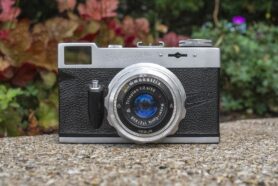
The Welta Belmira is a 35mm rangefinder camera produced by VEB Welta-Kamera-Werk from 1956 to 1961, though it was actually designed by Belca-Werk in Dresden as early as 1951 and delayed for years due to production struggles at the small factory. The camera emerged from the fractured postwar German camera industry, in which East German firms like Belca (formerly part of Balda) were absorbed and renamed amid Cold War-era corporate splits. The Belmira stood out for its unusual coupled rangefinder design, which used a reflective glass rod rather than a conventional beamsplitter or prism, along with a large but yellow-tinted viewfinder. It was typically fitted with either a Meyer-Optik Trioplan or Zeiss Tessar lens, sold only in East Germany, with an estimated production of at least 38,000 units based on lens records.
The author picked up a cosmetically excellent copy in 2023 and detailed its specs: a 50mm f/2.9 Meyer-Optik Trioplan lens, Vebur leaf shutter (1–1/250 sec plus Bulb), focus range of 0.8m to infinity, no meter, cold shoe/PC sync flash options, and a distinctive all-metal body with an unusual base design and cassette-to-cassette film transport. Handling revealed several ergonomic quirks: the viewfinder sits awkwardly in the upper right corner, the rangefinder patch is thin and hard to see, and the shutter speed dial is inconveniently mounted upside-down on the front face. After owning it for three years, the author finally shot a roll of Kodak TMax 100 and found the images excellent—sharp, low-vignetting, and clean—showcasing the Trioplan lens's surprising quality. However, the film transport proved seriously flawed, jamming repeatedly during shooting despite functioning smoothly without film loaded, forcing the author to salvage exposures mid-roll.
Overall, the author found the Belmira one of the rare cameras that failed to charm despite its quirky appeal, citing the awkward viewfinder placement, difficult rangefinder, oddly positioned shutter dial, and unreliable film advance as major detractors. While acknowledging the camera "looks cool" on a shelf and produces genuinely strong images, the combination of ergonomic and mechanical issues left the author unwilling to shoot it again, concluding it will likely remain a display piece rather than a user camera.
AI-generated summary. May not capture every detail — read the full article below for the complete picture.
This is a Welta Belmira, a 35mm rangefinder camera produced by VEB Welta-Kamera-Werk between the years 1956 and 1961. Although credited as a Welta camera, the Belmira was originally designed by Belca-Werk in Dresden, Germany as early as 1951, but didn’t get released until five years later. The Belmira was a fairly simple camera but featured a combined image coupled rangefinder with a very strange design. Usually found with either a Meyer Trioplan triplet or a Zeiss Tessar, the camera was otherwise an ordinary but affordable East German leaf shutter camera.

Film Type: 135 (35mm)
Lens: 50mm f/2.9 Meyer-Optik Trioplan coated 3-elements in 3-groups
Focus: 0.8 meters to Infinity
Viewfinder: Coincident Image Coupled Rangefinder
Shutter: Vebur Leaf
Speeds: B, 1 – 1/250 seconds
Exposure Meter: None
Battery: None
Flash Mount: Cold shoe and PC Port M and X Flash Sync
Weight: 595 grams
Manual (in German): https://cameramanuals.org/pdf_files/welta_belmira.pdf
Before World War II, a large part of the German camera industry was located in and around the Dresden area. Zeiss-Ikon, Ernemann, Certo, Balda and many others all produced cameras in the area. Dresden was not only a hot bed of camera and lens manufacture, it was a manufacturing hub for the entire country. A huge number of companies making goods such as aircrafts, automotive coaches, typewriters, porcelain goods, and other products also called the Dresden area home, in addition to many prestigious universities who were also located in the area.
The massive amount of manufacturing in the Dresden area made it a highly sought after target by the Allied forces, and during a three day stretch from February 13 through the 15th, 1945 British and American forces dropped more than 3900 tons of high explosive bombs and incendiary devices on the area, reducing much of the city and its infrastructure to rubble.
After the war, Germany became divided between Allied and Soviet controlled portions of the country. Although these names weren’t used right away, this split of Germany later became known as the Federal Republic of Germany (West Germany) and the German Democratic Republic (East Germany). In addition to splitting up the country into two separate entities with two different styles of governments, many logistical challenges lie ahead. One of those challenges was what to do with companies who wanted to exist in both halves of the country. Companies like Zeiss-Ikon, Ihagee, and others had factories or business in both halves, and each laid claim to the intellectual rights and trademarks of the pre-war versions of themselves.
 Legal battles ensued over West German and East German versions of the same company. In the case of Zeiss-Ikon, two different versions of the company were allowed to exist. In 1947, a West German version based out of Stittgart was called Zeiss-Ikon AG Stuttgart, and in East Germany, a version called VEB Zeiss Ikon were both setup and produced cameras using the Zeiss-Ikon name. In the case of Ihagee, production largely stayed in East Germany in the Dresden area, however an attempt by Ihagee’s original founder to restart a new West German Ihagee eventually succeeded in the 1960s.
For smaller, less well known companies, two versions of the same company never materialized, rather, one would simply exist and the other either disappear or reform under a new name. In the case of Balda, whose original cameras were produced in Dresden, the original company founder would relocate to West Germany, and the East German version would be merged into VEB Zeiss Ikon and renamed VEB Belca-Werk. Belca produced mostly inexpensive folding cameras for the first few years of its existence before being fully absorbed into VEB Kamera-Werke Niedersedlitz in 1956.

At the 1951 Leipzig Spring Fair, Belca would show an all new prototype 35mm rangefinder camera called the Belmira. The Belmira was unlike other “new cameras” being released around this time as it was not based off any current or prewar designs, and featured a unique body design with an a large viewfinder, a coupled rangefinder with automatic parallax correction, and a fixed lens mount. Although the camera would be shown in 1951, early production struggles from the small factory prevented the camera from being released until 1956 at which point it was produced under the Welta marque.

Few rangefinder cameras were produced in East Germany at the time and the manner in which the Belmira’s rangefinder worked was different from any other. Unlike most rangefinders which use either a semi-transparent mirror called a beamsplitter, or an angled semi-reflective prism, the Belmira used a thin glass rod which was reflective on one side. This glass rod would protrude at a 45 degree angle through the center of the viewfinder reflecting a thin strip of light towards the rangefinder window. In order to boost the contrast of the rangefinder, the main viewfinder window was tinted a darker color. This solution was inexpensive and inelegant, but it did work.
Differences from the 1951 prototype and 1956 production versions are mostly cosmetic with the largest changes being to the design of the shutter release and film advance lever. In addition, the automatic parallax correction feature was dropped and the Cludor leaf shutter was replaced with a Vebur shutter with a top 1/250 shutter speed (instead of 1/200).

The camera was released in 1956 a few months before Belca became Welta, so it stands to reason that some do exist with Belca branding, but I have never seen one. When it went on sale, the Belmira could be purchased with either a Meyer-Optik Trioplan or Carl Zeiss Tessar for 182 and 210 DM respectively. There is little evidence that the Belmira was intended for export as all versions and documentation suggest this was intended for the East German market only.
Production of the Belmira increased in 1957 and continued until about 1960 when cost cutting requirements were put into place by the East German government which resulted in many smaller companies being shut down. There is no known production numbers for the Belmira, but a record indicating that 38,000 Tessar lenses were intended for the Belmira suggests that at least that many were made. Throughout its production, one small change was made to the rangefinder window, which on the earlier versions was a rectangle, and in later versions was designed like a horizontal line with a diamond in the center.

I picked up this Belmira in a large group of cameras in the summer of 2023 and while it wasn’t one I was looking for at the time, I had seen them show up in other collections and had wanted to pick one up eventually if the price was right. This particular camera was in excellent cosmetic condition and appeared to be in good working order, so I thought I would quickly get to it.
The Belmira has what I’d call a typical East German feel to it, which is to say, good, but not great. Nothing about the camera feels cheap, but it doesn’t exude quality like a Zeiss-Ikon Contax or even early Japanese rangefinders. The camera is mostly metal except for the tip of the film advance lever, and various pieces inside the film compartment. The ergonomics are strange and with the viewfinder in the extreme upper right corner of the camera, it is a little odd to handle.

Up top, a large diameter rewind knob is in the usual location with a film reminder disc in the center. A mix of English and German writing allows you to choose from multiple types of film with an inner ring which can show various combinations of DIN film speeds. Next is an accessory shoe which is nothing more than a bent piece of sheet metal, and then the exposure counter and a knob which is used to reset it. The exposure counter counts upwards, showing how many exposures have been made on the current roll. A raised portion for the viewfinder on the right has an empty space of metal which looks like it should have some kind of engraving there, but it doesn’t.

There is little to see on the sides, with only a PC flash sync port on the left side. The Belmira lacks strap lugs so the only way to support the camera would have been to use the original case that came with it new, or use one of the kind that attach to the tripod socket on the base of the camera.

The base of the camera is unusually attractive compared to most other cameras as it has body covering most of it with chrome trim around the perimeter. On one side is a fairly large chrome film rewind button, a 3/8″ tripod socket in the center, and a small sliding switch which acts as the door release for accessing the film compartment.

With the film door unlocked, it slides off the bottom of the camera. Film transports from left to right onto a removable take up spool. This suggests the camera offers cassette to cassette film transport but with no way to open and close a reloadable cassette without first opening the camera, I don’t know how many people would have done this. When this Belmira came to me, the take up spool was missing, so I just used the inner spool from a 35mm cassette, which worked fine. One oddity of the film compartment is that a hinged roller covers the film sprocket gear. When loading film into the camera, you must swing this roller downward, then stretch the film across the gear and then fold the roller back down, holding it in place. With the leader secured to the take up spool, slide the door back on, reset the exposure counter and you’re ready to go. Inside the film door is a flat black metal pressure plate and a blue metal clip on the supply side to hold the cassette in place. The Belmira lacks any sort of light seal so nothing needed to be replaced. On the inside bottom of the camera with the door off is the camera’s engraved serial number.

Looking down at the top of the lens, a painted on depth of field scale is closest to the body. While many cameras used painted numbers, that the Belmira has both painted and engraved numbers looks odd. In front of it is the focus ring with engraved distances from 0.8 meters to infinity. The focus ring has a prominent knurled ring which is easy to locate with the camera to your eye. Next is the aperture ring with click-less stops from f/2.9 to f/16. A red triangle near the front is the index mark for both the aperture and focus rings. It points to a black painted triangle in the depth of field scale near the back.

Up front, the Vebur shutter has a black face with upside down shutter speed numbers from 1 to 250 plus Bulb. The numbers are upside down so that you can more easily read them while looking down at the top of the camera, but you can’t actually see them from the top unless you tilt the camera a bit. I definitely did not like this location or design of the shutter speed dial. It worked OK, but just felt poorly executed. Besides that, the front of the camera has the front angled shutter release which looks like it straight off a Contax or Praktica SLR, and an embossed Welta logo opposite the shutter release. The very first Belmiras were produced when the company who made them was still called Belca, so I am unsure if these cameras have a Belca logo here, as I have never seen one. Another hint that mine is a later camera is because of the strange “line with a diamond in the center” rangefinder window up top.

The viewfinder window is quite large and easy to see all four edges of the viewfinder but the entire thing has a pretty strong yellowish tint to it which unfortunately reduces some of the benefit of the large size. This tint was done by the factory to help make the very tiny and otherwise difficult to see rangefinder “line with a diamond in the middle” less difficult to see. It is definitely not the worst rangefinder patch I’ve seen, but I wouldn’t call it good either. Assuming everything is clear, it works well enough in good lighting. In poor lighting however, I would either use a different camera, or get good at guess focus.
I would own this camera for over 3 years before taking it out. In my initial handling of the camera, I wasn’t sold on the ergonomics, especially the location of the eyepiece and the inconsistent film transport, but curiosity eventually got the best of me and I loaded in a bulk roll of Kodak TMax 100 and took the camera out. I used it as a walk about camera, leaving it in the center console of my car for a couple weeks capturing random shots of things I saw.


Starting with the good. The images from the Meyer-Optik Triolplan were very good. I have often been impressed with triplets on simpler cameras as it seems like the simpler the camera, the better the lens performs. Looking at the images here, it is clear this lens is in great shape with no haze, fungus, or other maladies that often plague old cameras. Sharpness is excellent in the center with little to no vignetting and only marginal softness near the corners. I did not shoot any color film through the Belmira, but suspect there may have been a tiny amount of “color mush” in the corners, but nothing that would have dissatisfied original owners of this camera. Clearly, the optical system was up to the task.
The rest of the camera however, was not so enjoyable. Try as I might, I just could not get the hang of the upper right corner location of the eyepiece. That the optical system on this camera is backwards from most 35mm cameras was a struggle for me. Perhaps that I am a left eye shooter in a camera where the viewfinder is on the right threw me, but I could never get the hang of it. Just look at the mirror selfie, and for how awkward I look in the image, it felt even worse. In addition to the backwards location of the viewfinder, the very thin rangefinder patch was very difficult to see. I am amazed that I nailed focus on so many images as I was convinced I would be off on at least some of these, but I guess I got lucky.

In addition to my issues with the viewfinder, the film transport on this camera sucks. When testing the camera without film, it seemed to work fine. The upper left corner location of the sliding film advance lever worked well enough, but as soon as film was in the camera, it was extremely tight. You can’t tell, but the above test photos are actually taken on two different strips of Kodak TMax 100 as the first one completely jammed in the camera. I had shot 4-5 images and then the camera wouldn’t advance and the only way I could fix it is by extracting the film out of the camera with the lights on to see what happened. I cut off the exposed section and then reloaded it and got a little farther before the same thing happened. This time I was able to save what I had shot. I tried again using the same film but in a different cassette thinking perhaps it was the reusable cassettes I was using, but nope, every time I shot this camera, the film advance would get super tight, and then jam.

To be fair, this is a greater than 60 year old camera which likely hasn’t been serviced in decades, so perhaps a CLA and some new lubrication would help, but the camera operates smoothly without film in it, so I’m not convinced a CLA alone would make the camera better. Just looking at how it works feels to me like this was a failure waiting to happen. If I ever get another Belmira, I will be sure to compare and see if the rough film advance is limited to my copy, or if others have the same problem.

The awkward viewfinder and janky film transport was enough to tarnish the shooting experience for me, so other things such as the front face mounted location of the shutter speed dial bothered me more than it probably would have on a more enjoyable camera. I did appreciate the front angled Contax SLR shutter release, but beyond that, there was very little about shooting this camera that I liked.
When testing as many cameras as I have, I am amazed at how infrequently I dislike a camera. I’ve often said that the more quirky the camera, the more interesting it is to me, but the Belmira is an exception to that rule. I’ll stop short of saying this is a terrible camera however, as it does look cool, and although the viewfinder is dark and has a difficult to use rangefinder, it is quite large, especially for a camera originally designed in 1951, and of course, the images it made look great. You could shoot the worst camera ever made, and if it makes nice images, it is possible to forgive it, so I suppose that’s what I should do here.
The Welta Belmira is a curious looking and quirky camera that looks cool on the shelf, is capable of making really good images and perhaps with service might have had a better film transport, but due to its strange ergonomics and operational issues, is a camera that will forever collect dust on my shelf as I don’t see myself ever wanting to use it again.
Related Posts You Might Enjoy
External Links
https://camera-wiki.org/wiki/Belmira
https://zeissikonveb.de/start/kameras/belmira.html
https://oldcamera.blog/2020/07/06/belmira/
https://www.lomography.com/magazine/2206-welta-belmira
http://www.cjs-classic-cameras.co.uk/other/welta.html#belmira
https://www.photo.net/forums/topic/484796-a-chequered-history-of-the-belmira/
https://cameracollector.proboards.com/thread/8902/welta-belmira-35mm-camera-germany
https://collection-appareils.fr/x/html/page_standard.php?id_appareil=10425