
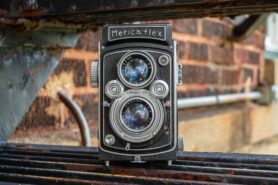
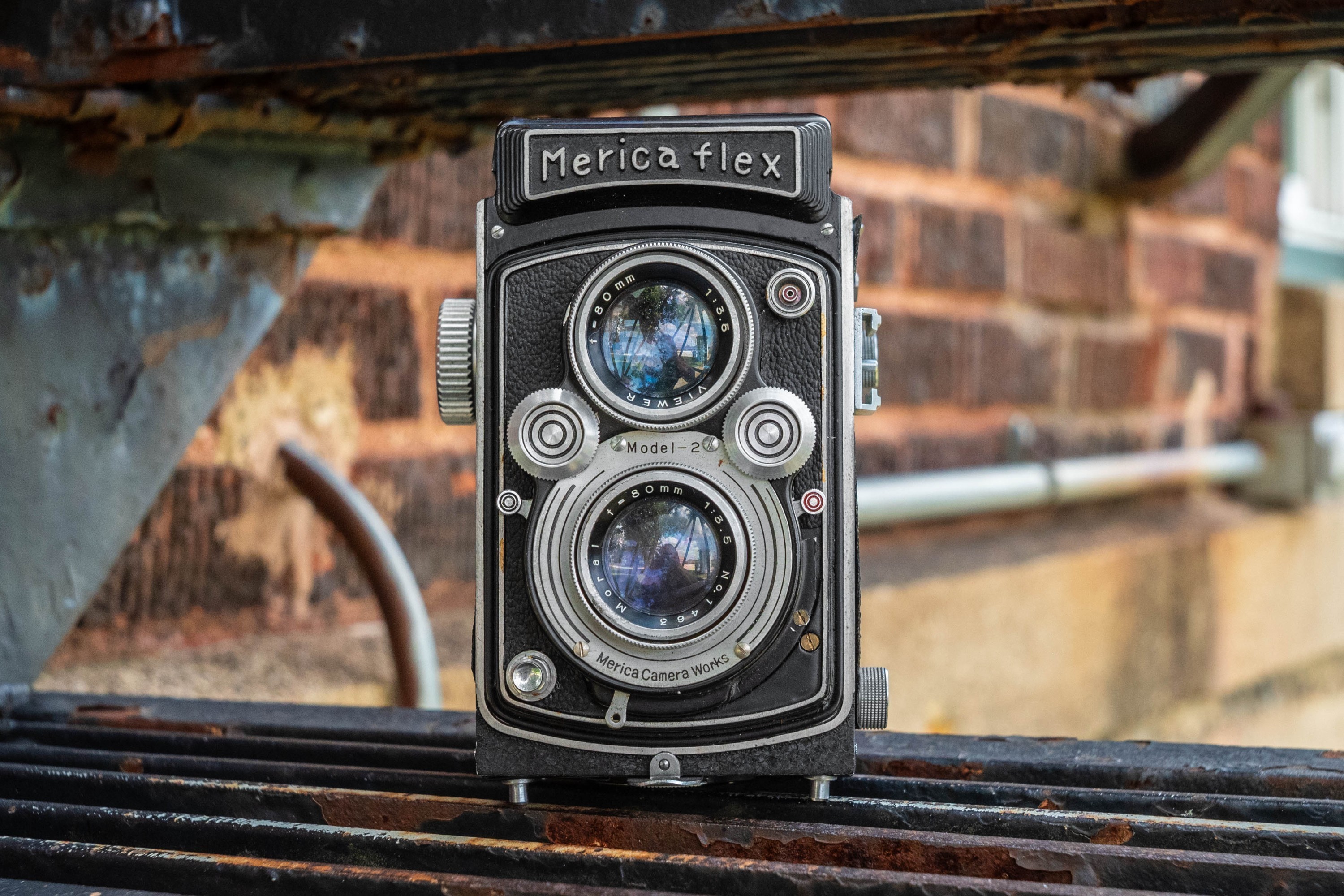
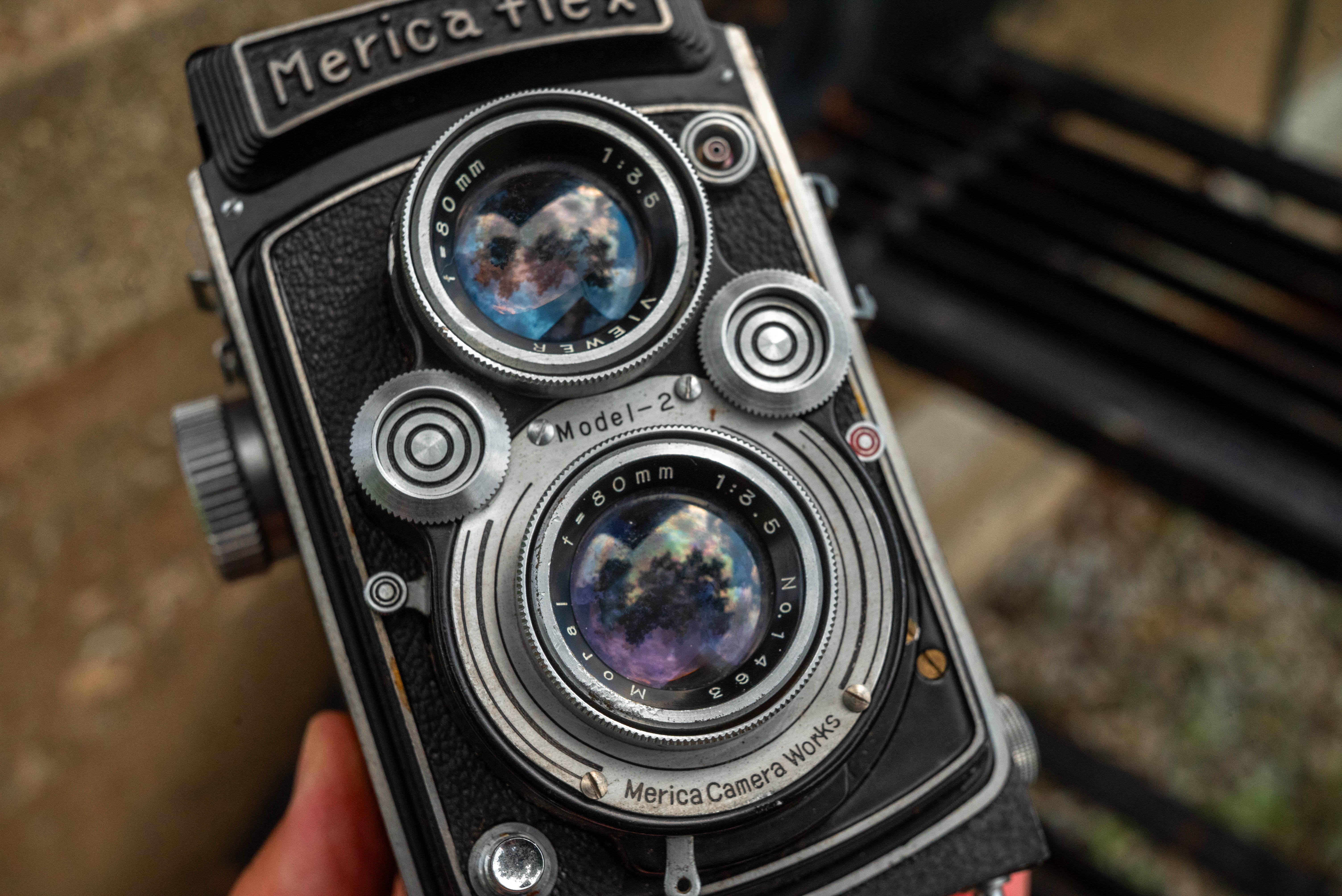
This is a Merica flex Model 2, a twin lens reflex camera made by Merica Camera Works in Japan in the early 1950s, probably around 1953. It was one of a large number of Japanese clones of German Rolleicord TLRs made in Japan around this time and like many others, it shoots 6cm x 6cm images on 120 format roll film. Although it shares a lot in common with dozens of other similar cameras, the Merica flex is unusual in its shutter speed and aperture controls, featuring dials in between the two lenses like later Rolleiflexes. It also focuses using a lever below the taking lens like the Chiyoda Kodak Minoltaflex TLRs. Although labeled as the Model 2, there is no indication a Model 1 ever existed and no information exists about the company “Merica Camera Works” the camera claims to be made by.
Film Type: 120 Roll Film (twelve 6cm x 6cm exposures per roll)
Lens (Taking): 80mm f/3.5 Viewer coated unknown-elements
Lens (Viewing): 80mm f/3.5 Moral coated unknown-elements
Focus: 3.5 feet to Infinity
Viewfinder: Waist Level Reflex Viewfinder
Shutter: Leaf Shutter
Speeds: B, 1 – 1/200 seconds
Exposure Meter: None
Battery: None
Flash Mount: Cold shoe and PC-Port Flash Sync
Weight: 850 grams
Manual: None

After the conclusion of World War II, Japan’s economy was in shambles. Prior and during the war, a large part of Japan’s manufacturing and industrial industries served the Japanese war effort and with heavy damage to the country’s infrastructure, plus a condition of Japan’s surrender to the United States, what factories survived were not allowed to produce any products which could have a military use. In an effort to turn Japan into an ally, the responsibility of rebuilding Japanese industry was the responsibility of the Supreme Commander for the Allied Powers which was the title given to General Douglas MacArthur on August 14, 1945.
MacArthur’s responsibilities as Supreme Commander included transforming Japan’s government from an imperial, totalitarian state to a democracy, developing a welfare system to assist Japanese citizens displaced by the war, rebuilding necessary infrastructure including hospitals, schools, and restoring electricity, heat, and fresh water to the island nation.
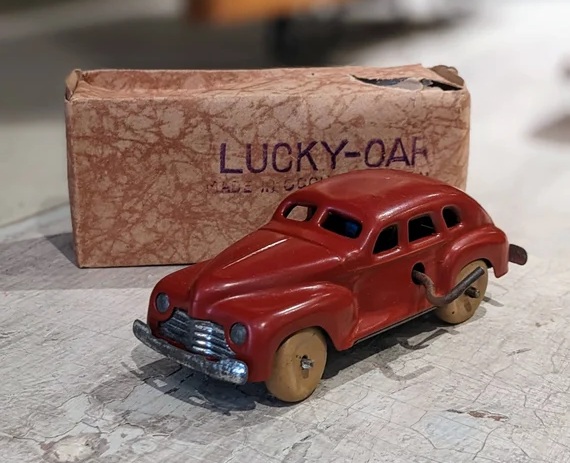
In order to accomplish this, MacArthur has to raise money to do it, funding from the United States couldn’t support it alone, so the need was quickly identified to find products that the Japanese could build and sell to help boost the local economy. While a large number of small trinkets and children’s toys were the first to be produced, various Japanese companies such as Nippon Kogaku (Nikon), Canon, and Mamiya had already shown an aptitude at building optical products, so a large number of photographic goods like cameras and lenses began production, exported to other countries or sold domestically to American occupation forces.
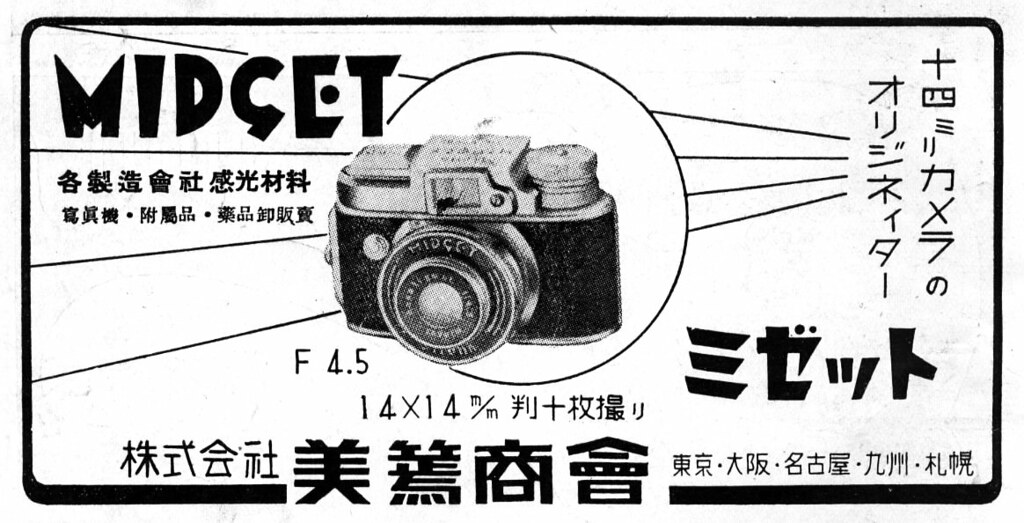
The late 1940s saw a huge number of subminiature “Midget” cameras which shot tiny exposures on 16mm and 17.5mm wide roll film. These cameras were often given away as novelties and children’s toys, but a small number of them were serious cameras with multi-element glass lenses, multiple speed shutters, and in some cases with interchangeable lenses.
By the 1950s, the appetite for more serious cameras grew and a popular style of camera was the twin lens reflex, a style of camera which shot 6cm x 6cm images on 120 format roll film. Most of these cameras borrowed heavily from existing German designs like the Franke & Heidecke Rolleicord. In an effort to build as many of these cameras as quickly and for as cheaply as possible, little was done to differentiate a Japanese TLR from the German cameras they were heavily based off, and as such many early 1950s Japanese TLRs all looked very similar to one another.
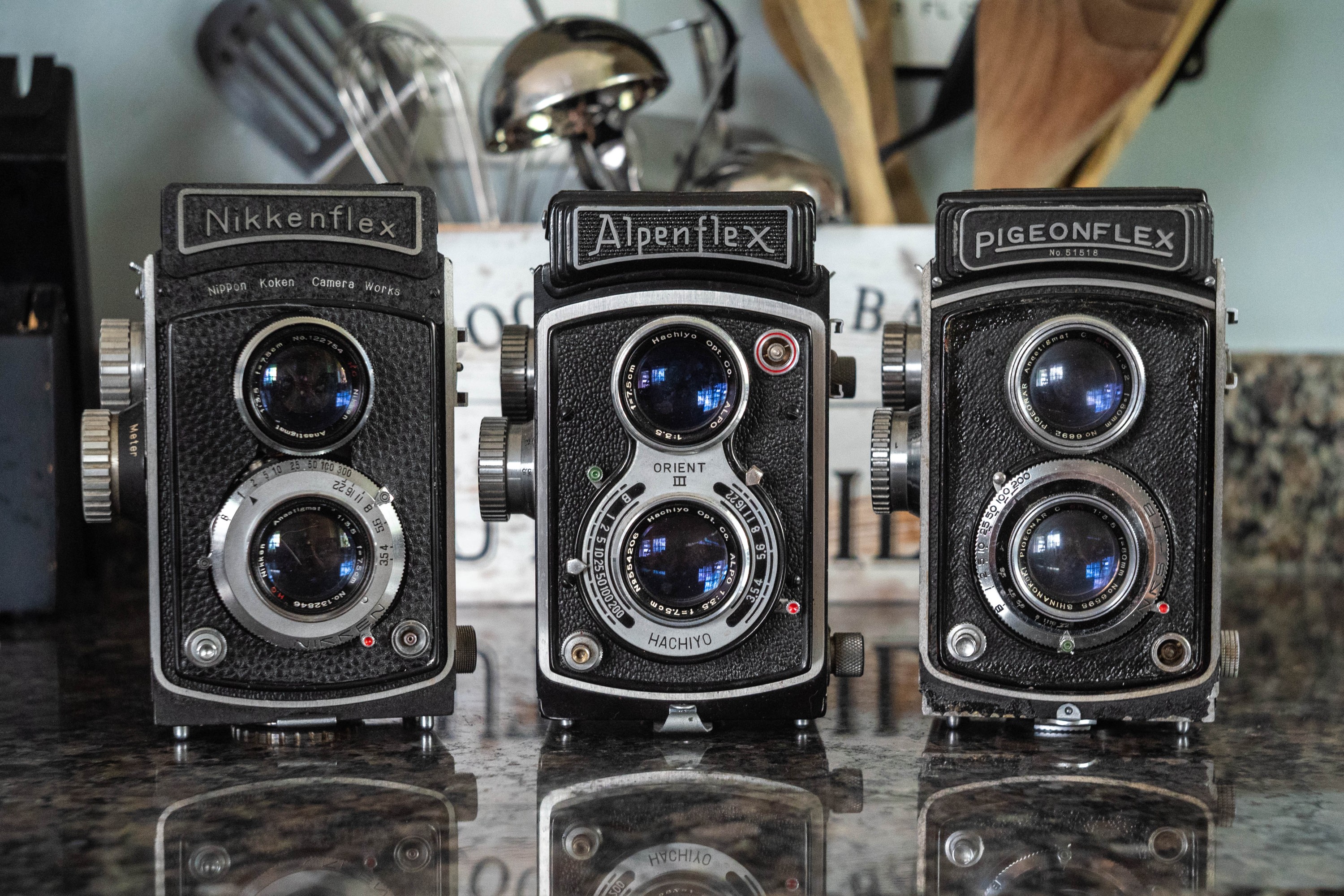
For collectors today, there are a dizzying number of these cameras with estimated counts well over 100 unique marques of cameras. A partial list of known Japanese TLRs is maintained here but I am certain is not complete. With names like Alpenflex, Cosmoflex, Nikkenflex, Pigeonflex, and Superflex, it seemed all you needed was a mold for an existing twin lens camera, access to someone else’s lenses and shutter, a parts bin of knobs levers and hinges, and the ability to think of a prefix to the word ‘flex’ and you could have your own Japanese TLR.
While browsing Yahoo Japan’s camera auction site one day in the spring of 2026, I stumbled upon a camera with the ridiculous name “Merica flex”. Certainly there was nothing American about this camera as this is clearly made in Japan. Why a Japanese camera would have a name of “Merica flex” isn’t clear, but my best guess is that it could be its creators intended for this camera to make it into the hands of US Service members via “Post eXchange” stores where American soldiers might see the patriotic name and want to bring one home. Who knows if that’s even true or not, but I’ll foreshadow the rest of this article and say that there’s going to be a lot of guessing coming.
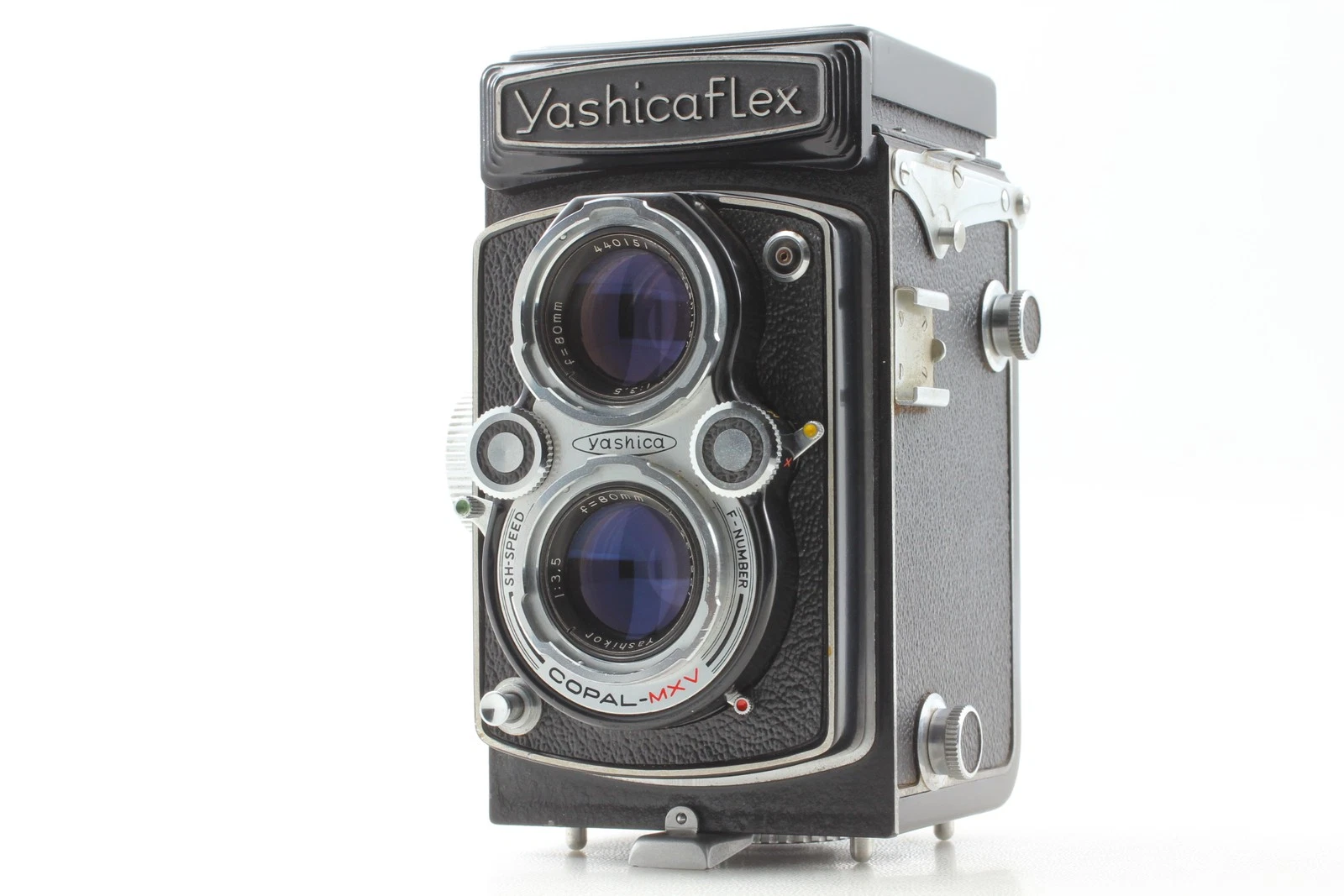
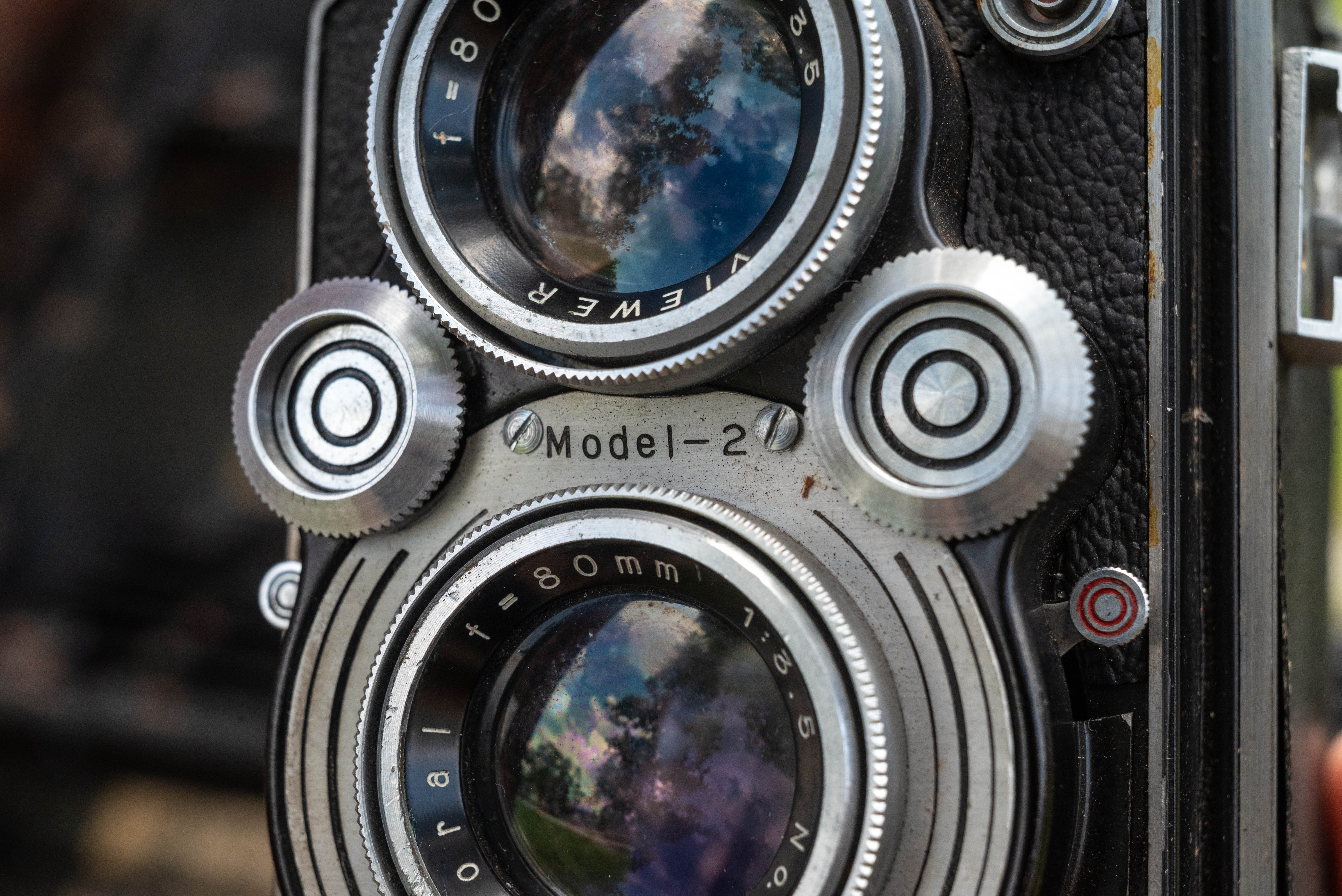
Clearly this isn’t an American camera, but it also isn’t just another Japanese Rolleicord copy either, as I noticed some differences with this model compared to other early Japanese TLRs I had in my collection. For starters, the Merica flex has two dials in between the viewing and taking lens for controlling shutter speed and lens aperture. This feature certainly isn’t unique as many later German Rolleiflex and Japanese Yashica and Petriflex TLRs have this feature, but I had never seen it on an inexpensive “no name” TLR like this. In addition, focus was controlled by a lever below the taking lens, similar to the Minolta Autocord and Meopta Flexaret. Perhaps this silly named and extremely uncommon camera was better than it first appeared. I had to have one, so I ended up buying that camera.
For anyone used to buying cameras through Japanese auctions (or for people in the US through proxy services like Buyee and From Japan), you are used to nearly every camera being listed as “Junk” and with no guarantee of functionality. This extremely common practice of describing everything as junk has more to do with legal requirements to offer returns on untested things, so nearly everything is listed this way, regardless if it works or not. For anyone needing a guaranteed working camera, buying from Japanese auctions is a risky endeavor, but if you can accept the risk that you might end up with a paper weight, the sky’s the limit on what you can buy.
When the camera arrived, I was disappointed to see that it was in a bit worse condition than I had hoped. Cosmetically the camera showed its age, but was still in tact. Functionally, the camera looked like the taking lens had taken a hit, pressing it into the shutter, permanently damaging it. When looked at from the side, the taking and viewfinder lenses were not parallel to each other and the shutter was clearly pressed inward and would not fire. In addition, the focus helix was also inoperable with the handle unable to move. Still, everything was there and for the price I paid for a camera which a couple weeks prior I had no clue ever existed, I was still happy.
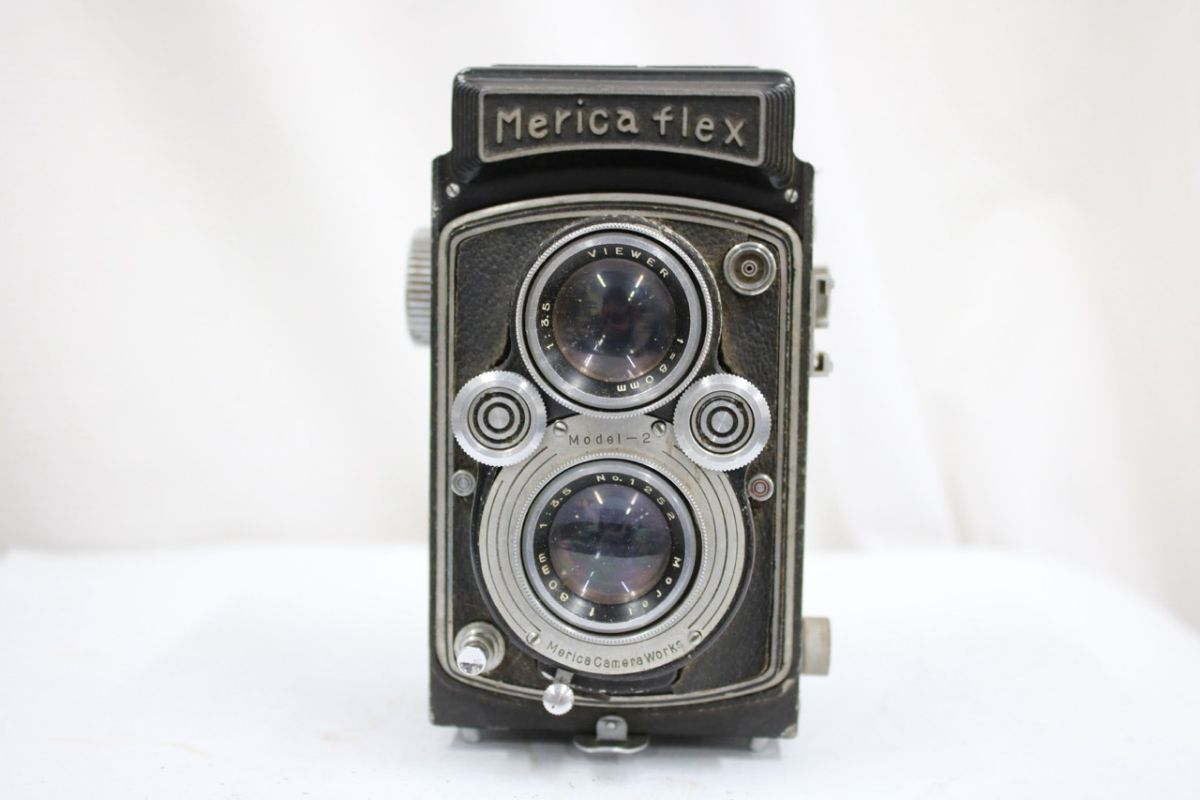
As I often do when a new camera enters my home, I began my research into the history of whatever new camera I had in my hands. In between the two lenses is printed “Model 2” which suggests there was a “Model 1” and with the manufacturer listed as “Merica Camera Works” I wanted to find out everything I could about this camera and the company who made it.
My research turned up empty. Other than an appearance on Collectiblend, in a wish list of cameras on tlr-cameras.com and a brief mention on Paul Sokk’s yashicatlr.com side, I found absolutely nothing about this camera or the company who made it. Having both interviewed and also chatted with on Episode 58 of the Camerosity Podcast, I decided to reach out to Paul Sokk with images of my camera to see what he could tell me about it.
Paul enthusiastically replied confirming that he was aware of the camera but sadly had little to help tell the story of this camera’s history. One thing he was able to confirm however, was something that I had long suspected, which was that a large number of these Japanese TLRs were assembled from mass produced parts made for a variety of other cameras. The small shops who are credited for making these cameras were more like “assemblers” than full bore manufacturers. While there is no evidence that an actual company called “Merica Camera Works” existed, most likely it was a small local shop who assembled cameras under their own name using parts made by someone else.
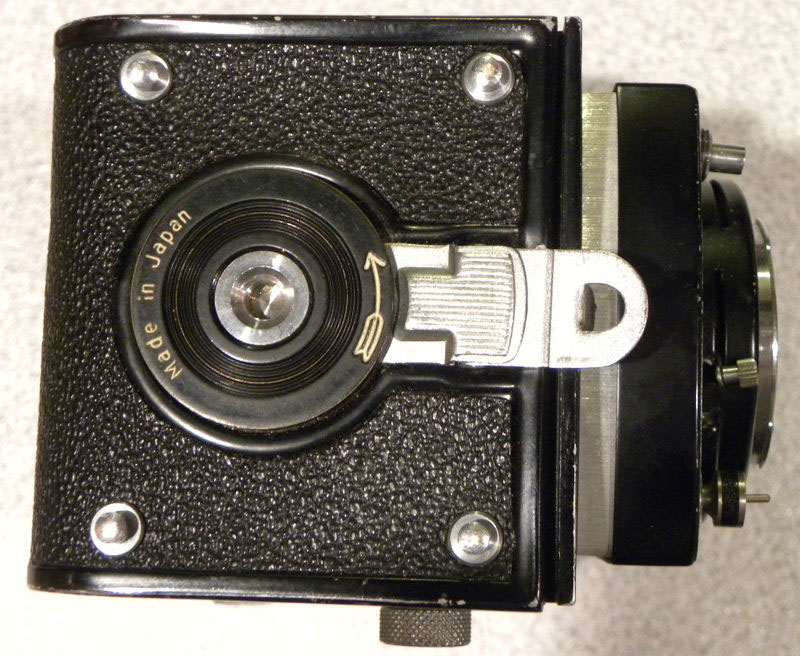
In Paul’s experience, when looking at a large number of Japanese TLRs, you start to notice that there are a lot of shared parts. Japanese TLRs from the early 1950s all shared the same basic die cast body which was almost certainly sourced from an actual Rollecord. Then parts like knobs, bezels, shutter plates, and strap attachments are bolted on to complete the camera.
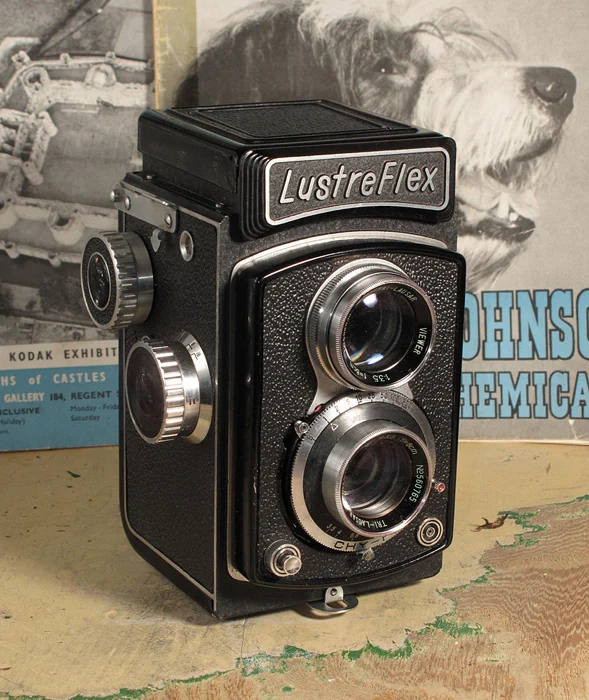
Paul noted that although the Merica flex does have some unique features seen on few other TLRs, he detected some aspects of the camera which shared a similar design to cameras like the Halma Flex and LustreFlex. He noted similarities with the side knobs, back lock, and strap holders with arrow-shaped attachment points. He further noticed that although not identical, the accessory shoe, viewfinder magnifier and other parts of the camera look very similar to those used on other Japanese TLRs, still supporting the idea that this camera was “assembled” from off the shelf parts by a small distributor attempting to capitalize on the popularity of this style of camera at the time.
Sadly, beyond the passing resemblance to other cameras from the same era, this is where the story of the Merica flex and Merica Camera Works ends, and there is a very good chance we may never know more than what I’ve shared here. Even the famed Sugiyama’s Collector’s Guide to Japanese Cameras has nothing to offer, other than suggesting the Model 2 was the only Merica flex ever made.
Paul ended his email saying that he has no clue to the camera’s origins and that while his shared parts theory has some supporting evidence, even that can’t actually be proven. I scoured every English and Japanese language resource I have in my archive, including copies of the Asahi Camera Manual’s annual yearbooks for 1952 through 1955 and 1957 and found nothing more about this camera. If this camera’s name suggested it might have been sold to American service members through the Post eXchange system, I’ve found no evidence of it there either. In the event I ever uncover more about the origins of this camera or the company who made it, I will certainly update this review.
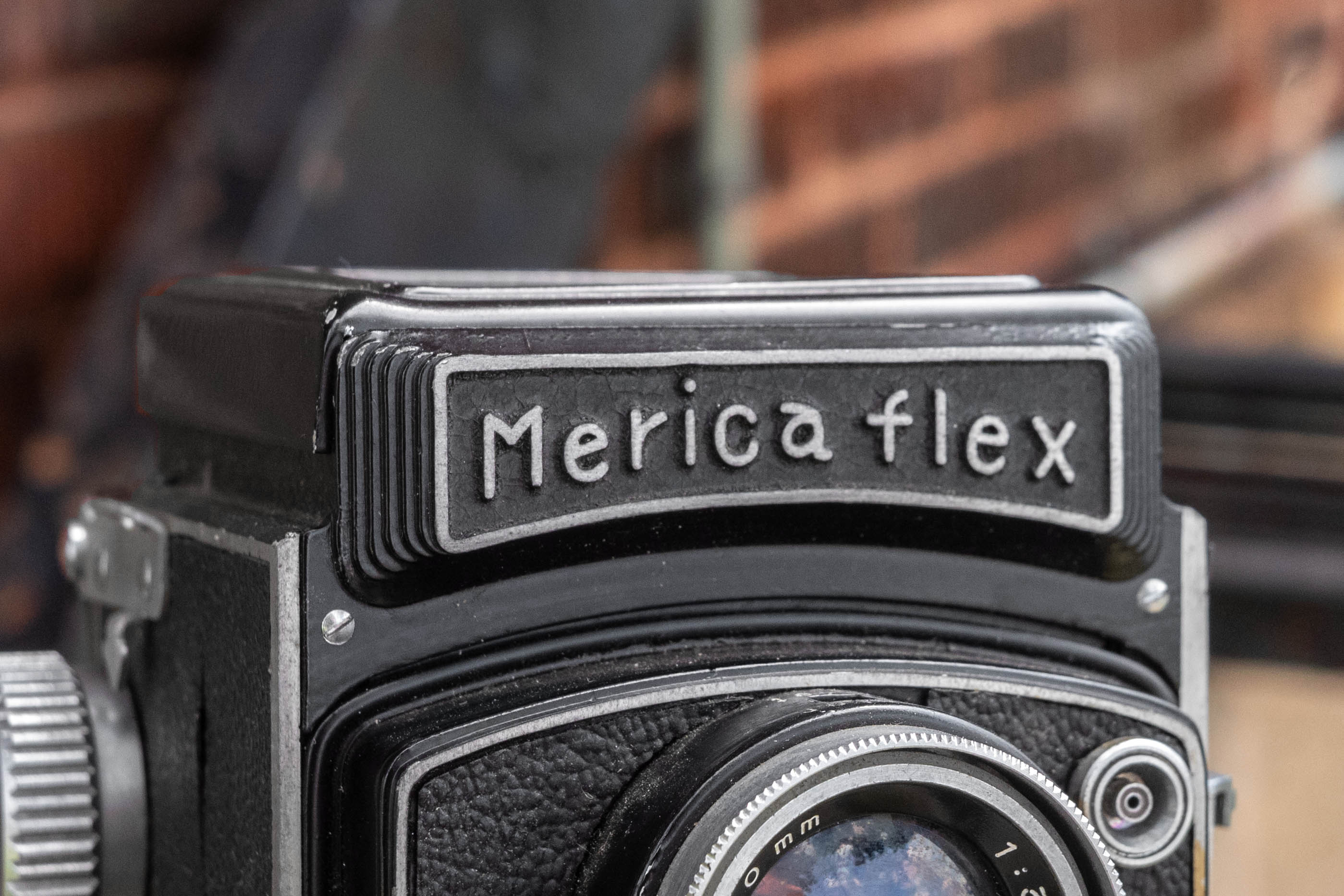
Looking at the name plate, an obvious space exists between the words “Merica” and “flex” suggesting that’s how it should be referred to, and not “Mericaflex” That the second word is not capitalized was a curious decision, or was it a mistake, maybe the camera should be called the Mericaflex, but whoever was in charge of engraving this plate just screwed up? We’ll likely never know.
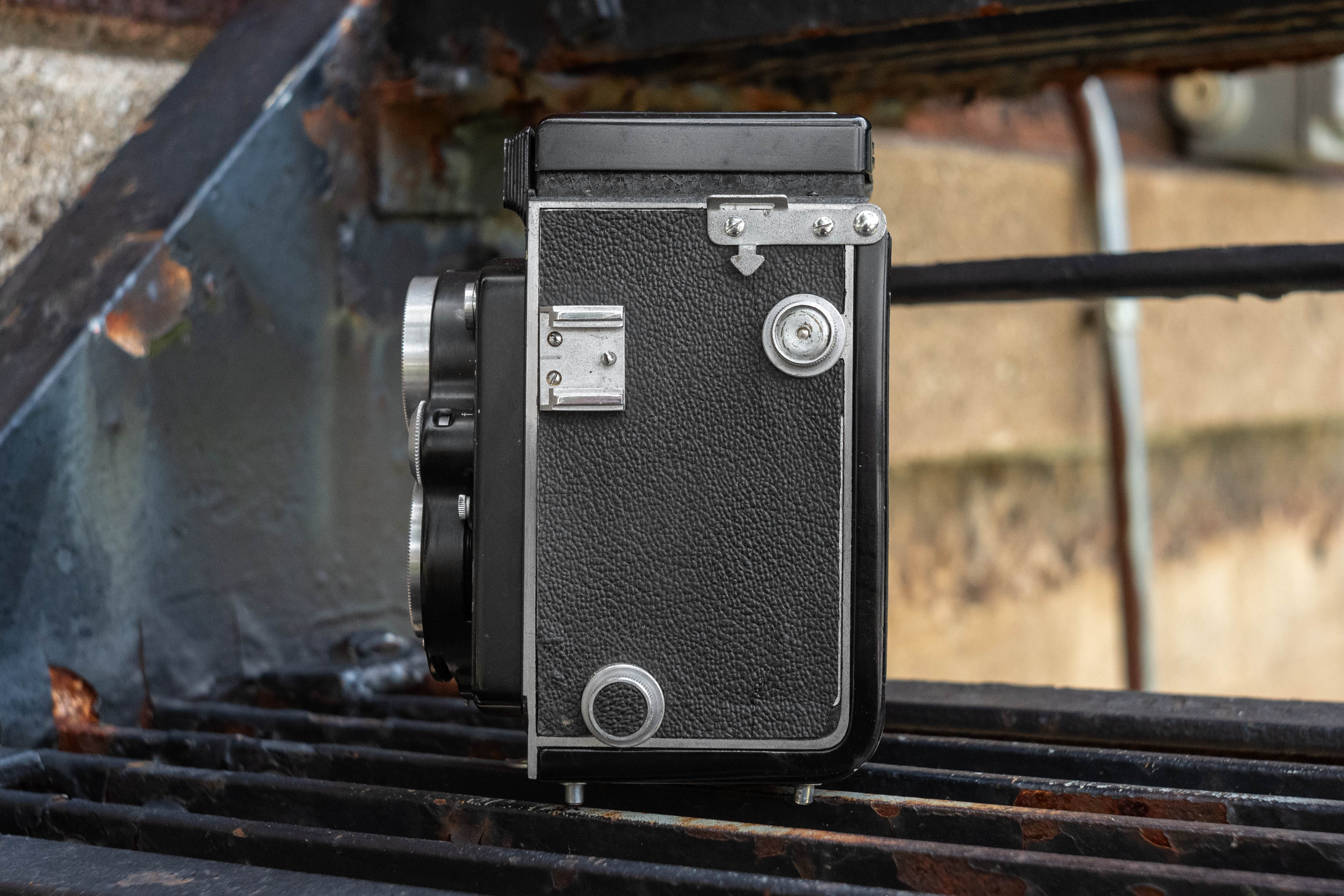
The camera’s left side has a pressed metal accessory shoe and two knobs which are used to pull out the film holders inside the film compartment. Notice the strap holder with the downward arrow shaped protrusion as this was one of the key elements which Paul Sokk identified as possibly being shared with other TLRs of the same era.
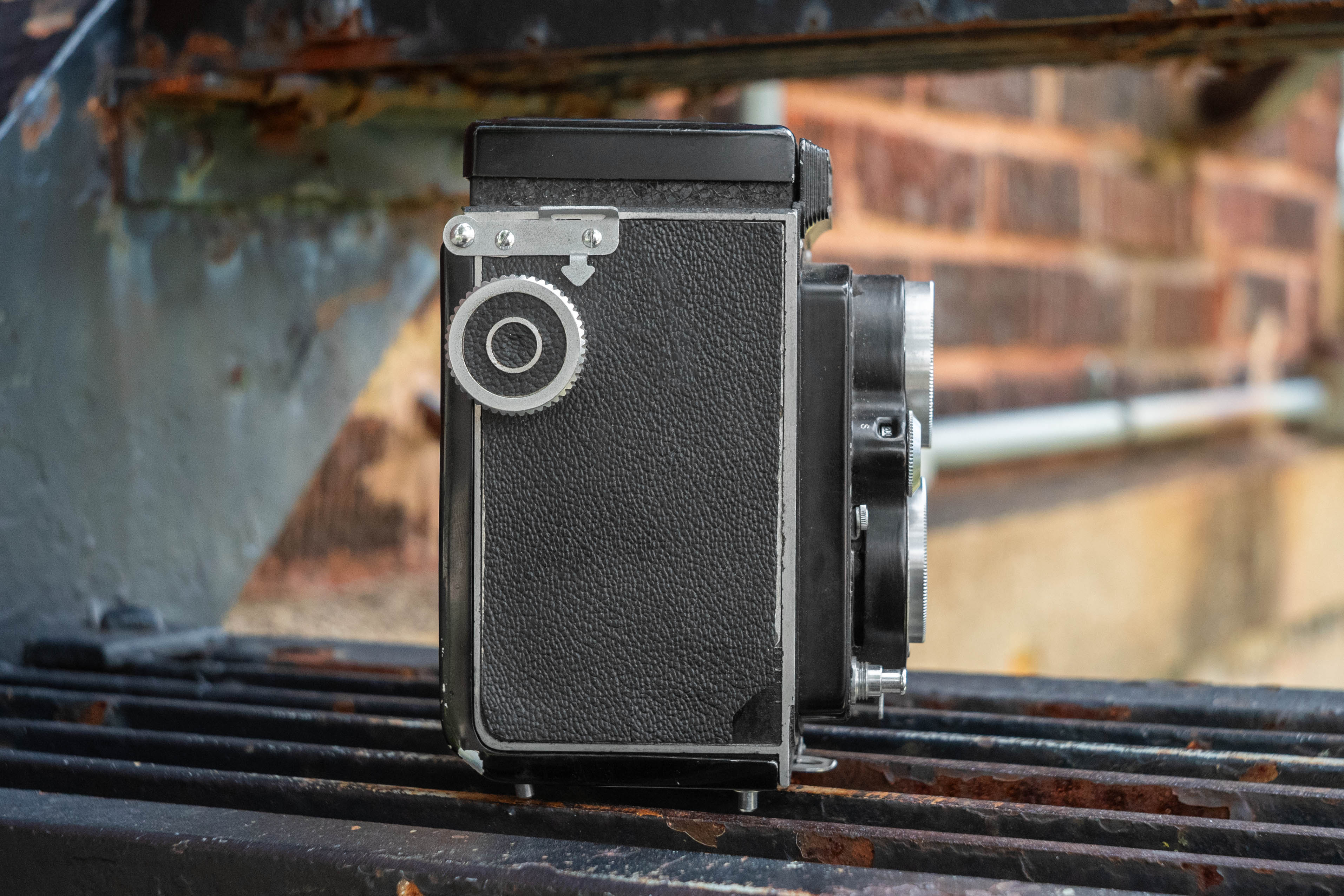
The opposite side is unusually sparse as this is where most cameras have a focusing knob, film advance lever, or in the case of “Automat” TLRs, the exposure counter. On the Merica flex we only see the film advance knob. The Merica flex lacks any sort of coupled film transport so the only way to keep track of exposures is via the red window on the rear of the camera.
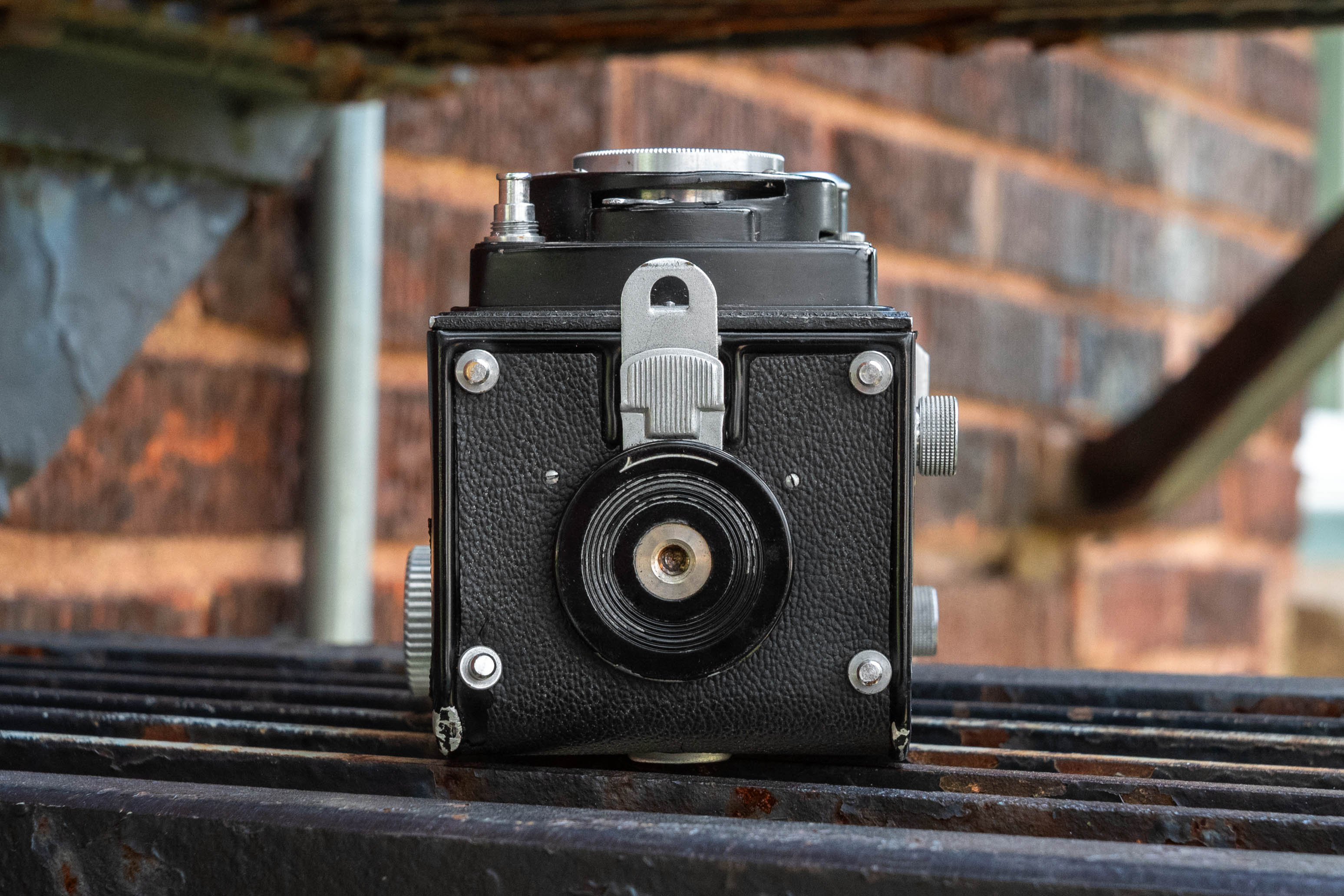
The base has a familiar 1/4″ tripod socket in the center and a folding latch which secures the film door shut when in use. To open the film compartment, rotate the mushroom shaped piece of metal in the direction of the arrow and then fold the latch downward to release the lock.
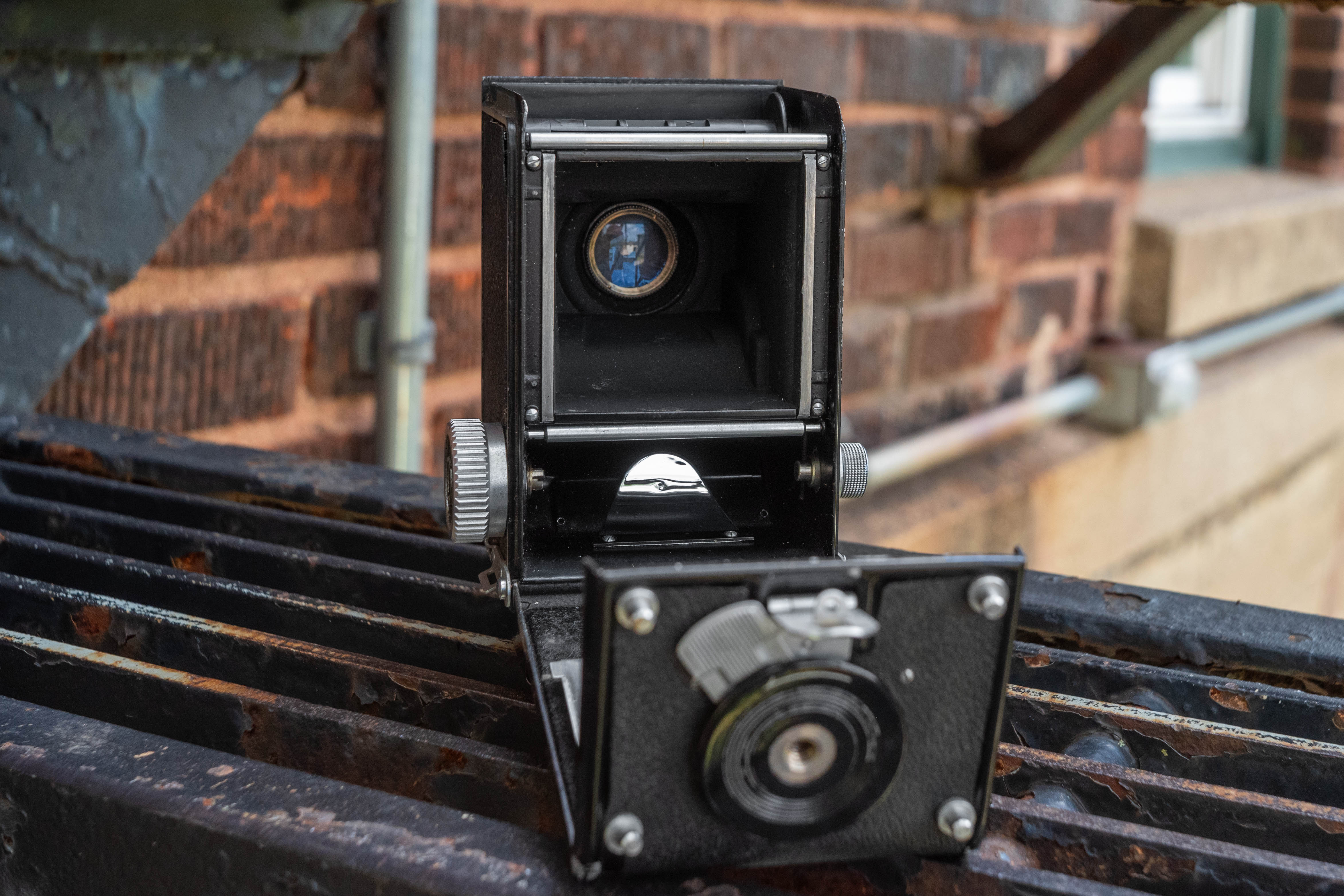
The film door is hinged near the top, which is how the German Rolleis were designed, but I have always found that this makes film loading a bit awkward as there is no way to keep the door from closing shut on your fingers with the camera in an upward orientation. Your best bet is to either load film with the camera upside down or laying on its face. A new roll of 120 film goes into the bottom chamber and the take up spool goes up top. Since there is no exposure counter on this camera, there are no red or white dots to align the Start mark on the backing paper with. Simply attach the paper leader to the take up spool, give it a couple turns to ensure it wont fall off, then close the door. Advance the film until the number 1 appears in the red window and you’re all set.
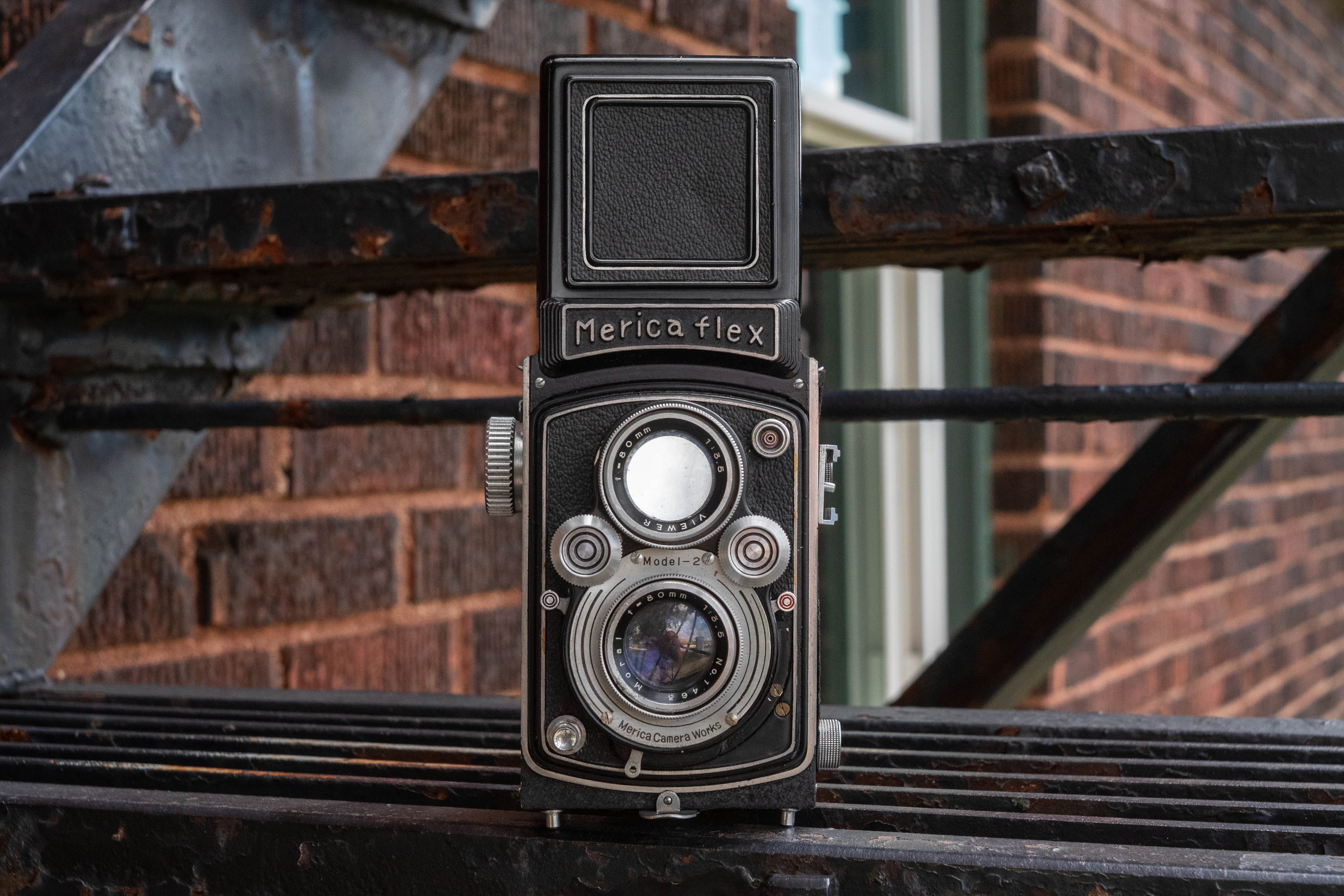
Up front we see a familiar TLR design but with those two knobs for shutter speed and aperture. On a lesser camera, might have thought that these were cosmetic only, but they definitely work. Shutter speeds are selected with the knob near the 10 o’clock position around the lens, and aperture f/stops with the knob near the 2 o’clock position. A flash sync port appears above and to the right of the viewfinder lens, and the shutter release is in the bottom left corner, within easy reach of the photographers right index finger while shooting.
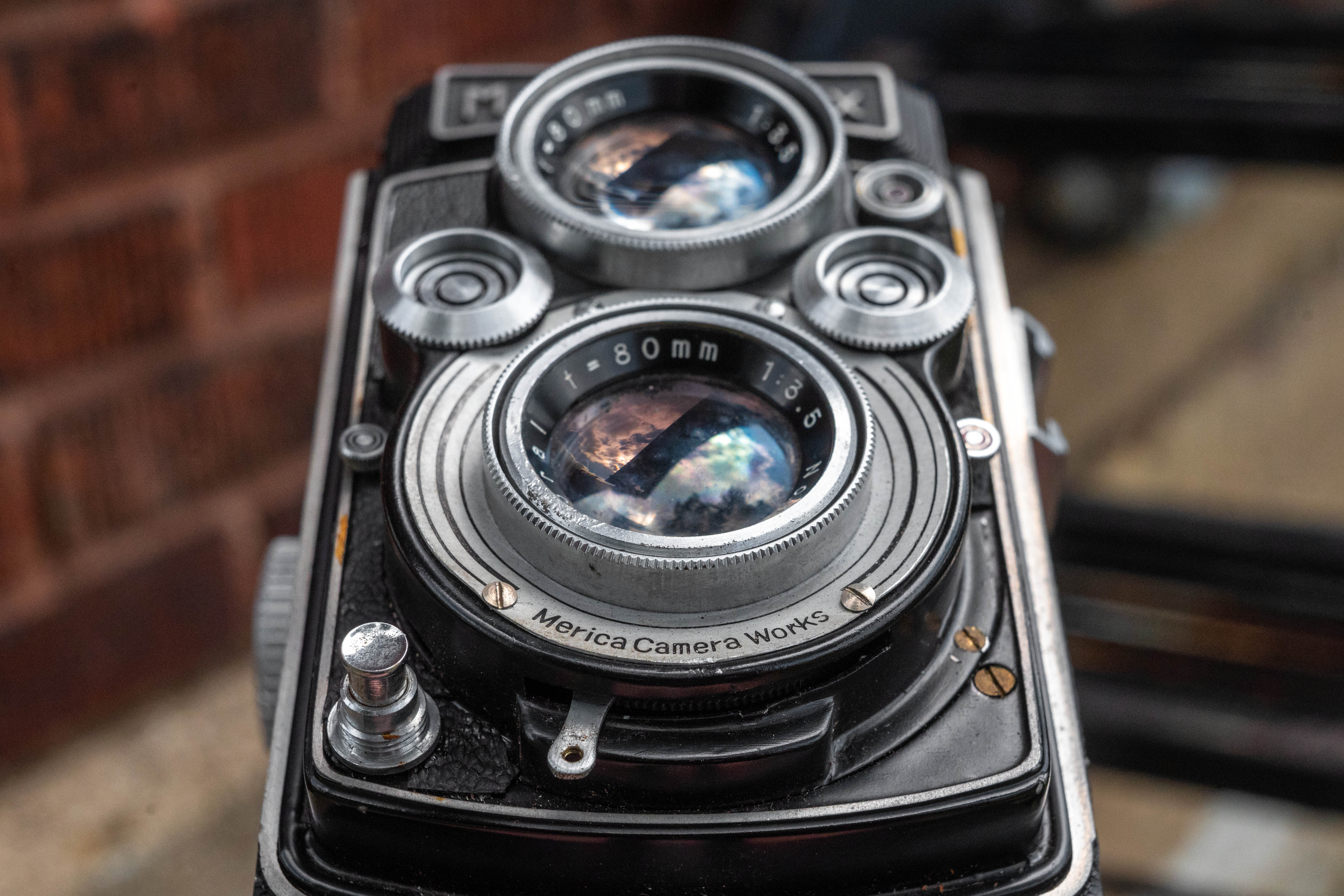
Focus is changed via a sliding lever beneath the taking lens. A small round handle should appear on the tip of this lever, but it is missing on this camera. As mentioned earlier in this article, this Merica flex was inoperable as the shutter has taken a strong hit, pressing it inwards towards the body and almost certainly damaging the focus linkage as I cannot move it on this camera, but I suspect the action is similar to the Minolta Autocord.
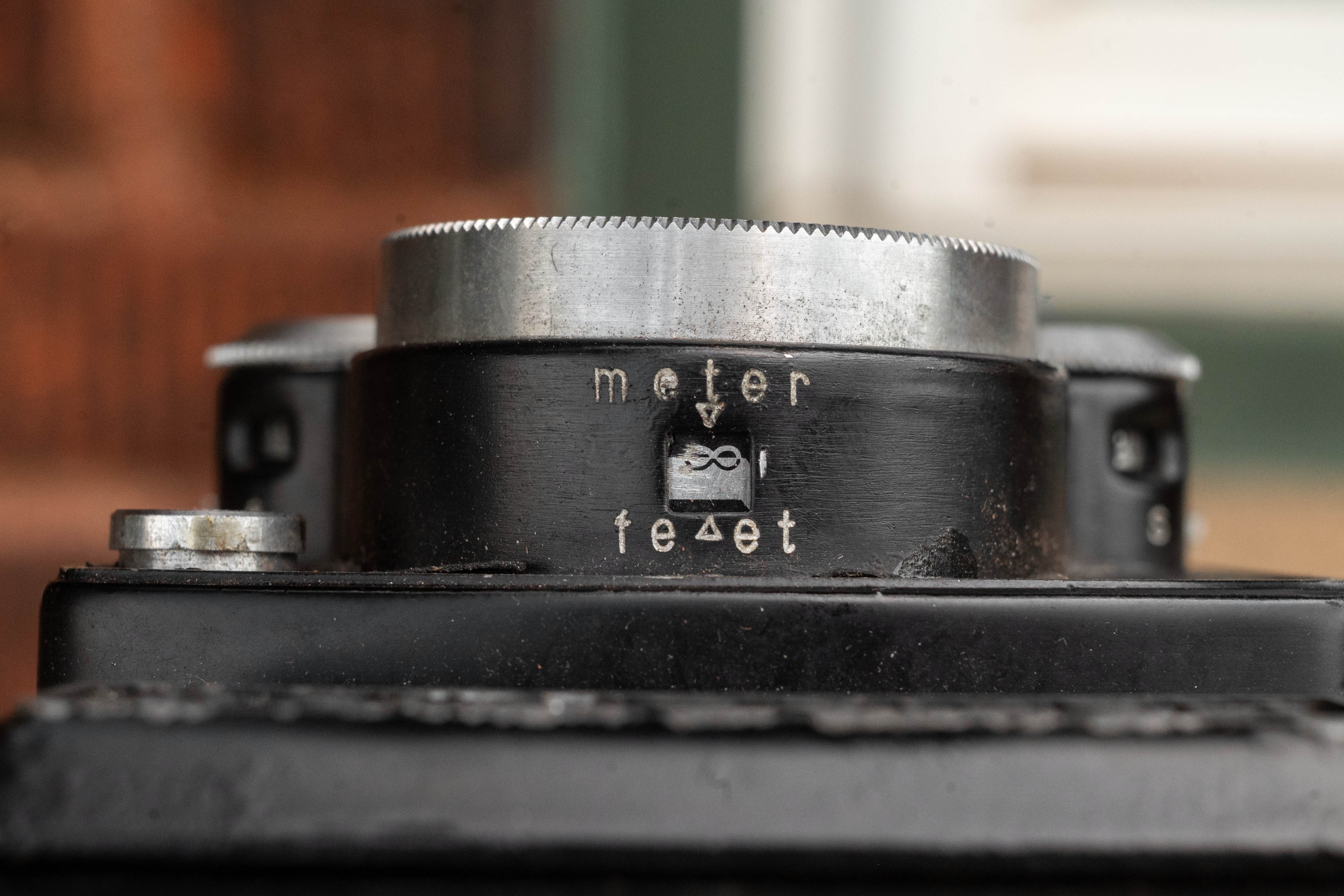
An interesting feature of the focusing system is that although the lever is below the taking lens, the focus scale is on top of the viewfinder lens, where you might see f/stops and shutter speeds on Yashica or Rolleiflex TLRs. Markings suggesting that distances in both feet and meters would be displayed, but I can’t actually see them as the focus lever is jammed and there is no way to get this to move.
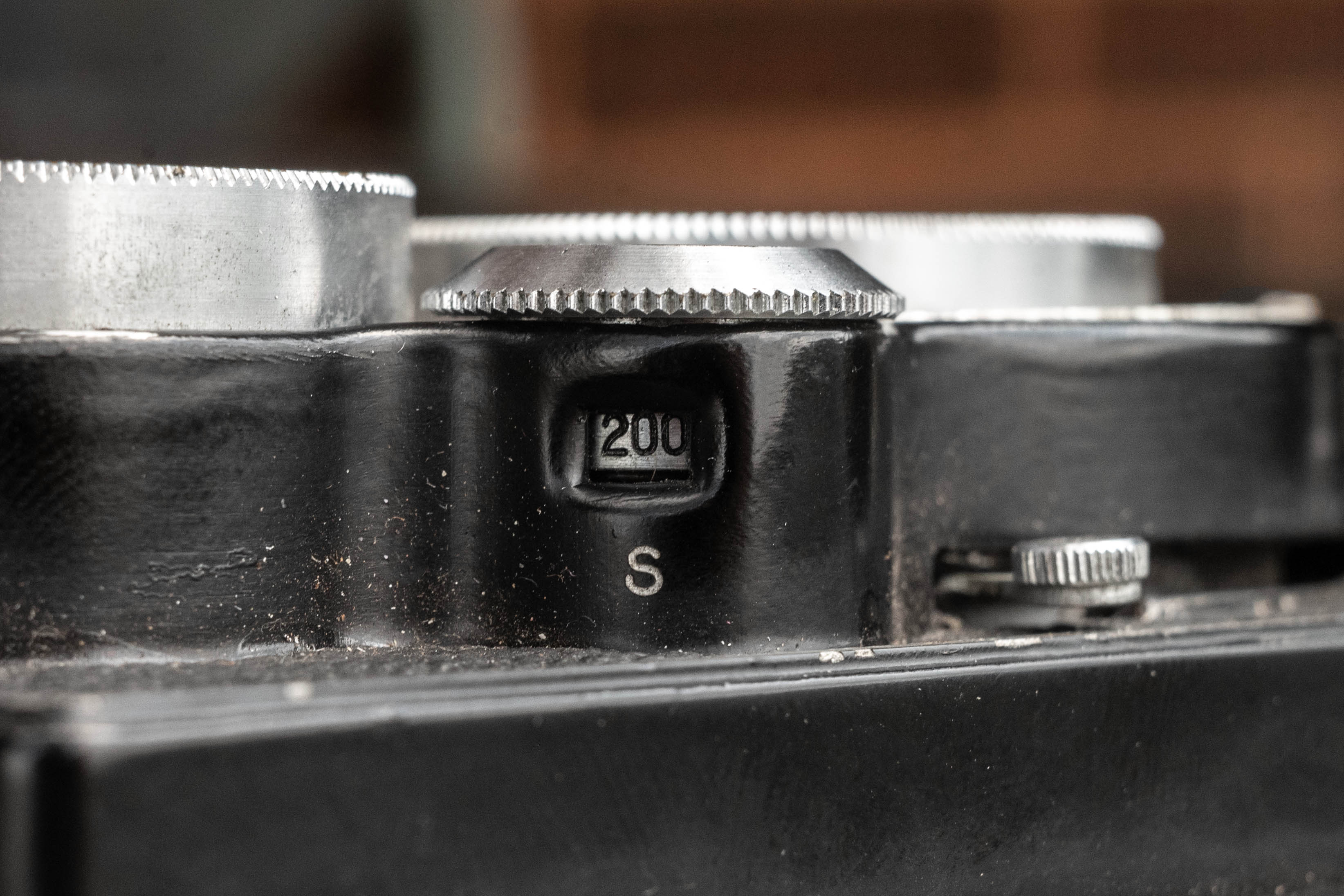
The Merica flex’s unnamed leaf shutter has a top speed of only 1/200 but does go down to 1 second, plus Bulb. I actually quite like the design of these knobs and prefer it to the more commonly found sliders found on most TLRs of this era. Below the shutter speed wheel is a lever with a black circle which is the shutter cocking lever, and on below the aperture wheel is a lever with a red circle which activates the self-timer. Amazingly, despite all of the functional issues this camera has, the self-timer actually does work!
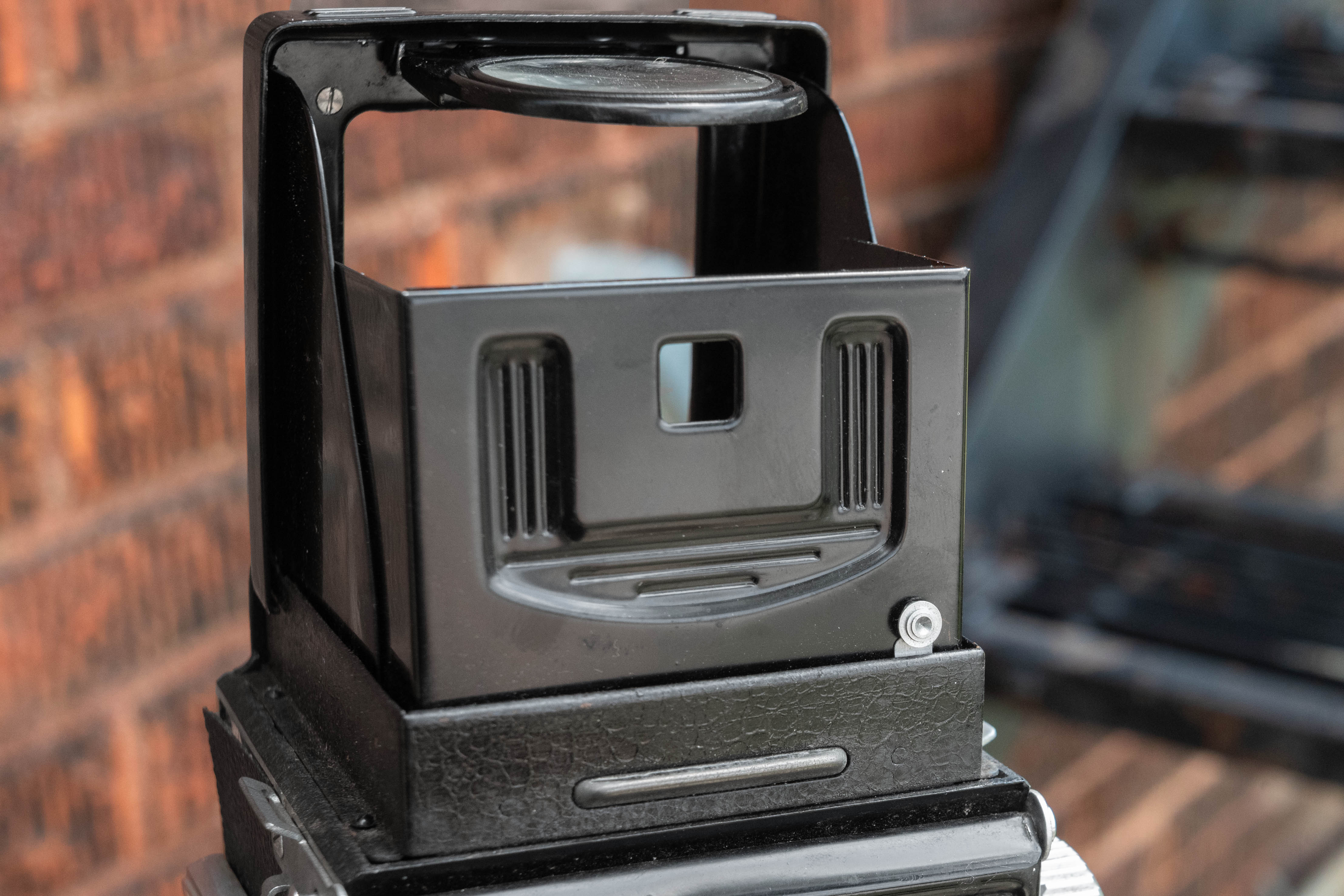
The Merica flex’s viewfinder has the usual compliment of features including a folding magnifying lens for precision focus, and a sports finder for fast action shots. To use the sports finder, first flip up the magnifier, then press in and down on the middle part of the lens hood until it hooks onto a little latch holding it in place. A small square on the back edge of the viewfinder hood is the eyepiece for the sports finder. With your eye close enough to the small square, whatever you see in the larger square should be what you’ll capture on film with the lens set to infinity. To close the sports finder, a small metal latch at the bottom right corner of the back edge of the hood is pressed to release it.
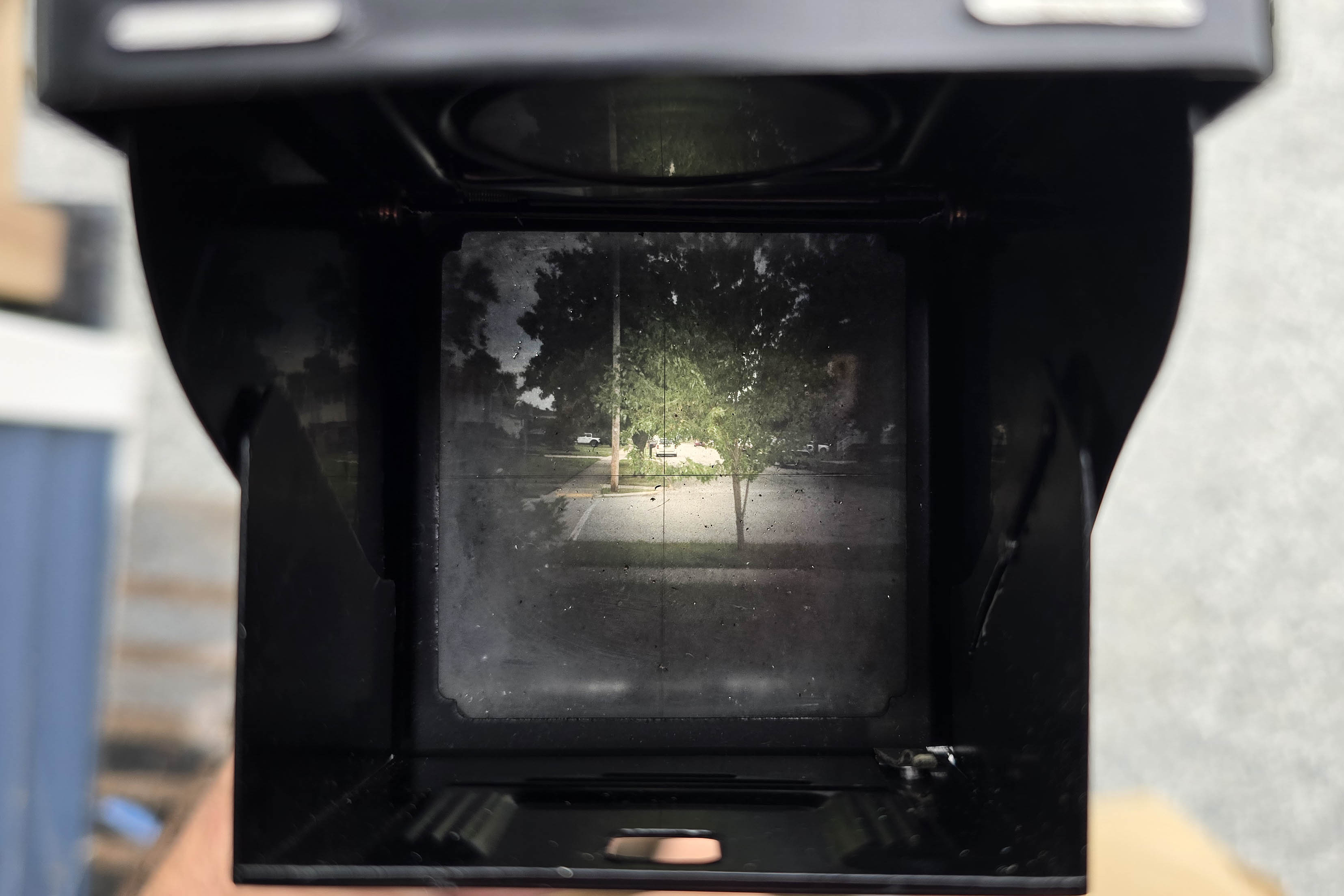
The reflex finder is of a rudimentary design, lacking in any focus aides like a split image or microprism circle. There is no bubble level, nor does the ground glass have a Fresnel pattern to improve brightness near the corners. The only thing to see on the focus screen is a single vertical and horizontal “horizon” for keeping the camera level. I found brightness of the viewfinder to be typical of prewar and early postwar TLRs. It gets quite dark indoors or in low light, but in bright sunlight is just barely bright enough to get the job done.
While I have no complaints with the viewfinder considering the Merica flex was a low production and inexpensive camera, that whoever built this camera gave it interesting features like the twin exposure dials and a bottom focus arm, it is a little disappointing they couldn’t have improved the viewfinder too.
The Merica flex came to me inoperable, so I was unable to shoot any film through it, but knowing the extremely high probability that this was a parts bin camera and that its lens was probably a copy of, or at least very similar to the triplet lenses used on a huge number of other Japanese cameras from the era, we can reasonably assume that the results from this camera in working condition would have been pretty decent.
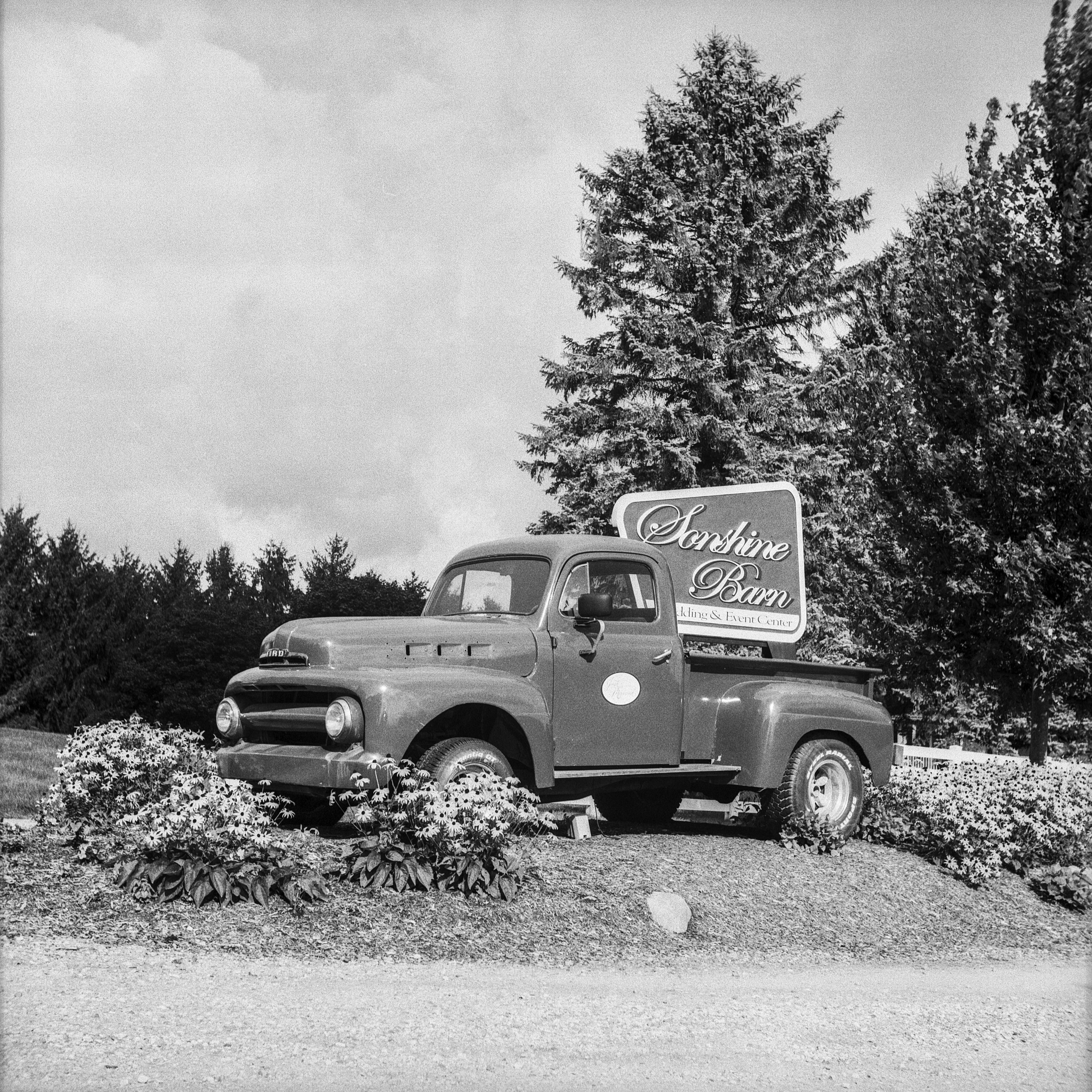
I could shoot any number of Beautyflexes or early Yashica TLRs and probably get results to what this camera would have been capable of. The image to the right was shot on a USC Auto Fifty, which was a rebadged Beautyflex with a triplet lens which likely performed the same as the Moral lens on the Merica flex.
I may not have been able to shoot film through this camera and frankly, the odds of me ever finding another are slim, however even without that experience, I feel as though there’s enough of a story to tell to make this review worthwhile. On its surface, yes, the Merica flex is just another early-to-mid 1950s Japanese TLR, but with the unique shutter speed and aperture knobs, bottom focus lever, and good looks, it is just interesting enough to be worthwhile of the full Mike Eckman dot Com treatment.
If you ever see one of these for sale, pick it up and if it works, please share with me the kinds of results you get from it!
Related Posts You Might Enjoy
External Links
https://yashicatlr.com/DesignHeritage.html
https://collectiblend.com/Cameras/Merica-Camera/Mericaflex.html
I did it! A full list of every TLR I could find – in book form.
https://au.blurb.com/b/11220365-tlr-compendium-a-guide-and-history
My understanding was that there were a lot of TLR’s produced in small runs of 2-5,000 for retail chains. They had odd names and were chosen as they were easy to assemble. Rent a 4 and a half tatami mat workshop, buy in a Tri-Lausar lens/shutter set, a bunch of knobs and have the rest made up by other workshops and you were in business. They are all very similar and there are perhaps a hundred of them. It took me a couple of years to track them all down. I never had a Merica-Flex but did have things like a Skyflex and others. They were closer related to cheap local TLR’s like the Toyocaflex than high end stuff like Minolta. Nikon planned one but it didn’t get past the concept stage.
Oh and the miniature cameras are usually referred to as ‘Hit’ cameras after the 17.5mm rollfilm they took. Some are highly collectible.