
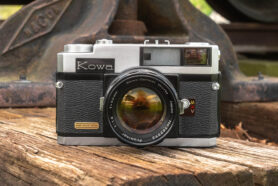
This is a Kowa Kallo 140, a 35mm rangefinder camera produced by Kowa Optical Co., Ltd. in Japan starting in September 1959. The Kallo 140 was the most ambitious 35mm rangefinder camera made by Kowa featuring a large and sturdy metal body, coupled rangefinder with automatic parallax correction, a unique interchangeable lens mount and the availability of a fast f/1.4 Kowa Prominar lens. The Kowa Kallo 140 was the first leaf shutter camera ever with an f/1.4 a feat equaled by other companies but never surpassed. Despite its impressive list of features, the Kallo 140 was a short lived model, catering to an audience that never embraced its combination of speed, interchangeable lenses, and high price.
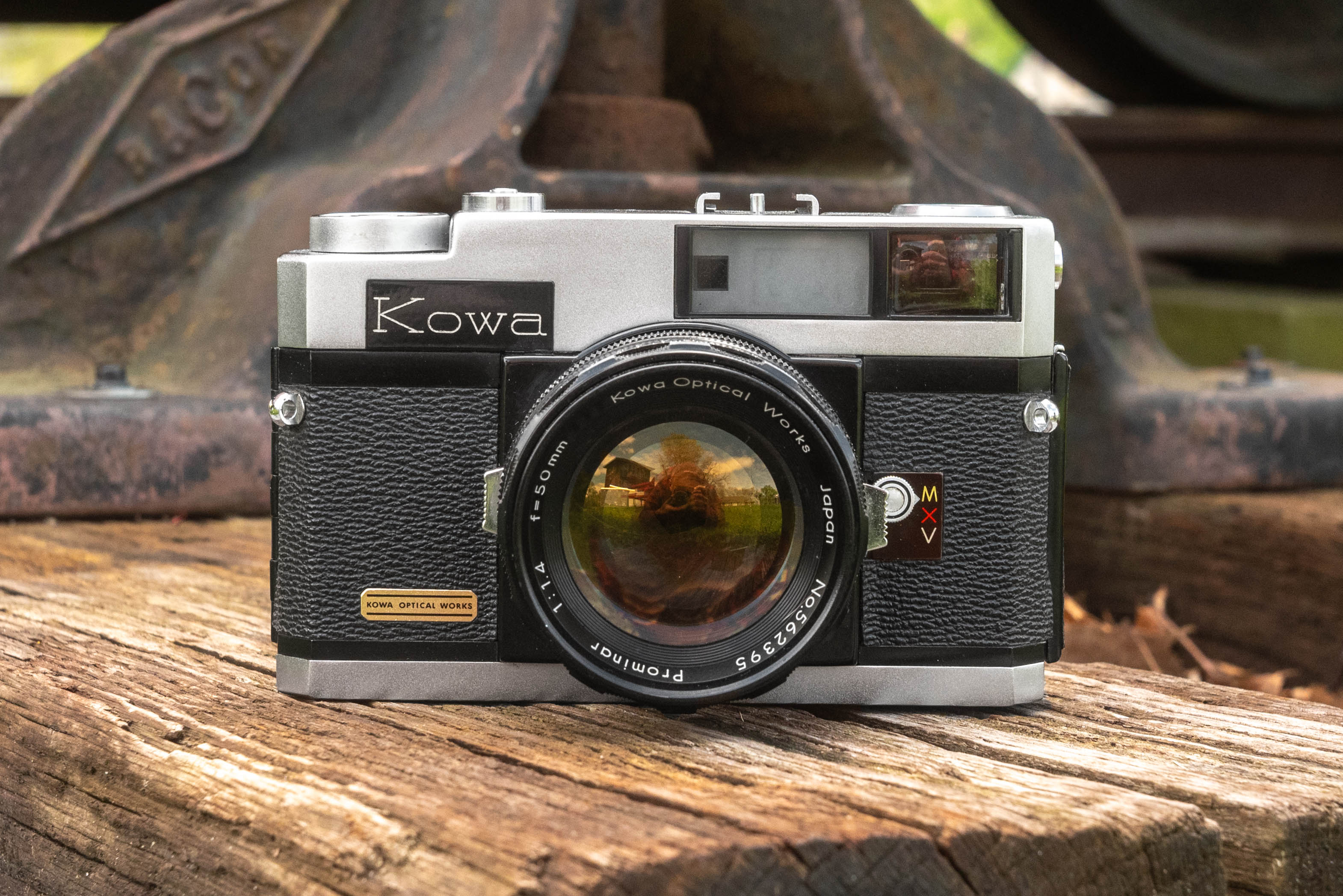
Film Type: 135 (35mm)
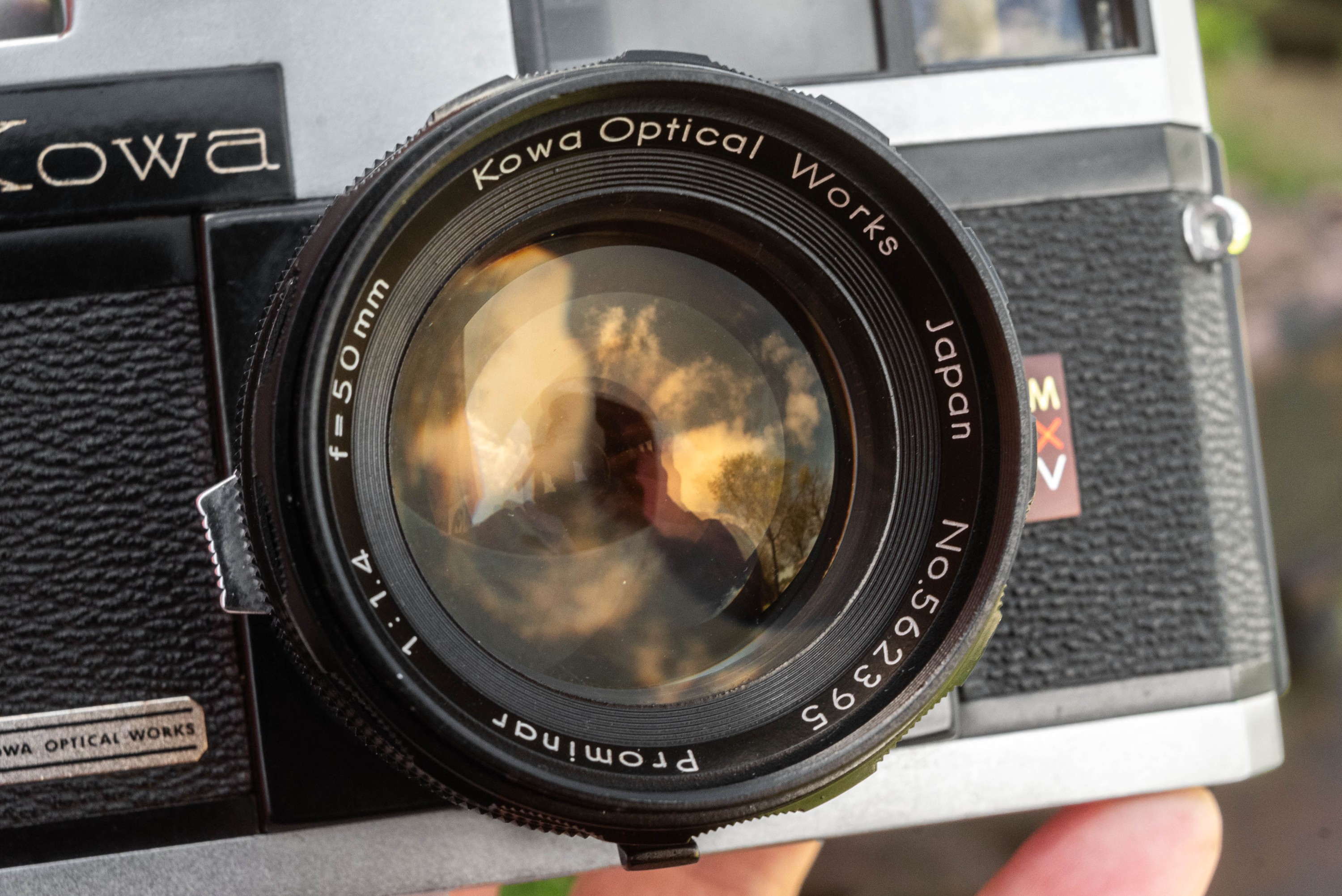
Lens: 50mm f/1.4 Kowa Prominar coated 7-elements in 4-groups
Lens Mount: Kowa Kallo Bayonet
Focus: 1 meter to Infinity
Viewfinder: Coincident Image Coupled Rangefinder w/ Automatic Parallax Correction
Shutter: Seikosha SLV 0 Leaf
Speeds: B, 1 – 1/500 seconds
Exposure Meter: None
Battery: None
Flash Mount: Cold shoe and M and X Flash Sync
Weight: 938 grams, 720 grams (body only)
Manual: None
Like many Japanese camera makers in the mid 20th century, Kowa did not start out making cameras. The origins of the company can trace its roots all the way back to a textile shop in Nagoya, Japan in 1894. This original company would go through many iterations of itself, making a variety of products that had nothing to do with cameras or the optics industry. It would not be until 1946 that it would be split up into several different companies, one of which became Kowa Koki Seisakusho, or Kowa Optical Works in English.

At the end of the war in 1945, Kofuku Sangyo (their earlier name), under its president Kawasaki Otozo, assessed the situation and began thinking about postwar recovery. Kofuku Sangyo had grown by exporting textiles, but Kawasaki felt it couldn’t go on like this and that they should diversify their products so he set his sights on optics (the Navy’s Toyokawa Naval Arsenal) and pharmaceuticals (the Army’s Sanitary Materials Depot), both of which the company had been involved with during the war.
For the optics side, he used connections with Onari Heiki, an arsenal supplier (a small subsidiary of Kofuku Sangyo, where Kawasaki also served as president concurrently). Through those connections he succeeded in recruiting five engineers, including the arsenal’s former director, a captain in the Japanese Navy named Deishi Hiroshi and an engineering lieutenant commander named Narimatsu Akihisa.
In June 1946, everyone gathered at the former youth school grounds of Onari Heiki in Gamagori, and Kowa Koki Seisakusho was born. Kowa’s first products were eyeglass lenses which they made for only one year, but the costs soon didn’t add up and production was stopped.
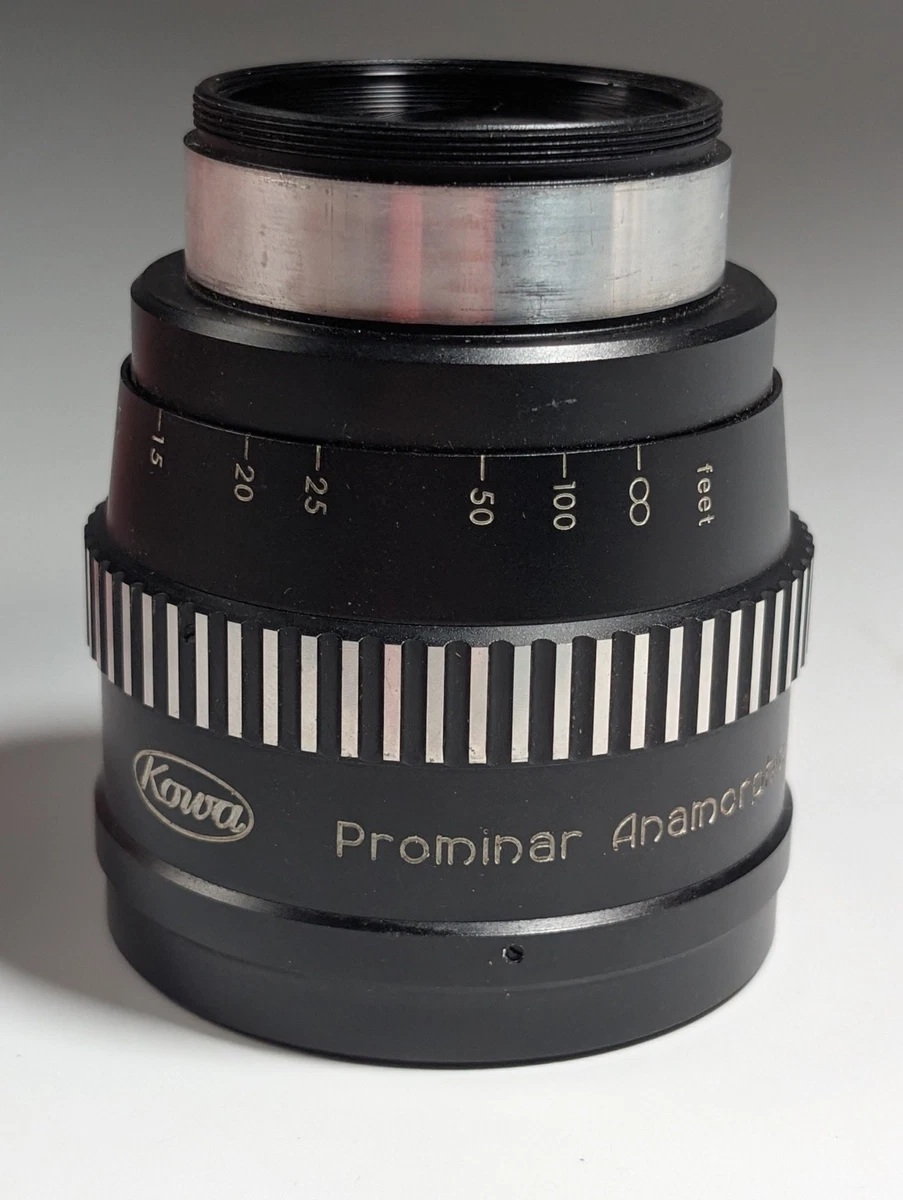
Kowa’s next product proved to be their most successful to that point, a lineup of anamorphic “Cinemascope” projection lenses which they gave the name “Prominar”. These lenses allowed them to secure a deal with 20th Century Fox which gave Kowa sales rights in Japan and Southeast Asia. By the early 1950s, demand for Kowa’s Prominar lenses grew and at one point allowed them to hold 90% of the Japanese market.
In addition to their successful line of projection lenses, Kowa also produced two kinds of binoculars, 6×30 and 7×50. Many of these early Kowa binoculars were sold ti the US importer, Bushnell and sold there under a different name. Along with binoculars, Kowa added rifle scopes, spotting scopes and eventually cameras to their portfolio.
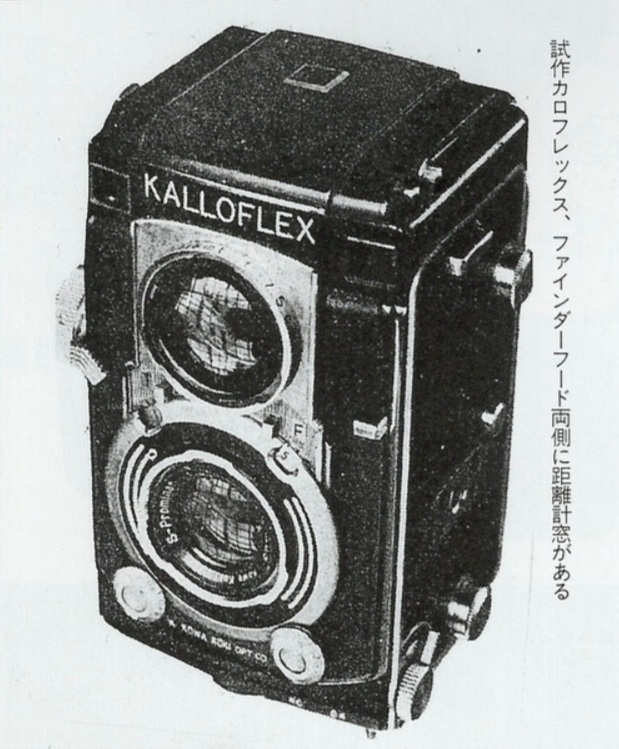
Kowa’s first photographic product was a copy of the German Rolleicord TLR called the Kalloflex Automat, released in 1954. Although a well built camera, early prototypes of the Kalloflex were much more ambitious. Early Kalloflex prototypes featuring a folding design which would collapse the camera when not in used and a combined reflex finder and optical rangefinder giving the user two options for focusing the image.
In the image to the right, the Kalloflex is shown collapsed. In shooting mode, the entire front plate extends forward using bellows, similar to how later Mamiya C-series TLRs worked. Two rangefinder windows are on either side of the Kalloflex name plate, and aperture and shutter speed wheels are below and to the left and right of the taking lens. The camera appears to offer multiple types of flash synchronization and what appears to be a clone of a Compur leaf shutter and bayonet mounts around the taking lens, suggesting compatibility with Rolleiflex/Rolleicord hoods and filters.

Development of the Kalloflex took as long as five years, but before the prototype could be completed, cost overruns and production problems resulted in a shift to a much more traditional TLR design, which is what was eventually released in 1954.
When it was released, the Kalloflex was positioned as a high-end Japanese TLR, and featured Kowa’s Prominar label on the lenses. Although a well built camera that was well received by photographers, it was only in production for about 4 years, as by then the company had already pivoted to 35mm rangefinders and eventually SLRs.
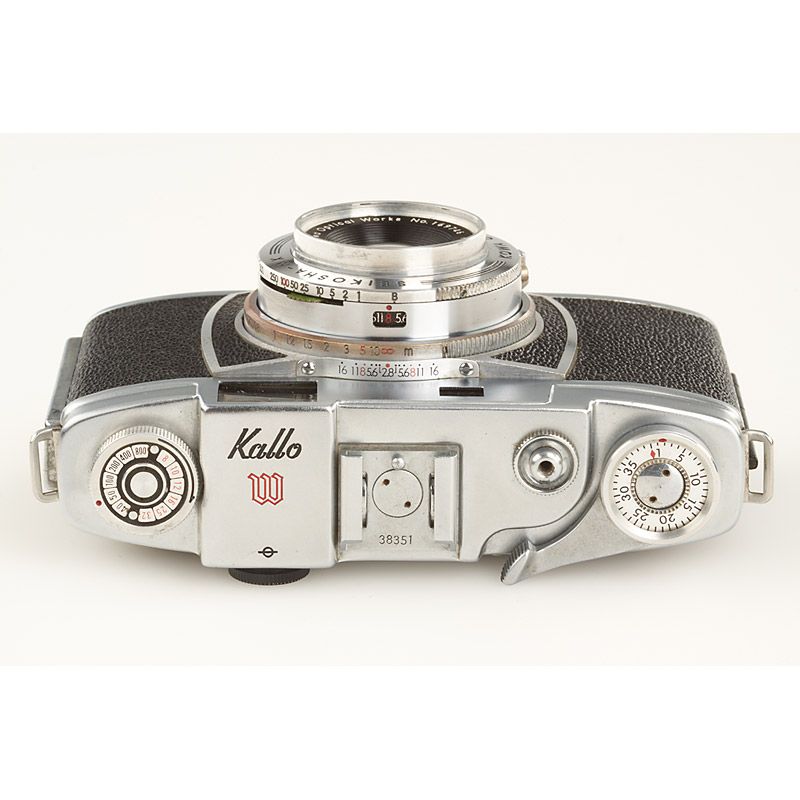
Kowa’s first 35mm camera was a rather ambitious model called the Kowa Kallo W. The Kallo W featured a 35mm wide angle Prominar lens and coupled rangefinder. It directly competed with the Olympus Wide, another 35mm camera with 35mm wide angle lens. Unlike the Olympus however, the Kowa had a rangefinder.
The Kowa W would set the stage for a line of Kallo rangefinder cameras featuring a variety of 35mm, 50mm, 85mm, and 100mm lenses. Models like the Kallo T 85 and Kallo T 100 were the only fixed lens rangefinders with telephoto lenses ever made showing Kowa’s commitment to a full range of focal lengths.
Perhaps foreshadowing a move to an interchangeable lens system, in 1959, Kowa would release the Kowa Kallo 140, a premium 35mm rangefinder camera with interchangeable bayonet lens mount, coupled rangefinder automatic parallax correction, available lenses from 35mm to 85mm. As icing on the cake, the standard “kit” lens in the Kallo 140 system was the Prominar 50mm f/1.4 lens which featured a 7-element design and was the first leaf shutter camera in the world with a fast f/1.4 lens, beating other models like the Yashica Lynx 14 by half a decade.
The Kowa Kallo 140 shared most of its body with the fixed lens Kallo 180 but the rear section of the Seikosha SLV leaf shutter and a new bayonet lens mount. Only three lenses were available for it, the previously mentioned 50mm, plus the 6-element Prominar 35mm f/2.8 and 5-element Prominar 85mm f/3.5.
In my research for this model, I could not find any English language manuals or advertisements and even promotional Japanese language material was difficult to find. Below, two low resolution scans of Japanese ads for the Kallo and Kowa branded versions of the camera are shown. The earlier ad shows a retail price of 23,800 yen which at the time would have been comparable to other fixed lens Japanese rangefinders like the Fujica 35 SE, Lord SL, and Mamiya Auto Metra.
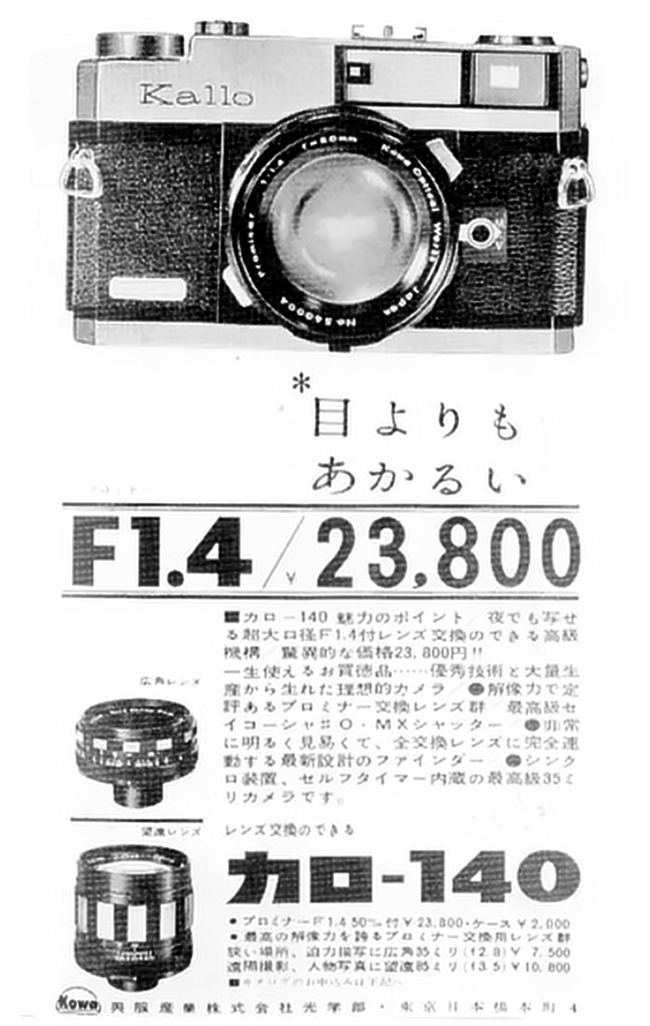
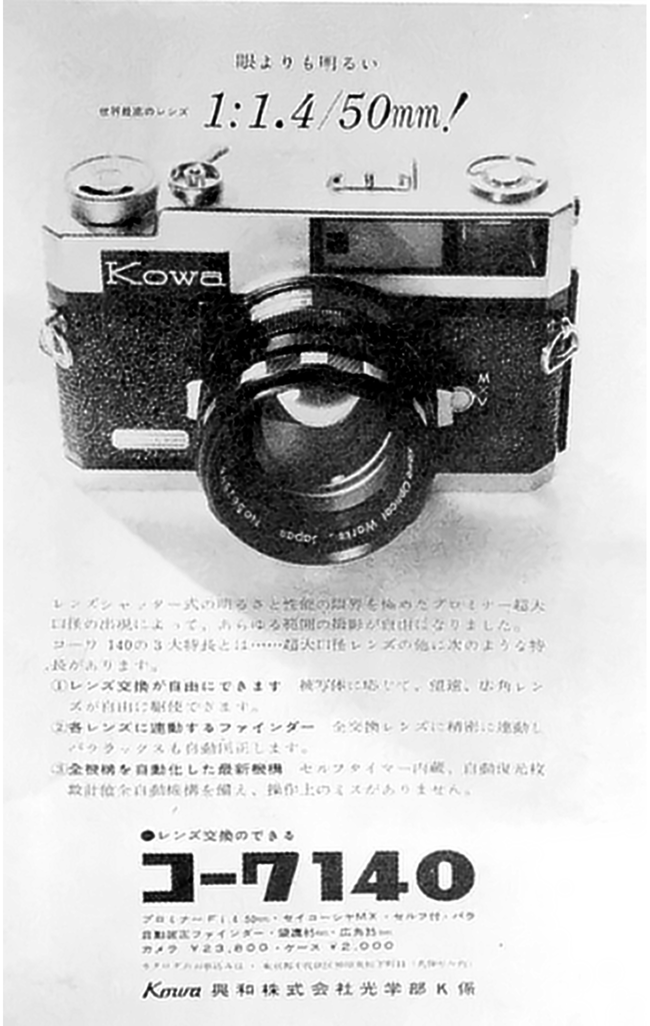
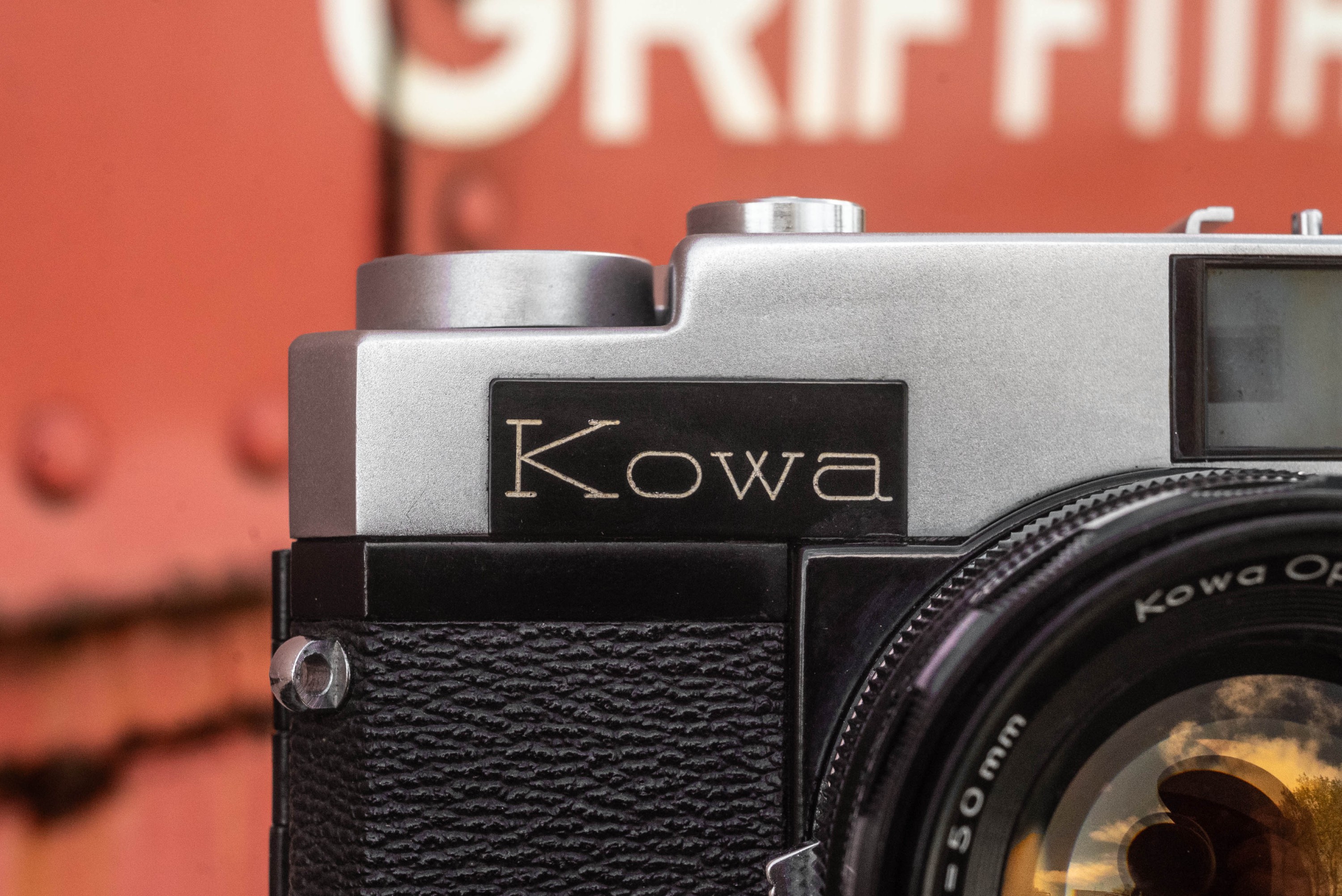
The Kowa Kallo 140 was in production for about three years, but a company wide change in May 1960 to drop the use of the name “Kallo” from the company’s rangefinders changed the name of the camera simply to Kowa 140. This resulted in two versions being made, the original versions with the name “Kallo” engraved directly into the chrome plate above and to the left of the lens mount, and later versions with a black plate in this location with the name “Kowa” engraved with white painted letters over it. This change was only cosmetic as the rest of the camera is exactly the same between the two.
The Kowa Kallo 140 was an ambitious camera by a company who clearly liked to try different things, from its ambitious first attempt at a TLR, to its first 35mm camera being a wide angle rangefinder, to it being the first company with a leaf shutter f/1.4 interchangeable lens camera, and at one time the company even built a camera that was powered by compressed carbon dioxide gas, but the production of the Kallo 140 did not last long. By the 1960s, Kowa’s focus increasingly shifted towards SLRs with a lineup of Kowaflex and later Kowa SLRs all of which used leaf shutters. Kowa never saw a level of success which matched their ambition, but for a small subset of photographers and collectors, Kowa cameras are fondly remembered for their excellent lenses and clever designs.
The Kowa Kallo 140 came to me during a very severe Japanese auction GAS attack where I felt like a kid in a candy store snapping up all these cool cameras that don’t often show up on US eBay at least not for prices I was comfortable with. I am not certain what I paid for the Kallo 140 but it certainly was way less than I could ever have hoped to get domestically. The camera was listed as in good working order so I took a chance and 3 weeks later, it showed up on my doorstep in as good of condition as the seller had promised (via Google Translate).
When looking at images of the Kowa Kallo 140 online, it is pretty obvious this is a large camera, especially considering the large size of the f/1.4 lens, but it is not until you handle to which the full impact of its heft becomes apparent. This is a large camera. Despite its size however it does have pretty good balance. I think that had they mounted this same lens on a more compact and lightweight body, it would have felt front heavy, but as it sits, the camera is large but balanced. Comparing this camera to a Yashica Lynx-14 with its massive f/1.4 lens, I prefer the Kowa more. Another advantage in favor of this camera is that the lens does not block a large part of the viewfinder like on the Lynx. No part of the projected frame lines are covered when peering through the viewfinder.
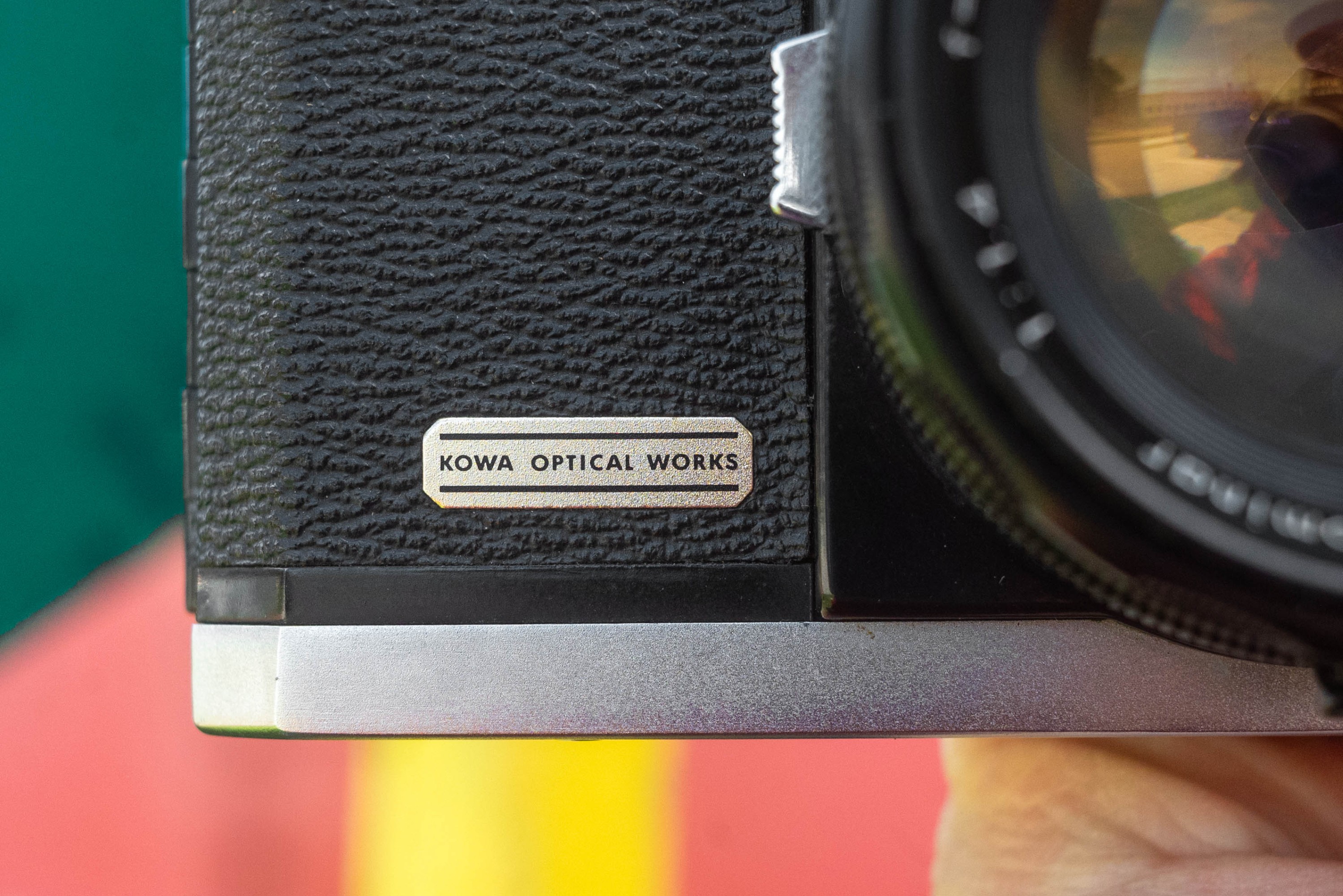
In addition to having good balance, the camera is well built with thick, shiny chrome and a pebbled body covering which on this version shows no signs of peeling, cracks, or other damage. I purchased this particular camera because it was in good condition, but in my research looking at other samples, most were in pretty decent shape suggesting that overall these cameras have stood the test of time well.
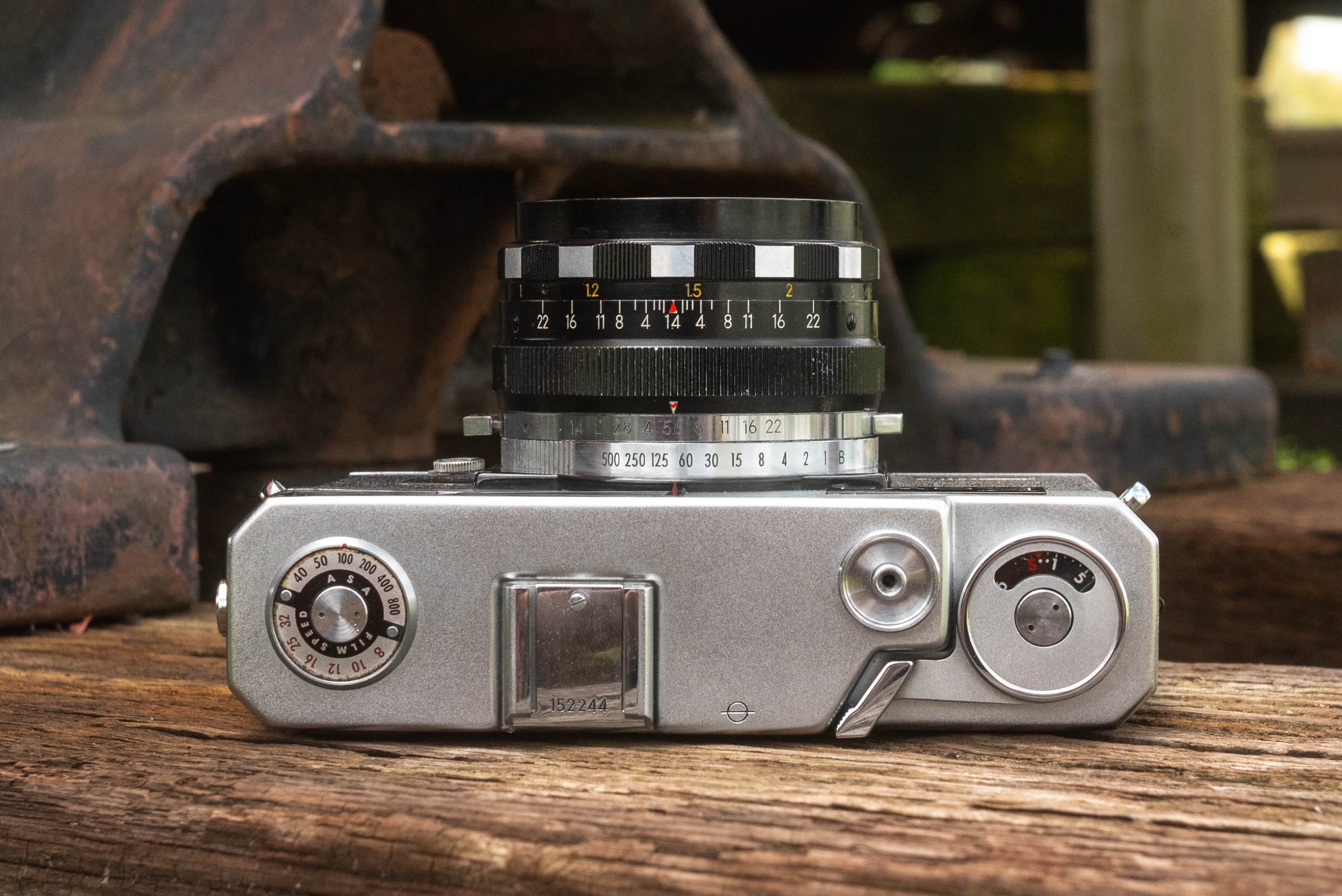
Looking down upon the top plate, the large body of the Kowa Kallo 140 afford a lot of space for the camera’s controls. On the left where you’d expect to see a rewind knob is a film speed reminder dial with ASA settings from 8 – 32 for color and 40 – 800 for black and white. This is an unmetered camera so this dial is purely there as a reminder. Next is the accessory shoe, and to its right is a film plane indicator. Above and to the right is the threaded shutter release button.
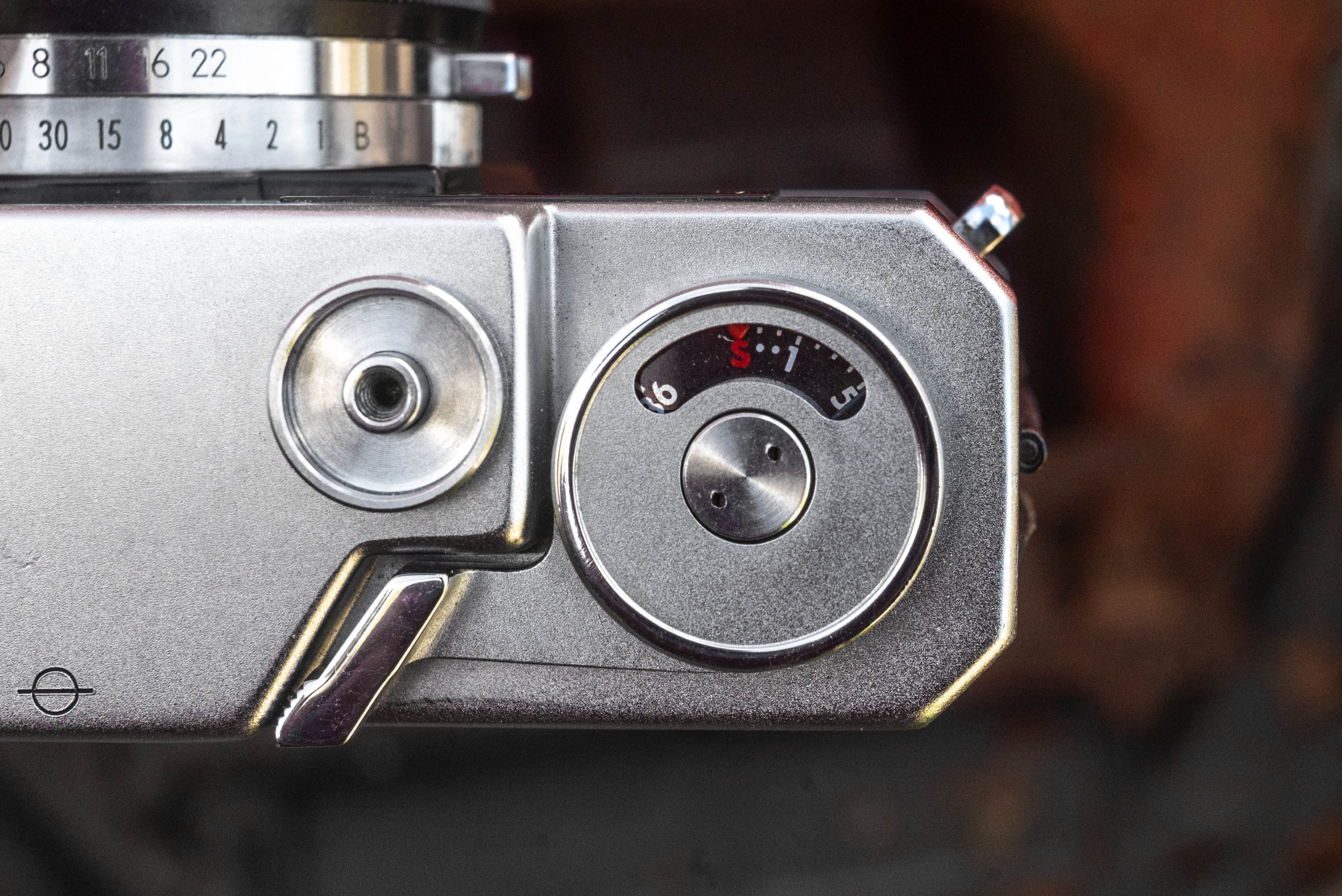
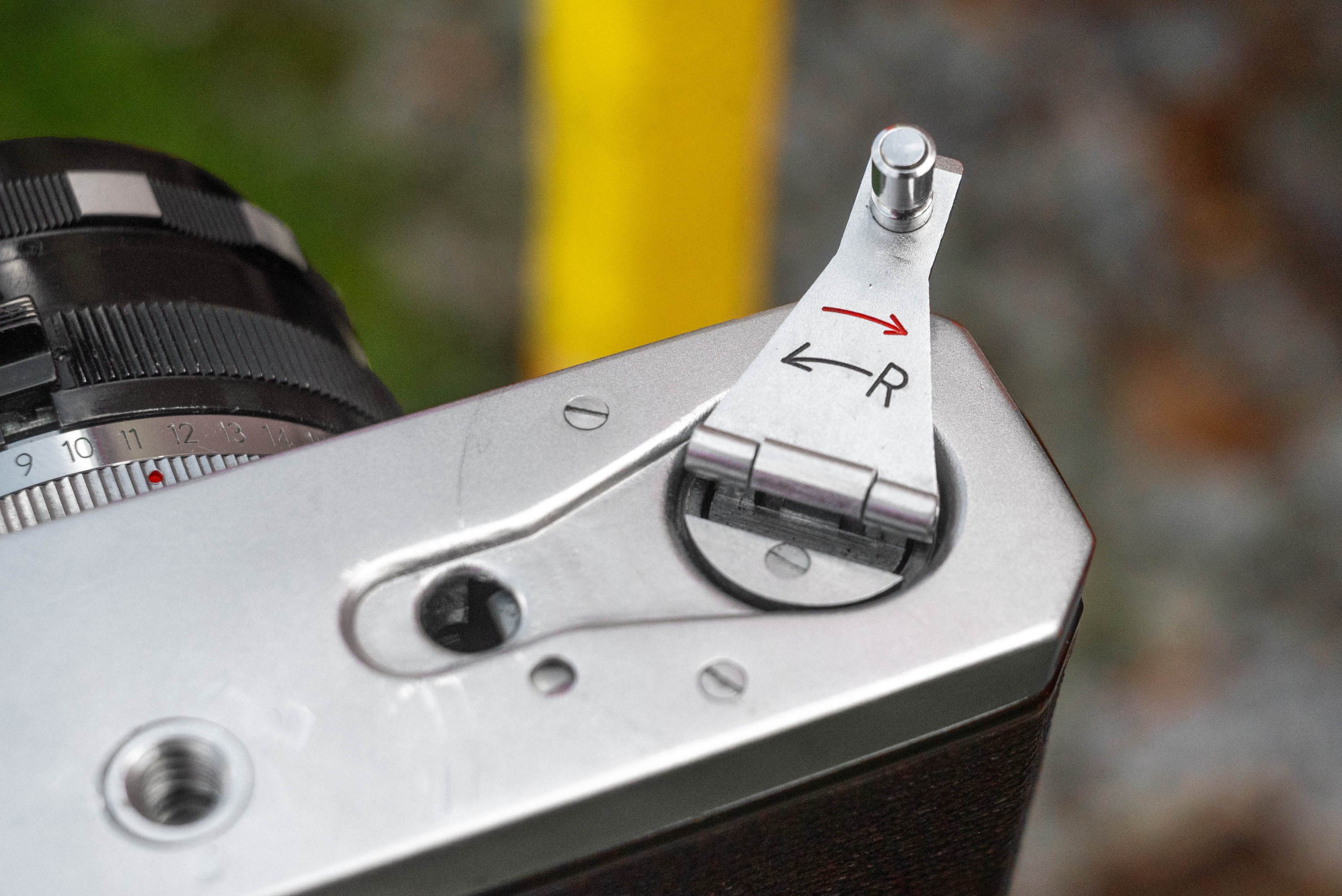
On the far right is the film advance lever with automatic resetting exposure counter in the middle. The counter is additive, showing how many exposures have been made on a roll of film and the film advance lever has a rather longish 210 degree throw. One thing I did not like about the film advance lever is that at rest, it folds in very tightly to the top plate, which looks nice, but makes it a little difficult to get out so you can advance it. It certainly isn’t difficult, it’s just not as seamlessly designed as other cameras.
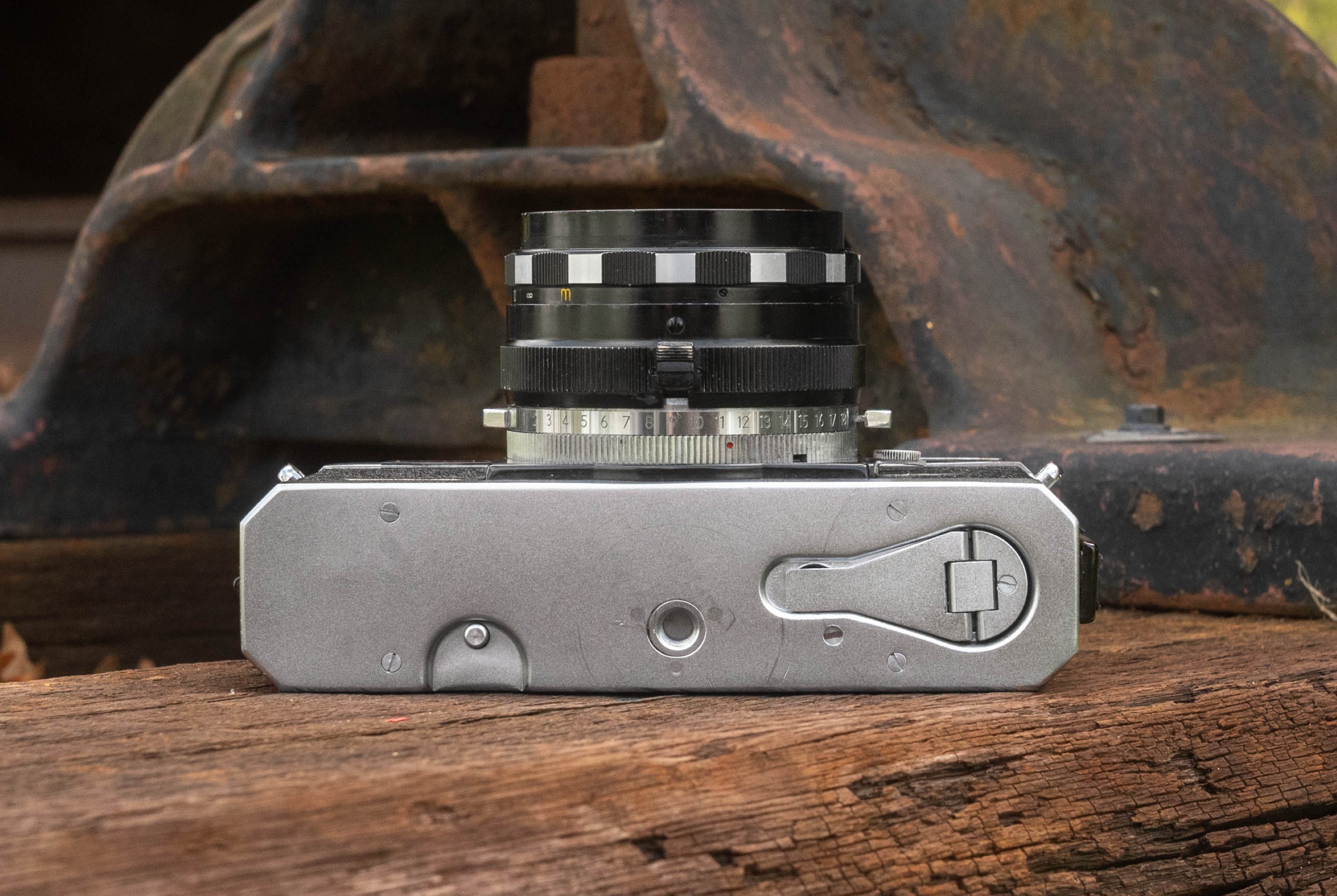
The base of the camera has a rewind release button, centrally located 1/4″ tripod socket and the film rewind handle. The design of the rewind handle is interesting as it is normally recessed into the bottom plate and only comes out when you press the film rewind button. This pops it up, allowing you to fold it out. Its length is about twice as long as most cameras, allowing you to have better grip on the handle while rewinding film into the cassette. On the inside of the film compartment, how it attaches to the cassette is a bit interesting too, but more on that later. When you are done rewinding, press the handle back into its recess and the rewind release button automatically pops back out.
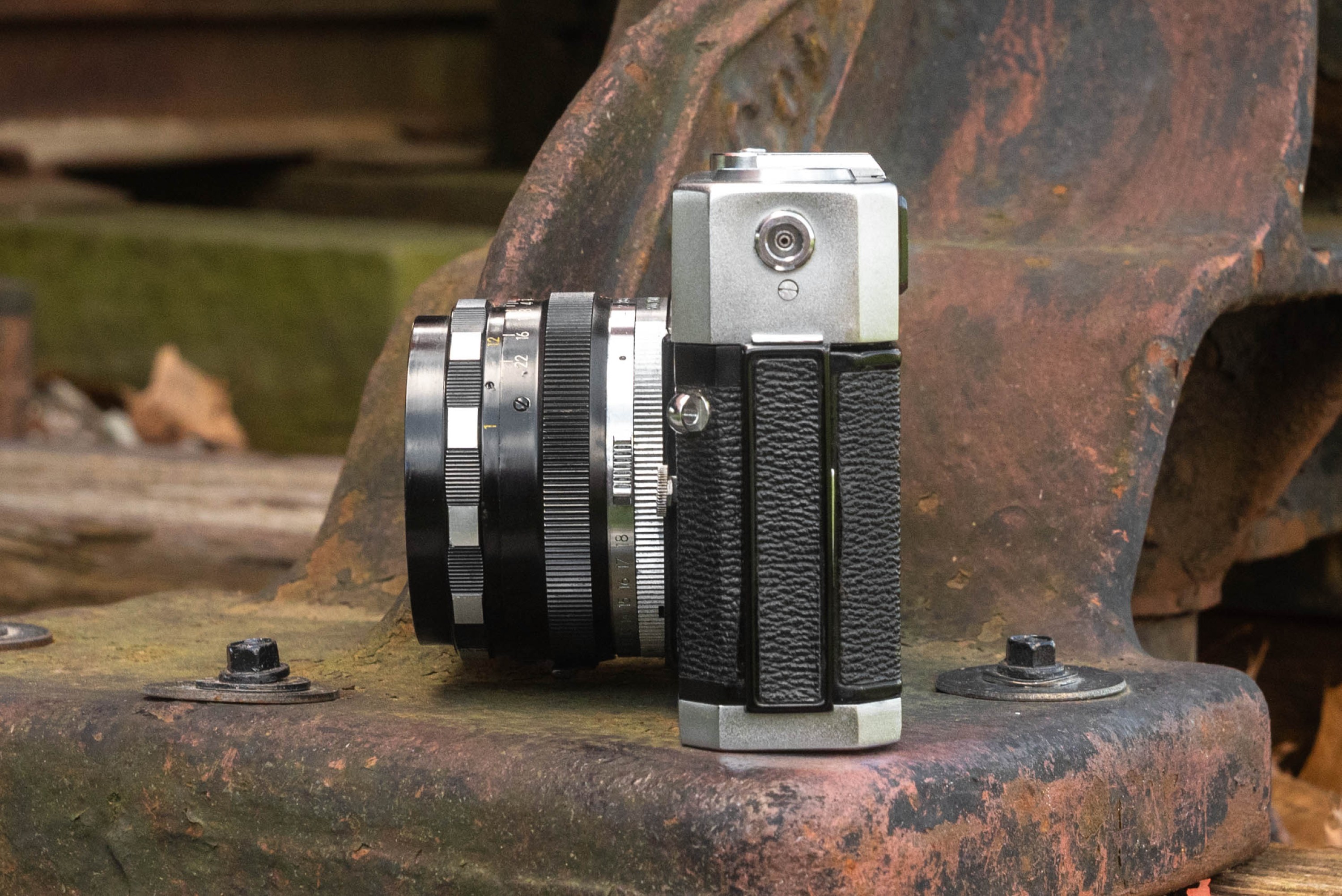
The sides of the camera are mostly symmetrical with the left side having the PC flash sync port and the film door release. This camera uses a sliding lock which was common in the 1950s and 60s in which you lift up on a tab near the top that unlocks the right hinged door allowing it to open.
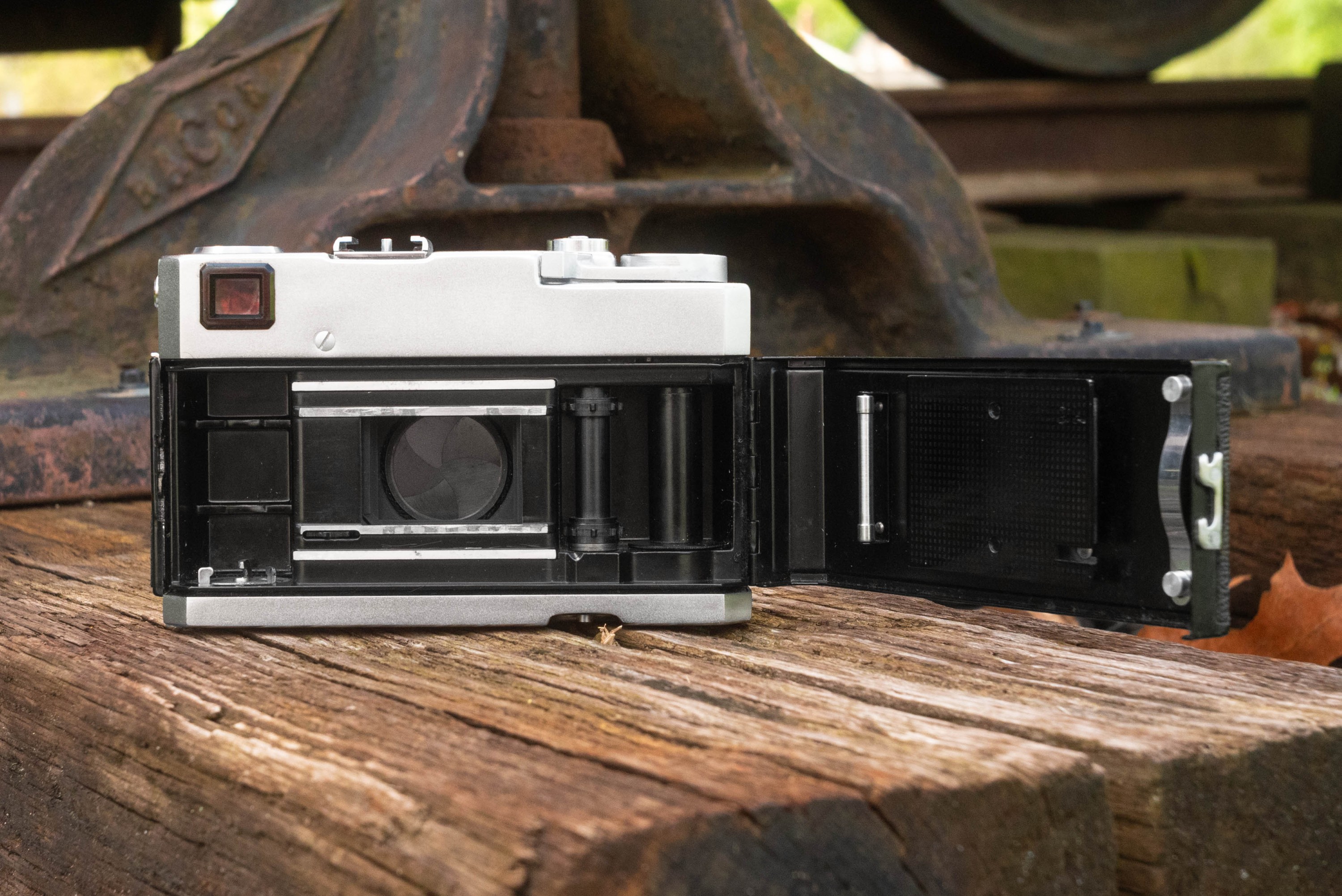
Around back there is little to see other than the rectangular eyepiece for the viewfinder and a large swath of body covering over the film door. With the door open, we see the film compartment. Film transports from left to right onto an integrated take up spool. The spool is single slotted and has a small tab for engaging one sprocket to prevent the film from slipping off. It is not one of my favorite style of take up spools, but it works. The inside of the film door has a large metal film pressure plate covered in divots which help reduce friction as film passes over it. Flanking the pressure plate are a metal roller and clip which help prevent the film transport from wiggling, ensuring flatness. The Kallo 140 predates the use of foam light seals and has black yarn in both film channels and a patch of black felt near the hinge, which on this camera was still doing its job keeping light out of the film compartment.
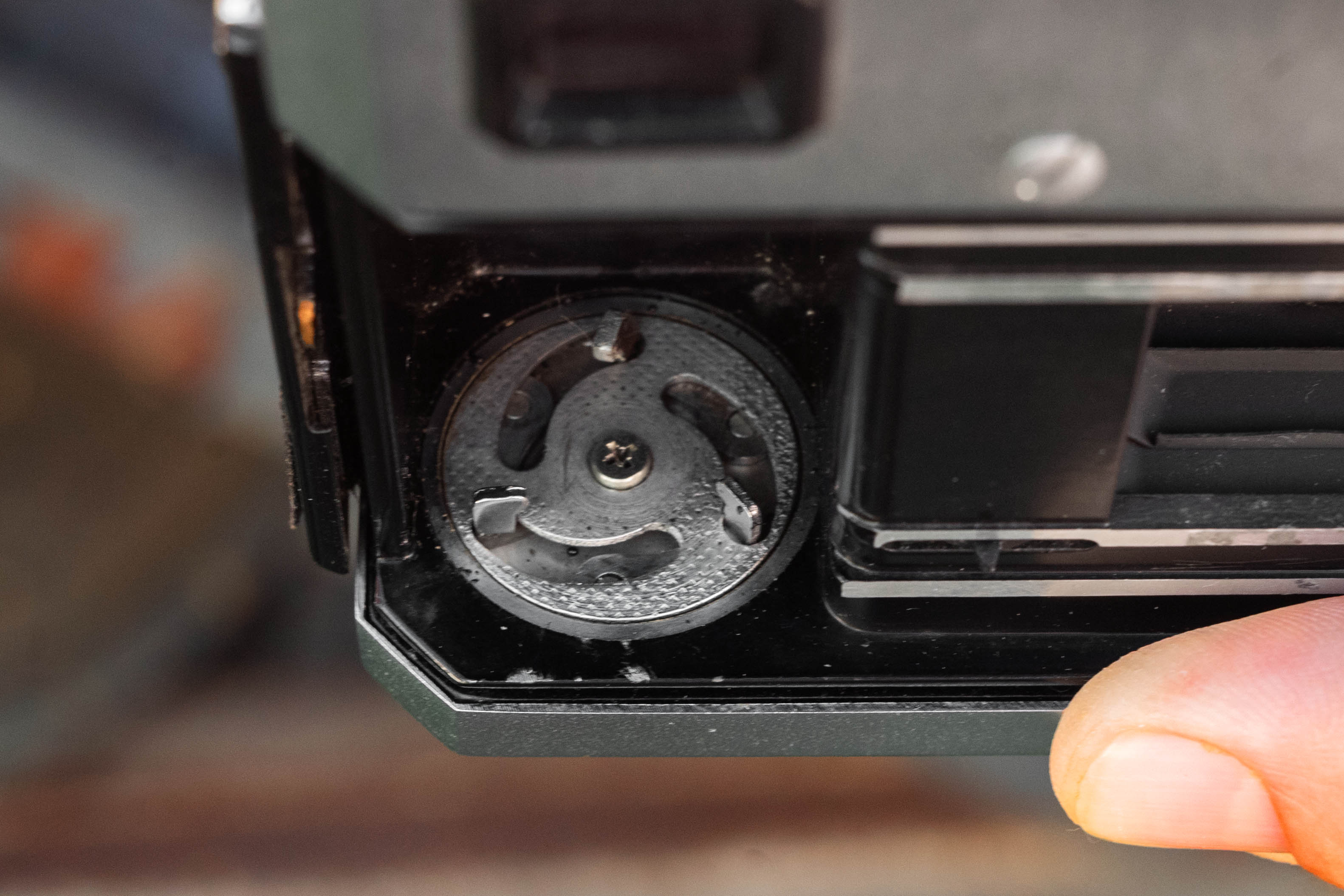
The base of the film supply side has an interesting design to the piece that holds the cassette in place. Three tabs which move from an inner to an outer position grip the cassette holding it firmly in place during normal film transport, however when rewinding film, they move towards an inner position, releasing their grip on the cassette. This allows for easy removal of the cassette without it getting snagged like on many other cameras. It seems like a complicated solution to an easy problem, but it does work well.
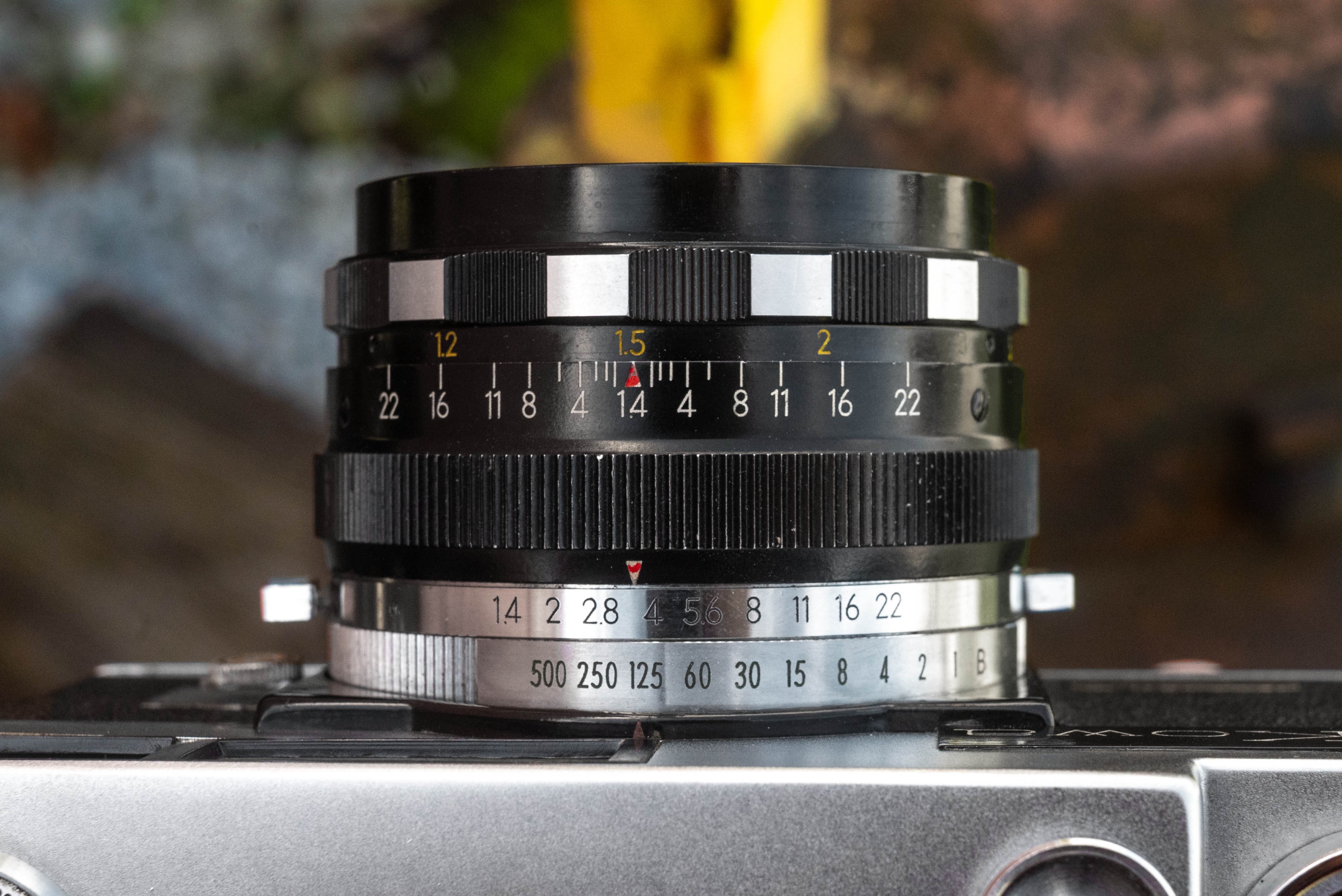
Looking down upon the top of the lens, the Kowa Kallo 140 features an all metal “zebra” design to the focus grip which was common in the 1950s. Up front, distances from 1 meter to infinity are chosen with a firm yet smooth motion. Behind the focus ring is a fixed depth of field scale which has markings from f/1.4 to f/22.
Everything from the depth of field scale forward is part of the lens, everything behind it is part of the shutter, which remains on the camera after removing the lens. Closest to the body is a shutter speed ring with speeds from 1 to 1/500 and then in front of that is the aperture ring. While I understand the need to locate the shutter speed ring on an interchangeable lens leaf shutter camera as close to the body as possible, the design of the shutter speed ring is one misstep with the camera in that it is too close to the body to easily reach. The aperture ring has two “ears” which make turning the ring easy, but the shutter speed ring has only knurled edges. The easiest way I found to change speeds was to grip both the shutter speed and aperture rings at the same time and move them both, them move just the aperture ring to your chosen f/stop. It sounds confusing, and it is, but it does work and you will eventually get used to it.
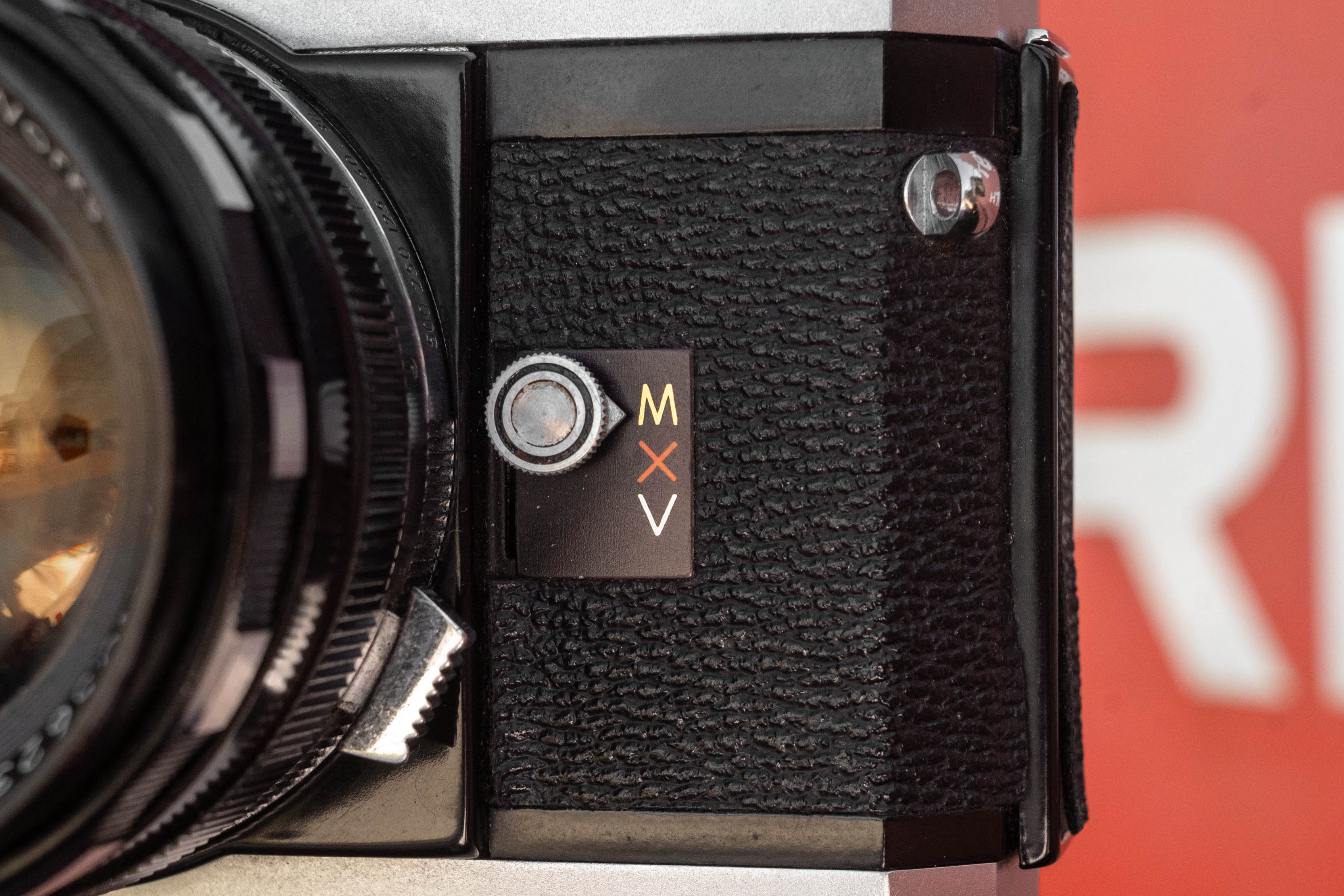
Looking at the front of the camera, to the left of the lens mount is a switch for choosing between M and X flash synchronization and V for the self-timer. While the Kowa Kallo 140 is a Japanese camera, the use of the letter “V” is a nod to German cameras which would use the letter V for “Vorlaufwerk” which literally means “pre-run mechanism” or “self-timer”. As with most vintage cameras, I strongly advise against using the self-timer without first making sure the camera has been recently serviced as a gummed up self-timer mechanism is a sure fire way to sieze up a shutter.
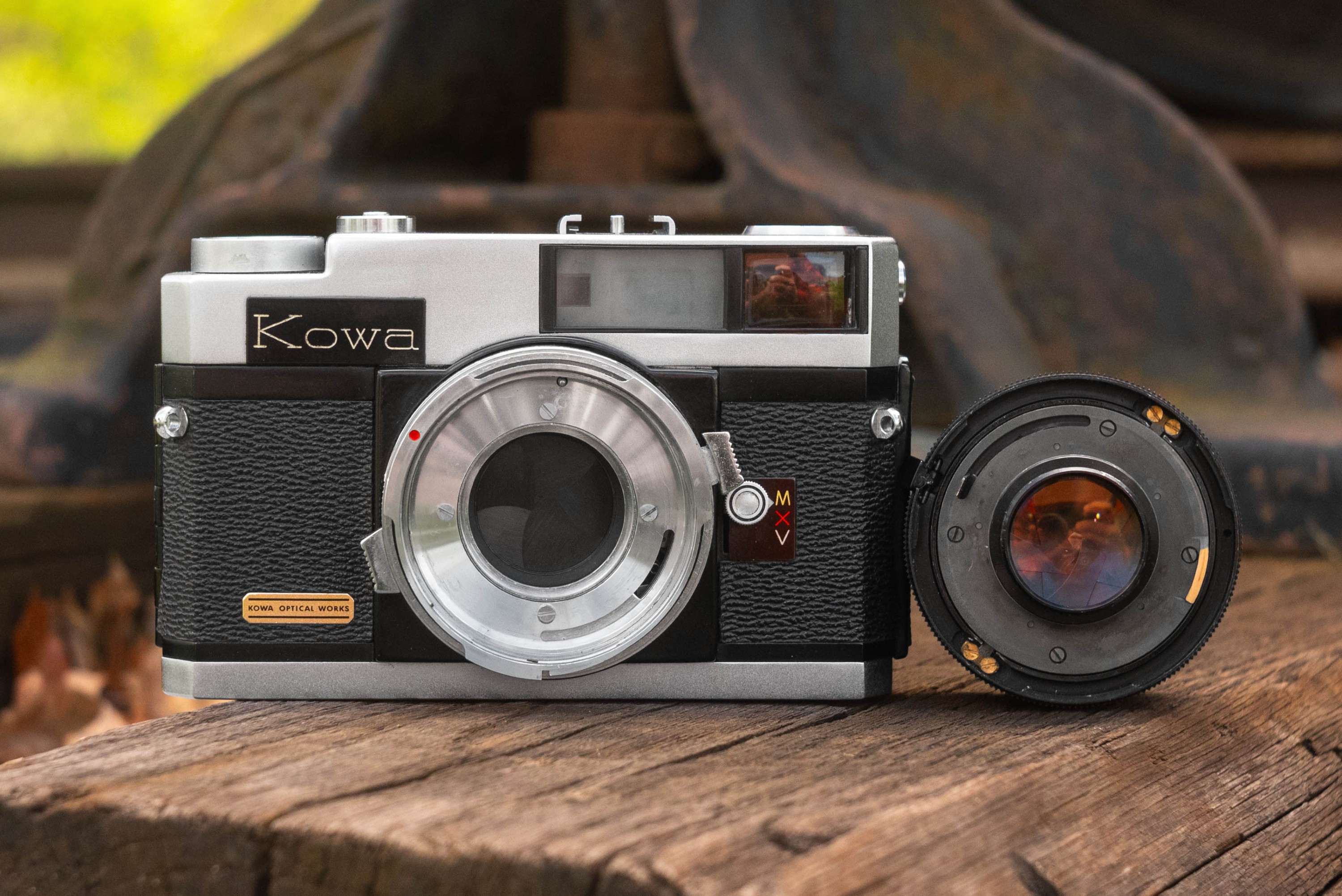
On the base of the lens mount is a small tab, which when pressed up, releases a lock pin for removing the lens. With this tab pressed up, a quick counterclockwise twist of the lens will remove it. The Kowa Kallo 140 uses a Seikosha SLV 0 leaf shutter that has a larger opening than typical leaf shutters of the era, which is needed to support the fast f/1.4 lens. Prior to the release of this camera in 1959, no other leaf shutter 35mm camera had a lens this fast, and even in the years since, very few manufacturers bothered to put a lens faster than f/2 on a leaf shutter camera, fixed lens or otherwise. Installing the lens requires lining up two red dots and giving the lens a quick clockwise twist until it locks into position.
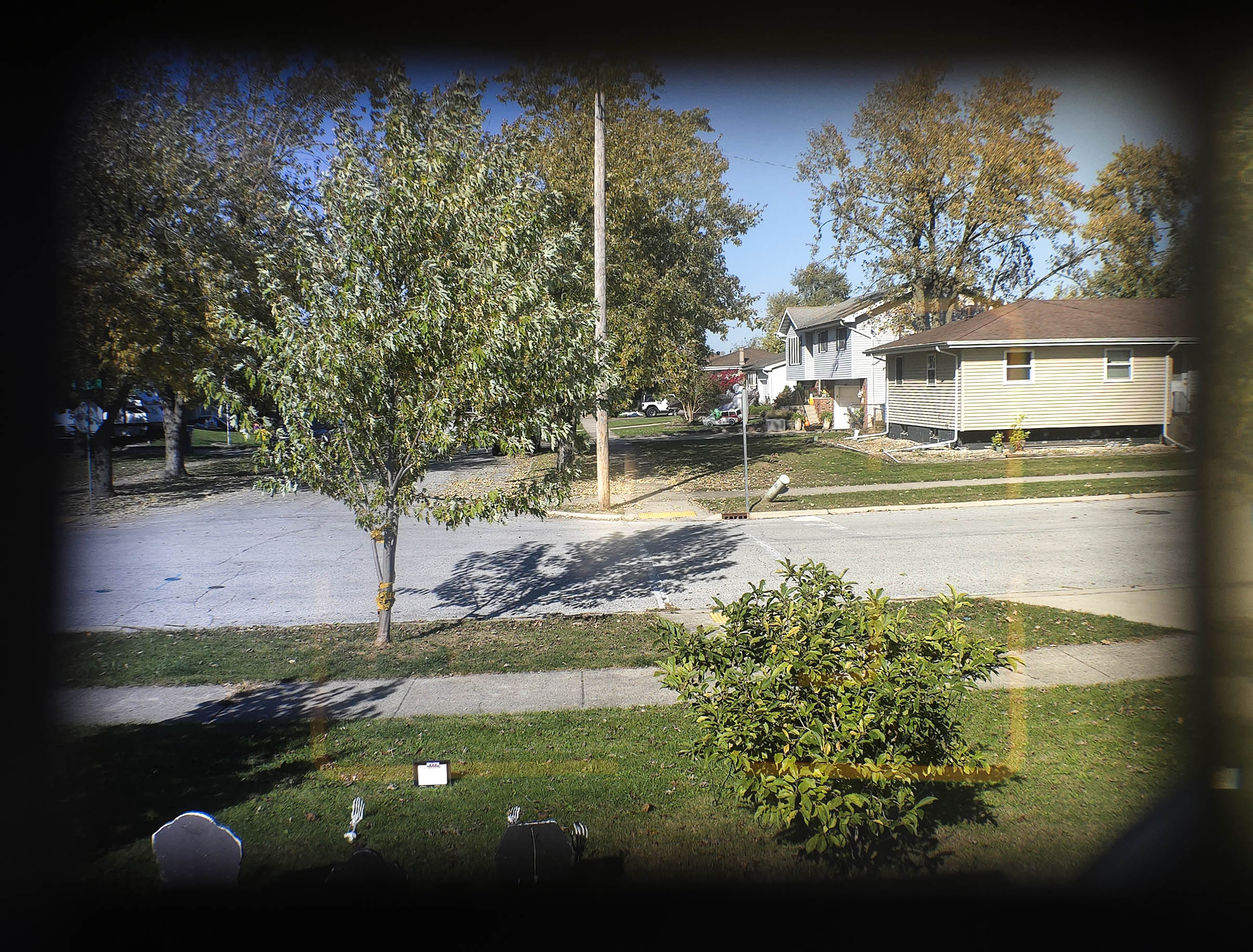
The viewfinder is of average design and although a bit hazy on this example was still clear and easy to see through. Two sets of projected frame lines exist, one for 50mm lenses and the other for the optional Prominar 85mm lens which was available. Although no frame lines exist for the Prominar 35mm lens, there is enough visible area outside of the 50mm frame lines to approximate a 35mm field of view. Both the 50mm and 85mm frame lines are automatically corrected for parallax and shift down and to the right at close focus.
In the center is a rather small square rangefinder patch which on this example was low in contrast, likely due to age. Even with improved contrast, I found that the rangefinder patch was disproportionally small compared to the entire size of the viewfinder. A larger rangefinder patch would have been far more useful without being overly disruptive. The main part of the viewfinder has a slight purple tint to help improve contrast on the rangefinder patch and frame lines, however the slight haze on this camera negated that somewhat.
Overall, I was pleased with my purchase. The Kowa Kallo 140 was a camera I was unlikely to find both in good working condition and at a price I was comfortable with on eBay, so I considered this a big win for Japanese auctions. The camera wasn’t perfect, but was in good enough working condition to warrant a test roll.
For the first roll of film through the Kallo 140, I chose a fresh roll of Agfa Aviphot 80, a repurposed aerial film which has been making the rounds of the camera shooting world lately. Friend of the site Vlad Kern of ussrphoto.com has been selling this stuff like hotcakes at all the local shows in my area and he can barely keep it in stock, so with the opportunity to shoot a roll in a camera with a reportedly sharp lens, I figured the old Kowa would be a good match for it.


I had intended on only shooting a single roll of film through the Kallo 140, but after seeing the results from the black and white Aviphot 80, I wanted to see what it could do with color film. At that same time, I had foolishly loaded in a 36-exposure roll of Kodak Gold 200 into an Olympus Pen D3 and upon realizing how long it was going to take me to finish that roll, I removed it halfway through and finished it in the Kowa.


With both black and white and color samples to look at, I can say that the Prominar f/1.4 lens is as sharp as any I’ve seen. I’m not one for MTF sharpness tests or looking at images of those weird black and white test pattern charts, but to the naked eye, these images are GOOD.
Sharpness is excellent corner to corner, giving the near-IR and fine grain black and white Aviphot 80 film a near digital pop that you wont see on many A-list 50mm primes. The color images were a bit less impressive, but that has more to do with the color cast of the Kodak Gold 200 film. Had I developed this at a lab with film like Kodak Ektar 100 or Vision3 250D, the color images would have likely rivaled the black and white images.
If image quality is the highlight of the Kowa Kallo 140, the camera itself is a mix of good and not-so-good. First, starting with the cons, this is a big and heavy camera. With the monstrous 7-element f/1.4 Prominar lens, the entire combination tips the scales at 938 grams which is well into SLR territory and way heavier than nearly every other 35mm rangefinder I’ve ever tested. This camera is not pocketable and demands a good neck strap to carry around. Depending on your needs for portability, the Kallo 140 would be an ill advised camera for casual frolics through a park where a compact camera would be better suited.
I previously complained about the design of the film advance lever which when in its stowed position, is too tight to the top plate making it a bit difficult to get out, but another minor nitpick was the layout of the exposure controls, specifically the shutter speed dial which for me, was too close to the body and uncomfortable to change. I understand the design, as having an interchangeable lens leaf shutter camera requires the shutter speed selector to be close to the body, but the implementation is not ideal here. Changing aperture is easier with the little tabs on the side of the shutter, but for dramatic exposure changes where you need to modify both settings, I found myself fumbling around with it. Certainly, its not possible with the camera to your eye.
Finally, in what should be good praise for the large and bright viewfinder with clear and easy to see frame lines with automatic parallax correction, the square rangefinder patch is far too small for such a big camera. For me, Kowa could have doubled the size of the rangefinder patch and it would not have felt too big, so I just don’t understand why they went big on so many aspects of the camera, but kept one of the most important parts of the camera tiny. Issues I had with poor contrast on this example are certainly due to its age, so I can’t fault it for that.
Beyond that though, the Kowa Kallo 140 is a sturdy and well laid out camera. With increased size comes increased space, allowing for a firm and confident grip while carrying it around. It fits nicely into my “average sized adult male hands”. The location and feel of the shutter release is exactly where you’d expect to find it, and the large diameter of the massive 50mm Prominar lens allows for easy changes to focus. And although it really isn’t something that affects normal shooting the camera, the design of the film rewind mechanism is pretty cool.
Clearly, a decent amount of thought went into this camera, but I can’t help but feel like it could have been even better. A larger rangefinder patch, easier exposure controls and a small size reduction would have gone a long way towards making this camera much better. No matter though, the Kowa Kallo 140 could have had a miserable shooting experience and I likely still would have wanted to use it to get images out of that glorious lens! As I write this, I only have the 50mm f/1.4 lens in my collection, but I’ll be sure to look out for the other two lenses, and if I ever do find them, perhaps I’ll come back and revise this review.
For now, the Kowa Kallo 140 (or simply the Kowa 140) is a very interesting camera with an unlikely combination of features, good looks and an amazing lens, and for that, it definitely is worth consideration, both for your camera bag and your shelf.
Related Posts You Might Enjoy
External Links
https://camera-wiki.org/wiki/Kowa_Kallo_140
https://www.hayatacamera.co.jp/monthlyphoto/2017-9-kallo140-prominar-50mmf1-4-80mmf3-5/ (in Japanese)
https://hcwc.way-nifty.com/blog/2025/07/post-4347c2.html (in Japanese)
https://ameblo.jp/miyou55mane/entry-12774490285.html (in Japanese)
https://web.archive.org/web/20220401061749/https://www.rangefinderforum.com/node/169607
https://www.club-niepce-lumiere.org/media/files/PDF-F/043.pdf