
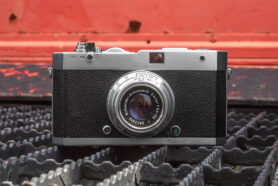
The Wenk Wenka II is a 35mm rangefinder camera made by Gebrüder Wenk, a Nuremberg, West Germany company originally founded in 1922 as an eyewear maker that briefly ventured into camera production from around 1950 to 1952. The Wenka was the company's only camera line, produced in a handful of evolving versions (0a, 0b, I, and II), and it was notable for several unusual design choices: a coupled rangefinder, a proprietary 40mm interchangeable lens thread mount, and images shot at an unusual 24mm x 30mm format rather than the standard 24x36. Perhaps most distinctive was its shutter—a horizontally traveling, two-curtain metal shutter positioned immediately behind the lens rather than at the focal plane, a design tied to patents filed by the company around 1949. The Wenka II specifically added an M/X flash sync selector button, screwed (rather than riveted) accessory shoe, bezels around the viewfinder windows, and a lowered top shutter speed of 1/500 (versus 1/800 on earlier models). Surviving examples suggest production was larger than the commonly cited "under 500" figure, based on serial number spreads the author observed.
In hands-on use, the author found the camera's build quality impressive—solid chrome plating, intact body covering, and mostly smooth controls, aside from a stiff shutter speed dial and a fussy film door lock with an unusual butterfly-style latch. Quirks included a self-resetting exposure counter, an oddly positioned shutter release squeezed next to an unusually long film advance lever, and a small, tinted rangefinder viewfinder with a unique dual-window optical design routing light through two mirrors to a centered eyepiece. Shooting a test roll of Kodacolor 200, the author praised the standard 50mm f/2.8 Schneider-Kreuznach Xenar lens for excellent sharpness, contrast, and color rendition consistent with its reputation on other cameras. The 24x30 format, intended to better match popular print sizes and squeeze more exposures per roll (similar in spirit to contemporary Japanese 24x32 rangefinders), gives images a more square-ish look than typical 35mm shots.
Overall, the author views the Wenk Wenka II as a genuinely well-built, capable camera whose unconventional engineering—despite being made by a company with no prior camera-making experience—never gets in the way of everyday shooting once you understand its quirks. While its unique shutter and rangefinder designs never caught on industry-wide, and the compact 24x30 format faded from popularity by the early 1950s, the author concludes that build quality and image quality were clearly not the reasons for the Wenka's short production run, and recommends it as a worthy addition to any collector's shelf or even a user's camera bag.
AI-generated summary. May not capture every detail — read the full article below for the complete picture.
This is a Wenk Wenka II, a 35mm rangefinder camera made by Gebrüder Wenk in Nuremberg, West Germany between the years 1951 and 1952. The Wenka was the only camera made by Wenk before they stopped making cameras. At least four versions of the Wenka were produced, the Model II being the last. All Wenka cameras have a 40mm interchangeable lens thread mount, a coupled rangefinder, and all shoot images 24mm tall by 30mm wide. In addition, the shutter is unique on this camera as it is a horizontally traveling two curtain shutter, but it not at the focal plane, rather is right behind the lens where a leaf shutter would typically be. Earlier versions of the Wenka had a top 1/800 shutter speed, but this one was limited to 1/500. The Wenka was produced in very small numbers and is extremely rare today.

Film Type: 135 (35mm) (24mm x 30mm images)
Lens: 50mm f/2.8 Schneider-Kreuznach Xenar coated 4-elements in 3-groups
Lens Mount: 40mm Wenka Thread Mount
Focus: 0.7 meters to Infinity
Viewfinder: Coincident Image Coupled Rangefinder
Shutter: Horizontally Travelling Behind the Lens Metal Shutter
Speeds: B, 1/25 – 1/500 seconds
Exposure Meter: None
Battery: None
Flash Mount: Cold shoe and PC Port M and X Flash Sync
Weight: 542 grams, 428 grams (body only)
Manual: http://www.cameramanuals.org/minolta_pdf/minolta_autowide.pdf
Gebrüder Wenk was one of many small German factories who played a small role in the history of German cameras. Originally founded in 1922 as a maker of eyeglasses and safety equipment, Gebrüder Wenk largely stayed true to its original mission of producing eyewear, but for a brief moment from the late 1940s through the early to mid 1950s tried their hand as a camera maker.
 According to multiple sources online, Gebrüder Wenk’s address in Nürnberg stayed consistent before, during, and after the war, suggesting the company didn’t grow much. Articles from the Nuremberg City Archives suggest that during the war, the company employed (possibly forcibly) Eastern European workers in their factories. There is no evidence of what the company was making at the time, but it doesn’t appear that cameras were being worked on yet, so we can only assume they stayed true to the company’s roots as a maker of eyeglasses.
The earliest references to the company as a camera maker occur in patent applications filed in December 1948. Several others, all from May 1949 strongly suggest camera development was well underway. Unlike US patents which list the names of the people whom the patents are credited to, I was unable to determine a name looking at the German patents I could find.
Three patents were file in May 1949, one for a photographic rangefinder, one for a metal slit shutter, and one for the 24×30 film format all strongly connect to the Wenka camera as it featured all three features upon its release. The most interesting one to me was DE1600969 which describes the shutter. Using Google Translate on the patent description it states that “rubber blanket” focal plane shutters are complicated and expensive to build, however created a shutter using metal blades with a variable width shutter was much less expensive and easier to build. Although the patent doesn’t explicitly describe it, the camera which Gebrüder Wenk would eventually build had a very unique horizontally travelling shutter which was not located at the focal plane, rather immediately behind the lens. In DE1600970, the patent describes the merits of a 24mm x 40mm film format, saying it matches more closely to the most popular print sizes for film, requiring minimal cropping, whereas the standard 24×36 format results in a greater loss of visual area when images are enlarged. It suggests that not only would a 24×30 camera produce images of a more ideal aspect ratio, but that the narrower images would increase economy, resulting in more images per roll.

Beyond these patents and a vague start date of December 1948, there is little to know about the development of the Wenka or when it first went on sale. Whoever was responsible for its design clearly had some ambitious ideas whose priorities were economy, ease of use, and performance. Some sources online suggest that the first models were released in 1949, but this seems implausible to me. My reasoning is that with known patents being filed in May 1949, it just doesn’t seem like there would have been enough time to get a camera completely built and into the hands of photographers before the end of that same year. Adding to my doubts for a quick release is that the Wenka was unlike any camera made by another company, plus that Gebrüder Wenk had no experience building a camera like this, further adds to my doubts. Perhaps the biggest nail in the coffin is that the one example of a very early serial number Wenka shown on coelncameras.com has a Schneider lens on it with a serial number dating it from early 1950s. It was extremely common back then for companies like Schneider and Zeiss to produce lenses before cameras that needed them were ready. In my best estimation, a late 1950 to early 1951 release date for the first Wenkas seems likely.

When the camera did appear, the first models were simply called the “Wenk Wenka” with no model identifier. Over the years, collectors have attempted to categorize three to four sub-classifications of the Wenka, the first referring them to Wenka Models A, B, and C, but a second system popularized by Jim McKeown breaks them down into four models called the Wenka 0a, 0b, I, and II. Although some changes were made to the design of the camera to warrant these sub-classifications, nowhere on the camera do any of these labels apply, nor do they on the lone advertisement for the Wenka I was able to find. My best guess is that Gebrüder Wenk produced Wenka cameras continually revising the design until the point where they discontinued the line without a thought of uniquely identifying the differences.
Since McKeown’s four versions seems to be more widely used today, a quick rundown of the differences are:

Wenka 0a – The first model has two large rangefinder windows up front. The combined image rangefinder encompasses the entire viewfinder window. This rangefinder design was detailed in German patent DE1600971, first submitted in May 1949. This version of the Wenka is the only one with “24×30” engraved in the top plate to the right of the film advance lever. Other notable characteristics are that it has a top 1/800 shutter speed, six screws on the front plate, the viewfinder and rangefinder windows lack a bezel, and the accessory shoe is riveted in place.
Wenka 0b – This is a slight revision to the 0a removing the “24×30” engraving. On the Wenka’s camera-wiki page, it suggests that on this version the accessory shoe is no longer riveted, but that it is screwed to the top plate. I do not believe this to be true as all versions of the Wenka I have rivets. I believe this change wasn’t made until the Wenka II.
Wenka I – The full size rangefinder design is dropped in favor of a more traditional one in which the rangefinder is a small circle in the center of the viewfinder. Externally, you can easily see this as the rangefinder window is a circle and much smaller than before.
Wenka II – A push button M / X flash sync selector is added to the front plate, below and to the right of the lens mount. The accessory shoe is held to the top plate with screws, not rivets. A thin bezel has been added around both the front viewfinder and rangefinder windows. The top shutter speed is lowered to 1/500.

Other differences – While researching this article, I looked at as many images of Wenkas as I could find and I found more subtle changes to the camera which all appear to be after the Wenka II was released, yet no collector has attempted to classify a Wenka IIb model, but for the sake of completeness, I noticed that later Wenka IIs have a completely different rewind knob that is thicker and has a flat top, rather than the domed design of the earlier models. In addition, the number of screws on the top plate are reduced from six down to one.

All Wenka cameras use a unique M40 lens mount which is not compatible with any other rangefinder lens mount, not even those who also use 40mm thread mounts. The standard lens found on most Wenkas is a 50mm f/2.8 Schneider-Kreuznach but at least two other lenses were produced for the camera, a 35mm f/3.5 ISCO Göttingen Westar and a 100mm f/4.5 ISCO Göttingen Westar.
It is unknown exactly when the Wenka was discontinued or how many were made. A common number repeated online is that less than 500 were produced, but I think that is on the low side. As I write this, three examples of the Wenka are available for sale worldwide on eBay, igorcamera.com has one for sale, and there have been several auctions for them on other auction sites like leitz-auction and Coeln cameras within the past couple years. In addition, if we look at serial numbers, the lowest I’ve seen is body number 5422, my example is number 6199, and the highest I’ve seen is 8551. Of course it is not a guarantee that any camera was produced with sequential serial numbers, so it is inaccurate to say that since the difference between 8551 and 5422 is 3129, that at least 3129 Wenkas were produced, it at least strongly suggests the number is much higher than 500. Certainly, the camera is uncommon, but if you really want to add one to your collection, you can do it at almost any time.
I first learned about the existence of the Wenk Wenka while working on my article for Unfortunately Named Cameras. This camera was suggested to me because of a slang term that the cameras name has in some English speaking countries. While the Wenka has a funny sounding name, its design was very different from other interchangeable lens cameras I had seen so it went on my unofficial “passive GAS” list, which is what I call cameras which I am not specifically seeking out, but if one ever crossed my path for a price I was willing to spend, I’d pick it up. I wrote that article back in late 2020 and it would take me a good five and a half years to come across one in my budget, and so here we are, my review for the Wenk Wenka II.

This Wenka came to me from a seller in Norway, which despite international shipping and tariffs, was still affordable and although it had to travel halfway across the planet, arrived without any damage. My initial impression of the camera was that it had really nice build quality, the chrome plating was in excellent shape without any corrosion or flaking, the body covering was in tact and showed no signs of cracking or peeling. The shutter speed dial was a bit tough to turn, but all speeds sounded good to the ear and the rangefinder was accurate at infinity. I was impressed!
The Wenk Wenka is an interesting camera with a design which is both strange and familiar at the same time. On one hand, it really doesn’t look like any other camera, yet its controls are mostly laid out where you’d expect them to be and in the cases where something is different, they’re not so different to require you to find a manual or spend 5 minutes fiddling with it to figure it out.
Despite being built in very small numbers by a company with little experience making cameras, the build quality of the camera is quite good and on par with that of most middle of the road 35mm German rangefinders. The camera has a nice feel to it, the chrome plating held up really well without any corrosion or oxidation, the body covering showed no signs of cracking or peeling and the most of the camera’s various controls seemed to move without issue with the lone exception being the shutter speed wheel which was a bit tight.

The top of the camera starts with the rewind knob on the left which is normally recessed into the top plate. To lift it up, you need to use your fingernail and get under it to pull it out, which isn’t ideal, but works well enough. Next is the accessory shoe directly below the camera’s name engraved into the metal. On the right is the shutter speed wheel, which is an actual wheel that rotates horizontally with white numbers indicating each selected speed. An indent at each speed makes it clear when you’ve reached a new speed. You can leave the shutter dial in between speeds, but it is not clear whether this will actually result in between speeds, more research will be required.

Below the shutter speed dial is a small curved window for the exposure counter. Since the Wenka shoots 30mm wide images, you’ll get more images on a regular roll of film than a 24×36 camera would, so the exposure counter goes up to 45. In my initial inspection of the camera, I couldn’t find a way to reset the exposure counter as there were no buttons, levers, or any type of external or internal control to reset it to zero. I initially thought that perhaps something was broken, until I loaded in a test roll of film and saw that it did increment when advancing the film. Then I tried rewinding the film and noticed that the counter goes backwards so I concluded that the exposure counter is designed in such a way to where it should always read 0 when film is not in the camera. As soon as you load in a new roll and start to advance film through it, the counter goes up. When you finish the roll and rewind the film, it should go back down to 0. If by some chance this gets out of sync and you need to manually reset it to 0, you can do this by manually spinning the geared shaft inside the film compartment with your finger.
To the right of the shutter speed dial in a very tight corner of the camera is a threaded cable release socket, a small black plastic shutter release button, and the axial center of the film advance lever. The design of these three things so close together is bizarre as the shutter release is so tightly squished next to the advance lever, that it requires a small notch in the button for it to clear the wind lever. In addition, the extreme up front location of the advance lever requires an unusually long film advance lever which reaches across the entire length of the top plate to the back of the camera. Perhaps it was the location of the Wenka’s focal plane shutter so close to the front of the camera that necessitated this arrangement, but it certainly is strange. One thing I did appreciate about the wind lever is that a full motion is pretty short, requiring about a 90 degree sweep to fully advance the film and cock the shutter. While moving, it gives off a strong ratcheting sound, which serves no purpose other than it sounds cool.

The base of the camera has nothing more than the tripod socket, the words “Made in Germany” and seven small feet which help stabilize the camera on a flat surface. On this example, the tripod socket has what looks to be a 3/8″ to 1/4″ adapter threaded in it for modern tripods. Most likely, this was added by some previous owner as some European cameras of this era still used 3/8″ sockets, so the adapter would have been needed for a modern tripod. In my research for this article, I noticed that some very early Wenka’s have two black circles in the bottom plate above the tripod socket, but it is not clear what these are for.

The sides of the camera are pretty symmetrical from left to right, only featuring a metal strap loop for attaching a neck strap to the camera. While not as elegant as the metal posts found on most cameras, the design of these loops make it very easy to attach pretty much any strap to the camera.

Around back we have the round eyepiece for the viewfinder, the back “finger” of the film advance lever, and my least favorite part of the camera, the removable film door lock. The design of the door lock is unlike any I’ve seen on another camera. It uses a circular design to which two halves of the circle fold out like a butterfly, to make a handle. When folded out, the lock can be rotated counterclockwise towards “Auf” to unlock it, and clockwise towards “Zu” to lock it. When unlocking the rear film door, it actually gets pushed downward, away from the body. As I read myself typing this, it sounds cool, and perhaps it might be, but it just doesn’t work too well. My issue with it, is that even in fully unlocked mode, I have to fiddle with the door to get it to release. In addition, with the door off, if this lock turns by even a small amount, it will not line up when trying to reinstall the door. It is not difficult to do, it just takes some patience and seems like an unnecessary design choice.

With the door off, we see the film compartment. At this point in exploring the camera, you get a good sense of exactly how small the 24mm x 30mm film gate is. It is not quite square like a Berning Robot or Zeiss-Ikon Tenax II, but at 6mm narrower than full frame 35mm cameras, it does look a bit strange. Also strange is that when looking inside the film gate, the metal focal plane shutter is closer to the front of the camera than rear. This creates a large void which you won’t see on any other camera.
The rest of the film compartment is pretty ordinary, at least for a 1950s rangefinder. Film transports from left to right onto a double slotted plastic removable take up spool. The Wenka does support cassette to cassette film transport, but lacks any ability to handle mid roll changes, so I doubt the camera would have been used much like this. To remove the spool or cassette on either side, a metal arm must be bent downwards to release the pin which holds it in place. Inside the film door is a small metal pressure plate with horizontal grooves to reduce friction as film passes over it. The camera’s serial number is present below the film gate, and the entire film compartment does not contain any sort of foam or felt light seals, so there would be nothing to replace when trying to use this camera today.

Although a couple of different lenses were made for the Wenk Wenka, the only one you’re likely to find is the 50mm f/2.8 Schneider-Kreuznach Xenar. Looking down upon it, a depth of field scale is engraved into the ring closest to the camera. Strangely, the DOF scale has a red index mark in the center, which does not line up with a black index mark on the camera’s lens mount at top dead center. The two index marks are offset by about 5 degrees. As this is the only Wenka I’ve ever handled, I cannot be sure if this is normal, but looking at my camera, I can’t see how it could be any different. In front of the DOF scale is the focus ring with distances from just under 0.7m to infinity. Finally, nearest the front of the camera is the aperture ring, with f/stops marked from f/2.8 to f/16. Because the aperture and focus controls are on the same part of the lens, as you focus the lens, the aperture scale turns. To help make reading the scale easier, it appears twice, 180 degrees offset from each other.

Up front, the Wenka has a 40mm thread mount, which apart from being incompatible with any other thread mount system, works like you’d expect. Righty tighty, lefty loosey. Two other interesting things are up front however. The first is a sliding “ST” lock near the upper left corner, in front of the shutter release. If you were to guess that “ST” stands for “self-timer” you’d be wrong, as this is a shutter lock for timed exposures. With the shutter speed selector in Bulb mode, press the shutter release and while holding it down, slide this lock towards in the direction of the arrow to lock it open. When the timed exposure is over, slide it back and the shutter will close. A second feature on the front of the camera is near the 5 o’clock position around the lens. This little button for choosing your flash sync speed for the sync port on the opposite side of the lens. Engraved into the front edge of the base plate are the letters “M” and “X”. To choose between the two, M is indicated with the button pushed all the way in, and X with it all the way out. This is a feature unique to the Wenka II, which does not appear on the earlier model.

The Wenka’s viewfinder is a coincident image coupled rangefinder and is quite small. The viewfinder has a very small magnification ratio, which makes images look much smaller than they appear in life. This makes seeing all four corners very easy, even while wearing prescription glasses, but does make things look super far away. The main part of the viewfinder has a pinkish tint to it which helps the clear round rangefinder patch stand out. Seeing the double image on this camera is quite simple, even in low light, but boy is it tiny!
An oddity of the Wenka’s design is that most rangefinder cameras have a main viewfinder window in which the main image passes straight through from the front to the back of the camera, using a 45 degree beamsplitter in the middle for the rangefinder patch, or for projected frame lines. On these cameras, the front viewfinder window is directly in front of the eyepiece, but on the Wenka, this is not the case. The eyepiece on the back of the camera is halfway between the two front windows. As light enters both windows up front, it reflects off two 45 degree mirrors until it converges together at the rear viewfinder window. This design is likely a result of the Wenka’s original rangefinder which took up the entire window, but it is not clear whether there is an advantage to doing it this way.
With reasonable certainty that the Wenka was in good operating condition, it was time to load in some film and take it out. For that, I chose a fresh roll of new Kodacolor 200 and carried it with me around my town in early spring of 2026.


Setting aside all that’s different about the Wenk Wenka, one thing that feels pretty predictable is the performance of the Schneider-Kreuznach Xenar 50mm f/2.8 lens. Variations on this 4-element Tessar style lens have appeared on countless cameras from Kodak Retinas to folding rangefinders and in every application I’ve seen this lens used, the images they make are excellent, a streak that continues with the Wenka.
Sharpness is excellent across the entire image with only subtle softening near the corners, contrast is well controlled not to be too punchy or too soft, color rendition, especially in bright sunlit scenes is excellent, and overall the images show none of the optical flaws associated with lesser lenses. Clearly the designers who built this camera made the right choice when choosing a kit lens for it.
The Wenk Wenka is undeniably a strange camera, but in use, you wont notice the unique behind the lens shutter, the dual 45 degree split viewfinder, or how the film door attaches to the body of the camera. The most obvious difference with this camera is that the viewfinder is much closer to a square than a typical camera. The 24×30 aspect ratio is neither square, nor as rectangular as a typical 24×36 camera and the that, combined with the more square-ish images are where the Wenka separates itself from other cameras.
The idea of a 24×30 aspect ratio camera was to keep the aspect ratio more in line with popular enlargements, such as 3×4 and 4×5. Japanese camera makers of the late 1940s and early 1950s went with the same idea with their use of 24×32 cameras such as the original Nikon and Minolta rangefinder cameras. Although a visually pleasing aspect ratio which also allowed for extra images to be taken on a roll of film, the more compact size would prove to be unpopular, especially with photofinishers and would disappear by the early 1950s.

Beyond the image size, using the Wenk Wenka is pretty straight forward. Most of the camera’s critical controls are where you’d expect them be, and other than an extremely long film advance lever, work as you’d expect. While we have the benefit of hindsight to know that many of the Wenka’s unique designs weren’t adopted by other manufacturers, I still enjoyed the creativity that the designers used while creating this camera. My favorite thing about collecting and using old film cameras are seeing all the other ways things could have been done. Was the rangefinder or shutter design better? It definitely isn’t worse!
It is hard to state exactly why the Wenk Wenka was produced for such a short time, or why other manufacturers did not follow in this camera’s unique footsteps, but clearly, build quality and the images it makes could not have been reasons. The Wenk Wenka is an interesting and well built camera that definitely deserves a spot on any collector’s shelf, and for those of you wanting to eek out a few extra exposures per roll of film, maybe even a spot in your bag!
Related Posts You Might Enjoy
External Links
https://camera-wiki.org/wiki/Wenk
http://www.novacon.com.br/odditycameras/wenka.htm
http://www.cjs-classic-cameras.co.uk/other/non-folding.html#wenka
A remarkably bizarre camera design … I’m happy to read of your experiences with the Wenka because, at $900 +/-, I will never own one of these!