
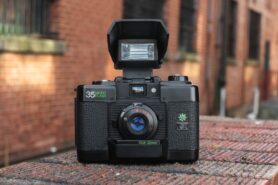
The Hanimex 35 Micro Flash is a compact 35mm point-and-shoot released around 1981 by Hanimex, an Australian distributor that rebranded OEM-produced cameras rather than manufacturing its own. The author believes it was likely made by Japan's Sedic Camera Company, based on similarities to other Sedic-produced cameras like the Hanimex 35 Reflex Flash. What makes this model unusual is its combination of a built-in pop-up electronic flash and a CdS exposure meter with an entirely manual exposure system—a pairing so uncommon that it probably explains the camera's short production run and near-total obscurity today, with almost no contemporary documentation beyond a brief 1980 magazine mention.
Specification-wise, the camera features a 32mm f/2.8 lens (possibly a 4-element, 3-group design), four-zone scale focusing with icon-based settings, and just two shutter speeds (1/60 with flash, 1/180 without). Its quirky control layout includes an ASA dial that doesn't actually affect exposure but instead displays lighting-condition icons, while a separate lever labeled with those icons actually controls the seven-click aperture diaphragm—meaning users must essentially ignore the labeled functions and treat the aperture lever using standard exposure techniques. The CdS meter only triggers a low-light warning LED and plays no role in actual exposure. In hands-on testing with Kodacolor 100, the author found center image sharpness and color rendition strong, but edge performance poor, with heavy vignetting and "murky" corner detail. Ergonomically the camera was praised for its comfortable grip, smooth thumb-wheel film advance, and light shutter release, though the author inexplicably missed focus on every close-up self-portrait shot during testing. A related sister model, the Hanimex 35ee Micro, offers full auto-exposure and a wider shutter speed range, which the author suspects would be a more versatile shooter, though their own copy was non-functional and untested.
Overall, the author views the Hanimex 35 Micro Flash as a curious, largely forgotten artifact of an era when manufacturers were still experimenting with point-and-shoot design conventions. While its optics and exposure quirks keep it from top-tier status, and it will likely never be a sought-after collectible, the author's verdict is that it's a fun, functional camera worth trying if found cheaply—capable of pleasant surprises despite its flaws.
AI-generated summary. May not capture every detail — read the full article below for the complete picture.
This is a Hanimex 35 Micro Flash, a compact 35mm point and shoot camera released by Hanimex in multiple markets around the world. The camera was made in Japan, most likely by the Sedic Camera Company, but this is difficult to confirm. The Hanimex 35 Micro Flash is a small camera with a built in pop up electronic flash and a CdS exposure meter, but the camera’s metering system is fully manual. The camera relies on a 4 zone focus system manually selected by the user. This combination of a manual exposure metered camera with built in flash, was very unusual and is likely the reason it wasn’t sold for very long.

Film Type: 135 (35mm)
Lens: 32mm f/2.8 coated 4-elements in 3-groups (I am not confident in this)
Focus: 4 Zone Focus (~1 meter to Infinity at Close-Up Setting)
Viewfinder: Scale Focus Optical Finder
Shutter: Metal Blade
Speeds: Two Speed, 1/60 with Flash and 1/180 Without Flash
Exposure Meter: Coupled CdS Cell w/ Low-Light Warning
Battery: (2x) 1.5v AAA Alkaline
Flash Mount: Built In Pop Up Flash
Weight: 220 grams (with batteries)
Manual: None
During the 20th century a large number of cameras were sold by local, regional, and national distributors under their own “house brand” labels, but were actually produced by other companies. One of the most well known re-branded cameras were the Tower line of cameras sold by the US department store chain, Sears, Roebuck & Co.
A huge number of German, Japanese, and even the occasional American camera was sold by Sears under their house brand. Two such reviews have been reviewed here, the Mamiya and Asahi made Tower 41 and Tower 45 are two such examples.

In addition to Sears, a large number of distributors all over the world rebranded cameras using their own house brand such as Montgomery Wards, Kalimar, Porst, Ringfoto, Bell & Howell, Honeywell, and for the purposes of this article, Hanimex.

Hanimex Corporation was an Australian distributor, originally founded in 1947 by a man named Jack Hannes. The name “Hanimex” is an abbreviation for HANnes IMport EXport and started out distributing goods throughout Australia and New Zealand before expanding internationally in the 1970s as the Hanimex Group.
Like Sears, Hanimex distributed a large number of German and Japanese cameras, but by the 1970s and 80s as more cameras were produced in Hong Kong and China, a large number of their products were built there. The camera-wiki page for Hanimex has a long list of many Hanimex branded cameras of which I am sure some are likely missing.
If you’d like to learn more about Jack Hannes and the history of Hanimex, I recommend reading this archived article written by Paul Burrows and originally posted on AVClub.com.
Who Made the Hanimex 35 Micro Flash?The maker of this camera is not clear. The answer is definitely not Hanimex as they were a distributor of OEM goods and did not make their own products. Manufacturers from all over the world would produce cameras and have them distributed with a Hanimex name and unless there was a variant of the same camera with the name of the company who actually made it, it can be difficult to determine who the original manufacturer of Hanimex cameras actually was.

In the case of the Hanimex 35 Micro Flash, my best guess is that it was made by the Japanese company Sedic Camera Company who was an OEM maker of cameras and accessories for a variety of distributors in the late 70s and early 80s. At least one other camera, the Hanimex 35 Reflex Flash was made by Sedic for other companies like Fuji with their Fujica ST-F.
Further supporting my guess, the camera-wiki page for the very similar Hanimex 35ee Micro also says that the camera was made by Sedic, although the source for this information is not clear. Since the Hanimex 35 Micro Flash and Hanimex 35ee Micro appear to be made by the same company and that the company had at least one other camera from around the same time made by Sedic, I feel it is a safe to conclude that they produced all of these cameras.

During my research for this article, I found only one piece of contemporary information in the form of a short preview from the November 1980 issue of Modern Photography announcing its upcoming release. The preview does not list a price or date for when it would be available, but early 1981 is a good guess. Apart from hinting of an automatic version (which is almost certainly the Hanimex 35ee Micro), no other technical specs are given for the camera. Without a price or even a date range for when it was available, I cannot guess how much it cost or how many were made, but my best guess is ‘not a lot’ and ‘very few’.
It is funny how GAS (Gear Acquisition Syndrome) works. Sometimes the most unlikeliest cameras will hit you hard and throw you down a rabbit hole of search and discovery. In the case of the Hanimex 35 Micro Flash, I was initially researching a completely unrelated camera, a fixed lens SLR called the Fujica ST-F. In 2019, I wrote a review for a Chinese copy of this camera called the Continental TXL. That camera was made in Hong Kong by a copycat company, but the original was made in Japan by Sedic Camera Company who also made a version for Hanimex called the Hanimex 35 Reflex Flash. It was when I read about this camera did I learn about the Hanimex 35 Micro Flash.

I liked the full sized pop up flash on a compact point and shoot layout. This era of compact 35mm cameras is fascinating to me as I’ve previously reviewed the Olympus XA2 and Chinon Bellami. In addition to these cameras all being extremely compact, they all have excellent lenses, and despite a rudimentary feature set, are generally pretty easy to use. I was intrigued with the Hanimex 35 Micro Flash and sought one out.
My first example, despite being listed on eBay as in full working condition, was not. It was immediately clear this camera was mis-labeled by the seller as the battery compartment was full of corrosion. Even after attempting to clean the contacts, the camera would not power on at all so I returned it.
My second example however, appeared to work perfectly, but in reading about it, the rabbit hole got deeper when I learned of a sister camera called the Hanimex 35ee Micro and several name variants of it, plus an additional grouping of cheap Taiwanese knockoffs really got me going. During this phase of “Rabbit Hole GAS” I acquired a non working Hanimex 35ee Micro, but eventually had to knock some sense into myself and prevent me from acquiring one copy each of every Japanese or knock-off model that was made. The rest of this review will be mostly about the Hanimex 35 Micro Flash, but I’ll comment where it differs from the Hanimex 35ee Micro.

The Hanimex 35 Micro Flash is very compact and although made mostly of plastic feels nicely made. The plastic parts of the camera have a matte finish which on this example have worn well. The body is covered in a soft synthetic material. It doesn’t feel like real leather, but if I dig my fingernails into it, it does have some grip. Compared to both the Olympus XA2 and Chinon Bellami, the Hanimex is nearly identical in width but as a result of the large flash, is slighter taller and thicker than both those cameras (the Bellami is quite a bit thinner due to its collapsible lens). Also like those other two cameras, all three have some way of protecting the lens which must be overcome to power the camera on. The Olympus has a sliding clamshell, the Chinon uses barn doors, and the Hanimex has a flash which swings up out of the way.

Up top, all three cameras have traditional rewind knobs with fold out handles. The Hanimex shares more in common with the Olympus XA-series in that both cameras use a thumb wheel to advance the film, and both have a soft touch shutter release which requires a very small amount of pressure to activate. The Bellami uses a film advance lever and has a taller, more traditional shutter release. The exposure counter is additive and automatically resets when opening the film door. From the top you can see the film advance wheel sticks out slightly beyond the edges of the camera and has white arrows indicating the direction of travel.

The base has a sliding door covering the battery compartment which holds two AAA alkaline (or equivalent) batteries. A 1/4″ tripod socket with plastic threads is also present, but probably wasn’t used often as the Hanimex 35 Micro Flash lacks slow shutter speeds or any type of Bulb or Timed shutter modes. The primary purpose of the tripod socket was to attach a threaded wrist strap which was the only way to secure the camera since it does not have any strap lugs. Amazingly, this example of the camera still had one attached, which I predict is often lost over time.

Around back, a toggle switch in the upper left corner switches between flash and no flash mode. Since lifting the flash also functions as the power switch, this switch is needed to shoot the camera without it. The left position looks like a gear, but possibly is supposed to look like the sun. With the switch in this position, a red LED will illuminate if the built in CdS meter detects too low of light to properly expose the image. This is one big difference between the Hanimex 35 Micro Flash and the 35ee Micro because the latter camera supports a range of shutter speeds from 1/15 to 1/500 which is partially controlled by the meter. The 35 Micro Flash has only two speeds, 1/60 with the flash on and 1/180 with the flash off. The only function for the CdS meter is to illuminate this warning light as it has no impact on the actual exposure.
In the center is the rectangular eyepiece for the viewfinder and to its right, a sliding switch which activates rewind mode. With this switch in the upper position, the film transport is deactivated and the film can be rewound. Deactivating rewind mode is done automatically by turning the film advance wheel to the next exposure. A small plate with the camera’s serial number is in the bottom right corner of the door.

Opening the film compartment is done by lifting the rewind knob and giving it a swift upward tug. The entire film compartment is nicely detailed for an inexpensive camera. A nice detail which doesn’t appear on too many point and shoots is that the inside of the film gate is lined with black felt to help reduce reflections. Film transports from left to right onto a multi-slotted plastic take up spool. Although not a typical Quick Load system, attaching the film leader is easy as there are multiple slots to choose from along with a large tooth for holding a sprocket. The film wraps around the spool clockwise, which is opposite of how the film is loaded in the cassette. The inside of the door has a large metal pressure plate covered in divots which help reduce friction as film passes over it. A metal clip on the supply side helps maintain pressure on the cassette when loaded. The Hanimex 35 Micro Flash came with foam light seals along the door hinge which on this example were degraded and should be replaced before using the camera.

With the camera powered off and the flash down, the entire front of the camera is covered by the flash and a large shield which helps direct the light forward. A silkscreened “35 Micro Flash” is in the upper left corner, with a molded plastic Hanimex logo and an atomic logo that looks very similar to the one used on the Yashica Electro series. To open the camera, simply grip the flash by its sides and lift up. This not only powers the camera on, but it unlocks the shutter release, so you cannot accidentally fire the shutter with the flash down.
Once you have the flash up, things get a bit interesting. The 32mm f/2.8 lens is surrounded by one ring and two levers. The front ring is for choosing one of four focus zones. Instead of distances, four icons are marked in orange paint, a single person for closeups, a group of people for groups, a dot which I assume is for some kind of snapshot focus setting, and a mountain for landscapes. I was not able to find a copy of the user manual for the Hanimex 35 Micro Flash so I cant say for sure what these distances mean, but most likely the four settings are for 3 feet and under, 3-6 feet, 6-15 feet, and 15 feet to infinity. This is one area where the Hanimex 35ee Micro is different in that it lacks the “dot” setting with only the other three to choose from.

At both the 9 and 3 o’clock positions around the lens are two plastic levers. The left on the left controls the ASA film speed setting for the camera, which is interesting as the camera’s meter doesn’t actually control exposure. Only three film speeds can be chosen, 64, 100, and 400 which can be seen through a small window. The real purpose of this lever is to move a mask in a clear window above the lens to one of three positions, At ASA 64, the mask is in the right position, 100 is in the middle, and 400 is on the left. Behind this mask is a wheel with several icons printed which have a lightning bolt, cloud, hollow sun, and solid sun. These icons are supposed to represent the types of lighting you would use the camera given one of the three film speeds you can choose. In a way, this functions similarly to a very basic exposure calculator, similar to the one on the Soviet era Agat 18K.

Strangely, although the right lever moves the icons, its actual purpose is to open and close the lens diaphragm. The aperture is entirely mechanical and can be done with or without power, altering the exposure of the single shutter speed. Although aperture f/stops are not marked on the camera, a total of seven click stops can be felt when moving this lever and while looking through the lens, you can see the diaphragm open and close in each of the seven positions. If we assume that wide open, the lens is f/2.8, perhaps each click represents f/4. f/5.6, f/8, f/11, f/16, and f/22.
Since I don’t have the user manual of this camera, I can’t tell you how Hanimex (or Sedic) intended you to use this very strange system of levers, but the reality is, that since the cameras shutter and diaphragm are entirely mechanical, the ASA film speed setting is useless. Assuming you have a shutter speed of 1/180 with the flash off and 1/60 with it on, using Sunny 16 or a hand held meter, consider the lever at the 3’clock position to be your aperture lever and just count how many stops down from wide open you are at and pick an f/stop that matches the light you’re shooting in. You don’t even need batteries to do this unless you want to use the flash. The really weird thing is, that once you get past the unorthodox controls around the lens, getting proper exposures from the camera is quite easy, as long as you understand the exposure triangle.

The viewfinder is as simple as it gets, a straight through optical viewfinder with no frame lines or anything else to see. I don’t know what the magnification ratio is, but it is quite small, so I’d guess somewhere around .5x – .6x. Beyond that, no other exposure information is visible other than the red under exposure LED which illuminates outside the frame of the viewfinder. With your eye to the viewfinder, you can still see the LED, but only barely.
The Hanimex 35 Micro Flash is an interesting camera, not only because of its unusually large (for a compact camera) pop up flash, but also that it was made for a distributor, yet never appeared under the original maker’s or any other company’s name. It was produced for only a short period of time, and in the years since its release, has mostly been forgotten, save for a few blog posts here and there.
With two versions of this camera, this one of which seemed to work fine, I was eager to load in some film, so in the summer of 2026, I loaded in a fresh roll of Eastman Kodak’s recently released Kodacolor 100 and took it for a spin.













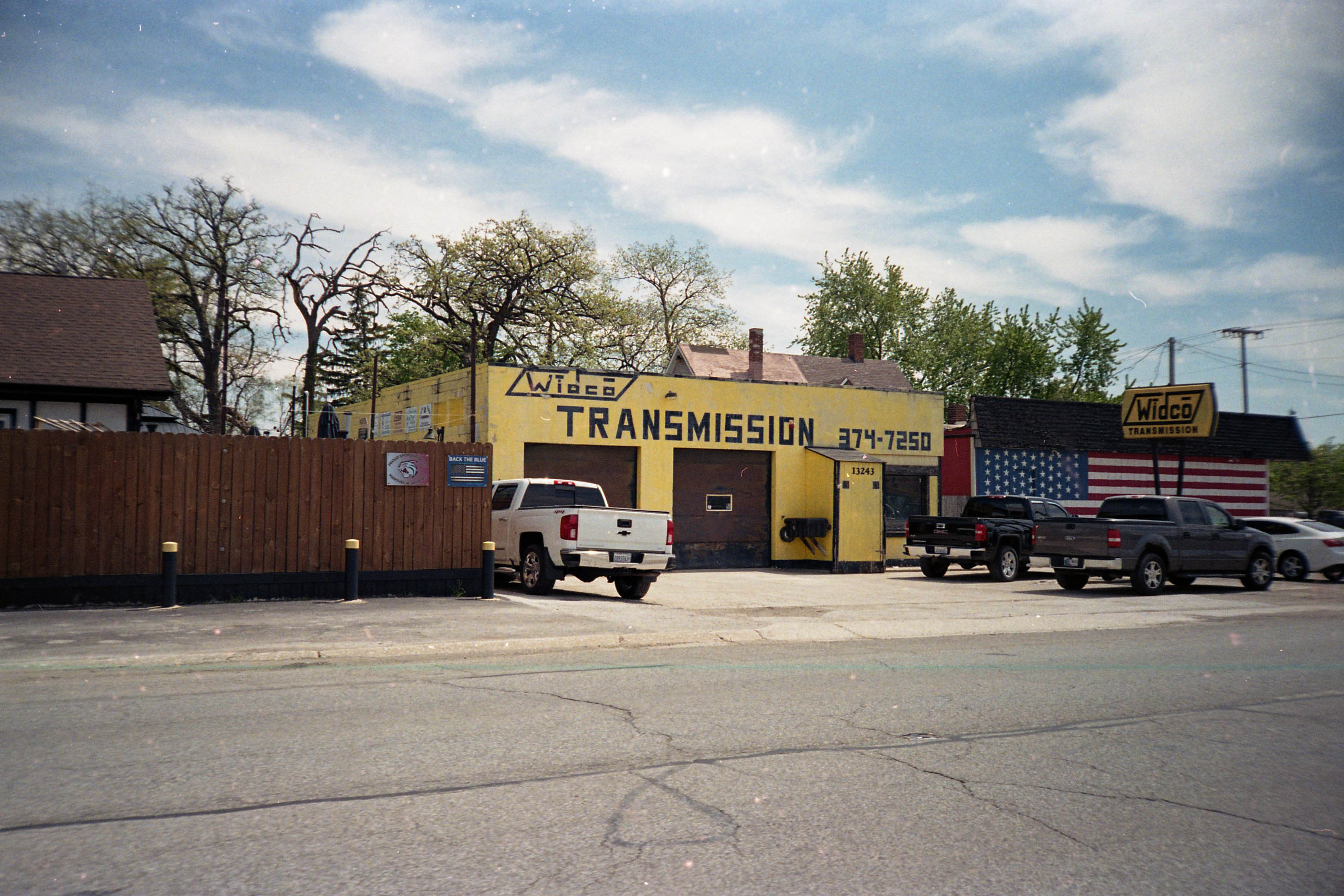



For starters, this was the first roll of Kodacolor 100 I had shot, developed and scanned since buying a bunch of it earlier this year and I am very happy with the results. Sharpness was great and grain was kept to a minimum like you’d expect from a 100 speed color film. While not as vibrant as Ektar 100 or even the old Kodak Gold 200, the colors were natural with still a good amount of a natural feel to it. I was also impressed at how well it handled both outdoor sunlight and interior shots as I didn’t feel like it strongly favored one over another. The only area which it didn’t blow me away was in overcast cloudy images, but to be fair, almost no color film does well with that.

In terms of lens performance, it was a mixed bag. On one hand, the Hanimex 35 Micro Flash was sold as an inexpensive and basic camera, so performance should be consistent with its target demographic. Center sharpness was quite good and color rendition was excellent. Outdoor images in good lighting showed a great amount of detail and life-like colors in the center 50-60% of the image.
Once you got beyond that though, things start to fall apart quickly. In my research for this camera, I found somewhere that suggested this camera has a 4-element in 3-group lens which I assumed meant it was a Tessar formula, but if this truly is a Tessar-style lens, it is one of the worst I’ve found. Vignetting in some instances was extreme as was edge softness. In fact, I don’t even know if I’d describe the edges of these images as soft, rather, murky and just all around blegh was more like it. It almost looked like the extreme edges of many of these images were smeared with some kind of petroleum jelly to muddle the detail.

Coming back around though, regardless of the lens construction, this was a cheap camera and the images here likely were good enough for the people who likely would have bought it. Today’s digital scanners are able to extract more detail and include the extreme edges of each exposure which likely would have been cropped out during printing at an early 1980s minilab, so it is entirely possible contemporary users of these cameras never had anything to complain about. Certainly, these images are serviceable, but I’ve become spoiled by other inexpensive 35mm point and shoots with good prime lenses, and I guess I just expected more here.

Beyond image quality, I was impressed with the metering system which to be honest, isn’t very enjoyable to use. Although this camera has a CdS exposure meter, this is a completely manual exposure camera. I found the design of the ASA film speed dial to be confusing and the goofy icon based aperture system and single shutter speed really don’t give you a lot of flexibility, but clearly none of this impacted my ability to get properly exposed images, even indoors. Focusing was fine as long as I shot stuff far away, but strangely all of my mirror selfies were out of focus. During my test roll, I took 5 images of myself, some with the flash on and some with it off and I missed focus badly on all five. Perhaps I misunderstood how it was supposed to work, or maybe there is a defect with this camera that only showed up at minimum focus, but clearly something was wrong as I should have been able to get it right with a manual focus camera at least once.

Ergonomically, the camera is quite good. The camera fits nicely into your hand, the location and feel of the shutter release is very good, and the large film advance wheel wraps around a corner, making it much easier than those found on other cameras. Having a large pop up flash on a small compact body was a good compromise to cameras like the Olympus XA2 or Canon MC which have optional detachable flashes, or later cameras with built in flashes at the expense of a much larger body. I didn’t love the metering system controls, but beyond that, the camera was compact and comfortable to use. And although I never encountered this while shooting, the location of the flash a couple inches away from the lens should have had a positive effect of reducing red-eye while shooting people with the flash on.
Between the Hanimex 35 Micro Flash and the Hanimex 35ee Micro, the latter camera might be the better user as it has a proper auto exposure metering system and a wide range of electronically controlled shutter speeds, suggesting it would deliver good results in a larger variety of shooting conditions. Sadly, my 35ee Micro was not working so I couldn’t test it, but I feel like I’ve seen enough to know that at the very least, the 35ee Micro would improve usability while delivering similarly good results.
This era of compact early point and shoots is very interesting. Unlike in the late 1980s and into the 1990s when most camera makers settled into a very predictable design and feature set, companies were still trying to figure out how an entry level and inexpensive camera should look and how it should operate. With reasonably fast 4 and sometimes 5-element primes, the results were often quite good, and assuming you didn’t go out of your way to not use the camera the way it was intended, you were usually rewarded with good to excellent results. The image results from this camera weren’t on par with the best point and shoots of the era, but it didn’t need to be as this camera would not have appealed to someone looking for excellent edge sharpness and minimal vignetting. Neither the Hanimex 35 Micro Flash nor the Hanimex 35ee Micro will ever be at or near the top of a camera collectors wish list, but if you find one in working condition for cheap enough, my advice is to give it a try. You might be surprised at how good it is.
Related Posts You Might Enjoy
External Links
https://camera-wiki.org/wiki/Hanimex_35_Micro_Flash
https://austerityphoto.co.uk/the-aussie-lomo-hanimex-35-micro-flash/
https://collection-appareils.fr/x/html/page_standard.php?id_appareil=11490
https://books.google.com/books?id=XBZpIPL1lloC&lpg=PA101&ots=_d7Bbyfhvp&pg=PA100