
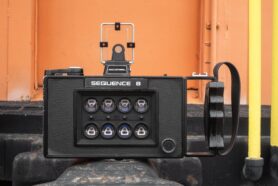
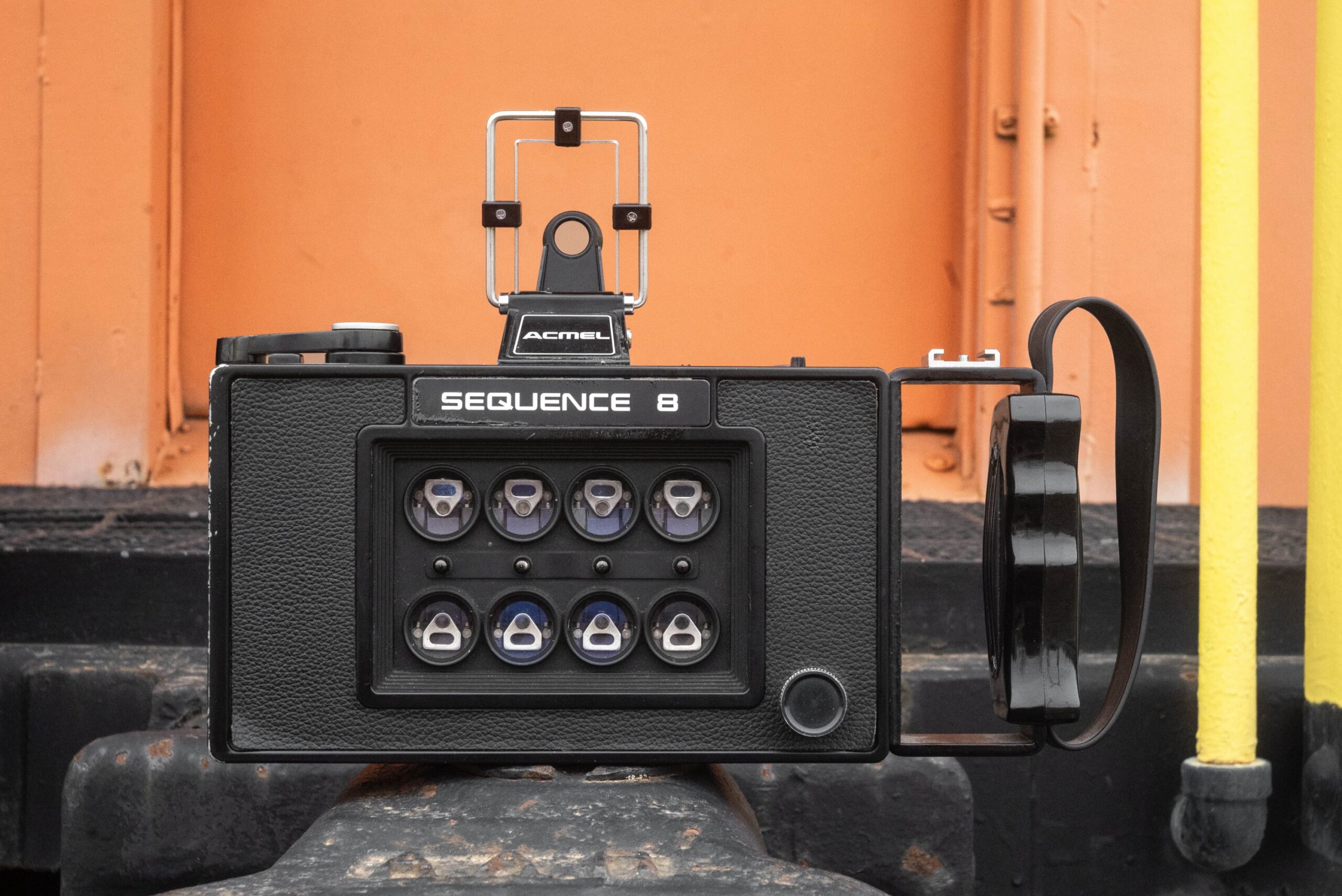
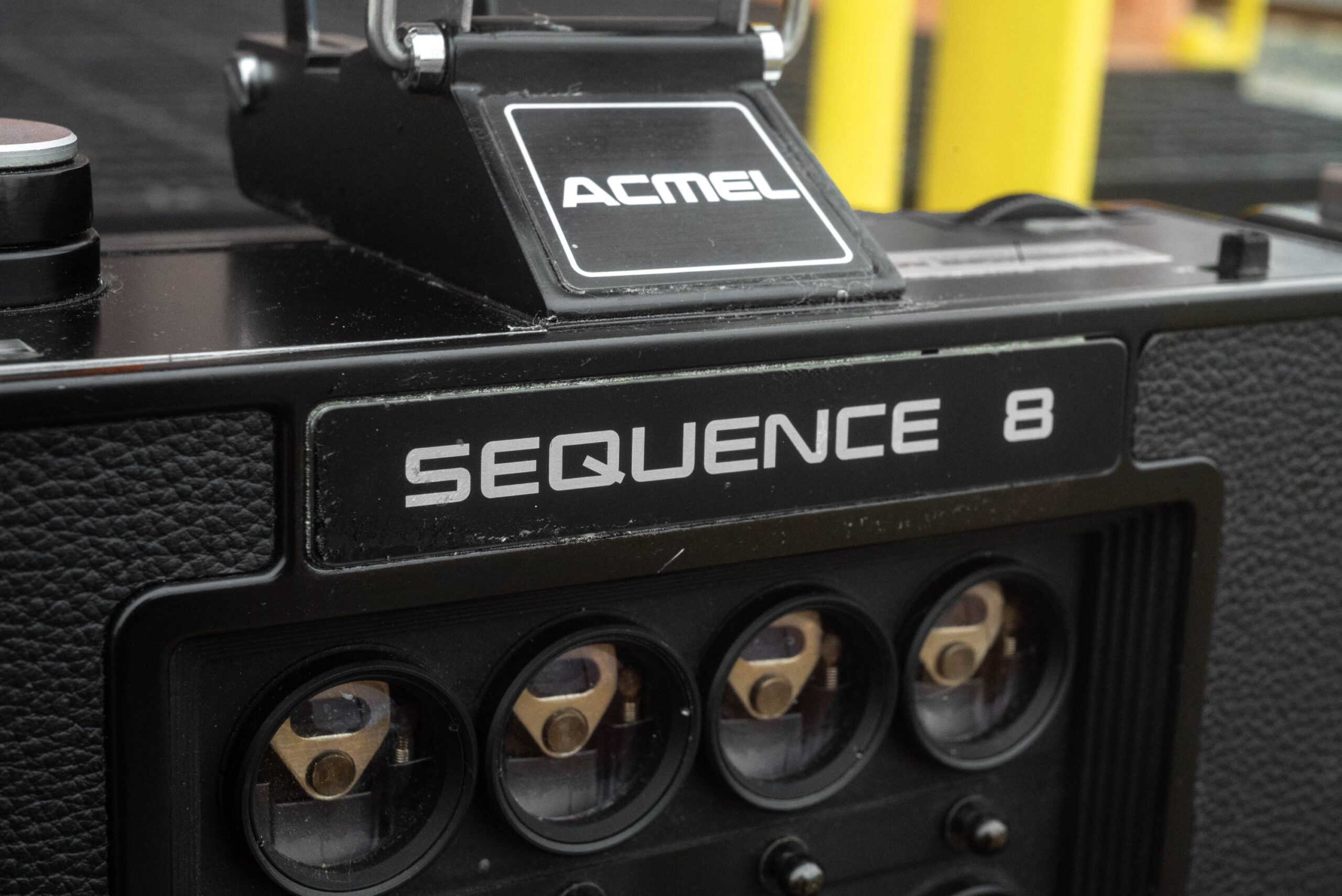
This is an Acmel Sequence 8, an eight lens sequence camera which makes eight individual photos using eight lenses and eight shutters on single sheets of Polaroid 100 Instant Pack Film. It was made in Japan by Asanuma & Co, Ltd. and sold in Japan as the King Check Polaphy. The camera was also rebadged for other markets including the United States where it was sold as the Acmel Sequence 8. The camera has the ability to shoot all eight lenses automatically with a variable delay, or by firing each shutter manually one at a time. The shutters are electronically timed and fixed at 1/300 seconds, so the only way to control exposure is via the aperture wheel, which can stop down each lens all the way to f/45. The Acmel Sequence 8 was built for a very specific purpose and as such, few were sold, making them extremely difficult to find today.
Film Type: Polaroid 100 Instant Pack Film (also compatible with Fuji FP Instant Pack Film), (eight 24mm x 40mm exposures per sheet)
Lens: (8x) ~50mm f/6.3 Unknown Brand unknown elements
Focus: Fixed, 2.5m – 5.8m at f/6.3, 1.8m – Infinity at f/16
Viewfinder: Flip Up Wire Frame Finder
Shutter: (8x) Vertically Traveling Metal Focal Plane
Speeds: Single, 1/300 seconds
Exposure Meter: None
Battery: (2x) 3v CR-1/3N Lithium Battery or (4x) 1.5v LR44 Alkaline Battery
Flash Mount: None
Weight: 2010 grams
Instructions: http://www.mediajoy.com/en/cla_came/KING_seq/a1.html
I’ve written reviews about cameras with very little historical information before. It can be difficult to dig up enough information to paint some kind of picture of a cameras origin, the company who made it, the year it came out, what it might have sold for when new, and even with the most difficult cameras, I’ve been able to find some kind of information which is scarcely available online.
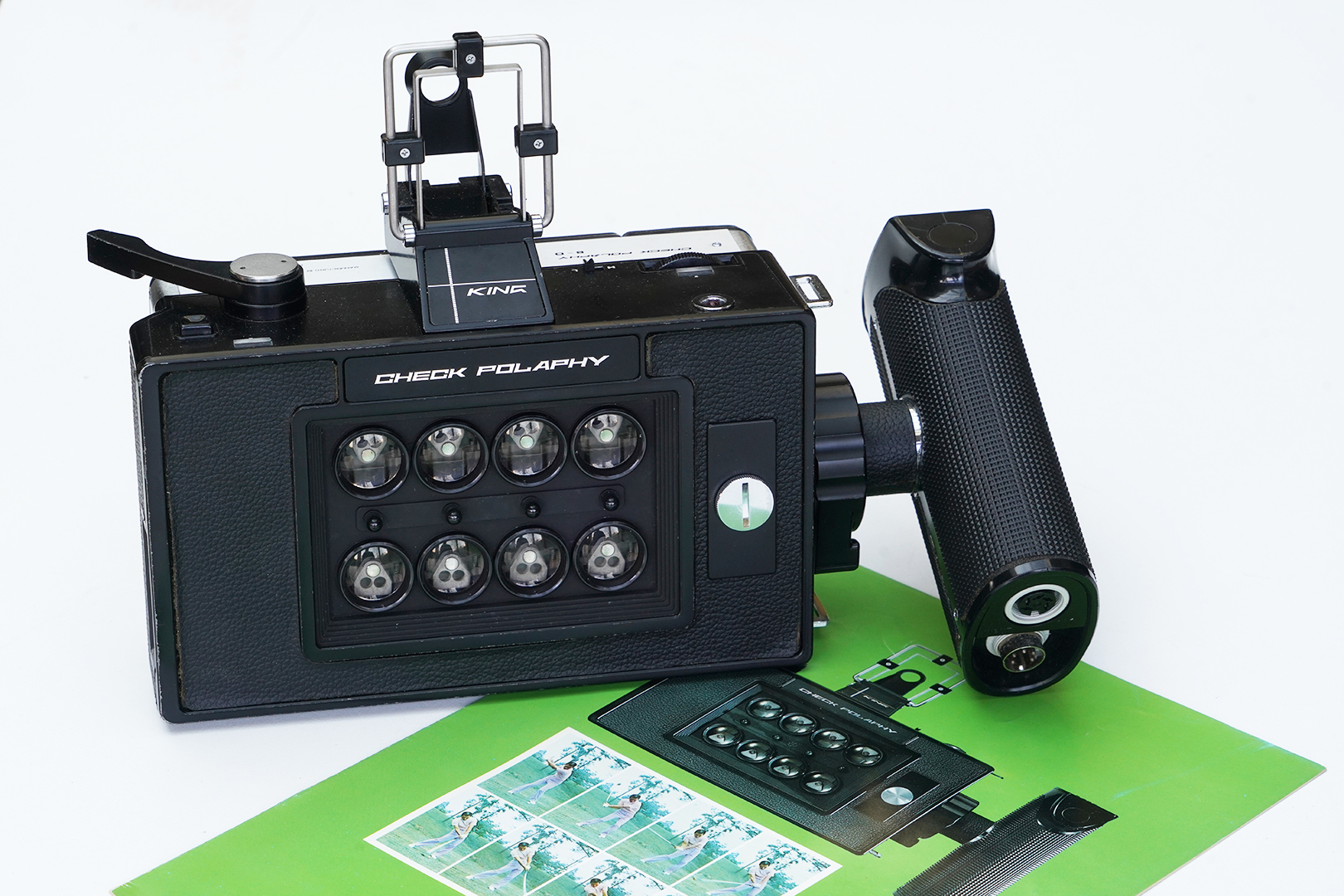
But with the Acmel Sequence 8, I might have met my match. This is a camera that at various points of writing this review, I wasn’t even sure of its name. Sure, it has the words “Acmel Sequence 8” on it, but other references to this camera have it called things like the “King Check Polaphy” and a number of other things. References to the company who made it, Asanuma & Co, Ltd., are thin and poorly referenced. At one point, I didn’t even know what year this camera was released, and even now, I am still not 100% that it was 1972. Strangely, with all of the reference materials I’ve accumulated in 11 years of writing cameras years, 1972 is one of those years I have very little to go off.
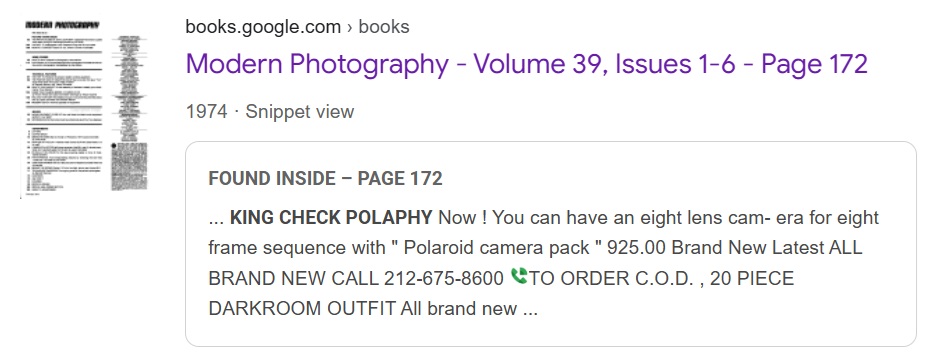
I feel fairly confident that the Acmel Sequence 8, or whatever its original name should be, was announced at the 1972 Photokina as an eight exposure instant camera which uses Polaroid 107 series film. In a Google Books snippet from a 1974 issue of Modern Photography, the King Check Polaphy was said to have a retail price of $925, but I can’t get an image of the page proving this. Beyond these tiny crumbs of information, I was unable to find any other advertisement, review, or reference to the camera in any format.
But it did exist, and I have one. Why does this one have the name Acmel and why does it have a sticker for a Swiss company that specializes in building materials? I have no idea. Where was this camera originally sold and was it really $925? Again, no clue! But I have one, and I’m gonna use it!
At 2010 grams (~4.4lbs) with film loaded in the camera, the Acmel Sequence 8 is one of the heaviest cameras I own, and with its large brick like shape and strange ergonomics, it is also one of the weird cameras to use.
When I started to research the camera, I struggled to find anything about it as the name “Acmel Sequence 8” doesn’t show up in any search results I performed. Further throwing me off the track is a sticker on the top of this camera which says “Weinberger AG Zurich Switzerland” which gave the impression this was a Swiss made camera. For whatever purpose Weinberger AG needed to put their sticker on this camera, I cannot be certain, but their 2026 website suggest they are a leader in building construction as well as infrastructure in water and energy management, so perhaps at one time they owned this camera and put their sticker on it.
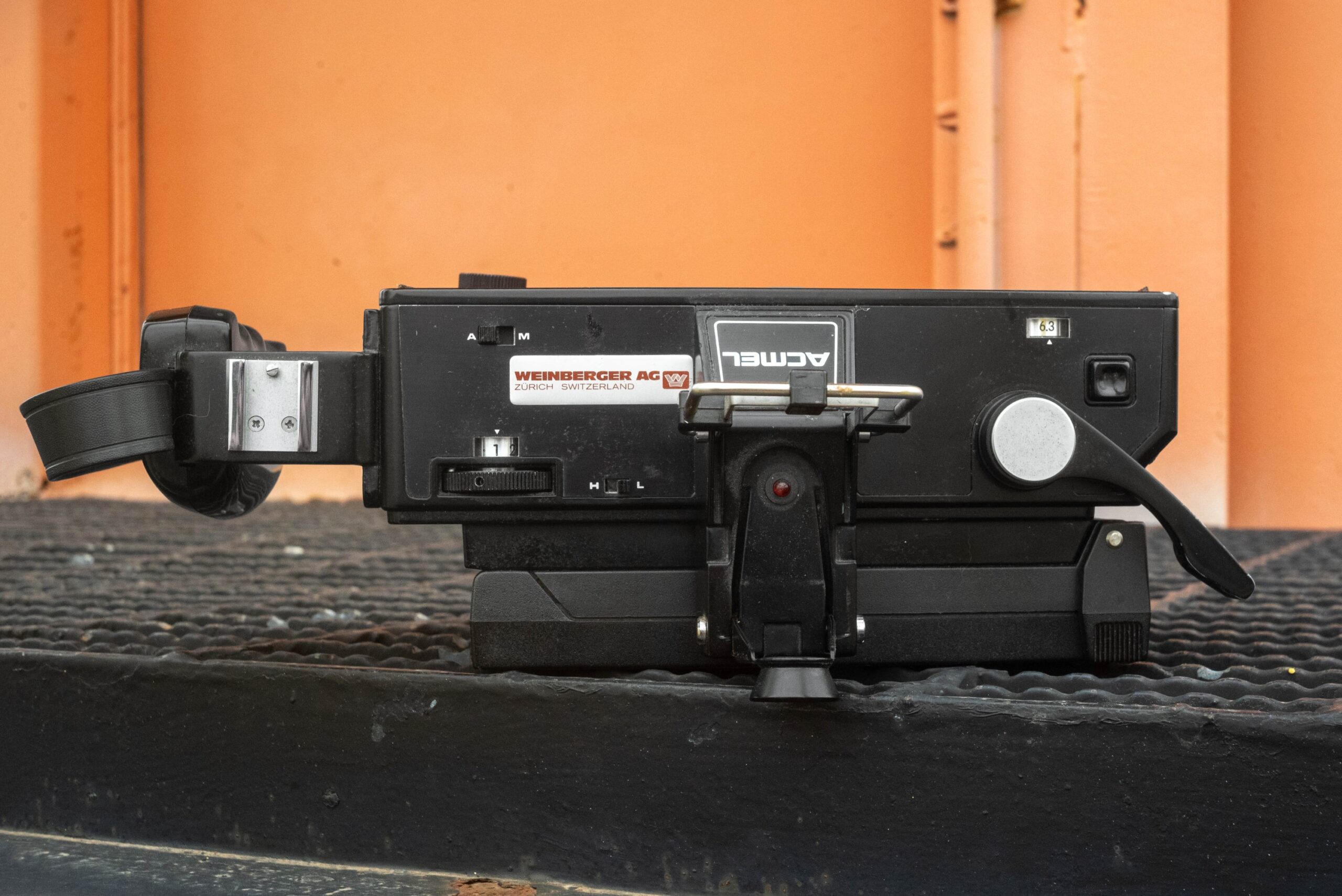
The Acmel Sequence 8 is very large, so each surface of the camera has controls with plenty of space between them. Looking at the top of the camera, starting on the flash handle is a standard accessory shoe, which I suppose could be for mounting a flash, but without any traditional sync ports or a hot shoe, I cannot be sure. Above and to the right of the accessory show is an A/M toggle switch which changes the shutter more from Automatic to Manual. In Automatic mode, a single press of the shutter release will fire all eight shutters in sequential order with an adjustable delay. With this switch in Manual mode, each of the eight shutters will fire with eight individual presses of the shutter release. This could be useful with sequence shots where the delay is variable and must be manually timed, or if you wish to shoot eight completely unrelated images on the same piece of film.
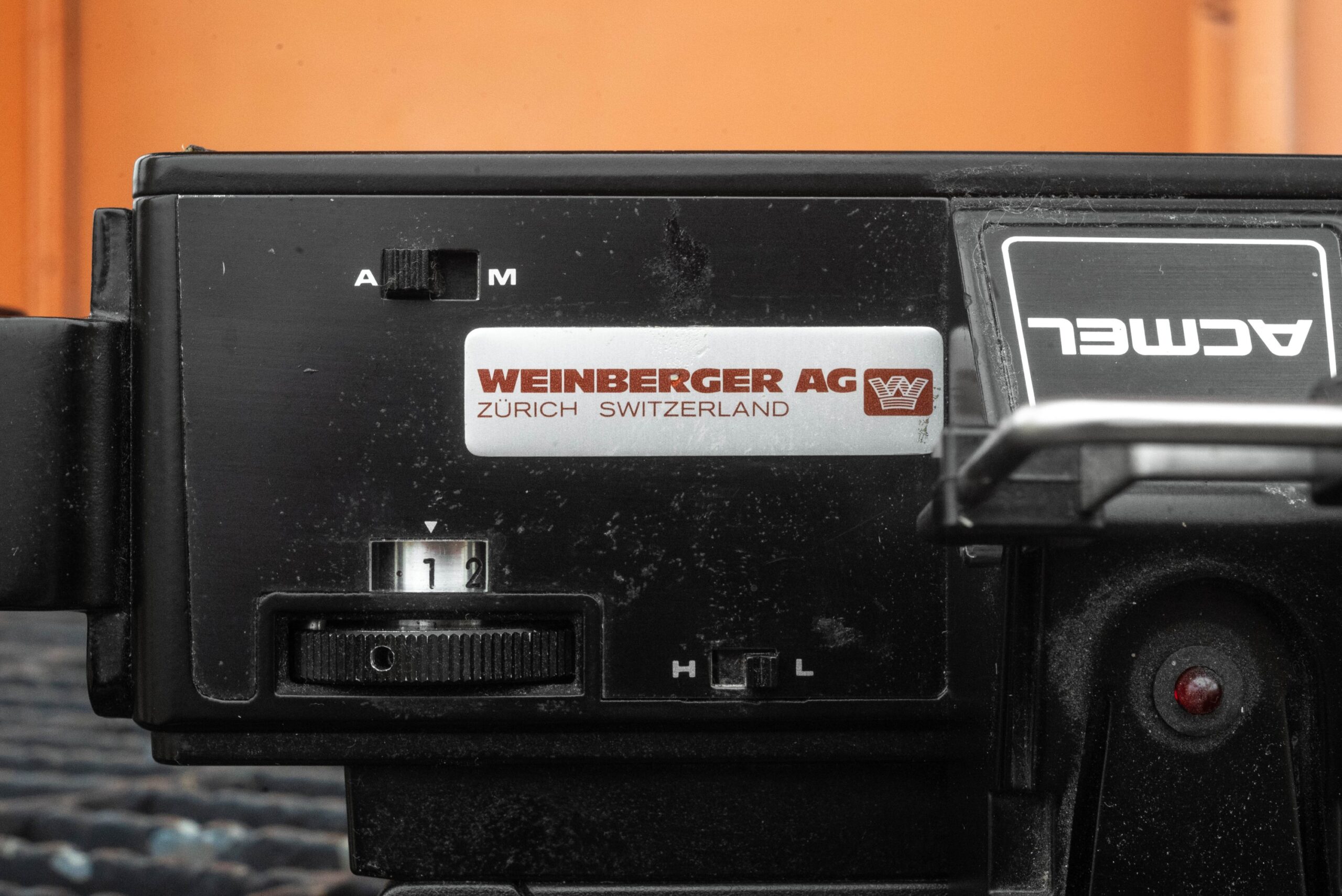
Changing the delay between each shutter firing in Automatic mode is done by both a knob and an H/L toggle switch. The knob doesn’t list the delay in seconds, rather it has numbers from 1-10 with 1 being the shortest delay and 10 being the longest. The H/L switch allows you to more quickly switch between Hi speeds and Low speeds. This is pretty confusing since the ranges of speeds between the two groups appears to overlap a bit. According to the limited information I could find online, it suggests the delay ranges from 0.07 seconds to 7 seconds which I do not believe is correct. I played with the camera using my smartphone as a stop watch and tried various combinations of the H/L switch and delay knob and this is what I found:
- Low and 10 – Each shutter fired about 1 second apart with the total duration between the 1st and 8th shutters firing about 8 seconds.
- Low and 1 – The total duration from 1st to 8th shutter is about 1 second.
- Hi and 10 – This sounded exactly the same as Low and 1.
- Hi and 1 – Each of the shutters fired extremely quickly, almost sounding like a short buzzer, but it felt longer to me than 0.07 seconds.
I did not have access to the user manual for Acmel Sequence 8 (or any other name variant) so I cannot be sure, but I would really hope that inside there is some kind of chart which gives you real world numbers which indicate the actual timings. The most important thing to remember though, is that none of these numbers have anything to do with the shutter speed, as each of the eight shutters all have only a single 1/300 shutter speed so you are not actually changing shutter speeds, only the delay between each shutter in Auto mode.
I made a short video showing the operation of the Acmel Sequence 8 and its eight shutters firing with various delay settings.
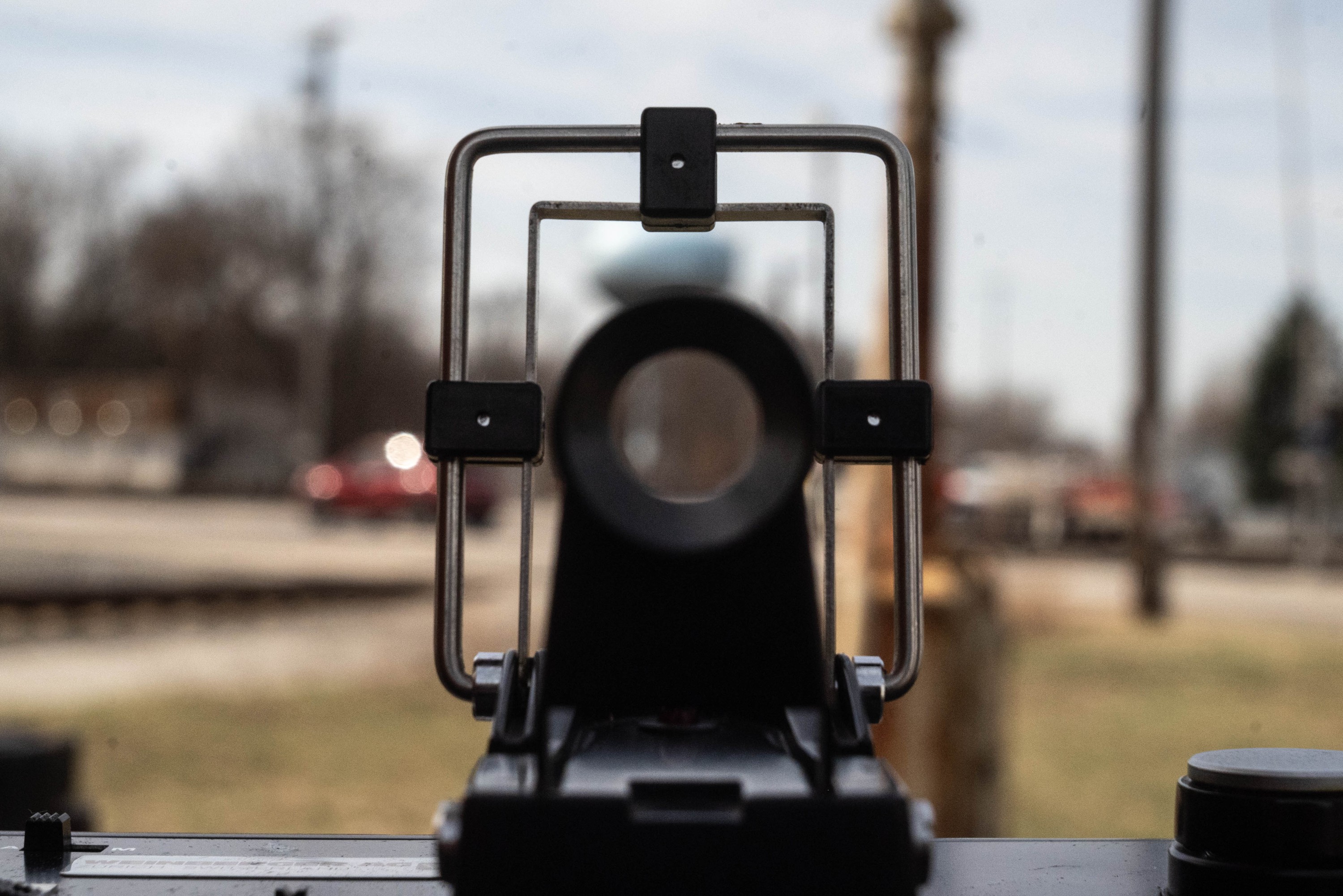
In the middle of the top plate is the folding wire frame finder. To use it, fold the rectangular metal part forward, and the plastic circular piece towards the back. With both halves folded up, position your eye close enough to the round piece so that you can see entirely through the rectangle. It should be noted that the viewfinder only offers a single perspective from eight different lenses, so each will have different amounts of parallax error. I measured the center line distance between the first and fourth lenses to be about 72mm apart, so you’re going to have the most extreme parallax with the four lenses near the edge. Although this is something worth keeping in mind, in practicality, it probably won’t make much of a difference as sequence cameras like this are meant to be used with things far away where parallax error isn’t much of a concern.
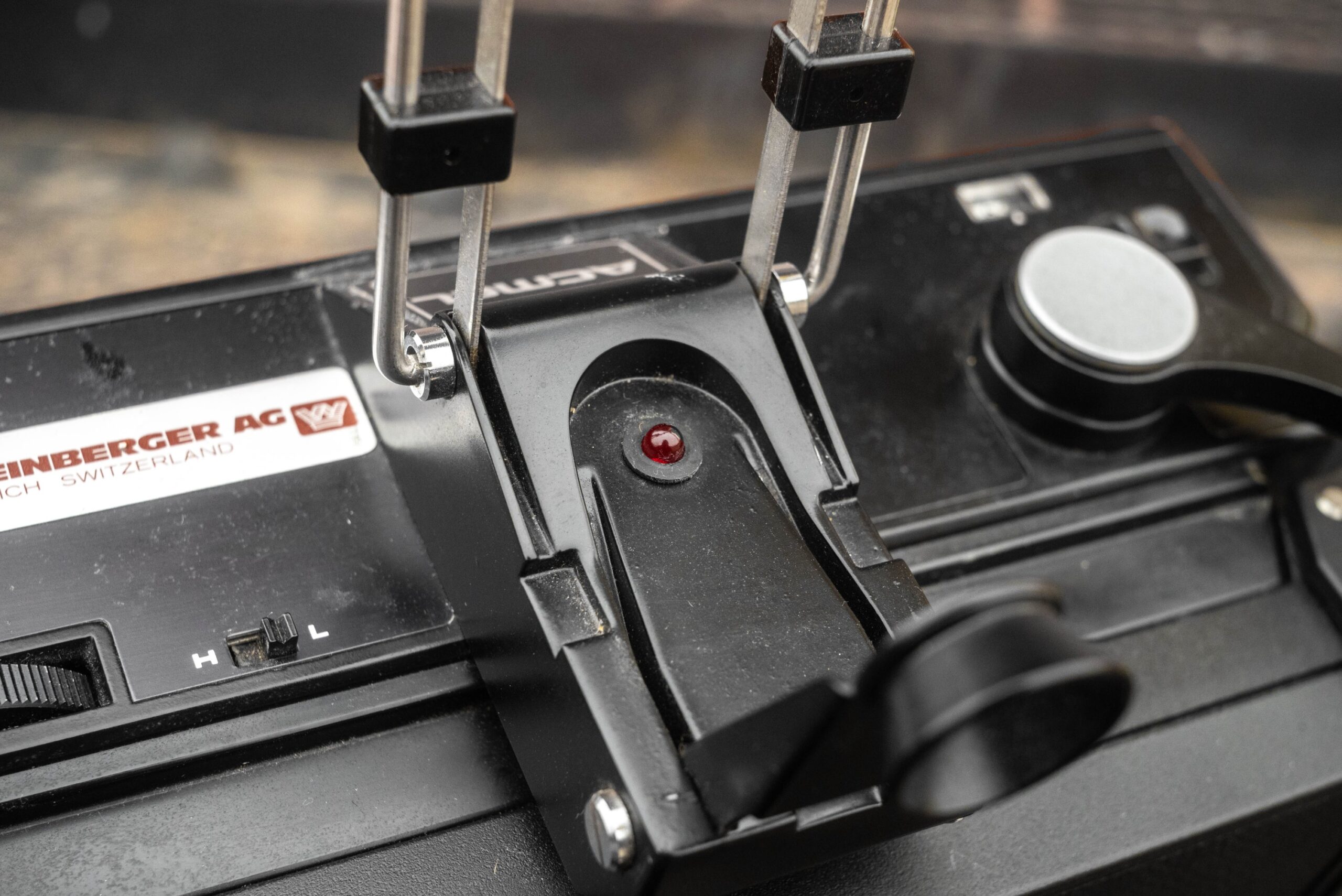
In the center of where the viewfinder folds down is a small red LED which is the shutter readiness light. The Acmel Sequence 8 does not have a dedicated power switch, so to power it on, you must wind the shutter setting lever until the red LED illuminates. Once it is illuminated, it will stay lit until the shutter release is pressed. All eight shutters are electronically controlled, so this LED must be illuminated before they will fire. I wanted to see if the camera would automatically power down after setting the shutters but not pressing the shutter release but this LED stayed illuminated for several minutes, suggesting you could drain the batteries if you left the camera with the shutters set for too long. The red LED turns off immediately after pressing the shutter release, in an essence powering off the camera.
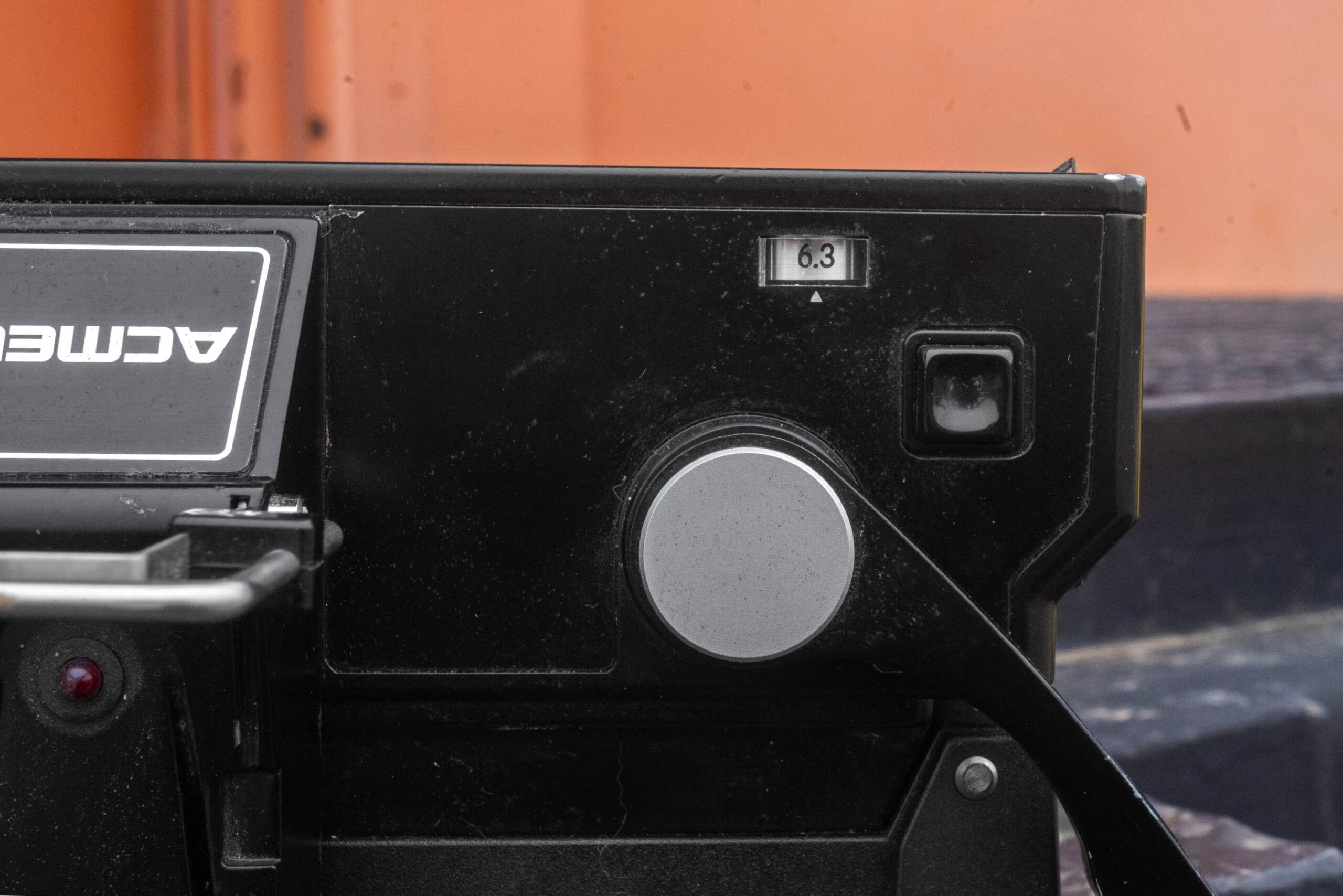
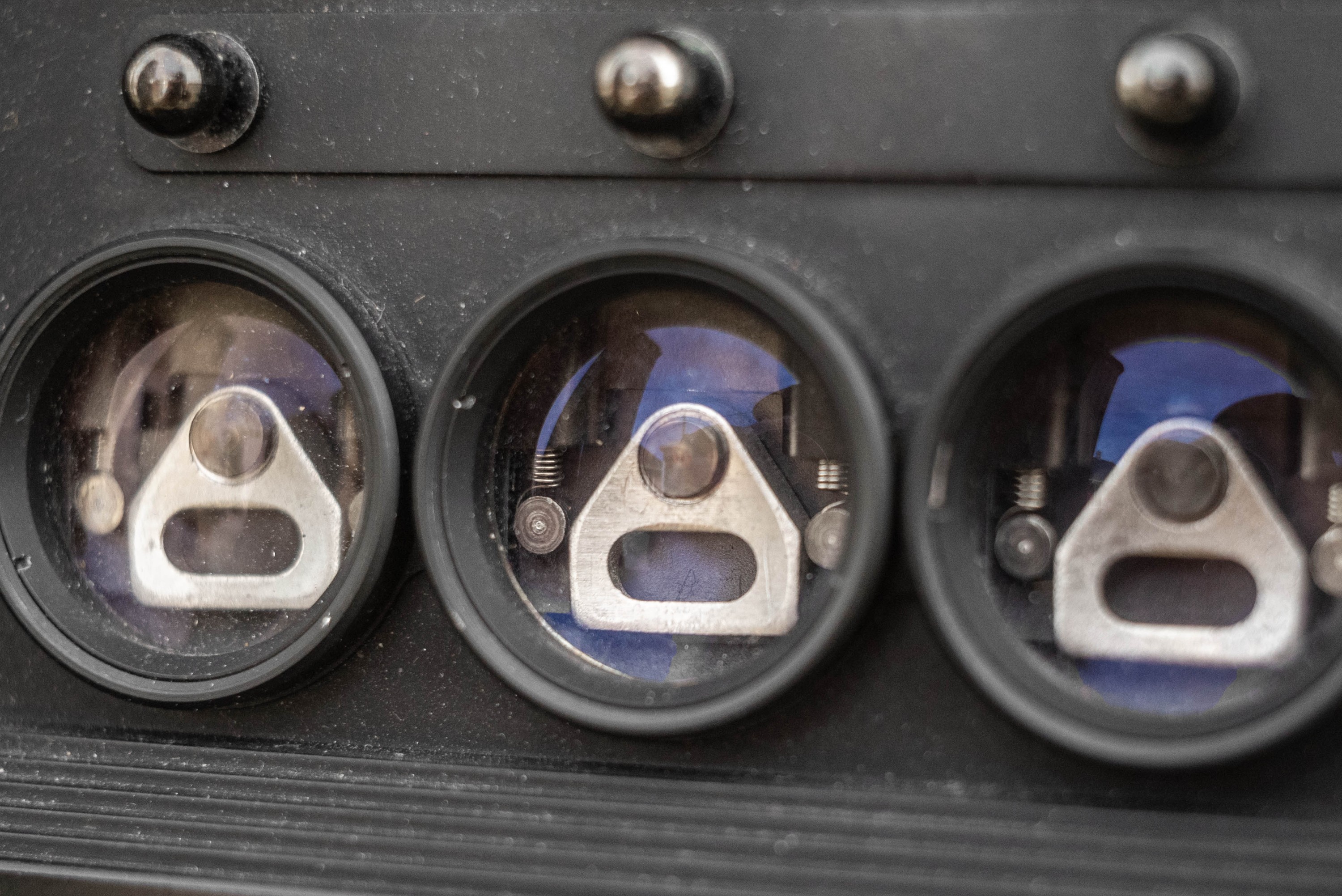
The shutter setting lever looks like a large film advance lever from a 35mm or roll film camera, however the Acmel Sequence 8 uses instant sheet film which does not need to be advanced, so this lever only sets the shutters. I did notice that on my example, sometimes winding this lever did not set all 8 shutters. You can easily tell whether a shutter is set or not by looking at it through the lens. With the shutters unset, there should be a silver metal piece visible, with it set, this silver piece disappears. If you wind this lever and one or more of the shutters does not set, you can wind the lever again until all eight shutters are set. I found no ill effect to winding this lever multiple times on the same exposure.
Above and to the right of the lever is a small window which displays aperture f/stops from f/6.3 to f/45 plus a final position with the letter “C”. With the camera set to the “C” position, the shutters are closed, preventing any light from passing through. This could be used to creative effect if you wanted to double expose certain frames but not others by putting the camera in Manual mode and only opening up certain lenses one at a time. Finally, to the right of the shutter setting lever is the shutter release button.
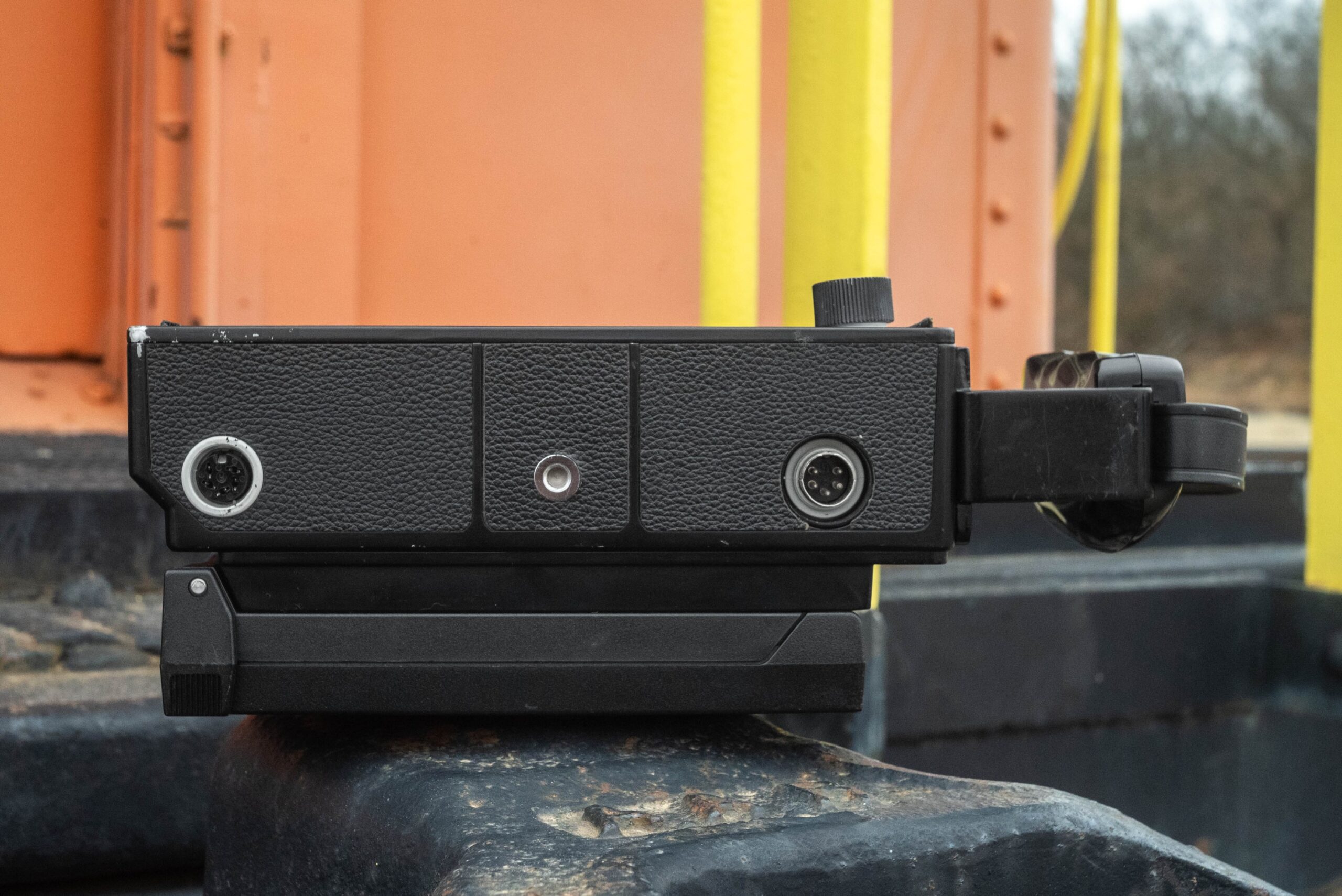
The base of the camera has a standard 1/4″ tripod socket in the center of the cameras mass, and on both sides are a male and female 5-pin serial port connector. The function of these serial ports is not clear, however I would suspect they possibly could have been used to remotely trigger the Acmel Sequence 8, or perhaps even daisy chain multiple cameras together for more than eight sequence shots.
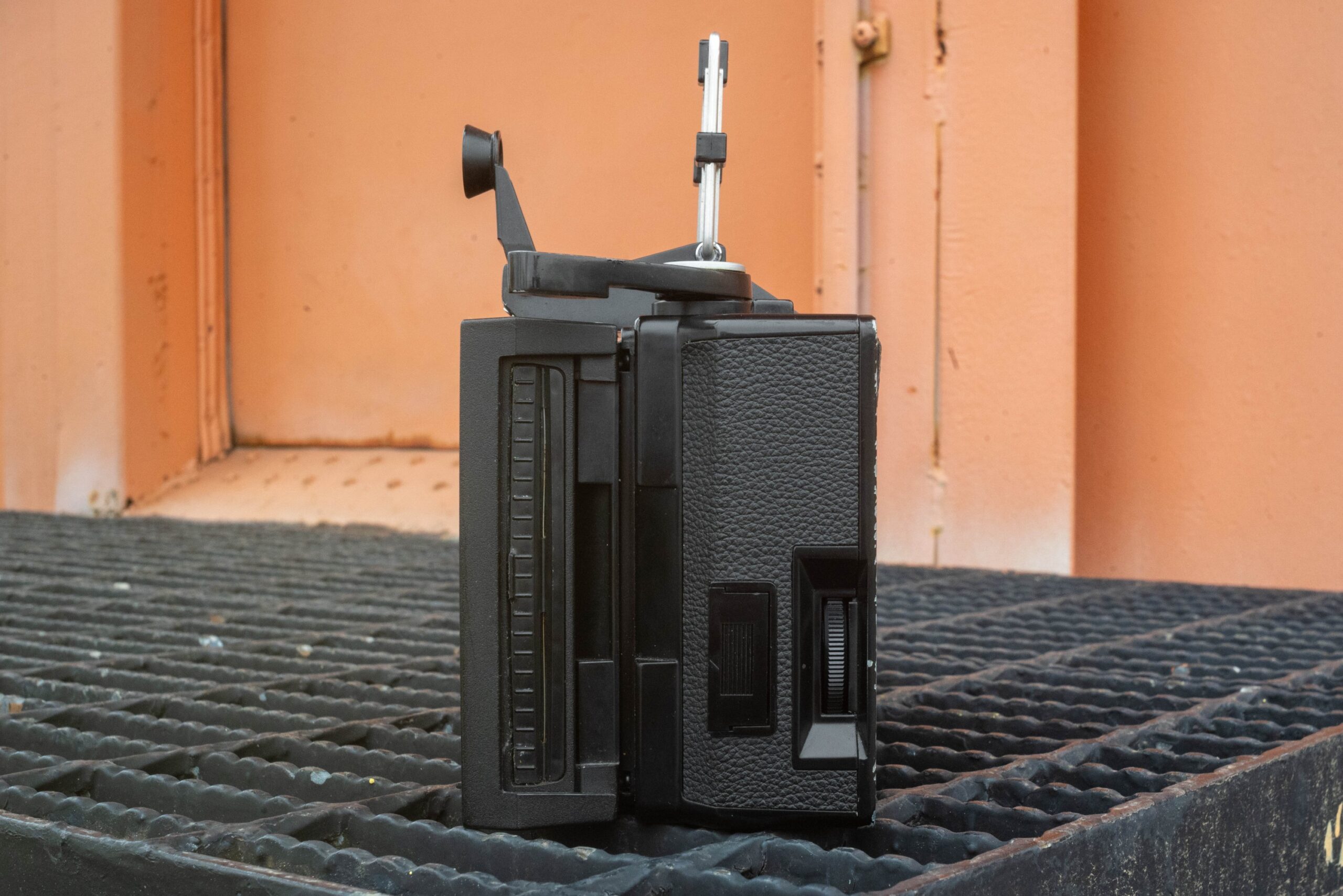
On the camera’s right side is the dial for controlling the aperture of the eight lenses, as seen through the f/stop display on top of the camera. Immediately behind the wheel is the battery compartment which has a sticker inside for two 3v CR-1/3N lithium batteries. I did not have this type of battery, so I just put in two 1.5v LR44 batteries in each side for a total of four, and the camera worked properly. The camera’s left side has a large handle with wrist strap which allows you to stabilize the heavy camera while shooting. I do not see a way to remove this handle.
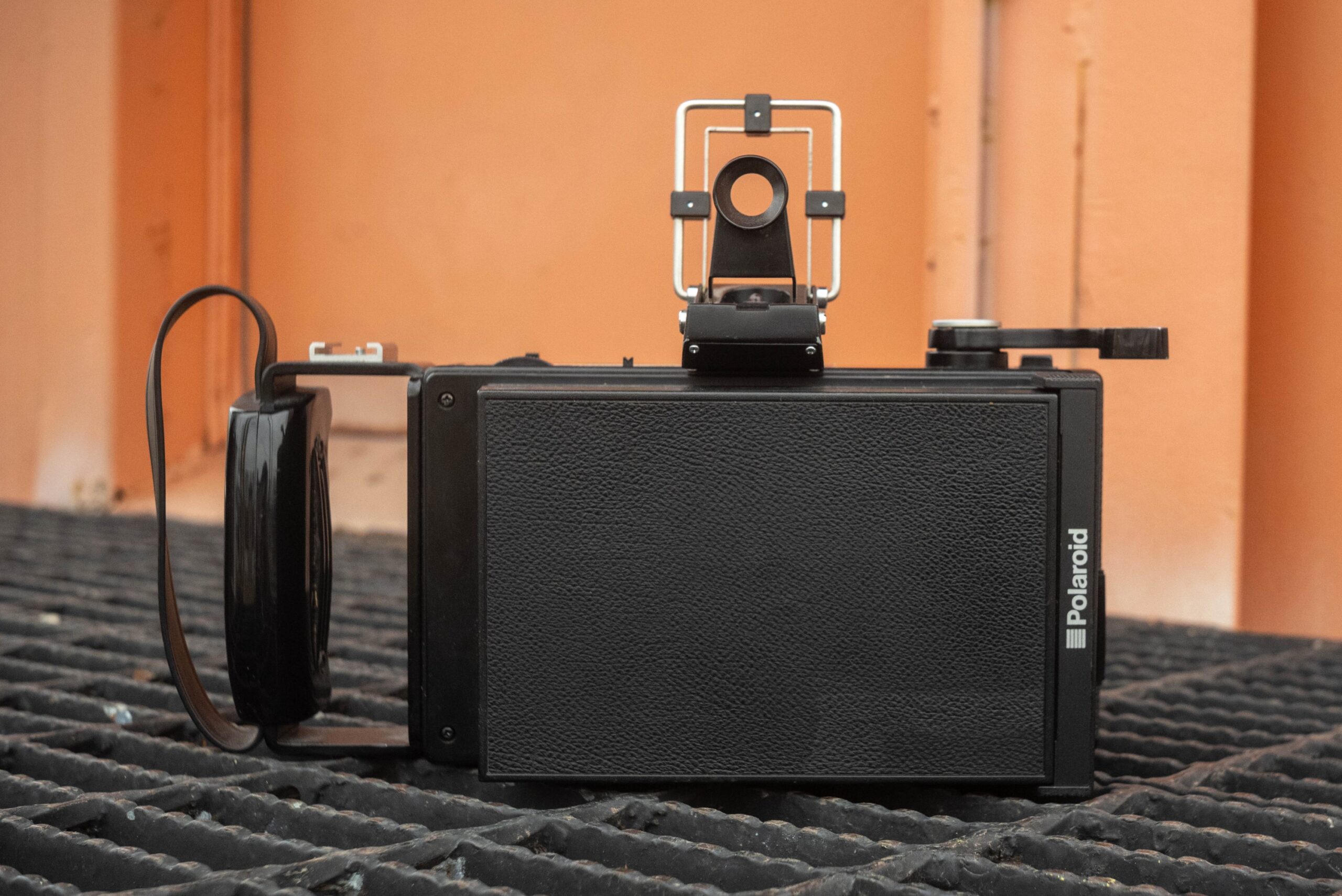
Around back there’s little to see other than the film compartment. The Acmel Sequence 100 was originally designed for Polaroid 100 peel apart instant sheet film, but later could be used with Fujifilm’s FP series of peel apart pack film. Both these Polaroid and Fujifilm instant film formats have since been discontinued so there is no longer any film that works in this camera made anywhere in the world. As I write this in 2026, it has been nearly a decade since the final Fujifilm packs were made, so finding frozen packs that still work is getting harder and harder to do.
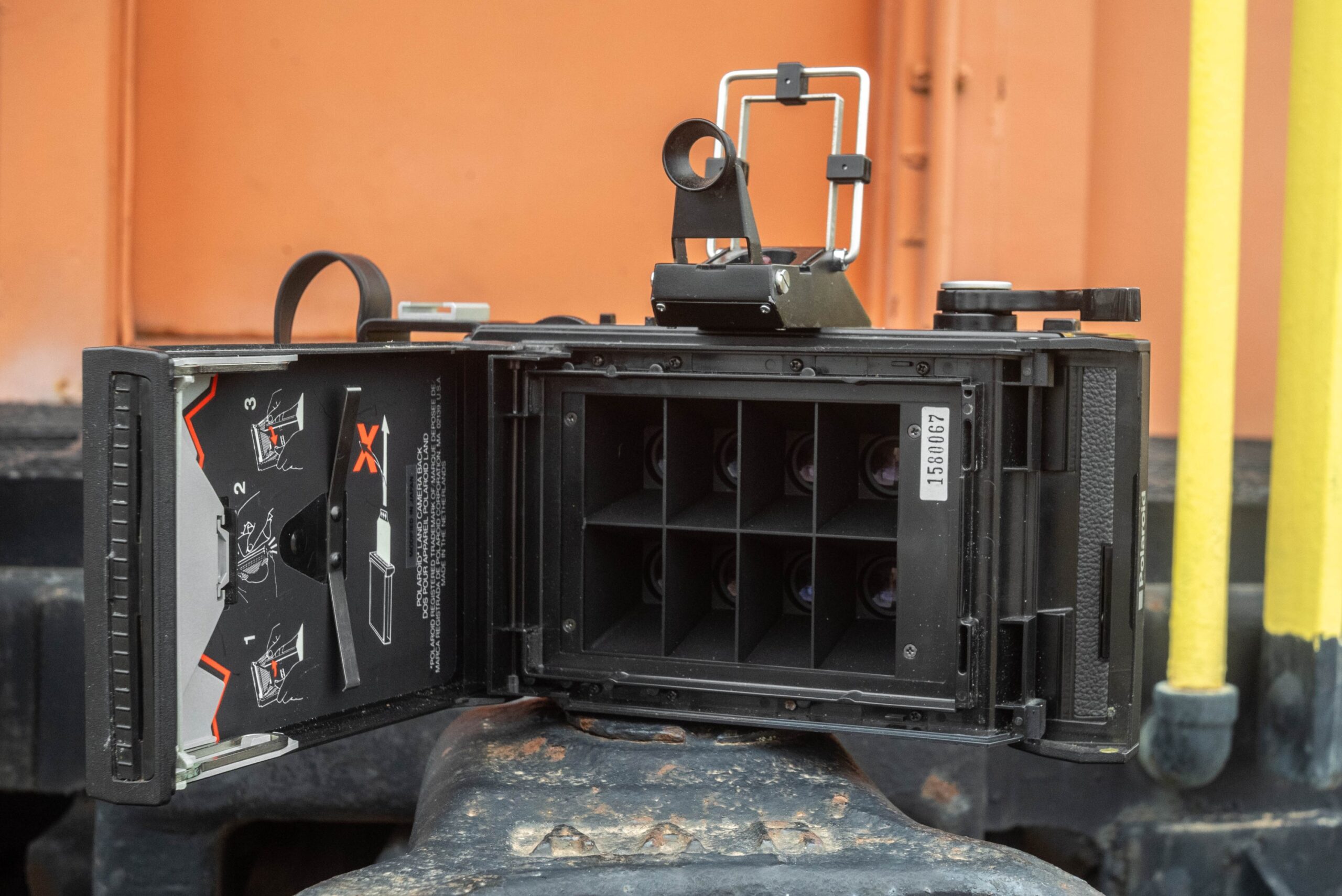
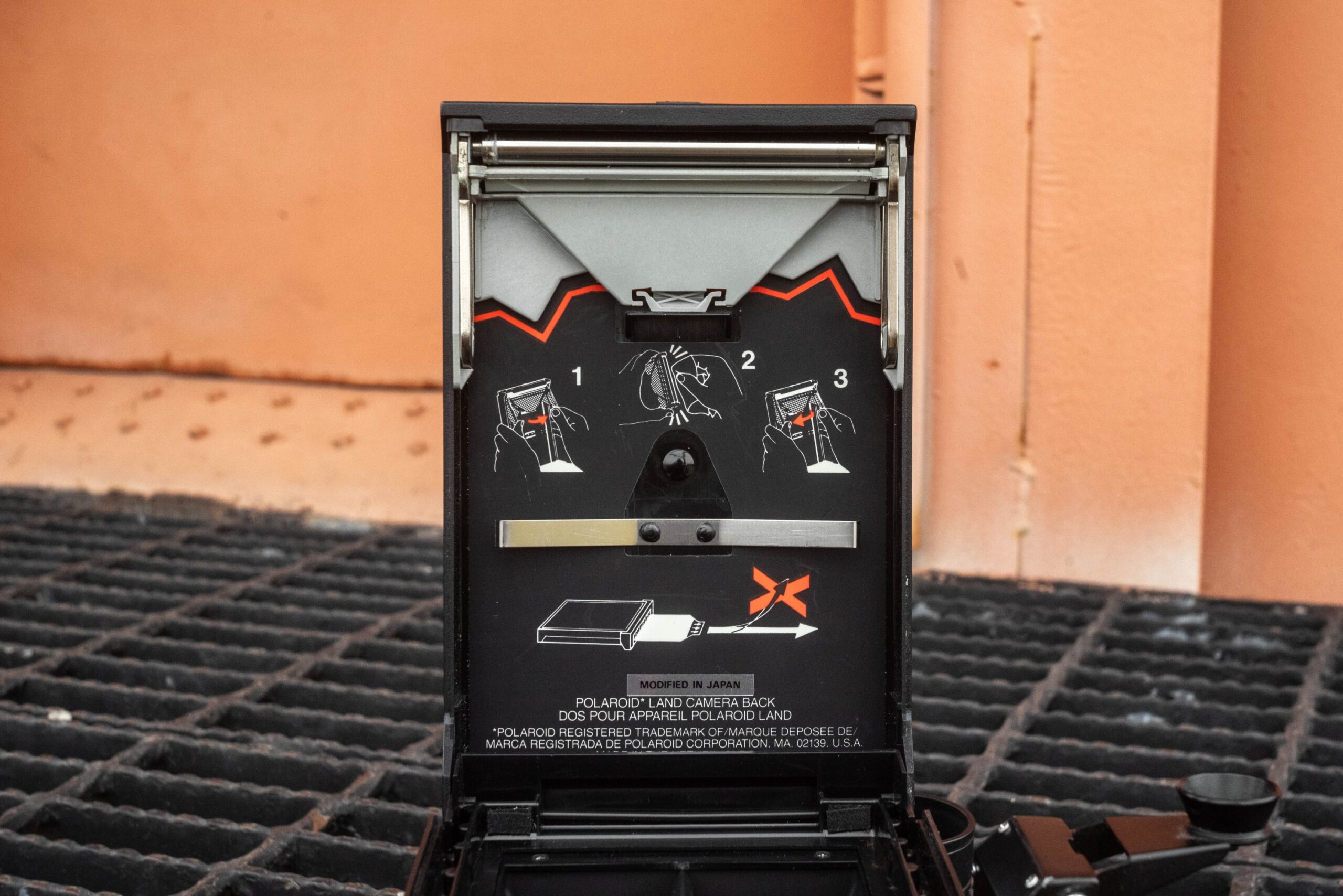
Loading film into a pack film camera is pretty easy once you understand how it works. To open the film compartment, a hinged plastic locking frame with the word “Polaroid” on it must be swung away from the back. Do not do this with film in the camera otherwise you will ruin unexposed sheets. Assuming the camera is empty, swing the left hinged door open. If an empty cassette is still in there, pull it out and discard it. An instruction sticker on the inside of the door explains that you should clean the rollers before inserting a new pack by pulling out on the roller frame and then wiping the metal rollers with a dry cloth. Press the rollers back into position and then insert a new pack into the film compartment with the cardboard dark slide facing down. Fresh film will have ten paper tabs, each marked with numbers 1 through 10 on them. These paper tabs must stick out of the camera after inserting a fresh pack in. With a new pack in place and the paper tabs sticking out of the right side, close the door and then fold shut the locking frame. The cardboard dark slide has its own tab and must be completely pulled out of the camera. This slide is pretty long, so just keep pulling until there’s nothing left. With the dark slide out, you are ready for the first exposure. From this point forward, do not reopen the film door until all 10 exposures have been made. You cannot reinsert the dark slide, like you can on something like a Hasselblad.
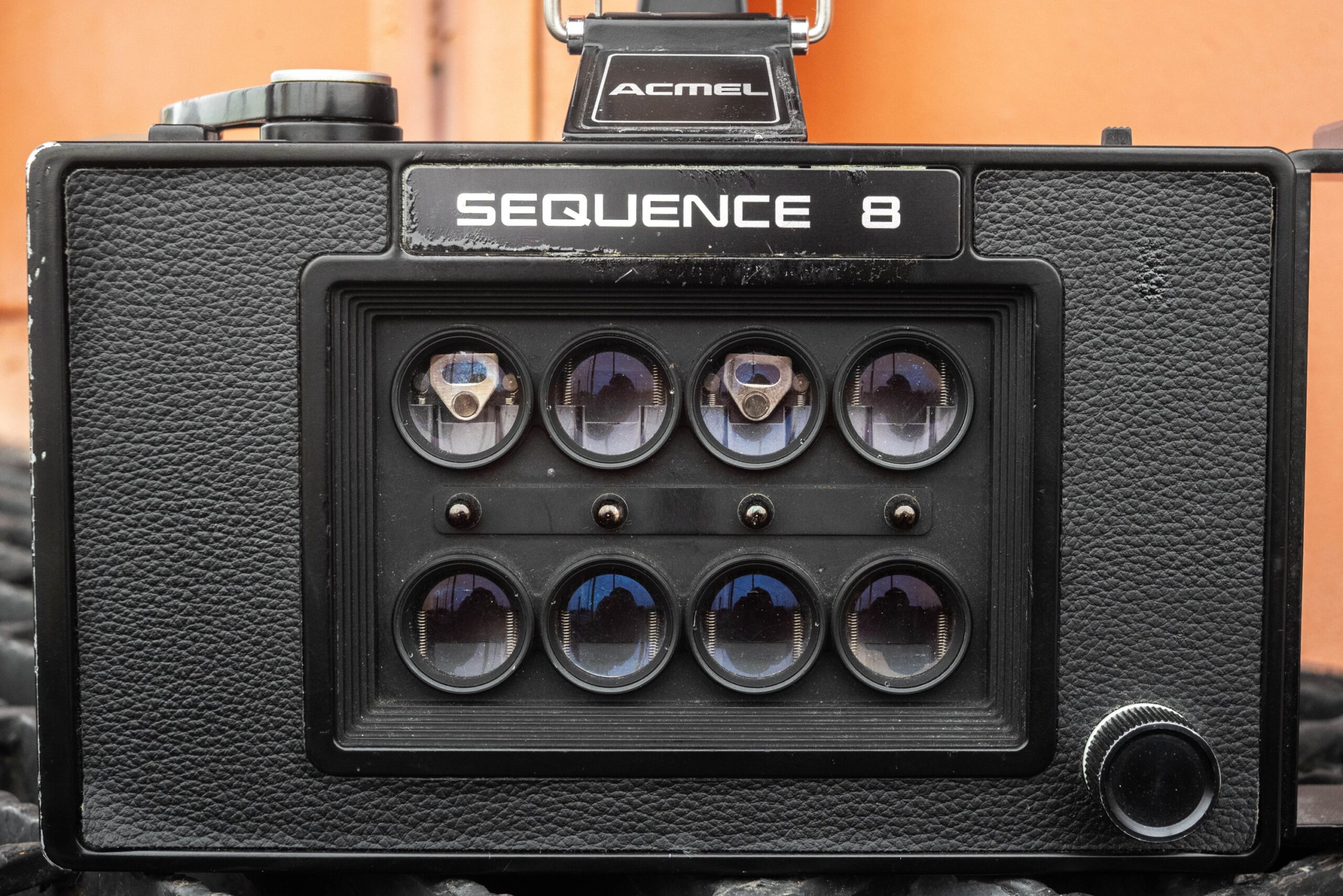
Up front you see the two by four grid of eight shutters and lenses. I wasn’t quite sure of the makeup of the lenses, but I feel like these have to at least be triplets as a four element lens would have probably been overkill, and that considering this camera was likely used by professionals, a simpler lens likely wouldn’t have cut it. In between the two rows of lenses and shutters are four metal posts which are there to hold in place two plastic lens caps that would fit over the lenses to protect them. The only thing left to see on the front is another serial port connector in the bottom right corner. Unlike the two ports on the bottom of the camera, this one has eight pins, which suggests it does something different from those, but exactly what, I am uncertain.
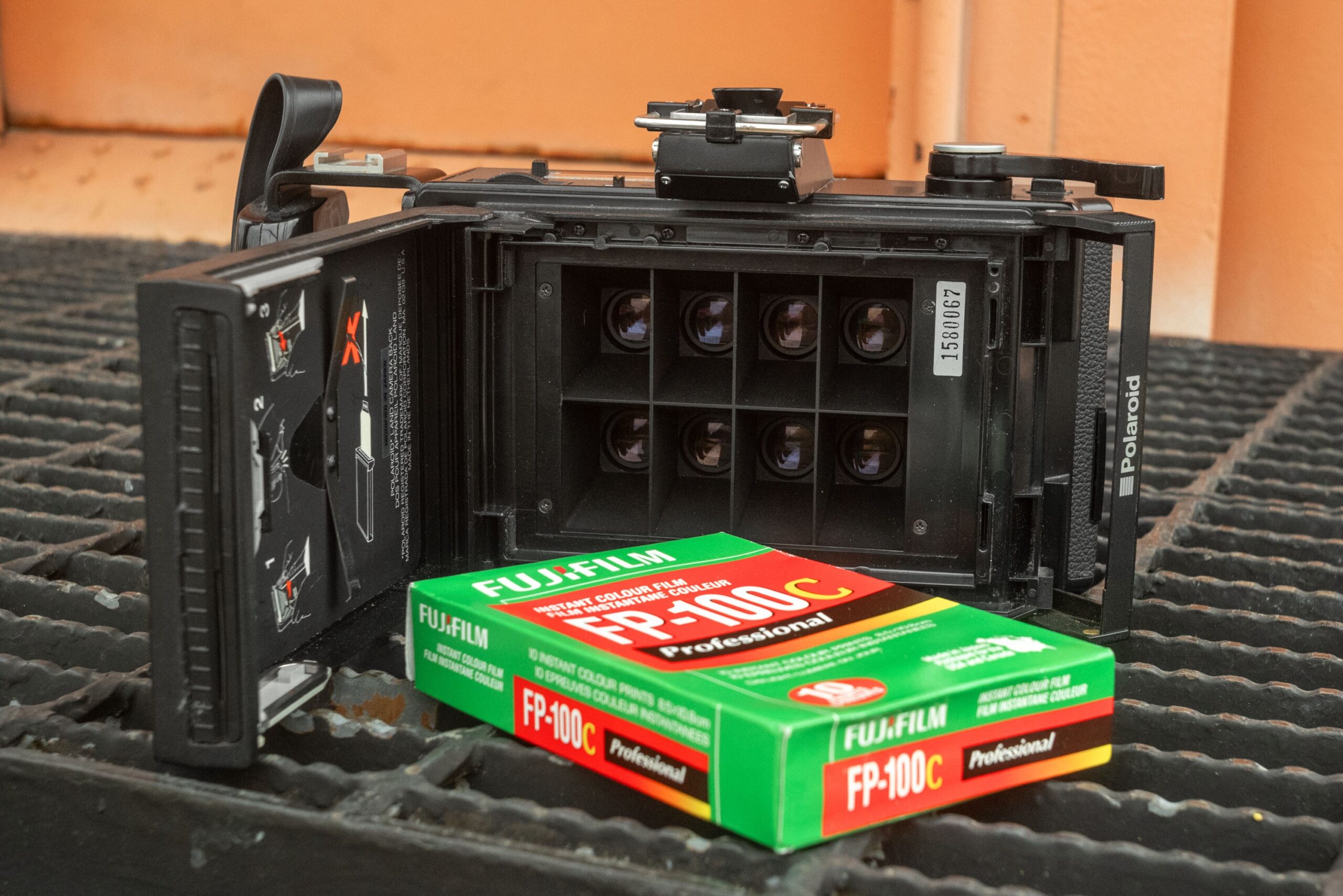
Despite the calendar saying 2026 and it being nearly ten years since Fuji stopped producing the last packs of Fuji FP-100C, I am one of the few people left in the world with a supply of unused frozen film. I picked this film up from the collection of Kurt Ingham, who had told me this film was still good, and so far, every pack I’ve shot of it has turned out well, so I decided to put a couple through the Acmel Sequence 8 to see what kinds of results I would get. The first pack was regular FP-100C but the second was the “Silk” variant, which differs from regular FP-100C with warmer tones and a matte-like finish to the prints. The camera does not have any ability to adjust for ISO of the film, and with only a single shutter speed, I needed to be creative in which lighting I shot it in. Since the Fuji film is rated at ISO 100 and the shutter on the Sequence 8 fires at 1/300, I kept it outside and used Sunny 16 with +1 EV.


When it comes to judging image quality, instant film cameras are some of the hardest to evaluate as instant film is so different from traditional film formats that apples to apples image quality comparisons are impossible. I was not able to find any information regarding the makeup of the eight lenses on the Acmel Sequence 8, but even if I did, finding out how many elements each lens had wouldn’t have likely told you much about the image quality.
Looking at the results from the test shots I made, the images are predictably soft and lacking in sharpness, at least when compared to color negative film, but compared to other types of instant film results, compare favorably. It is clear that whatever types of lenses this camera has, they were good enough for the job they were asked to do. An interesting, yet unexpected artifact of the sequential lens design is that each image overlaps the image next to it by a small amount. This certainly isn’t enough to ruin the images, but for someone looking to crop a single sheet into eight separate images, would have needed to take this into account.
While testing the Acmel Sequence 8, initially I used it in automatic mode, allowing the 8 shutters and lenses to capture options in motion. See the images of the little girl on the swing set, jumping into a pool and riding her bike. While undoubtedly cool, I found the process of taking these images to be anxiety inducing. Never mind the fact that packs of FP-100C can sell for upwards of $200 for 10 shots, that each image was the equivalent of spending $10 was bad enough, but having so little control over exposure, estimating my composition using a wire frame finder, and not always knowing the exact delay between the shots made getting a “picture perfect” sequence photo difficult.
It wasn’t until I loaded in a second pack of film, this time Fuji FP-100C Silk (there goes another $200) that I had the idea to try the camera in manual mode where I have to fire each of the 8 shutters one at a time. Once I started using the camera to capture collections of photos, I found the process to be a lot more fun. In a number of the exposures, I would walk around a city center, or a military helicopter and look for images that would fit together in a scene. I used the same concept as you would for a diptych where I wanted to group similar, but not identical images together. I really enjoyed the act of using the camera this way, and had it not been for the rarity and expense of continuing to use more and more packs of film, I could see myself shooting a lot of images this way. I am fairly certain that using the camera this way was not how most people used it, but if they did, they probably enjoyed it as much as I did.
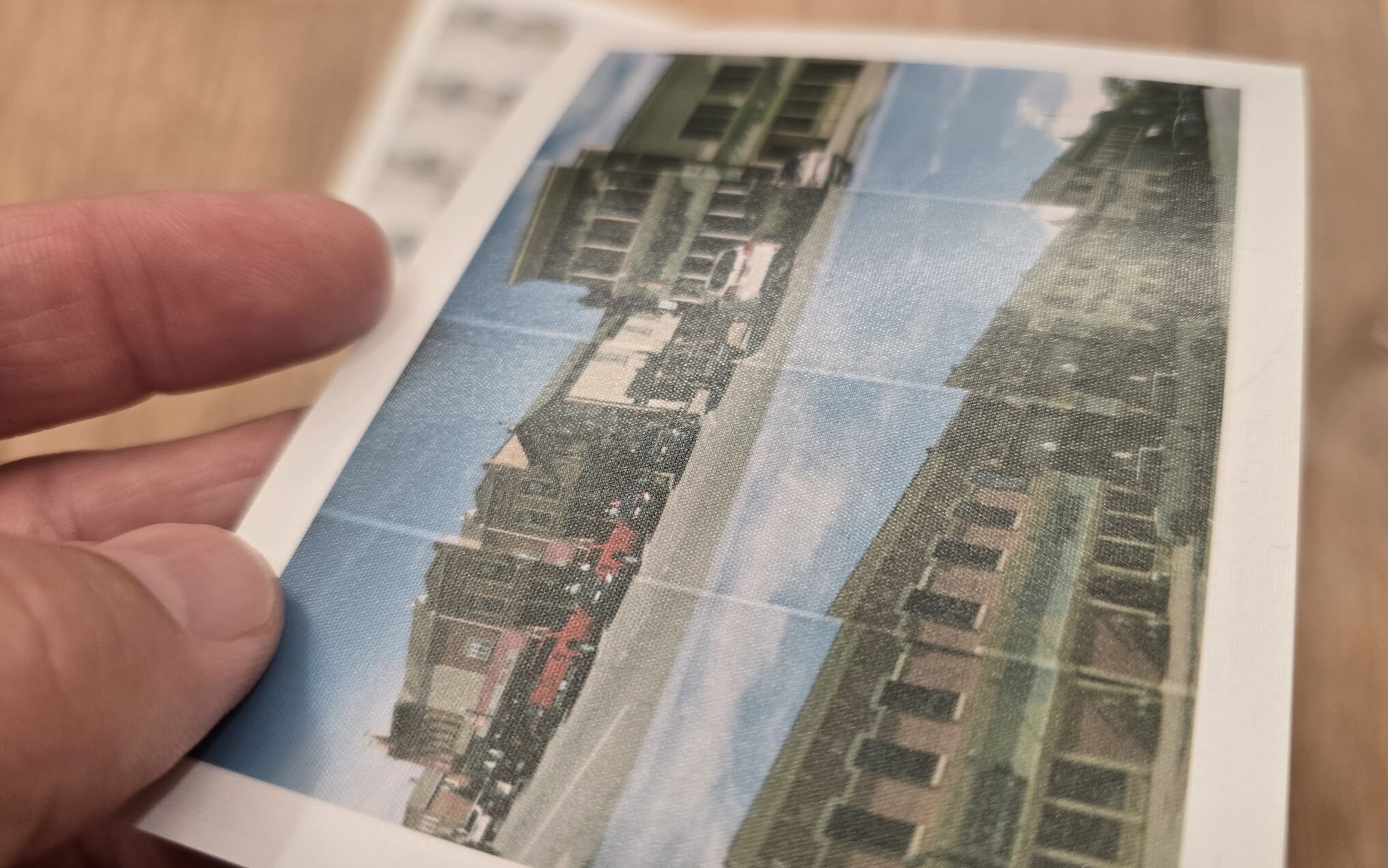
What is FP-100C Silk? Fuji’s “Silk” line of peel apart instant film is just like regular FP-100C, but the color palette is slightly warmer and each print has a pebbled “matte” finish which reminds me of older photographic prints from the era of my grandparents. Not only does the matte finish help hide finger prints which show up easily on the glossy finish of regular FP-100C, but it looks cool and probably is more scratch resistant too.
The Acmel Sequence 8 was not a general purpose camera, and should not be judged as one. This was a specialty camera built for a very specific purpose and I think it does a good job of it, even if I enjoyed using it in full manual mode. Each of the eight 24mm x 40mm images are slightly larger than a negative from a full frame 35mm camera and are just large enough to be able to make out enough details to see motion between each of the eight shots. Had this camera been used to determine a photo finish in a track and field event, I feel as though there’s enough photo area to tell when someone’s leg crossed a finish line before someone else’s. Fine details like reading the text on a runner’s shoe wouldn’t be possible, but that wouldn’t have been the point. Considering the use for this camera, I think the images look very good. As an aside, it still amazes me that the Fuji FP-100C films I used still looked this good nearly a decade after their expiration date.
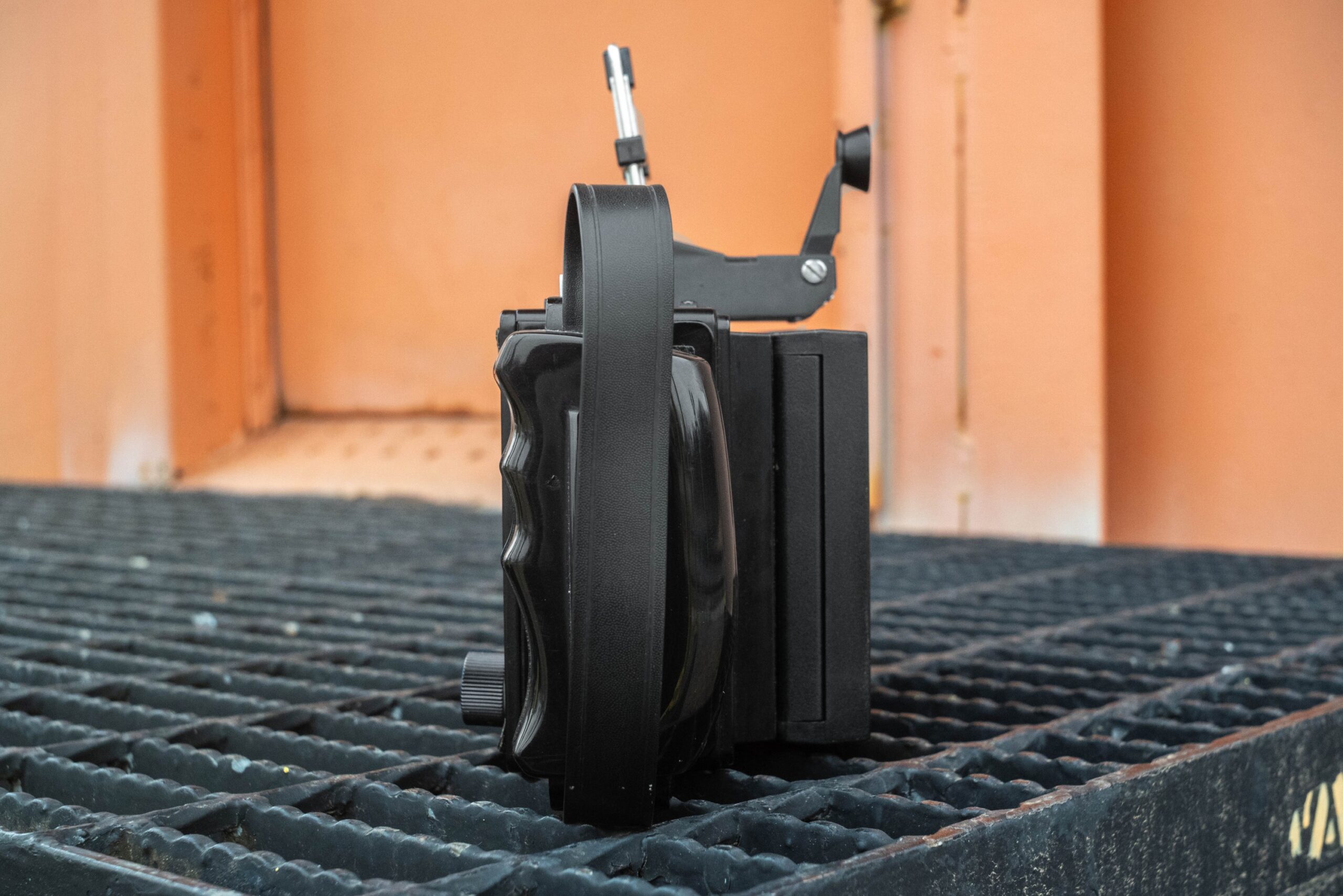
Using this camera was a mixed bag. It should be pretty obvious by looking at the images of this camera in this review, that the Acmel Sequence 8 is a very large device. Combined with the large, permanently mounted handle, the camera is nearly a foot wide, and weighs almost 4.5 pounds (~2010 grams). There is not a jacket in the world in which this camera could discreetly slip into, and although the sounds of the shutter aren’t overly loud, that you hear the sound of eight of them individually firing (in Auto mode), means that people will notice you shooting this camera.
While the Acmel Sequence 8 is huge and not very portable, it is a simple camera with little need to read a manual beyond understanding how the shutter delay works. Beyond that, your only control over exposure is via the aperture wheel on the side and that’s it. I didn’t mind using the wire frame finder as precise composition is not a requirement of a sequence camera. With a fixed 1/300 shutter speed, you cannot change shutter speeds which limits the camera’s use in low light scenarios. Assuming the eight nearly half-century old shutters weren’t firing at their original speeds, and that ASA 100 instant film is all that I had access to, all of my test shots were done using Sunny 16, assuming I had a shutter speed of around 1/100 of a second. Instant film doesn’t have a ton of latitude, but I figured I would be “close enough”.
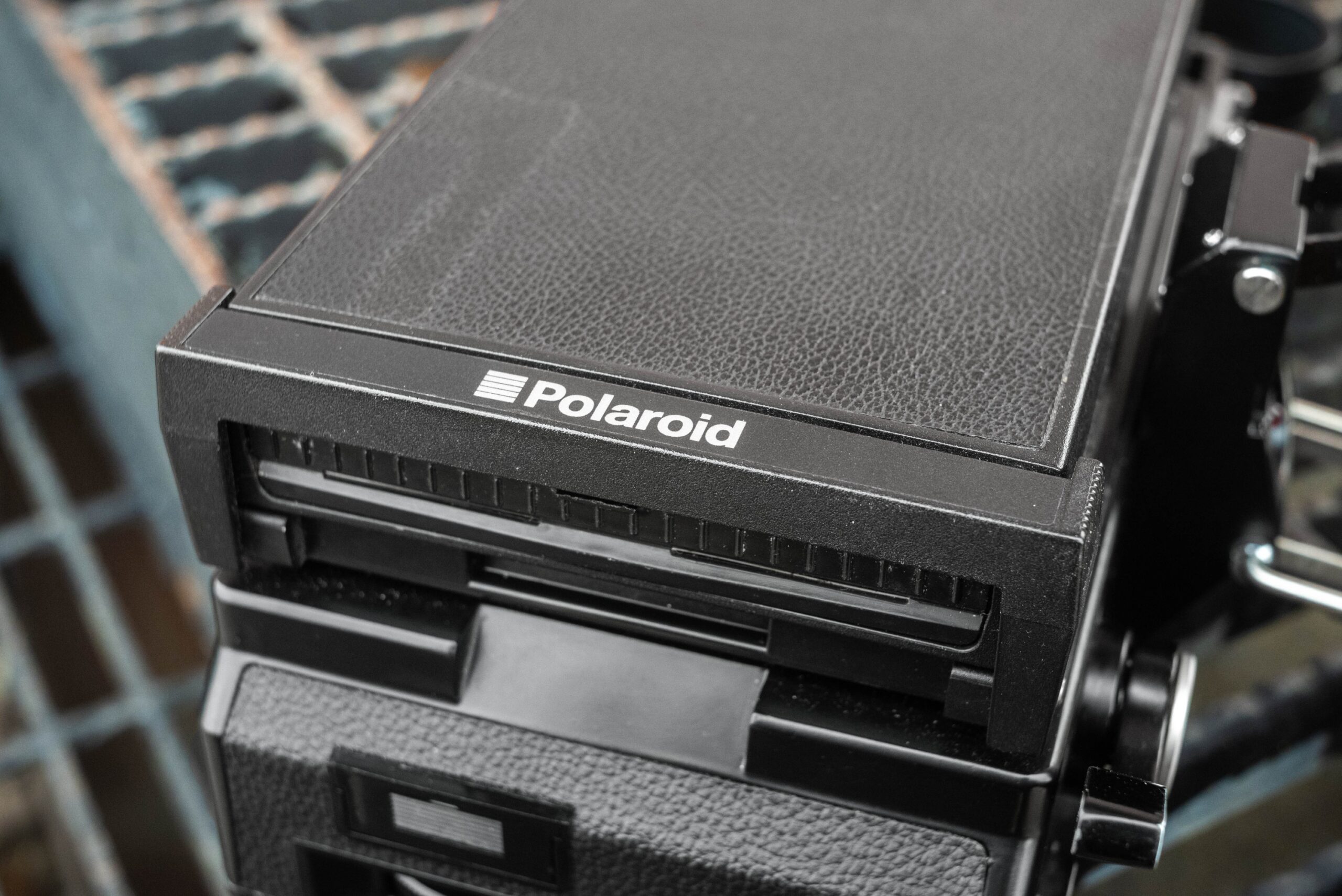
Beyond wishing there was more exposure control, the only other nitpick I have of the camera is that I didn’t care for the plastic latch that holds the film door shut. Instant film is prone to the same light leaks as regular film is, and if the film door were to accidentally open with unexposed film in it, you’d ruin some exposures. Although it never happened to me while shooting the camera, I felt as though it would have been too easy to accidentally release the latch and have the door pop open.
The Acmel Sequence 8, along with the other name variants it was sold under, is a pretty uncommon camera. It was intended for very specific uses and as a result, probably not a lot were made. Finding one in good condition is hard enough, but considering that instant peel apart film hasn’t been made in over a decade, the possibility of shooting one of these cameras is extremely rare. If by some chance, you still have some usable film and have a need for 8 small images on instant film in rapid sequence, there is no better option, and for that incredibly niche purpose, I think this is a very cool camera which I am happy to have in my collection.
Related Posts You Might Enjoy
External Links
http://www.mediajoy.com/en/cla_came/KING_seq/index.html
https://www.eyescoffee.com/v1/collectcamera/kingcheckpolaphy/
https://www.oldcam.be/en/auction/200/item/5320
https://collection-appareils.fr/x/html/camera-3274-Asanuma_King%20Check%20Polaphy.html