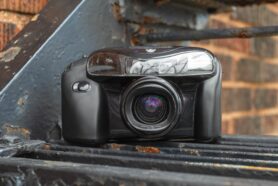
The Konica AiBORG is a 1991 "bridge camera"—one of several oddly styled hybrid still cameras from the early '90s, alongside the Chinon Genesis, Canon Photura, Ricoh Mirai, and Olympus IS-series. Nicknamed the "Darth Vader" camera for its bulky black plastic body, it featured a 3x 35-105mm zoom, a 5-point "moving frame" autofocus system, and a dozen scene modes accessed via an icon-based menu. The author originally reviewed and harshly panned it back in 2016, calling it the worst camera he'd ever used, and years later decided to borrow a working copy from a fellow collector (Ray Nason) to see if his opinion would change with more experience and a better-functioning sample.
Revisiting the camera in 2025, many of the original complaints held up: the shutter release is awkwardly placed on the front grip, the sliding power switch is oddly designed and protrudes when in use, the four-way joystick for zoom/autofocus is poorly positioned relative to natural hand placement, and the scene-mode menu remains gimmicky and cumbersome, burying useful options like spot metering behind several unnecessary steps. The viewfinder, while impressively packed with zoom-matched framelines and automatic parallax correction, remains uncomfortably small, and oddly displays distances only in meters. Film loading, however, was straightforward, with automatic DX detection and rewind. Where the author's opinion shifted was on image quality: contrary to his 2016 verdict, this second AiBORG produced sharp, well-exposed, and well-focused images across a full roll of Fuji 400, with only minor vignetting at the wide end and only mild autofocus hunting on the shutter. He now suspects his original camera may have had a fault or that he simply misjudged its optical performance the first time.
Despite the improved image quality, the author's overall verdict is unchanged: the AiBORG remains a "terrible" camera when judged as the serious, premium product Konica marketed it as (originally priced around $510, roughly $1200 adjusted for inflation). Its poor ergonomics, confusing controls, and cramped viewfinder are inexcusable flaws for a camera of that price and pedigree, even if the lens and metering system perform well. He concludes that while it's not among the truly disposable "scam cameras" he's encountered, it stands as the worst *serious* camera he's tested in over a decade of reviews—and jokingly warns his future self never to revisit it again.
AI-generated summary. May not capture every detail — read the full article below for the complete picture.
Back in April 2016, I published a review for an advanced point and shoot camera called the Konica AiBORG. In that review, I was highly critical of the AiBORG, saying the ergonomics were terrible, the layout of controls was illogical, that it had a tiny and difficult to use viewfinder, and it produced images with poor quality. In the grading scale I used back then, I gave it a total score of 2.0, with the two points coming from the fact that it does have a very long list of features. In the years since that review, I have never given any camera a rating that low and I’ve continually referred to the AiBORG as the worst camera I have ever used.
Back then, this site was in its infancy, I hadn’t even 100% committed it to camera reviews as I would still occasionally publish my thoughts on music, TV shows and other non-camera related content. The way in which I approached camera reviews, including the level of research and my understanding of how cameras work and their histories was very different than it is now. While I won’t say my reviews have ever been perfect, I’ve certainly come along way since April 2016.
As my site recently celebrated its 10th anniversary, I have reflected back on some of the articles I’ve written in the past and I’ve put thought into what things I would do differently if I was doing them today. In several episodes of the Camerosity Podcast, the Konica AiBORG has come up and I’ve reiterated my declaration that it is a terrible camera, but that got me to thinking… Was I overly harsh on the camera? Perhaps my approach, or how I tested the AiBORG in 2016 is different than how I would have reviewed it today. Maybe, I thought, it wasn’t really as bad as I remember, so I thought if I was going to give a camera a re-review, this would be it.
My first challenge was finding one. That original AiBORG left my collection long ago and since then, prices on them are much higher than they were in 2016. Looking at used sales for AiBORGs on eBay, many are in inoperable condition and even then people are asking $100 and up. Confirmed working examples had opening bids with prices I wasn’t comfortable with spending for a camera that had a very good chance of still being terrible. Putting my desire to buy another AiBORG aside, I decided to try a different tactic and put out a call to the Camerosity community to see if someone would lend me theirs and almost immediately, Ray Nason offered up his. Ray hand delivered the AiBORG to me at the end of March when I saw him at the Cincinnati Camera Show.

Ray’s AiBORG was in good working order, but it did show signs of use. Someone clearly put this camera through its paces at some point in its life, which is actually a good thing as shelf queens often are at higher risk of developing issues. After putting in a fresh 2CR5 lithium battery, Ray’s gently used Konica AiBORG fired right up.
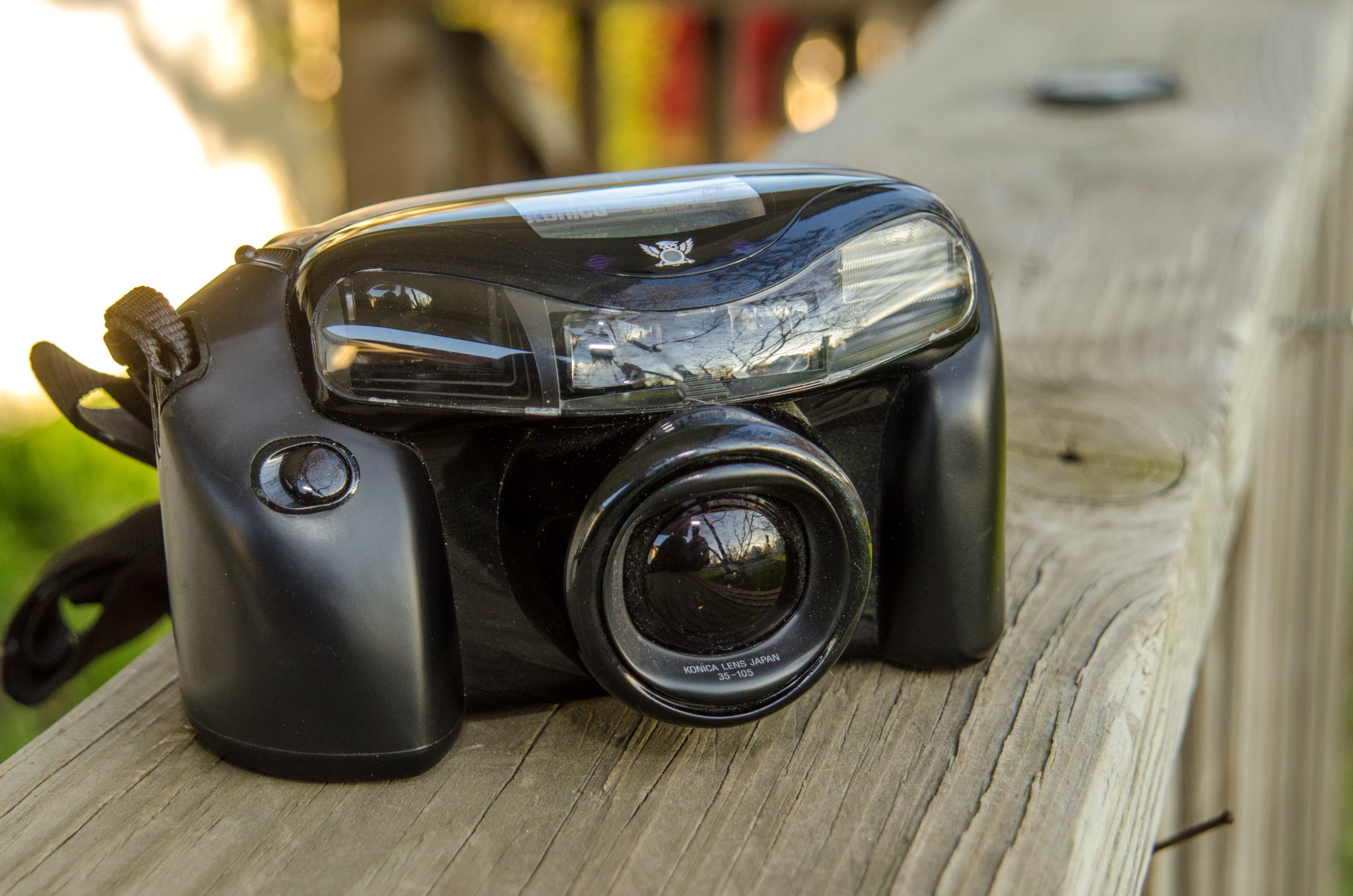
The general appearance of the Konica AiBORG is quite polarizing. Almost immediately after its release in 1991, it was given the nickname the “Darth Vader” camera for its mostly black appearance with what look like dual hand grips, somewhat mimicking the shape of Anakin Skywalker’s protective helmet. That the AiBORG has such a non-traditional shape was not out of the norm for the era it was made during a time when many manufacturers were experimenting with strangely designed “bridge cameras”. Chinon had the Genesis, Canon had the Photura, Ricoh had the Mirai, and even Olympus tried to reinvent the 35mm SLR with their IS-series.

A common trait of all bridge cameras is that they’re usually very bulbous and not very pocketable. With the exception of the Coke-can shaped Canon Photura, you’re not going to fit a Ricoh Mirai into anything resembling a small pocket, and the Konica AiBORG is no exception.

The AiBORG’s body is entirely made of plastic. The plastic is of the hard, shiny variety and over time shows signs of wear and tear. This makes finding a truly mint condition AiBORG difficult as most will have surface scratches in the shiny plastic and areas where the silkscreened paint has worn off. The large hand grip on the camera’s right side gives it a level of grip not often found on point and shoot cameras. On the left side (facing the rear of the camera), a second, but smaller grip allows the camera to be securely held with both hands.

The camera’s shutter release is on the front face of the larger hand grip. This location was one of my biggest gripes from my 2016 review because its location is extremely awkward, and requires you to contort your right index finger to reach. When picking up the camera with my right hand, my right index finger naturally falls nowhere near this location. I have what I’d consider average size adult hands, and I suspect that people with longer fingers than I would struggle even more with the shutter release’s locaiton.

Two signature features of the Konica AiBORG are the 3x 35mm – 105mm zoom and the 5 point “moving frame” auto focus system. While the AiBORG wasn’t the first camera with a 3x zoom, it was still a relatively new thing to have, and to have multiple auto focus points in the same camera was a pretty big deal. Add to that a long list of exposure and shooting modes and you can see why people got excited about the technical specs of the camera.

The problem is, nearly every mode and every tactile switch on the camera is poorly executed. Starting with the camera’s power switch on the back right corner, you have to use a fingernail to pry out a sliding lever to power the AiBORG on. With the camera powered on, the power switch protrudes out of the back, just begging to get snagged on something. I don’t know that in 10+ years of writing reviews on this site, have I ever seen a more strangely designed power switch.
Changing both the zoom and auto focus system is done with a four way joystick on the back of the camera, which like the locations of the power switch and shutter release, is poorly located. You can tell that Konica intended the user to control both functions with your right thumb, but the joystick’s location is too far up and to the right of where your thumb naturally falls. Making matters worse, positioning both your right thumb and index finger in a position to locate both the joystick and the front shutter release at the same time is nearly impossible and any attempt to do so will result in instant hand cramps. I suppose those with smaller hands and shorter fingers might find these locations more ideal, but for me, I struggled with both. Handling the camera in 2025, my opinions of these ergonomics are the same as they were in 2016…terrible.

Another major gripe was the confusing top LCD display and ludicrous icon based menu system for the Konica AiBORG’s 12 scene modes. I spent a lot of time in my 2016 review covering each of the modes, so if you’re interested to know more about them, I definitely recommend reading that review. My 2025 opinion is unchanged. While I applaud Konica’s attempt to think outside the box and come up with some cool new ways to use your camera, many of these modes are gimmicky and likely not anything probably 99% of the AiBORG’s users ever tried more than once. Even more frustrating, is that of the few modes you might actually want to use, such as Spot Metering Mode, or using the +/- EV setting, these modes can’t be accessed directly, you must first cycle through six other, far less useful modes before you can get there.

Finally, my last major complaint is the tiny viewfinder. In my 2016 review, I comment that the AiBORG’s viewfinder is smaller than the Konica Auto S2 from 25 years earlier, and while that is true, one thing I didn’t give it enough credit for is the amount of technology in the newer camera’s viewfinder. In addition to the LCD overlay, the AiBORG’s viewfinder matches the 3x zoom of the lens, showing the correct focal length from 35mm to 135mm. In addition, the AiBORG offers automatic parallax correction, masking off areas that will be cut off when focusing the lens to minimum distances. All this technology added complexity, which likely required it to be more compact. While this is a good, logical explanation, it is still uncomfortably small.
Comparing the physical size of the AiBORG’s viewfinder to that of the other four bridge cameras in the group photo above, the Konica is smaller than the Olympus, Yashica, and Ricoh, but matches that of the Canon Photura. So while there is probably a good reason for the viewfinder to be this size, it is still painfully small for a camera whose 1991 price would have been more than entry level SLRs.
Oh, and in addition to all my issues with the viewfinder, I still find it very strange that the camera only displays distances in meters. While those of you outside of the United States likely will not see this as an issue, it is a strange thing to see in a 1990s camera as most offered both.

Now that I’ve suitably aired my grievances over the ergonomics, menu system, and tiny viewfinder, I can say that loading film into the camera is refreshingly normal and pain free. Open the back with a small latch on the camera’s left side, press in a new cassette, stretch the leader to the yellow line and close the door. The AiBORG has automatic film loading and DX detection, so no additional steps are needed to get the camera ready for the first shot. In addition, the camera automatically rewinds film at the end of the roll.

While using the camera, I really tried to adapt to the camera’s awkward controls. Maybe the problem was me? I tried to position my hands in a way that was more compatible with its controls, rather than hold it how I thought it should be, but no matter how hard I tried, I just couldn’t do it. I struggled with the viewfinder and its meter only distance measurement. The little triangle that shows the detected focus distance is small and faint, making it difficult to see in all but the brightest scenes. I was able to see all four corners while wearing prescription glasses, but barely. I had to press the camera uncomfortably close to my face to see them. In my 2016 review, I commented that the viewfinder was dark and blurry which didn’t seem to be the case here. While certainly the brightness is not that of a modern SLR with laser etched ground glass, it was acceptably bright for me, so perhaps my original camera had some issues.
When it came time to actually test the camera, it was still late spring with inconsistent lighting outside, so I chose Fuji 400 thinking that the extra speed would give me greater opportunities to shoot the AiBORG in good lighting to give the camera its best chance at making good images.


Shooting the AiBORG again in 2025 was mostly uneventful other than a few instances where there was a noticeable delay in getting the shutter to fire. When this happened, I would have to hold the shutter release down for 1-2 full seconds before anything would happen. I assume this delay was the metering or focusing system trying to lock in on whatever I was pointing the camera at, but that I didn’t try to shoot any difficult images, I can’t explain why it took so long. Slow auto focus performance was pretty common in the 1980s with point and shoot cameras, but it was disappointing to see that a supposed premium camera from 1991 still struggled with slow performance. As I neared the end of the roll, I nervously awaited seeing the results. After all these years of hating the AiBORG, would it be redeemed?

One thing I got wrong from that first review was my claim that the AiBORG wasn’t capable of good images. I don’t know if that original camera had operational issues or that I just didn’t know what the heck I was doing as the images I got from this second example were quite good and easily on par with other Konica cameras of the era.
Using the camera to shoot general things around the town where I lived, I found that the 13-element zoom lens produced images with good sharpness and contrast from corner to corner. Some vignetting was visible at the widest end, but nothing you wouldn’t expect from any consumer zoom lens from the early 1990s. The lens’s 3x range from 35mm to 105mm covered the sweet spot of the most commonly used focal lengths. Certainly it wasn’t as flexible as superzoom cameras which were on the horizon, but I never found an instance where I felt a wider or longer lens would have been necessary.
The camera’s metering and focus systems both worked well, returning an entire roll of properly exposed and focused images. The only image in the gallery above which wasn’t perfect is my mirror selfie, but I’ll actually defend the AiBORG here as shooting reflected images through a mirror is something that nearly every auto focus camera I’ve used, struggles with. Clearly the optical system of the Konica AiBORG was up to the task, and for some reason, I missed that in my original review.

Here I am, at the bottom of the review, having re-reviewed a camera that was surprisingly terrible in 2016. In the years since, I have often referred to the Konica AiBORG as the worst camera ever. Nine years later, with hundreds of more camera reviews under my belt, surely I have found worse, right? If you count those “scameras” with the lead weights in them and the all plastic “Japanese Optical Lens” cameras which were sold by telemarketers and given away as rewards for signing up for a credit card, yeah sure, those are worse. I might even agree that a wrapped in cardboard, all plastic disposable camera with fixed focus, fixed exposure, and f/11 lens is a technically worse camera than the AiBORG, but for me, those cameras aren’t meant to be serious cameras. Promotional “trashcams” are not real cameras, they are functional toys. A disposable camera is meant to be disposable, and built in the cheapest possible way while still being able to make okay images.

The Konica AiBORG is not those cameras and should not be compared in the same way. This was a serious camera that Konica proudly advertised as a “top of the line” model. Even the camera’s name, “Ai-BORG” is meant to suggest futuristic technology like Artificial Intelligence and Cyborgs. When it was new, the camera had a suggested retail price of $510 which when adjusted for inflation compares to $1200 today. Sure, it never sold for that much, but even at a more realistic street price of $350, this was a serious investment for anyone who purchased one, and for that kind of money, terrible ergonomics, a confusing and illogical menu system, and a barely adequate viewfinder just simply don’t cut it.

Reviewing old cameras requires you to step into the shoes of the person who might have bought a particular model when it was new, and when I do that with the AiBORG, there is no way I can imagine that original owners of this camera were happy with their purchase. I will admit that I missed a couple things in my original review, but nine years have passed and after shooting this second example, I can’t honestly say my opinion has changed much. I got much better images this time around, and I feel that I have a better understanding of some of the reasonings behind why this camera works the way it does, but overall, for a company like Konica with such a storied history, to make such a poorly designed camera is inexcusable. I have a hard time believing that this model ever went through any sort of user acceptance testing before it was released.
Quite simply, the Konica AiBORG is now, and has always been a terrible camera. There are far too many ergonomic, functional, and technical flaws to excuse its good image quality and long list of features. I can still say that in the ten plus years I’ve been writing reviews on this site, it is the worst “serious” camera I have ever used. And if I can leave a note for future Mike, if in the year 2035 I think I want to re-revisit this camera again, DON’T!!!
You have been assimilated?
Some years ago I was asked to write a “10 Ugliest Cameras’ for a local (Australian) magazine’s website. It was part of a regular series on photographic disasters. Guess which camera won? Over stiff competition.
I too later went back and tested it and agree – weird as hell, i found, but capable of decent images if you could work it out. It is a Konica lens after all.
In that it was fun to play with. For the challenge if nothing else. But still as ugly as… Note: Samsung also had a few uglies in the late stage of film. One so bad that a local retailer had a $20 bill on the shelf under each of the two he’d stocked (bought in on a Friday afternoon when he’d had a beer or two, as he did). The $20 was for the assisatnt who could sell it. It worked for one.
But Then I noticed something else. It’s as if the product development team had sat around and asked, “How can we make it worse? I know – glitter!” Yes, in the deep black plastic of the helmet’s top there is embedded a subtle trace of glitter.
I wonder what happened to the designers and anyone who signed off on it. Some gulag in the Japanese frozen north, next to the chilled apes? There are bad corporate decisions and I can name a lot of cameras that fit but this?
I was a kid when this camera came out, and I thought it was the ugliest I’d ever seen. Silly too, with the icons.
The reason the AF system does not work in the mirror shots is because those active systems use a IR beam, which does not see your reflection, it sees the mirror. So the AF focuses on the mirror, not on your reflection, which is twice as far away.