The Kilfitt Mecaflex is a compact 35mm leaf-shutter SLR designed by Heinz Kilfitt, notable for being the only mass-produced 35mm SLR to shoot 24mm x 24mm square images. First produced by Metz in Germany starting in 1953, production later moved to SEROA in Monaco from 1958 after Kilfitt's arrangement with Metz fell apart. The camera's design priority seems to have been showcasing Kilfitt's lenses, with only a handful of Kilar lenses ever made for the system, and the camera itself remains rare and little known outside collector circles.
The review camera featured a 40mm f/3.5 Heinz Kilfitt Kilar lens, a Prontor-based leaf shutter (1 to 1/250 or 1/300 depending on version), a non-removable waist-level finder with a clever pop-up magnifier offering two levels of magnification, and a fast-action sports finder. The author compared an early Metz-built Mecaflex to a later SEROA model, noting cosmetic differences (body texture, shutter labeling, and the addition of a split-image focus aid on the SEROA version). Hands-on testing was plagued by problems: a faulty lens on the author's SEROA copy ruined a test roll, a borrowed Metz Mecaflex produced perfect mechanical results but was let down by badly expired film, and a third attempt required shooting wide open at f/3.5 due to a broken diaphragm. Despite these issues, the Kilar lens performed impressively wide open, with strong center sharpness, pleasing bokeh, and only minor edge softness. However, the author found the ergonomics frustrating—cramped shutter release and rewind knob, a bayonet mount lens that could easily fall off, and generally uncomfortable handling despite the camera's logical control layout.
Ultimately, the author credits the Mecaflex for its historical significance, unique square-format SLR design, and excellent lens, but found the actual shooting experience unpleasant due to its numerous ergonomic compromises. The verdict is clearly negative on usability: despite curiosity about what it would be like to shoot a 24x24 SLR, the author concludes readers "won't enjoy this camera" and was relieved to finish testing it.
AI-generated summary. May not capture every detail — read the full article below for the complete picture.
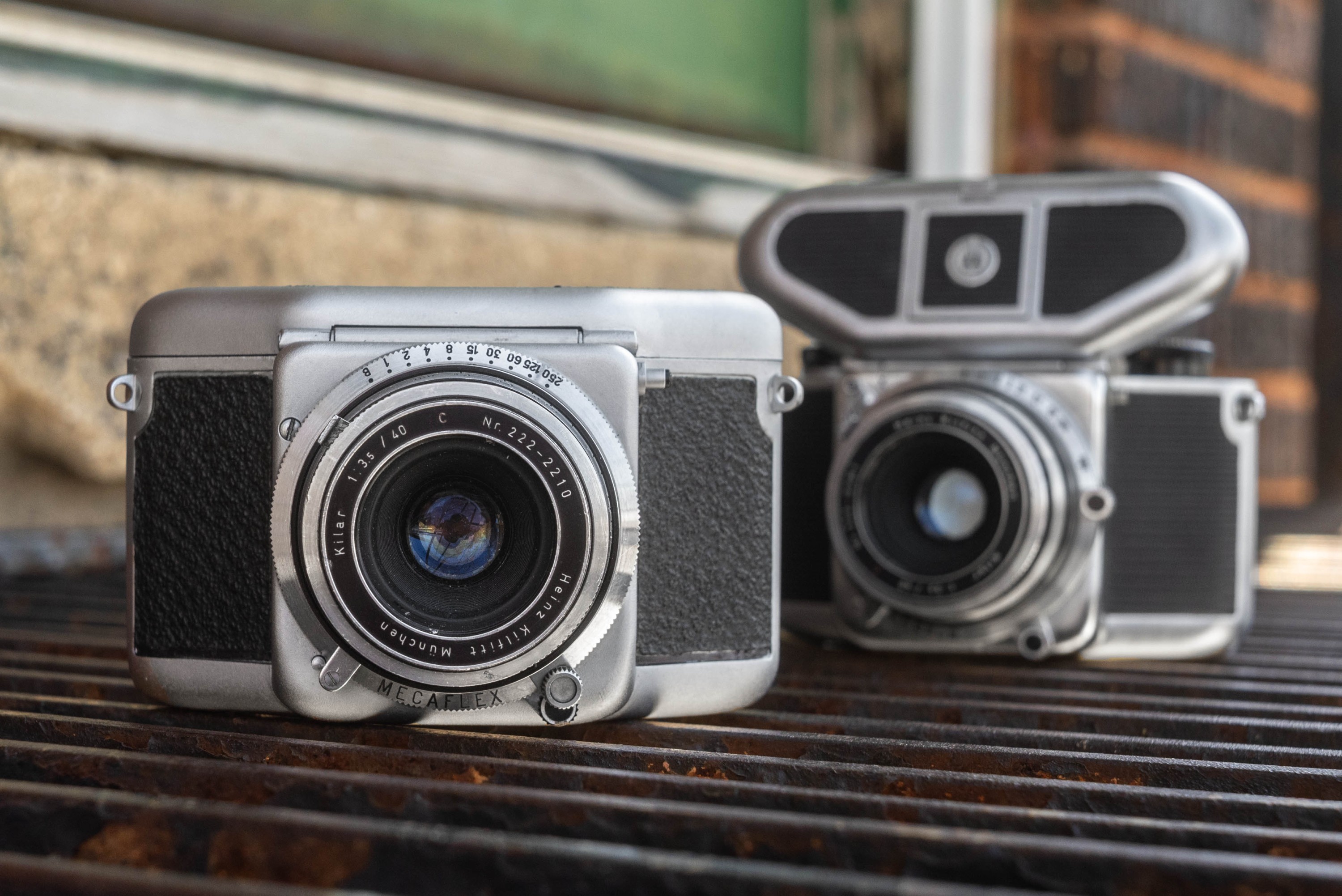
This is a Kilfitt Mecaflex, a 35mm leaf shutter SLR camera designed by Heinz Kilfitt but produced by SEROA in the Principality of Monaco starting in 1958. This version of the Mecaflex was a continuation of a model produced under the same name by Metz in Germany starting in 1953. Although the two cameras are similar, there are several differences between Metz and SEROA produced Mecaflexes. The Mecaflex is a very compact and curious single lens reflex camera which shoots 24mm x 24mm square images on regular 35mm film. It is a fully functioning SLR with a waist level finder, interchangeable lens mount, and film advance lever.
Film Type: 135 (35mm) (24mm x 24mm Square Format Images)
Lens: 40mm f/3.5 Heinz Kilfitt Kilar C coated 4-elements in 3-groups
Lens Mount: Mecaflex Breech Lock Bayonet
Focus: 0.5 meters to Infinity
Viewfinder: Waist Level Coupled Reflex Viewfinder and Fast Action Finder
Shutter: Prontor Leaf
Speeds: B, 1 – 1/250 seconds
Exposure Meter: None
Battery: None
Flash Mount: PC Port M and X Flash Sync
Weight: 680 grams, 618 grams (body only)
Manual (in German): https://cameramanuals.org/pdf_files/mecaflex.pdf
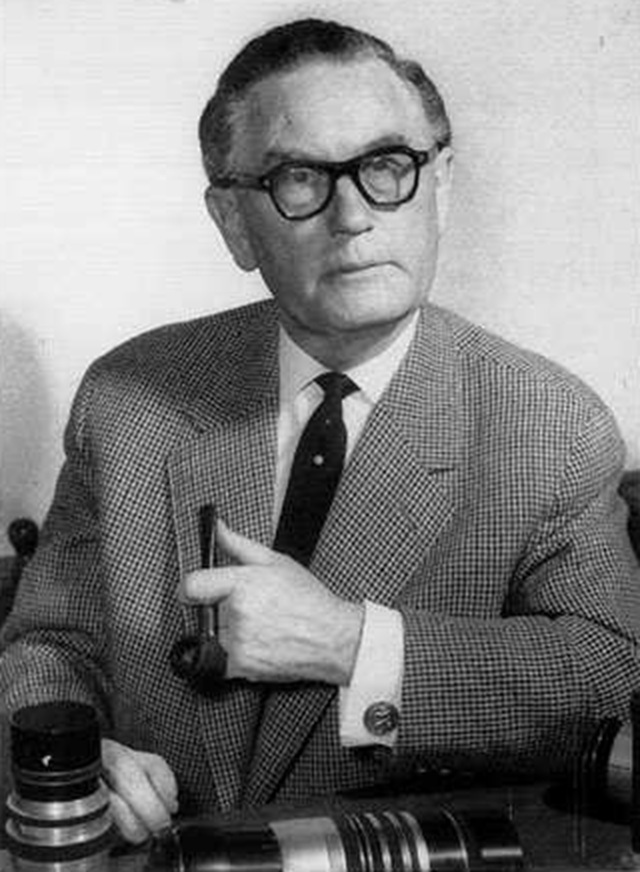
Whenever you mention the name Heinz Kilfitt to a camera collector, the first products that will likely come to mind will be one of his company’s excellent lenses made for the Alpa, Exakta, and other camera systems. The Kilfitt-Makro Kilar is one such lens which I have previously written about and declared to be my favorite film lens of all time.
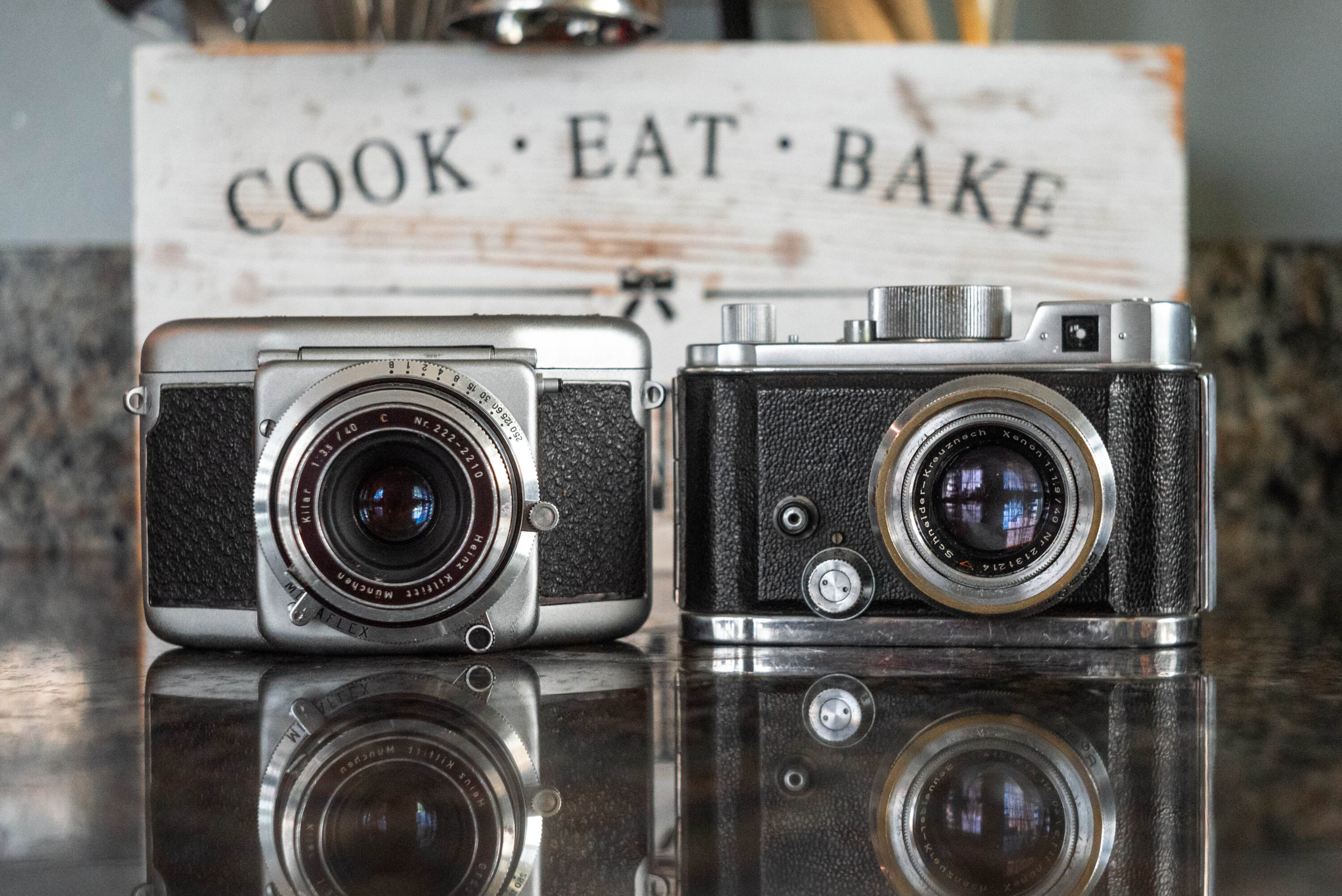
In addition to lenses, Heinz Kilfitt was known for the spring wound Robot camera, first designed in the early 1930s. Beyond the Robot’s signature clockwork motor drive, the early models were very compact and shot 24mm x 24mm images on regular 35mm film loaded into special cassettes. Later versions of the Robot could load regular 35mm cassettes, but still required a special Robot take up cassette and even later Robots abandoned the square format and shot regular 24×36 images. Robot cameras would remain popular for several decades, being used by militaries and in industries where a compact motor driven camera was useful.
When talking to those collectors about Heinz Kilfitt, less frequently will the Mecaflex come up as it was produced for a shorter amount of time than the Robot and is less well known today. Side by side, the two cameras are very similar in both size and weight with the Robot edging out the Mecaflex in width and height, but being slightly narrower front to back. On a scale, the Mecaflex weighs 680 grams with the 40mm f/3.5 Kilfitt Kilar lens which is a bit heavier than a Robot II at 656 grams with a 40mm f/1.9 Schneider Xenon lens. At arms length however, both cameras are similar enough in size and weight to where they both feel about the same.
Where the Robot manages to fit in an entire clockwork motor drive and unique rotary shutter into a very compact body, the Mecaflex is a complete single lens reflex camera with a mirror box, reflex mirror, and waist level viewfinder, plus it supports the use of standard 35mm film cassettes, unlike the Robot which used different combinations of specialized cassettes. Clearly, packaging a lot of features into very small spaces was one of Heinz Kilfitt’s strengths.
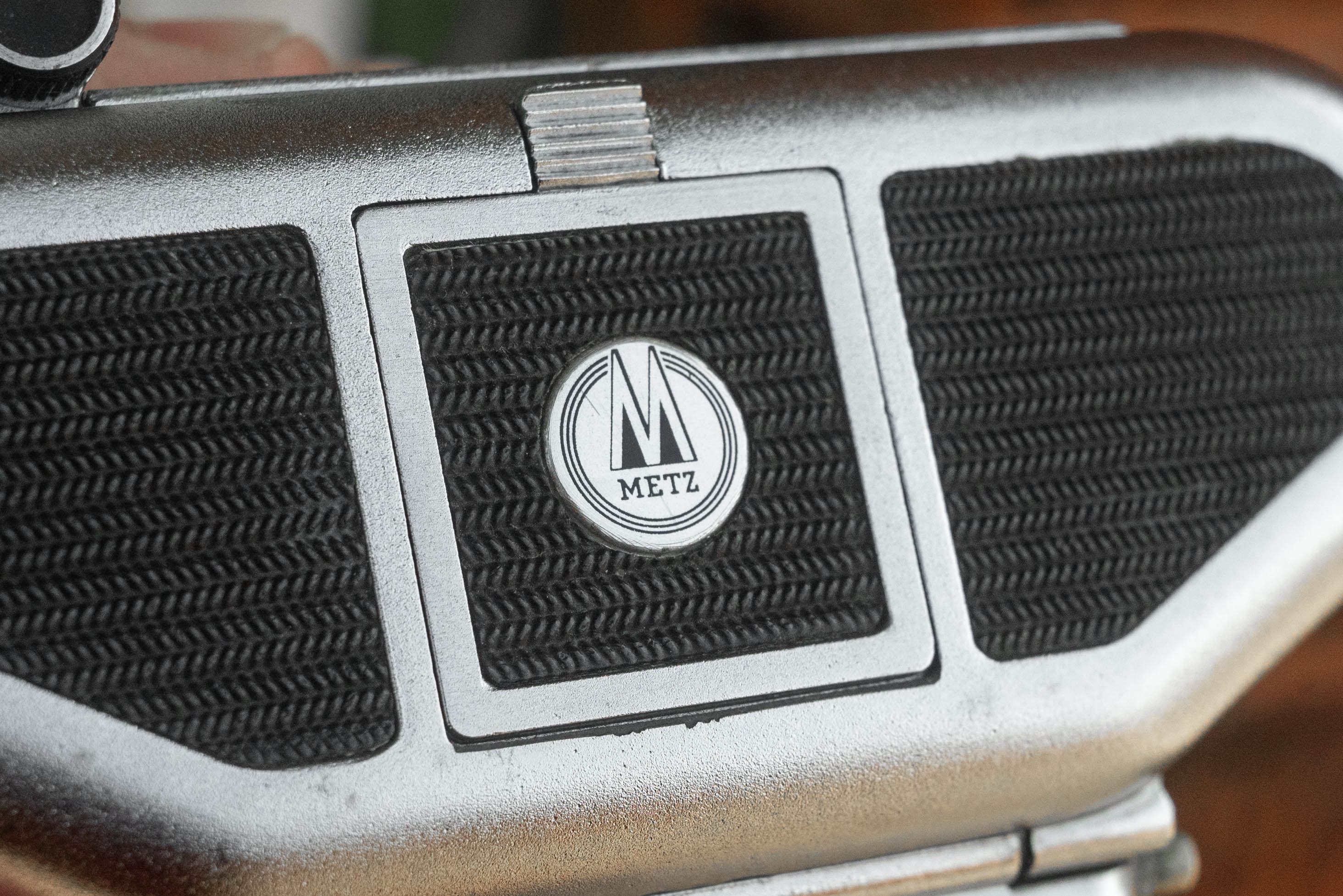
Kilfitt would build lenses for the camera at his factory Kilfitt Kamerabau, in Liechtenstein, but construction of the camera was outsourced to Metz Apparatefabrik in Fürth, Germany, a company who was previously known as a radio and television maker but saw its greatest success making photographic flash units. It is not clear whether the design for the Mecaflex camera or its lenses were completed first, but considering Kilfitt handled lens construction himself, it would appear that the lenses were his priority, and building a camera which could use them was second.
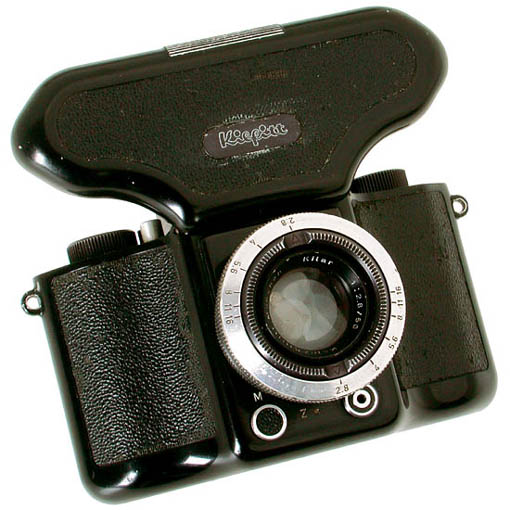
An early prototype of what would become the Mecaflex was shown at Photokina in 1951, but the first cameras did not become available until 1953. Upon its release, only two Kilfitt lenses were available, both 40mm Kilfitt Kilars, one with an f/3.5 maximum aperture and a second with a slightly faster f/2.8 design. A third 40mm lens was produced in France by Berthiot near the end of the camera’s production, but wouldn’t have been available while Metz was making the camera. A telephoto 105mm f/4 Kilar telephoto was also made in extremely low numbers.
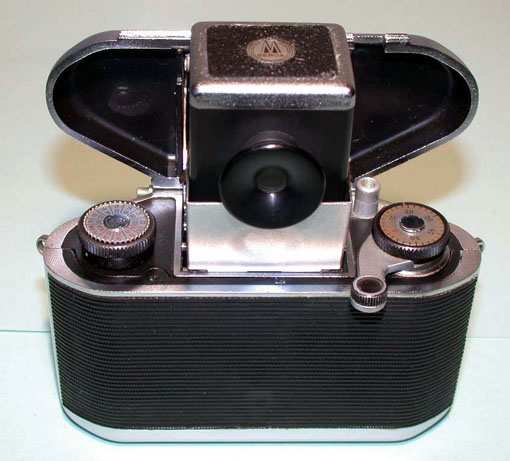
Although the Mecaflex had a non-removable waist level finder, several attempts to produce an accessory eye level finder were made. Since the waist level finder’s hood cannot be removed from the camera, installing any of the eye level finders requires you to partially disassemble the hood by detaching the back half of the hood from the front half by releasing two pins on the side giving you enough room to slide the finder into position.
While researching this article, I found three different designs of the eye level finder, only one of which appears to have been commercially available, although in very small numbers. The earliest design appears to use an actual pentaprism and can be seen in a Leitz Photographica Auction listing. The pentaprism version is clearly a prototype and no other images of it have ever been found suggesting development didn’t make it very far.
Both other eye level Mecaflex finders had a simpler design, relying on a mirror which reflected the ground glass image from the waist level finder to an eyepiece on the back. This would have meant that the image seen at eye level would still be reversed right to left. One version had an uncoupled meter on top, also seen in the Leitz Photographica auction, and the final version can be seen in the following short video made by historian John Wade.
There is not a lot of highly detailed information about the Mecaflex or its history, but several sources, including an excellent article written by historian John Wade for Shutterbug magazine, suggest that whatever agreement Kilfitt had with Metz to produce the cameras fell apart. Exactly what went wrong is not clear, however it probably isn’t a stretch to think that a radio and television maker who had little to no experience producing cameras, probably struggled with the Mecaflex’s proprietary design. In addition, the small size of the camera suggests that its internal mechanism likely required precision parts which were difficult to make, and that probably added to the complexity of its construction. While researching this article, I found no evidence that the Metz Mecaflex was sold in the United States, but a London based retailer named J. J. Silber Ltd. reportedly sold the camera for around £55.
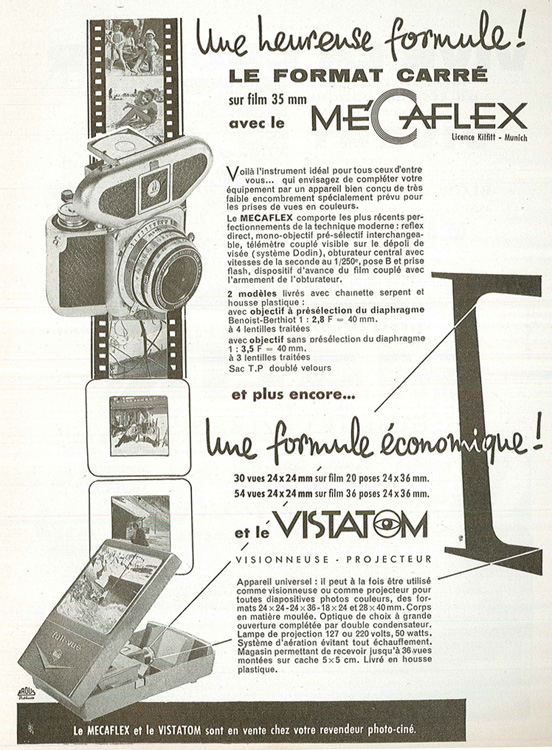
Production of the Metz Mecaflex started in 1953, but it is not clear when it ended. I’ve never seen any kind of detailed production numbers for the Metz Mecaflex, but the number had to have been quite small. As I write this, an eBay search for Mecaflex cameras returns only 3 cameras for sale worldwide. After a dissolution of the contract with Metz, Kilfitt was left with a surplus of lenses but no body to attach them to, so in 1958, a new agreement was reached to resume production of the Mecaflex in Monaco by Société d’Etude et Recherche Optique et Acoustique, or SEROA for short.
SEROA built Mecaflexes would largely retain the same design and features of the earlier cameras with some cosmetic changes, a new type of split image focus screen, and a new shutter. Although 1958 is widely reported as the date the updated cameras went into production, it is not clear when it ended, but a French language ad from 1961 suggests that it was made until at least then. It was around this time that a non Kilfitt lens, the Benoist-Berthiot 40mm f/2.8 was produced, but I’ve never seen an image of one.
In the years which have passed, the Mecaflex is relatively unknown outside of the camera collector community. Its strange design, rarity, and high prices have kept it out of the hands of most casual users so finding detailed information about them today is difficult. In addition, that no other company designed a similar square format 35mm SLR suggests that demand was very low, further keeping these cameras well out of reach for most people.
I first picked up a SEROA Mecaflex in the collection of cameras from Kurt Ingham. This camera was in excellent cosmetic condition and the shutter worked correctly, but after shooting my first test roll, I found that every single image was out of focus, which after a bit of troubleshooting, I discovered was due to a fault in the lens. After a bit of a search, I was able to convince Igor Reznik from Igor’s Camera Exchange in Solon, Ohio to loan me his earlier Meca Mecaflex which worked perfectly. Having the ability to inspect both versions of the Mecaflex, and shoot one of them was an opportunity that I didn’t want to pass up.
For anyone who is unfamiliar with the Mecaflex, you’d be forgiven if you didn’t realize this was an SLR. From the extremely small size to the fact that it shoots 24mm x 24mm square images, it really is unlike any camera you’ve ever seen, and that starts with the top plate…which has nothing on it other than the logo and some body covering. On the back edge of the top plate is a long knurled bar which acts as grip to to open the camera. Lift up on this bar and the entire top of the camera swings forward, automatically erecting the waist level viewfinder hood. Comparing the two cameras, the earlier Metz Mecaflex has a body covering with a horizontal rope-like texture, and the later SEROA Mecaflex has a pebbled texture. On both cameras, the body covering is very hard, suggesting it is synthetic and not real leather.
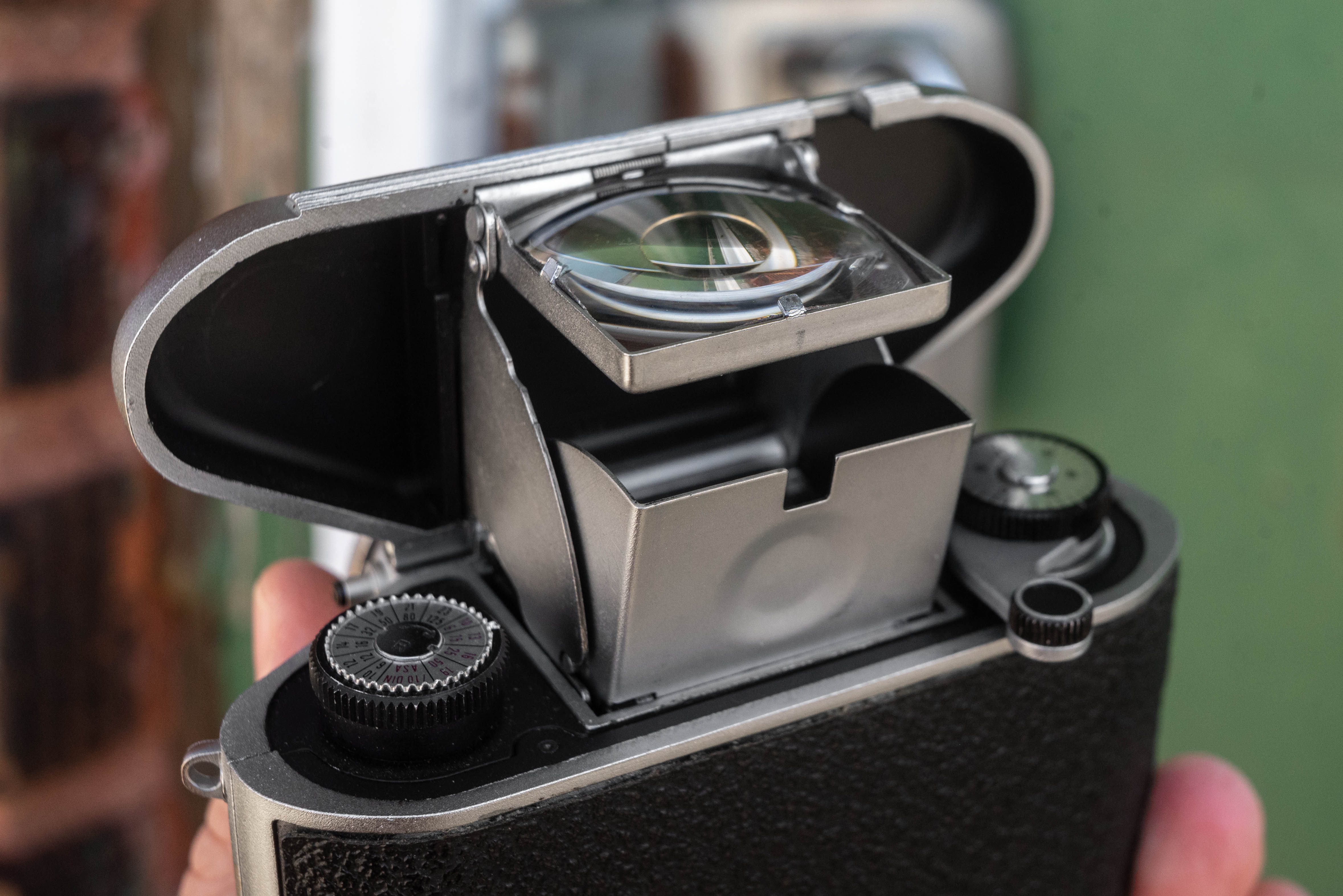
When lifting up on the top plate, it has two positions, the first allows you to see straight down and see the focusing screen. However, if you press the top plate beyond the position, a large square magnifying glass pops into position giving you a magnified view of the focus screen. I found that while using both the Metz and SEROA Mecaflexes, folding the camera shut often caused the magnifier to get stuck. If this happens, you have to completely open it and try again. I could never figure out why sometimes it worked and others it didn’t, but this behavior was the same between the two cameras.
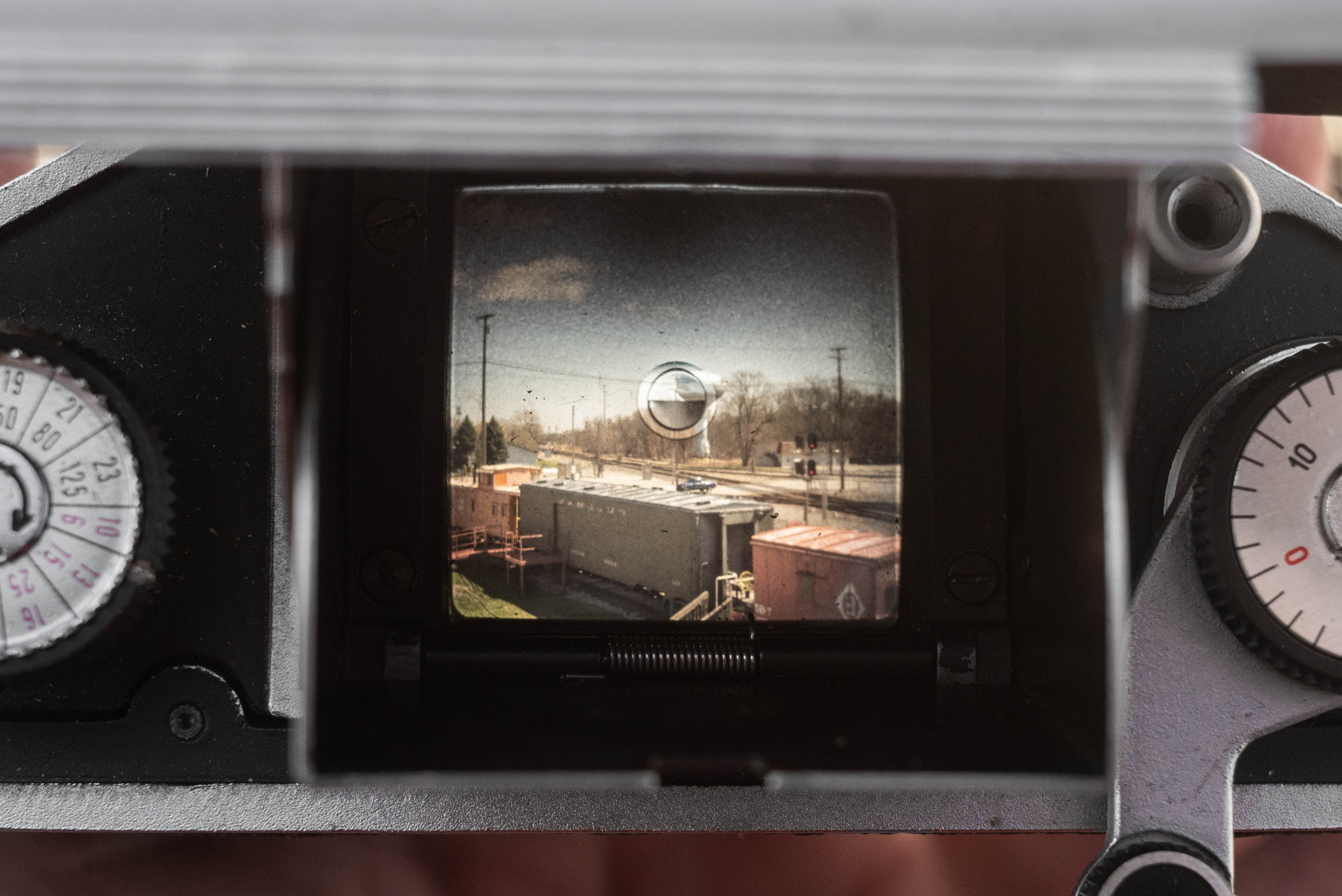
An interesting feature of this magnifier is that it has a central circle which magnifies the image even further, giving you two levels of magnification. With your eye close to the center circle, you can get a highly magnified view of not only the entire ground glass, but the split image focus aide. This automatic erecting two level magnifier is one of the Mecaflex’s neatest features and in my opinion negates that no pentaprism viewfinder was made for this camera. As is the case with all waist level finders, the image is horizontally reversed, so left is right and vice versa. Between the two Mecaflexes I had for this review, only the later SEROA model had the split image focus aide. The earlier Metz version featured only a ground glass with no focus aides.
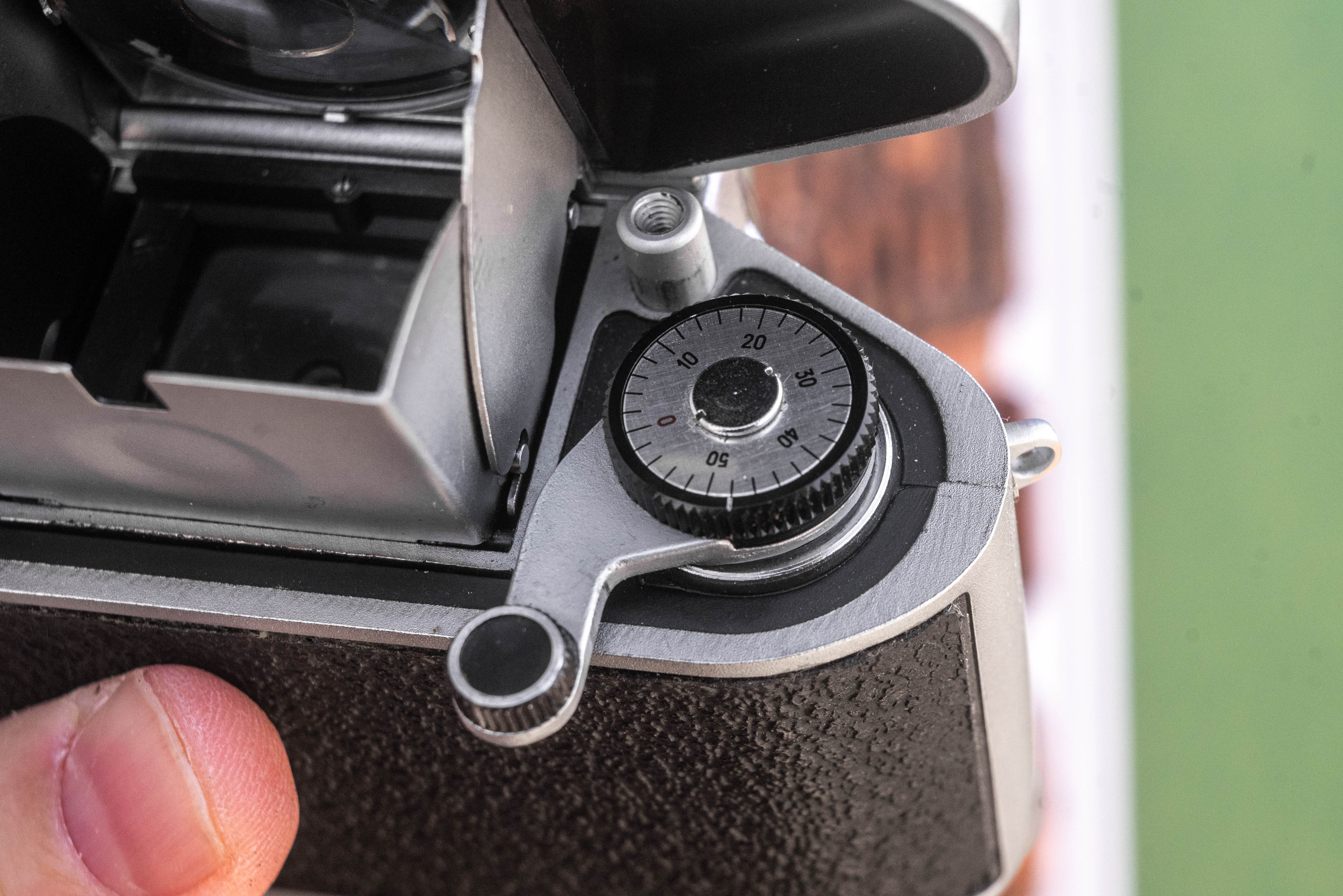
Also under the top plate, to the left is the rewind knob with a DIN/ASA film reminder dial on top. The rewind knob is quite small and pretty tight against the hood, making it difficult to grip while rewinding film. To the right of the viewfinder is the rather small film advance lever, exposure counter, and squished uncomfortably close to the front hinge is a cable threaded shutter release button. The exposure counter is additive, must be manually reset after loading in a new roll of film, and as a result of the 24×24 image size, goes up to 60. Whenever you shrink anything to unusually small proportions, you risk sacrificing usability for some things, and the tight quarters of the shutter release is one of them. The shutter release location on the Mecaflex isn’t completely unusable, but I can’t help but wonder what a front plate shutter release might have been like on this camera.
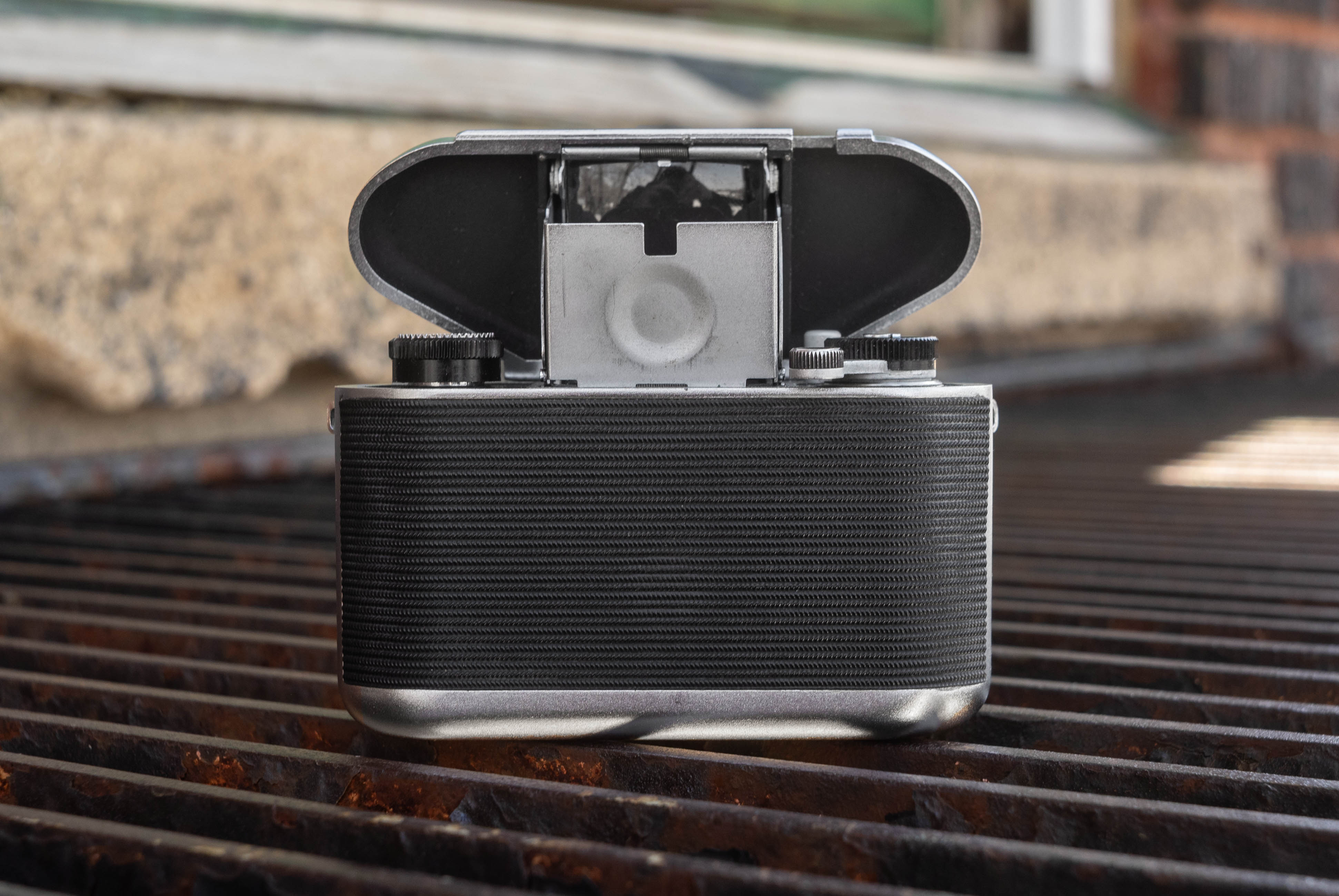
Both sides and the back of the camera have little to see other forward angled metal strap lugs on the sides, and the round tip of the film advance lever which sticks out of the back of the camera. You cannot move this lever unless you open the lid as it prevents it from moving. Beyond this, a large swath of leatherette covers the entire rear of the camera. Looking at the rear of the viewfinder hood, a small square notch is the rear opening for the fast action sports finder which you can open after flipping up the magnifier and pushing in on the center of the top plate.
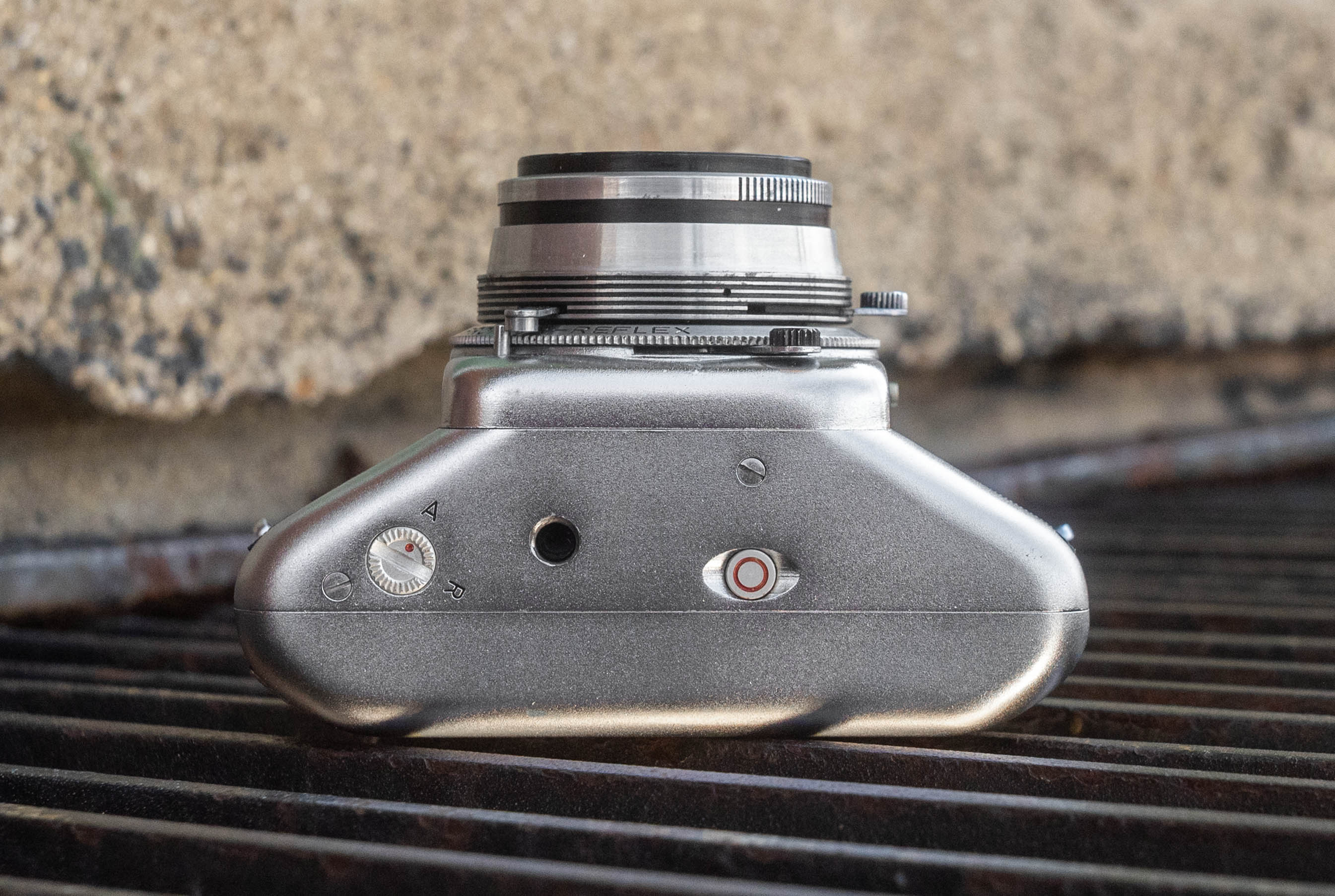
Flip the camera over and the base has an A/R mode dial which is for advancing or rewinding film, a 1/4″ tripod socket, and a small recessed button which is used to release the door lock for accessing the film compartment. To remove the film door, you must first flip up the top plate of the camera before pressing the door release as it will not come off with the top down. With the top plate up, the door comes off by pulling the bottom outward to release a latch along the top perimeter. Putting it back on is opposite of taking it off where you need to connect the top first, before pressing the bottom into the body.
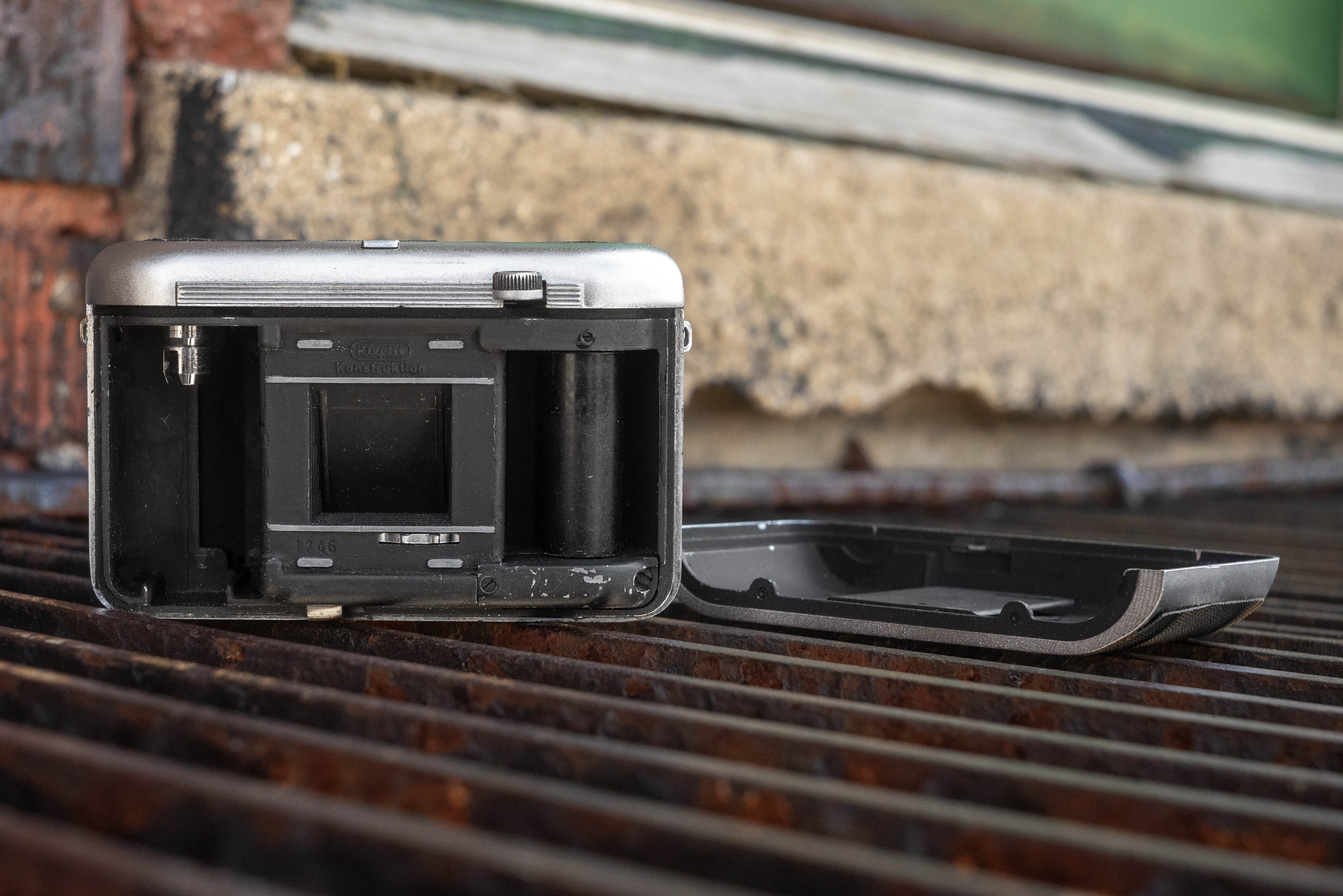
After removing the back, you are presented with the film compartment, which resembles that of a typical 1950s 35mm film compartment, just smaller. Front and center is the square film gate and a capping plate which prevents the film while the reflex mirror is down. Film transports from left to right onto a single slotted integrated take up spool. Film winds around the spool counterclockwise and despite only having a single slot, is easy to attach to the leader. For such a small camera, loading film is easy to do, and doesn’t require flipping up a hinged pressure plate or any proprietary cassettes like some other compact cameras require. The inside of the door has a black painted pressure plate and the entire film compartment lacks any sort of light seals which would need replacement.
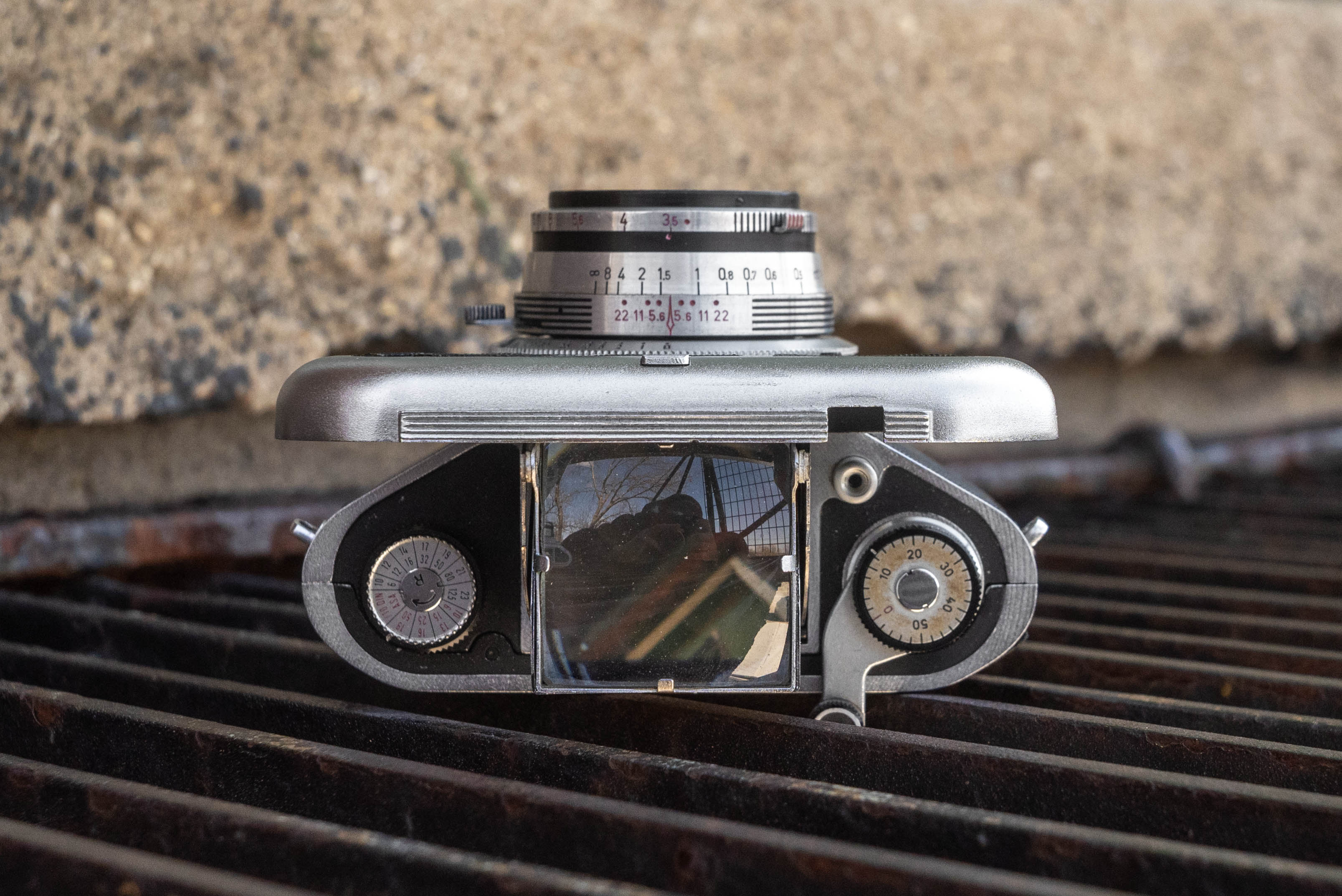
Looking down upon the Mecaflex with the standard 40mm f/3.5 Kilar lens, a ring around the shutter changes speeds from 1 to 1/300 plus Bulb on the earlier Metz Mecaflex and 1 to 1/250 on the later Seroa Mecaflex. In front of the shutter speed ring is an engraved depth of field scale on the lens and then the focus distance scale. Distances are engraved from 0.5 meters to infinity. A full movement from minimum to infinity requires approximately a 90 degree motion of the focus arm. This is both fast enough to be done in one single motion, but still slow enough that precise movements are possible. Closest to the front of the lens is the aperture ring with settings from f/3.5 to f/22. The aperture ring locks into place at every indicated stop and requires you to press a small tab to the right of the f/3.5 position to unlock the ring. This is done to prevent accidental changes to the diaphragm, but has the side effect of slowing you down when making exposure changes to the lens.
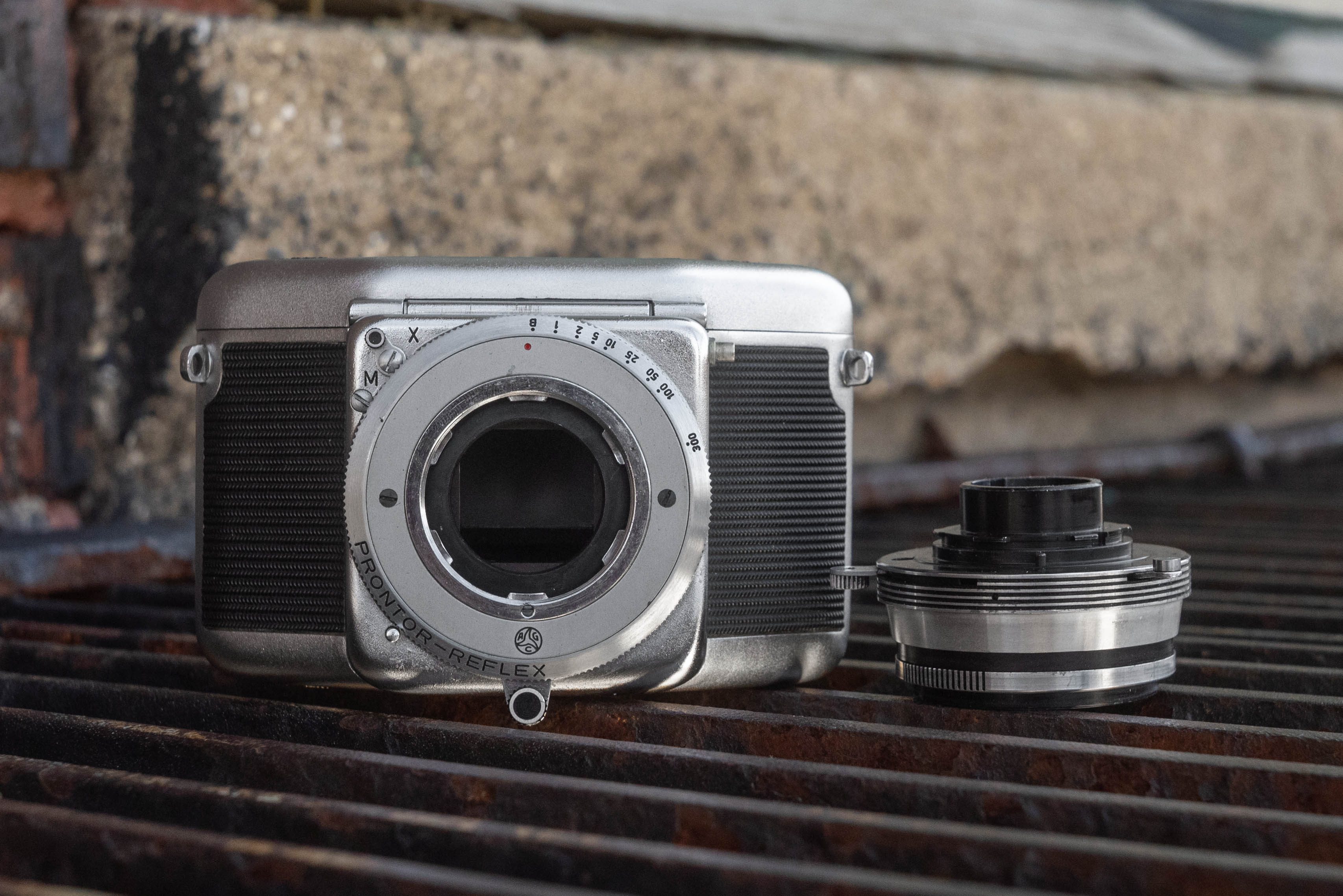
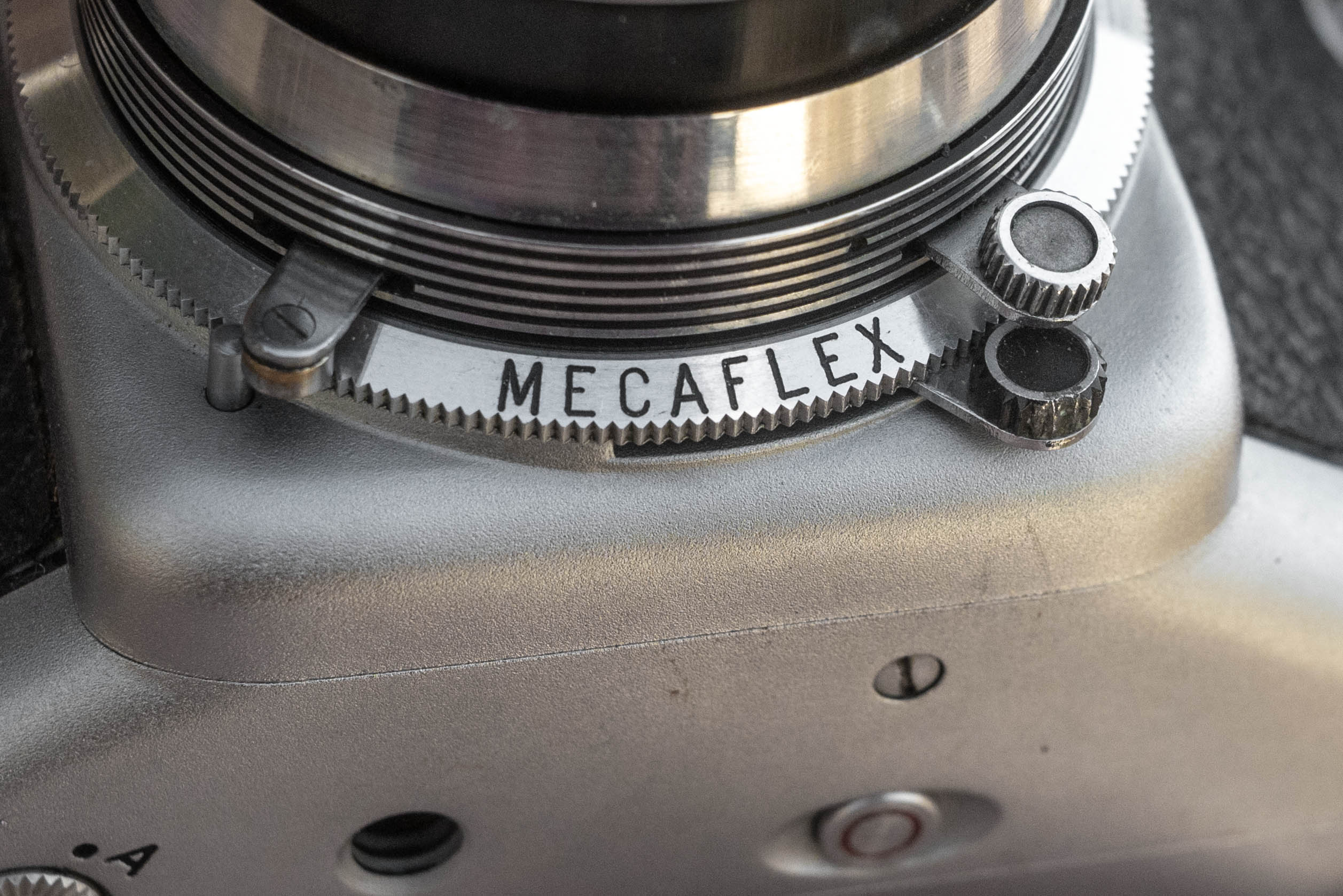
Up front, there’s little to see other than the lens and two circular tabs sticking out and a flash sync port sticking out of the upper right side of the mirror box. The first of the two levers is the focus arm which changes position depending on how the lens is focused, but the second is the breech lock release lever which is located near the 5 o’clock position around the lens. To swap lenses, move this lever to the left until the lock is disengaged, at which point the lens literally falls off the camera, so be careful. For this review, I had access to two different Mecaflexes and on one, this lever was extremely loose, suggesting it might have been damaged. The other was much tighter, and felt as though the lens wouldn’t fall off the camera in normal use but it is still something that you’d want to pay attention to. An interesting difference between the two Mecaflexes is that the earlier Metz Mecaflex has its shutter labeled as a Prontor-Reflex, and the later Seroa Mecaflex labels the shutter as a Mecaflex shutter.
My first attempt at shooting my Seroa Mecaflex returned an entire roll of badly out of focus images due to an issue with the lens, but Igor’s earlier Metz Mecaflex worked perfectly, so it was the one I used for my test images. For these, I loaded in a roll of semi expired Fuji Color 100 and took it out shooting.


If you’re looking at the gallery above and are thinking, “Gee Mike, those don’t look like color photos”, do not adjust your monitor, you are correct. As it would turn out, the roll of Fuji Color 100 I shot in Igor’s camera was so far gone beyond its expiration date that the developed roll returned no usable images. Base fog was so extreme that even when turned to the max settings, my Epson flatbed scanner could not get any good images, but by the time I discovered this, I had already sent the camera back.
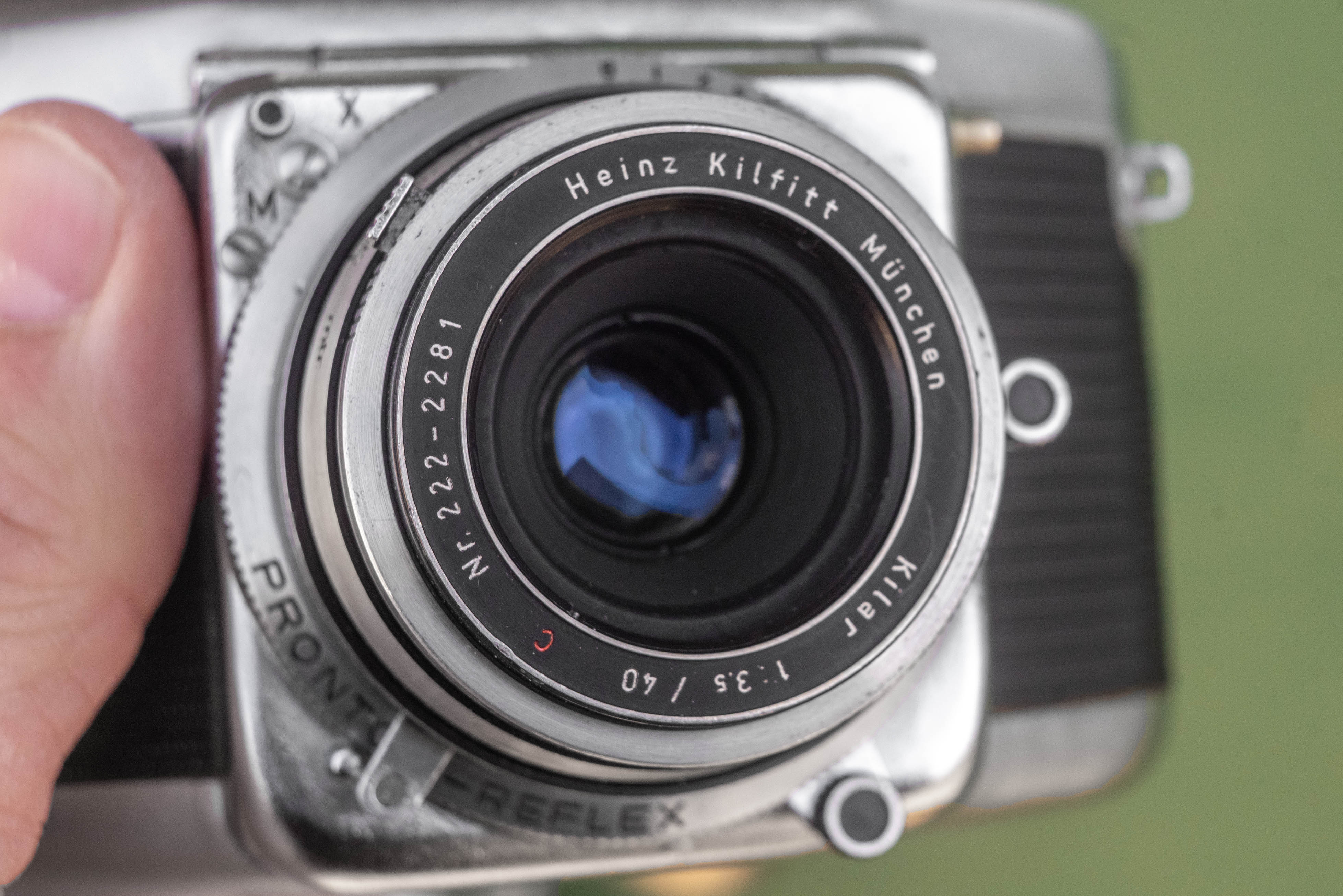
Desperate to get some sample images, I went back to my original Seroa Mecaflex and attempted to resolve the lens issue. I was only partially successful as I was able to fix the issue with the focus but at the expense of no longer having a functioning diaphragm. The shutter worked, the lens focused correctly, but it was permanently wide open at f/3.5. For my third and final attempt at shooting a Mecaflex, I loaded in some bulk Kodak TMax 100 and set the shutter to 1/250 outdoors and 1/60 indoors and hoped for the best.
Normally when shooting a lens wide open, what you gain in blurred backgrounds, you lose in contrast and detail around the edges. Thankfully, Heinz Kilfitt was a talented lens maker and the 40mm f/3.5 Kilar performed well wide open. Sharpness and contrast remained high in the center with a less than expected amount of softness and vignetting near the edges. While I didn’t intentionally try to induce bokeh, I found the out of focus details in the background had a pleasing look without any harsh or distracting details characteristic of lesser lenses. Had I been able to stop down some of these shots to f/5.6 or f/8, I likely would have increased sharpness further, but overall I didn’t find the lack of a functioning diaphragm to be much of an issue with this test roll.
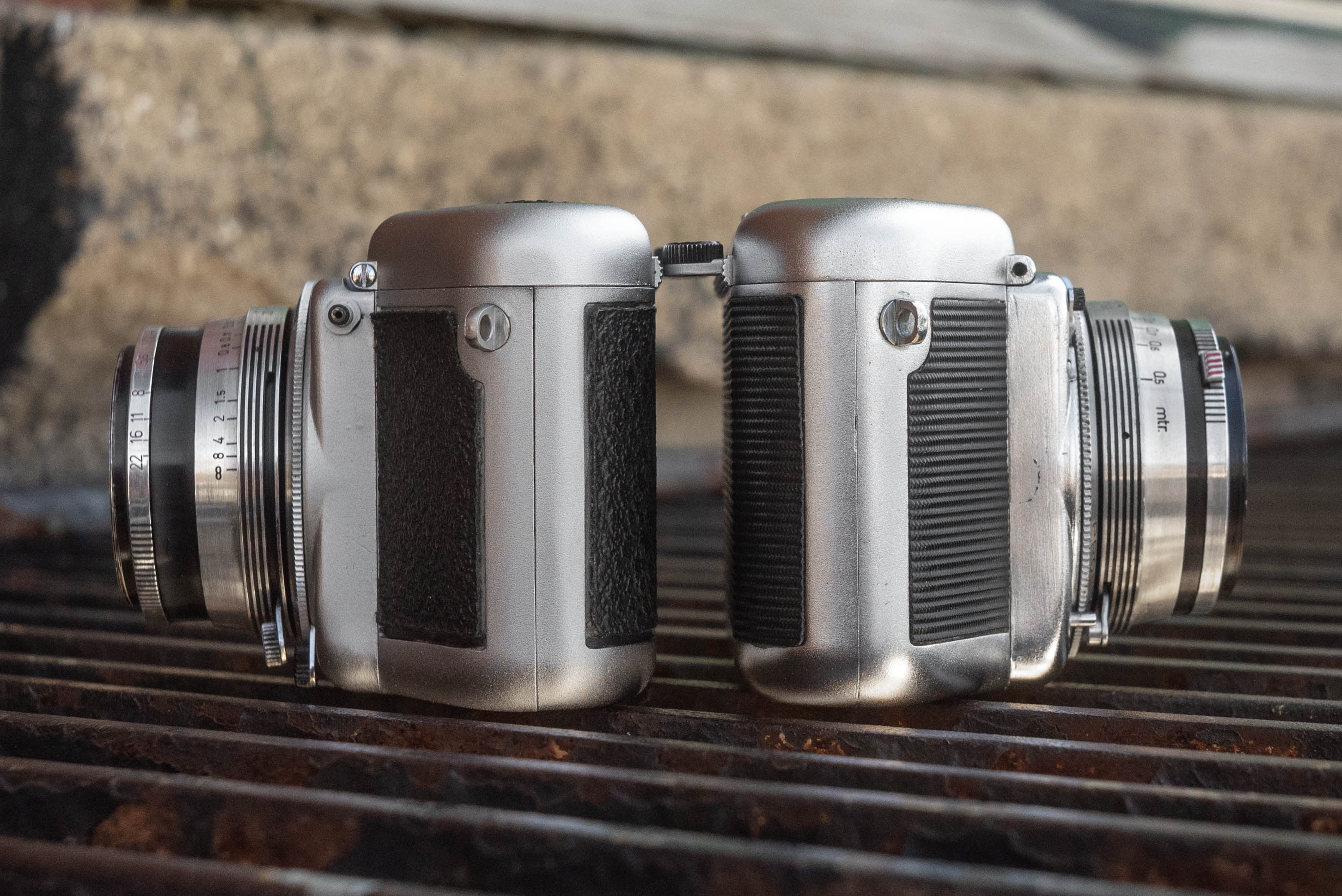
The Mecaflex has the unique distinction of being a one of a kind camera in that it was the only mass produced 35mm SLR which takes 24mm x 24mm images. All other square format 35mm cameras are either rangefinders, scale focus cameras, or in the case of Instamatic cameras like the Kodak Instamatic Reflex, don’t use regular 35mm film. The Mecaflex is also extremely compact. It is the smallest 35mm SLR I’ve ever handled and shorter and narrower than both the Berning Robot II and Zeiss-Ikon Tenax II which also shoot the same size square images. With a one of a kind design and an extremely small size, expectations for how the camera handles will need to be adjusted to account for strange ergonomics and other compromises.
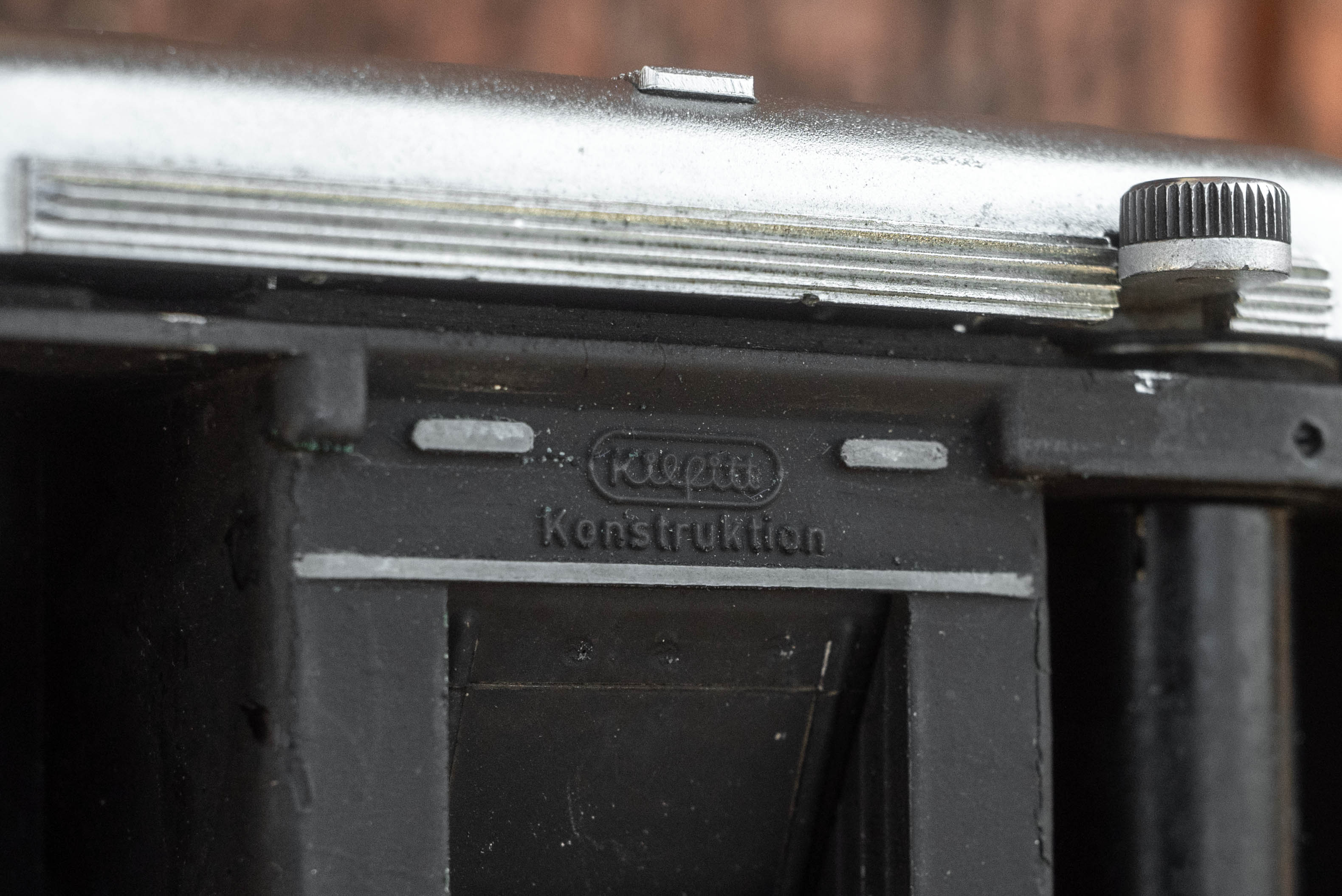
The good news is that the Mecaflex isn’t confusing to use. Most of the camera’s controls are logically located where you’d expect them to be and don’t require a user manual to figure out. But just because something isn’t confusing, doesn’t mean it is pleasant to use. By far, the biggest usability issues I encountered while shooting the Mecaflex are in how cramped many of the camera’s controls are, especially the shutter release and film rewind knob which are both crammed into a corner next to the viewfinder hood and behind the folding top plate. Even with the camera at waist level looking through the viewfinder, I found the process of locating the shutter release with my finger to be unpleasant due to how tight of a location it is in. After finishing each of the three rolls I shot, rewinding the film was a challenge as it is difficult to grab the knob and rotate it a full 360 degrees. Its tight location next to the viewfinder hood only allows for half turns, which was not only slow, but also annoying.
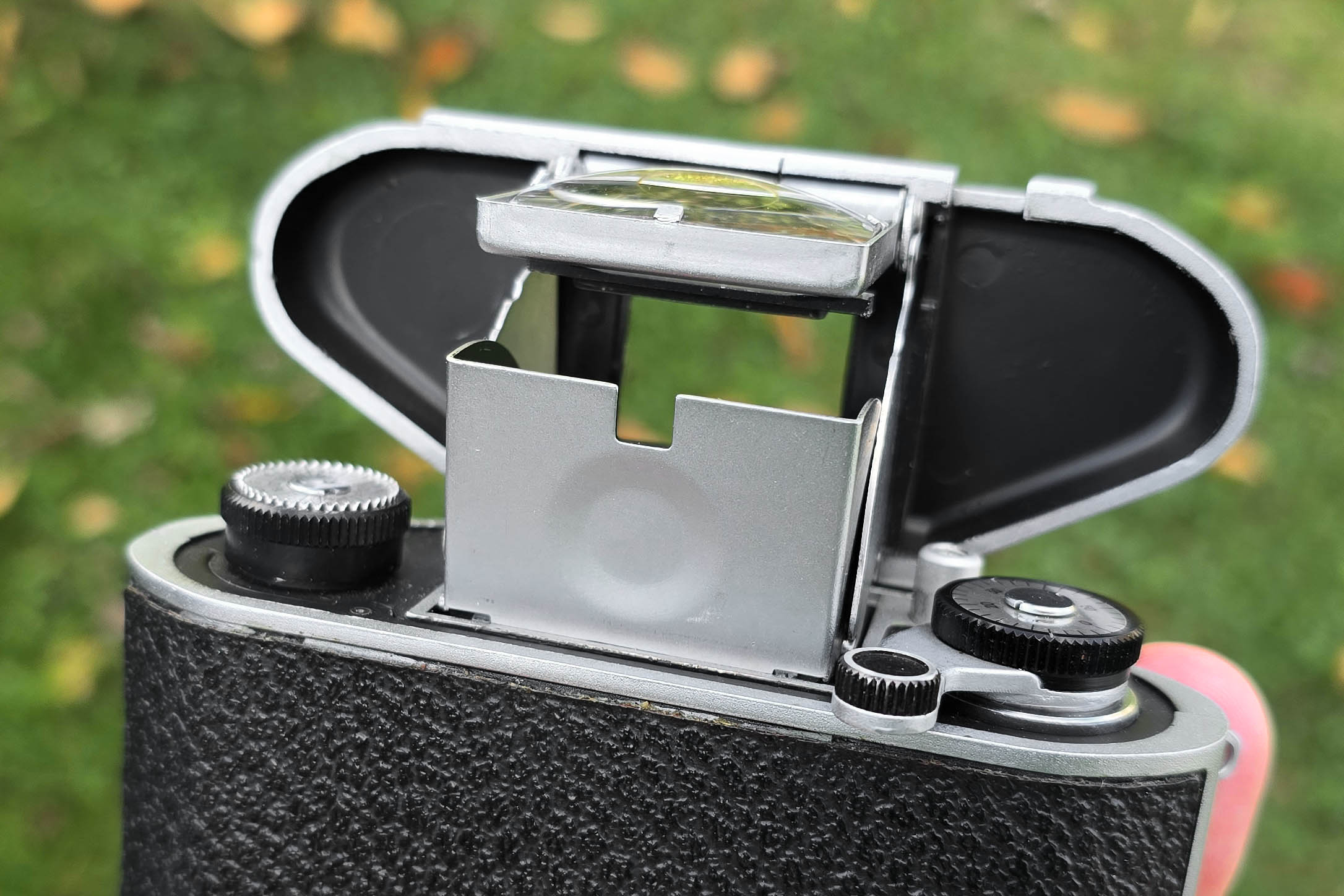
A side effect of the smaller image size is that the viewfinder is also small, and while using the waist level finder, it was difficult to see the whole image with the camera at your chest. Thankfully the people working for Heinz Kilfitt thought of this and added a very large magnifier to the viewfinder hood. While most cameras with waist level finders have magnifiers, the one here is different in that it covers the entire image. A firm push on the front hood causes a square piece of glass to pop up, allowing you to see the entire focusing screen at eye level. In addition, on the later Seroa Mecaflex a circle in the center has an extra level of magnification bringing the center of the image even closer to your eye, making precision focus very easy. This extra precision circle does not appear on the earlier Metz Mecaflex I borrowed from Igor suggesting this was a change made on later cameras. Although I did generally like the large magnifier, I found the camera to be easiest to shoot using the fast action finder on the hood.
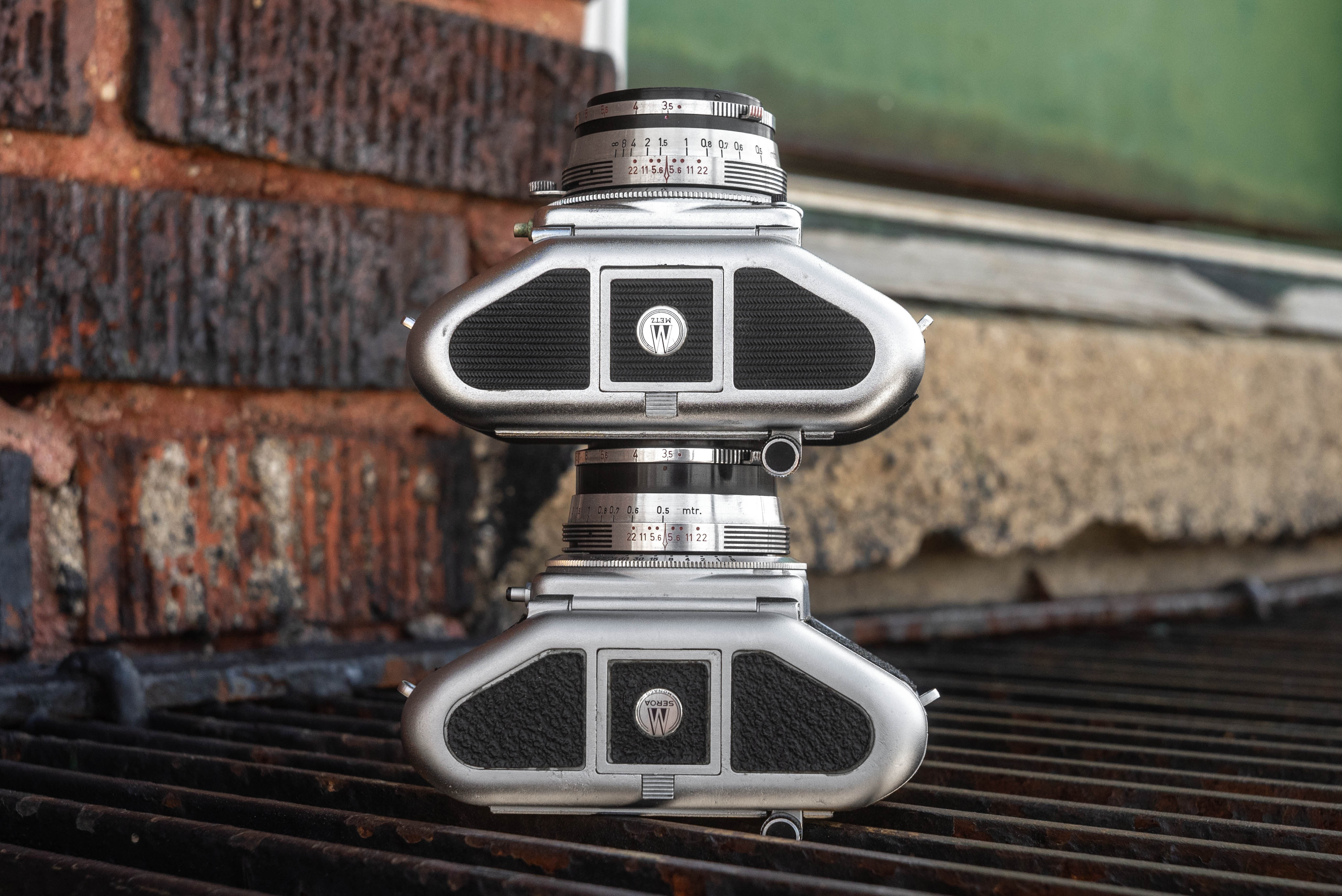
In an earlier draft of this article which I started to write before I finished any rolls of film, I said that the designers of the Mecaflex did a good job of fitting a fully functional SLR into such a small package, and while I suppose that it still true, the more I handled the camera as I shot all three rolls of film, the more I hated the experience. What I initially dismissed as minor nitpicks grew and made it a challenge to want to finish each roll. When I saw that the roll of Fuji color film didn’t produce any usable images, I almost scrapped the idea of including sample pics as I didn’t want to shoot the camera a third time, but knowing how few people get the chance to shoot one of these, I felt I owed it to you all to see it through to the end.
While the camera is small and very portable, and I did get really good images from the 40mm Kilfitt lens, the cramped top plate, the tight location of the exposure controls, the poor design of the bayonet lens mount which made accidentally removing the lens while shooting a real concern, ending with the miserable design of the rewind knob, I was elated when I got usable images from the roll of TMax so that I could put this thing back on the shelf where it belongs.
The Mecaflex scores some points with me for its historical significance, its cool appearance and its lens, but not much else. If you’ve ever wondered what it would be like to shoot a 24mm x 24mm SLR, keep wondering because you won’t enjoy this camera because I certainly didn’t.
Related Posts You Might Enjoy
External Links
https://camera-wiki.org/wiki/Mecaflex
https://en.wikipedia.org/wiki/Mecaflex
https://www.submin.com/35mm/collection/mecaflex/index.htm
http://robot-camera.de/RoBoT_Historie/Heinz_Kilfitt/MECAFLEX/body_mecaflex.html
https://www.shutterbug.com/content/mecaflex-square-format-35mm-slr