
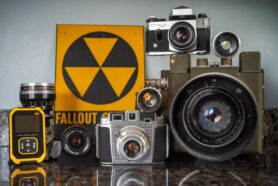
Camera collectors are well aware that many of the most admired lenses of the mid 20th century are slightly radioactive, but if you’re like me and don’t remember high school science class enough to truly understand what radiation is and how it works, most of the time we just shrug it off. As my collection has grown and the number of potentially radioactive lenses increased, I began to wonder if having so many in close proximity to my desk was dangerous. Was I slowly killing myself sitting a couple feet away from a wall full of old cameras, or were fears of radioactive meltdowns a side effect of my 1980s upbringing?
What is Radiation?
I know many camera collectors, and none of them are scientists. Before I can begin to answer any questions you might have about radioactive lenses, I think a good starting point would be to explain what radiation is, what are the different types of detectable radiation, and how radiation is measured.
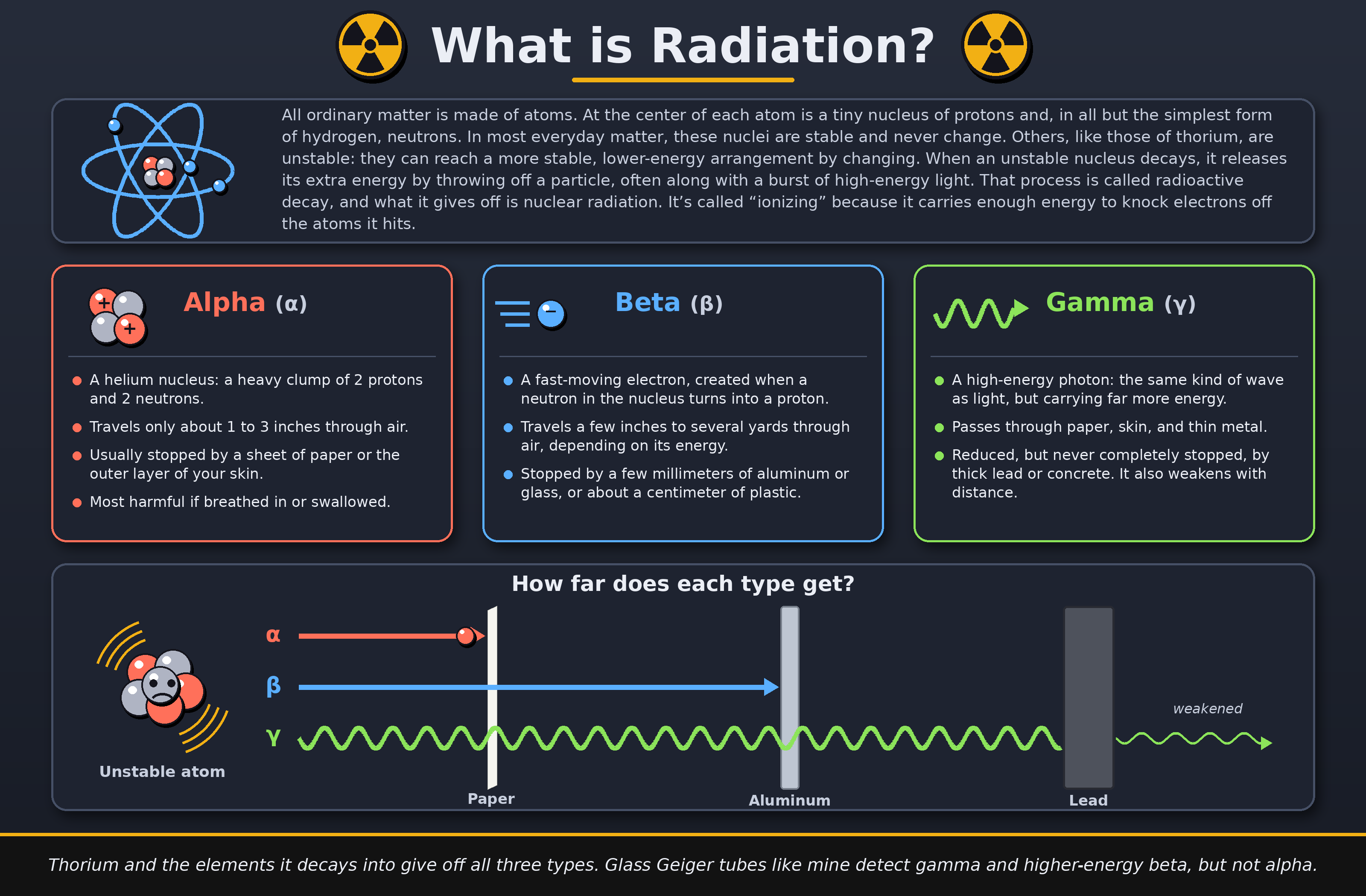
Radiation is not inherently bad, we’re exposed to low levels of natural radiation all the time. It can come from cosmic rays, granite countertops, airline flights, and even bananas which contain naturally radioactive potassium. For camera lenses, the type of radiation we’re most interested in comes from the elements thorium and lanthanum.
Thorium is radioactive and as its atoms decay, they turn into other elements such as radium, radon, and eventually stable lead. Several of these decay products are radioactive themselves and together they give off three main types of radiation. Alpha particles are usually stopped by a sheet of paper or the outer layer of your skin. Beta particles travel farther and need a few millimeters of aluminum or glass, or about a centimeter of plastic to stop. Gamma rays pass through most everyday materials. Thick lead or concrete reduces them but never stops them completely, and they become far less intense with distance as they spread out.
Lanthanum has been widely used in lens construction since the 1930s and is still used in modern lenses today, but it is not meaningfully radioactive. Natural lanthanum contains a tiny trace of a radioactive form, but the amount is so small that only sensitive equipment can pick it out from ordinary background radiation. On a $30 detector, it wouldn’t stand out from the background radiation that is around us all the time. If a lens noticeably raises the reading on a detector, thorium is the likely culprit, not lanthanum.
History of Lanthanum and Thorium in Lenses
The story of how radiation had anything to do with photographic lenses begins after World War I, when glass chemist George W. Morey of the Carnegie Institution began working with Eastman Kodak’s lens designers on a new kind of optical glass, one that could bend light strongly without splitting it into colors. Kodak’s own research laboratories later expanded the work, and the new glass, made with rare-earth elements like lanthanum and, in some formulas thorium, were first used in lens designs in 1934. Kodak went on to use thoriated glass in many of its lenses through the 1940s and 50s, including a large number of Ektar (among them the famous Aero-Ektar), Ektanar, Ektanon, and Anastar lenses.
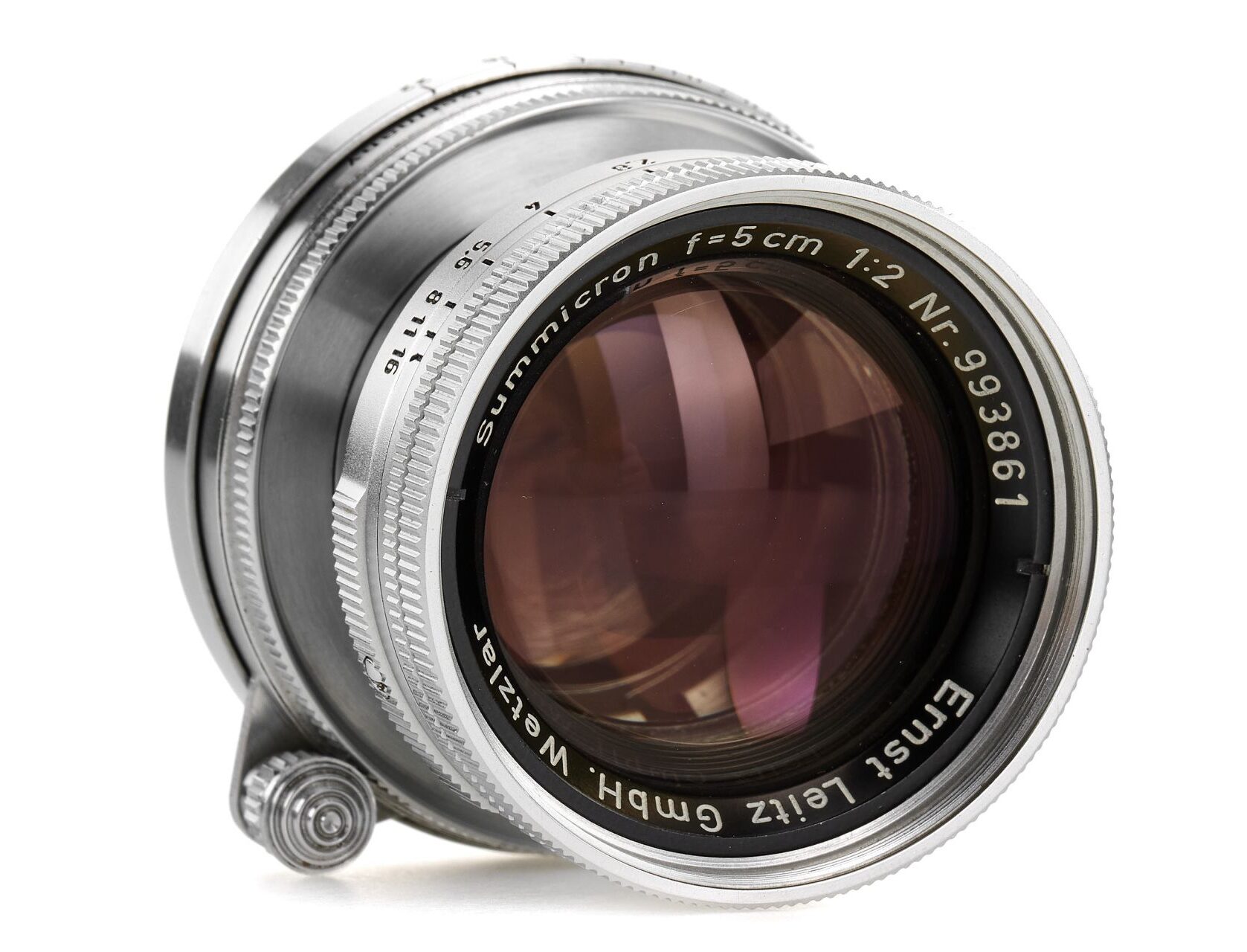
Kodak wasn’t the only one working with thorium in the 1940s and 50s. Glassmakers including Schott in Germany, Corning Glass Works in the United States, and Chance Brothers & Co in England also produced thoriated optical glass. Continuing into the 1960s and 1970s, many of the big camera makers used it in at least some of their lenses, including Asahi (Pentax), Canon, Fuji, Nippon Kogaku (Nikon), Olympus, Carl Zeiss Jena, and Leitz. By the 1980s, the use of thorium in lens construction was discontinued as improved formulations using lanthanum and other rare-earth elements, and later extra-low dispersion glass, delivered similar optical benefits without the radioactivity.
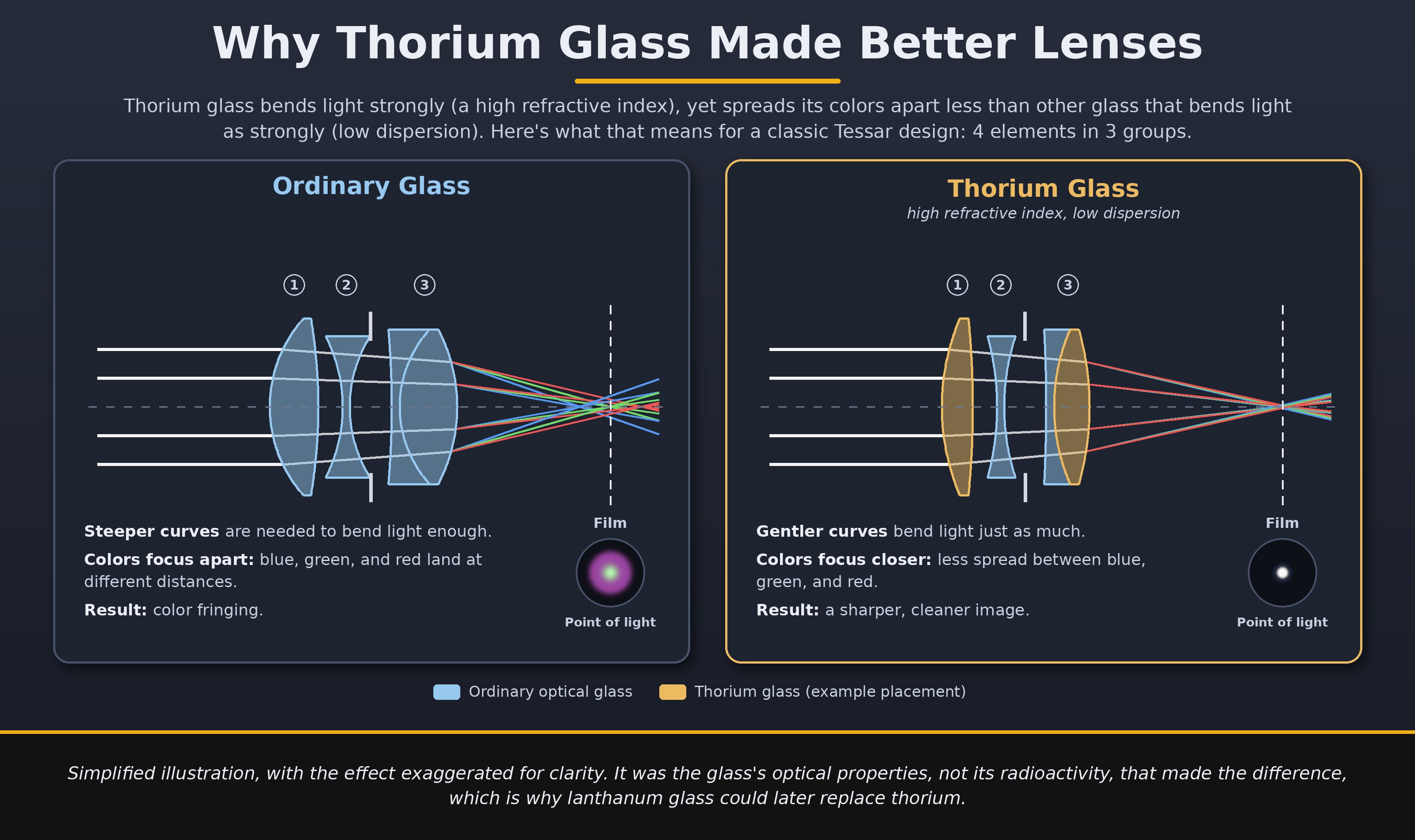
The benefits of radioactive thorium glass lenses comes down to how glass bends light. Lens designers want glass with two properties that usually work against each other. The first is a high refractive index, meaning it bends light strongly, and the second is low dispersion, meaning it doesn’t split light into its component colors as it bends it.
Most glass that bends light strongly also spreads colors apart which causes color fringing, also known as chromatic aberration. If you’ve ever looked at a high resolution scan or a high megapixel digital image and seen purple, magenta, or green colored outlines along high contrast edges, you’ve seen chromatic aberration. Thorium glass offered both a high refractive index and low dispersion to minimize these effects. A designer could get the bending power they needed with gentler lens curves and fewer corrective elements. This not only improved image quality, but also allowed for lenses to be made with simpler formulas that kept costs down.
 One telltale sign of a thoriated lens is a yellow or amber tint to the glass which can act similar to having a yellow filter mounted to a lens. A misconception among some vintage camera lens collectors that just because a lens has a yellow appearance, that it must be radioactive, is not accurate as there are two very different reasons a lens may appear yellow.
- A yellowish coating is a tint to the light reflecting off the lens surface. Many Aashi Takumars have a gold to yellow appearance to the front element, but this is a result of the lens coating, not due to any radioactivity of the glass. An easy way to identify a non-radioactive yellow coating is by simply looking through the lens at a white background. If the image still looks white, then only the coating is yellow, not the glass.
- Thorium yellowing is a discoloration of the glass itself caused by thorium radiation over decades. This is different from a yellow coating as you can see it by looking through the lens at something white.
Does UV Light Reduce Radiation? A common practice for users of yellowed lenses is to subject them to intense UV light to reverse the yellowing effects of thorium radiation. While this usually does work to reduce the yellow tint, it has no effect on the radioactive properties of the glass. The yellowish tint that you see in vintage radioactive lenses is a side effect of the radiation, not a symptom of the radiation itself. When these lenses were new, they were just as clear as non-radioactive lenses. The yellow color develops over time and the UV light helps to counteract that, but because the thorium is still there, it can return.
How Do I Measure Radiation?
For this article, I needed a way to measure radiation in my lenses. My limited knowledge of radioactivity comes from 1980s movies in which “science looking people” detected radiation with hand held devices that made a clicking noise which increased in speed as the radiation increased, so my Gen-X brain searched the internet for such a device.
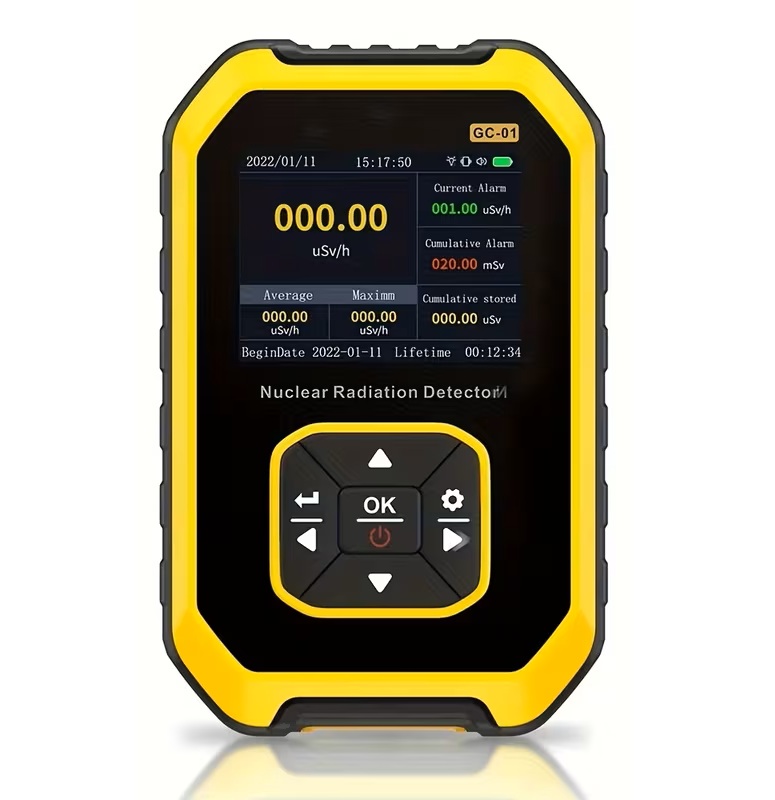 I quickly realized that buying a proper radiation detecting device, or a “Geiger Counter” would be an incredible waste of money so I began looking for discount options and ended up purchasing something called a GC-01 radiation detector on Temu for the low-low price of only $30. Although I am fully aware of that a majority of products sold on Temu are of extremely low quality, I was pleased to see that upon receipt of my purchase, it was equipped with an 88mm long glass Geiger-Müller tube, which is most likely an M4011 tube. I confirmed this by opening the GC-01 and measuring it with my ruler (also purchased from Temu).
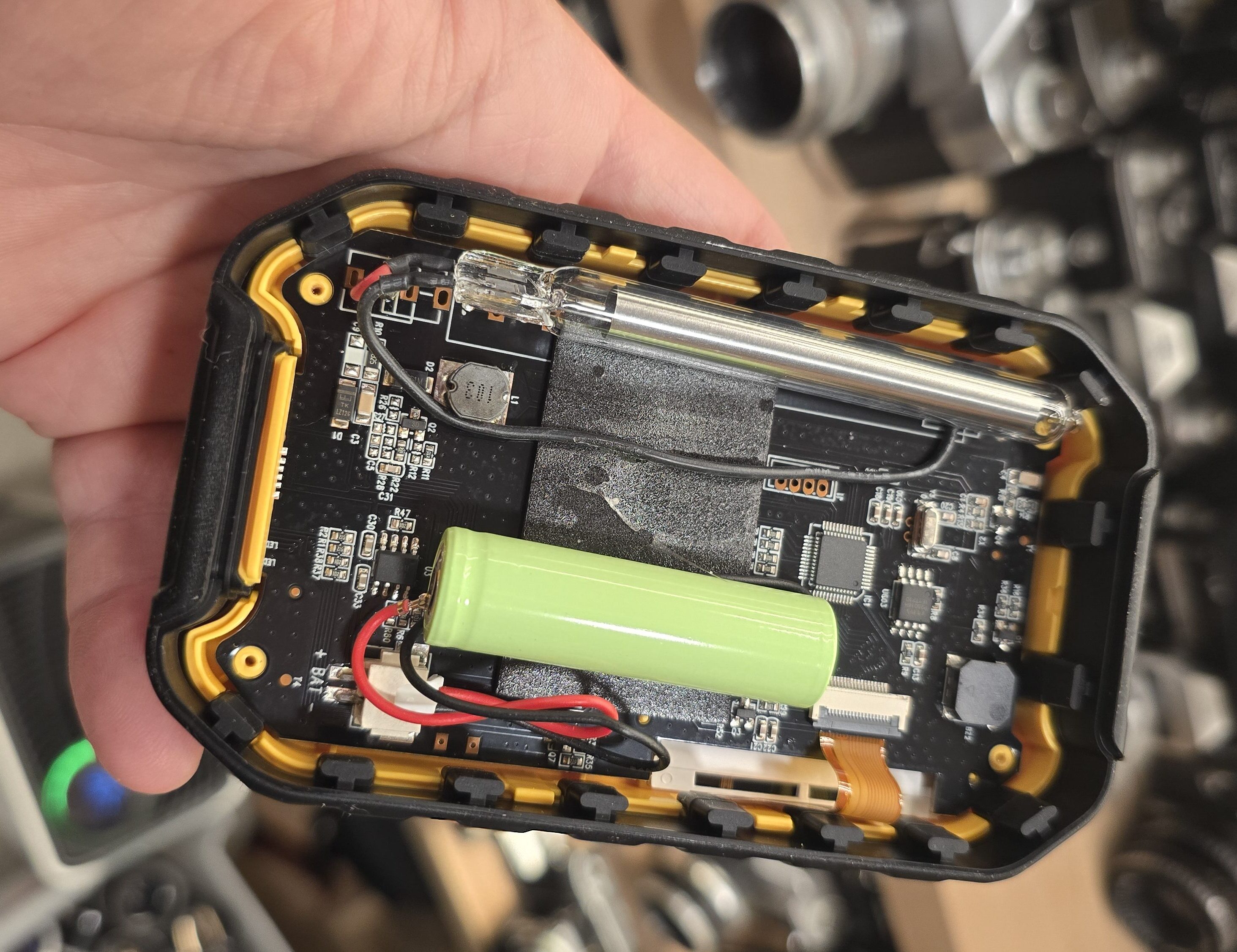
A quick Google search revealed that the M4011 was a very popular glass and metal tube found in many hobbyist radiation detectors and was capable of detecting gamma and beta radiation but it could not detect alpha particles. This wouldn’t end up being an issue as thorium in vintage lenses emits both gamma and beta particles, so I was still in business.
Continuing with the assumption that you’re like me and this is by far, the most in depth amount of reading you’ve ever done about radiation, I should also tell you about how radiation is measured. For the purposes of this article, we will be concerned with two measurements, microSieverts per hour (µSv/h) and Counts Per Minute (CPM).
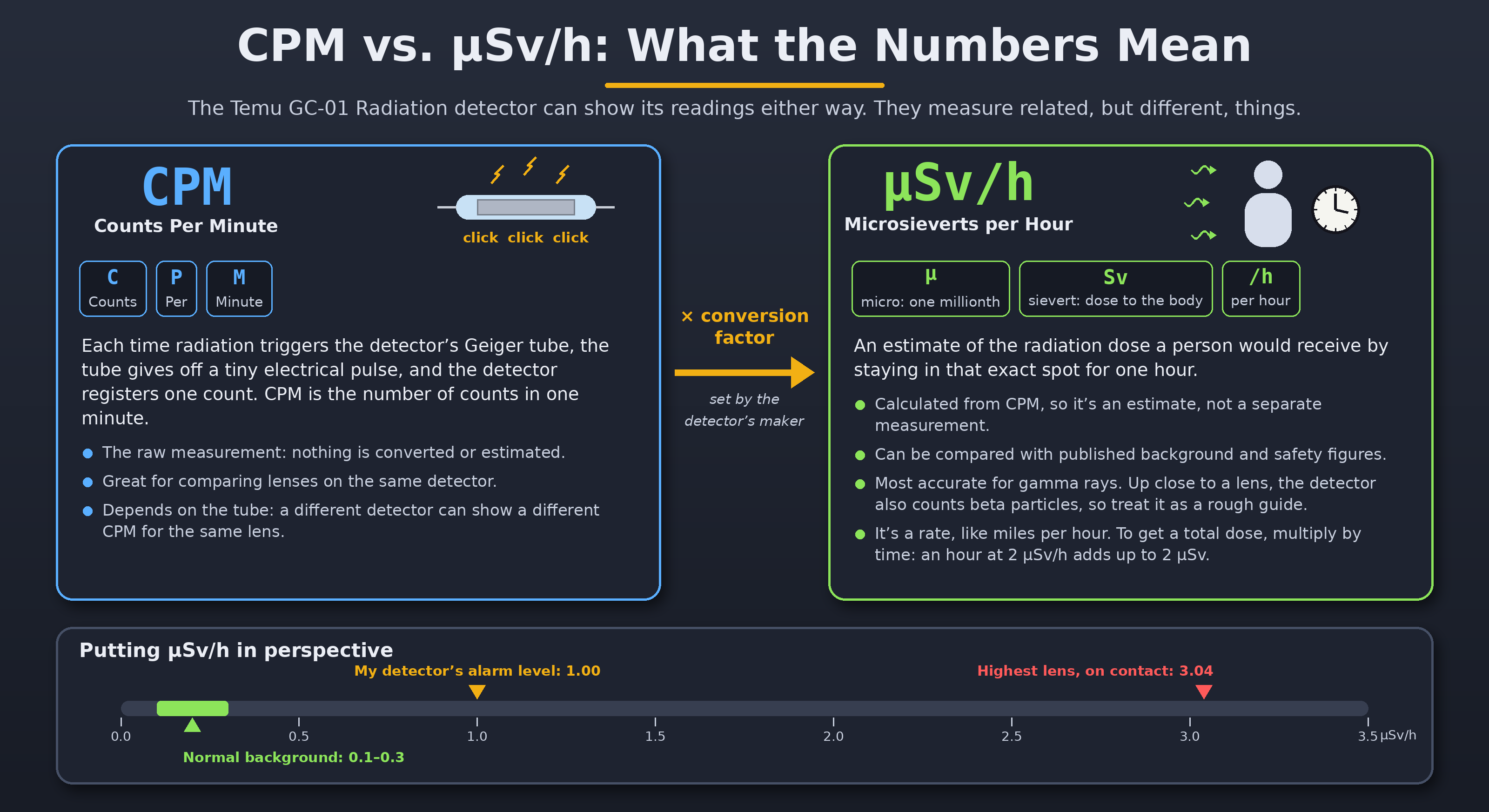
The Sievert is the standard unit for measuring a radioactive dose to the body. It accounts for both how much energy the body absorbs and how harmful that particular type of radiation is to living tissue. A full Sievert is a huge dose which would cause severe medical issues if exposed all at once, so everyday readings are measured in microSieverts (µSv), or millionths of a Sievert.
The Temu GC-01 shows both CPM and microSieverts per hour (µSv/h) which tells you how much exposure you’d get if you stayed in that exact spot for an hour. CPM is the detector’s raw unconverted count for each lens. The µSv/h number isn’t measured directly, rather the detector counts radiation events and converts that number into µSv/h using a fixed factor. Since we know that the GC-01 contains a “hobbyist quality” M4011 tube, the µSv/h readings should be treated as a useful comparison between lenses rather than a precise dose.
For perspective, normal background radiation typically reads around 0.1 to 0.3 µSv/h. Over a year, the average American receives roughly 3,000 µSv (3 millisieverts) from natural sources. Much of that yearly total comes from breathing radon gas which a detector like the GC-01 doesn’t pick up, so the background readings on my detector don’t account for all of the radiation that I am being exposed to on a daily basis.
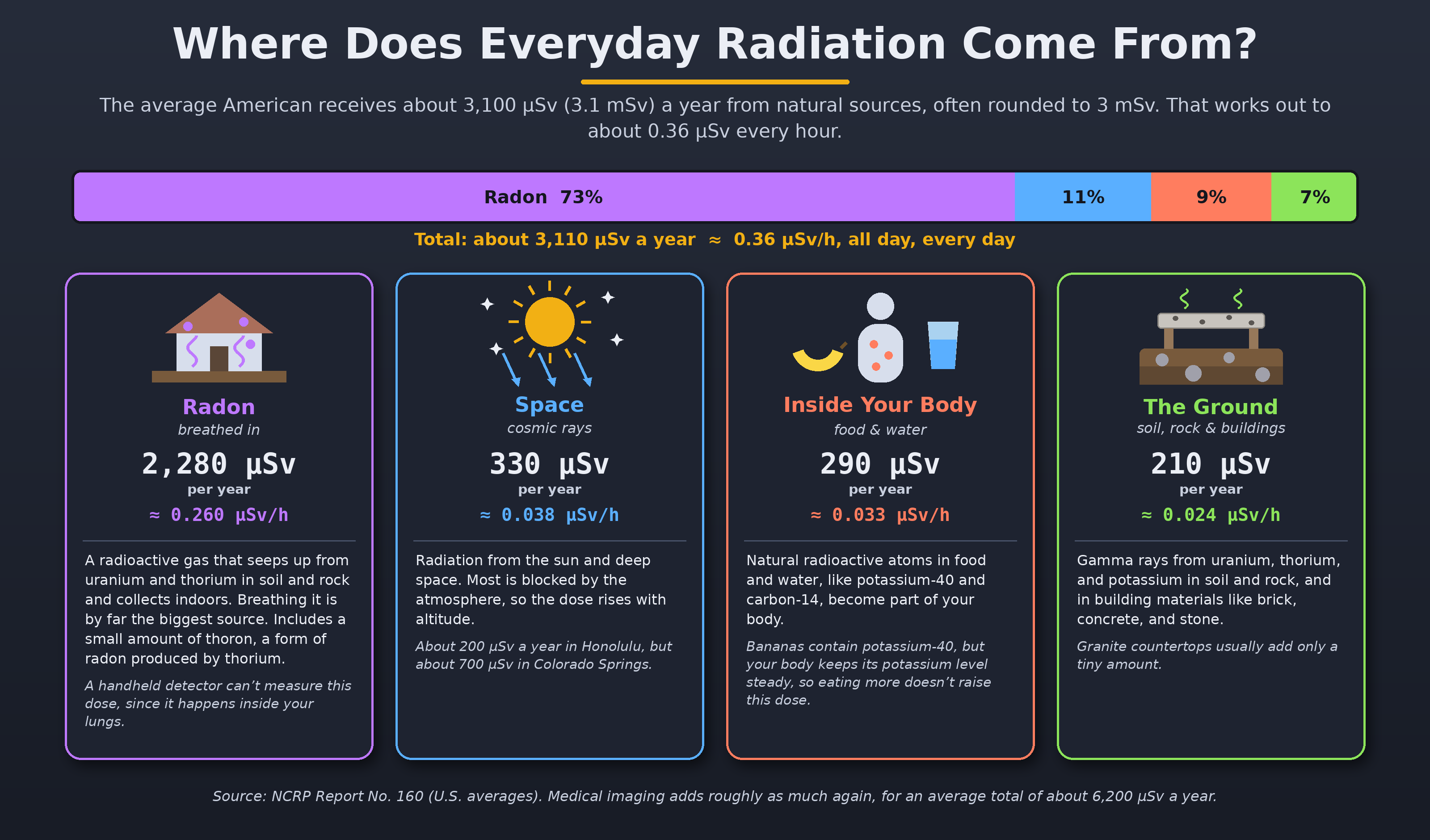
Testing my Cameras and Lenses
Now, armed with a high school level understanding of radiation and the units of measurement to test it with, I needed to know which of the hundreds of cameras and lenses in my collection might be radioactive. Thankfully, camera-wiki has an article which lists a bunch of lenses which are known to contain radioactive elements. It is worth noting that in almost every instance of a lens being radioactive, not every element in its design contains thorium or any radioactive properties. In fact, many lenses only contain thorium in the rear element, rather than the front. Thankfully, I had a good number of lenses from camera-wiki’s list in my collection, so I chose a few which I wanted to put my Temu GC-01 to the test.
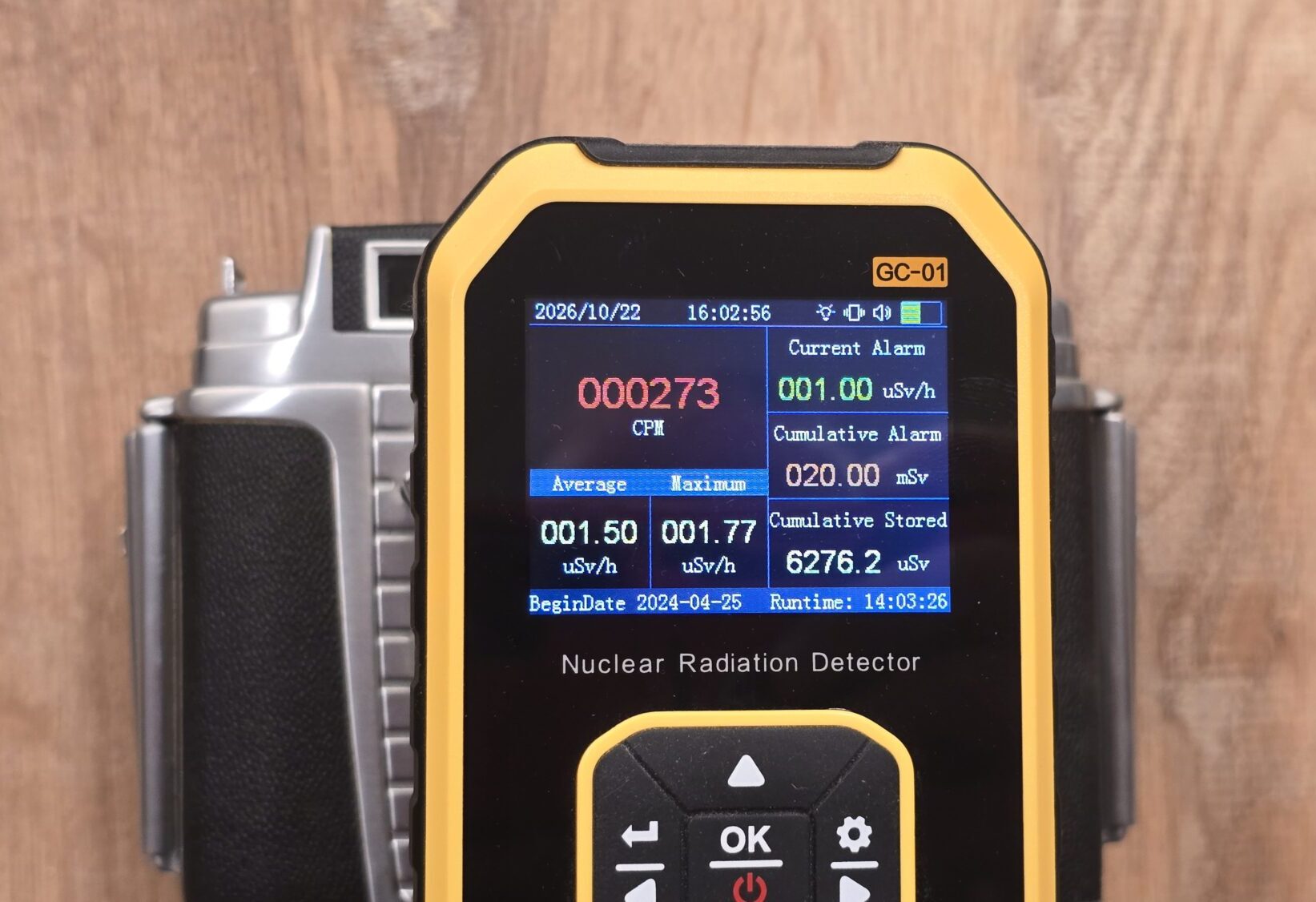
For every reading, I placed the detector directly on the lens as close as I could get it to the front or rear glass element. I wouldn’t discover this until later, but the M4011 tube in the GC-01 is actually on the left side, but since I was laying it flat on its back, this shouldn’t have impacted the readings.
I took both a µSv/h and a CPM reading for each lens, letting the numbers settle for at least a minute before taking a screenshot. Readings fluctuate constantly so the two measurements for the same lens won’t convert perfectly into each other and in some cases, I was unable to get a screenshot showing the maximum. For many lenses, the front element isn’t radioactive but the rear is, so in cases where the front didn’t show a meaningful amount of radiation, I would re-test the rear of the lens.
Before I began, I needed to get a baseline reading so that I knew how much radiation was normal for my room. The room where my cameras are located is approximately 11 feet wide by 14 feet deep and is in the basement of my home. Although my basement has never had any issues with radon, it is worth noting that I am located below ground level in a fairly confined space, filled with over 1000 vintage cameras, so the possibility of a measurable amount of radiation is not zero. I took my Temu GC-01 and did three tests in the room, two in the middle and one near the door and the average readings were between 0.13 and 0.24 µSv/h and 15 to 39 CPM. For the purposes of this article, I will consider these measurements to be the normal background level for non radioactive lenses.
Knowing Eastman Kodak’s strong connection to radioactive lenses, I thought what better lens to test than a World War II era surplus Folmer Graflex K-21 aerial camera with the highly sought after Kodak Aero-Ektar 178mm f/2.5 lens. Shooting a K-21 aerial camera is nearly impossible today as these cameras were designed to be controlled remotely by an operator sitting in an aircraft. The camera itself lacks the necessary controls to use it independently, but that hasn’t stopped ambitious tinkerers like John Minnicks from dissecting the lenses and building custom large format “Aero-Liberator” cameras. John has previously appeared on an episode of the Camerosity Podcast, so if you’d like to learn more about how he uses Aero-Ektar lenses, check it out!
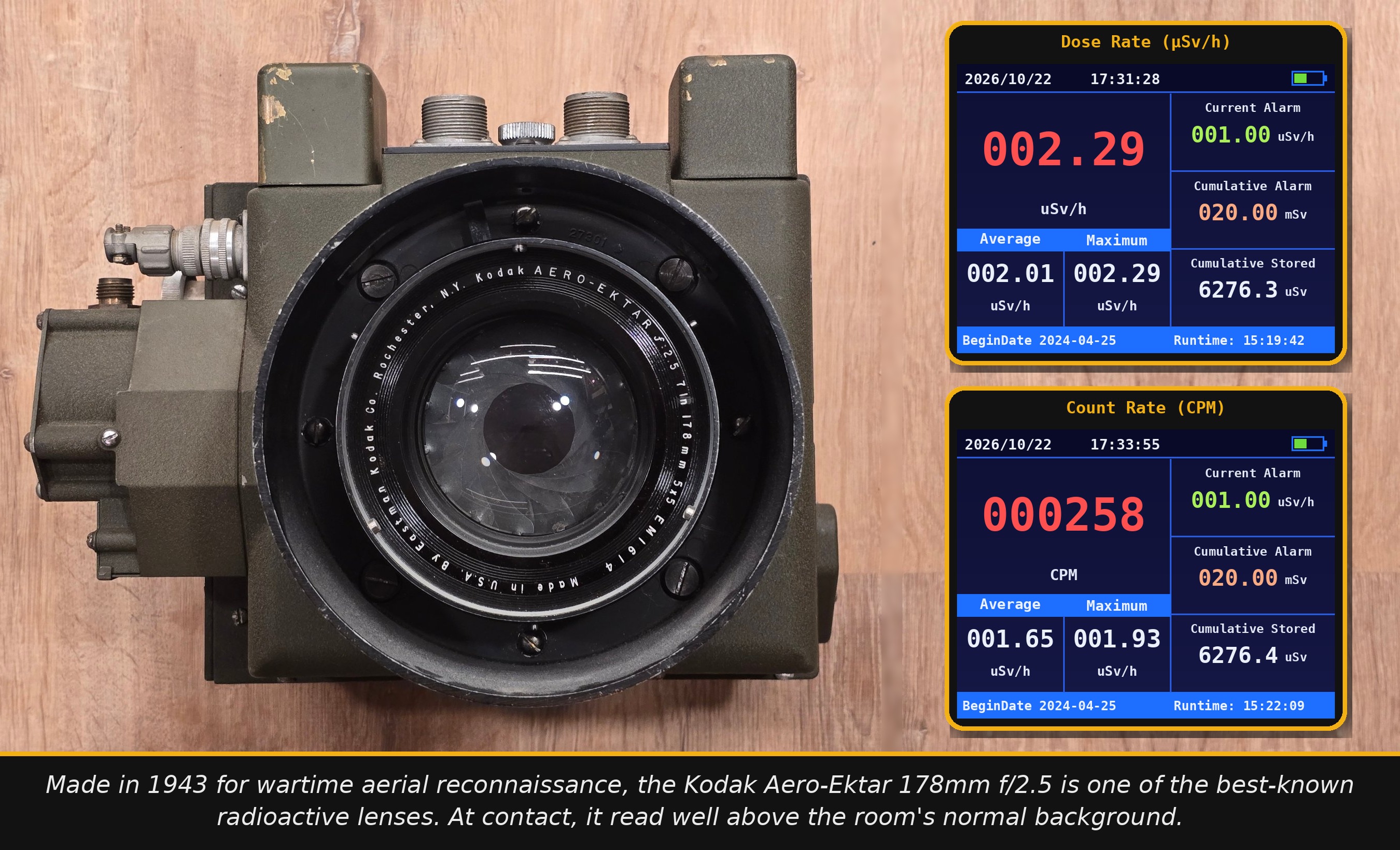
As soon as I powered on my radiation detector, the numbers started to climb, confirming that yes, the Aero-Ektar is definitely radioactive. This being my first ever use of a radiation detector, I did some research into how Geiger-Müller tube based detectors work, and the most important thing I learned is that the levels will fluctuate, sometimes wildly, so in order to get an accurate reading, you need to take a reading over time. For this and all future tests, I would leave the detector on for at least a minute allowing the numbers to stabilize and only capture a screenshot of the highest readings.
Looking at the peak numbers, a reading of 2.29 µSv/h is roughly 6 times the average rate of 0.36 µSv/h that which Americans receive natural background radiation each day and is roughly 10 to 18 times higher than my room’s background readings of 0.13 to 0.24 µSv/h. Are these numbers dangerous? Keep reading…
For my next test, I wanted to check an actual Kodak camera, so I looked at my shelf and picked the Kodak Chevron, a beautiful looking rangefinder camera which shoots 6×6 images on 620 format film. This particular camera has a CAMEROSITY date code indicating the camera was made in 1953 which is quite a bit later than the Aero-Ektar, but that lessons learned in optical glass for military use would have trickled down to civilian cameras by then, I felt this would be a good candidate.
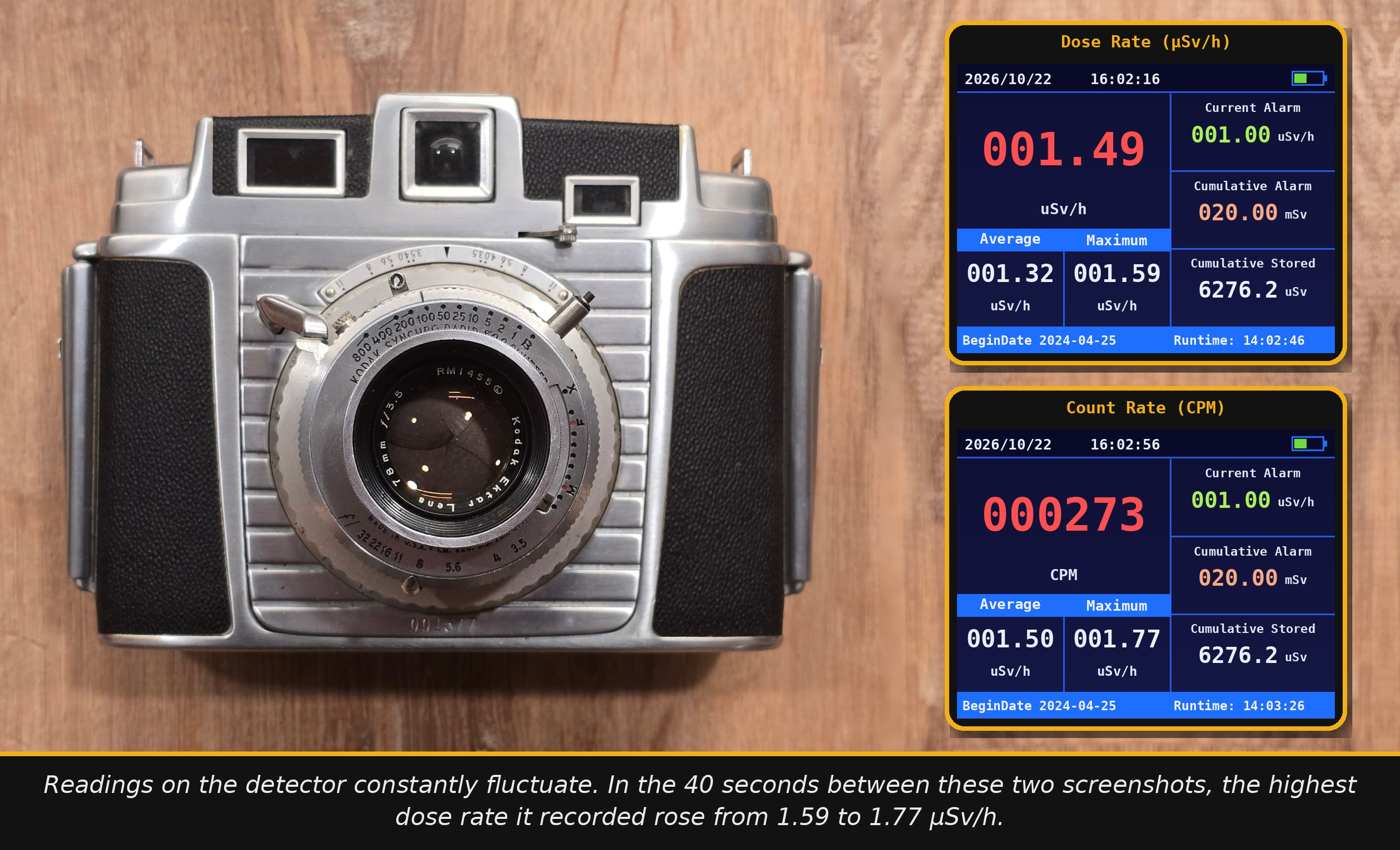
Like with the Aero-Ektar, my suspicions of radiation were confirmed when the numbers started going up. At a peak of 1.77 µSv/h, the Kodak Ektar 75mm f/3.5 lens didn’t reach the levels of the military lens, but it having a significantly smaller lens likely meant it would be less radioactive, or at least that’s how I imagined it. Remember, I am not an expert at this and I am using a $30 radiation tester.
If the Kodak Chevon was radioactive, then certainly the earlier Kodak Medalist should be right? For this test, I chose my 1946 Kodak Medalist II as I felt the original model might be a little too early.
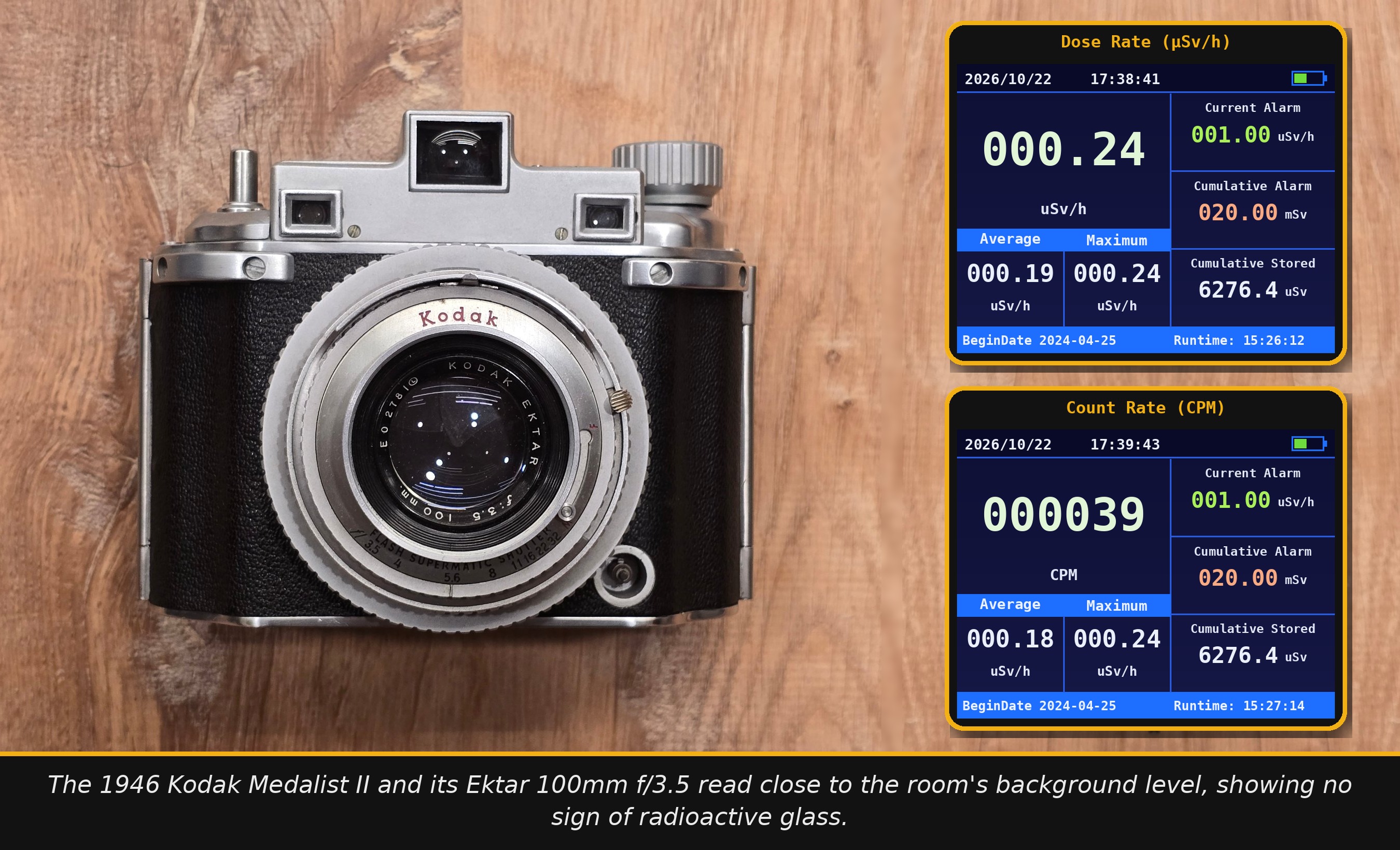
Nope. With peak measurements of 0.24 µSv/h and 39 CPM the numbers from this camera are in line with my room’s normal numbers suggesting there is nothing radioactive about this lens. Does this mean the Kodak Chevron, with its thorium equipped lens is capable of better images?
Having tested three Kodak lenses, I wanted to try something else, so I went with a couple from camera-wiki’s list of radioactive lenses. The first was the Canon FL 50mm f/1.8 lens which mounts to any FL or FD mount SLR. I put it on a period correct Canon FTb and got testing!
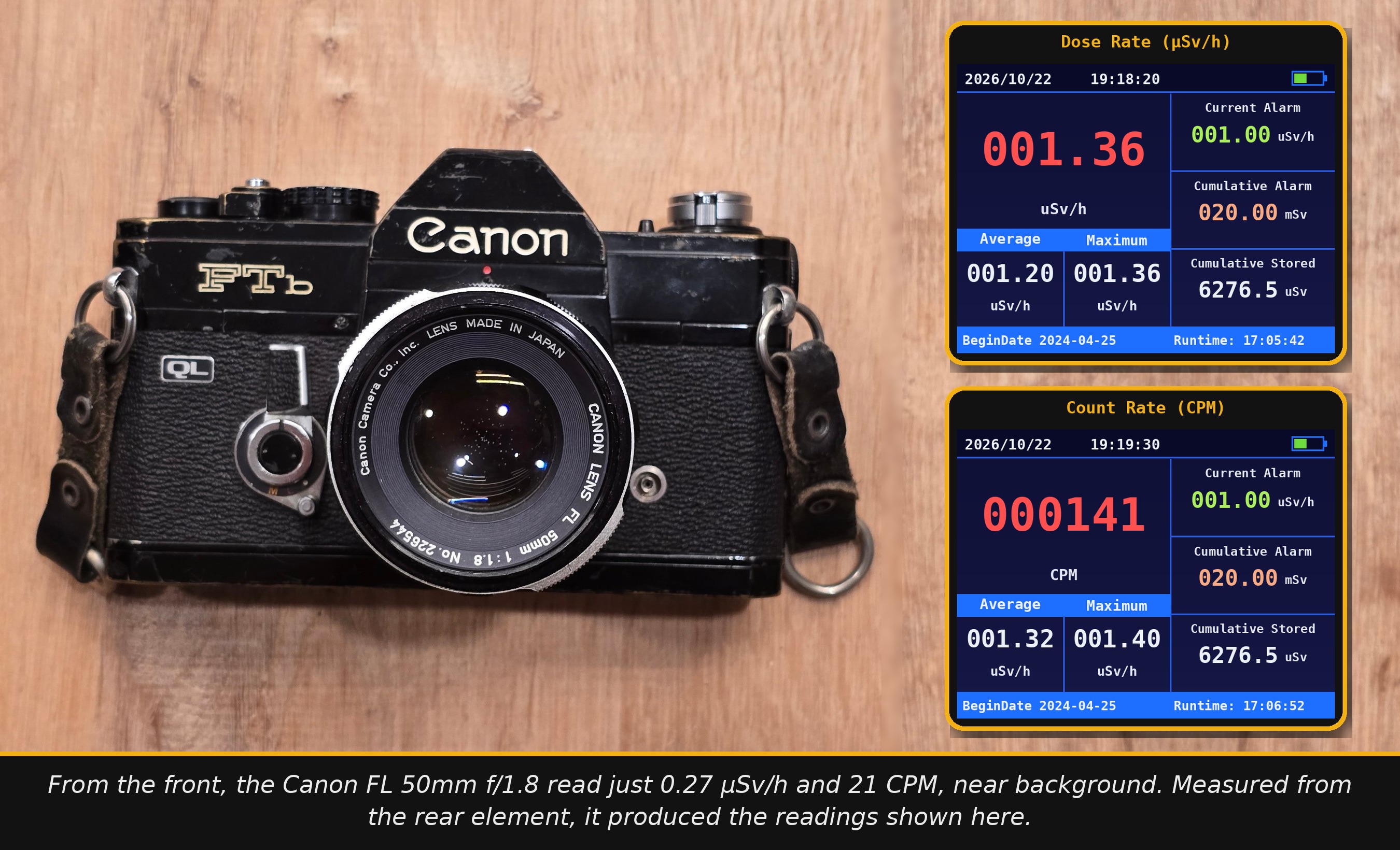 A curious observation of the Canon FL 50mm f/1.8 lens is that when I laid the Temu GC-01 over the front element like I had done on all previous tests, the numbers didn’t change. In fact, after several minutes of sitting on the lens, I never got a reading higher than 0.27 µSv/h and 21 CPM. Did camera-wiki have it wrong, or perhaps maybe not every example of this lens is radioactive. But then I remembered something I had read online, which is that many radioactive lenses have the highest levels near the rear element, not the front. To see if this was true for the Canon FL lens, I dismounted it, flipped it over, and repeated my test with my detector laying on the rear of the lens.
A ha! Readings with a peak of 1.36 µSv/h and 141 CPM showed that the rear element or group of the Canon FL 50mm f/1.8 lens was indeed, radioactive. It was at this point in my test that I limited myself to cameras with interchangeable lenses as I wouldn’t be able to as easily test the rear element of a fixed lens camera. For my next test, I chose another from the list, the beautiful Voigtländer Zoomar 36-82mm f/2.8 mounted to a period correct Voigtländer Bessamatic. The Zoomar is an interesting lens, not just for its design, but as the first commercially available zoom lens for a still photographic camera (zooms existed for motion picture cameras earlier), the Zoomar is historically signifcant.
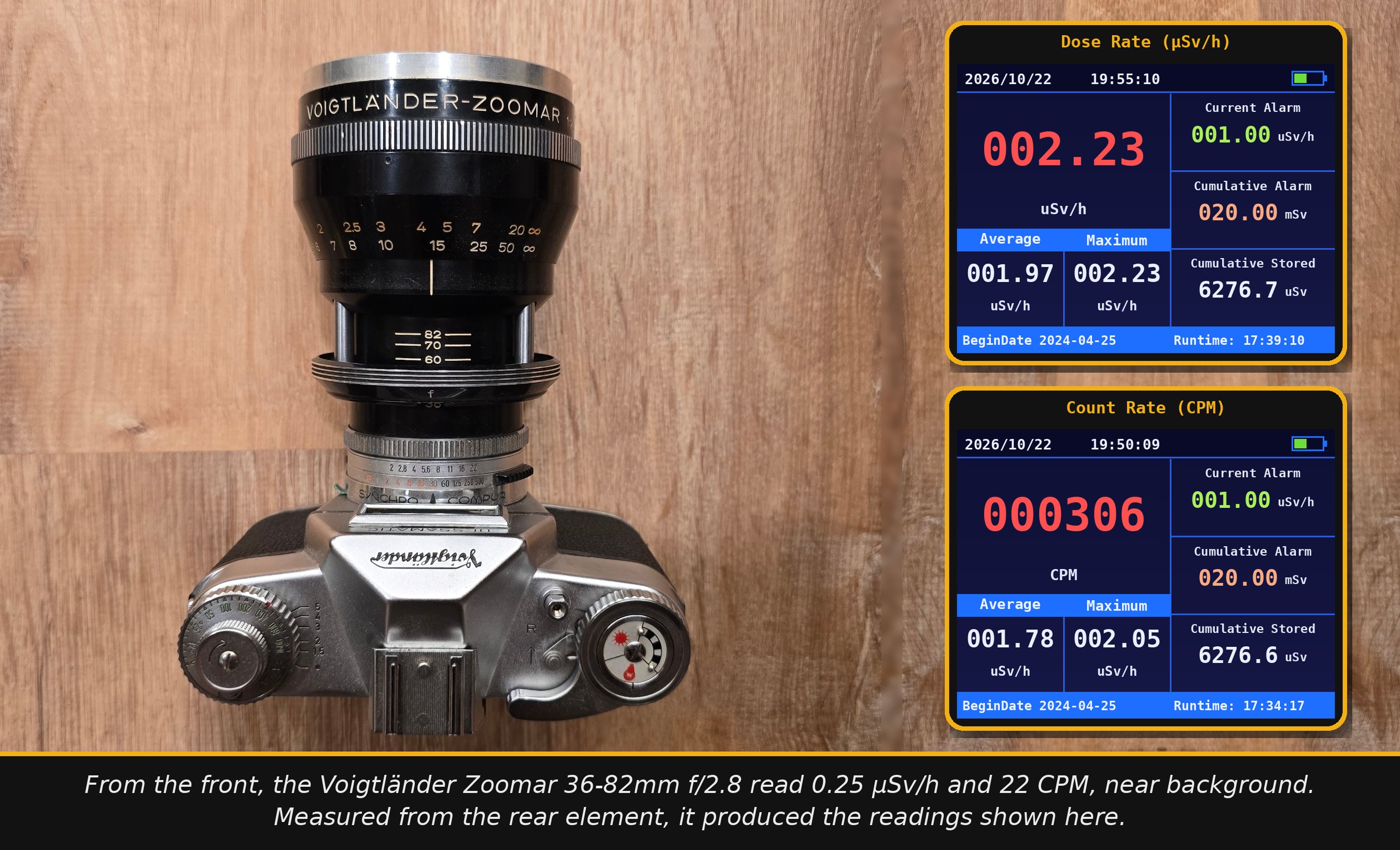
Like with the Canon FL lens, my first attempt to measure radiation on the front element returned numbers barely above normal for my room, so I dismounted the lens and tested the rear element and as promised the numbers started to climb. Earlier, I had hypothesized that the Chevron’s lower radiation than the Aero-Ektar could be explained by it having a smaller element, but with the Zoomar’s rear element being very tiny, this theory turned out to be invalid. Peak numbers of 2.23 µSv/h nearly matched that of the Aero-Ektar and 306 CPM exceeded it.
The use of thorium in a zoom lens like the Zoomar makes sense as early zoom lenses like this often struggled with color accuracy and softness, so the high refractive and low dispersion properties of thorium glass would certainly help improve the image quality.
While researching this article, I found information that Carl Zeiss Jena was also in the business of using thorium in its lenses as late as the 1970s. I was told to specifically look for the “zebra” lenses in which the focus ring was made of alternating black paint and chrome surfaces. Looking at my shelf, I had such a lens in the Pancolar 50mm f/1.8 lens on the Pentacon Super, so I took it off and tested it.
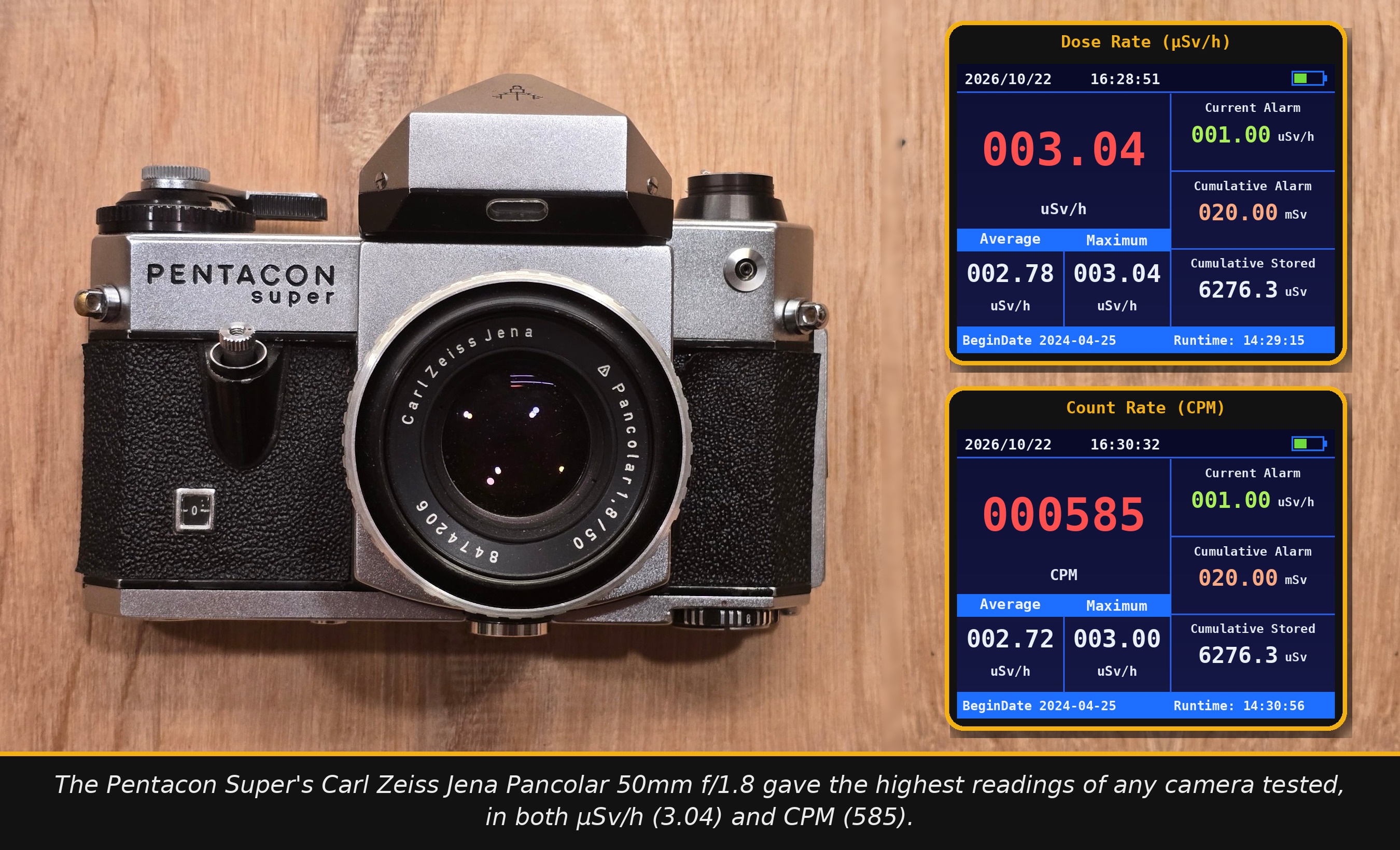 With readings of 3.04 µSv/h and 585 CPM, the Zeiss Pancolar lens topped every other lens in this test by a large margin. At first this surprised me as this lens was made so much after the war, but then again, Zeiss has always been on the forefront of optical design, so it stands to reason the German engineers at the time wanted every advantage they could get. Why exactly this lens tests so much higher than others, I have no idea, but clearly this one is HOT!
Moving on, I wanted to find some other radioactive gems in my collection and although the camera-wiki list doesn’t mention any Soviet lenses, I had this idea that the Soviets probably used thorium too. I looked for a good candidate and ended up choosing the Helios 44 58mm f/2 lens from the KMZ Start. I chose this particular lens as this example has a very strong and vibrant bluish purple coating that absolutely glows in sunlight. Indoors, under warm light you cant see it as easily but trust me, this lens has some special coatings and I thought for sure if there was a radioactive Soviet lens, this would be a good one to test.
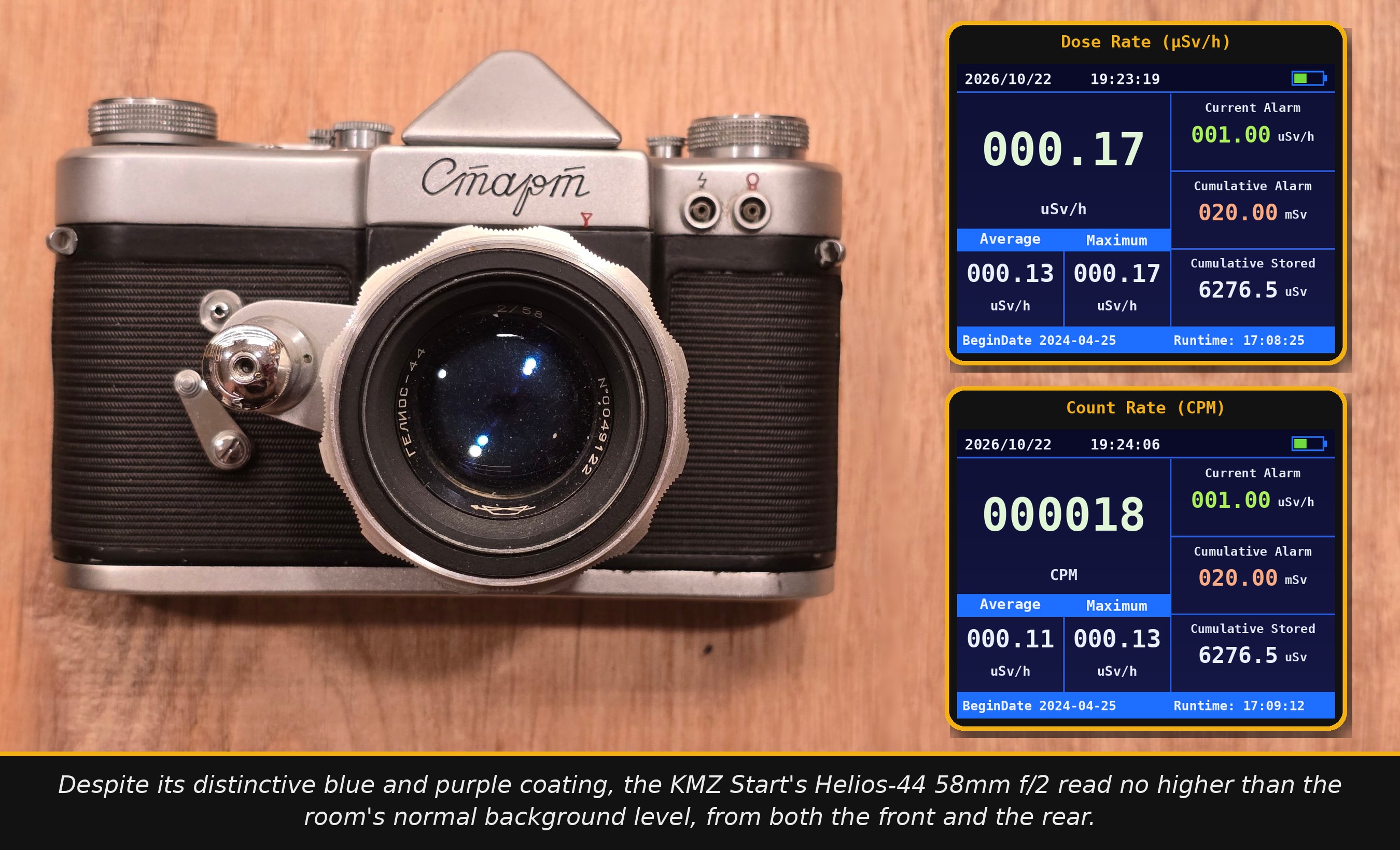
Despite a very strong color cast from the lens coating on the Helios 44, both the front and rear elements of this lens tested at levels normal for the room, suggesting there is no thorium anywhere in this lens. Still not wanting to give up on my theory that using radioactive lenses seemed like a Soviet thing to do, I also tested two different Jupiter-8s on a Kiev 4, a Zorki 4, and an Industar-22 on a FED-2 rangefinder and none of them tested positive.
Thinking that perhaps my mistake of interpreting a bright blue lens coating might suggest radiation, I knew that radioactive lenses are often yellow, so I looked through my lenses to see what other yellow lenses I had. Comparing what I had with what was on the camera-wiki lens, I had wanted to test a Super Takumar, but lacking in the exact model mentioned in the list, I pivoted to a circa 1957 Takumar 58mm f/2 lens on the original Asahi Pentax. This was the first pentaprism equipped Pentax camera and the company’s first use of the M42 thread mount on an SLR. I thought for sure that with its noticeable yellow coating and 1957 production date, it would be a prime candidate for thorium.
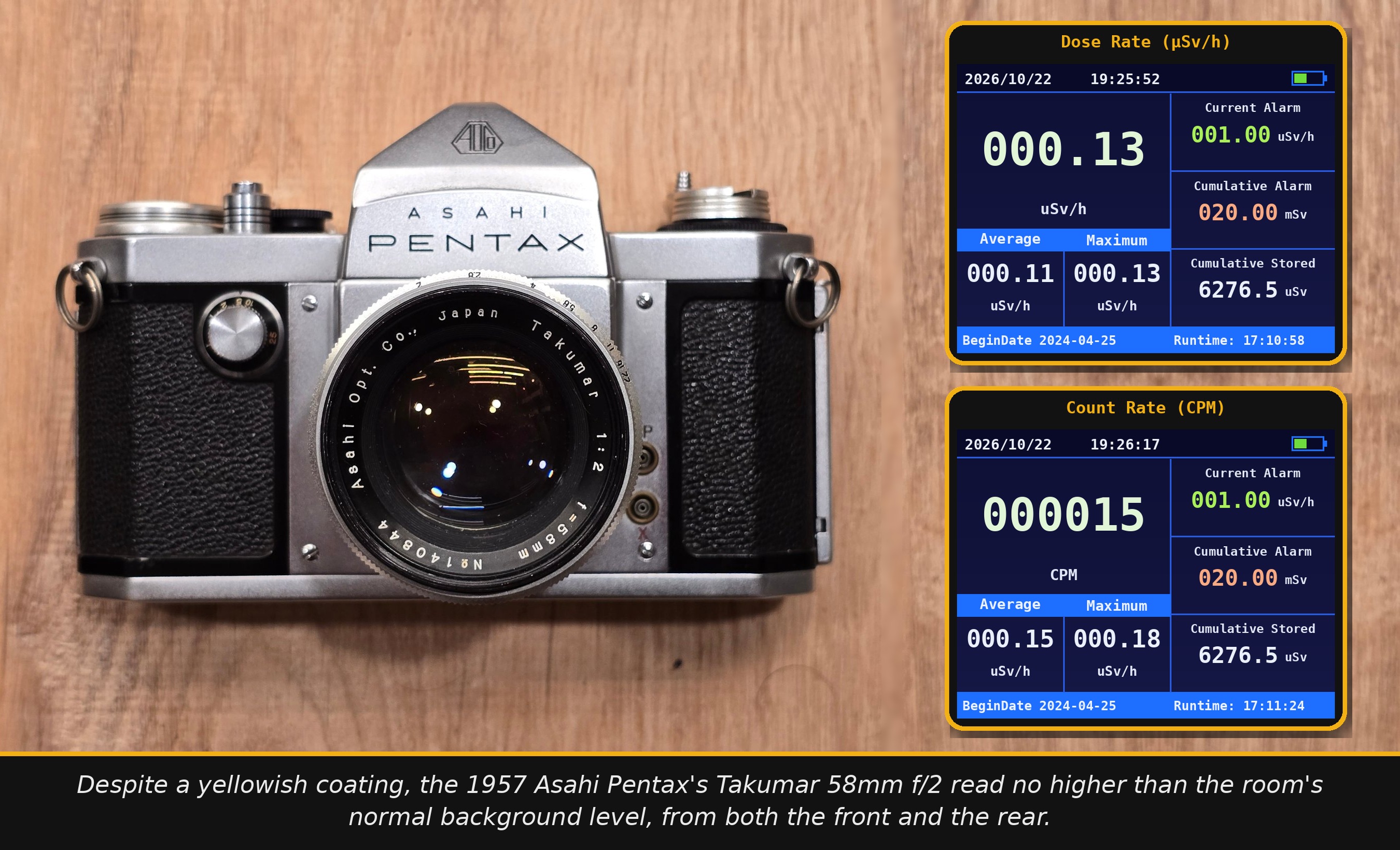
Nope again. As it turns out, I am pretty bad at guessing whether non-Kodak lenses are radioactive and figured I should probably just stick with confirmed lenses. The Takumar lens, despite a golden-yellow lens coating turned out to be completely free of radiation both at the front and rear elements.

As I was learning, these last two tests made a useful point about color. The Helios-44’s striking blue and purple coating and the Takumar’s yellowish coating come from very thin coating layers that reflect certain colors of light, the same effect that makes soap bubbles colorful. This coloration has nothing to do with whether the glass underneath contains thorium. Thorium yellowing is different as it is a discoloration of the glass itself, which you can see by looking through the lens at something white. This could easily be confirmed as looking through both the Takumar and Helios lenses at a white wall, the image still appeared white.
Does Distance Matter?
So far in this test, every reading I took was taken with the detector touching the lens. Clearly my inexpensive detector had no problems detecting radiation this close but with a collection of several hundred cameras and that with readings in the middle of my room consistent with normal background radiation, I could conclude that the radiation dissipates with distance, but how much distance is required before a radioactive lens like the Zeiss Pancolar 50mm f/1.8 is undetectable against background radiation?
To test this, I repeated my earlier measurement of the Pentacon Super with the Pancolar lens, but at various distances away from the glass. I started a mere 3 inches above the surface of the front element, then repeated it at 12 inches and again at 3 feet. In one last test, I wanted to see whether the camera itself could block radiation, so I performed another measurement at the very rear of the camera, approximating where a photographer’s face would be with the camera to their eye.
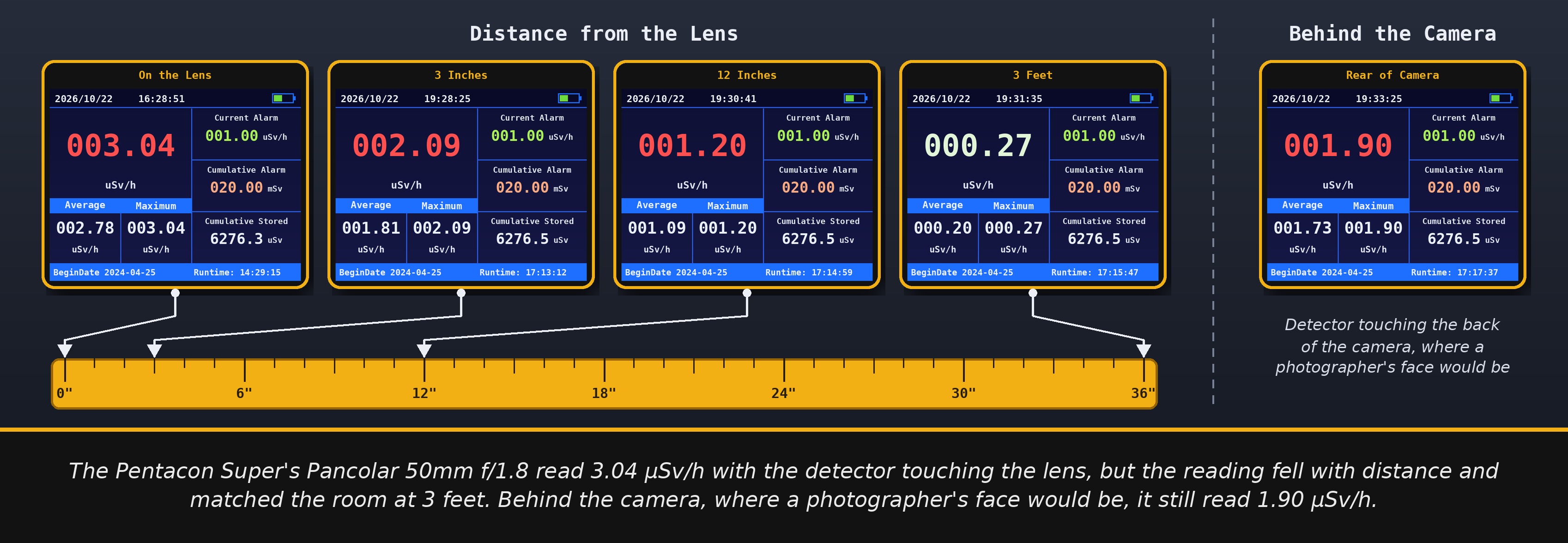
The reading dropped from 3.04 µSv/h touching the lens to 2.09 µSv/h at 3 inches and 1.20 µSv/h at 12 inches. At 3 feet it had fallen to 0.27 µSv/h, about the room’s normal background level. Behind the camera, the body blocked some of the radiation but not all of it, and the detector still read 1.90 µSv/h which is important as this means that while shooting the camera, a measurable amount of radiation above background is hitting your face.
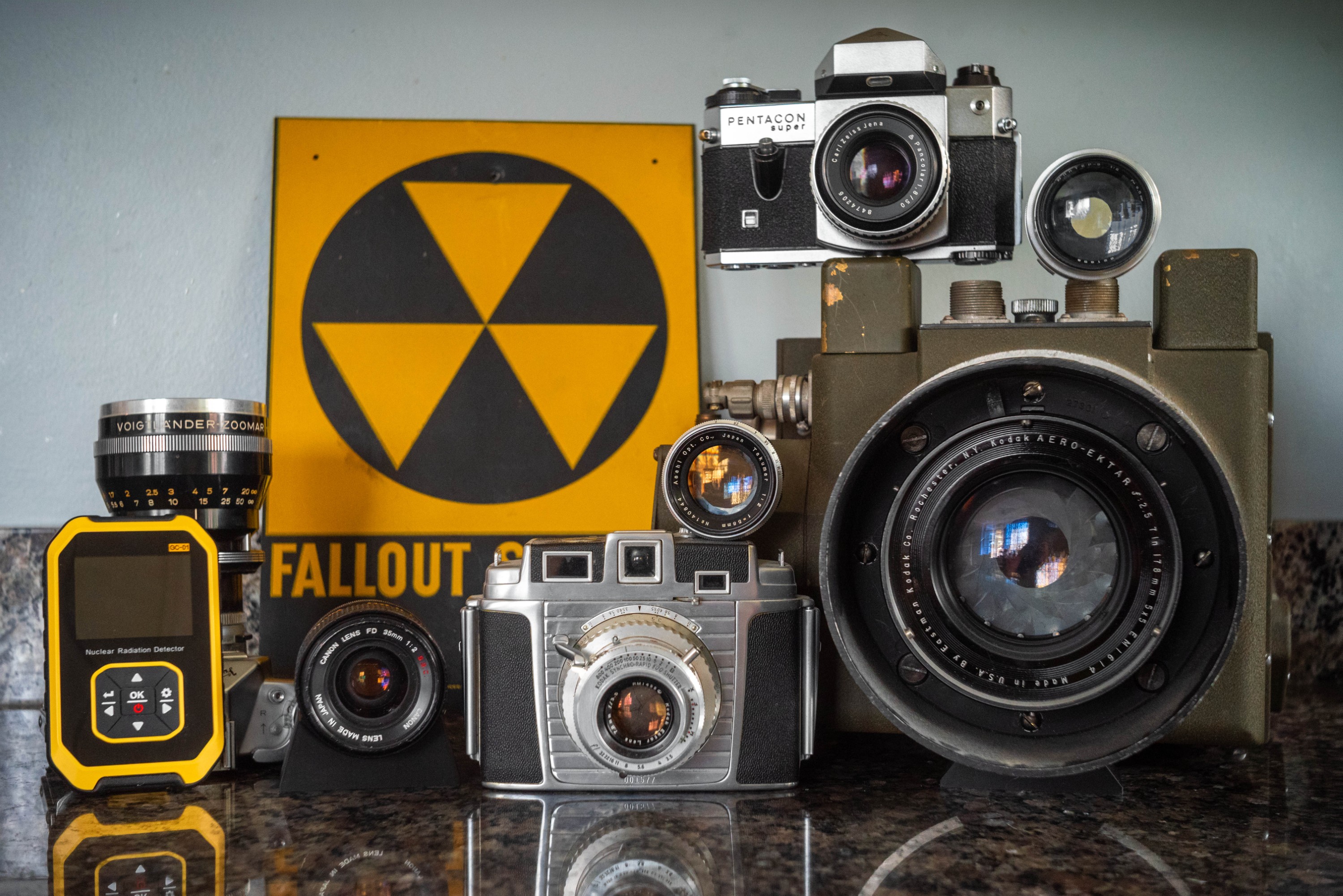 As much fun as I was having pulling cameras and lenses off my shelf and holding a radiation meter in place for a minute while taking screenshots of it with my phone and importing it into a photo editor to make a nice graphic, I felt as though I had enough information about some lenses that were definitely radioactive and some that weren’t. In addition, I could see that with the most radioactive lens I was able to test, its levels dropped significantly the farther you got away from it, but I still wanted to know if the accumulative effects of having hundreds of cameras and lenses all within a couple feet from my desk, was putting me in any danger.
Am I in Any Danger?
The quick answer is no. A few feet away, even the most radioactive lens I own was indistinguishable from the room’s normal background levels, and my desk is farther from my shelf than that. The only places the detector picked up meaningful levels of radiation were when it was in very close proximity to the lens glass.
But lets just say that in some sort of twisted camera torture fantasy, I wanted to lock someone in my office and duct tape the most radioactive lenses I had directly to their skin, how long would it take before the radiation from those lenses caused any real harm?

The infographic above explains that even in that completely ridiculous situation, the amount of time a radioactive lens emitting 3.04 µSv/h held in constant contact with skin for 24 hours a day, would take 14 straight days to even reach the US Nuclear Regulatory Commission’s public limits. For someone working in a nuclear plant or as an X-ray technician, would need to have that lens touching their skin for 2 years straight to reach a level that could be considered dangerous.
For an actual photographer who holds these cameras to their face, the camera itself shields some, but not all of the radiation from the lens, but even on the most arduous photo shoots, the cumulative amount of radiation exposed to someone’s face over time is incredibly small. Taking the 1.90 µSv/h reading at face value, an hour of shooting with the Pentacon Super would add roughly 2 µSv to your body which is around a quarter of what the average American receives from natural background in a typical day.
While it is pretty clear that using lenses with radioactive elements, even for extended periods of time, or having a large collection of them sitting on a shelf several feet away from a desk isn’t meaningfully hazardous, there are still a few fringe cases which could cause concern.
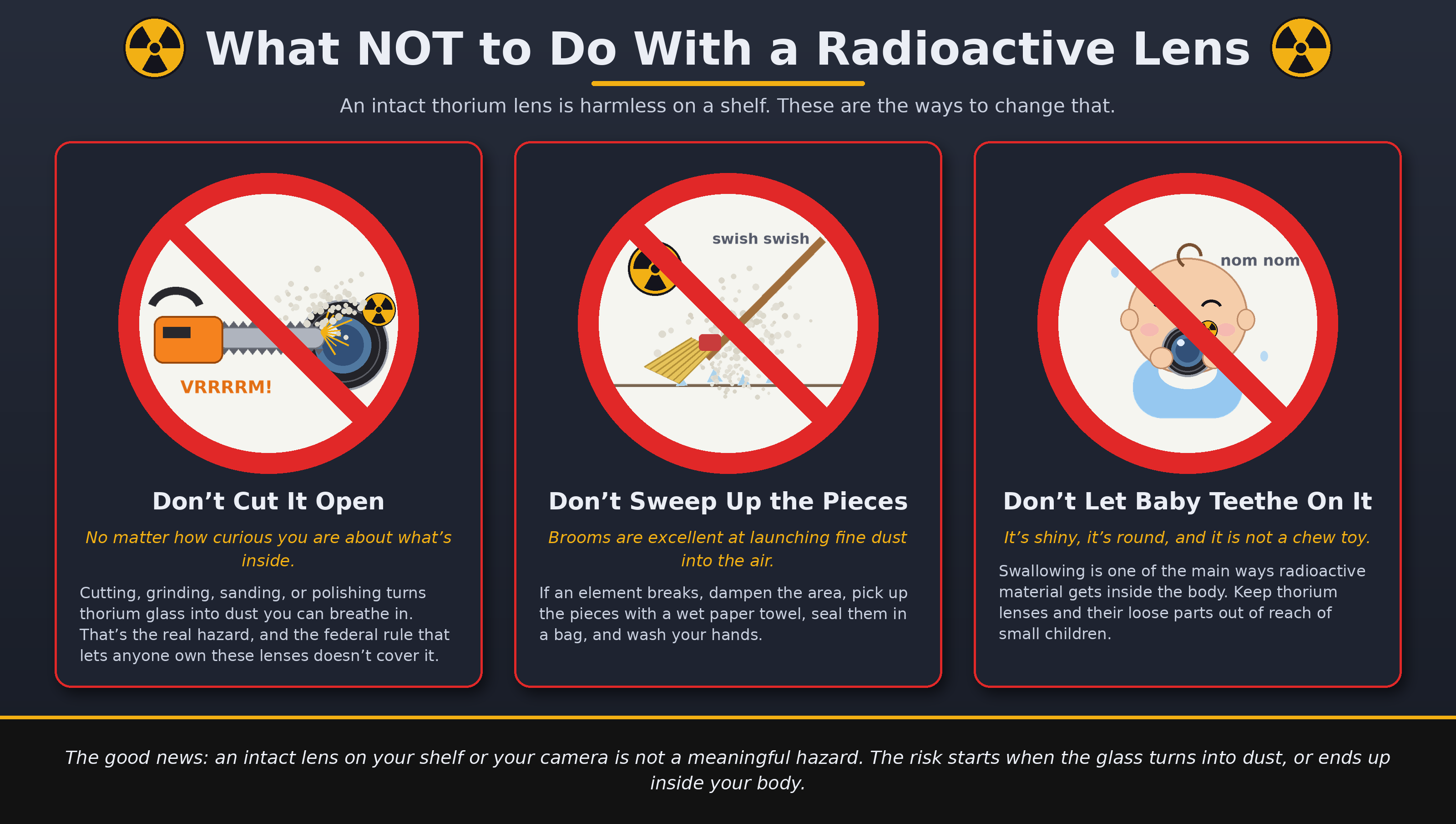
The first is that you should use caution when disassembling a lens containing thorium elements. Likewise, extreme caution should be used when grinding, sanding, or polishing the glass as thorium dust is far more hazardous than it is sitting in a lens. Pressing a radioactive lens against your face for a couple minutes is not dangerous, but breathing in radioactive dust definitely is.
If a glass element ever breaks and shatters into pieces, clean it up carefully with a wet paper towel, seal the pieces in a bag to dispose of it, and wash your hands. While glass shards usually won’t become airborne, you don’t want to risk breathing in any dust or possibly getting any splinters in your skin.
Finally, its a good idea to keep these lenses away from children and babies. Small children are much more sensitive to radiation than adults and while it is unlikely that a small child will fit a Kodak Aero-Ektar lens in their mouth, its just not worth the risk.
Thorium lenses deserve respect, not fear. Use them like you would any other lens, but use common sense. Don’t take them apart, grind them up and snort radioactive dust, or give rare Zeiss lenses to babies.