
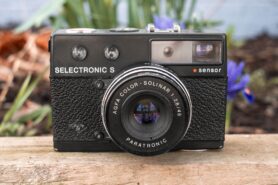
The AGFA Selectronic S is a West German-made 35mm rangefinder camera produced by Agfa-Gevaert between 1970 and 1976, representing the top-tier model in the company's rangefinder lineup above the Optima 500. It features aperture priority automatic exposure, an electronic Paratronic shutter with stepless speeds from 15 seconds to 1/500, and a 4-element AGFA Color-Solinar lens. Design-wise, it's notable for the large orangish-red shutter release created by the design studio Schlagheck & Schultes, which became a signature element across many AGFA cameras of the era. The camera arrived at the tail end of West German rangefinder manufacturing before companies shifted production overseas or exited the camera business entirely, and the author notes it seems to have never been sold in the US, with little documentation available about its release or pricing.
In hands-on testing, the author found much to admire: the Solinar lens produced excellent center sharpness with only minor softness wide open and no major vignetting, the aperture-priority metering worked well even with incorrect alkaline batteries substituted for the original mercury cells, and the large viewfinder—bright, with rangefinder patch, frame lines, and a full information display of shutter speeds and apertures—was a particular highlight. The oversized shutter release also impressed, requiring minimal pressure and travel while being easy to locate by feel. However, some quirks proved less successful: focus throw is very short, making fine focusing tricky, and there's no manual shutter speed control. The combined film advance/rewind lever, along with the "quick load" film system where the leader is fed blindly into a slot, drew criticism—the author experienced the film slipping off the spool and worried about the fragility of the small plastic lever controlling rewind mode, though no major failures occurred during testing.
Overall, the author views the Selectronic S as "more good than bad," praising its distinctive design, strong lens, and excellent viewfinder while acknowledging the film transport's added complexity as an unnecessary solution to a non-problem. Despite these quirks, and the camera's apparent rarity today (suggesting limited popularity in its time), the author considers it a worthy addition to a collection as one of the last German-made rangefinders outside of Leica's Wetzlar factory, marking the end of an era for German camera manufacturing.
AI-generated summary. May not capture every detail — read the full article below for the complete picture.
This is an AGFA Selectronic S, a 35mm rangefinder camera made by Agfa-Gevaert AG in München, West Germany between the years 1970 and 1976. The Selectronic S was the company’s top of the line rangefinder camera featuring aperture priority automatic exposure, an electronic shutter with a huge range of continuously variable speeds from 15 seconds to 1/500, a good 4-element Color Solinar lens, and an attractive all black body. The Selectronic S was the rangefinder version of the viewfinder only Selectronic, and was considered an upscale model to the silver AGFA Optima 500 which was also available at the time.

Film Type: 135 (35mm)
Lens: 45mm f/2.8 AGFA Color-Solinar coated 4-elements in 3-groups
Focus: 3.3 feet / 1 meter to Infinity
Viewfinder: Coincident Image Coupled Rangefinder w/ Shutter and Aperture Display, ~0.8x Magnification
Shutter: AGFA Paratronic Electronic Shutter
Speeds: 15 – 1/500 seconds, step less
Exposure Meter: Coupled CdS Cell w/ viewfinder match needle and Aperture Priority AE
Battery: (2x) 1.35v PX625 Mercury Battery
Flash Mount: Hot shoe with M and X Flash Sync
Weight: 488 grams
Manual: None
Throughout the 20th century, AGFA was a major player in both the photographic film and camera industries, releasing a large number of film emulsions like Agfacolor and Isopan and cameras like the Karat and Optima series.
Despite a large number of successful models, one thing AGFA lacked was a unified design language, something that people could use to quickly identify an AGFA model from one of many competing alternatives on the market.

That would all change in 1967 when an independent German design studio named Schlagheck & Schultes was founded by Norbert Schlagheck and a former Siemens employee named Herbert H. Schultes. Schlagheck & Schultes aimed to create industrial and commercial designs for various industries, and with Schultes previous relationship with AGFA while working for Siemens, he secured a relationship that would modernize AGFA’s design ethos for the next decade and a half.

The standout feature of AGFA Cameras designed by Schlagheck & Schultes was a large reddish orange shutter release button prominently located on the top plate of each camera. Schultes liked the red button so much, he used it on other non-camera designs his studio created, such as the Osram table lamps pictured to the right.
Camera-wiki’s page for Schlagheck & Schultes lists 14 different AGFA models designed by them, but in reality, there were many more subvariants of these cameras that all had it too, making the total number much higher.

The large orangish red shutter release of AGFA cameras designed by Schlagheck & Schultes gave AGFA a common design language for their cameras, but it also offered some practical benefits to the cameras too.
Rather than having a large spring loaded mechanical button like on most cameras of the day, the shutter release on cameras like the AGFA Selectronic S was 16mm in diameter, set within a 0.7mm high chrome plated brass collar which made it easy to locate with the camera to your eye. The orange button covers the actual shutter release beneath it, giving a basic level of protection against dirt, grime, and moisture. Pressing the shutter release is very precise, requiring approximately 300 grams worth of pressure, and only requiring 0.5mm worth of travel. The idea behind such a precision shutter release was to avoid body shake due to movement caused by pressure from the photographer’s finger pushing down on the camera while firing the shutter.

The large reddish orange button on AGFA cameras remains a staple of their design language to this very day with Agfaphoto’s current generation of reusable 35mm point and shoot cameras.
The AGFA Selectronic S was the company’s top of the line 35mm rangefinder camera in the early 1970s, offering a solid metal body, coupled rangefinder, automatic exposure, and a good 4-element Tessar style lens. While researching this article, I found very little in the way of marketing or promotional material. The short snippet to the right comes from an article covering the 1970 Photokina in the January 1971 issue of Modern Photography. It confirms things we already know about the camera, but offers no insight to when it actually went on sale, or for how much.
An appearance at Photokina does not guarantee export to the United States, and that so little can be found about it online, my best guess is that this camera never made it here. If it did, my best guess would be that due to its German construction and reputation, it likely would have carried a moderate price tag, but not so high as to compete with the large number of 35mm SLRs which were popular at the time.
The AGFA Selectronic S represents a last hurrah of West German made 35mm rangefinder cameras. With an ever increasing need to cut costs, by the early 1970s, many West German companies had either begun outsourcing production to places like Singapore, Hong Kong, or Japan, or they just stopped making cameras altogether.

Information online suggests the AGFA Selectronic S was produced until 1976 when it was replaced by the AGFA Optima Sensor series, which considering how uncommon this camera is, I have my doubts about. While it is likely true that the Optima Sensor series made its debut in 1976, I feel as though there is a good chance the Selectronic S sold for a much shorter time, but that is just a guess. If anyone knows of any more detail about this camera’s production run, or where it was marketed, please let me know in the comments.
The Selectronic S features the iconic large orangish-red shutter released designed by Schlagheck & Schultes on a huge number of AGFA cameras from this day. Not only is the large shutter release beautiful, but it is also very easy to locate and press.
The Selectronic S has a mostly metal body with some use of lightweight plastics, but still feels compact in your hands. Combined with a modern metering system, aperture priority AE, a coupled rangefinder, and a full information viewfinder, there is a lot to like about the camera. The camera has a robust feel to it, suggesting good build quality, but without the “density” of other German cameras.

The top plate is pretty clean with only the flash hot shoe, a film speed dial and the large shutter release. The film speed dial shows ASA and DIN speeds from 25/15 to 400/27. The lack of support for films higher than ASA400 is a sign of the times and wasn’t as limiting as it would have been later in the century as films with speeds faster than 400 were not common.

Flip the camera over and the bottom has a 1/4″ tripod socket, the additive exposure counter, and the combined film advance and rewind lever. Due to the location of the film advance lever on the bottom of the camera, it must be activated with your left thumb while supporting the bottom of the camera. It does feel strange compared to most other cameras, but you do get used to it pretty quickly after handling the camera. The exposure counter on this camera does not automatically reset when loading in a new roll of film and must be manually set back to 0 after a new roll has been inserted. Like the ASA film speed setting on the top of the camera, the exposure counter has a slot where a small coin can be inserted to make turning it easier.

The designers of the AGFA Selectronic S made the curious decision to combine both the film advance and rewind levers into one. Under normal operation, winding the lever advances the film, cocks the shutter, and advances the counter, just like on any other camera. But when putting the camera into Rewind mode, using a small lever on the front of the camera, the film transport is deactivated and the gearing on the film advance lever changes direction, allowing this lever the ability to rewind the film back into its cassette. In addition to changing the direction of the film transport, in rewind mode, the film transports twice as fast, moving two exposures for every movement of the lever. This process of using the advance lever to rewind film is certainly strange, but it does work, and I suppose it allows for a cleaner camera design by only requiring one lever or knob to do two things.

The AGFA Selectronic S lacks strap lugs on the sides but does feature the film door lock and battery compartment on the right side. The battery compartment is actually a curved tray that pulls out of the camera using your fingernail. In the tray rest two PX625 mercury batteries to power the meter and electronic shutter. The camera’s right side has the serial number and what looks to be some kind of date code stamped into the metal.

Around back is the large round eyepiece for the viewfinder in the upper left corner. To the right is a battery test button which when pressed causes the needle in the viewfinder to move, and a threaded cable release socket for the shutter release.

Opening the left hinged film door reveals an interesting film compartment. Film transports from right to left onto a sort of early “quick load” take up spool which is covered by a plastic flap. Normally, The spool itself has no slots or anything where you physically attach the film leader when loading in a new cassette. Loading film involves pushing the leader through a small slit in the plastic cover until it hits the back wall of the camera and then closing the door. Somehow, using some type of spring loaded roller, the film will start to wrap around itself on the take up spool as you continue to wind the camera. It is a pretty nifty system, but I have to wonder how often this system fails to load the film and users of these cameras took them out, taking photos and winding on the camera not realizing that their film wasn’t advancing.

The rest of the film compartment is pretty normal. An oversized metal film pressure plate is on the inside of the door, covered in small divots to help reduce friction as film passes over it. A small sticker on the inside of the door reminds you to use AGFA Film 135, and not that evil Kodak stuff. There is also no light seal material anywhere on the door or in the film compartment for you to replace.

Looking down on top of the AGFA-Color Solinar lens and shutter, closest to the body is a wide aperture ring with f/stop markings from f/2.8 to f/22. The AGFA Selectronic S is an aperture priority auto exposure camera with no ability directly control shutter speeds, so this ring is the only exposure control (besides the film ASA dial) which you can use to change exposure. Next is a depth of field scale and finally the focus ring closest to the front indicated in feet and meters from 3.25 feet or 1 meter to infinity.

Up front, we see the mostly clean exterior of the AGFA Selectronic S. A red dot next to the word “Sensor” appears on the right side below the viewfinder window. On the opposite side of the shutter are two levers, one labeled “V” and the other “R”. The “V” is for “Vorlaufwerk” which loosely translates to pre-work, which is the name given to self-timers on German cameras. The “R” is for rewind or “Rückspulen” in German. This is the lever to reverse the film transport for rewinding film at the end of a roll. To use it, press in towards the lens and then up to engage rewind mode. Once the camera is in rewind mode, there are two ways to deactivate it. A small metal button behind the lever can be pressed to manually put the camera back into normal film transport mode. The other is to simply open the film door and remove the film. The physical act of opening the door puts the camera back into normal mode.

The AGFA Selectronic S has a large and very bright viewfinder which is easy to use, even while wearing prescription glasses. The main part has a strong purple tint with the rangefinder patch and frame lines in a yellowish hue which offers excellent contrast. The full information viewfinder shows both your manually selected aperture f/stops across the top, and a range of shutter speeds from 1/30 to 1/500 across the right side which the meter will choose once you press the shutter release. The meter is active after advancing the film, but turns off after each press of the shutter release. Below the slowest indicated speed of 1/30 is an icon of a camera on a tripod which is where the needle will point for any speed below 1/30 down to a full 15 seconds. This icon is supposed to remind you to stabilize the camera for slow shutter speeds.
Upon initial inspection of the AGFA Selectronic S, everything appeared to be in working order. I was excited to load up some film and shoot the camera, but more than anything, I was most eager to see how the film transport worked. With a “feed it and forget” it film loading procedure and a film transport that relies on the same lever to both advance and rewind film, I wanted to experience the camera with film in it. For the first roll, I loaded in some semi expired Kodak BW400CN chromogenic film and carried the camera with me for a couple of weeks.


Throughout the 20th century, AGFA cameras were known to be of generally good build quality and featuring good to excellent lenses. I have shot several AGFA models such as the Selectaflex SLR, Ambi Silette rangefinder, and the Parat half frame camera and was pleased with the results from all three, so I had assumed I would get similar results from the 4-element Solinar lens on the Selectronic S.
As expected, the images turned out very nice. I cannot confirm this, but I believe the Solinar to be a Tessar-style lens of which many manufacturers built to great success. The images from the Selectronic S were about as good as any you’d find at this camera’s price point. Sharpness is excellent in the center and holds up pretty well in the corners without any major vignetting or other optical anomalies. Wide open, the lens shows some softness like in the mirror selfie and in the low light park scenes, but nothing that anyone would complain about. The lone flaw in my sample images was one double exposure which didn’t repeat itself throughout the roll. Clearly, the lens was up to the task of making great images.

The autoexposure system worked well, especially considering I was using contemporary alkaline PX625 batteries instead of the correct voltage mercury batteries this camera was designed for. This either means that the camera has a built in voltage limiting circuit, or I just got real lucky as all of my images came out properly exposed.
Using the camera however, was a bit of a mixed blessing. The overall size and feel of the camera is on par with 35mm rangefinder cameras from the 1970s. An increased use of weight saving plastics and a reduction in size increased the compactness and portability of the camera. This often comes at the expense of focus accuracy as a complete turn of the lens from minimum to infinity focus requires less than a quarter of a turn. This improves speed, but can sometimes have the negative side effect where it can be difficult to attain fine focus as the rangefinder patch moves so fast. The inclusion of aperture priority automatic exposure is very nice, but there is no ability to directly control shutter speeds, which for a premium German rangefinder feels like a missed opportunity.

On the “not so great” end of things, I really wanted to like the film transport on this camera, but my conclusion was that a more traditional approach would have been better. Certainly companies around this time were experimenting with Quick Load film systems. Kodak had a similar system in the Signet 80 and Canon experimented with an elaborate hinged roller on some of their SLR and rangefinder cameras of the day, but I feel as though the one used on the Selectronic S is begging for issues such as the double exposure I included in the gallery above.
When feeding the film into the “slit” you can’t actually see it attaching to the spool. I found that in more than one occasion, it slipped off and I had to reopen the camera and attach it again. In addition, combining the film advance and rewind mechanisms in the same lever looks and sounds very cool, but the additional complexity involved in changing the gearing direction for the same lever adds unnecessary complications to the camera’s design. I found that in use, rewinding the film felt disconnected, and I had concerns with the small plastic lever which engages rewind mode. If this lever were to break, there is no way to disengage the film transport, resulting in no way to rewind your film. While I usually applaud companies for thinking outside the box, in this case, AGFA’s system feels like a solution looking for a problem. Thankfully though, I didn’t have any major problems with the transport, but I can see how it might have.

On the plus side, the large shutter release is both attractive and works quite well. With the camera to your eye, it is impossible to miss the shutter release and pressing it feels very precise. The patent for the shutter release states that only 300 grams of pressure with a travel of 0.5mm is required which makes for a very easy and gentle shutter release. It is worth noting however that other companies such as Olympus and Mamiya who developed similar soft touch shutter releases often found that they didn’t hold up well and would fail over time. Whether the AGFA’s has a more reliable design or if I am just lucky, is anyone’s guess.
Continuing with the pluses, I loved the viewfinder. Many of AGFA’s 1970s camera offerings had huge viewfinders and that this one not only adds a rangefinder window, but also a full information finder is icing on the cake. I would have preferred there to be more than five shutter speeds displayed, but if the lens and shutter release are the camera’s best virtues, the viewfinder is very close behind.
The AGFA Selectronic S is a cool camera with more good than bad, and even the bad isn’t really that bad, just different. I applaud AGFA’s decision to try something new and that large shutter release certainly gave them a brand identity. For as many cool things as I can say about this particular model, that they’re so hard to find today suggests they really weren’t that popular. These represent some of the last German made rangefinders outside of Wetzlar and signaled the end of an era. For that, the cool design, good lens, and quirky film transport, these cameras are worthy of adding to your collection.
Related Posts You Might Enjoy
External Links
https://camera-wiki.org/wiki/Agfa_Selectronic_Sensor
https://forum.mflenses.com/our-rangefinder-collections-t10698,start,120.html
https://www.collection-appareils.fr/x/html/camera-12345-Agfa.html
Cool post on a really interesting camera. I noticed from your photos that you were right down the street from my office, on Big Beaver Road and I-75.
Mike,
Nice review. I have one and shot a few rolls with it, with similar results. The frame counter threw me though, and after the second roll, I thought it was broken. But your review states that the frame counter must be manually reset, and that might have been the problem of not knowing the end of the film. The numbers were off. I would think that a camera of this time period would not have a counter feature that seemed to be of older cameras, where one has to reset the numbers. I also have the original case, which is nicely leather covered, but is also a bit as strange as the camera. I’ll try to send you a pic of it, and will try another roll with resetting the frame counter.
Ciao, complimenti per il tuo lavoro, molto interessante. Solo una precisazione. La fotocamera è espressamente progettata per l’uso di pile da 1,5 volt, ecco perché non hai avuto problemi. Se estrai il vassoio batterie, potrai leggere sul bordo per quali pile era in origine progettata.
Un saluto dall’Italia
Alessio
PS
Abbiamo muna collezione di camere molto simile….
I’ve been using the Agfa Selectronic S quite a lot, especially for color photography, and I’ve already taken some really great pictures with it. The Color-Solinar is a very nice lens, and I’m always impressed by the results.
Getting 1.5 V batteries is no problem at all, so I don’t see that as a disadvantage either. Overall, I think it’s a really lovely camera – compact, easy to carry around, and a great companion for everyday photography. I’m very happy to have it in my collection of German cameras.