
This installment of Keppler's Vault revisits a 1952 photo essay documenting the human toll of polio, once one of the most feared childhood diseases in America. The piece opens with historical context: at its peak in 1952, polio infected nearly 60,000 children in the U.S. and killed over 3,000, with survivors often facing paralysis or death from respiratory failure. Photographers of the era, including those featured in Modern Photography magazine, played a role in public awareness campaigns, partnering with organizations like the National Foundation for Infantile Paralysis and MoMA to raise funds and educate the public through Polio Drives.
The centerpiece of the article is a series of photographs shot over eight months in 1952 by independent photographer Suzanne Szasz, working for Women's Home Companion magazine, inside the children's ward of New York's Willard Parker Hospital. Szasz focused on six-year-old Eileen Dicheck, a polio patient, but included other children in the ward to build trust and capture natural, candid interactions. Her approach emphasized minimal gear—relying on a single automatic Rolleiflex and natural light—embodying a "one camera, one film" philosophy that forced discipline and simplicity in her shooting process. The author reflects on this approach, contrasting it with his own tendency to overpack gear on shoots, noting how Szasz's minimalism allowed her to blend in and document the children authentically. Eileen's story ends happily: after eight months, she recovered and returned home, with her mother having consented to the photographs in hopes of comforting other families facing similar struggles.
The overall takeaway blends photographic appreciation with a broader public health message. The author notes that Eileen's recovery came just three years before Jonas Salk's 1955 polio vaccine, which helped eradicate the disease in the U.S. by 1979. Using this history as a springboard, the author urges readers not to forget the real dangers of preventable diseases like polio, measles, and mumps, citing recent outbreaks tied to declining vaccination rates. The piece closes as both a tribute to Szasz's understated photographic craft and a heartfelt plea for continued vaccination, framing the 1952 photographs as a lasting reminder of what's at stake when such diseases are allowed to resurface.
AI-generated summary. May not capture every detail — read the full article below for the complete picture.
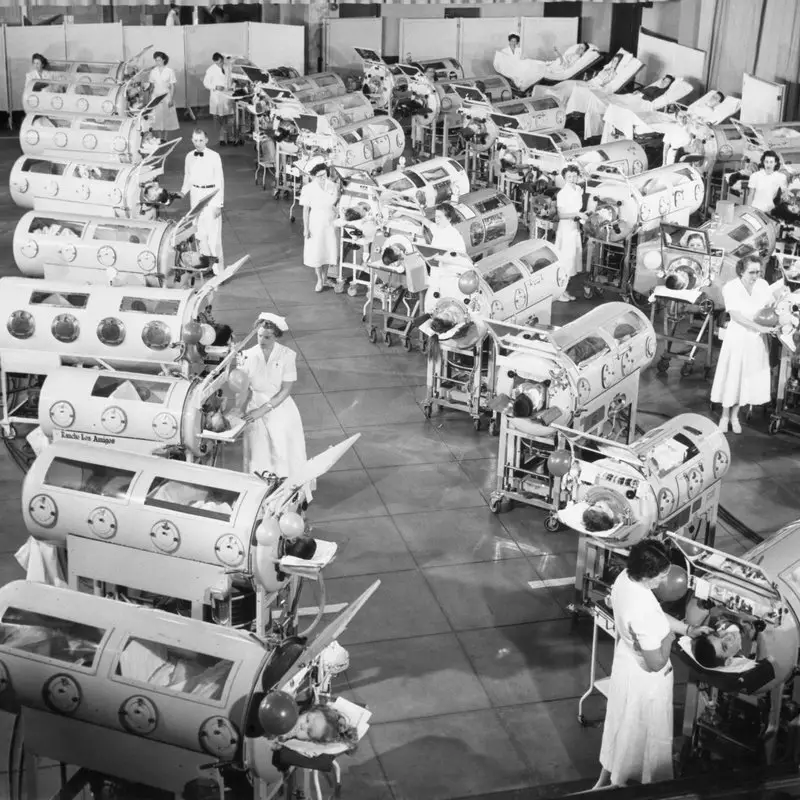
Polio is a horrible, horrible disease. During it’s peak in 1952, Polio infected nearly 60,000 children and caused over 3,000 deaths in the United States. The numbers were significantly higher in other, less developed countries. The virus most commonly affected children, specifically those aged 5 and under. When a child was diagnosed with Polio, 1 in 200 would suffer from irreversible paralysis, and of those cases 5 to 10% would die due to immobilization of their breathing muscles.
Once someone has Polio, it can never be cured, however it’s symptoms can be minimized through continued treatments. Even with treatments, symptoms of post-polio syndrome may reoccur which include muscle weakness and difficulty moving.
If you were born after 1955, consider yourself extremely fortunate to have been born in an era where you didn’t need to worry about this terrifying disease. The CDC says that there have been no new cases of the Polio virus (officially called Poliomyelitis) in the United States since 1979. The last known case of someone bringing it into the country occurred in 1993. Worldwide, cases of Polio have dropped 99% from over 350,000 cases in 1988 to 36 in 2016.
In the early 1950s, polio was every parent’s worst nightmare. As a parent myself of two children under 5 years of age, the thought of them contracting such a terrible disease is unimaginable to me. Since Polio is spread through airborne particles and by infected food and water, the chances for healthy children to get it were very high. I could not imagine the thought of sending my kids off to school or to a friends house and not knowing if they’d come in contact with it.
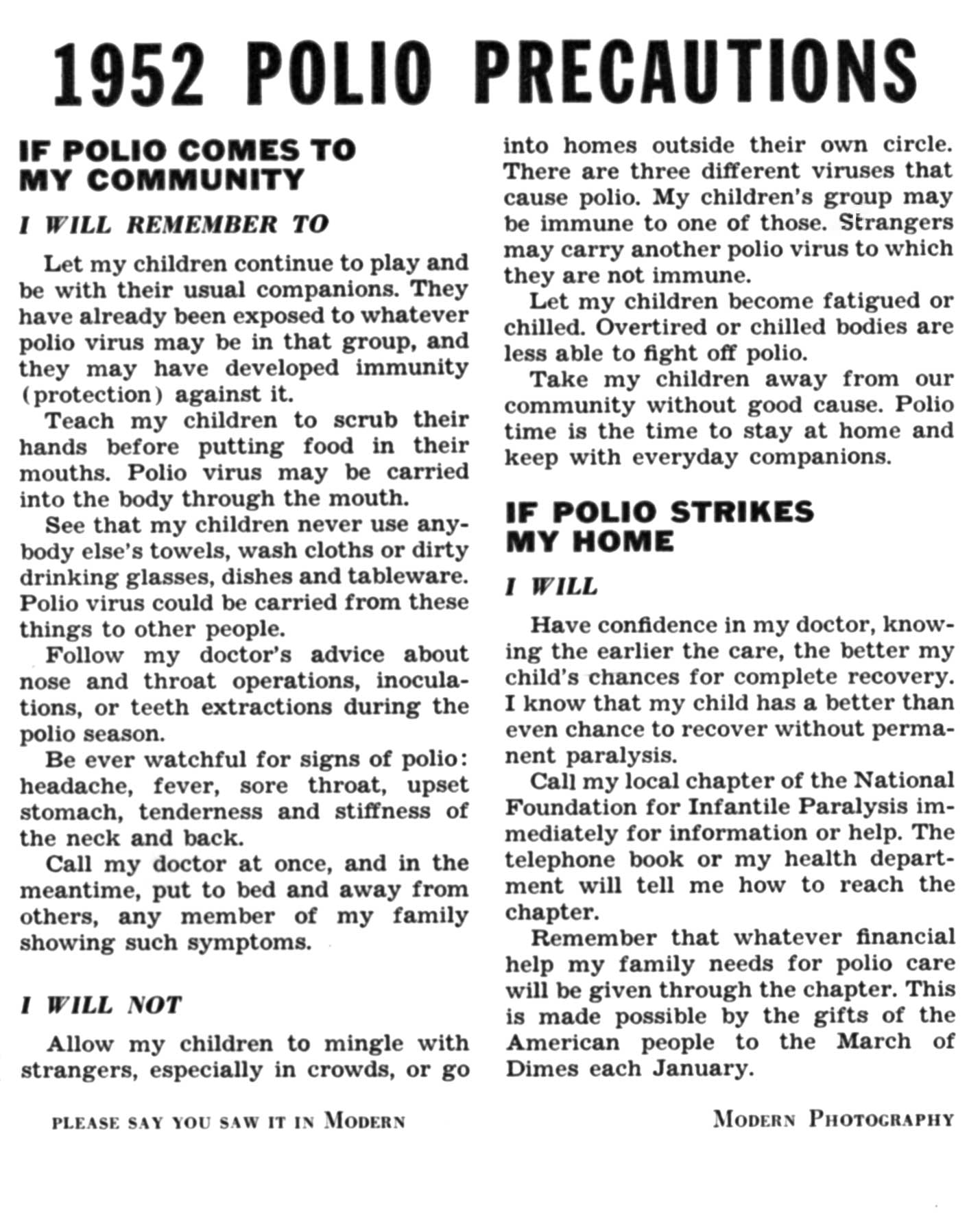
Everyone, photographers included, needed to help spread awareness by informing their customers on prevention tactics and what to do to help those in need. Modern Photography frequently included information like the text to the right in their issues in an effort to help those who may need it.
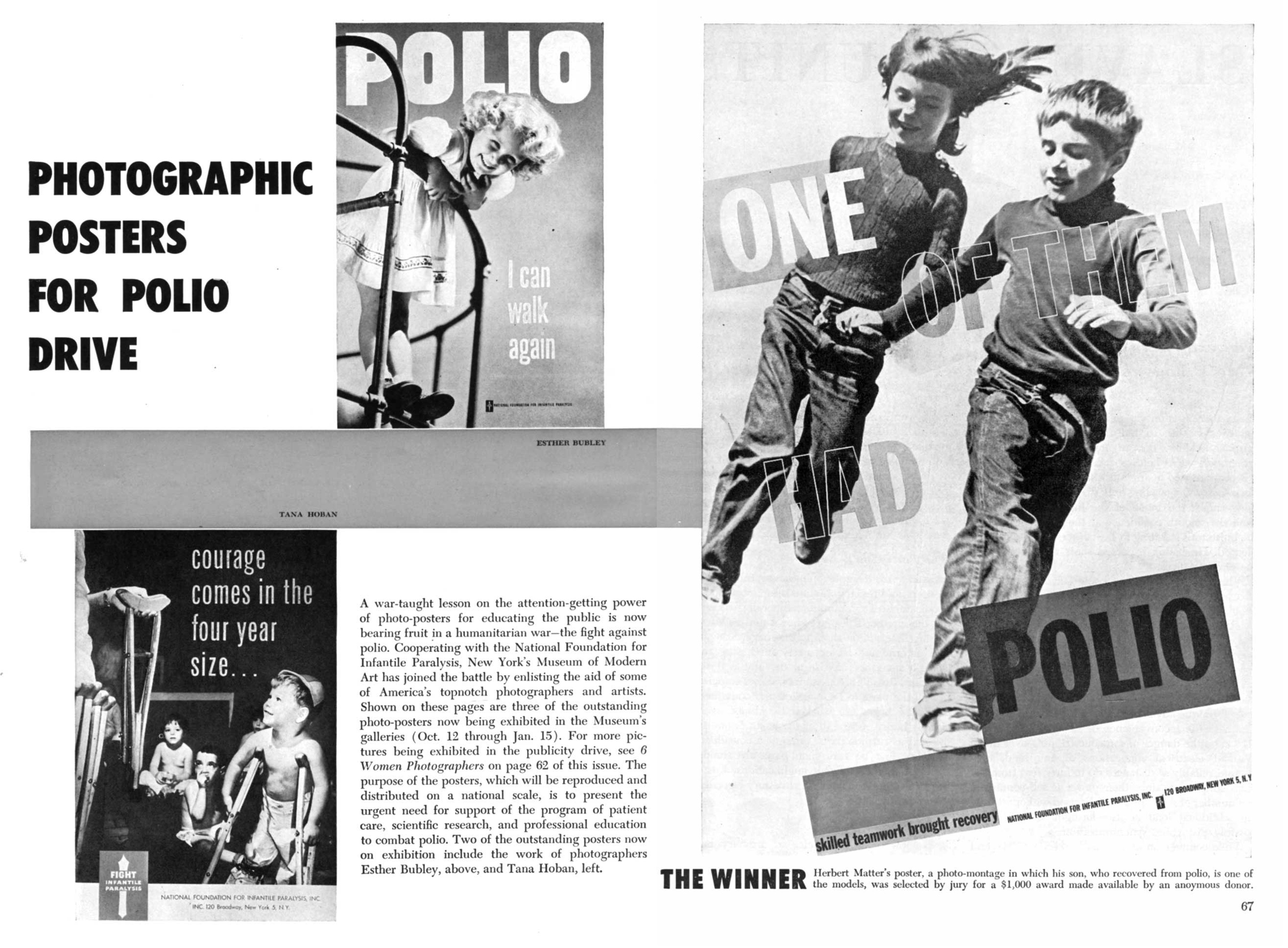
They even ran Polio Drives to help promote the creation of posters to aide in public awareness of the need for Polio research. Together with the National Foundation for Infantile Paralysis and the New York Museum of Modern art, photographers all across the country displayed their works to help raise money to fight the disease.
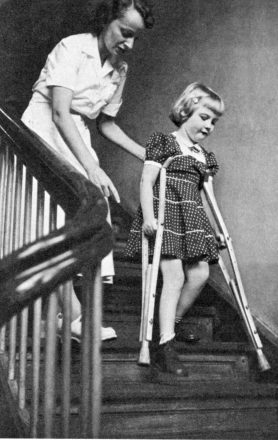
Over the course of eight months in 1952, an independent photographer named Suzanne Szasz, while working for Women’s Home Companion magazine, shot a series of photographs in the children’s ward of New York’s Willard Parker Hospital. There she met 6 year old Eileen Dicheck who had the misfortune of contracting the Polio virus.
Although the focus of Szasz’s work was on little Eileen, in an effort to include as many children as possible and feel welcomed as a friend, and not a stranger, she included all of the children in her photographs. In the article below, Suzanne Szasz offers several tips for photographing children, sick or healthy. She found that by being accepted by the children first, they were able to interact with each other in a way that was more natural and comfortable. Szasz wanted to blend in and become invisible to the children, so that she could capture candid photographs of the challenges the children had to go through.
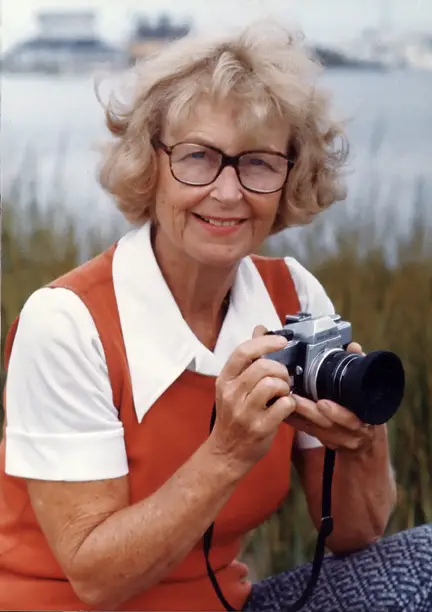
In an effort to minimize disruptions to the children or the staff’s routines, Suzanne kept her gear to a minimum, relying on a single automatic Rolleiflex and using natural light as often as possible. The article mentions the “one camera, one film” mantra that gets repeated today in photographic challenges, forcing a photographer to perfect their craft using as minimal of a setup as possible. I have personally made the poor choice of taking too many cameras out on a photographic adventure and find the constant switching of cameras to be disruptive and slow.
Although I encourage you to read the entire article below, I won’t make you wait to find out that this story has a happy ending. After 8 months, Eileen Dicheck beat her disease and was able to go home and return to normal life as a normal little girl.
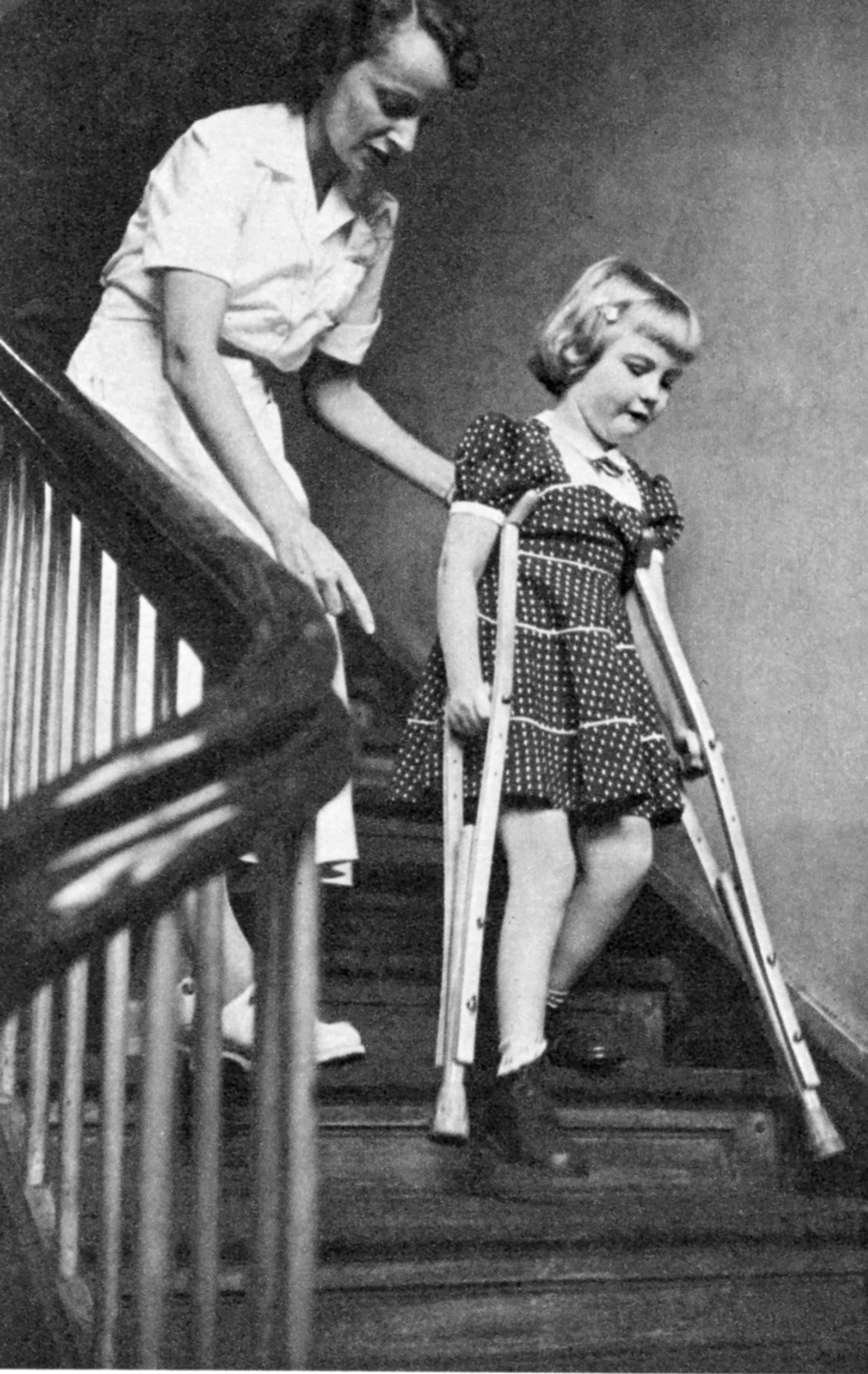
Eileen’s story is powerful. As a parent, I couldn’t imagine seeing my kids suffer like this. The story mentions the need to get permission from Eileen’s mother to photograph her daughter. Her mother was glad to do it for the sake of other mothers whose children were also afflicted and let them know that they are not alone.
These photographs were shot in 1952 when Eileen was 6 years old, which means there is a good chance that Eileen Dicheck is still alive today, and whether she realizes it or not, her story likely gave hope to many families who went through something similar. Unfortunately for Eileen, but thankfully for millions of children worldwide, a vaccine was only 3 years away. In 1955 Jonas Salk developed the first successful polio vaccines which began an end to the chapter of this disease’s terrible reign.
If anyone reading this blog knows or knew the Eileen Dicheck in this article, and is willing to fill in the blanks about her story, please let me know!
I realize this a photography blog, but this story moved me. In fact, it was one of the inspirations to start the Keppler’s Vault series in the first place. I didn’t want to start off with this as the first article as I thought I should ease you all into it. If you’ll entertain me just a little while longer, I need to get a tiny bit preachy.
The CDC considers Polio eliminated in the United States today due to the wonderful breakthroughs of modern medicine. There are other horrible diseases however, that were also once extinct such as the mumps and the measles which in recent years have seen significant increases in outbreaks due in large parts to a growing movement to not vaccinate children. These vaccines are not experimental fringe medicines invented by large pharmaceutical companies to rip you off. These are tried and true vaccines that work. Polio, Measles, and the Mumps are horrible things to experience and can (and do) kill children. Even if they survive the outbreak, many of these diseases carry severe long term effects such as pneumonia, hearing loss, meningitis, and infertility.
Eileen Dicheck survived Polio, but she was lucky, as many children didn’t. I think it is more important than ever before to read articles like these and face the realities that these diseases are still out there, and just because they’re not on the evening news or your social media feed, doesn’t mean we should turn our backs on the medicines and vaccinations that we are so fortunate to have today. Photography can be used for many purposes. In this case, these photographs taken in 1952 still serve as a reminder that this could happen again. Please, vaccinate your kids.


All scans used with permission by Marc Bergman, 2018.
A great story, and wonderful to have the scans of the magazine pages! I have just begun an article on Szasz for Wikipedia and am trying to find where I can get permission to use the portrait of Szasz that you include here – it would help to convey something of her personality. Can you give me a lead on it please? Much appreciated.
James, thanks for the compliments. Sadly, the image of Szasz is one I found through Google Image Search. I know that using other people’s images without their permission is frowned upon, but I really do make every attempt I can to gain permission when using images in my articles that I did not shoot myself. In this case, I had no way of knowing who the creator of that image is. If you ever find out, please let me know!