
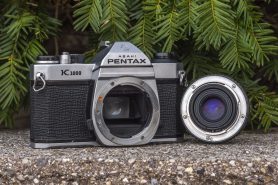
This installment of Keppler's Vault revisits Asahi Pentax's origins and its pivotal 1975 shift from the venerable M42 screw mount to the new K bayonet mount. The piece traces Pentax's history from the 1952 Asahiflex—the first Japanese SLR and the first camera with an instant-return mirror—through the 1958 debut of the pentaprism Pentax, which adopted the M42 "universal" screw mount later shared by numerous German and Japanese manufacturers. While M42 helped make Pentax one of the world's most popular SLR brands through the 1960s and 70s, the mount had real limitations: it took nearly three rotations to attach or remove a lens, and it struggled to support automatic diaphragms, aperture indexing, and eventually autofocus, forcing companies like Pentax, Yashica, and Fuji to create proprietary, often incompatible workarounds.
The core of the article draws on two September 1975 magazine pieces—one from Modern Photography, the more detailed of the two, and a shorter one from Popular Photography—both announcing the new Pentax K-mount alongside three launch cameras: the KM, KX, and K2, listed from least to most expensive. Notably, the author admits to having previously assumed the K1000 was the first K-mount camera, but confirms here that it was actually the fourth model, arriving a year later. The K2 is highlighted as the flagship, carrying over features from the screw-mount Pentax ES II while adding a new electronic Seiko shutter with stepless speeds and auto-exposure support, a new Silicon Photo Diode meter, Pentax's first f/1.2 50mm lens, and a lineup of 26 bayonet lenses spanning 15mm to 1000mm. The article notes that Asahi's move was unusual for the era—prior mount changes by other makers were typically backward-compatible, with Konica's earlier F-to-AR switch being an exception made before it was a well-established brand.
The overall takeaway is that Asahi's bold decision to start completely fresh with the K-mount proved highly successful in hindsight, forming the foundation for Pentax's lens system for decades, including its later DSLRs, which retained K-mount compatibility much as Nikon preserved its F-mount. The author suggests this move likely influenced Minolta and Canon to similarly abandon their older SR and FD mounts for the Alpha and EOS systems in 1985 and 1987. The piece closes with a bonus find: a September/October 1975 Honeywell Hotline dealer newsletter also announcing the new K-mount and its three debut cameras, with all images used courtesy of Marc Bergman.
AI-generated summary. May not capture every detail — read the full article below for the complete picture.
When the company known today as Pentax released their first camera in 1952, they were then known as Asahi Kōgaku Kōgyō K.K., or Asahi Optical Company in English. At the time, Asahi Optical was a lens maker, producing photographic lenses for a variety of other Japanese companies.
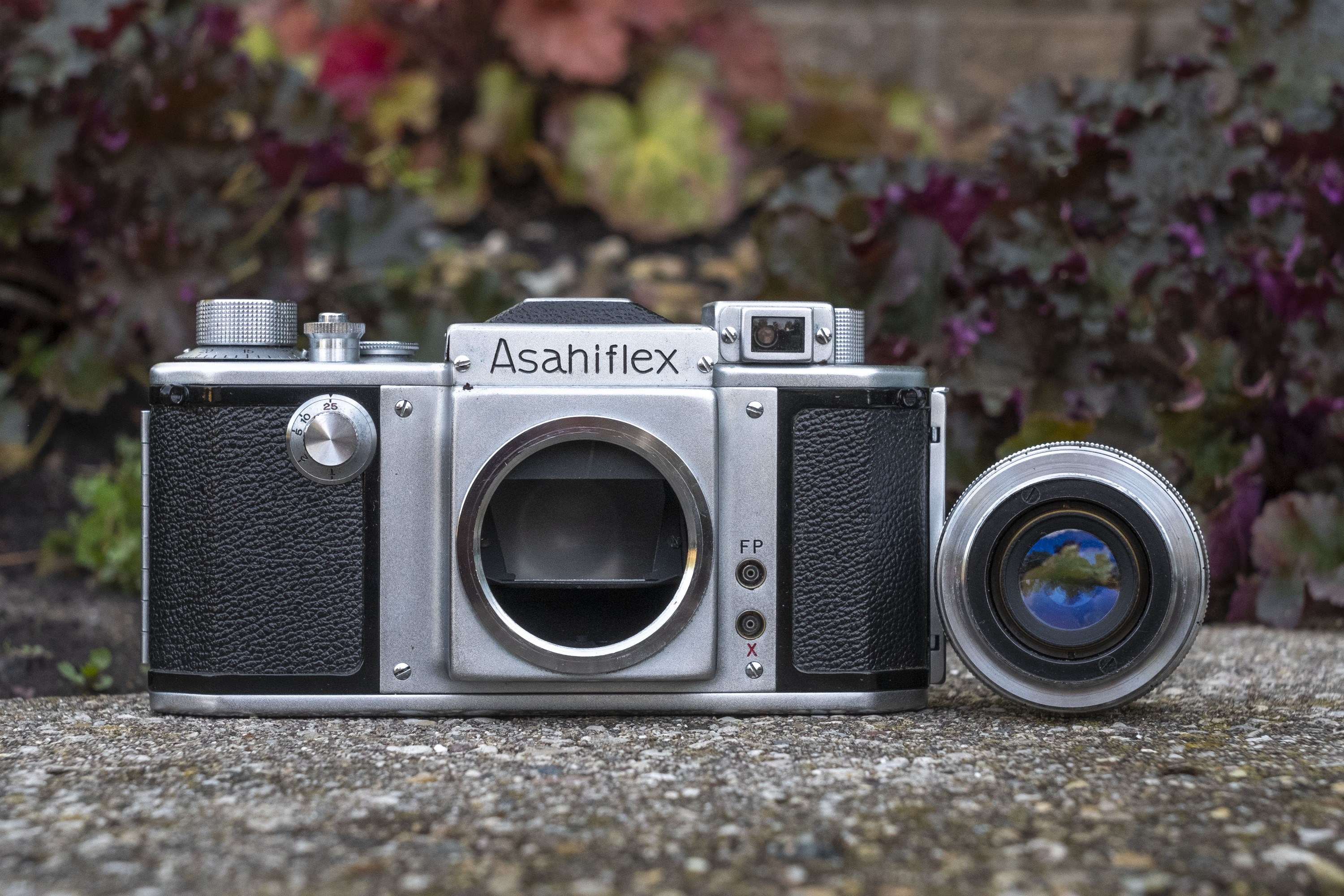
That first camera was called the Asahiflex and it’s design was inspired by the East German KW Praktiflex. Like the Praktiflex, the Asahiflex was a Single Lens Reflex camera with a waist level finder and an interchangeable screw lens mount.
The Asahiflex was a pioneering camera that was not only the first Japanese SLR, but was also the first camera in the world with an instant return mirror. With an excellent reputation as a lens maker, and good build quality for their cameras, the Asahiflex quickly gained popularity, being exported to the United States by the Sears Roebuck & Company and sold here as a range of Tower SLRs.
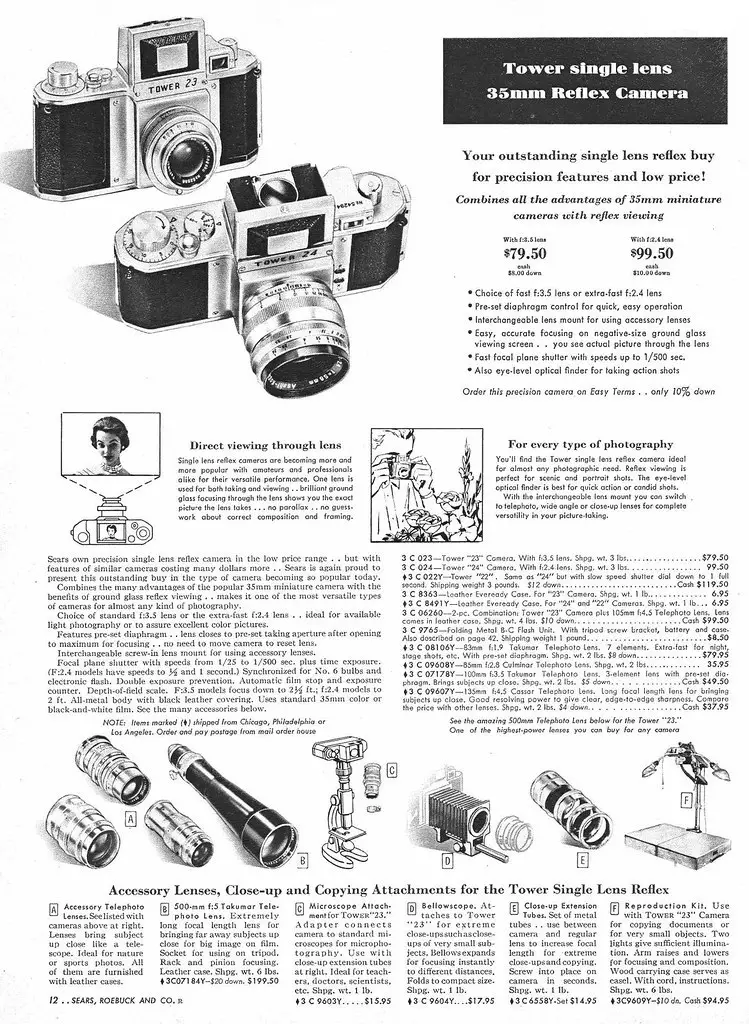
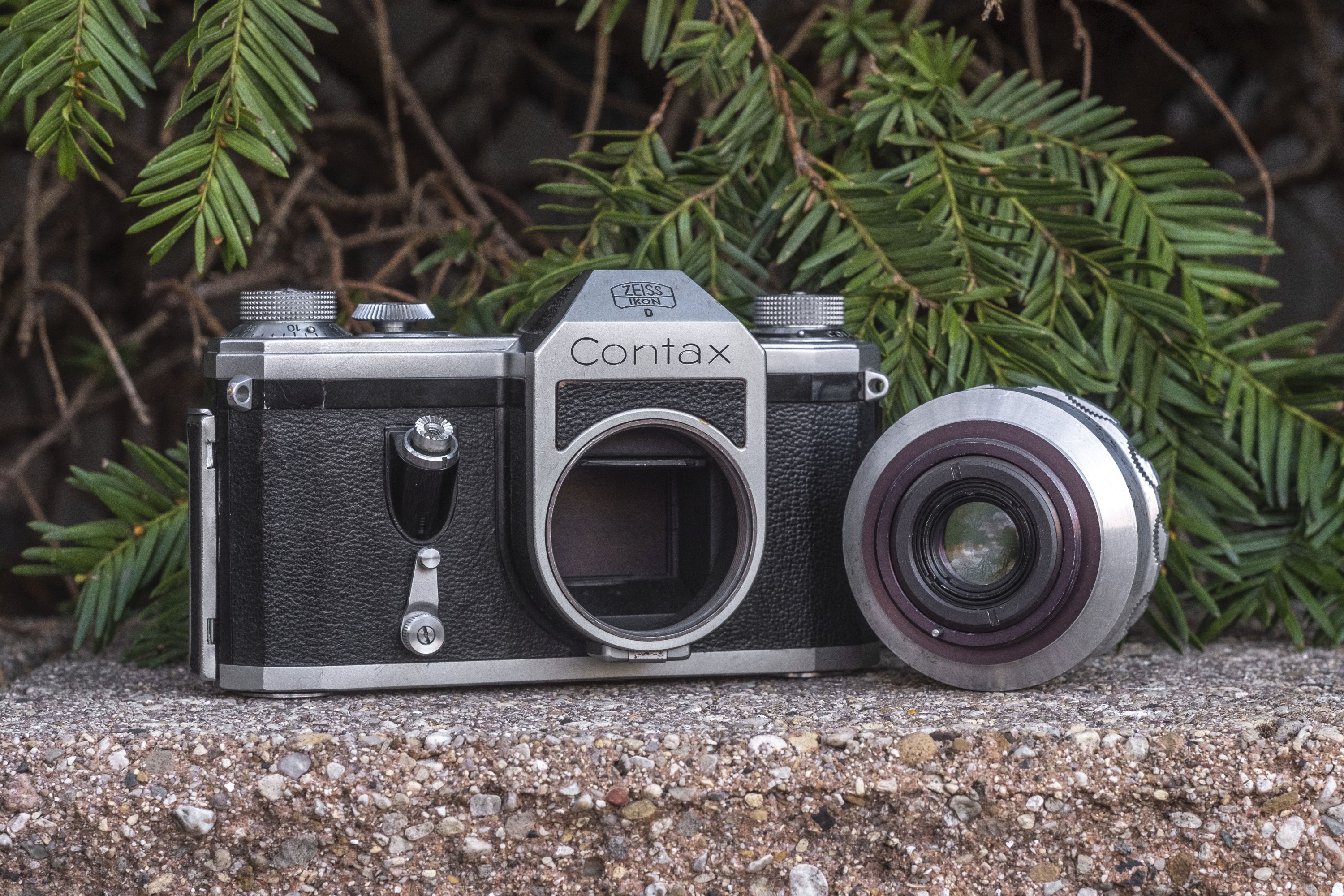
Within a few short years after it’s release, SLRs increased in popularity and photographers began to demand pentaprism viewfinders over the waist level finders of the Asahiflex and Praktiflex. When Asahi redesigned the camera to feature a pentaprism and rename it the Pentax, they also increased the size of the original camera’s 37mm screw mount to the “universal” M42 mount used by other German companies like KW and Zeiss-Ikon.
The first Pentax cameras hit the market in 1958 and quickly helped to establish Japan as a premiere maker of quality SLRs. By the end of the decade, nearly every other Japanese maker had released their own pentaprism SLR, but Pentax SLRs stood out as having the right balance of quality features at a price lower than their competitors.
Throughout the 1960s and into the 70s, Asahi sold millions of Pentax SLRs, making them one of the most popular in the world. To many, the M42 lens mount became known as the Pentax Screw Mount, as a myriad of other German and Japanese companies rushed their own M42 SLRs to the market. At one time M42 cameras were produced by Wirgin, Pentacon, Voigtländer, Fujica, Riken (Ricoh), Yashica, Petri, Cosina, Chinon, and KMZ (Zenit).
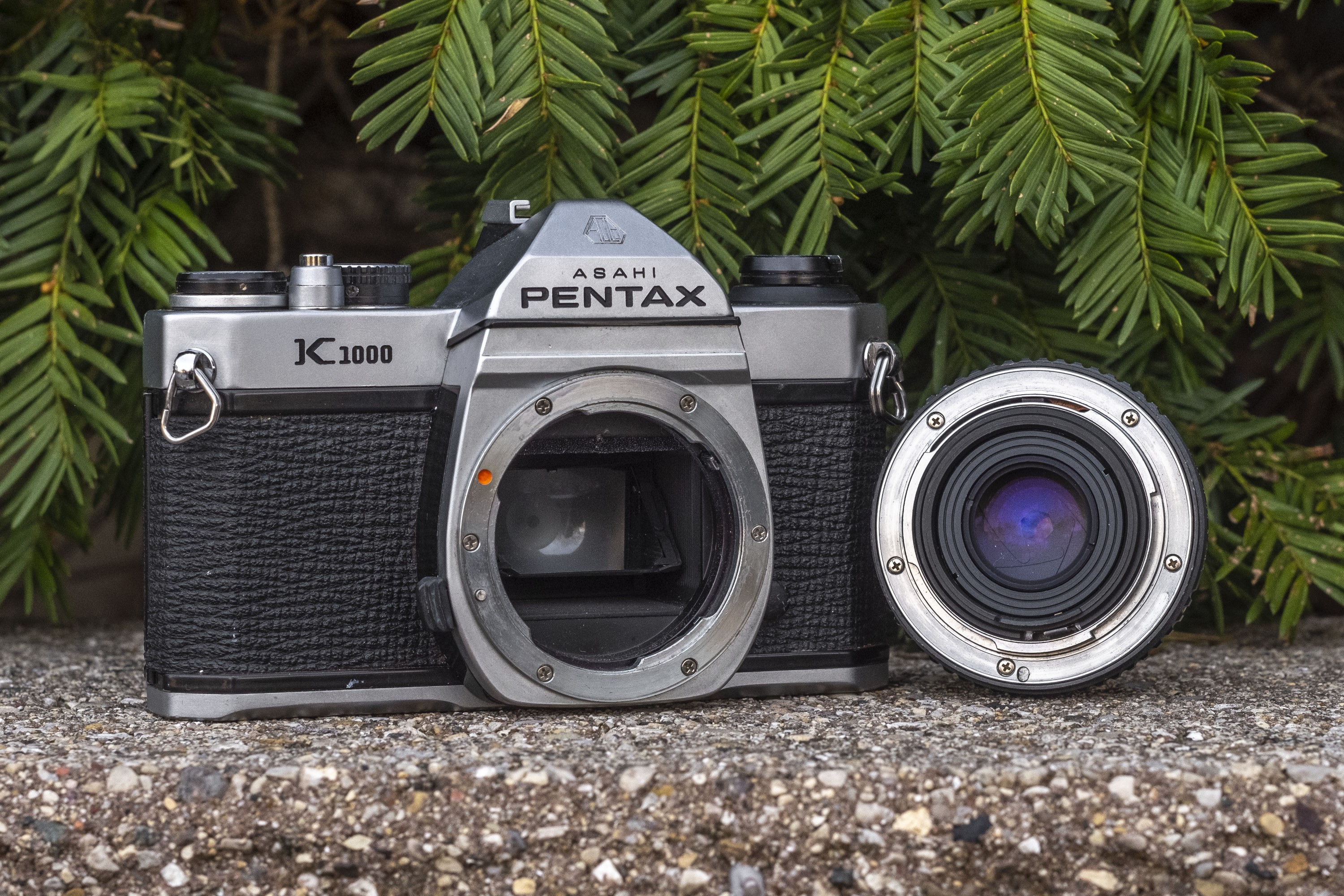
Despite the immense success of the M42 mount, it had several drawbacks. For one, it required nearly three full rotations to mount and dismount compared to increasingly popular bayonet mounts. Another was that it was difficult to accommodate camera to lens couplings which were required for automatic diaphragms, aperture indexing for exposure metering, and eventually, auto focus. Several companies would develop their own workarounds to add some of these features to M42 lenses, but many of the solutions were not compatible with others. In order to accommodate automatic exposure on Pentax, Yashica, and Fuji cameras, special lenses designed for those specific cameras were required. In the case of Yashica, some of their own lenses were not compatible with their AE equipped M42 models.
As other companies like Nippon Kogaku (Nikon), Canon, Minolta, and Konica had fully embraced bayonet mounts, it became clear that Asahi would have to make a switch to a new bayonet mount if they wanted to remain competitive as bayonets not only were faster to take on and off and allowed for future upgradeability, but with a larger internal diameter, would support a greater range of faster and wider lenses.
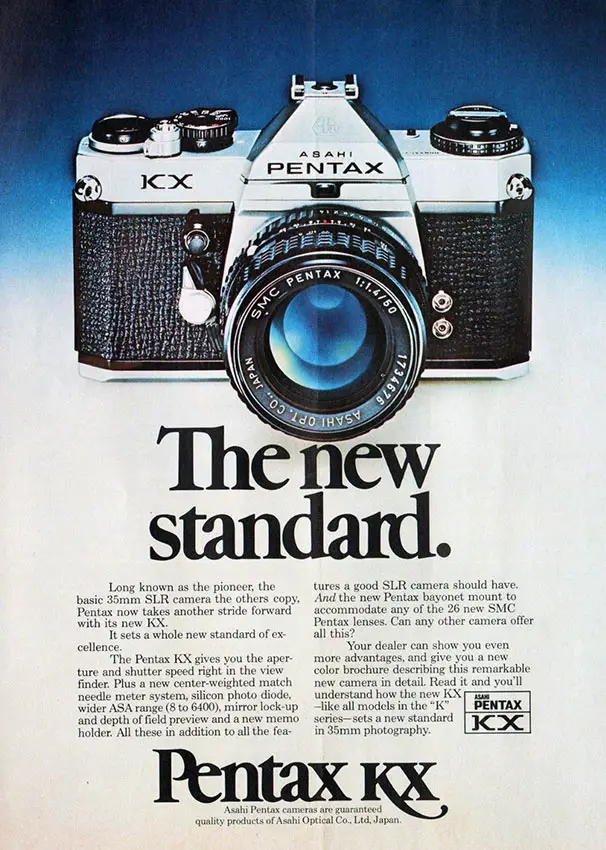 This week’s Keppler’s Vault brings you two articles from two different magazines, both from September 1975 announcing Asahi Pentax’s new Pentax K-mount and three new SLRs that would use it.
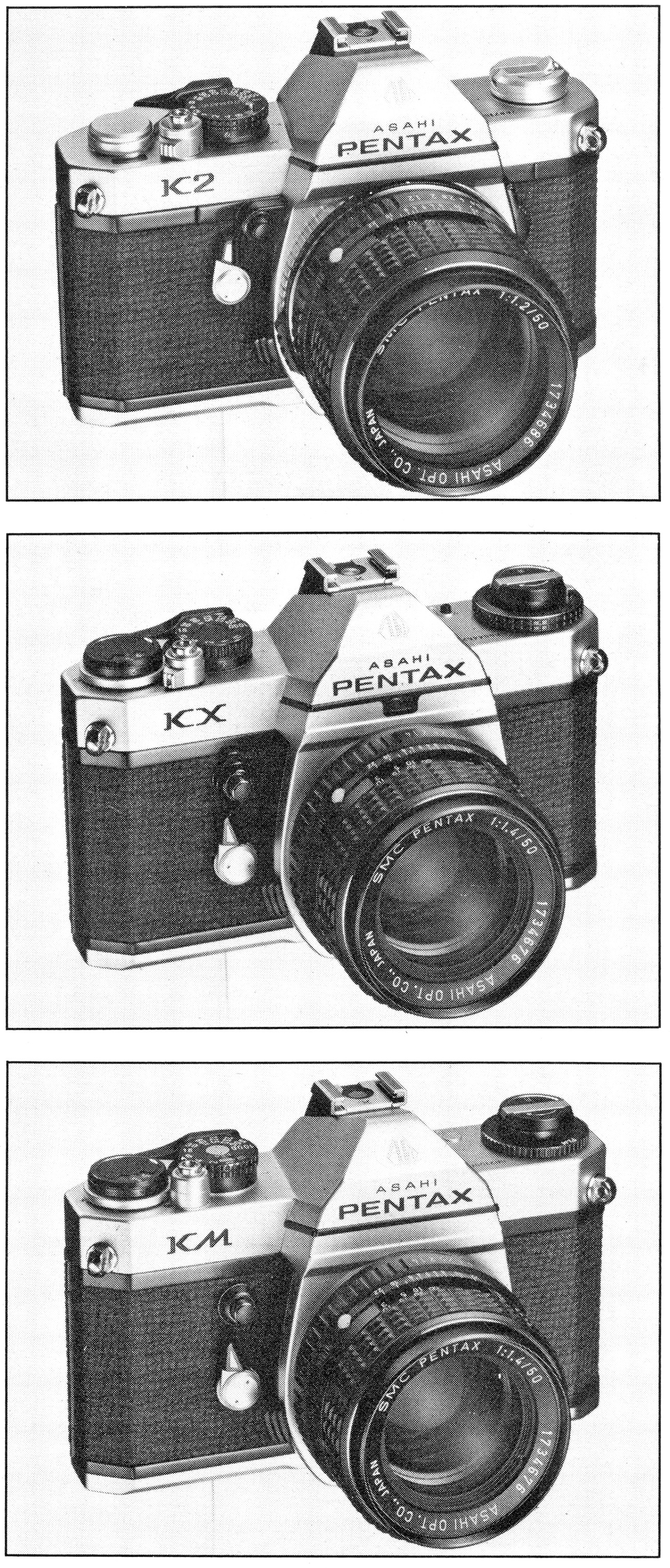
It was not unusual at that time for a camera maker to make small changes to an existing mount, but when Asahi released the K-mount, it was the first time that a major SLR camera maker had completely started over with an entirely new mount. In every other case where a change to a mount was made it was usually backwards compatible with previous lenses, or in the case of Konica when they switched from their original F-mount to the AR-mount, the company was not yet an established maker of cameras.
Both articles introduce the new K-mount along with three new cameras, from least to most expensive, the KM, KX, and K2. The first article from Modern Photography is longer and goes into greater detail than the second from Pop Photo, but both cover mostly the same information. I’m going to admit that prior to reading this article, I had always assumed the Pentax K1000 was the first K-mount camera, but it was actually the fourth model, released a year later.
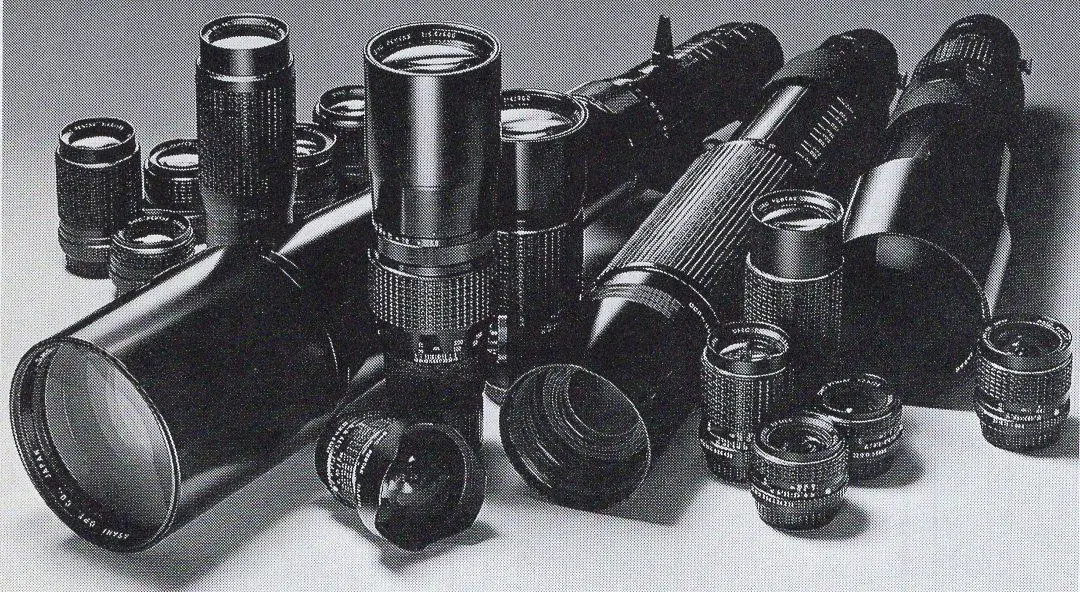
Highlights include the K2 which has many of the same features as the screw mount Pentax ES II, but with an all new electronic Seiko shutter with step less speeds and support for automatic exposure, new Silicon Photo Diode meters, the company’s first f/1.2 50mm lens, and an impressive selection of 26 bayonet lenses, ranging from 15mm to 1000mm.
Today, we have the benefit of hindsight to know that the Pentax K-mount and the K-series of cameras was very successful. Pentax would continue with the same basic mount, revising it a number of times to add support for more metering modes and auto focus. The K-mount was retained with only minor changes when Pentax would release their first DSLR and would maintain backwards compatibility with film lenses on their digital cameras, much like Nikon did with their F-mount.
Asahi’s success at starting completely over with an all new lens mount likely inspired Minolta and Canon to do the same thing when they each abandoned their SR and FD mounts in favor of the Alpha and EOS mounts in 1985 and 1987 respectively.
As an additional bonus, while working on this article, I found something called the Honeywell Hotline, which appears to be some sort of dealer newsletter for Pentax products, and in their September/October 1975 issue, there is this announcement of the new Pentax K-mount and the three cameras mentioned above.
All scans used with permission by Marc Bergman, 2020.
Mike, just a quick note: Asahi didn’t come up with the dame change to Pentax. The name is a conflation of Pentacon and Contax and was registered to VEB Pentacon, and by some form of agreement Asahi got hold of the rights to use it.
Of the competing early adopters of automating the M42 mount lenses one was Pentacon themselves with their “electric” mount and lenses.
Another often-forgotten, but notable attempt at a full-aperture-metering M42 mount was the Olympus FTL, which was introduced in 1971 and summarily abandoned in 1972 in favor of the OM-1 bayonet.