
The KMZ Zenit is a 35mm SLR produced in the Soviet Union between 1952 and 1956, notable as the first Zenit camera and KMZ's first SLR. Essentially a Zorki rangefinder with a mirror box and fixed pentaprism added, it shares the same body, bottom-loading film compartment, and 39mm thread mount as its rangefinder sibling—though a longer 45.2mm flange distance means rangefinder lenses won't focus correctly. The camera's development traces back to Soviet optician Ivan Turygin, whose exposure to Zeiss-Ikon Contax S production in postwar Germany likely inspired the Zenit's design. Only about 39,019 of this first-generation model were made before the improved Zenit-C arrived in 1955.
The article's author tested a well-worn example fitted with a KMZ 3.7cm f/2.8 MIR-1 wide-angle lens (not the original kit lens, but a period-correct wide-angle option similar to the Carl Zeiss Jena Flektogon). Specs include a cloth focal plane shutter with speeds from B to 1/500 sec, no meter, and a viewfinder offering only 67% coverage—well below the 90-95% typical of SLRs, meaning a third of the captured image isn't visible while shooting. Despite this, the author found the ergonomics excellent: the body is compact, well-balanced, and familiar to anyone who's used a Leica-style rangefinder, with a shutter release repositioned for improved comfort. Shooting expired Kodak BW400CN developed in HC-110, the author praised the MIR-1 lens for its sharpness, contrast, and pleasing vignetting, calling the lens-camera pairing "excellent."
The verdict is largely positive: while the tiny viewfinder and unusual lens mount decision are clear flaws—especially frustrating for precise framing—the Zenit's compact size, solid build quality, and rangefinder-like handling make it an enjoyable, easy-to-use camera even for first-time users. The author contrasts it favorably with later Soviet Zenits, which sometimes feel like they're missing something compared to contemporary German or Japanese SLRs; this original model, by comparison, feels fully of its time and complete on its own terms, making it a fun, characterful shooter for casual enthusiasts rather than professionals.
AI-generated summary. May not capture every detail — read the full article below for the complete picture.
This is a KMZ Zenit (Зенит), a 35mm single lens reflex camera made by Krasnogorski Mekhanicheskii Zavod (KMZ) in the former Soviet Union between the years of 1952 and 1956. The Zenit was the first Zenit camera, first SLR produced by KMZ, and only second Soviet SLR to be produced in large numbers. If the Zenit looks like an SLR version of the Zorki rangefinder camera, that’s because it is. Workers at KMZ basically took the Zenit and added a mirror box and fixed pentaprism to the top. Like the Zorki, the Zenit also uses a 39mm thread mount, but due to the distance between the lens flange and focal plane, required special SLR-only lenses to work properly. The original Zenit was built at a time when build quality from the KMZ factory was very high and when found in good working condition, can still be an excellent camera to use today.

Film Type: 135 (35mm)
Lens: 3.7cm f/2.8 MIR-1 (Мир) coated 6-elements in 4-groups
Lens Mount: 39mm SLR (Zenit) Thread Mount
Focus: 0.7 meters to Infinity
Viewfinder: Fixed SLR Pentaprism, 67% Field of View
Shutter: Cloth Focal Plane
Speeds: B, 1/25 – 1/500 seconds
Exposure Meter: None
Battery: None
Flash Mount: None
Weight: 720 grams, 526 grams (body only)
Manual (in Russian): https://mikeeckman.com/media/KMZZenitManual.pdf
Manual (similar model, Google Translate): http://www.zenitcamera.com/mans/zenit-s/zenit-s.html
I’ve covered the Soviet camera industry thoroughly on this site. While there have been a great number of worthwhile Soviet cameras made over the years, two of the most common are the Zorki rangefinder and Zenit SLR. According to the production estimates at sovietcams.com, well over 12 million Zenit SLRs and over 4.5 million Zorki rangefinders were produced between the years 1947 and 1996 making them some of the highest produced cameras ever made.
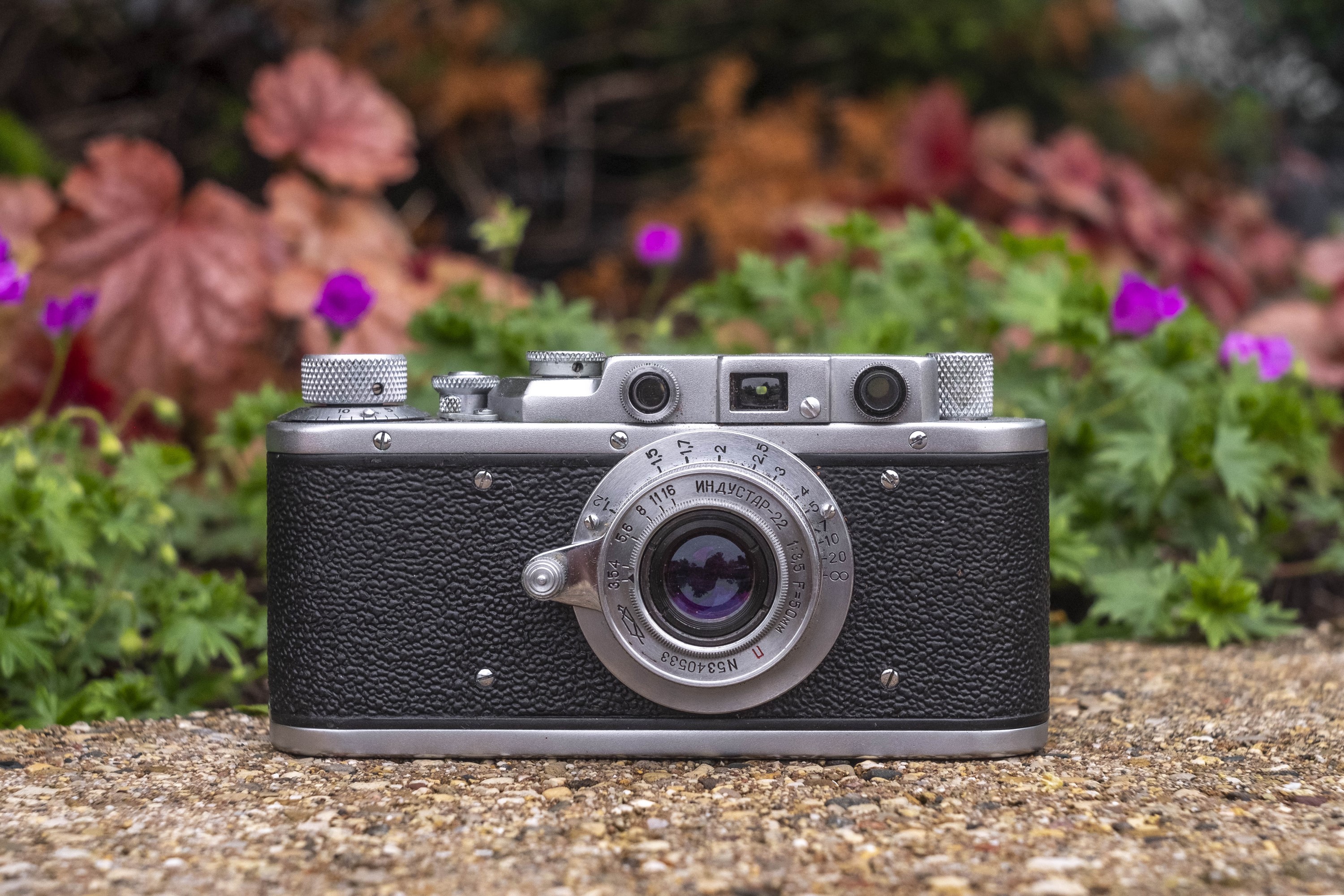
While the Zorki and Zenit turned out to be very different camera lines, they have a shared story in their earliest years. In previous articles about the Zorki rangefinder, I explain that the first Zorki was the result of the FED rangefinder from Ukraine being relocated into Russia during World War II to help product its assets from German invasion. The Soviet government did not want their valued cameras and production lines to fall to enemy hands so manufacturing equipment was shipped to Russia and eventually setup at the KMZ factory in Krasnogorsk. Their proactive measures proved to be wise as the German military eventually occupied the area of Kharkov where the FEDs were made but the equipment was safe in Russia.
Within two years of the end of the war, the KMZ plant was able to resume production of a combined FED/Zorki rangefinder. These models, featuring both factories logos were produced from late 1947 to early 1949.

Fun Fact: Some of the earliest Zorki cameras were covered in leather sourced from Zeiss-Ikon in Dresden. These models have a metal plate screwed into the back of the camera to cover the Zeiss-Ikon logo embossed into the leather. If you remove the plate, you’ll have a FED/Zorki camera with a Zeiss-Ikon logo!
At the time the first Zorki rangefinders were being produced, it stands to reason that the Soviet optical industry had noticed the rising popularity of 35mm SLRs being produced such as the Ihagee Exakta and the Carl Zeiss Contax. The Soviet Union itself had already released an SLR in the 1930s called the GOMZ Sport, but it was a short lived model, produced in limited numbers.

As was the case with many Soviet cameras, who gets credit for the design of a new model is difficult to determine as many products were created by committees and rarely a single person. In this case however, a person who likely had an influence on the creation of what would become the Zenit was a Soviet optician named Ivan Afanasyevich Turygin who in 1927 calculated the first photographic lens to be produced in the Soviet Union, the Ortagoz which was later mounted to the Fotokor No.1. Turygin’s early success saw him work his way up the chain to higher positions at KMZ.

In 1941, Turygin was promoted to a position at KMZ to help evacuate mechanical and optical equipment for safe keeping. From 1945 to 1947, he was in Jena, Germany where he oversaw production of the earliest copies of the Zeiss-Ikon Contax S, a 35mm SLR camera with a fixed pentaprism viewfinder. Although the Contax was a pre-existing design with origins from as far back as 1939, it was Turygin who oversaw the final development of the camera and its introduction to the market.
It is believed that his exposure to the Contax S development is what prompted KMZ to begin work on an all new interchangeable lens SLR to be produced alongside the Zorki rangefinder. The new camera was given the name Zenit (Зенит) which translates to “Zenith” in English, suggesting the camera would be the peak of design or quality. Rather than design an all new camera and shutter system from the ground up, the basic body of the Zorki was modified, adding a mirror box and substituting the rangefinder with a fixed pentaprism, just like the Contax. Also like the Zorki, the Zenit would remain a bottom loader, making it one of the few bottom loading SLRs ever made. Strangely, the designers at KMZ gave the Zenit a lens mount that was physically identical to that of the Zorki, which was M39 x 1, but it had a longer 45.2mm flange distance, which meant that rangefinder lenses would physically mount to the Zenit, but not actually focus correctly.
Fun Fact: One possible explanation for why KMZ chose an M39 mount for the Zenit but with a longer flange distance than the Zorki comes from a short article about the history of the Zenit and Zenit-S on photohistory.ru which states that for a brief time, KMZ intended to make “universal” M39 lenses that could work on both rangefinders and SLRs. For SLRs, the lenses would mount directly to the camera, but for rangefinder use, a threaded extension tube with a rangefinder coupling ring would sit between the lens and the camera. In theory, this would allow for an upgrade path for those who started with rangefinders, but later wanted to upgrade to an SLR. These “universal” lenses were produced for less than a year before development stopped.

It is not clear exactly when work began on the Zenit, but according to Princelle’s 2nd edition of the Authentic Guide to Russian and Soviet Cameras, the first prototypes were made in late 1950. A total of six of these early units were made and they are easily distinguished by being the only Zenits with a Zorki style exposure counter beneath the advance knob. Other differences from pre-series cameras is that the design of the pentaprism is angular, unlike production first generation Zenits which have a curved prism, and also that the standard lens was a collapsible Industar-22 lens.

Work on the pre-series Zenits continued until 1953 when the first Zenit cameras went into general production. All early Zenit cameras share a body that is nearly identical in width and thickness to a Zorki rangefinder. The shutter and most of the film compartment is the same with the biggest difference being the mirror box and reflex finder in the middle.
The ergonomics of the camera were surprisingly good. Early KMZ cameras were built to a high quality standard which compared favorably to German cameras. Where nearly every other camera manufacturer was designing new 35mm SLRs from the ground up, that KMZ was able to successfully add all the necessary SLR parts to a rangefinder body was remarkable, a feat even Ernst Leitz never attempted. If you ever wanted to know what a Barnack Leica rangefinder would be like if it was turned into an SLR, this was your answer.
 There is a lot to like about this first Zenit, but there are some drawbacks. Showing its rangefinder roots, the Zenit required you to load film through the bottom of the camera. This was something that long time Leica/FED/Zorki users were used to, but would be foreign to new SLR users. Another, more significant flaw was that in their effort to fit SLR parts into a rangefinder body, some compromises had to be made on the size of the mirror box, mirror, and focusing screen. The smaller mirror and viewfinder produce an image that is only 20mm x 28mm, which is only 67% of what will be captured on film. It is pretty normal for an SLR to crop a small amount of the visual information in the viewfinder, but most SLRs are in the 92% to 95% range. To lose nearly a third of the visual information is a pretty big deal!

Finally, that the Zenit used lenses which outwardly look identical to rangefinder lenses, but required a different flange distance was a pretty strange decision by KMZ. It is normal for rangefinder lenses to not work on an SLR without a special adapter, but usually those lenses have incompatible lens mounts making it obvious. It makes sense that in using a rangefinder as the basis for your SLR means that the film compartment can’t easily be changed, and a larger mirror box and viewfinder would have required a significantly larger body, but the decision to use the same exact lens mount was unecessary. The explanation that KMZ wanted a universal lens seems poorly thought out too, as during the time the Zenit first came out, owning a camera in the Soviet Union was very expensive, but to own two was unheard of.
I would like to say that the first Zenit was a success as it had a good build quality, a good standard Industar-22 lens, and launched a very successful line of Zenit SLRs, but with only 39,019 made, this first model was short lived. In 1955, an updated model called the Zenit-C was released which added flash synchronization and that model was produced until 1961 with a total of 232,949 units, bringing the total production of 1st generation Zenit cameras to just under 272,000 made.
As is the case with all Soviet reviews, there is no promotional or marketing material that I could find showing how the camera was sold, and finding a retail price for them is difficult as well. The best I was able to find was a 1960 price guide, which shows the later Zenit-C being sold alongside a Zorki-C rangefinder. The price guide shows the Zenit selling for 700 roubles and the Zorki for 375 roubles, representing a price that was nearly double that of the rangefinder so perhaps these earlier Zenits sold for about double that of the Zorkis which were in production at the same time.

My first attempt at shooting an old Zenit SLR was when I borrowed a very nice looking example from a friend who was happy to let me take it for a ride, but he admitted it probably wouldn’t work. I did my best with that camera, but as he predicted, the camera was loaded with problems. The mirror would always flip up after firing the shutter, but would never come back down unless I took the lens off each time and helped it. Worse, the film transport was completely messed up, and you could wind the camera on and on forever, and the film would never move. I ended up returning that camera to its owner and shelved my plan for an early Zenit review.
Then in 2023, I came across this example in a nice collection of cameras. Attached to the Zenit was an M39 Industar-50 lens which worked fine, however wouldn’t have been the original kit lens this camera came with new. The Industar had a 1965 serial number, which suggested it would have originally come on a later Zenit-3M. I would have been happy to shoot the camera with the Industar-50, but to my amazement, in the same bag was a beautiful KMZ 3.7cm f/2.8 MIR-1 wide angle lens. The MIR-1 is closely related to, but not a copy of the Carl Zeiss Jena Flektogon from the same period. With 40mm lenses being my favorite focal length, I was eager to try the Soviet 3.7cm lens and what better camera to do it on than this Zenit.

It is important to remember that despite this being an SLR, the original Zenit is really just a Zorki rangefinder with a mirror box on it, so nearly all of the same characteristics of a Zorki and the Leica II rangefinder which it is based on, apply here.

The most notable rangefinder feature is the bottom loading film compartment. Loading film into the Zenit is exactly the same as a bottom loading Leica, including the need to trim the leader to around 10cm in length before inserting it into the camera. This process can be aided with aftermarket spools like those found on Canon rangefinders, or 3D printed spools like those from companies like Ausgeknipst. For me, I’ve never found bottom loading film cameras to be that much of a hassle, so I just used the original spool and hand cut the leader using a pair of scissors.

While the Zenit shares a large part of the design with the Zorki rangefinder, the side profile makes it very clear this is an SLR. Despite it being a first attempt by KMZ to produce a SLR, the shape and contour of the pentaprism looks strikingly similar to other designs from the 20th century. The large size of the 3.7cm f/2.8 MIR-1 lens further adds a look of “chonk” that rangefinders usually lack. Both sides of the camera body have metal strap lugs which are forward angled to help maintain balance while the camera is dangling from your neck with a heavy lens attached.

The top plate is dominated by the large and curved pentaprism, but otherwise looks like a Zorki. Controls such as the rewind knob, shutter speed dial, advance/rewind lever, threaded shutter release button, and combined film advance knob and exposure counter work almost exactly as you’d expect. Like the original Zorki, you must wind the camera before you can change shutter speeds. The reason isn’t necessarily because you’ll break anything (although it is possible), but more because the shutter speed dial rotates as you wind the camera and the index mark will not point to the correct speed if the camera is not wound. One improvement to the Zenit over the original Zorki is that the shutter release is on a stepped plate, higher than it is on the rangefinder, and for me, this is in a more comfortable location for my right index finger to reach.

Looking down upon the wide angle MIR-1 lens, a fixed depth of field scale is closest to the body with a rear angled distance scale which is a bit difficult to read. While this isn’t a kit lens that would have come on the Zenit when it was sold new, this lens was made to fit early Soviet SLRs, so the location of this ring is a bit strange. Compared to a Industar-50 SLR lens which I also have (not pictured), the focus scale is much easier to read on that lens.

Earlier in this article, I mentioned the use of a 39mm threaded lens mount which has the exact same diameter and pitch as Leica rangefinders and their copies like the FED and Zorki. This proved to be a very strange decision as the mirror box pushes the lens farther away from the film plane. The longer 45.2mm flange distance is 16.4mm longer than that of the Zorki rangefinder and functions exactly the same as if you attached a 16.4mm extension tube on the rangefinder. This means that although you can attach rangefinder lenses to the camera, they will only focus on very close objects and never reach infinity.

The viewfinder is very basic, showing a large piece of ground glass and nothing else. There are no frame lines, no focus aides, or any exposure information. In addition, the Zenit has an extremely small 67% field of view, which means that what you see in the viewfinder is only 67% of what the lens sees. This is extremely small compared to most other 35mm SLRs which usually have a field of view in the 90-95% range. With the wide angle 37mm MIR-1 lens mounted, the image through the viewfinder is closer to that of a normal SLR with a 55mm lens attached. Yet, despite these limitations, I found the screen to be bright enough in outdoor light, and even though I couldn’t see all of what will be captured on film, it didn’t seem to negatively impact the shooting experience. The KMZ Zenit lacks an instant return mirror, which means that the viewfinder remains black after exposing an image and will not open again until you advance the camera. Although primitive by today’s standards, was acceptable in the era this camera was made.
Whenever I shoot a Soviet camera, I often try to use something like Svema, or at least something Eastern European like an ORWO based film, but I had nothing in stock at the moment, so I went with an expired roll of Kodak BW400CN which is an ASA 400 speed chromogenic black and white film which is designed to be developed in C41 chemicals. Although I’ve gotten good results from this film using C41 chemicals, I actually prefer the look of the film developed in regular HC-110, so that’s what I did for this roll.


Even though the MIR-1 was not a standard lens for the KMZ Zenit, that it would have been the most common wide angle option and that it is a bit faster than the standard Industar-22 f/3.5 lens found on many Zenits, I found it to be my ideal shooter.

Images from the Soviet lens were very sharp and showed excellent contrast. The deep purple and blue lens coating does an excellent job of controlling contrast and reducing light loss. A bit of vignetting was visible, but well within the norms of a mid 1950s wide angle lens. I’ve always been of the opinion that there’s good vignetting and bad vignetting. When the edges of your image are dim, dull, and void of detail because the lens you’re using is of inferior design, that’s bad vignetting, but when you’re getting an even amount of darkness around all four corners and sharpness is still retained, that’s good vignetting, and the MIR-1 has good vignetting. I did not shoot any color film, but I suspect my opinion wouldn’t change much, that the KMZ Zenit and MIR-1 37mm lens is an excellent combination.

Using the Zenit was a joy as its size was barely larger than a rangefinder, and the camera’s overall dimensions not only kept the weight down, but the curved body made it very easy to hold and grip, even without a neck strap. In addition, the similarities of its controls to the Zorki and Leica rangefinders give it a sense of familiarity, even if you’ve never handled one before. Unlike some other cameras, the very first time you handle an early Zenit, you should be able to start shooting immediately, without needing to spend much time reading the (non-English) user manual.
By far, the biggest con to using the KMZ Zenit is its viewfinder. Now, to be fair, most Zenit viewfinders aren’t well known for having industry leading brightness, but a combination of a dim focus screen without any focus aides, and the very low 67% coverage of the viewfinder meant that while shooting, you can never see all of what will be captured on film. In fact, with the 37mm focal length, the loss in coverage resulted in a perceived focal length pretty close to 55mm, just like a standard lens. So while shooting with the MIR-1, the viewfinder looks like a nifty fifty, but the images come out wide angle. As long as you don’t forget this while shooting and aren’t expecting any tightly framed portraits, it is not much of a deal.

For a professional, losing a third of your viewable image would be a deal breaker, but for a casual photographer who enjoys galivanting around with a 70 year old Soviet camera, it is a lot of fun. I very much enjoyed the compact size, excellent ergonomics, and overall ease of use of the KMZ and didn’t care that I was basically guessing on most of my images.
Overall, the KMZ Zenit is a really cool camera that was a lot of fun to shoot. If you ever wanted to know what it would be like to take a thread mount Leica rangefinder and turn it into an SLR, this is it! While I’ve enjoyed shooting later Zenits, it always seems like the later Soviet cameras are lacking something present in other contemporary cameras. This original Zenit doesn’t feel that way. It feels like a camera firmly from the mid 1950s, and anything it can’t do compared to more advanced German or Japanese SLRs, isn’t missed.
Related Posts You Might Enjoy
External Links
https://camera-wiki.org/wiki/Zenit_1
https://fotoussr.ru/cameras/zenit-1/ (in Russian)
https://www.photohistory.ru/index.php?pid=1207248178964102 (in Russian)
http://www.zenitcamera.com/archive/zenit-1/index.html (in Russian)
Very nice review, thank you! First Zenits quite undeservedly forgotten nowadays. As you say, a fun and reliable camera to shot with!
A Syynet tee shirt …. ruh-roh, Mike has gone to the dark side!
possible correction for the fun fact section on the universal lens idea. I think that the extender section is mounted when the lens is used on a rangefinder (which has a shorter flange distance) and taken off when the lens is used on an SLR (which has a longer flange distance). Not the other way around. It says so also in the source that you used.
You’re right, thanks for the correction. I had it right in my head, but just typed it wrong. I have corrected the review.
Zenit M39 SLR would look better if you mount an Industar-50 lens on it.
As well as flash synch, the Zenit-S had a different mirror drive mechanism. The original Zenit used a system of levers to cock the mirror, but the Zenit-S mirror is wound down by a cord. I had to replace the cord in my Zenit-S.
My camera came without a takeup spool. I was given a spool from a prewar Leica, which fitted fine after I ground some metal off the lower end.