

The Konica FT-1 is a 35mm SLR made by Konica between 1983 and 1987, notable as the last SLR Konica built in-house before outsourcing production of its final model. Nicknamed "FT-1 Motor," it succeeded the pioneering FS-1 (the first SLR with a built-in electronic motor drive) and offered an electronic shutter, shutter priority automatic exposure, a modern Silicon Blue Diode/GaAsP TTL meter, and Konica's quick-load film system, all while lacking a manual film advance lever but retaining a manual rewind knob. It arrived at a time when Konica's SLR reputation, built on solid but unexciting 1960s-70s Autoreflex models, was fading as the company struggled to compete and increasingly targeted beginner photographers.
The author's hands-on experience came after two prior non-working FT-1 units, finally acquiring a functioning black body paired with the well-regarded 40mm f/1.8 Konica Hexanon AR lens, bought cheaply because it was mounted to a camera the author didn't expect to work. Specs highlighted include a vertically traveling metal shutter (2–1/1000 sec plus B), a bright pentaprism viewfinder with split-image/microprism focusing aid and LED exposure readout, a detachable AAA battery compartment (with an optional AA grip), and a film transport indicator on the back. In testing with two rolls of film (Fuji 400 and an expired scientific Kodak film), the author found the 40mm Hexanon lens excellent even wide open, with sharp, well-exposed images across both indoor and outdoor scenes in shutter-priority AE mode. Handling was praised as compact and ergonomic, with a nostalgic, cinematic-sounding shutter and film advance.
The verdict is largely positive: despite Konica's poor quality control in this era and the camera's reputation for unreliability (borne out by the author's repeated encounters with dead units), a working FT-1 is a genuinely enjoyable, capable camera with excellent lenses. Minor criticisms include a cheap-feeling combined power/AE-lock switch and the choice of lower-capacity AAA batteries over the optional AA grip. The author suggests that had its electronics aged better, the FT-1 could have rivaled cameras like the Canon AE-1 in popularity, and recommends shooting one if you find a functioning example.
AI-generated summary. May not capture every detail — read the full article below for the complete picture.
This is the Konica FT-1, a 35mm SLR produced by the Konica Corporation of Japan between the years 1983 and 1987. The FT-1 is often referred to as the FT-1 Motor as that is how it is displayed on the camera. The inclusion of the word “Motor” highlights the camera’s built in battery powered motor drive, replacing the need to manually wind the camera or add on bulky external motor winders. Beyond the motor drive, the FT-1 was a well equipped camera featuring an electronic shutter, shutter priority automatic exposure, a modern Silicon Blue Diode exposure meter, and Konica’s own quick load film transport. Despite what looked to be a competitive feature set on paper, it would be Konica’s last SLR to be built in house as construction of their final SLR was outsourced to a third party.

Film Type: 135 (35mm)
Lens: 40mm f/1.8 Konica Hexanon AR coated 6-elements in 4-groups
Lens Mount: Konica AR Bayonet
Focus: 1.5 feet / 0.45 meters to Infinity
Viewfinder: Fixed SLR Pentaprism, 92% Field of View, 0.81x Magnification
Shutter: Vertically Traveling Metal Focal Plane Shutter
Speeds: B, 2 – 1/1000 seconds
Exposure Meter: TTL GaAsP Meter w/ LED Viewfinder Display and Shutter Priority AE
Battery: (4x) 1.5v AAA Alkaline or Rechargeable Batteries (Optional AA Grip was Available)
Flash Mount: Hot shoe with PC Port M and X Flash Sync, 1/100 X-Sync
Weight: 766 grams, 628 grams (body and batteries)
Manual: https://cameramanuals.org/konica/konica_ft-1.pdf
Konica has a long and storied history in Japan, with roots taking back to a pharmacy company in the 1800s as the maker of Japan’s first consumer camera, then called Konishiroku, seemed ready to take over Japanese optical industry with the release of the prototype Rokuoh Sha Rubikon rangefinder camera in 1947. Later released as the Konica I, this modest camera hit the ground running as the first high quality 35mm rangefinder camera to be produced in Japan after the war. The Konica I would branch off into several sub models, before ending the series with the Konica IIIM around 1960. Although quite successful with their rangefinders, Konishiroku’s entry into the world of SLRs wouldn’t be a graceful.
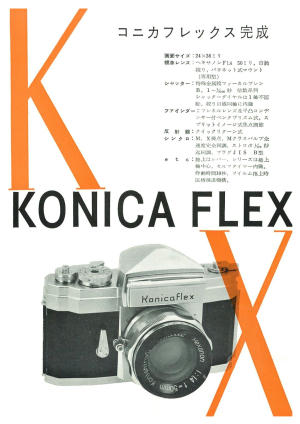 Konishiroku would tease the Japanese press in 1959 with the promise of a brand new Konica Flex SLR with premium features such as a coupled exposure meter, vertically traveling focal plane shutter with top 1/2000 speed, a brand new interchangeable lens mount, and interchangeable viewfinders, Konishiroku was set to make a big splash.
Upon the release of the newly renamed Konica F SLR, the photographic world was unimpressed. The camera’s bulbous dimensions, finicky new lens mount, and sky high price kept sales slow. Making matters worse, the Konica F’s all new in-house developed focal plane shutter was unreliable and determined to be difficult to repair, all but killing the chances for a Konica SLR dominance.
The company would regroup, and quickly release a couple more economically priced SLRs with reduced feature sets, but it was too little too late. Konica SLRs were being greatly outsold by its Japanese competition. It would take the company only six years to abandon the Konica F’s original mount and go with one that was physically larger, had a better aperture coupling, and supported open aperture metering for newer TTL metering technologies. The new Konica AR mount would first appear in 1966 on the Konica Auto-Reflex to much greater fanfare. The Auto-Reflex would sell well and help the company launch a series of more and more advanced Autoreflex SLRs through the 1970s.

For today’s collectors, the late 1960s and 1970s Konica SLRs are generally thought of in a positive regard, as they were reasonably well built cameras that came with great lenses, but they’re usually pretty low on the “Collector GAS” list. Konica SLRs, while fine manual focus cameras, weren’t exactly exciting. Most people’s memories of their camera output of this time were as family shooters who wanted something more than a Brownie, but weren’t exactly pros.
As the years continued, Konica SLRs increasingly employed the use of light weight polycarbonate plastics and electronic circuits. Konica SLRs weren’t seen as industry leaders either for pros, or advanced amateurs, so the company increasingly looked for ways to appeal to beginner photographers wanting modern conveniences like automatic exposure and electronic motor drive.
In 1979, Konishiroku would release the Konica FS-1, the world’s first SLR with a built in electronic motor drive. Many cameras from the past had either spring wound mechanical drives, or externally mounted electronic motor drives, but the FS-1’s electronic motor was completely self contained within the camera body. In 1980, a simplified model called the FC-1 without the motor drive would debut, and then in 1982, came the top of the line Konica FT-1. The FT-1 would replace the FS-1, retaining its electronic motor drive, GaAsP exposure meter, and optional shutter priority automatic exposure, while updating the ergonomics, and adding a few features such as AE-LOCK, a drive mode switch, and an EV compensation dial.


In a June 1983 Konica dealer catalog, the a silver body FT-1 with a 50mm f/1.8 or 50mm f/1.4 lens carried retail prices of $425 and $506 respectively, with black body FT-1s adding an extra $9 to the price. As was typical of the industry at the time, no consumer would have paid full retail with street prices usually around 25% lower. Assuming a 25% discount on $506, a realistic street price of $379.50 has an inflation adjusted price of $1240 today.

The Konica FT-1 came in both black and silver body variants but were otherwise the same. A third variant called the Konica FT-1 Pro Half was released in 1985 and took a chrome body FT-1 but modified the film gate to shoot 18mm x 24mm “half frame” images. Unlike the company’s Konica Auto-Reflex SLR from the 1960s which had a switch that could alternate between full and half frame images on the same roll of film, the Konica FT-1 Pro Half was exclusively half frame.
For its time, the Konica FT-1 was a very good option for someone on the beginner end of the market who wanted the latest conveniences of a fully automatic SLR, but with enough manual control to give them room to grow in their photographic journey. It sold well enough for Konica to keep making them for four years, but after years of declining SLR sales, in 1987 the entire company would abandon the 35mm SLR market, instead opting to focus on simpler point and shoot models.
This is the third Konica FT-1 camera I’ve come across in my time collecting. The first one was in extremely rough condition and showed signs of considerable battery corrosion and I had little hope that it would work, which it didn’t. The second came in a large lot of cameras that had a few things I was specifically after, but the FT-1 there was a bonus camera that looked better than the first one, but that too, didn’t work.
In the years since, as I learned more about this generation of early 1980s SLRs, I became less and less interested as the general consensus was that by then, Konica’s quality control had dropped from their earlier cameras and that a large number of Japanese makers were producing several models with nearly the same specifications, so even if I wanted an FT-1, it wouldn’t be much different than other similar cameras of the same era.

Then in a completely unrelated incident, I became infatuated with the Konica Hexanon AR 40mm f/1.8 lens and found it to be the best bargain in compact semi-wide angle fast SLR prime lenses. An oddity of camera and lens collecting is that sometimes when you are looking for a specific lens, it is less expensive to buy a lens already mounted to a camera, than it is to buy the lens by itself. Such was the case of the 40mm f1.8 Hexanon. By itself, the lens regularly fetches $100 and up, but I found this example mounted to a really nice looking black FT-1 body for about $40 so I snapped it up. I didn’t care if the body ended up being like the previous two FT-1s I had come across, since I only wanted the lens anyway.
Yet another oddity of camera and lens collecting is that when you buy a junk body, or get one part of a lot not expecting the rest of it to be any good, usually the thing you didn’t want, ends up working perfectly, and that is what happened here. Upon its arrival on my doorstep, I was elated to see that not only was the 40mm lens in excellent condition, but the body it was mounted to was in perfect working condition as well.
With a working Konica FT-1 with the 40mm f/1.8 Hexanon lens in my possession, I was able to admire that this is a pretty decent looking camera with styling that probably felt really “hi-tech” in 1983. The polycarbonate black body with bold white Konica logo across the prism is striking. The layout of controls, buttons, and switches on the top plate looks modern yet futuristic at the same time. The word “MOTOR” appears next to the FT-1 logo on the front to remind people that this camera has a battery powered motor drive, which means it no longer has a use for a film advance lever, yet the camera is not so advanced that it eschews its rewind knob and handle. This combination of motor drive with manual rewind reminds me of the Nikon N2000 / F-301 which has a similar feature set.

Up top, the top plate is a bit cluttered, but all the controls are in an ergonomically pleasing location and whose function is pretty obvious without having to refer back to the manual. The only unlabeled control is a small silver button above and to the left of the shutter speed dial, which is the self-timer release. The lack of a film advance lever on the right gave the designers a bit more room to increase the size of the shutter speed dial and the shutter release. The shutter speed dial has speeds indicated from 2 to 1/1000 with a large gap between the slowest and fastest speeds, which you can rotate through. I applaud Konishiroku’s decision to stick with knobs and levers, rather than the temptation of buttons like Asahi Pentax did with their ME Super from the same era.

The sides and bottom of the camera have many of the things you’d expect to see in these locations such as the 1/4″ tripod socket, rewind release button, a door latch for the film compartment, and metal strap lugs.

On the camera’s right side, wrapping around to the front of the camera is the combined finger grip and battery compartment. To change batteries, press in and down on a sliding lock on the rear edge of the battery compartment and the entire compartment detaches from the camera. Four AAA batteries install inside the removable compartment observing polarity, and then the entire compartment slides back onto the camera opposite of how you removed it. In the era the Konica FT-1 was made, the user manual advises against using rechargeable Nickel-Cadmium batteries, however I am certain modern rechargeable Ni-MH or Lithium batteries would work fine. When new, Konica sold an optional hand grip which used larger AA batteries for increased battery life, however this requires removing the AAA compartment first. I did not have access to the AA battery holder.

Around back, the film door has a square box end holder which is used to remind you what type of film is loaded into the camera. To its right is a small circle which acts as a film transport indicator which spins both when film in the camera is advancing or rewinding. In the era of electronic motor drive cameras, customers were likely concerned to know if their film was actually moving inside the camera so this feature is located in a more prominent location than on some other cameras. The Konica’s user manual suggests that certain thin base films may not trigger this transport indicator, even though the film is correctly moving inside the camera.

Pressing the latch on the camera’s left side opens the right hinged door to reveal the film compartment. Film transports from left to right onto a quick load automatic take up spool. When installing a new roll of film, extend the film until the tip of the leader touches the inside right edge of the film compartment and then close the door. The camera’s electronic motor will automatically advance the film to the first exposure as soon as you close the door. The exposure counter is directly above the take up spool and is visible with the door shut. To the left of the exposure counter is a film end indicator light which will light up once you’ve reached the end of a roll of film. Since the Konica FT-1 lacks automatic film rewind, this light tells you when it is time to manually rewind the film. The Konica FT-1 originally came with foam light seals along the door edge and inside the door channels, which on this example were degraded. You should replace these before shooting any film through the camera to prevent light leaks and the crumbling material from getting inside the shutter.

Looking down upon the top of the slim 40mm f/1.8 Konica Hexanon AR lens, closest to the body is the aperture ring with settings from f/1.8 to f/22 plus a green AE position. When the lens is in the AE position, it becomes locked, and to get it out of AE mode, a small chrome button on the side of the aperture ring must be pressed while rotating the ring. Since the Konica FT-1 supports shutter priority automatic exposure, you must mount a Konica AR lens with this feature in order to use the lens and camera in AE mode. Non AE lenses will still work, but only in manual exposure mode. In front of the aperture ring is a fixed depth of field indicator and in front of that is the focus ring with distances indicated from 2 feet / 0.45 meters to infinity. The front of the lens has a 55mm filter ring.

Up front, the Konica FT-1 has an attractive appearance with tapered edges to the top plate and the FT-1 Motor logo in white and orange. Below the logo is a red light which blinks when the self-timer is engaged. On the opposite side of the lens mount is a PC flash sync port, which on this example still has its original cover, something that is often lost on these cameras. Near the 4 o’clock position around the lens mount is a chrome lens release button. The Konica FT-1 uses the Konica AR bayonet mount and like most other bayonet mounts, press and hold the lens release while rotating the lens counterclockwise to remove it and clockwise to mount it back on.
The viewfinder is predictably bright and very easy to use, much like many SLRs of the early 1980s. This generation of camera has the advantage of the latest laser etched Fresnel focusing screens, but without the need for LCD overlays which can decrease brightness. Light on the focusing screen is evenly distributed corner to corner, and with a split image focus aide with microprism collar, achieving manual focus is very easy to do. A range of f/stops from 1.4 to 22 line the left side of the focus screen is overlaid into the visible area. With the camera in AE mode, a red LED outside of the visible area will indicate what the meter is going to use. In manual exposure mode, the meter will still make recommendations showing what it recommends, but will not show what you’ve manually selected within the viewfinder. As a reminder that you are in manual exposure mode, an red LED next to the letter M will blink.


The Konica FT-1 is from an era of cameras in which the controls were consistent from company to company. If you’ve ever shot a late 1970s to early 1980s manual focus SLR, picking one up should feel pretty familiar. Other than the absence of a wind lever and the slightly awkward power switch, the Konica FT-1 is easy to pick up and go. Feeling pretty confident the camera was in good operating order, I decided to load it up and take it out shooting.
I ended up using two rolls of film in the Konica FT-1, a fresh roll of Fuji 400 which was my actual test roll, but then I did a second one of a questionable film I have a large supply of called Kodak Pan 2484. As best as I can tell, this was a scientific film designed for taking photos of CRTs and possibly even oscilloscope screens. It was originally rated with a high ISO, but has lost a lot of sensitivity, so I rated it like an ISO 200 speed film. I had shot this film once before in an entirely mechanical camera and got mixed, extremely grainy results, so I had always wanted to try it again in a more modern AE camera, and well, the Konica FT-1 became that camera.


The 40mm f/1.8 Konica Hexanon AR lens is already one of my favorites and one that I routinely recommend on both this site and the Camerosity Podcast as one of the best lens values out there, so I already knew what to expect from the images I got while shooting it on the Konica FT-1. The 40mm focal length is my favorite standard focal length as I find 50mm to be just a little too long when I am out casually shooting. I often feel as though my first instinct in framing with a 50mm lens is wrong and I have to take a step or to backwards to get everything in the image that I want.

Predictably, all images from both rolls of film turned out great. Sharpness was excellent with no noticeable softness or vignetting near the corners, not even in scenes where the sky is present. Even wide open, the lens performs well. Images in the gallery above of the kitchen, the Kodak light, and beer taps are all shot wide open and although they don’t have the same razor sharpness of the lens at f/8, I’d still say it is quite good. If somehow, you have not yet heard me praise this lens, I’ll say it again here, the Konica Hexanon 40mm f/1.8 lens is both a great lens and a ridiculous bargain at the prices they typically go for in the used market. Even if you have no intention of shooting one with the Konica FT-1, it works great on every other Konica SLR from the Auto-Reflex forward, and with an adapter, works great digitally as well.

As for the Konica FT-1 camera, I was impressed. This model came out at a time when Konica’s quality control was not very good. Add to that the experimental nature of early 1980s electronics, and you don’t end up with a camera that holds up to the rigors of time well. My story above about this being my third attempt at finding a working FT-1 is not unusual. I have heard similar claims from many people who have acquired many of these cameras, only to find that they don’t work.
However, with a working example, the ergonomics and handling is excellent. Without the need for a film advance lever, the camera is quite compact and feels great in your hands. I am actually impressed at how small the camera is, when you consider there is some kind of electronic motor inside the body for advancing the film. While 35mm SLRs continually shrunk in size from the late 60s through the early 80s, by the middle of that decade, cameras started to grow again as room needed to be made for more and more electronic motors and other gadgets.
I shot the entirety of the two rolls with the camera in Shutter Priority AE mode, effectively like a point and shoot SLR. Indoor scenes, I set the camera to 1/30 to control body shake and for all outdoor scenes I chose 1/125 and let the meter handle the rest and I can say that every image from those two rolls came out properly exposed, even in challenging metering scenes like my mirror selfie.

In addition to good ergonomics and excellent metering, for those of you ASMR fans out there, the sound of the FT-1 firing its shutter and then advancing the film was very nostalgia inducing. I cannot prove this, but I would be willing to bet that the Konica FT-1, or at least a camera very much like it was one that sound editors sampled for use in movies when the sound of a camera firing was required. That ‘ka-click-wheeeeeeee’ sound that every camera seen in every movie made for the past 40 years makes (even on cameras that don’t make those sounds) sounds exactly like the FT-1, and I am not ashamed to admit that even without film in the camera, I often would dry fire the camera just to hear its sounds.

For cons, I really only have two. The first is that the design of the combined power switch and AE-L setting isn’t the best. On my example, moving the switch to turn the camera on and off felt cheap and didn’t inspire confidence that it wouldn’t one day break off in my hand. That this camera is over 45 years old and still working suggests that may not have ever happened, but it does feel cheaply designed. The second is that I question the decision to release this camera with a AAA battery compartment when a larger one which uses AA was also available. Certainly, the AA battery compartment does add some weight and size to the camera, but to have batteries that will last nearly twice as long seems like a worthwhile tradeoff. I haven’t shot the FT-1 enough times to run through a set of fresh AAA batteries, but I suspect original owners of this camera probably got tired of having to replace the lower capacity AAAs as often.
Beyond that, the Konica FT-1 is a fine camera with a great lens. It is a shame that its electronics have aged so poorly because if this camera had been more dependable, I could see this being a very popular option today, in the same league as the Canon AE-1 for photographers wanting to get back into film with the safety of auto exposure, and modern conveniences like a motor drive, very bright viewfinder, and excellent lenses. If you manage to come across a working FT-1, don’t pass up the chance to shoot a roll through one while it still works. This camera may have a poor reputation for reliability, but that has nothing to do with how fun it is to shoot or the results you’ll get from it.
Related Posts You Might Enjoy
External Links
https://camera-wiki.org/wiki/Konica_FT-1_and_FT-1_Pro_Half
https://davidde.com/2021/07/10/review-the-konica-ft-1/
https://www.35mmc.com/07/07/2023/konica-fs-1-and-ft-1-review-the-shape-of-things-to-come/
http://www.theothermartintaylor.com/moveabletype/archives/cameras/000221.html
https://blog.dominikmarczuk.pl/2025/03/konica-ft-1-motor/
https://www.botew.com/konica-ft-1/
https://www.buhla.de/Foto/Konica/eFT-1Haupt.html
https://www.collection-appareils.fr/x/html/page_standard.php?id_appareil=11301
It is a great camera. However, the electronics aged horribly. I have four bodies and one of them works. I purchased them in part for the lens which are among my favorites. The 40mm is a true legend. The price spiked last winter but it has become more affordable recently.
I have a large collection of Konica cameras and lens. I try to avoid using the ones with battery aided motors since the reliability is so bad.
However when the motor works correctly what a masterpiece.
However, I usually stick with my T3 when I am out in the field. The FT-1 has a novelty feel to it.
The electronics are NOT unreliable! What stopped many FT-1 from working is the degradation of only three plastic strips that compress three connectors. And these can be replaced by non-professionals!
There is an almost complete guide on Flickr by swveit; one needs only a small cruciform screwdriver (I invested in a small iFixit kit, which on top of being good quality and ergonomics give me access to japanese JIS screw bits that are an even better fit than the standard Philips), q-tips, some rubbing / isopropyl alcohol or lighter fluid to clear the gunked/crumbling (depending on what material Konica used and maybe the storage conditions) plastic strips, vinegar to clean corrosion underneath (contact cleaner if there is a lot of it), some quiet space and a little organisation to not lose parts and reassemble them correctly, and you can very easily sort out two out of the three mentioned weak points in an evening. The third one, under the flexboard, is more challenging to access, but can be left for later if cleaning the first two makes the camera functional.
https://www.flickr.com/photos/15235665@N04/albums/72157623203627474/
I am currently working on a FT-1 and will try to make an even clearer guide (especially wrt. the third strip) in photo and video form by the end of this month.
As this was usually the first thing that stopped these cameras from working, the rest is usually in very good condition both mechanically and electronically. That makes most FT-1s time capsules, and excellent cameras, uncomplicated yet with some creative controls, with a very good viewfinder and with almost perfect lenses.
I am sure that both of you, Mike and Mark, can restore them into working condition and give them away to friends and family. I am not a professional repairman, but this is such a simple and well-defined problem that repair is within reach of amateurs.
If you can bear the risk of sending them my way (to France) by post, I would be happy to try to do it for you. (Or come visit in person – Evian-les-bains is very photogenic.)