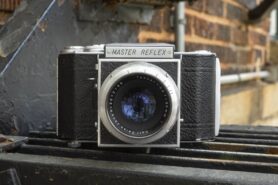
The VEB WEFO Master Reflex is a 6x6 medium format SLR made in East Germany starting in 1950, sold domestically as the Meister-Korelle and exported to the US under the Master Reflex name. It descends from Franz Kochmann's earlier Reflex-Korelle (first produced in 1935), though it uses its own unique 58mm interchangeable lens thread mount rather than the original camera's 40.5mm mount. Kochmann himself, a German Jew, was forced from his company and country by the Nazis, eventually dying in the Netherlands in 1956, while his firm passed through several hands—Korelle-Werke, then VEB WEFO—before the Meister-Korelle's redesign introduced a right-hand lever advance, helical focusing lens mount, and a unified 1–1/1000 shutter speed dial. Production troubles plagued WEFO, and after about a year the company folded into Welta, which made the camera until 1952. In the US, it was marketed as an affordable route into interchangeable-lens medium format SLRs, selling with either a Meyer f/3.5 or Zeiss Tessar f/2.8 lens for $189.50–$199.50 (roughly $2,350–$2,460 adjusted for inflation).
Handling the camera, the author found it shared the Reflex-Korelle's boxy shape and mirror-box design, though lenses aren't interchangeable between the two. The waist-level finder is dim by modern standards, lacking Fresnel screen technology, though usable outdoors, with a fold-out magnifier and sports finder as aids. Controls—film advance, shutter release, self-timer, and a single-dial shutter speed selector—were well-placed and pleasant to use, and the preset-aperture 80mm f/2.8 Zeiss Tessar produced sharp, pleasing images with only mild corner softness, tested on a roll of Harman Phoenix 200 film. However, the author encountered persistent film transport problems, resulting in overlapping frames and uneven spacing, netting only 10 of 12 possible exposures. Other quibbles included the camera's large, boat-like size for a 6x6 SLR (though kept relatively light by the Tessar's aluminum construction) and the generally slow, deliberate shooting process typical of mid-century SLRs.
Despite its film-advance quirks and bulk, the author's verdict is largely positive: the Master Reflex remains an enjoyable, capable camera whose lens quality holds up well, and its historical role as a budget-friendly entry into medium format SLR photography still resonates today, since it's more affordable than contemporaries like Hasselblad, Mamiya, or Bronica. Its short production run is attributed less to any design flaw than to the rising popularity of more compact, easier-to-use 35mm SLRs at the time. The author expresses enthusiasm for shooting it again in the future.
AI-generated summary. May not capture every detail — read the full article below for the complete picture.
This is a Master Reflex, a medium format Single Lens Reflex camera made by VEB Werkstätte für Feinmechanik und Optik (WEFO) starting in 1950. The Master Reflex shoots 6cm x 6cm images on regular 120 format roll film. The name “Master Reflex” was what the camera was called when exported to the United States. When sold in Germany, it was called the Meister-Korelle and was a continuation of the earlier Kochmann Reflex-Korelle, first produced in 1935. Like that original camera, the Master Reflex has a cloth focal plane shutter with a wide range of speeds, but has its own unique interchangeable lens mount to which a variety of lenses could be attached. Shortly after production of the Meister-Korelle began, VEB WEFO went out of business and production was shifted to Welta, who continued to produce the camera until about 1952.

Film Type: 120 Roll Film (twelve 6cm x 6cm exposures per roll)
Lens: 80mm f/2.8 Carl Zeiss Jena Tessar 4-elements in 3-groups
Lens Mount: M58x1 Thread Mount
Focus: 3.3 feet to Infinity
Viewfinder: Waist Level Reflex Viewfinder, Sports Finder
Shutter: Cloth Focal Plane
Speeds: B, 1 – 1/1000 seconds
Exposure Meter: None
Battery: None
Flash Mount: None (This example has an aftermarket flash port added.)
Weight: 936 grams, 700 grams (body only)
Manual: https://cameramanuals.org/pdf_files/master_reflex.pdf
There is not a lot of history out there about Franz Kochmann or the company he started in 1921 in Dresden to build cameras like this Korelle. The only sources of information I was able to find online repeat the same couple of sentences over and over without much in the way of additional information.
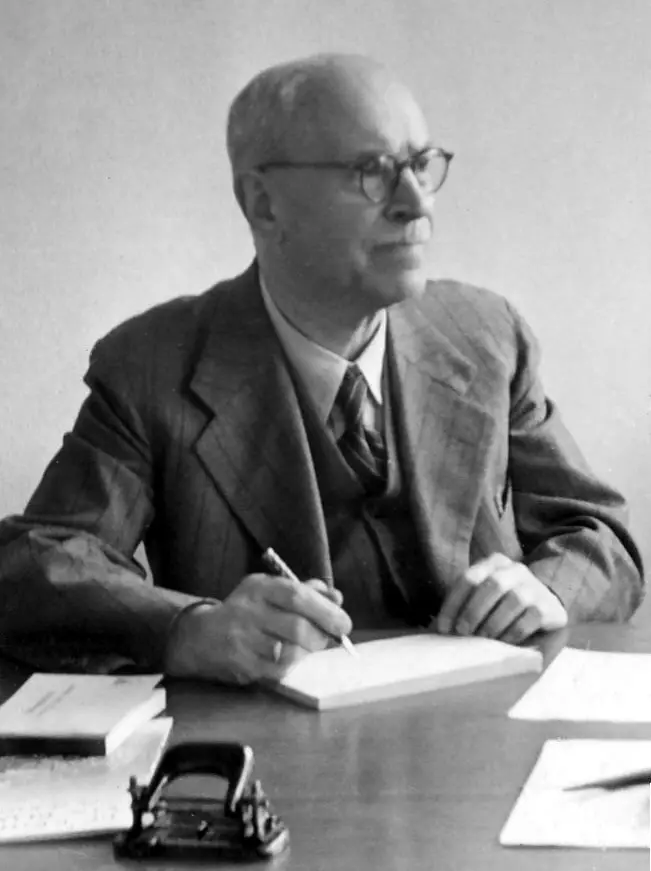
Franz Kochmann, a German Jew, was born in Dresden in September 1873 and from a young age, he had an interest in art and photography. He either came from a wealthy family, or built a lot of wealth on his own as he owned a large estate called the Villa Kochmann.
Kochmann was interested in art as he had acquired a large art collection, and even had a painting of his house done in 1913 by expressionist painter Ludwig Meidner.
In 1921, his interest in photography led him to form his own camera company called Franz Kochmann Fabrik Photographischer Apparate and he started making simple folding plate cameras. In 1924 a solid bodied single lens reflex camera called the Enolde Reflex was produced. The Enolde name was reused a number of times on various folding plate and rollfilm cameras throughout the 1920s.
In 1931, a new series of compact folding strut cameras called the Korelle was released. Models in the Korelle series were released in pairs for three straight years, using almost every imaginable format of film available at the time.
The first model was simply called the Korelle and it took 3cm x 4cm images on 127 roll film. The second was a full frame model called the Korelle 4×6.5. In 1932, the Korelle P and K were released, the first of which took 4.5cm x 6cm images on sheet film, and the second was a solid bodied model that used double perforated cinema 35mm film and took 18mm x 24mm images.
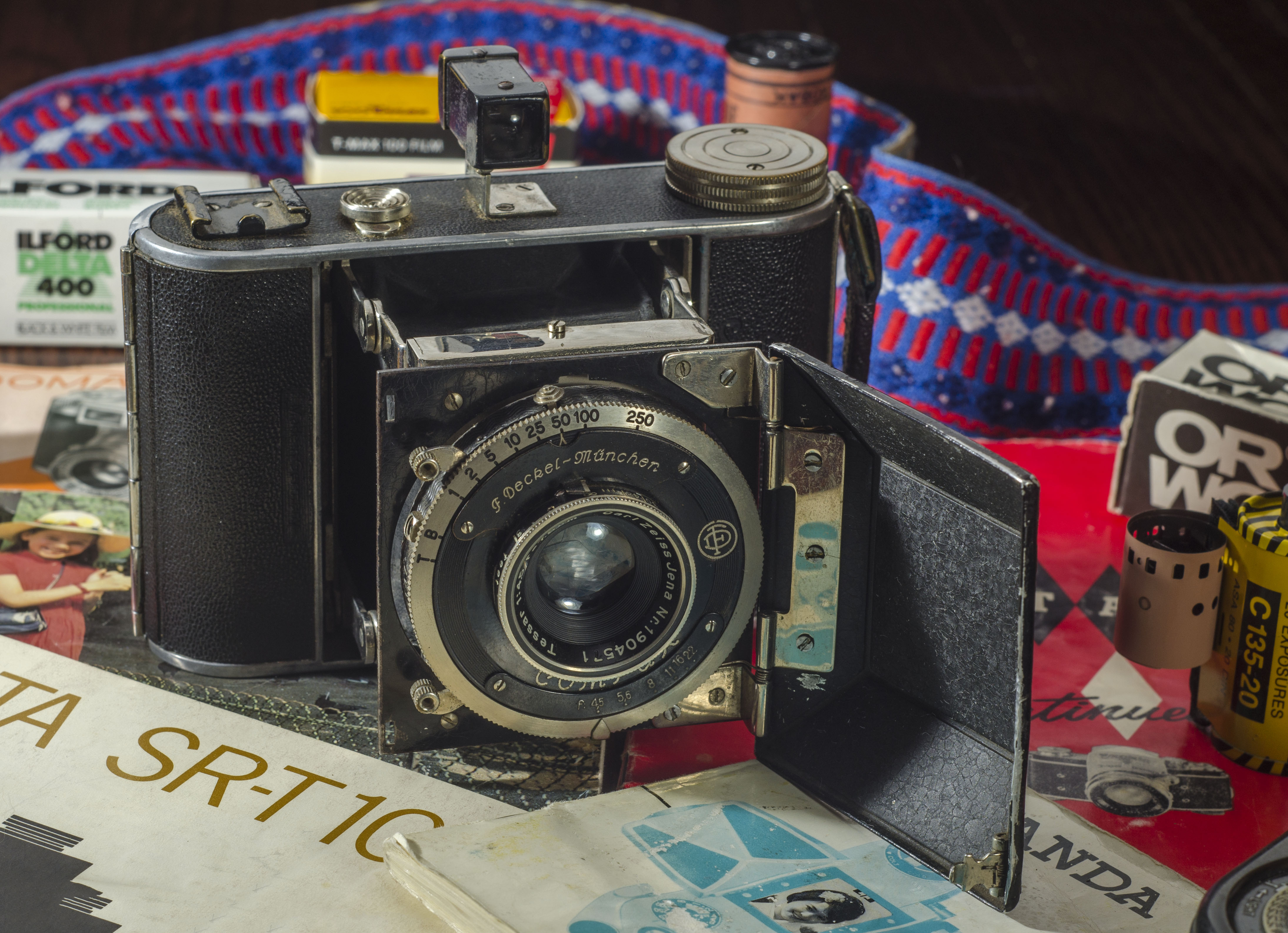
In 1933, two more models were released, this time using 120 roll film. The first, was the Korelle 4.5×6 which took “half frame” 4.5cm x 6cm images, and the second, the Korelle 6×6 took…you guessed it…6cm x 6cm images.
Finally in 1934, the last of the folding Korelles was released, this time a traditional folding (non-strut) 6×9 model.
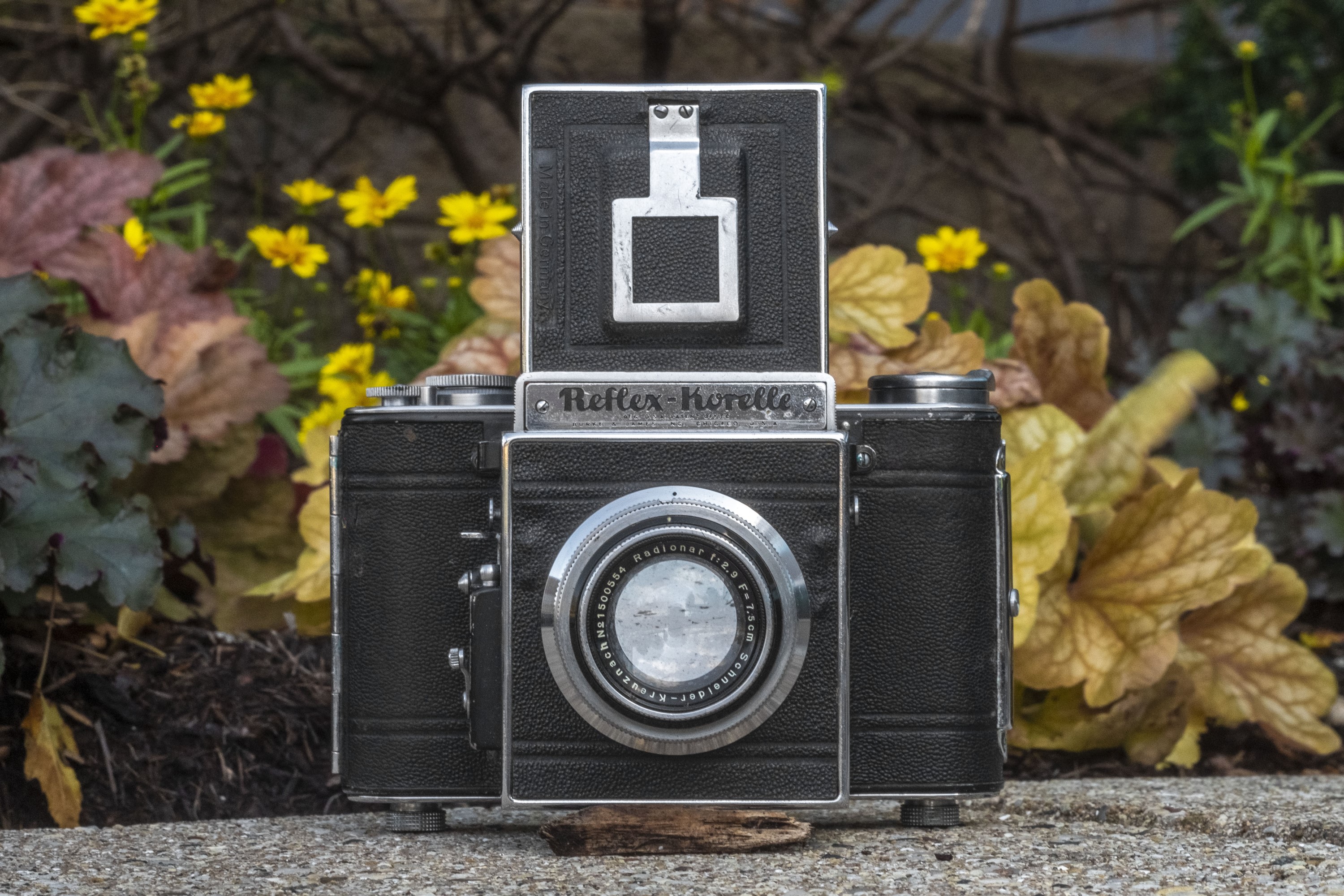
In 1935, the Korelle name was used in a new series of solid bodied single lens reflex cameras called the Reflex-Korelle. The Reflex-Korelle would prove to be Kochmann’s most successful model, with variants being released both before, and after the war.
The Reflex-Korelle was successful enough in Germany, that the company attracted the interest of Burke & James in Chicago, and an export arrangement was made allowing for models to be sold in the United States.
As is the story of all German Jews in the late 1930s, the rise of the Nazi party proved to be a problem for Kochmann and his family. Franz Kochmann would attempt to flee Germany, but unlike other German Jew camera makers like Henry and Joseph Wirgin or Paul Guthe and Benno Thorsch from KW who successfully migrated to the United States, Kochmann and his family were denied exit from Germany.
Later in 1938, Kochmann’s company, his estate, and all of his belongings were seized by the government, and he was forced to relocate to the Dutch city of Utrecht, which at the time was already under Nazi control. Under a law called the Alteration of Family and Personal Names, all Jewish men were forced to change their name to “Israel” to more easily identify them as Jewish.
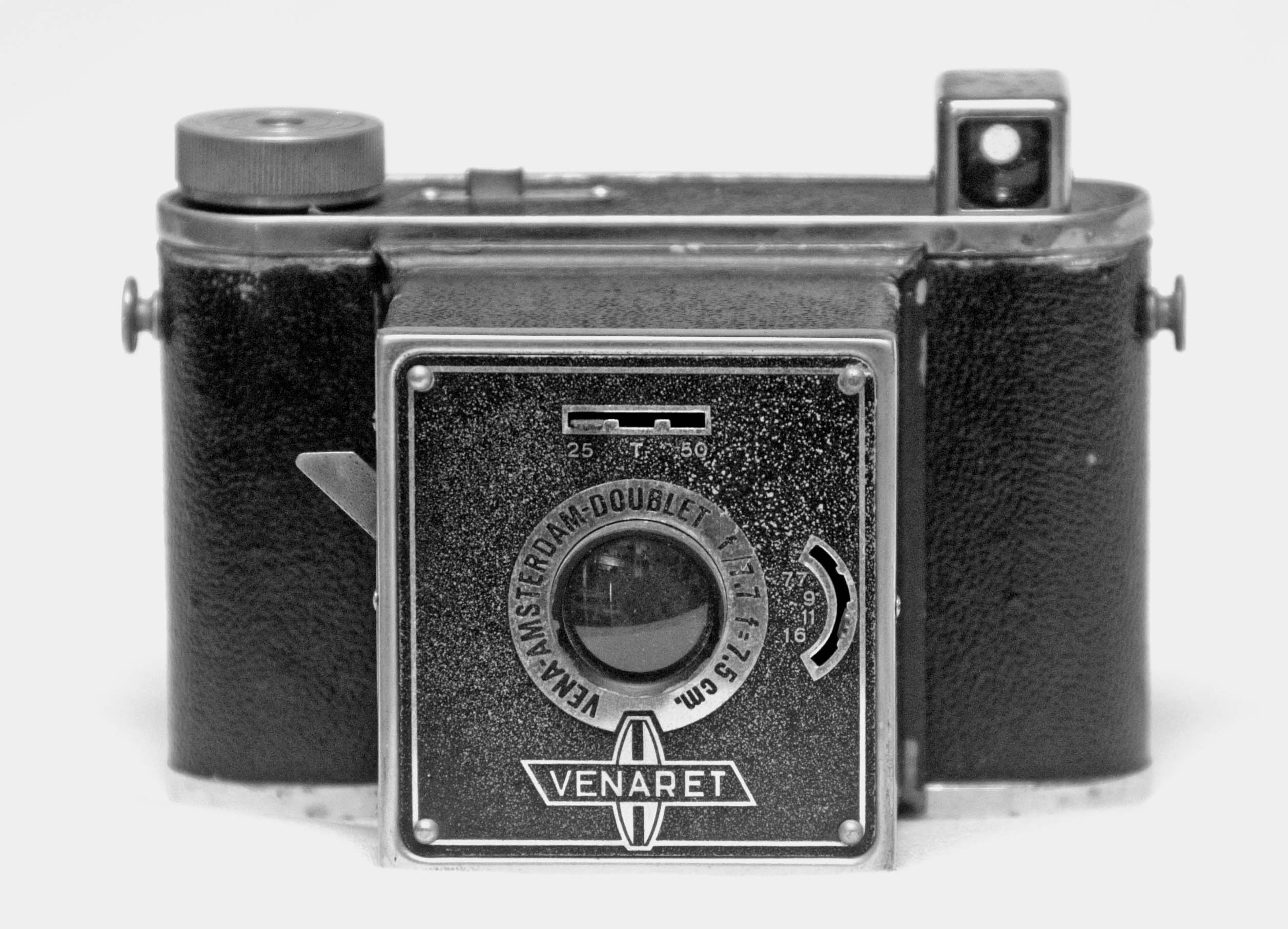
Israel Kochmann would remain in Utrecht for the remainder of his life, at one point working for the Dutch camera maker Vena, designing simple and inexpensive cameras like the Venaret. Kochmann would tragically die on June 25, 1956 after being hit by a car.
Back in Germany, after Franz Kochmann’s departure, the Kochmann company would be renamed Korelle-Werke KG and ownership was given to G.H. Brandtman & Co. The Korelle-Reflex would remain in production and for a short while in 1939, exported to the United States as the Korelle-Reflex II.
After the war, Korelle-Werke attempted to setup a temporary manufacturing location in Dresden as their original factory was completely destroyed by Allied bombing raids. New production of Reflex-Korelles was short lived as in early 1946, the Soviet army would take over the company halting production. I do not know if any Reflex-Korelles from this period were ever completed. If they were, they have to be very rare.
A second attempt to restart Reflex-Korelle production occurred in 1947, but the factory condition was so terrible that full scale production never got going and no new models were completed.
In 1948, the Korelle-Werke company was taken over by an all new entity called VEB Werkstätte für Feinmechanik und Optik (WEFO). The abbreviation VEB stands for Volkseigener Betrieb which translates to ‘Publicly Owned Operation’ in English and was the main legal form of industrial enterprise in East Germany from the late 1940s until the early 1960s.

A redesigned Reflex-Korelle called the Meister-Korelle was to be the primary product of VEB WEFO and production started in 1950. The Meister-Korelle had several changes from the original Reflex-Korelles, most notably a redesign of the top plate including a right handed lever film advance, an all new interchangeable lens 58mm thread mount with helical focusing, and a revised shutter speed selector with all speeds 1 – 1/1000 on a single dial (compared to two on the original models).

With the new lens mount, at least six lenses were available ranging from the standard 80mm f/2.8 Carl Zeiss Tessar to a 250mm f/5.5 Meyer-Optik Tele Megor telephoto lens. No wide angle lenses were offered in the mount as very few options existed at the time and designing one for a low production medium format SLR likely didn’t make sense. For closeup work, a set of four extension tubes were also available in the 58mm thread mount.

The Meister-Korelle was an ambitious model produced by a company with little experience with precision optics manufacturing and the model was constantly plagued with technical problems. Many models had issues before they left the factory, with film transport issues being very common. VEB WEFO stumbled through production of the Meister-Korelle for about a year, at which point, the company was shut down and its assets merged with VEB Welta-Kamerawerke.
The Meister-Korelle was produced by VEB WEFO for a little over a year and then in 1951 was taken over by Welta, who continued to make it under their name until 1952. It is believed that another Dresden area camera maker, VEB Kamera-Werkstätten Niedersedlitz considered restarting production of the Meister-Korelle, but it was deemed too complicated of a design. Instead, the company designed their own 6×6 SLR called the Praktisix.
During its production, export versions were made for the US market and rebranded Master Reflex, but other than the name, nothing was changed. The Master Reflex was seen as a cost effective entry into medium format SLRs. With affordable 35mm SLRs still a couple years away, in the very early 1950s, the Master Reflex was the most affordable way to get into interchangeable lens reflex cameras for American customers. In the ad below, the camera was sold with an f/3.5 Meyer lens or f/2.8 Zeiss Tessar for $189.50 or $199.50 respectively. When adjusted for inflation, these prices compare to around $2350 and $2460 respectively.

Over the years, I’ve come across several Kochmann Reflex-Korelle SLRs and they all shared one thing in common, they didn’t work. Something about the design of a 1930s medium format SLR seems to render these cameras inoperable after nearly nine decades. I suppose I shouldn’t be too surprised as I don’t think the designers of even the highest quality Zeiss and Leica cameras ever imaged that people would still be using their products nearly a century later. Still, I couldn’t help but feel a pang of disappointment every time I would come across a Reflex-Korelle and would discover the curtains were rotted out, the shutter was inoperable, or both. Perhaps I would never get my chance.

Then one day, while browsing “Ye Olde Camera GAS Marketplace (aka eBay)” I came across an unusual camera which I only briefly remember seeing once before. A camera that looked remarkably like my white whale Reflex-Korelle, but with a strange name. I put in a low dollar bid and to my delight, a couple of days later I had discovered that I won a shiny new (to me) Master Reflex. Upon its arrival, not only was I elated to see that the camera worked perfectly, but that the resemblance to the Reflex-Korelle was more than superficial, but that this came from the same family lineage. Sure, it wasn’t the same camera, but it was close enough for me!

Comparisons to the original Reflex-Korelle are pretty easy to make. Both cameras have the same basic shape, resembling a 6×6 roll film camera with a large mirror box cube grafted onto the front and interchangeable lens thread mount. The lens mount itself is different between the two cameras however, so lenses cannot be swapped.

Looking down at the top of the camera, the square viewfinder takes up a lot of room. Like any other waist level camera, the hood opens up to reveal the ground glass which shows light that comes through the lens. The Master Reflex predates the use of laser etched Fresnel patterns, so the focus screen is dark with heavy vignetting near the corners. It is usable in bright light, but you’ll struggle with fine details indoors or in heavy shade. For precision work a magnifying glass on the rear edge of the hood can be folded into position to see fine details on the ground glass.

To the right of the viewfinder is the film advance lever and shutter speed dial. Above the film advance is a little shutter readiness indicator which turns red when the shutter is cocked. To its right is a reset switch for the exposure counter. The exposure counter is in a little round window to the left of the viewfinder. The film advance lever is geared and has a nice scalloped shape to it which fits comfortably on your thumb while winding. Shutter speeds from 1 second to 1/1000 plus Bulb are selected by the speed dial.

Around back is a round window for reading the exposure numbers on the film and a metal door to protect the window from stray light. Under normal operation, this window is only needed for loading in a new roll of film and getting it to the first exposure. After advancing the film to the first exposure, reset the exposure counter to ‘1’ using the switch on the top plate and the camera’s built in exposure counter can be used for the remaining 11 exposures. In the event the film transport has a defect, you can just read the numbers manually on the backing paper after each shot. Also from the back, you can see the round magnifier on the back edge of the viewfinder hood.

The base of the camera has a 1/4″ tripod socket on a raised foot beneath the mirror box. This location in the center of the camera’s weight means it would have good stability when mounted to a tripod. Two feet on each end of the film compartment can be pulled down while loading film to make inserting and removing the spools easier.

The film compartment is opened by pressing up on a latch on the camera’s left side. The right hinged door swings open to reveal a pretty typical roll film compartment. Film transports from left to right onto standard 120 spools. Kodak’s 620 film cannot be used in this camera as the keys are not the correct shape. In the center is the large opening for the focal plane shutter. A large chrome plated pressure plate is attached to the inside of the door. The use of unpainted metal means that reflected light could have been an issue when using slide film or other film stocks with a clear base. The Master Reflex predates the use of foam light seals, so there is nothing to replace before using the camera.

The sides of the mirror box both have round lugs for a neck strap which is useful to help support the camera during long shooting sessions. On the photographer’s right side is the shutter release button, with a threaded cable release socket behind it. Below the shutter release button is a small self-timer lever. Rotate the lever clockwise until it stops moving and upon pressing the shutter release, an approximate 10 second delay will begin before the shutter fires.

Looking down at the top of the 80mm Tessar lens, the all metal body has a thick and easy to grip focus ring which turns smoothly from just under 3.5 feet to infinity. An engraved depth of field scale is closest to the body and has a range from f/22 to f/2.8. Strangely, the index mark for the DOF scale is not at top dead center and off to the right a bit. The lens on this camera is a preset design, which means there are two rings near the front which control the diaphragm. The knurled ring physically opens and closes the lens to whatever the preset f/stop is. To change the preset f/stop, you must first pull back on the knurled ring towards the body of the camera, and with a second hand, rotate the ring closest to the front of the lens to whatever f/stop you choose. This design allows you to choose an f/stop ahead of time, then while looking through the viewfinder, easily open the lens back up to allow maximum amount of light into the viewfinder, and then quickly stop it back down to your preset f/stop without having to stop looking through the viewfinder. This was a popular method used in early 35mm and medium format SLRs of the era, before automatic diaphragms became common.

The Master Reflex has a interchangeable lens threaded mount with a large 58mm diameter which is not shared by any other camera. This is significantly larger than the 40.5mm diameter thread mount on the earlier Reflex-Korelle. While I could not find any official explanation for the change, my best guess would be to support larger, heavier, and perhaps faster lenses. Had the Master Reflex been more of a sales success, perhaps some sub f/2.8 lenses and maybe even some crazy wide angle zooms might have been made for it.
With everything appearing to be working correctly on the camera, I decided to load in a roll of film and take it out shooting. For what likely was the first roll of film shot in a Master Reflex in decades, I chose a fresh roll of the new Phoenix Color 200. This is a new C41 color film emulsion made by Harman, the same company that produces Ilford film. Phoenix film is considered an “experimental” film as the kinks to mass produce an all new C41 film take some time to work out. Early tests from other photographers online report strong warm undertones with some halation in high contrast scenes. I was pretty excited to see the results from this new film and what looked to be an excellent condition Zeiss Tessar lens.


Shooting the Master Reflex was a great deal of fun, but within the first couple of exposures, I could already tell I was having some film transport issues. I followed the instructions in the manual and wound the film until the first exposure number appeared in the red window, and then tried to depend on the film advance after that, but it never seemed to stop. I am unsure if I did something wrong, or if the 75 year old camera was in less than optimal working condition, but it clearly wasn’t advancing right. For the rest of the roll, I attempted to use the red window on the back of the camera, but then my 47 year old brain sometimes forgot to do that, so I wound up with a roll of partially overlapping images and then some images with far too much space between exposures. Out of the 12 exposures I should have gotten with the camera, I got 10, one of which I grotesquely over exposed because I forgot to stop down the lens before pressing the shutter release.

Of the 9 others, the images were predictably good. Zeiss Tessars are one of the longest produced and well known lens formulas ever made. The example on this camera was in good condition without any fungus, haze, or major scratches, so the light passing through made images with excellent sharpness in the center and only a bit of softening near the corners. It is difficult for me to judge the color accuracy as the Harman Phoenix film was well known for having a skewed color palette, but overall, I found the images pleasing.
I generally liked using the Master Reflex and found its controls to be exactly where I expected them to be. I liked the shape and feel of the film advance lever and the location of the shutter release was perfectly situated where my right index finger expected it to be. I also liked that the shutter speed dial was a single piece design with fast and slow speeds all in sequence, and that it didn’t require it to be lifted before changing speeds.

In terms of nitpicks, the viewfinder was predictably dark for an early 1950s SLR. These cameras predate the use of laser etched Fresnel bright screens which maximize light transmission from corner to corner. Using the camera outdoors in bright light was easy enough, but in less than ideal light, I found it better to use the sports finder, although that comes at the expense of composition accuracy. Another nitpick, which someone not used to shooting mid century SLRs might not be used to is how slow the process of shooting the camera is. From having to manually advance the film, paying attention to the exposure counter, setting exposure on a preset lens, composing, manually focusing, and then pressing the shutter release, this isn’t exactly a fast action camera, but it is something you will get used to.

My only real complaint about the Master Reflex is something I don’t love about all medium format SLRs, which is their size. In order to fit a reflex mirror and ground glass to accommodate a 6cm x 6cm image, everything must be supersized. This is not a small camera. From side to side, the edges of the film compartment exceed half a foot and the location of the lens up front is nearly as far. Dimensionally, I find these cameras to be less portable than 6×6 TLRs, even though they’re not as tall. Thankfully, the overall weight of the camera with the lens attached is kept in check due to the Tessar’s mostly aluminum construction. Had this entire camera and lens been made of brass, it would have felt like a boat anchor while out shooting.

For what it is though, the Master Reflex is a great camera, and in working condition and for the price, would have been a very attractive option for photographers in the very early 1950s. The model’s short production run certainly wasn’t the result of the camera’s usability or results, rather that much more compact and easier to use 35mm SLRs were increasing in popularity around the same time and probably stole most of the Master Reflex’s potential customers.
Perhaps the biggest compliment I can pay the Master Reflex is that its biggest selling point today is the same one that it had in 1950, which is that it is an affordable entry into medium format SLRs. While certainly not cheap, compared to other medium format SLRs like those made by Hasselblad, Mamiya, or Bronica, it is an affordable option. I found the Master Reflex to be fun to use, and even though I didn’t get a full 12 images out of my first test roll, I can see myself giving it another go in the future.
Related Posts You Might Enjoy
External Links