
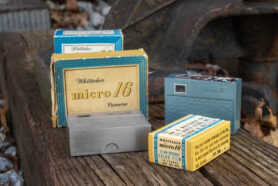
The Whittaker Micro 16 is a subminiature camera produced starting in 1947 by William R. Whittaker Ltd., a Hollywood-based company that had originally made aircraft parts during World War II before branching into cameras. Shooting 24 exposures on double perforated 16mm film loaded into proprietary cassettes, the camera was a simple, fixed-focus device with a single shutter speed and three aperture settings, sold new for $29.50 (about $450 today) with free film development included. It was marketed to amateurs through general-interest publications like Life and Popular Mechanics rather than photography magazines, and was made in multiple colors with accessories including a clip-on sports finder, a case, flash, and a slide viewer for viewing developed positive strips.
In hands-on testing, the author found the camera surprisingly heavy and dense for its size, with a die-cast body showing visible machining marks and casting pits. Its reflex viewfinder is awkward, requiring the camera to be held 10-12 inches from the face and giving only a rough approximation of framing. Loading film is fiddly, with the pressure plate and cassette threading being especially difficult in darkness, and the author typically managed only about 18 usable exposures per load. The shutter release requires an unusual upward pull motion and is nearly silent, making it hard to confirm an exposure was made. Using Kodak-style Cine 16 BW 40 film developed as a negative (rather than reversal) and processed in HC-110, the author found image quality better than expected but not exceptional—grain was more pronounced than anticipated, clarity was good but not great, and there were minor light leaks attributed to cassette loading rather than the camera itself.
Overall, the author considers the Micro 16 an enjoyable, pocketable shooter that performs adequately in well-lit conditions with slow-to-medium speed black-and-white film, though it would struggle with slide film or low light. Despite gripes about the shutter release ergonomics and the anxiety-inducing silence of the shutter, the author concludes that original owners likely would have been pleased with results from such an inexpensive 1947 camera, and recommends it as a worthwhile addition for collectors or users of small cameras, especially given its distinctive design, affordability, and range of collectible accessories and color variants.
AI-generated summary. May not capture every detail — read the full article below for the complete picture.
This is a Whittaker Micro 16, a sub-miniature camera made by the William R. Whittaker, Ltd. Company in Hollywood Camera starting in the year 1947 and into the 1950s. The Micro 16 shoots twenty-four exposures on double perforated 16mm film loaded into special cassettes made for the camera. The Micro 16 is a simple camera with fixed focus, a single shutter speed, and only three aperture settings, but has a sturdy build quality which feels unusually heavy for a camera of its size. The company who made it produced aircraft parts during the war and expanded to cameras after. The Micro 16 is most commonly found with a chrome finish, but versions made in green, blue, black, and gray were also made.

Film Type: Double Perforated 16mm Film (twelve to twenty-four exposures per roll)
Lens: Unknown Focal Length Achromatic Doublet f/8 uncoated 2-elements
Focus: Fixed, ~3 feet to Infinity at “Bright” Setting ~f/16
Viewfinder: Optical Reflex Finder (An optional clip-on Sports Finder was available)
Shutter: Metal Blade
Speeds: Single, ~1/50 second
Exposure Meter: None
Battery: None
Flash Mount: None
Weight: 254 grams
Manual (version 1): https://www.cameramanuals.org/pdf_files/micro_16.pdf
Manual (version 2): https://www.submin.com/16mm/manuals/whittaker/index.htm
In the aftermath of World War II, there was a huge need for manufacturing in the United States both in the civilian and military market. A large number of returning soldiers coming back from Europe and the Far East expanded out west and into areas of the country sparsely populated in the early 20th century. As the population boomed, the economy surged and a great number of new companies were created.
In 1947, a former engineer named William R. Whittaker formed his own company in Hollywood, CA to produce aircraft valves and other parts. Strangely, in addition to production for the aviation industry, Whittaker also built a camera.
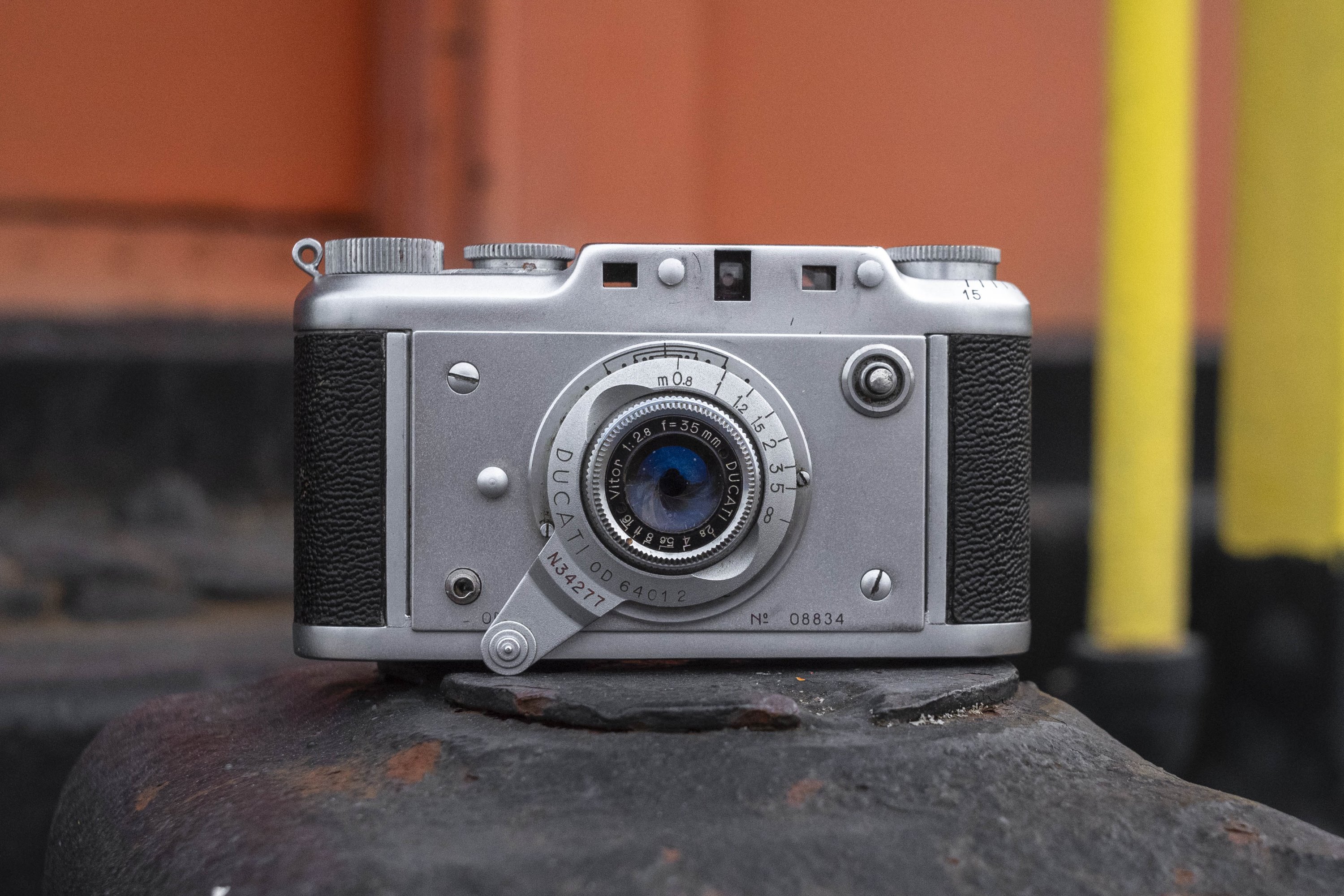
That an aviation company also made a camera isn’t really that unusual as there are many examples of this throughout the 20th century, Italian motorcycle company Ducati made two cameras, a UK based radio and television company called Peto Scott Electrical Instruments produced the Ilford Witness, a French underwater diving company called La Spirotechnique created the Calypso underwater camera which later became the Nikonos, and of course the entire Argus camera company originally started out making radios.
Why exactly Whittaker decided to produce a camera and why he chose a subminiature 16mm camera that could fit into a packet of cigarettes is anyone’s guess, but he did and surprisingly, the cameras sold reasonably well. Perhaps on a high from the outcome of World War II, many people were enticed by the possible clandestine uses for a compact camera, and more still were motived by its price.
Selling in 1947 for $29.50 which when adjusted for inflation, compares to around $450, the camera was affordable by most people, and with the promise of free development with every purchase of a roll of film, anyone could produce black and white or color negatives and slides for not a lot of money. In my research for this camera, most of the advertisements were found in Life Magazine and Popular Mechanics, rather than dedicated photography magazines which is not surprising considering the amateur nature of the camera, but that it appeared in major publications of any kind suggested it was taken seriously, at least for a while.


I was unable to find any contemporary reviews of the camera, so I can’t say for sure how it was received, or if its appeal went beyond its small size and low price. Did people use these cameras for birthdays, holidays, and vacations, or did young adults live out fantasies of being an Allied spy breaking into German compounds and photographing documentation with it.

The camera was higher in quality than the typical novelty or toy camera of the era, and although it lacked much in the way of exposure control, with three aperture settings, and a what the manufacturer called a color corrected Achromatic Doublet lens it should have been capable of decent images.
Available in multiple colors, and in a kit with a case, flash, and extra film, the Whittaker Micro 16 was a complete camera which would have expanded its use beyond a simple toy camera. The cameras lack serial numbers and there was no production records kept so it is unclear how many were made or for how long. Whittaker did make at least one other subminiature camera called the Pixie, but it would appear that their time as a camera maker would by over by the early 1950s.
The company would continue on in the aviation industry producing goods for the US military, they would merge with other technology companies, becoming The Whittaker Corporation in the 1960s. The company would continue on until the 1990s when it would be merged with Meggitt Plc, a UK based company involved in the aerospace and defense industries. Although I cannot find any references to a Whittaker company which exists today, it would seem that pieces of the company continued to exist into the 21st century.

The Whittaker Micro 16 is a small camera. Designed to fit into a package of cigarettes, it was well suited to a wide range of discreet photography, however I would hesitate to call this a spy camera. Cameras like the various iterations of the Minox subminiatures or the Soviet era KMZ Ajax-12 are well suited to being tucked away in a small pocket or coat sleeve and shot directly at something. The Whittaker Micro 16 works more like a very small box camera with a difficult to see through reflex finder with an inverted image. Its film transport is via a metal rod that sticks out of the side of the camera, and its sharp edges would likely get caught up on fabric while being taken in and out of clothing. Still, the Whittaker Micro 16’s size suits it to uses where a typical camera might not.
In your hand, the camera feels like a small brick of metal, which is exactly what it is. With a weight of 254 grams without film loaded, the camera certainly isn’t heavy, but when you consider that a Toko Tone “Hit Style” subminiature camera weighs only 88 grams and produces similar sized images, the Whittaker is hefty for its size. In addition, the die cast body makes no effort to hide machining marks inside the film compartment and the exterior is covered in small pits in the metal from the casting process. I’d describe the Whittaker’s metal body to be more “chiseled out of iron” rather than “carved from billet steel”.

When holding the Whittaker Micro 16, I consider the “top” to be the side with the logo and viewfinder. The viewfinder is a reflex type like you’d see on a Kodak Brownie box camera and cannot be used at eye level. If you put your eye too close to the eyepiece, the image turns into a blurry circle. I found that the best way to hold it is with the camera about 10 to 12 inches away from your face. While this isn’t far, the small overall size makes composing your images difficult. The priority for framing your images on the Whittaker Micro 16 is to make sure the camera is level, and whatever subject you hope to photograph is loosely within the frame, but you’ll definitely want to leave some wiggle room so as not to cut the heads off anyone you want to photograph.
An optional “sports finder” was available as an accessory for this camera which clipped onto the side of the body giving a larger eye level approximation of your image. I did not have one of these accessories while testing this camera, but from images of it online, it does seem like it would have been useful.

Flip the camera over, and the “bottom” has the film door, exposure counter and 1/4″ tripod socket. The thought of this camera mounted onto a tripod is quite funny to me, not only because the camera has no slow shutter speeds, not even a Bulb mode, but also that having something this small on a tripod just seems weird. A nice design detail to both the “top” and “bottom” of the camera is that both sides have a sort of pebbled texture imprinted into the metal. Not only is this a nice cosmetic touch, but it also makes the camera a bit easier to grip than a large swath of smooth metal would have.

Loading film into the camera is done by lifting up on the door and swinging it forward. There is no lock or latch holding the door shut, just friction. On the two Micro 16s I have, it takes a good amount of fingernail strength to get it to open so I don’t have a lot of concern that it could open accidentally, but I am sure it has happened before. The film compartment consists of four parts, the most obvious of which the supply and take up cassettes. Film transports from right to left into metal cassettes which can be reloaded, or purchased new with film already in them.

When this camera was new, cassettes with enough film for 24 exposures were sold, but if you want to shoot this camera today, you can feet any double perforated 16mm film into the cassettes by hand. When feeding film into a cassette, it just rolls around itself inside of the metal shell, so you must take care not to pinch or overload the cassette. I found that when I was loading film into mine, I struggled to get past enough for about 18 or so exposures. My best advice is not to over do it.

The next part of the film compartment is the large sawtooth exposure counter with exposure numbers from 1 to 24. The numbers marked on the counter show through a small round hole through the door and the counter is advanced each time the plunger on the side is pressed in to advance the film. You can watch the operation of the counter with the door open by holding the camera above your head while repeatedly pressing the plunger in and letting it come back out.
Lastly the film pressure plate is nearest the back of the camera. The pressure plate has a red painted rectangular tab sticking out of one side, and this is important because you need to pull back on the pressure plate when loading film into the camera so that you can thread it between the plate and the film gate. Doing this in complete darkness is extremely difficult, although I suppose if you were a regular user of a Whittaker Micro 16, you might be able to do it in darkness, but I certainly couldn’t. I would anticipate losing the first inch or two of film each time you load it into the camera with the lights on. With film properly loaded on the right and threaded into a take up cassette on the left, and it passing between the pressure plate and film gate, the last steps are to manually reset the exposure counter to 1 by spinning it with your finger and then closing the door.

The sides and back of the camera have nothing on them other than the film advance plunger which is on the left side of the camera when the viewfinder and logo side are facing up. The advance plunger has a clever gravity lock feature in which it will automatically lock after being pressed in with the camera upside down. With the viewfinder side facing up, you can repeatedly press the plunger in and have it pop back out again over and over. With the film door side facing up, press the plunger in and a pin falls into place locking it into position which is useful when storing the camera or putting it into your pocket.

The front of the camera is the busiest side as it has both the viewfinder and lens openings, the shutter release, and an exposure slider which moves a plate with two different holes to restrict light entering the lens. Instead of a traditional aperture or diaphragm as found on most cameras, the sliding plate acts similar to Waterhouse stops in which two round holes of different diameters cover parts of the lens to effectively stop it down. With the slider in the “Color” position, the lens is not restricted, acting as wide open, “Dull” moves a large hole, stopping it down one stop, and “Bright” moves a small hole, stopping it down further. According to the Whittaker Micro 16’s manual, the three settings compare to f/8, f/11, and f/16 but I suspect these are simply estimates.

The shutter release on the Micro 16 is a spring loaded lever, which naturally rests nearest the bottom side of the camera. Firing the shutter requires you to move it towards the top side of the camera and letting it go to return back to its resting position. This takes some getting used to as when holding the camera at waist level, the action of firing the shutter requires you to lift up on the shutter release rather than pressing down. It is not difficult to do, just strange. By far, the most noteworthy characteristic of the shutter release is how quiet it is. For anyone who plays with vintage cameras regularly, the audible click of a shutter firing gives you a sense of certainty that the shutter is working, but the one here is almost completely silent. In a totally quiet room, you can barely hear the sound of the spring loaded shutter blade moving, but in anything other than complete silence, it is inaudible. You won’t know if you made an exposure until after developing the film.
Beyond what is already mentioned here, there’s nothing else to say about using the Whittaker 16. By far, the biggest obstacle to using this camera is sourcing and loading film into it, but once that is done, you can walk around with this tiny thing and capture candid moments pretty easily. Assuming you were conservative and only loaded about 18 exposures worth of film into the camera, you can easily get through an entire roll in a quick walk through a park or a downtown city area. These cameras weren’t just small, they were designed to be easy to use and for the most part, they are.
An accessory slide viewer was available for the Whittaker Micro 16, which allowed users to look through strips of developed slide film and view them as if they were being projected onto a large screen. This was almost certainly created as a response to the Sawyer’s View-Master system which was released in 1939 and had grown in popularity after the war. Since projecting tiny 16mm negatives using a standard slide projector was not a practical thing to attempt these small plastic viewers which illuminated the image with ambient light passing through a frosted window, were an acceptable alternative.
Along with the camera, I had one of these viewers in the original box. In my tests of the camera, I only shot black and white negative film, so I wouldn’t have been able to use this device, but it seems simple enough and likely returned results at least comparable to View-Master slides.


Without a reliable supply of double perforated 16mm film to load into the tiny Micro 16 cassettes, I visited the Film Photography Project’s store and ordered a 100 foot roll of their Cine 16 BW 40 Black and White Reversal film. Normally, this film is intended to be developed using a black and white reversal process which would result in a positive image suitable to be run through a 16mm projector, but my goal was to develop the film as standard black and white negative film using HC-110. This would render the images unsuitable for projection, but that wasn’t my goal. I would just scan the images in as I would any other black and white film shot through a still camera.
The Film Photography Project store has a large variety of 16mm film speeds available for purchase. I chose an ISO 40 speed film as I thought the smaller grain might get me more detail out of the tiny images, plus that the Whittaker Micro 16 has a single 1/50 shutter speed, with a 40 speed film, I could shoot it using Sunny 16 without having to do any complicated exposure calculations in my head.


I could never find the official size of exposures made with the Micro 16, but a quick measurement using a ruler shows that the size was comparable to the 13mm x 17mm size of 110 film cameras. Before judging the image quality of images this small, proper expectations must be set. In addition, with a doublet lens of unknown construction, the lack of modern lens coatings, a single shutter speed, and limited exposure control, that you can get anything from a camera like this is an accomplishment.

Looking at the images from my test roll, they were were better than I had thought, but still not as good as I hoped they could be. Grain was more pronounced than I expected on the 40 ASA speed film but that certainly was no fault of the camera. Clarity for the tiny images was good but not great. I am going to assume that the doublet lens probably produces images with vignetting and softness in the corners, but I couldn’t really see it. I noticed some light leaks which likely was a result of how I loaded the cassettes, but once again, not as bad as it could have been.

Having three exposure settings was more than adequate for well lit outdoor scenes. This is not a camera that you’d want to shoot in a dimly lit bar or on a dried salt lake bed in the middle of summer with high speed film, but it gets the job done with average speed ASA 50 to about 200 speed films. My only test roll was using black and white negative film which has a great deal of latitude, but I think the camera would really struggle with slide film.
In use, the Whittaker Micro 16 was enjoyable. I liked the shooting experience, the camera slips nicely into the smallest of pockets, the action of the film advance was very neat, and although I didn’t find the reflex viewfinder too useful, it worked well enough.

Overall, I liked the quality of the images I got, and perhaps adjusting expectations for what a sub-$30 camera from 1947 is capable of, I think original owners of these cameras would have been pleased with the results. If I had one nitpick of the camera it is the way the shutter release works. I didn’t like how I had to pull up on it each time I shot an image. I feel like rotating it 90 degrees so its motion was side to side would have felt more natural. In addition, the near silent operation of the shutter caused me anxiety after each image. I cannot imagine using this camera on a family vacation trying to capture once in a lifetime shots where you have no idea if it is working or not.
For anyone interested in trying one of these out, I really think the optional clip on wire frame finder would be a worthwhile upgrade. Whether you are a user or a collector of small cameras, the Whittaker Micro 16 definitely belongs in any collection. Not only is it attractive and has a design unlike any other camera, but they’re usually pretty cheap to buy and with multiple colors and a small array of accessories to collect, you can have the added thrill of completing the set.
Related Posts You Might Enjoy
External Links
https://camera-wiki.org/wiki/Whittaker_Micro_16
https://www.submin.com/16mm/collection/whittaker/introduction.htm
https://www.youtube.com/watch?v=fB2kXOFGDJM
https://schneidan.com/2016/12/15/spy-cameras-minolta-16-whittaker-micro-16-mamiya-super-16/
https://www.flickr.com/photos/30811353@N04/albums/72157634185962227/