

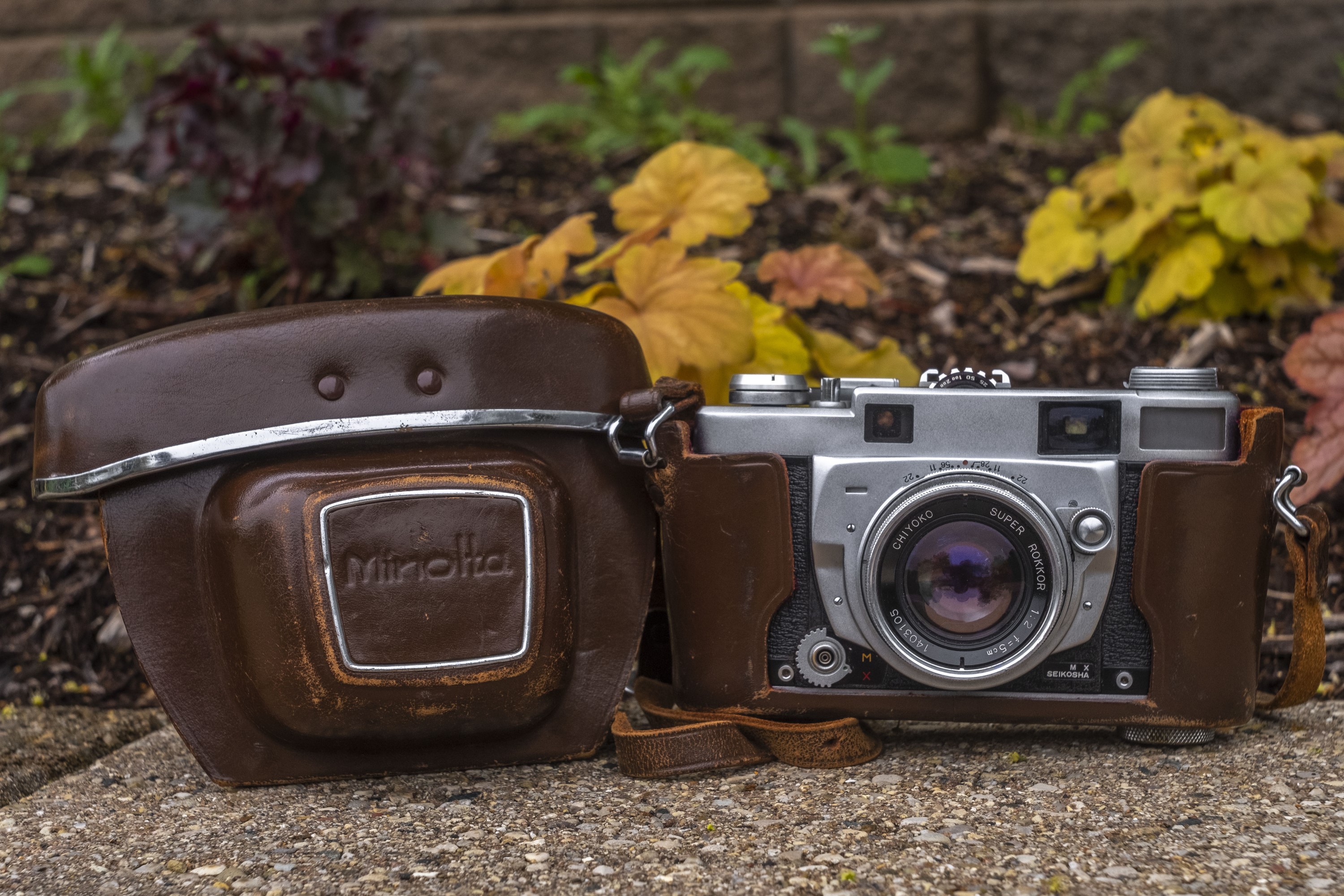
This is a Minolta 35 Model IIB, a 35mm rangefinder camera produced by Chiyoda Kōgaku in Tokyo, Japan in 1958. The Model IIB was the last model in the Minolta 35 series of interchangeable lens rangefinder cameras, dating back to the original model from 1947. Despite being Minolta’s last hurrah for interchangeable lens rangefinders, they improved quite a bit from earlier models in the series. The Model IIB was the first to have a rapid advance lever, viewfinder magnification increased to 0.8x improving accuracy of the rangefinder and it came with a number of cosmetic changes. One final change was a new standard lens was developed for it, a 6-element in 5-groups Super Rokkor 5cm f/1.8 lens. For those still in the market for this style of camera, the Minolta 35 Model IIB was quite an appealing camera.

Film Type: 135 (35mm)
Lens: 5cm f/1.8 Minolta Super Rokkor coated 6-elements in 5-groups
Lens Mount: 39mm Leica Thread Mount
Focus: 3.3 feet to Infinity
Viewfinder: Coincident Image Coupled Rangefinder, 0.8x Magnification
Shutter: Cloth Focal Plane
Speeds: T, B, 1 – 1/500 seconds
Exposure Meter: None
Battery: None
Flash Mount: Cold shoe and PC Flash Sync
Weight: 852 grams, 596 grams (body only)
Manual (similar model): https://www.cameramanuals.org/minolta_pdf/minolta-35_color.pdf
When you think of the most common Japanese Leica Thread Mount copies of the 20th century, there are a lot of options. Companies like Canon, Nicca, Leotax, Tanack and others had their earliest successes making copies of the Leica II and III rangefinder.
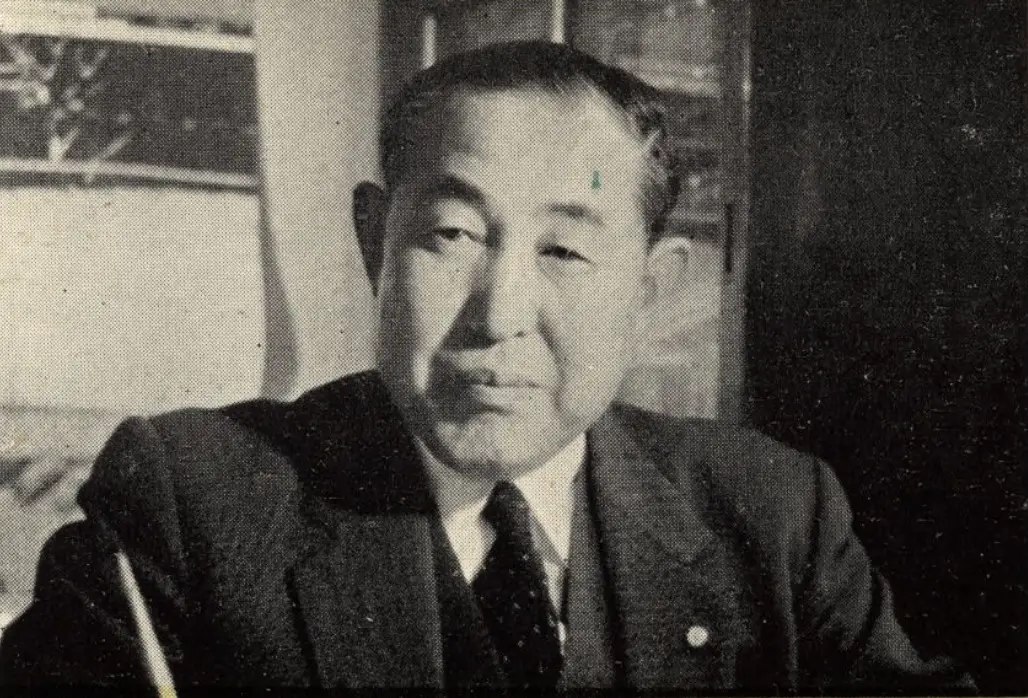
One company that few people would likely associate as making a Leica copy was Minolta, or as they were then called, Chiyoda Kogaku. This is interesting because the man who formed Chiyoda Kogaku, Kazuo Tashima, was infatuated with German camera design so much, that he hired two German technicians to help him build his earliest cameras. The first Minolta cameras were heavily influenced by German models like the Plaubel Makina and the Zeiss-Ikon Ikonta and Icarettes. In 1937, Minolta would launch the Minoltaflex, essentially a copy of Franke & Heidecke’s Rolleicord. The Minoltacord would evolve into the Minolta Autocord, which borrowed (and improved) heavily from the Rolleiflex.
So, with Minolta’s heavy influence of German camera companies, it should be no surprise to know that at one time they did have a Leica-inspired camera which was then called the Minolta 35.
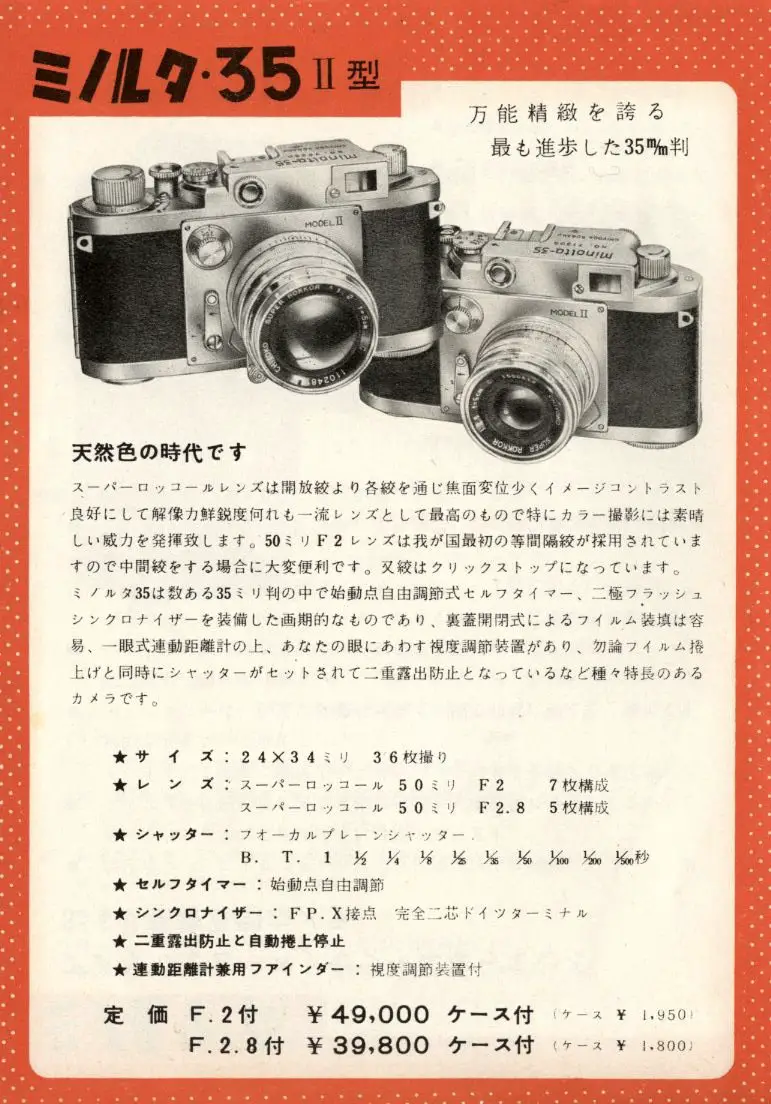
Although Kazuo Tashima clearly had no problem releasing Minolta cameras that were heavily based off German design, he was consistent in that no Minolta camera would ever be an exact copy. Any new camera to bear the Minolta name should improve upon the original model and be unique in its own way. It is perhaps this reason that the Minolta 35 is often left off the list of Leica copy cameras as it was quite different from the very beginning.
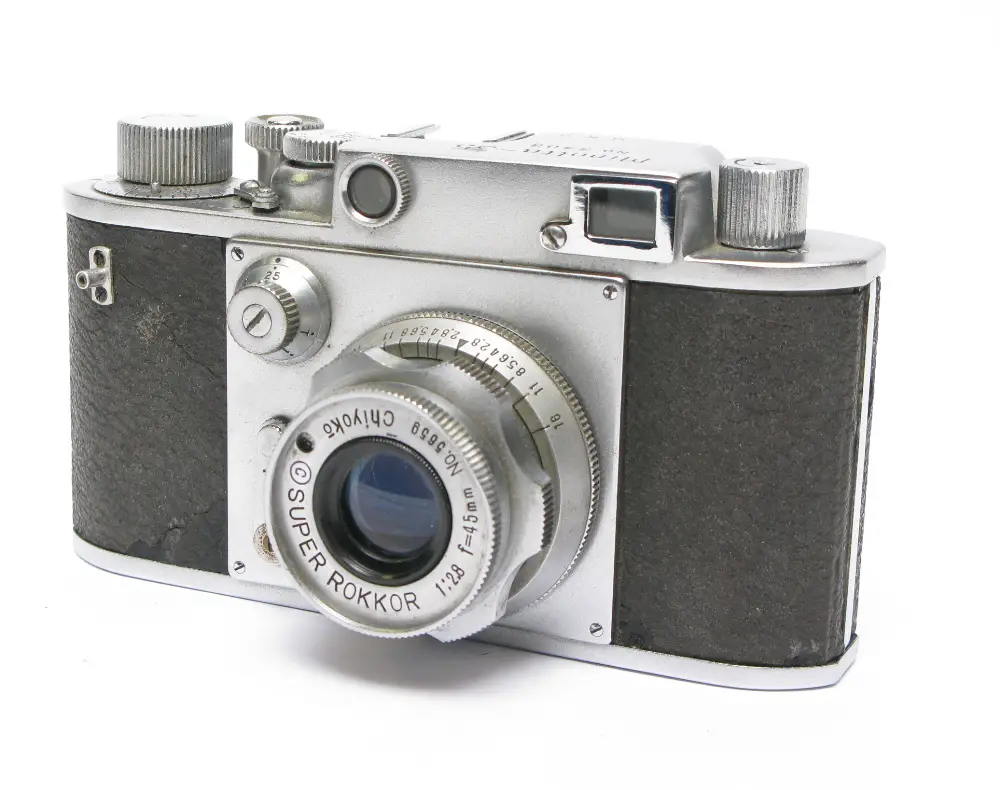
First released in 1947, the Minolta 35 had a combined coincident image rangefinder, self-timer, hinged rear film door, an integral film take up spool, and most significantly, shot 24x32mm exposures, which at the time was a standard in Japan and would yield four extra exposures on a single 36-exposure film cassette. It came standard with a very good Super Rokkor 45mm f/2.8 that was said to be superior to the Leitz Elmar found on many Leicas, yet it supported every German and Japanese lens made for the original Leica.
The Minolta 35 was one of the first Japanese made cameras to see success outside of Japan after the war. Although Nippon Kogaku would release their first Nikon rangefinder in 1948 and Canon had been producing their Leica copies since the mid 30s, it was Tashima’s knowledge of the German camera industry and the contacts he had developed which allowed his cameras to get a bit more exposure.
Chiyoda Kogaku produced the Minolta 35 from 1947 to 1958 and in that time changed the camera at least eight times (nine if you count which lens it came standard with). The camera-wiki page for the Minolta 35 does a good job of detailing the differences, taking its information largely from Sugiyama’s “The Collector’s Guide to Japanese Cameras”, so I won’t re-explain all of the changes, but here is a short summary:
- Minolta 35 (models a through d) – Each of these first four variants were sold as the Minolta 35 without any model numbers listed on the camera. Differences between these cameras are mostly cosmetic with the biggest physical changes being an incrementally increasing width to the film gate, first to 33mm, then to 34mm with the (d). A change to the rangefinder base length made the rangefinder more accurate, and strap lugs were added to the (d) also.
- Minolta 35 Models E and F – Released in 1951 and 1952 respectively, these are the first two models in which “Model E” and “Model F” are engraved into the front plate of the camera, differentiating them from previous models. Changes include the addition of a diopter adjustment, new flash sync plug, and on the Model F, the numbers 1, 2, and 3 next to the self-timer.
- Minolta 35 Model II – Released in 1955, the Model II coincided with three new Rokkor lenses available, plus a complete redesign of the film door release making the film compartment more secure. Two distinct versions of the Model II exist, with the biggest difference being in the shape of the top plate. The later version is more angular and has a different stepped plate under the shutter speed dial. Other cosmetic changes were made, but functionally, no differences.
- Minolta 35 Model IIB – Released in 1958, the Model IIB was the last interchangeable lens Minolta rangefinder but despite being at the end of the line, had a large number of changes, the most significant being a switch from a film advance knob to a lever. As with the release of the Model II, more lenses were introduced, including a new top of the line Super Rokkor 5cm f/1.8 lens which was standard on the camera.
The Model IIB is also the only model in the series in which the film gate is enlarged to shoot 24mm x 36mm images.Cosmetic changes include a black shutter speed dial plus black accents around the slow speed dial and exposure counter. The typeface used in the Minolta logo was updated to their new style, and the rewind knob was different.
24×36 or Not? While researching this review, several sources of information, including the Model IIB’s camera-wiki page all state that the Minolta 35 Model IIB was the first of the series to shoot full 24×36 images, and that’s how I initially wrote this review.

However, after seeing the results from my first roll of film, the spacing between each image was much larger than it should have been. I shoot a lot of cameras and many times, old cameras don’t always space images well. When this happens, the spacing can be erratic, with some images being farther apart from others. But when I see a camera where every image on the entire roll is evenly spaced incorrectly, that tells me the camera is doing it. After scanning in the images and seeing they clearly were not 36mm wide, I got out my super scientific wooden ruler and sure enough, each image was exactly 34.5mm wide, which accounted for the larger than usual gap between images. This was further confirmed after scanning in the negatives into Photoshop and upon using my normal crop settings, each image came out a little too narrow.
At the time Chiyoda Kogaku would have been designing the Minolta 35 Model IIB, the company would have also been hard at work on the company’s first 35mm SLR, the Minolta SR-2. Improvements to the shutter have led many to believe that some parts of the Model IIB’s shutter is shared by the SLR, including the curtain material.
By the time of the Model IIB’s release, consumer buying preferences had strongly shifted to SLRs. While the Model IIB saw a large number of improvements from the previous model, its release was greatly overshadowed by the SR-2 and led to this model being produced for only a year.
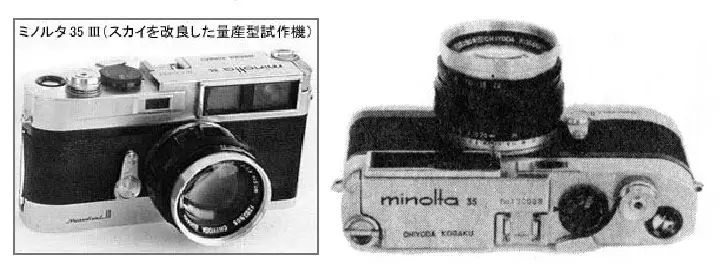
Around the time of the Model IIB’s release, an even more advanced model was in the works to be released as the Minolta 35 Model III, but it was scrapped before the camera was finished. Prototype versions of the unreleased Model III have been given the name Minolta SKY with SKY being an abbreviation for Shashin Kikai Yarikake which loosely translates to “photographic instrument in progress”. Had this camera made it to market, it would have probably competed with the Leica M3 with an all new bayonet lens mount, improved viewfinder with projected frame lines, and new f/1.4 lenses.
Despite ending production of the Minolta 35 series at the end of the 1950s, the company did not give up on rangefinders as their more consumer friendly Minolta A-series, Hi-Matic and Uniomat rangefinders would start production in 1955 and continue to be produced for at least another decade. A short lived leaf shutter interchangeable lens model called the Minolta Super A was produced in 1957, and the company even returned to interchangeable lens rangefinders with the Minolta CL and CLE cameras, produced in cooperation with Ernst Leitz Germany in the 1970s.
Production numbers are not well documented for Minolta 35 cameras, so it is difficult to get a sense for how well they sold or how they were marketed. That the series was produced for over a decade with regular updates suggests they were popular models, but by the time the Model IIB came out, the writing was on the wall for the series. In my research for this article, I could find absolutely no ads or contemporary reviews of the Model IIB. Even in some old back issues of Camerart magazine from 1958 to 1959 the camera is not mentioned, nor do any advertisements appear in any of the bookmarked vintage camera ad websites I regularly visit.
While writing this article, using a very unscientific eBay search of Minolta 35 models for sale all over the world, a total of 38 matches for Minolta 35 Model IIs were found, and of those 38, only five were the model IIB and they were all being offered by Japanese sellers. If this ratio is even close to accurate, this suggests that approximately eight times as many Model IIs were made than Model IIBs. Furthermore, that I found no reference to the Model IIB in any American publications of the era, suggests that the model may have been offered for sale in Japan only. If anyone reading this has any information to support or disprove this, please let me know. Had the camera been offered in the United States, it likely would have been sold for slightly less than an equivalent Leica IIIg from the same era which I am not even going to speculate on what that could have been.
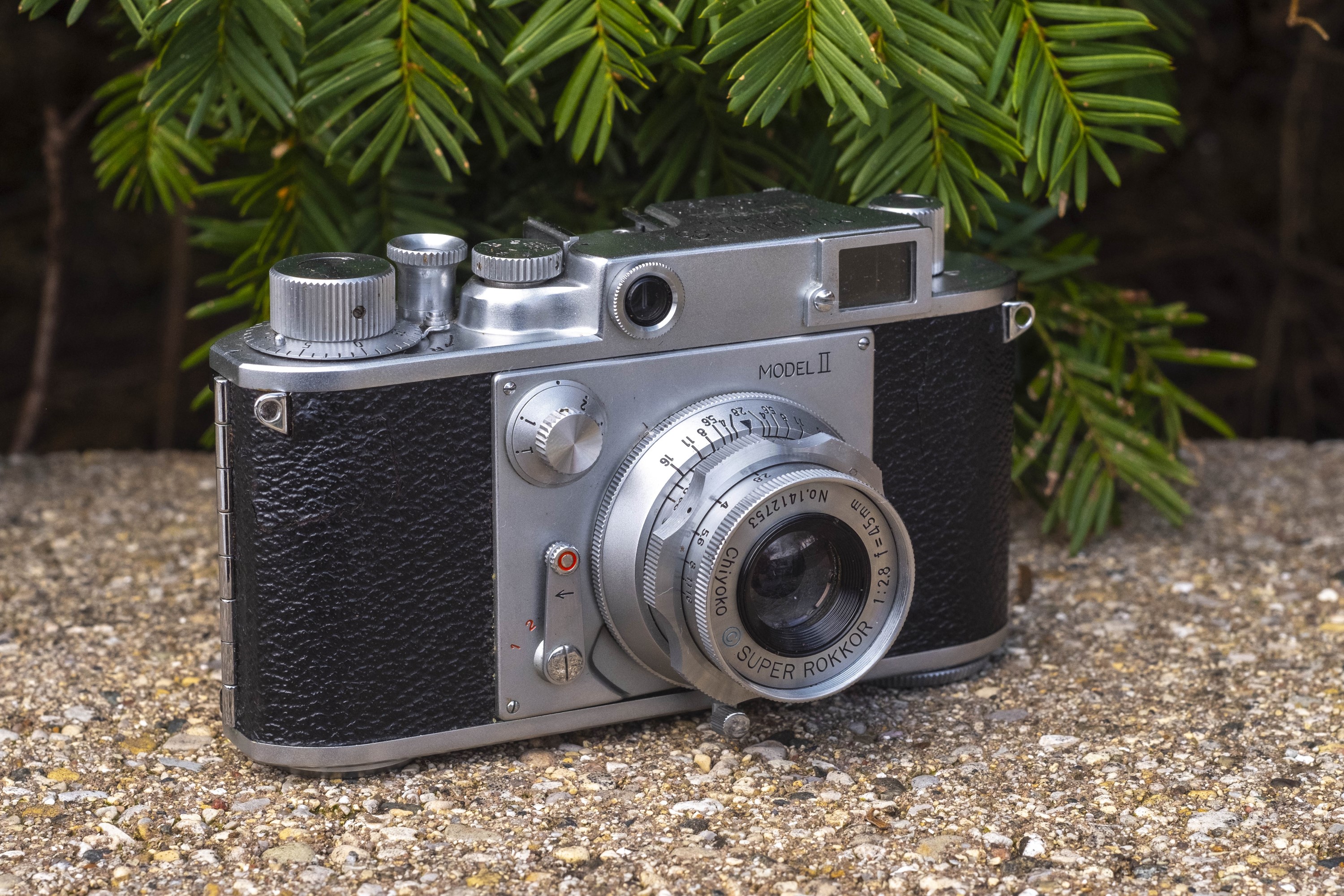
I reviewed a Minolta 35 Model II as part of my Cameras of the Dead series back in October 2018. As the name of the series implies, that camera didn’t work. In the years since, I have passively wanted to try a working Minolta 35, but strangely, these cameras seem to have a higher failure rate than most LTM rangefinders. Issues with the shutter are extremely common with these cameras. I once read somewhere that the material used in the shutter curtains themselves was at fault as the rubber coating becomes brittle and flakes off, jamming the shutter and causing light leaks.
I had nearly given up on ever finding a working Minolta 35 when one day I came across one for sale from my second favorite eBay seller, Roberts Camera in Indianapolis, Indiana. Not only did they have a really nice condition camera with what looked to be a working shutter, but the model was the uncommon Model IIB with a nice looking Super Rokkor 5cm f/1.8 lens. The price wasn’t cheap but since Robert’s labeled the camera AS/IS with a faulty rangefinder, the bidding stayed low.

Upon its arrival, I was elated to see that the Model IIB and Super Rokkor lens were both in excellent condition. Aside from a small amount of oxidation in the chrome, the body was perfect, the lens was clear with no haze, fungus, and only very minor cleaning marks, and strangely, the rangefinder which was supposedly not working, was clear and accurate at all distances. I have no idea what the appraisers at Roberts saw in this camera, but I took the risk and got a perfectly working camera.
Comparing the Minolta 35 Model IIB to other 1950s rangefinders, the build quality is superb. The camera is very dense with a great feel to all of its controls moving with just the right amount of resistance to feel purposeful but not loose. With the Super Rokkor lens mounted, the body and lens tip the scales at 852 grams, which is about 75 grams heavier than an Asahi Pentax and 50mm f/2 Takumar lens from the same period.

The Minolta 35 Model IIB is a very different camera than a comparable Leica III, but still shares enough design language as that camera to not feel foreign to someone whose is picking one up for the first time. Up top, most of the camera’s controls are exactly where you expect them to be, with the most obvious difference being the film advance lever instead of a knob. For a camera released in 1958, it is a tad bit disappointing to not see a handle on the rewind knob, nor a top 1/1000 shutter speed. The sequence of shutter speeds still follow the older, non mathematical sequence. Speeds like 1/35, 1/50, and 1/100 are still present instead of 1/30, 1/60, and 1/125 like you’d expect on a modern camera.

Around back, a round eyepiece is in the upper left corner. The Minolta 35 Model IIB uses a combined viewfinder and rangefinder, so there is only one window, and while it is larger than the original Leica’s it is not as big as other similar cameras by other companies like Canon or Yashica. Also, the flash sync port is in the center of the top back, below the accessory shoe.

The base of the camera has a 1/4″ tripod socket on a small platform on one side which allows the camera to sit level on a flat surface. The opposite site has the very large film compartment lock, which was changed on the earlier Model II. This style of lock is one of the easiest I’ve found on any camera and a design I wish more companies used because not only does the Open position release the lock, it actually pops the door open, making it very simple to access the film compartment.

Loading film is extremely convenient too, with a large circular door lock on the bottom of the camera which simply has to be turned a red Open position to unlock the door. With the right hinged door open, the film leader attaches to an integral take up spool with a metal clip to hold it in place. I would have preferred a multi-slotted design, but the metal clip works good enough. Once your film is loaded and the door closed, the latch is secured with a satisfying click as you turn the large knob on the base of the camera to the blue Shut position. The Minolta 35 Model IIB predates the use of light seal material, so there will be no degraded foam strips that need to be replaced. A side note about the film compartment is that due to the tall top plate, the film gate looks unusually small compared to the rest of the film compartment, but that’s just an illusion.

The Super Rokkor 5cm f/1.8 lens was all new for the Model IIB and has updated cosmetics including a thick black focus ring, focus scale, and aperture ring. With the aperture ring easily located near the front of the lens and the very thick focus ring, this Super Rokkor is one of the easiest to use LTM rangefinder lenses I’ve ever handled and something I would strongly consider using on other LTM cameras.
Only the front filter ring and depth of field scale near the back of the lens are in chrome. The aperture ring has click stops from f/1.8 to a small f/22 which is unusual to see on a rangefinder lens from the era as most stopped at f/16 and sometimes even f/11. The Super Rokkor lens on this camera is a joy to use, is optically excellent, and quite frankly looks gorgeous mounted to the camera. If I didn’t already have so many other equally excellent lenses for my other LTM rangefinders, I could see myself transplanting this lens on other bodies to shoot with it.

Up front, there’s not many surprises as the standard LTM lens mount works as you’d expect, lefty loosey, righty tighty. The rangefinder coupling is a wheel like on real Leicas and other quality Japanese copies. Slow shutter speeds are chosen using a separate knob with speeds from 1 to 1/25 plus T. The only confusing thing is the self-timer lever which has etched numbers 1 through 3 in red behind it. A full motion of the self-timer lever produces a delay of about 8 seconds. According to the manual, you can shorten this to around 4 seconds by only half pressing the self-timer, but it doesn’t really explain what the numbers mean.

The viewfinder in the Minolta 23 Model IIB is a mix of good and disappointing. For the good, it is sufficiently large to be usable for people with prescription glasses, and it features a tinted rangefinder patch in the center which has good contrast over the rest of the viewfinder, making it easy to use in all but the worst light. The not so good is that for a camera released in 1958, it was lacking in features that had become common with other brands such Canon’s rotating viewfinder prism offering multiple focal lengths first released with the IIB in 1949 and Leitz’s larger viewfinder with projected frame lines first offered in the M3 from 1953. Perhaps comparing the Minolta to Leitz and Canon’s cameras isn’t exactly fair, for a company who regularly competed with German designs and prided themselves in innovative features, the “vanilla” viewfinder (for 1958) on the Model IIB seems like a bit of a disappointment.

The Minolta 35 Model IIB is a mixed bag of good looks, great build quality, and an outstanding lens, but it also falls behind the competition in several areas, including the top 1/500 shutter speed, basic viewfinder, and lack of any features that would have allowed it to stand out from the competition. Minolta was a pioneer with their other cameras such as the Minolta Autocord TLRs and their soon to be released SLR series, so I am uncertain if the lack of innovation in their LTM rangefinders was due to lack of vision, or that by the time the Model IIB was in development, the company had already committed to SLRs.
It was time for me to test the Minolta, so I loaded in a roll of recently expired Kodak Ektar 100. Although not fresh, I’ve had luck with this film so my hopes were that I’d get a roll of vibrant and properly exposed images at box speed. After shooting that first roll, I quickly reloaded the camera with a roll of Kodak BW400CN black and white film.


Once again, I’ll be a broken record here and state that when it comes to interchangeable lens cameras made by A-list companies, my comments are less about the results and more about the experience of using a camera.
Minolta was a very capable lens maker and the Super Rokkor 5cm f/1.8 lens is as good as any that were ever made. Every image I shot was extremely sharp across the frame, with excellent contrast, excellent colors, and none of the optical deficiencies often associated with lesser lenses. There was no vignetting, no softness near the edges, no strange out of focus details, quite simply, these images are as perfect as you’ll see on a LTM rangefinder. As of the writing of this review, I haven’t yet tried this lens on a digital camera, but I definitely plan on it someday as I am sure it will compare favorably to the best lenses ever made.
Earlier in this review I commented that other sources online for the Minolta 35 Model IIB claim this to be the first of the Minolta 35 series to shoot full size 24mm x 36mm images, but after developing both rolls of film, I found this to not be the case. The frame spacing between every image was consistently wider than it should have been. Images did not span a full 8 perforations, and upon measuring the width of each image, I found them to be 34.5mm wide. Here is a full scan of a strip of film to show how the negatives look:

The first time I handled the Minolta 35 Model IIB, I was convinced this could be the pinnacle of Leica Thread Mount interchangeable lens 35mm rangefinders. Sure, I had shot many genuine Leicas, Canons, Niccas, Leotaxes, and other Soviet cameras, but I really felt Chiyoda Kogaku had hit a homerun with this model, after all, the camera is freaking gorgeous and it has an awesome lens, so it has to be great, right?

After making it through a roll and having more time to reflect on the camera’s usage, I can’t say I came away as enamored as I thought I would be. To be clear, the Minolta 35 Model IIB is a very good camera and offers several useful features over earlier cameras of this type. The film advance lever is nice, having a hinged film door is more convenient than having to bottom load film, I like the way the door locks and unlocks, all but eliminating accidentally opening the film compartment with film in the camera, and the 5cm f/1.8 Super Rokkor lens might be the most beautiful LTM lens I’ve ever used, however the camera clearly has some deficiencies.

I didn’t love the viewfinder. It was neither larger, brighter, nor more useful than ones offered by other Japanese companies and with Canon’s use of a rotating prism to change focal lengths, it simply falls behind what others were doing at the time. The lack of a 1/1000 shutter speed really isn’t a big deal to me as I rarely shoot any camera at its maximum speed, but the lack of the option to do it feels like a missed opportunity. Finally, that this camera offers nothing that allows it to stand apart from dozens of competing models left me, and I suspect customers from 1958, underwhelmed.

Certainly the Minolta 35 series was popular as it was made for over a decade, and Minolta definitely saw value in rangefinders as they continued to make fixed lens ones for more than a decade after this model, but I can’t help shake the feeling that their heart wasn’t into this one. Even though the era of SLR supremacy was already upon them by the time this model came out, there was still “meat on the bone” in ways they could have made this camera better, yet they didn’t.

Why is this? I’m sure it comes down to money. My best guesses is that the company was so focused on SLRs, that whoever their A-team of designers and engineers was, probably weren’t available to continue advancing a dead end system. Perhaps there was an issue of their capacity to continue building more advanced models. After all, this was the same reason that Nippon Kogaku stopped advancing Nikon rangefinders after the SP, because the company was all-in on the upcoming Nikon F.
Whatever the reason, the Minolta 35 Model IIB is left as a curious footnote to Chiyoda Kogaku’s excellent line of interchangeable lens rangefinders. It is a good camera with great build quality, excellent lenses, and some improvements over the original formula, but falls short of being a truly excellent camera. Whether that is enough for you to add one to your collection is up to you, but if you do, at the very least, it is not a bad camera, and if you shoot it, you’re going to be very happy with your images.
Related Posts You Might Enjoy
External Links
https://camera-wiki.org/wiki/Minolta_35#Minolta_35_Model_IIB
https://earthsunfilm.com/vmlp-34-the-minolta-35-iib-inspired-by-leica-and-very-nice/
https://www.collection-appareils.fr/x/html/appareil-4256.html
https://corsopolaris.net/supercameras/MinoltaRF/minolta35.html
Dang, that’s a pretty camera. Shame that it came up a bit short in the usage.
Great review Mike! I absolutely agree, the Super Rokkor 50mm 1.8 is a great lens. I was shocked by its sharpness. These lenses are not cheap, but they do deliver.
The 1/500 top shutter speed I expected to be limiting. However, the latitude of film makes it a minor issue. For example, HP5+ shot two stops overexposed looks great.
I wonder if it was due to the scrapped Minolta Sky not coming out they just kept it as is with minimal updates.
The earlier models stack up well to their competition especially a late 40s era to early 50s Minolta 35 with the film door, and fixed film spool. But does feel outdated by the mid to late 50s post Leica M3 introduction.
Im still pretty happy with my model IIa, just need to get the shutter capping fixed on 1/500 or run low speed film
A great review as always Mike. I think I concur with your evaluation. It’s a very nice camera in comparison to the many other Leica copies out there, especially the easy film loading back door, but I’ll never understand why they didn’t do a 24×36 frame opening, as this had become the standard in the middle 50’s. I bought a IIB many years ago when they were extremely hard to find in the US as most were still Japan and paid quite handsomely for it. I had a number of earlier Minolta 35 rangefinders and assumed as was always written, this model had the standard frame size, but did the same after shooting, measuring the film gate and thinking something was wrong! Not as if this was the end of the world, but I didn’t find any difference as compared to the earlier E, F and Model II, ones I had. The camera was quite appealing with the black accents, but again, was pretty 67 (if I can use this ….) I also have the 5cm/F1.8 Rokkor and again agree, this is about as good as it gets for LTM lenses. I am particularly fond of my Leotaxs’ and their Topcon lenses and recently have been exploring the Tanack range of cameras. Again, the Tanar lenses are somewhat rare but I will say are very competitive vs anything else out there from Japan or may I also say Germany…. To the point, I wish Minolta had continued the Sky development as this camera’s features could have been the real competition to Leica M3 and M2’s, and could have been seen as the ultimate RF camera ever built, especially if they had released it with the planned 5CM/F1.4 Rokkor. Again, we’ll just have to live with the F1.8 version… which ain’t bad!
Gary, check out Jay Javier’s reply in this thread, he explains that rather than copy the Leica shutter design, they copied the Exakta design which has twice as many rollers and is a much tighter fit, possibly explaining why a full 36mm wide image was impossible. Now if someone could just edit the camera-wiki article to correct their mistake!
I have three of the II/IIa and two of the IIB. All except the second IIB came with broken shutters. I had to repair the shutters of 4 of them. The shutters have plenty in common with the shutter of an Exakta and very little with the Leica derived shutters. Four poles instead the two plus concentric drum found in Leica style shutters.
Minolta put the Exakta style mechanism in what’s supposed to be a Leica-sized package. This caused odd assemblies where one would find screws with filed heads. Or the shutter channel with rollers so tight that a slightly thicker cloth can get in the way of the self timer releasing arm and cause the shutter the stick.
Minolta apparently built their SR from ground up, without using their RF as a starting point. The shutter in their SR SLR cameras also had the four-pole shutter, but this didn’t have the same mechanism for controlling speeds as the one they had in the M-35IIa and IIb. This type of shutter appears to have been used in Japanese SLRs of the 60s which did not use the Copal Square.
Many references also say that the Minolta IIB already had the 24X36 format. But it didn’t. It retained the 24×34 frame size but with wider spacing as what NK did with the Nikon S. I has assumed too that it will have plenty in common with the Minolta SR2 or SR1 (these SLRs had came out when the Minolta-35 were still around). Apparently not. The SLRs shared little with the 35s- I would say that the leatherette trim and the shutter cloth were the only ones that these two Minolta types shared.