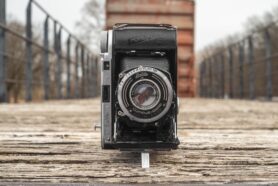
The Balda Super Pontura is a premium folding medium format rangefinder camera made by Balda-Werk in Dresden between 1938 and 1939, produced only briefly before World War II redirected German camera factories toward war production. As Balda's flagship model, it featured a coupled split-image rangefinder with (supposedly) automatic parallax correction, a top-plate shutter release, a brushed metal top plate, leather covering and bellows, and the ability to shoot both 6x9cm and 4.5x6cm images via a removable mask. Contrary to its name, there was never a standard "Pontura"—the "Super" designation simply denoted rangefinder-equipped models, consistent with naming conventions used by other German makers of the era. It's uncertain whether the camera was sold in the US, though export-style features like a 1/4" tripod socket and English depth-of-field chart hint it may have been.
The author's example, part of the Kurt Ingham collection, arrived with a damaged shutter that required a donor Compur-Rapid replacement (with the original Balda nameplate retained) and a full CLA by repair tech Alan Wade. Key specs include a 10.5cm f/4.5 Schneider-Kreuznach Radionar lens, Compur-Rapid shutter (1–1/400, T, B), focus range of 4 feet to infinity, and no meter, flash sync, or battery dependency. Standout design details include a uniquely wide gap (~9cm) between the viewfinder and rangefinder windows, a door-mounted curved focusing lever operated by the right index finger (which moves the entire lens/bellows assembly rather than the lens elements), and hinged spool holders for easier film loading. The author could not determine how the claimed automatic parallax correction actually functioned, despite research. Shooting tests with expired Kentmere 400 and Ektacolor 160 film showed the Radionar triplet delivered good sharpness, with mild softness and vignetting in the corners of 6x9 shots that disappeared in the cropped 4.5x6 frame.
Overall, the author found the Super Pontura a well-built, enjoyable shooter—particularly praising the door-mounted focus lever and top-plate shutter button, which made it feel nearly point-and-shoot for a prewar folder. Downsides were minor and typical of the folding camera genre (bellows care, manual cocking, awkward film loading) aside from the unusually wide rangefinder/viewfinder separation. The verdict is that while uncommon, the Super Pontura doesn't dramatically outshine comparable 6x9 folders of its time except for its novel focusing mechanism, making it most appealing to collectors and completists rather than an essential upgrade for those who already own similar cameras.
AI-generated summary. May not capture every detail — read the full article below for the complete picture.
This is a Super Pontura, a folding medium format rangefinder camera produced by Balda-Werk Dresden in Dresden, Germany between the years 1938 and 1939. The Super Pontura was a top of the line camera with features like a coupled split image rangefinder with automatic parallax correction, a top plate shutter release, premium lenses, and using a mask, the ability to shoot both 6cm x 9cm images and 4.5cm x 6cm images. The Super Pontura has a good build quality and is has a brushed metal top plate and all metal body with leather covering and leather bellows. One final feature is that the lens automatically retracts to the infinity location when closing the camera, eliminating the possibility of bending the struts with the lens set to a shorter distance.

Film Type: 120 Roll Film (eight 6cm x 9cm or sixteen 4.5cm x 6cm exposures per roll)
Lens: 10.5cm f/4.5 Schneider-Kreuznach Radionar uncoated 3-elements in 3-groups
Focus: 4 feet to Infinity
Viewfinder: Split Image Coupled Rangefinder
Shutter: Compur Rapid Leaf
Speeds: T, B, 1 – 1/400 seconds
Exposure Meter: None
Battery: None
Flash Mount: None
Weight: 782 grams
Manual: http://www.cameramanuals.org/minolta_pdf/minolta_autowide.pdf
In 1897, a German mechanic named Max Baldeweg moved to Dresden to seek work in one of the many industrial companies in that area. After a couple of years, Baldeweg had developed an interest in photography and in November 1908 opened his own company which produced and sold a variety of photographic accessories such as vignetting machines, film pack cassettes, and photographic blinds. Baldeweg’s earliest products weren’t marketed with names and were sort of like an early “white label” distributor.

Baldeweg’s company was quite successful and by 1912 opened a second factory and changed the name of his company to Fabrik Photografischer Artikel Max Baldeweg. Around that same time, Baldeweg started using the “Balda” trademark on several of his products, and the very next year changed the entire name of his company to Balda-Werk Max Baldeweg.
Over the next decade, Balda-Werk expanded its business, producing a large number of products in support of the photographic industry, but it wasn’t until 1925 that the company produced it’s first commercial camera, a simple box camera called the Balda Box. Later Balda cameras grew in complexity and quality. Soon folding cameras with innovative features like rangefinders, helical focus, and coming with top tier German lenses and shutters became available.
One such camera made its debut in 1938, a premium 6×9 folding camera called the Super Pontura, it featured a coupled rangefinder, the availability of premium Zeiss and Schneider lenses and had a clever focusing rack in the folding bed which moved the entire front standard forward and back, using a curved lever on the outside of the door.

Contrary to the camera’s name, there was never a regular Pontura, the use of the word “Super” at the time was consistent with some other German camera makers which that word was used to describe cameras with a rangefinder (Zeiss-Ikon Super Ikonta, Certo Super Sport Dolly, AGFA Super Isolette, etc). The closest camera to the Super Pontura in Balda’s lineup was a similarly styled 6cm x 6cm camera called the Balda Baldaxette which had a nearly identical top plate with coupled rangefinder, and similarly high quality body and the availability of premium lenses.

The Super Pontura was only produced for a little over a year, but its short life likely had little to do with the camera’s merits, rather the commencement of World War II in late 1939. As was the case with a majority of the German camera industry, factories capable of building cameras were often repurposed to make things for the German war effort.
I am uncertain if the Balda Super Pontura was ever sold in the US, but my best guess is that this was a Europe only model. In a German language catalog to the left, the Super Pontura could be purchased with a 105mm f/4.5 Zeiss Tessar lens for 150 RM with the regular Compur shutter and 160 RM with the Compur-Rapid. Making a meaningful conversion from 1930s German Reichsmarks to modern day US dollars is pretty difficult to do but considering that Balda was a lesser known company than Zeiss-Ikon or Voigtländer were then, a good guess is that these would have sold for less than a Super Ikonta or Prominent 6×9.
After the war, Balda would not continue producing any of its prewar 6×9 camera, but instead would focus on less ambitious models like the Balda Baldinette folder. The company would continue throughout the 1950s as an inexpensive alternative to other East Germany camera makers, but would eventually be fully absorbed into the nationalized VEB Pentacon Dresden.
This Super Pontura was part of a collection of cameras previously owned by Kurt Ingham. When I went through the collection, a large number of folding cameras were set aside to be sorted later. Since it was such a large collection, I wanted to prioritize cameras that had a greater chance at being something significant.

Of course, that doesn’t mean that there weren’t any worthwhile folding cameras, its just that a lot of them weren’t. When I came across the box containing this Super Ponutra, I was immediately taken aback at its styling and build quality. This was a special camera, I could immediately tell.
Unfortunately, it didn’t work. Although externally, the camera was in great condition, the bellows appeared to be light tight and the lens looked good, the shutter was trashed. Looking through the lens, I could see at least one shutter blade had come off its track and was just floating around in there. Trying the fire the leaf shutter with a blade flopping around is only a recipe to further damage the camera, so I set it aside.
A year later, while looking for stuff to sent to get repaired, I sent off the Super Pontura to Alan Wade at Cameraworks and asked if he could repair the leaf shutter. He told me that the blades were too far gone, but was able to swap out the Compur Rapid shutter with that from a different camera, and even swapped the cosmetic name plate, to retain the Balda engraving. The replacement Compur-Rapid received a full CLA with old grease cleaned out and proper lubricants placed in the places where it was supposed to be. Alan was also able to get inside the top plate to calibrate the rangefinder and also clean out most of the haze in the viewfinder. It wasn’t perfect, but was significantly better than it was. When the camera was returned to me, I was elated at its condition and couldn’t wait to give it a go.

Looking at the Super Pontura, the camera’s chrome top plate, rangefinder window, and the chrome focus scale on the front door all stand out, giving the camera a look that separates it from just another 1930s folding camera. The top plate starts out with a large, knurled film advance knob which on rotates clockwise. Above and to the right of the knob is a small button for releasing the front door. On the far right of the top plate is a large domed shutter release button, which is in a very natural location for your right index finger when holding the camera in landscape orientation. For instances where the camera is to be shot vertically, it is also comfortably located for your right thumb while supporting the bottom of the camera. In between the shutter release and advance knob is a large and elegantly engraved “Super Pontura” logo. Four screws hold the plate to the camera.

The back of the camera has two eyepieces, one for the main viewfinder on the left and the other for the rangefinder on the far right. The distance between the two eyepieces is greater than on any other camera I’ve ever seen. In the middle of the door is a large depth of field chart for a 10.5cm lens. Although this particular Super Pontura has an f/4.5 lens, the depth of field table goes all the way up to f/3.8 suggesting this same plate was used on cameras with faster lenses. Finally, two red windows on the bottom of the door are used for film transport. The one in the bottom right corner is exclusively used when shooting 6×9 images, but the one in the middle is used along with the other one when shooting “half frame” 4.5×6 images. A slider between the two red windows open and closes a door which protects the two red windows from excessive light entering the film compartment.

Flip the camera over, and the base has only a 1/4″ tripod socket which I found interesting as most German cameras from this era had the larger 3/8″ socket. This, along with the English language depth of field table on the rear of the camera possibly suggest this particular camera was created for export to the United States or other English speaking European countries where the smaller sockets were more common.

With the camera in a vertical orientation, a leather strap acts as a handle for carrying the camera. Beneath the strap is a sliding lock which is used for opening the film compartment. On this specific camera, moving the lock was not difficult, but even with the lock loose, the door was still very tight to the body and required extra effort to open. The opposite side of the camera is the door hinge, and nothing else.

Releasing the latch allows you to swing open the right hinged door revealing the film compartment. Like most roll film cameras, film transports from right to left onto removable 120 spools. One of two things that stand the Super Pontura apart from just a regular 120 roll film camera is that each compartment for the take up and supply spools have a hinged film holder that swings out allowing you to put in a roll of film, set it properly, and then swing it back into the body of the camera. This makes loading film far easier than without it, but it also adds another layer of light protection inside the film compartment in case light were to leak in. The other change is the removable mask which is required to shoot half frame 4.5×6 images in the camera. The mask is made of very thin metal and simply rests in the film compartment blocking the areas of the 6×9 image which shouldn’t be exposed to light. As with all removable masks, these are often lost over the course of the camera’s life and are extremely hard to find still with the camera. If you had one of these cameras but were missing the mask, you could probably create one out of card stock or some other type of rigid material and sandwich it in there.

Turn the camera to face you in portrait orientation and you’ll see a pretty typical Compur-Rapid shutter. This one has the Balda name plate decoratively embossed near the top. If you remember earlier in this article, I had said that the original shutter was damaged, so I had one replaced, but the this front plate was reused so it would look original. This Compur-Rapid is a ring set design which means shutter speeds are selected using a ring around the perimeter of the shutter. Speeds from 1 – 1/400 plus T and B can be chosen. Like other Compur-Rapid shutters of this era, the T and B speeds do not require the shutter to be cocked, and will open and close using the shutter release with it uncocked. In fact, with the shutter in either position, you cannot activate the cocking lever, nor can you select these speeds with the shutter already cocked. If your camera behaves this way, it is not a defect, this is normal.

Also like shutters of this era, the Compur-Rapid has a delayed action (self-timer) feature which is not apparent to someone not familiar with it. To use the self-timer, you must press the cocking lever beyond the fully cocked position. Under normal operation, a small switch at the top of the shutter, behind the Balda logo, prevents you from accidentally activating the self-timer when cocking the shutter. If you want to do it, you must pull back on this switch to allow the cocking lever to go beyond the fully cocked position. Doing this engages a separate clockwork mechanism which delays the shutter by about 8 seconds.
Near the bottom of the shutter closest to the door is the aperture selector. A small pin that wraps around the front of the shutter face slides left and right pointing at various f/stops. On this example, the largest setting is f/3.8 which is impossible considering the lens on this camera is f/4.5 but otherwise goes down to as small as f/22. The final feature of this shutter is a threaded hole on the side of the shutter below the cocking lever which is for screwing in a cable release. This era of Compur-Rapid does not have any provision for flash sync.

A very unique feature of the Balda Super Pontura which I’ve not seen on any other camera is the door mounted focusing lever. The Super Pontura focuses not by rotating any parts of the lens, but rather than moving the entire bellows, shutter, and lens forward and aft a bit. Unlike other folding cameras which do this by moving a lever on the bed or rotating a dial on the side of the door, the Super Pontura has a curved lever on the outside of the folding door in easy reach of your right index finger, with the camera in landscape orientation. With the rangefinder window to your eye, you can easily focus the camera by pushing up or down on this lever until the two images align. In text, this likely seems pretty straightforward, but it is not until you have the camera in your hands and you can try it yourself, do you see how cool this is.
The Balda Super Pontura has separate viewfinder and rangefinder windows which is consistent with how cameras of this era worked, however something that isn’t consistent is how far apart the two windows are. The gap of nearly 9cm between the centerline of both windows could possibly be a record for any rangefinder camera I’ve ever handled. The viewfinder itself is a straight through optical design with two vertical lines which frame 4.5cm x 6cm images. I could not find a way to make the masks go away for shooting 6cm x 9cm images.

The rangefinder is of a split image design, with the top half clear and the bottom half yellow. Focusing the lens only moves the top half. Like all rangefinders, proper focus distance is achieved when any vertical edge is aligned between the two halves of the image. The Balda Super Pontura claims to have an automatic parallax correction feature which I was unable to understand how it works. Inside the top rangefinder window is a curved, red transparent piece of plastic with a notch in the middle. This piece moves with the rangefinder window as you focus the lens, but doesn’t appear to do anything else. On a normal camera with automatic parallax correction, the rangefinder window should tilt in the direction of the taking lens when focusing close up, but I cannot see this happening when I focus to the minimum distance. It is possible that after nearly 90 years of age, this feature isn’t working, or perhaps I just don’t understand how it works (both are very likely). In my research for this review, I was unable to find a user manual for the camera, so if anyone knows better, please let me know in the comments section below.
After receiving the Super Pontura back from Alan, I was eager to test it out, but winter was fast approaching and I knew if I was going to get anything resembling decent shots, I’d have to load in some faster black and white film, so for that, I chose a semi-expired roll of Kentmere 400 that I had bought at some point and forgot about in the back of the fridge.


After going through the first roll in a single day, I felt like I was on a roll so I loaded in a roll of expired Kodak Ektacolor 160 and put into place the 4.5cm x 6cm mask in the film compartment so I could expose that roll using the smaller print size.


Looking back at these two rolls, my half frame color roll had a lot more mistakes on it and out of focus images, suggesting that I didn’t put as much thought with the second roll, which I suppose is how someone who is intentionally going to halve the image area of a 6×9 camera to get a more economical 16 exposures from a roll would shoot it.
Whether or not I was putting forth my best effort at composing the images from these two rolls, it is clear that the Super Pontura was a camera up to the challenge of what I threw at it. The f/4.5 Radionar triplet performed admirably, delivering images with good sharpness across the frame. Softness and some mild vignetting is visible near the corners in the 6×9 images, but completely gone in the half fame images. For someone who primarily shot this camera with the half frame mask in, they likely were very pleased with the image quality of their 16 shots as they were all made in the best part of the Schneider’s coverage circle.
According to the German language catalog page earlier in this article, you could order the Super Pontura with an upgraded 4-element Zeiss Tessar, but based on what I can see here, I doubt you’d notice a different in images shot with that lens as the Radionar already does a great job.

The experience of shooting with the Balda Super Pontura is much like that of other folding 6×9 cameras in which there is a large amount of bellows exposed, and care must be taken not to poke it with your fingers or get it wet. Although the leather bellows on this camera were in good condition and had no obvious light leaks, there is a finite amount of times where animal skin can be folded and opened up again before it will fail, so special care must be taken when shooting the camera.

By far, the coolest feature of the camera was the door mounted focus lever, which falls in a very natural location for your right index finger. In addition, the presence of the top plate shutter release was also elegant as you can easily move your finger from focusing straight to firing the shutter. Assuming you were out shooting in consistent lighting where you didn’t need to make changes to the exposure, the Balda Super Pontura was as close to a point and shoot as you’ll ever get with a prewar folding 6×9 camera.
I didn’t love how far apart the rangefinder and viewfinder windows were, but otherwise, I didn’t have any cons that aren’t also there on other cameras of this type, such as awkward film loading, manual shutter cocking, and that in order to protect the bellows, you must fold and reopen the camera every time you want to use it.
The Balda Super Pontura is a pretty uncommon camera, but it was produced in an era where its style and list of features was common. If you already own several folding 6×9 cameras, beyond the very cool door mounted focusing arm and the automatic parallax correction feature which I couldn’t figure out how it worked, there is not a lot to differentiate this camera from what you already have. If you are a completist however, or just like the idea of owning a folding camera with a feature unlike others, then this is a GAS worthy addition to your collection.
Related Posts You Might Enjoy
External Links
https://camera-wiki.org/wiki/Super_Pontura
https://www.jnoir.eu/en/cameras/balda/super-pontura/
https://web.archive.org/web/20160328172624/http://www.cosmonet.org/camera/pontur_e.htm (Archived)
https://www.collection-appareils.fr/x/html/camera-20136-Balda_Super%20Pontura.html (in French)
The parallax correction in Balda folders works by tilting the viewfinder window as you focus closer. It’s hard to notice if you don’t know how it works since the shift is very gradual.
Thanks for the explanation MJ. I will have to dig out the Super Pontura and take another look and see if I can make it work.