
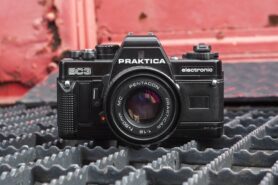
This is a Praktica BC3 electronic, a 35mm SLR camera made by VEB Pentacon Dresden in Dresden, East Germany between the years 1987 and 1988. It used the Praktica Bayonet mount, which was an all new bayonet mount used by B-series Prakticas in the 1980s and 1990s and had a lightweight composite body, making it very easy to handle and carry about. The BC3 electronic was a variant of the BC1 electronic and was released in different regions with only subtle cosmetic changes. Compared to earlier Prakticas, it was an advanced model with aperture priority automatic exposure and a stepless, electronically timed vertically traveling focal plane shutter.

Film Type: 135 (35mm)
Lens: 50mm f/1.8 Pentacon Prakticar MC coated 6-elements in 4-groups
Lens Mount: Praktica Bayonet Mount
Focus: 1.5 feet / 0.45 meters to Infinity (Variable Depending on Lens)
Viewfinder: Fixed SLR Pentaprism, 95% Field of View, LED Exposure Display
Shutter: Vertically Traveling Metal Focal Plane
Speeds (auto): 40 – 1/1000 seconds, step less
Speeds (manual): B, 1 – 1/1000 seconds
Exposure Meter: TTL Coupled Gallium Arsenide Phosphide Cell w/ Aperture Priority AE
Battery: 6v 4LR44 Silver Oxide Battery
Flash Mount: Hot shoe and MX Flash Sync, 1/90 X-Sync
Weight: 704 grams, 522 grams (body only)
Manual: https://www.cameramanuals.org/praktica_pdf/praktica_bc3.pdf
In the late 1970s, the East German Praktica SLR was one of the best selling SLR systems of all time. With production numbers starting with the very first KW Prakticas from 1949 through the end of the VEB Pentacon Praktica L-Series in the late 1970s, an estimated 6.3 million cameras were sold all over the world beating anything ever created by Zeiss, Leica, Nikon, or Canon.
 One of the keys to the Praktica’s success was its generally simple operation which not only kept the camera affordable but also reliable and easy to repair. Prakticas were cheap enough to be the first cameras for young photographers, but also good enough to be used by professionals looking for a simple SLR with an availability of good lenses. While a lot of positive things could be said about the Praktica, innovative was not one of them. During the model’s first three decade run, Praktica SLRs used the M42 screw mount which was originally developed by Zeiss-Ikon in the 1940s for its Contax SLR. While the M42 lens mount was simple, reliable, and a HUGE number of lenses were made for it, it didn’t work well for advanced features like automatic exposure, open aperture metering, or electronic control. Over the years, attempts were made to upgrade the M42 mount by adding electrical connections on the Praktica VLC series, or the dual aperture pins of M42 lenses made for the unrelated but similar Pentacon Super, but for the most part, M42 bodies and lenses were reserved for simpler cameras.
In the late 1970s, it was time for VEB Pentacon to make a change. As other companies like Asahi did with their Pentax SLR, VEB Pentacon created an all new bayonet lens mount which not only simplified mounting and dismounting lenses, but allowed for all of the modern features that previous Praktica cameras weren’t easily capable of. The new lens mount was simply called the Praktica Bayonet mount, or sometimes PB or even B-mount. The new mount had a large internal diameter of 48.5mm and a flange focal distance of 44.4mm ensuring support for faster and heavier lenses, but also supporting backwards compatibility with earlier M42 lenses.

In addition to using the new bayonet mount, new Praktica models featured an all new and more compact body built using composite materials, an electronically timed focal plane shutter, aperture priority automatic exposure, and an updated light condenser system which not only improved metering accuracy and viewfinder brightness.
The first camera to use the new Praktica Bayonet mount was called the Praktica B200 and it was released in December 1979. Featuring the entire suite of new features afforded by the new mount, the B200 was easily the most advanced 35mm SLR ever made in East Germany. In 1981, a simpler model called the B100 was released which eliminated the ability to manually select shutter speeds, limited the slowest automatic speed from 40 seconds down to 1 second, and removed the depth of field lever. Together, these two new models sold around 420,000 units.

In 1984, an updated model called the Praktica BC1 was released which shared the same features as the B200, but added improved computer flash control and came with a couple minor cosmetic changes. A few variations of the BC1 were also sold, some with a smooth leather-like body finish and others with a textured bumpy body covering. Name variants called the Praktica BCX, Praktica BC3, and Jenaflex AM-1 were also sold in various international markets. With approximately 315,000 units sold, the Praktica BC1 and its variants would end up being the best selling of all the Praktica BC and BX series cameras.

The Praktica BC1 was sold all over the world including the United States, but I struggled to find any advertisements, reviews, or promotional material showing how much it would have cost here. Using my typical resources, the best indicator for the camera’s street price was a back-of-magazine ad for Cambridge Photo in New York City from July 1985. In the ad, the Praktica BC1 (same as BC3) was sold with the 50mm f/1.8 Prakticar lens for $119.95. In that same ad, comparable aperture priority electronic shutter cameras like the Minolta X-570, Pentax ME Super, and Olympus OM-10 with comparable lenses sold for $184.95, $163.95, and $139.95 respectively, suggesting the Praktica was seen as an economic choice to these other Japanese brands.

VEB Pentacon would continue making the Praktica BC1 and BC3 until about 1988, and the last of the BC-series in 1990. Two new series of Praktica SLRs were to replace the BC-series, the first was the BX-series which debuted 1987 with a model called the BX20. Several models in this lineup were planned but only two were ever put into widescale production. A third series was planned to debut in 1995 called the BY-series, and had it ever made it to production would have been the first Praktica SLR to have Auto Focus, but it was never finished due the collapse of the East German government.
Today, most people who think of Praktica SLRs usually think of the more commonly found M42 screw mount models. Of all the different types of Prakticas, the L-series, produced from 1969 – 1989 was the most successful, with an estimated production of 4.8 million units. Despite being some of the newest and most feature rich models, people today rarely seek out the later B-series making them pretty good values in the used camera market. These cameras are new enough to still appeal to those who demand modern conveniences like auto exposure and cheap enough that you can afford to take a chance on an “As/Is Untested” model in case it doesn’t work.
I’ve handled and shot a large number of Praktica SLRs and despite their often crude East German reputation, I’ve often found them to be quite enjoyable cameras to use. Spec for spec, Prakticas rarely compare favorably to contemporary Japanese cameras, but they’re not difficult to use, and they almost always came with Zeiss or other excellent performing lenses, so even the most basic Praktica is capable of amazing images.

Millions of Prakticas were made by VEB Pentacon Dresden from the 1950s through the 1980s and for most of that time, every model used the venerable M42 thread mount, which wasn’t a bad thing, but it did limit how advanced the camera could become. Thread mount lenses are notoriously difficult to add features like open aperture metering, automatic exposure, and electronic communication between lens and body. Other companies, including VEB Pentacon eventually overcame these obstacles somewhat, but every time a company released an M42 SLR with one of these features, there was always some kind of compromise. The only way to truly incorporate modern features into an interchangeable lens SLR was to design it with a bayonet lens mount which as we know, near the very end of the 1970s, the first Prakticas with an all new bayonet lens mount were released.

I had never handled a Pentacon “B” camera, but had always wanted to. By the 1980s, production of Praktica cameras had dwindled as superior Japanese models were readily available in most European countries and in the United States, so there was far less demand, even for a more advanced Praktica.
This Praktica BC3 electronic came to me from the collection of Kurt Ingham and while I initially found it interesting, it took me a while to get around to shooting it. The feel of the camera is…OK. Clearly incorporating a lot of plastic and other composite materials in its construction, the camera does not have the reassuring heft of earlier all metal Prakticas or even composite Japanese cameras like the Canon A-1 or Minolta X-700. Other cost cutting measures such as a silkscreened EV compensation scale on the top of the camera, and a front facing Pentacon logo which almost always gets rubbed off, further suggest cost cutting measures.
I’ll stop short of calling the Pentacon BC3 electronic a cheap feeling camera as I’ve definitely felt worse (Zenit 212k, I’m looking at you), but it is definitely a step down from contemporary Japanese cameras. On the plus side, the body is covered in a type of soft vinyl that has a good amount of grip and when combined with the small right hand finger grip on the front of the camera, makes the Praktica BC3 electronic very comfortable to hold.


Up top, the controls are a bit dated for a camera released in 1987, but should appeal to someone who feels the pinnacle of camera design was 1977. From left to right there is the film rewind knob with folding handle and ASA film speed dial around it. Film speeds from 12 to 3200 can be chosen by pressing down on the ASA button and rotating the dial. A small handle to the right of the ASA dial is an EV compensation switch which has markings up to +/- 2EV. Changing this requires you to lift up on the entire film speed dial and rotating the handle. Above and to the right is a black button which functions both as an exposure lock and battery check.

Atop the prism is a standard flash hot shoe and to its right is the shutter speed dial. Full stop shutter speeds from 1 second to 1/1000 can be chosen, along with Bulb, a dedicated 1/90 X-sync speed, and a green “automatic” setting which puts the camera into aperture priority AE mode. In this mode, the camera’s meter can select step less speeds as slow as 40 seconds up to 1/1000. To the right of the shutter speed dial is a chrome cable threaded shutter release button with a shutter lock collar around it. Next is the film advance lever which requires a rather short 125 degrees to advance the film and set the shutter. Finally, on the very right is the automatic resetting exposure counter.

The base of the camera has a mechanical and two electrical connections for an optional Praktica B-motor drive. Next to it is the rewind release button, a centrally located 1/4″ tripod socket, the door for the 4LR44 battery compartment and the words “Made in German Democratic Republic” silkscreened into the plastic. A small rectangle behind the tripod socket does not appear to do anything and is not mentioned in the camera’s manual.

Around back is the rectangular eyepiece for the viewfinder which has grooves on the sides for some kind of viewfinder accessories. Beneath is on the door is a plastic box end film reminder and the camera’s serial number stamped into a piece of plastic near the right side of the door. Grooves in the vinyl body covering on the right side enhance grip while holding the camera.

Opening the film door is done by tugging up on the rewind knob. The right hinged film door reveals a surprisingly ordinary film compartment for a camera released in 1987. Like the top plate, the design of this part of the camera is straight out of the 1970s, with no support for DX coding, no quick or automatic film loading features, and no support for optional data backs. On the plus side, if you like simplicity, the Praktica BC3 electronic’s film compartment is refreshing to see as you really don’t need all of those other features. Simply insert a fresh cassette of film on the left, extend the leader across the film gate and into one of two slots on the integrated take up spool, wind the camera a couple of times and close the door. Foam light seals are present on the door hinge and in both door channels, but on this example had not yet degraded. Still, I would advise anyone wanting to shoot film in a 1980s SLR to check and replace the seals if necessary.

Looking down upon the top of the Prakticar lens, the focus ring is nearest the front and has markings in both feet and meters. Behind it is the aperture ring which had click stops from f/16 to f/1.8. Simple.

The biggest news when VEB Pentacon released the new Praktica B-series was a switch to the Praktica B-Mount from the tried and true M42 mount which all previous Prakticas used.
Changing lenses is done the same way as on any bayonet mount camera by pressing a lens release near the 8 o’clock position around the lens and giving the lens a twist. Installation is the opposite of removal and doing an entire lens swap on a bayonet camera is easily twice as fast as that of a thread mount.
Next to the mount, and above the lens release button is the electronic self-timer lever and a sliding depth of field preview button. This DOF button would also have been used for taking a meter reading when adapting M42 thread mount lenses using an adapter that was commonly available at the time. To the right of the lens mount is a blank rectangle which would have had an Ernemann tower logo on it, but on nearly every example of this camera I’ve seen online, is worn off.
The Praktica BC3 has a modern viewfinder for an East German Praktica, but that it was released in the auto focus era, has the look of something from the 1970s. Brightness and light distribution are quite good, allowing you to easily see your image in all but the worst light, but on the other hand, shutter speeds are printed in the visible image area like cameras from the 1970s, making them a bit hard to see. The Praktica BC3’s finder is a full information finder as it also shows aperture f/stops via a “judas window” at the bottom of the viewfinder. It doesn’t show up in the images below, but in good light, a small window lets you read the aperture f/stops from the lens through a tiny window. While it was normal to see judas windows and shutter speeds in the visible area on cameras released in the mid 1970s, in 1987, it would have felt dated. Neither good nor bad is the inclusion of a double split image focus aide that is angled at 45 degrees instead of horizontal like on many other cameras. The idea behind a diagonal split image is that you can just as easily use it with the camera in both portrait and landscape orientation, where as a horizontal one, works better only in landscape.


After spending some time with the Praktica BC3, I loaded in a fresh 4LR44 battery and took it out shooting. For the first roll of film, I chose a retail roll of Kodak TMax 100. Although I shoot a ton of TMax 100, it is usually from bulk rolls, I haven’t had as consistently good results from the retail rolls, so I had my fingers crossed that this roll would turn out okay.


If anyone had any doubts regarding the potential performance of the Praktica BC3, they should have not worried a bit about the performance of the Pentacon Prakticar lens. Although pictured with the f/2.4 version to the right, a majority of this review was shot with the f/1.8 version, and to my eyes, it compares favorably to any top tier German or Japanese lens maker. Images have excellent contrast and are razor sharp in the middle with only very subtle softening at the corners. I saw no vignetting near the corners, and although I only shot a single roll of black and white film, I feel confident that the performance of this lens, along with its deep blue and purple multi-coating, would have rendered colors accurately, with little to no chromatic aberrations, common to lesser lenses.

I quite liked the experience of shooting the Praktica BC3 as I found its ergonomics to be excellent. This is a compact and lightweight camera with every control exactly where my fingers expected them to be. The synthetic leather body covering (although peeling in one tiny corner) has a supple feel which improves grip, almost making it feel like real leather. The tiny finger grip on the front of the camera is ideally located for your right fingertips to allow for additional security while holding the camera, similar to cameras like the Canon A-1 and Nikon F3.
I neither loved nor hated the double diagonal split image focus aide in the viewfinder, as I didn’t think it offered me any additional assistance of a normal horizontal split image, but it was cool. I found the viewfinder to be competitively bright, although the in image shutter speeds felt a little outdated for a late 1980s camera. As a whole, I found very little to dislike about the camera other than some perceived cost cutting with the silk screened markings on the top plate and a feature set that was about a generation and a half behind the competition.

Throughout this review, I make several comments comparing the Praktica BC3 to contemporary Japanese cameras of the 1980s and while that makes for some good Internet debate, it is not really a fair comparison because although yes, the Praktica BC3 does not compare feature for feature with a Minolta X-700 or Nikon FA, but it was never designed to. East German cameras were rarely sold alongside premium Japanese models and even when they did, the Prakticas were sold for considerably less. Earlier in this review, I found retail prices showing the Praktica was cheaper than nearly every competing Japanese SLR with the same general specs. For someone with not a lot of money to spend, the Praktica BC1 or 3 offered a nice compromise of features and quality for not a lot of money and it is that type of camera that this should be compared to.
As an economically priced loss leader, the Praktica BC3 checks off all the boxes. It has a compact and lightweight body that is easy to hold, the control layout is very familiar to anyone who has ever shot a classic SLR, its got an accurate aperture priority automatic exposure metering system, and it comes with excellent lenses which produce images rivaling the best German and Japanese companies…all for under $120!
The Praktica BC3 never needed to be the best at anything other than value and when judged like that, this camera is a winner. I found the camera to be a joy to shoot, it was small enough I could fit it into my coat pocket, the viewfinder was as bright as anything from the era, the metering system was great, and the images were even better. I know these cameras aren’t the easiest to find in the United States today, and their all electronic operation brings into question long term reliability, but in working order, I definitely recommend this camera!
Related Posts You Might Enjoy
External Links
https://camera-wiki.org/wiki/Praktica_BC_3
http://www.praktica-collector.de/224_Praktica_BC3.htm
Interesting read, Mike. A Praktica was my first “serious” camera that I purchased from a friend’s dad when I was about 12 years old for $20. It still works perfectly and makes nice sharp images with its Zeiss Tessar lens. Here is a link to a picture of it on Flickr. https://flickr.com/photos/22888993@N03/23222814631/ Feel free to remove the link if you prefer to not have folks post them in the comments.
Never heard of the BC-3. I have a BC-1, early production example that still has the all-metal rewind crank and the body itself appears to be made entirely of metal as well. This is in contrast to my Praktica L which was among the first SLRs to have polycarbonate body panels, at a time when no Japanese maker was using them.
Dear Mike, you did a great job with your review and it is heartwarming to read your assessment coming from accross the pond. I was born in Czechoslovakia the year Neil Armstrong put his foot on the moon and for a teenager from behind the Iron Curtain, a modern Praktica electronic was the greatest gift you could find under the christmas tre. My grandfather saved a whole year to be able to give me this precious gift and I loved avery bit of it. Czechoslovakia had a film producing industry (the company Foma from Hradec Králové still exists today and produces OK BW film, e.g. like Ilford/Harman) and thus I spent hours on end in the darkroom developing my BW films and prints shot with my Praktica.
My Praktica ws stolen during a summer holiday in Yugoslavia in the late 1980s and I have missed it ever since. Nostalgia got the better of me during COVID … so I went looking online and found one on eBay. Holding the camera again in my hands after more than three decades was marvellous. I started shooting film with it again and developed my BW rolls … it works well and is just great nostalgia. I agree 100% with all what you wrote about the camera, there is a lot of history to its production and export from the GDR … in any case, back in Czechoslovakia this was one of the top products you could buy from neighbouring GDR, as western products were hard to come by and their prices were astronomical, given the inaccessibility of hard currency before 1989. In the 1980s my father had a Minolta XG-7 (from a Japanese colleague whom he worked with in Iraq at the time) and this was a a marvel of a camera in Czechoslovakia.
So were the times before 1989 … but the passion for photography was the same on both sides of the Iron curtain.