

The Mamiya 6, produced from 1989 to 1993, was a semi-professional medium format rangefinder camera notable for being the world's only interchangeable lens medium format rangefinder at the time of its release. Despite sharing a name with the earlier Mamiya Six folding cameras of the 1940s-50s, it was an entirely new design that emerged after Mamiya's 1984 bankruptcy pushed the company to refocus solely on professional medium format cameras, abandoning 35mm production. The camera used a collapsible bellows-style lens mount hidden inside a squared tube, supported three interchangeable lenses (50mm f/4, 75mm f/3.5, and 150mm f/4.5), and offered aperture priority auto-exposure, dual 120/220 film support, and automatic parallax-corrected frame lines in its viewfinder.
The author, who was drawn to the Mamiya 6 partly as a more affordable alternative to the famed Mamiya 7, found the camera to feel surprisingly modern for its 1989 debut, with a solid metal-and-composite body that has aged well. Detailed hands-on notes cover its shutter speed dial with AE/AEL modes (with early copies using symbols later changed to text), an interlocked film advance, a built-in cloth dark slide required for lens changes, and a pressure plate that switches between 120 and 220 formats. The author praised the viewfinder as exceptionally large and bright, comparing it favorably to Leica M-series and Voigtländer rangefinders, and highlighted the clean, uncluttered red LED exposure display. Shooting three rolls (Kodak Gold 200 and Fuji Acros 100) with the 50mm f/4 lens across trips to Indianapolis, Minnesota, and Mackinac Island, the author found the lens razor sharp with only mild corner softness and no vignetting, producing some of their favorite film images. Minor gripes included the lack of lens compatibility with the Mamiya 7 and a redundant battery-check LED.
Overall, the author considers the Mamiya 6 an outstanding camera and, at the time of writing, their favorite 6x6 in their collection. The main drawback is cost: original prices adjusted for inflation would exceed $4000 today, and even used examples remain solidly in four-digit territory, making it a camera the author recommends wholeheartedly but acknowledges isn't accessible to everyone.
AI-generated summary. May not capture every detail — read the full article below for the complete picture.
This is a Mamiya 6, a medium format rangefinder camera produced by Mamiya Camera Co. Ltd in Tokyo, Japan between the years 1989 and 1993. Although sharing a similar name and shooting the same size images, it is not at all related to the earlier Mamiya Six folding camera produced in the 1940s and 50s. The Mamiya 6 was a semi-professional camera offering wide angle and telephoto interchangeable lenses with electronic shutters, aperture priority automatic exposure, semi-automatic film loading, and support for both 120 and 220 film formats. A later revision from 1993 called the Mamiya 6 MF also shot 4.5x6cm images continued production until 1999.

Film Type: 120/220 Roll Film (twelve or twenty-four 6cm x 6cm exposures per roll)
Lens: 50mm f/4 Mamiya G coated 8-elements in 5-groups
Lens Mount: Mamiya 6 Bayonet
Focus: 3.5 feet / 1 meter to Infinity
Viewfinder: Coincident Image Coupled Rangefinder w/ Automatic 50mm, 75mm and 150mm Frame Lines and Parallax Correction, 83% Field of View, 0.58x Magnification
Shutter: Seiko #00 Electronic Leaf Shutter, in Lens
Speeds: B, 4 – 1/500 seconds
Exposure Meter: Silicon Photo Diode w/ Aperture Priority AE
Battery: (2x) 1.5v LR44 Silver Oxide Batteries
Flash Mount: Hot shoe and M and X Flash Sync
Weight: 1284 grams, 926 grams (body only)
Manual: https://www.cameramanuals.org/mamiya_pdf/mamiya_6.pdf
Mamiya was founded by Seiichi Mamiya, the son of Katsusaburo Mamiya whose company, Mamiyado Co., Ltd. produced safes and lock boxes. The younger Mamiya would branch out in 1940, forming his own company called Mamiya Kōki Seisakusho or Mamiya Optical Works who that same year would release the Mamiya Six a folding medium format camera which shot 6cm x 6cm images.
Whether Seiichi Mamiya would ever realize it, the 6×6 film format would be the one his company would have the most success with throughout the 20th century.
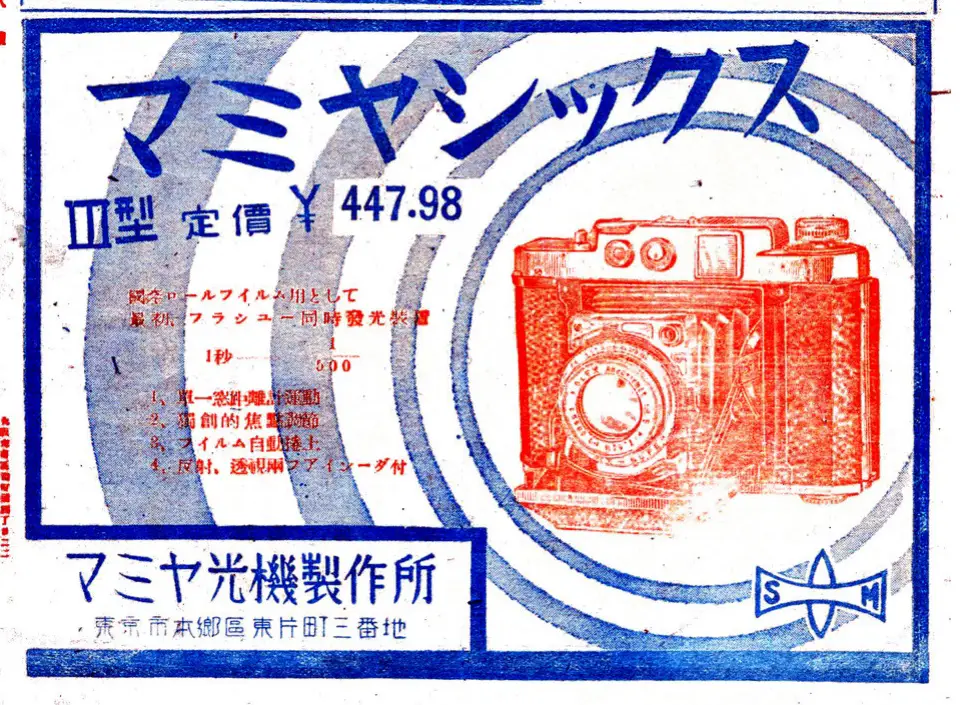
The Mamiya Six was immediately successful due in part to its good build quality, but also that it could be had with a huge number of lens and shutter combinations, even some which would be installed by the end user themselves.
After World War II, the Mamiya Six was the first Japanese camera to restart production, beating that of every other Japanese optics company. The Mamiya Six would be produced until the end of the 1950s in a very large number of variants and different models, all shooting the same 6×6 format as that original camera.
As the era of the folding camera fell out of favor, Mamiya would expand into the 35mm market, releasing a lineup of scale focus, rangefinder, and SLR cameras, but the company’s Mamiyaflex TLR would continue its streak of making good quality 6×6 cameras. The Mamiyaflex TLRs would initially struggle to differentiate themselves from the enormous variety of other Japanese 6×6 TLRs until 1956 when the company went large with the “Professional series” interchangeable lens Mamiyaflex C.

This new series of camera took the earlier TLR design and supersized it, replacing the folding rack system with a bellows unit and removable front plate which could be swapped out with different combinations of lenses and shutters. In addition to interchangeable lenses, the viewfinders could also be swapped out for eye level prisms instead of the standard waist level design.
This ability to fit the Mamiyaflex C with a reflex viewfinder capable of wide angle to telephoto focal lengths and a close focus capability never before seen on medium format TLRs and folding cameras allowed it to stand out from other camera offerings from the time, and expand the company’s reach well into the professional market. The Mamiyaflex C would evolve into the Mamiya C-series, including more advanced models like the Mamiya C220 and C330, the later of which had variants produced until the 1990s.
Mamiya’s success with medium format TLRs and later SLRs such as the RB67 and M645 entrenched them in the pro market, but the company’s 35mm offerings never saw the same level of success and in 1984 saw the company file for bankruptcy. Although a set back in the company’s history, this period saw a new Mamiya re-emerge with a renewed focus solely on professional quality medium format cameras. No further 35mm cameras would be produced, instead the company relied on the success of its Mamiya C-series and other medium format cameras.

In 1989, the company would make a bold decision to return to its roots and would release an all new collapsible lens Mamiya 6, this time stylizing the name with a numeric number 6, instead of the word “Six” like the earlier folding cameras. The “New Mamiya 6” as it was called then would be an all new camera, sharing almost nothing with the earlier camera other than the name and film format. The new camera would still use a bellows system like the Mamiya Six, but instead of a folding bed, the entire front of the camera would slide in and out of a squared circle tube. The fragile bellows would not be externally visible and could only been seen through the film compartment. Like the rest of Mamiya’s offerings, it would feature interchangeable lenses but also added a modern exposure metering system and dual format support for 120 and 220 film.

Along with the camera, three lenses were available for its mount. The standard 75mm f/3.5 was the standard kit lens that came with most copies, but a 50mm f/4 and a 150mm f/4.5 lens were available. When mounting any of the three lenses to the camera, they would automatically couple to the viewfinder, changing the frame lines, and displaying ones that matched the focal length of whatever lens was attached. I found no information suggesting lenses of other focal length were developed.
At the time of its release, the Mamiya 6 was the world’s only interchangeable lens medium format rangefinder camera. It receive almost unanimous praise from professional and amateur photographers alike for its robust build quality, large and very bright viewfinder, easy to use rangefinder, and excellent lenses. Of course, all of this high praise also came with a high price. In the December 1992 review to the right, the Mamiya 6 carried a retail price with the 75mm f/3.5 lens of $2570, or $1450 body only. As was typical of the era, retail prices were usually 25% higher than actual street prices but even at $1925 with the lens or $1085 body only, the camera was still very expensive. When adjusted for inflation, the street prices compare to $4415 and $2485 today.
For anyone who has listened to a bunch of episodes of the Camerosity Podcast, you’ve no doubt heard repeated references to the Mamiya 7 as being the best camera ever. One of our hosts, Theo is head over heels over this camera and regularly takes it with him on vacation or other shooting adventures. From how he’s described this camera plus what I can gather online, it is quite a capable 6×7 rangefinder camera with modern electronics and an interchangeable lens mount.
After hearing Theo’s repeated serenade of praise for the Mamiya 7 a couple of times, I began to think maybe I should add one to my collection. Then I checked the prices and that put that goal to rest. If I were to ever get a Mamiya 7, it would have to come very, very cheaply, or be very, very easy to steal (I promise, I don’t actually steal cameras!)

Thankfully, as these things happen when you’re constantly buying and trading cameras from people, I picked up what I thought was the next best thing, the Mamiya 6. Not the folding kind of Mamiya Six that was extremely popular in the 1940s and 50s, but the plastic bodied collapsible lens solid bodied interchangeable lens Mamiya 6 from the early 1990s.
After consulting with Theo, I asked him what his thoughts were on the Mamiya 6 and he acknowledged he’s never used one, but after doing a small amount of research, the main differences between the Mamiya 6 and 7 is that the 7 came out five years later, shoots 6×7 images instead of 6×6, and it no longer has a collapsible lens mount, replacing it with a new one which allows for a more flexible range of lenses all the way down to a 43mm super wide angle lens.
Even wtihout handling a Mamiya 7 myself, I feel pretty confident that the Mamiya 6 feels just as good as its younger sibling. When I first started researching this article, I was surprised to learn that this camera made its debut in 1989 as it feels more modern than that. The inner body is all metal with a composite outer shell with a matte black finish. The feel of the camera is smooth and luxurious and thankfully, Mamiya avoided the types of synthetic body coverings that other manufacturers used around this time which have aged poorly, turning into a sticky crumbly mess. This Mamiya 6 is in extremely good condition and likely doesn’t look much different than the day it was made.

The camera has a clean top plate with a large silkscreened Mamiya 6 logo to the left of the flash hot shoe. Next is the very large shutter speed dial with settings from 4 to 1/500 sec, plus Bulb, A, and AEL settings. The dial also has a small window for changing the ISO film speed for the meter from ASA 25 to 1600. In the center of the shutter speed dial is a button which must be pressed anytime you set the camera to A or AEL mode and would like to go back to a manual shutter speed. This lock is there to prevent someone from accidentally getting out of AE mode. Below and to the left of the shutter speed dial is a small button which when pressed, allows you to rotate a collar below the shutter speed dial which controls the EV compensation from -2 to +2 EV.
My Mamiya 6 Doesn’t Have an AE or AEL Setting: When the Mamiya 6 was first released, early copies had a Circle and a Square on the shutter speed dial to indicate AE and AEL modes. As you might image, this caused confusion among Mamiya 6 owners, so a subtle revision to change this to the letters AE and AEL was made shortly after this camera was released. If your copy has the Circle and Square, it just means you have an earlier camera.

Next is the film advance lever. Although resembling a normal film advance lever on a 35mm camera, lever wind medium format cameras often require more than one motion to fully advance the film from one exposure to another. The number of motions also changes between the first and last exposure due to the thickness of the spool. Thankfully, the Mamiya 6 has an interlock preventing you from over-advancing the film, so you can operate this lever until it stops on its own. Above the film advance lever is the automatic resetting exposure counter which shows the number of exposures made on the current roll. Since the Mamiya 6 supports both 120 and 220 film, this counter goes as high as 24. Above the exposure counter, on a forward angled portion of the top plate is the shutter release button with a shutter release lock collar beneath it which also doubles as the camera’s power switch. This slightly angled location for the shutter release is very comfortably located on top of the front hand grip.

The base is unexpectedly cluttered with a lot more things than you’d expect to see on the bottom of just any other camera. Starting with the normal things, we have a 1/4″ tripod socket slight off center from the middle, the camera’s serial number, and two round circles that pop out of the camera when loading film to allow for the forks that hold the film spools to move out of the way. On a slightly forward angled spot on the bottom of the hand grip is a circular door for the battery compartment. This is where you’d insert the two 1.5v LR44 or SR44 batteries which are required to power the camera. As an aside, I am not used to seeing such a large camera use such smaller batteries. Before opening this door, I was certain the Mamiya 6 would use something larger like a PX28 or CR123 battery.
Finally, the last thing on the bottom is a large circular lock whose function is not immediately apparent. This dial, along with a small slider which moves in a right angle pattern, open and close the integrated cloth dark slide inside the film compartment. Since the Mamiya 6 has an interchangeable lens mount and the lenses contain the actual shutter, once you remove the lens, there is nothing to prevent light from entering the film compartment. So in order to remove the lens, you must first rotate this dial counterclockwise as far as it will go, before you can dismount the lens. When you have a new lens back on the camera, to close the dark slide, press the button in the direction of the arrow and the cloth curtain will snap shut (actually open, it is opposite of how a shutter works).

On the back, we start with the large square eyepiece for the viewfinder in the upper left corner. The eye piece has a built in rubber pad which is useful for those wearing glasses so the camera won’t scratch your lens. To the right of the viewfinder is the PC flash sync port. On this example, a rubber grommet is covering the port and it does not look like it has ever been taken off. Below the sync port is a slider for the 10 second electronic self-timer. The self-timer can be cancelled at any time by simply pushing the slider back to its original position. A small circle to the left of the self-timer slider sorta looks like a button, but is actually a service port for the camera and doesn’t do anything. In the middle of the door is a film box end reminder frame. This is where you’d stick the cardboard piece of the box to act as a reminder for what kind of film is in the camera. Below this frame is a little window which indicates 120 or 220 depending on the position of the pressure plate inside the camera.

Metal strap loops are located on both sides of the camera for attaching a neck strap. On the camera’s left side is the door release latch for the film compartment. To open it, press in on a small button while simultaneously pressing down on a sider to release it. Finally, on the camera’s right side, just to the right of the strap loop is a threaded socket for a cable release if you wish to use one.

Opening the right hinged film door reveals a modern medium format film compartment. Film transports from left to right onto ordinary 120 or 220 spools. When you finish a roll of film, the most common thing to do is to move the empty spool from the supply side to the take up side on the right. In order to get the spools out, a small red button below both spools must be pressed to pop out the little fork, allowing you to remove and insert a spool. Centered above the film gate is a metal triangle which is the point which you must align the Start mark on a new roll of film when loading it into the camera. After attaching the paper leader to the take up spool, continually advance the film until the Start mark line up with this triangle and the close the door and keep winding until you’ve reached the first exposure. This process is the same for both 120 or 220 film. A later revision called the Mamiya 6 MF adds multi-format capability, allowing you to insert a mask for 4.5cm x 6cm images, but that’s not the version seen here. One interesting thing about the film gate is that you can see the inner pleats of the folding bellows, which are not visible from the front of the camera.

On the inside of the film door is the large square film pressure plate. The plate is covered in small divots which help reduce friction as film passes over it. The Mamiya 6 supports both 120 and 220 film, but since 220 film lacks backing paper behind the film, a change must be made to the pressure plate to account for the difference in thickness. On the Mamiya 6, you can easily switch by rotating the pressure plate 90 degrees. A white dot will align with the numbers 120 or 220 printed on the inside of the door. Changing this also changes the number visible below the film reminder frame on the back of the camera. The Mamiya 6 does not have any sort of light seal material in the film compartment to worry about going bad.

An interesting feature that was produced for the later Mamiya 6 MF was the ability to shoot 35mm film in a panoramic format. Using this kit, a 24mm x 54mm mask was inserted into the film compartment, along with two spool holders, and a special bottom mounted rewind crank. Using this kit and the wide angle 50mm Mamiya lens allowed for images with a similar angle of view to that of the Hasselblad XPan.
This panoramic adapter wasn’t specifically designed for the earlier Mamiya 6, but will still work with limited functionality. You can still insert the mask and the two spool holders, but the rewind handle will not mount as the camera is missing the connection point for the rewind handle. The Mamiya 6 also cannot count 35mm exposures, nor does it have frame lines in the viewfinder for framing the panoramic images. If you are willing to manually rewind film in darkness and don’t mind guess framing your images, you can use it on the Mamiya 6.
Looking down on top of the collapsible lenses, Mamiya cleverly designed them in such a way that when the lens is collapsed you cannot easily see the focus distance scale as it disappears inside the camera. This should act as a reminder that you need to extend the lens before trying to shoot it. With it extended, a depth of field scale is engraved nearest the lens mount, along with the focal distance of whichever lens you have mounted. Next is the focus distance scale with numbers from 3.5 feet and 1 meter to infinity. Finally, nearest the front of the lens is the aperture ring which on the 50mm f/4 lens seen here, has prominent click stops from f/4 to f/22.


With the lens collapsed, the Mamiya 6 is smaller than it otherwise would be, and certainly smaller than many medium format cameras, but it is not quite pocketable. Carrying around the Mamiya 6 would be best done with a neck strap, camera bag, or if you insist on putting it in a pocket, you’d need a large coat with very large pockets. If you forget to extend the lens when shooting, the camera has a shutter lock which prevents you from pressing the button with the lens collapsed.

If you are lucky enough to not only own a Mamiya 6, but also more than one lens and you want to change it, you must remember that each lens also contains the shutter, so when taking the lens off, the shutter is not able to protect any film you have loaded into the camera, so before you can do that, you have to close the integrated dark slide using the key on the base of the camera. With the lock turned to where the white dot is pointing towards the “Pac-Man with Mouth Closed” icon, the dark slide is shut and you can proceed to remove the lens. With the white dot pointing at the “Pac-Man with Mouth Open” this means that the dark slide is open, and you cannot remove the lens.
To remove the lens, first extend the lens using the black button near the 4 o’clock position around the mount and pull it out, then press and hold the smaller chrome button near the 8 o’clock position around the mount while rotating the lens counter clockwise. Installation of the lens is the opposite of removal, just remember to keep the lens mount extended out before trying to reattach a lens. After attaching the lens and making sure it is secure to the camera, your final step is to disengage the integrated dark slide, so that you may resume making exposures.

The viewfinder on the Mamiya 6 is simply massive and extremely bright. Featuring a high contrast rangefinder patch, adjustable frame lines which automatically correct for parallax, and a red shutter speed scale along the side, the viewfinder is one of the best I’ve ever seen. Taking a cue from the Leica M-series in which the camera changes frame lines depending on which lens is attached, in the image to the right, I have the 50mm wide angle lens attached, so the lines appear near the visible edge of the square image. That you don’t have to see frame lines you’re not currently using cleans up the viewfinder, making it less busy than other cameras in which multiple sets can be seen at once.
Along the left side are red LEDs that indicate the meter’s chosen exposure speed in AE mode, and in manual mode, both the meter’s chosen speed and your manually selected speed. That you can see both numbers at the same time in manual exposure mode works similarly to a match needle system in which you choosing the same setting the meter recommends will give you correct exposure for the current lighting. Of course, in manual mode, you don’t have to go with what the meter recommends, so if you want to intentionally go over or under the meter’s recommendation you can.
While reading the user manual, I noticed something which was missing from my camera. Apparently, the Mamiya 6 would have come with a plastic body cap, which you can mount to the camera when storing the camera without a lens attached. The main purpose of any body cap is to prevent stuff from getting inside the camera, but Mamiya cleverly added a spare battery compartment to the body cap, allowing you to store 4 extra batteries for the camera in case you needed ones while out shooting.
After spending some time with the Mamiya 6, I was very excited to spend some time with it. I had a variety of upcoming travel plans in which I could use it, so I ended up shooting three rolls of film, some at Indianapolis Motor Speedway, others at a family reunion in Minnesota, and in upper Michigan on Mackinac Island at the breathtaking Grand Hotel. I shot two fresh rolls of Kodak Gold 200, and a roll of semi-expired black and white Fuji Acros 100.


Normally when reviewing interchangeable lens cameras I use whatever standard lens would have originally come on a camera and then if I had lenses of other focal lengths, I’ll add additional comments for those lenses. In the case of the Mamiya 6, I did not have the standard 75mm f/3.5 lens, but rather than 50mm f/4 wide angle. Being a fan of wide angle lenses, I shot all three test rolls in the camera using this lens because I loved it so much.

A risk you often take when shooting a wide angle lens is that images will often show darkness near the corners and edges and a loss of sharpness. This vignetting isn’t always bad as it can often give images character, but generally speaking are considered an inferior characteristic to lenses who can maintain brightness and sharpness corner to corner. Living up to its “Professional” reputation, the Mamiya 50mm f/4 lens delivers the goods across the entire image. Sharpness is razor sharp in the middle and only shows very mild softness near the corners. Vignetting is completely absent, even in images where the sky is present, which is where you commonly would see it. Adding the additional detail from the larger negative compared to a 35mm camera, and these are some of the nicest images I’ve ever shot on film. And while I didn’t shoot either of the two other lenses available for the Mamiya 6, that they have the reputation they do would suggest I would have been as equally pleased with the images shot through those.

Beyond image quality, I can’t say enough about the large and extremely vibrant viewfinder. The Mamiya 6’s viewfinder compares favorably to a current generation Leica M-series rangefinder or one of the Cosina Voigtländer cameras from the early 21st century, except much larger. With the widest 50mm frame lines visible, looking through this camera feels like looking through one of those large picture windows people have in their living rooms. The rangefinder is definitely big, yet pales in comparison to the overall view through the viewfinder.

I applaud Mamiya for not cluttering up things with excessive information. The red LED shutter speed scale that runs along the left side does its job with no frills. I also am very pleased that the exposure meter still offers suggestions in manual exposure mode, allowing you to pick and choose when you use it. A strange curiosity is in the red battery check light that illuminates in the upper right corner when half pressing the shutter release. The presence of an LED which confirms the camera has power is not an unusual feature, except the shutter speed scale also lights up with this red LED, giving the same benefit. The inclusion of a separate LED to do the same thing seems odd, but also doesn’t hurt anything either.
The overall feel of the camera is excellent. I applaud the designers who made this camera feel as close to a 35mm rangefinder as possible. The long throw of the film advance is certainly unique as 120 film doesn’t always transport the same distance after each exposure, so sometimes you have to give it part of a second movement to get to the next exposure, but for anyone who has ever shot a modern 35mm rangefinder, using the Mamiya 6 is almost the same, just larger.

The one missed opportunity for the Mamiya 6 is that its lenses are not compatible with the larger Mamiya 7. To be fair, that camera shoots larger 6×7 images, but the circle of coverage for 6×6 is so close to 6×7, I feel like they could have made it work if they wanted to. The Mamiya 7 also loses the collapsible lens mount of the Mamiya 6, so perhaps that has something to do with it.
Overall though, the Mamiya 6 is a hell of a camera. With the 50mm f/4 wide angle lens, shooting it is an awesome experience and something I intend on doing again. I would say this is a camera that everyone reading this should consider picking up if it weren’t for the extremely high prices these cameras demand. Looking back at the original street prices of these cameras, adjusted for inflation they compare to over $4000 in 2026 dollars, so thankfully used examples of this camera aren’t that expensive, but at prices still well within the 4-digits, this simply isn’t a camera everyone can afford.
If however you can, or you know someone willing to loan you theirs, definitely don’t miss out on the opportunity. I am certain that some day I will contradict myself here, but as I write this, the Mamiya 6 is my favorite 6×6 camera in my collection.
Related Posts You Might Enjoy
External Links
https://camera-wiki.org/wiki/Mamiya_6
https://www.kenrockwell.com/mamiya/6.htm
https://web.archive.org/web/20130615034132/https://www.photo.net/photo/mamiya-6.html (archived)
Yes, simply love it! I had the incredible luck to find this with the 75mm and 150mm lenses for only $800 (Canadian) about 2 years ago, and bought the 50mm just a bit later. Indeed, great viewfinder, great lenses, medium format compact (ok, not to the old folders or a TLR, but compared to any SLR).
I owned one of these almost from new, with all three three lenses. Traveled the world with it for 20 years.
I finally had to sell it (the third one I owned) because the film advance interlock failed (again) and I could not find anyone to fix it.
A good review! I owned a Mamiya 6 in the late 1990’s for around 10 years, and stupidly sold it the 50, 75 and 150mm lenses mainly because I was concerned about getting the camera and lenses serviced in then new digital world. In hindsight, it was easily my favourite travel camera with the 50mm, or the better 75mm which had been matched to the body. I found the 150mm astonishingly sharp when the focus was nailed and is a rather underrated lens. The meter was great for E6 and black & white. It was a shame that the 6 stopped being produced in favour of the 7 when it did, as it would still be an excellent camera.
My favourite medium format camera ever! I had one with all three lenses (did not use the 150mm much) and foolishly sold it as I thought I did not use it enough in the digital world. I quickly had seller remorses and would love to get one back, just not at the current going prices…
Mike, if you know of anyone who services Mamiya MF cameras with electronic shutters, please post that info. The lack of service has stopped me from buying any version of this fine camera.
Hello Roger, maybe you can get in touch with the French Mamiya specialist Hervé Thurel (https://focale22.com/gb/main7.html). Hervé is the last Mamiya repair expert in France. He may inform you. I know he just retired but can give good advices. I called him 4 montes ago because I wanted a Mamiya 6 and talked reliability. He told me to buy one without worrying. I did not yet. One day. Good luck.
Many thanks for the contact information!