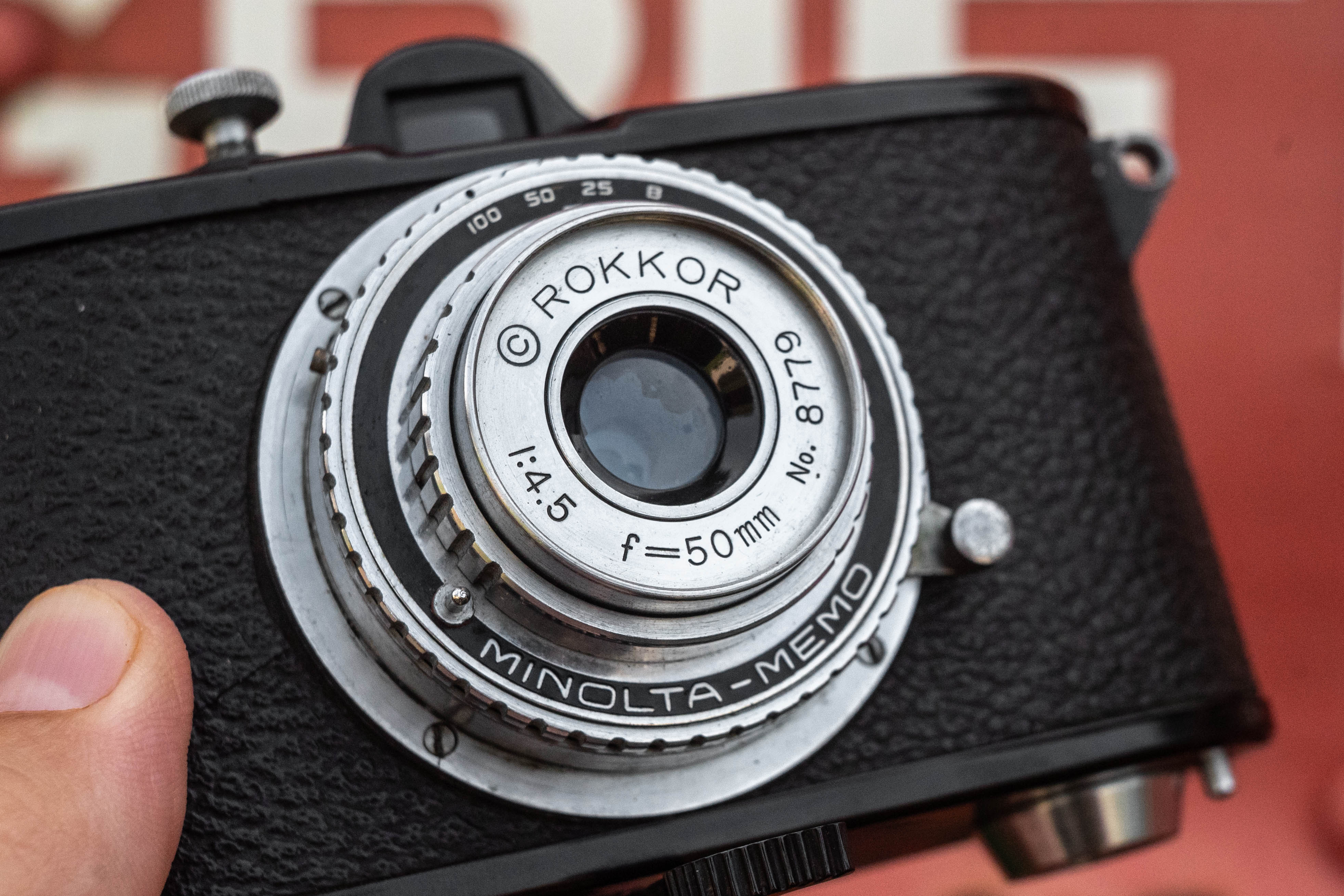
This is a Minolta Memo, a 35mm camera produced by Chiyoda Kōgaku Seikō in Tokyo Japan starting in September 1949. The Memo was a simple camera made mostly of metal and Bakelite. It was the first Japanese camera to feature a film advance lever and was also the first Minolta camera to shoot a full 24mm x 36mm image size. The camera’s rounded body is unique and looks like any other Minolta camera, but despite interesting cosmetics and an innovative film advance, was a rather simple camera with a three speed Konan leaf shutter, simple optical viewfinder, and a slow f/4.5 triplet lens.
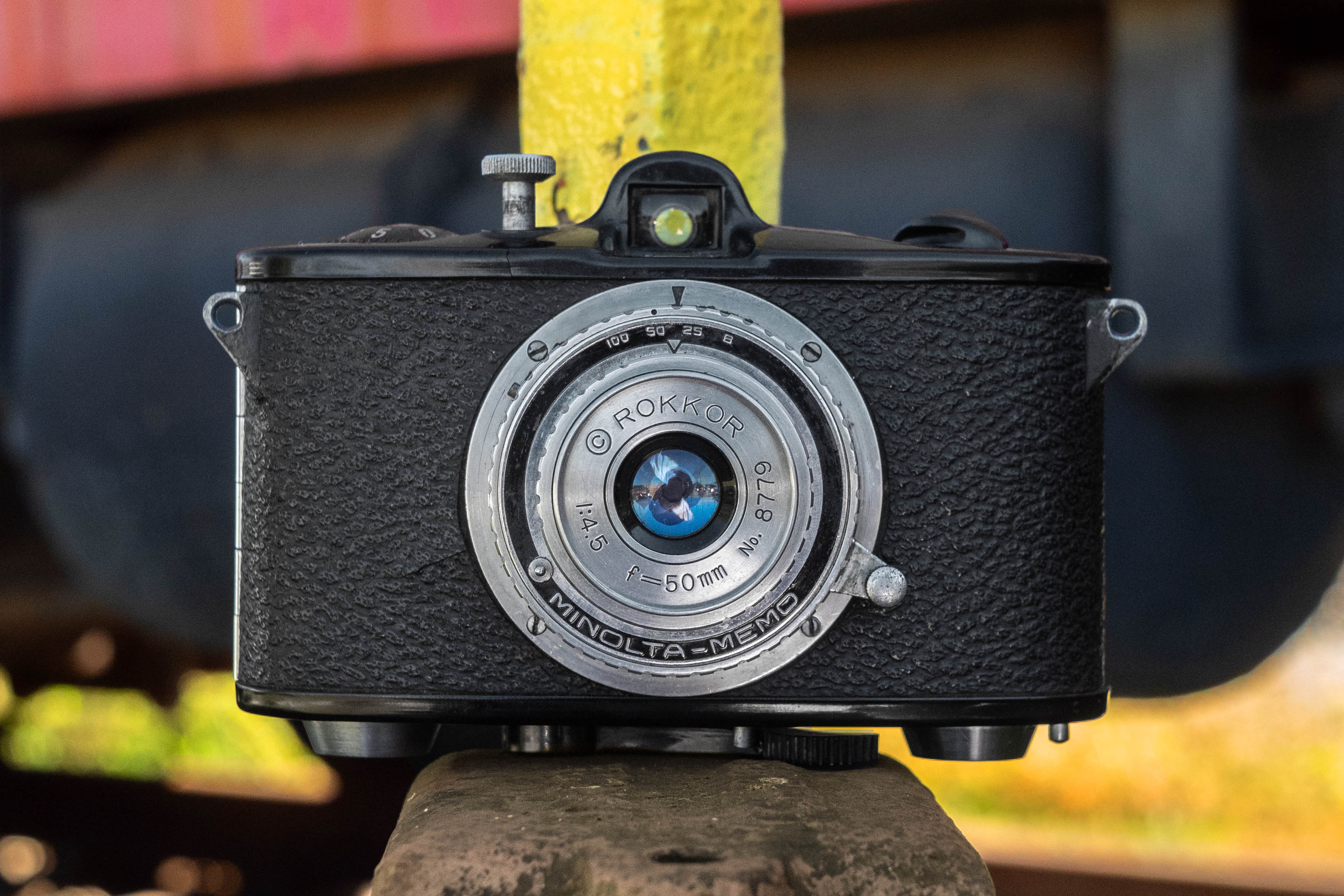
Film Type: 135 (35mm)
Lens: 50mm f/4.5 Rokkor coated 3-elements in 3-groups
Focus: 3.5 feet to Infinity
Viewfinder: Scale Focus Optical Viewfinder
Shutter: Konan Behind the Lens Leaf Shutter
Speeds: B, 1/25 – 1/100 seconds
Exposure Meter: None
Battery: None
Flash Mount: None
Weight: 630 grams
Manual: None
It doesn’t happen as often as it used to, but every now and then I still stumble upon a camera that I’ve never seen before. Such an event occurred one day early this spring while browsing Buyee, I came across a strange Minolta camera called the Memo which I had never seen before.
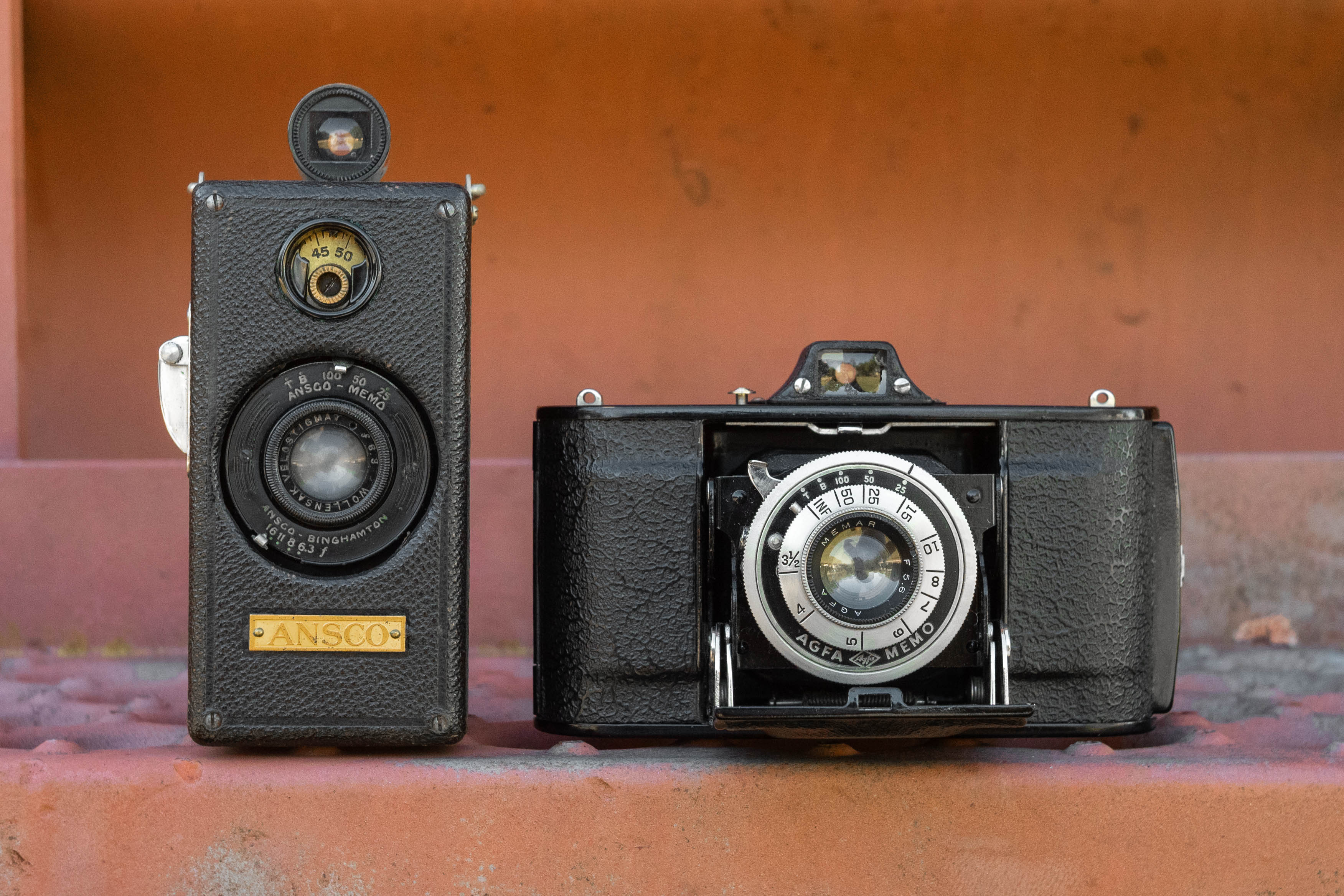
The name “Memo” has been used by other companies before most notably ANSCO and AGFA who each have had cameras with that name, but in both cases they used a special paper backed 35mm film which was different from the regular type 135 cassettes we are used to.
Unlike those cameras, the Minolta Memo uses regular 35mm film but just had a really interesting and curvy appearance, unlike any other Minolta camera I had ever seen. Looking at images of ones online, it was clear this was a simple camera but with some interesting features.
Very little info about the Memo exists online, but the few things you’ll see at the usual sources is that this camera was made in 1949 and was “the first Japanese 35mm leaf-shutter camera with lever-wind film advance”. Whether that means it was the first Japanese 35mm camera with a film advance lever and it also had a leaf shutter, or that it was the first to have both features at the same time is unclear, but whatever the case, most cameras from 1949 did not have film advance levers, so we’ll just go with that historical tidbit.
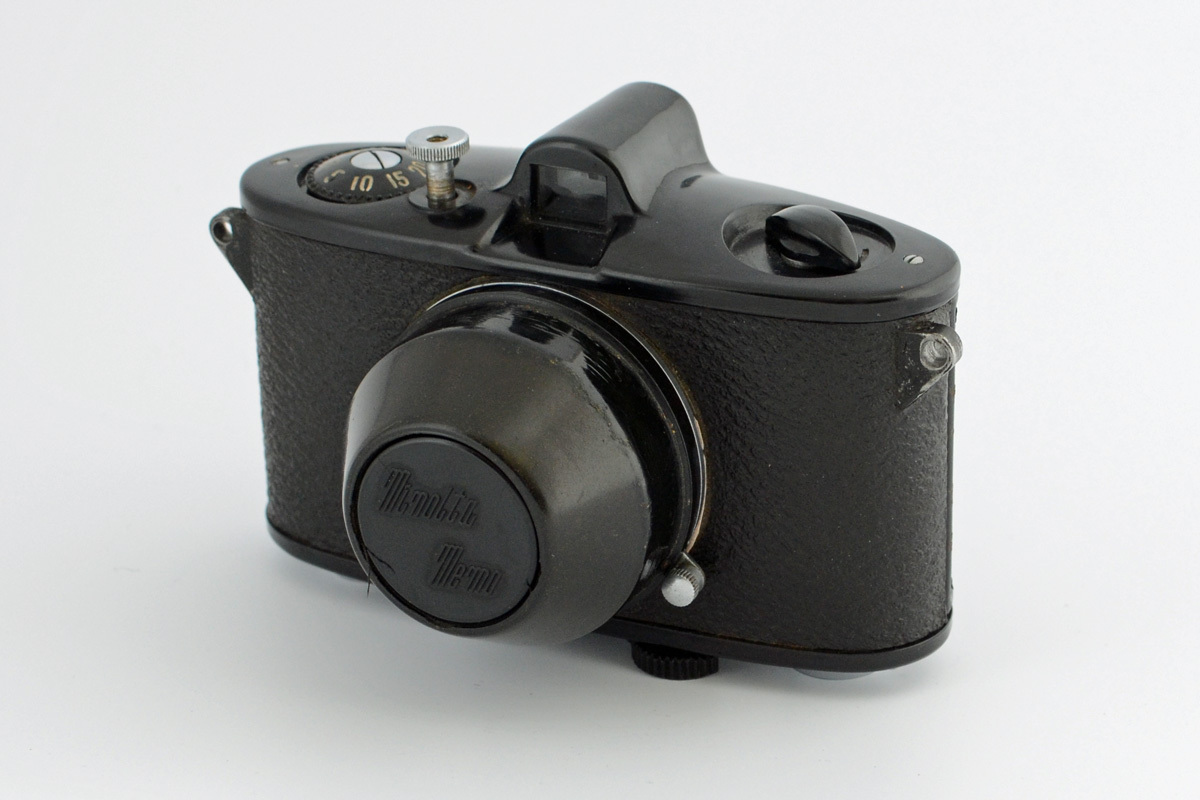
Another interesting feature of the Minolta Memo is that when new, it came with a two-piece Bakelite lens cap which covered not only the lens but also the entire shutter. This cap could be removed and reversed. The front piece came off and then the back half could be pressed onto the lens acting as a lens hood. This exact same concept was used by Carl Zeiss Jena when they released the Werra in 1954. Whether or not Zeiss took inspiration from the Minolta Memo is unclear. Because the cap was removable and made from the same brittle plastic as the wind lever, this piece is often lost and is rarely included with Memos which show up for sale.
The Minolta Memo is noteworthy not just for its features, but also its design as it looks like no other camera of the era. Minolta’s own interchangeable lens 35mm rangefinder which was already in production at that time looked like a highly modified Leica, and later Minolta A-series cameras were quite different too. The main body and film compartment are made of die-cast aluminum and both the top and bottom plates, plus the film advance lever are made out of Bakelite plastic. In my initial assessment of this camera, I believed the body to be brass or a heavier metal as it feels too heavy to be aluminum, but this Japanese language article strongly suggests the material is aluminum.
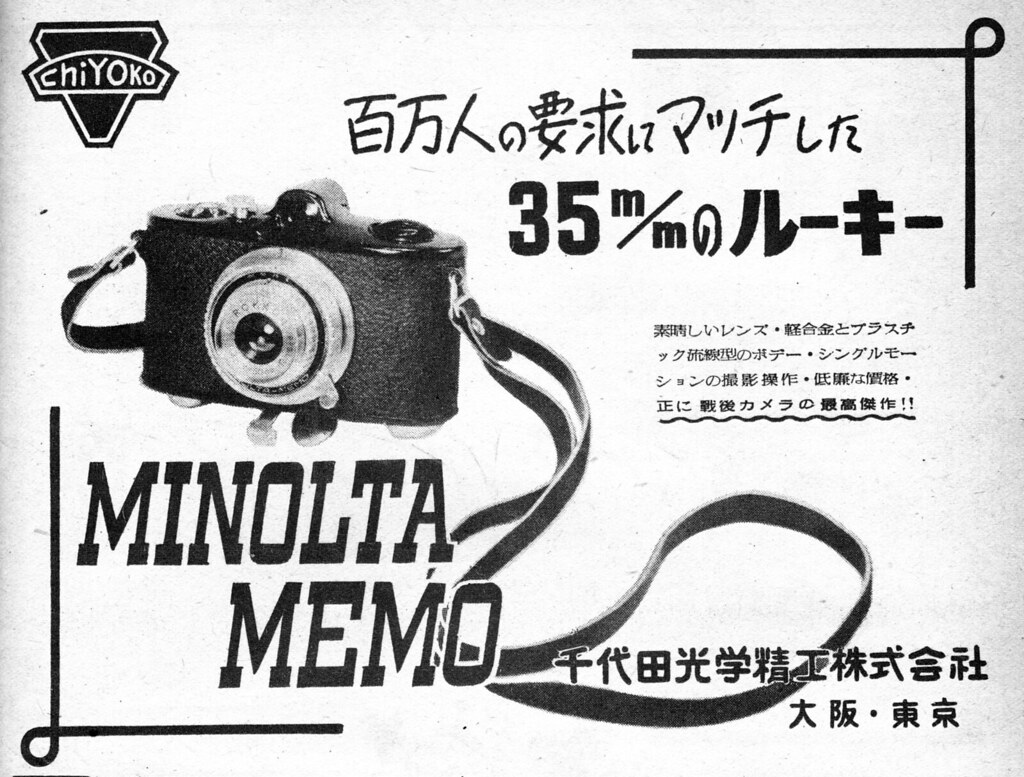
The Memo appears to have been produced for a very short time, probably for only one year which suggests 1949 was the only year of production. I have no idea of how many were built, but based on how infrequently they show up for sale on eBay or through Japanese auctions, my best guess would be between 5000-10,000 units based on production numbers of other, similar cameras made for only one year.
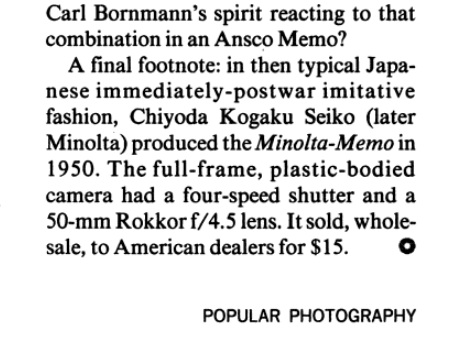
In my research for this article, I could only find a single Japanese language advertisement for the camera which I initially assumed meant it was sold only in Japan, however further research turned up a single paragraph on page 36 of the October 1983 issue of Popular Photography which states that the Minolta Memo was sold to US dealers for $15. Despite this claim, I have found absolutely no evidence proving this to be true in any English language publications of the era.
With a slow f/4.5 lens and a 3-speed shutter, this was clearly an entry level camera, but with a bottom mounted film advance lever and a Rokkor lens, I knew I needed to get my hands on one.
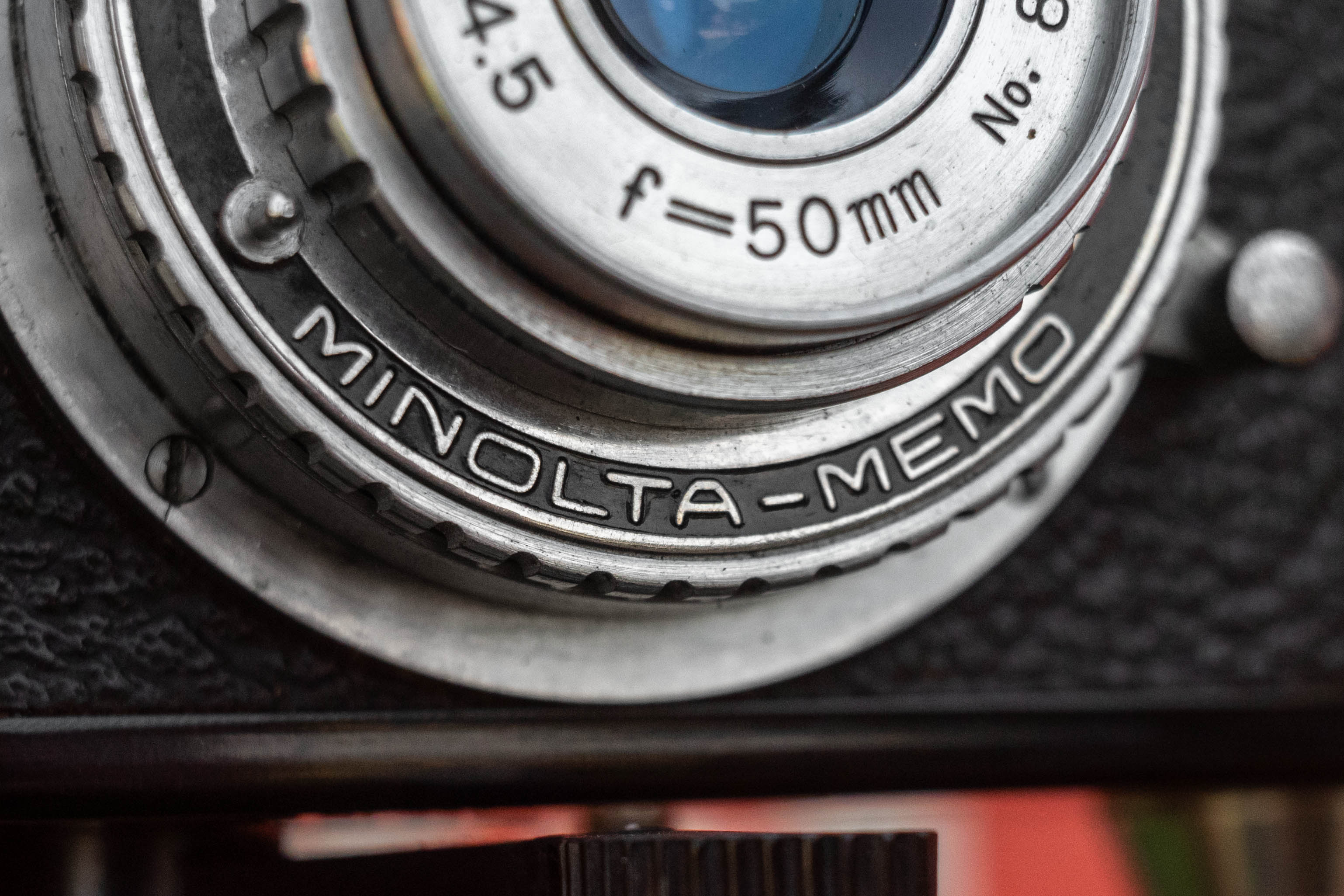
As it would turn out, finding one of these cameras at an affordable price and in working condition took a while, but in summer 2026, a package arrived on my doorstep with this camera in it. As soon as I unwrapped it from the bubble wrap, I was immediately struck by how heavy it was. I had read that this camera used Bakelite in its construction and that the advance lever is often broken on these, but I guess I assumed that most of the camera was Bakelite. It certainly looked like it from the images, but as it turns out, most of the Memo is metal. And its not even a lightweight metal like aluminum, it looks to me like it is made of black painted steel (nope, its aluminum) which accounts for the camera’s 630 gram weight. At the same time I was writing this review, I was also working on one for the Olympus M-1 SLR which has a weight of 680 grams with a 50mm f/1.8 Olympus M-System F.Zuiko and although the Minolta is lighter, it somehow felt heavier. In my mind, I was picking up an inexpensive and simple plastic camera and its weight deceived me.
Weight aside, the Minolta Memo has a really nice feel to it. The curved body fits perfectly in my hands and the camera’s unique bottom mounted film advance lever was naturally located where my “trigger finger” expected it to be. Even the top plate shutter release is comfortably located in easy reach of my right index finger, and with a nice scalloped curve on the top surface, felt very natural to use.
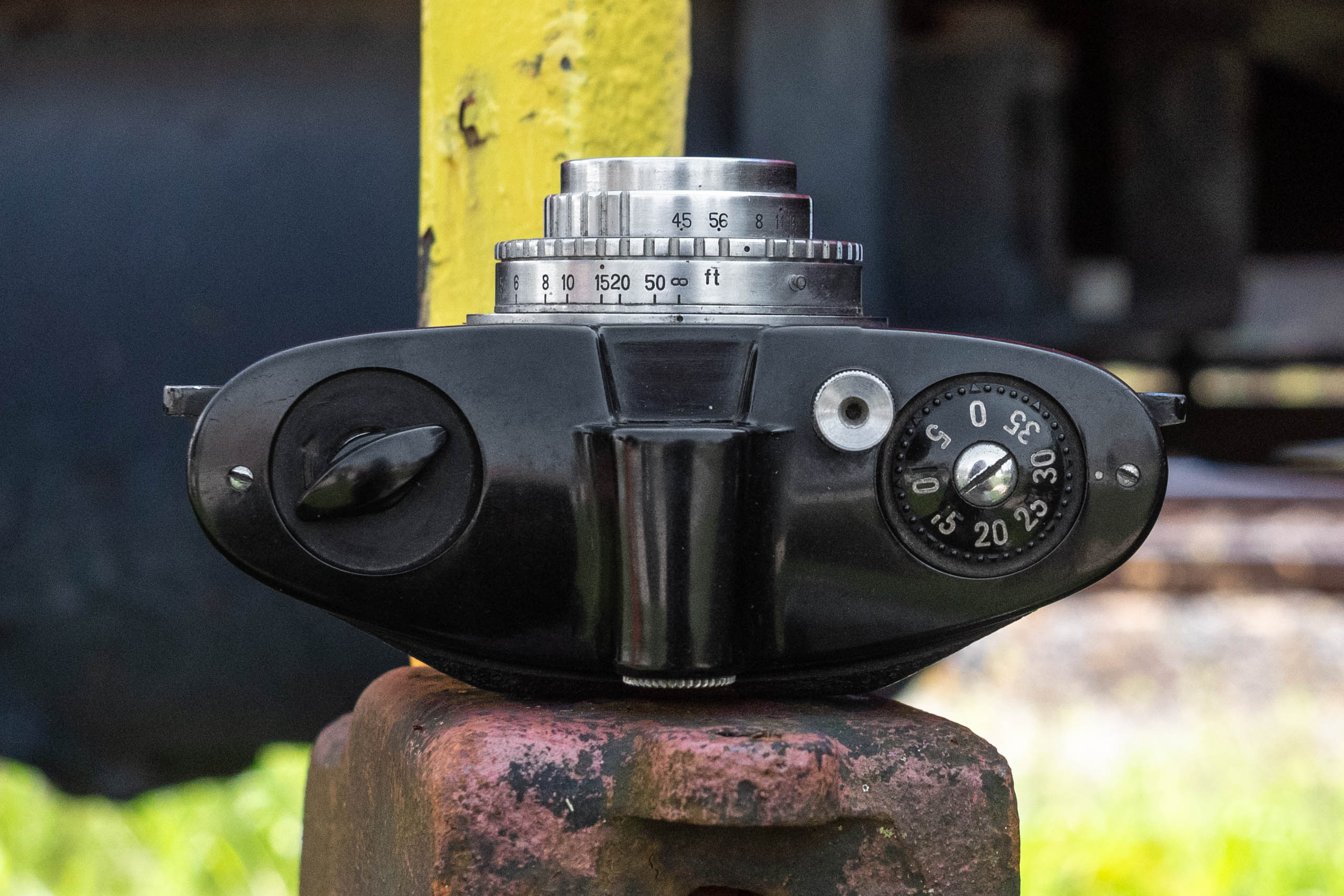
The top plate is made entirely of Bakelite and has a trapezoid shape, similar to an Ihagee Exakta or Exa, but backwards in which the angled sides are on the back of the camera, not the front. A large black rewind dial is on the left with an arrow indicating the direction of travel. Next to it is a nicely sculpted hump for the optical viewfinder. There’s nothing particularly special about it other than it blends in nicely with the curves of the camera. Next is the cable threaded metal shutter release which has a nice recess to it for your finger to rest on. On the right is the large exposure counter which is also made from Bakelite but has paint filled numbers that look unlike any I’ve seen on another camera. My example had some of the paint filling missing on some numbers, but in my opinion, this added to the “patina” of the camera. The exposure counter is additive and counts from 0 to 39 and must be manually reset after loading in a new roll of film.
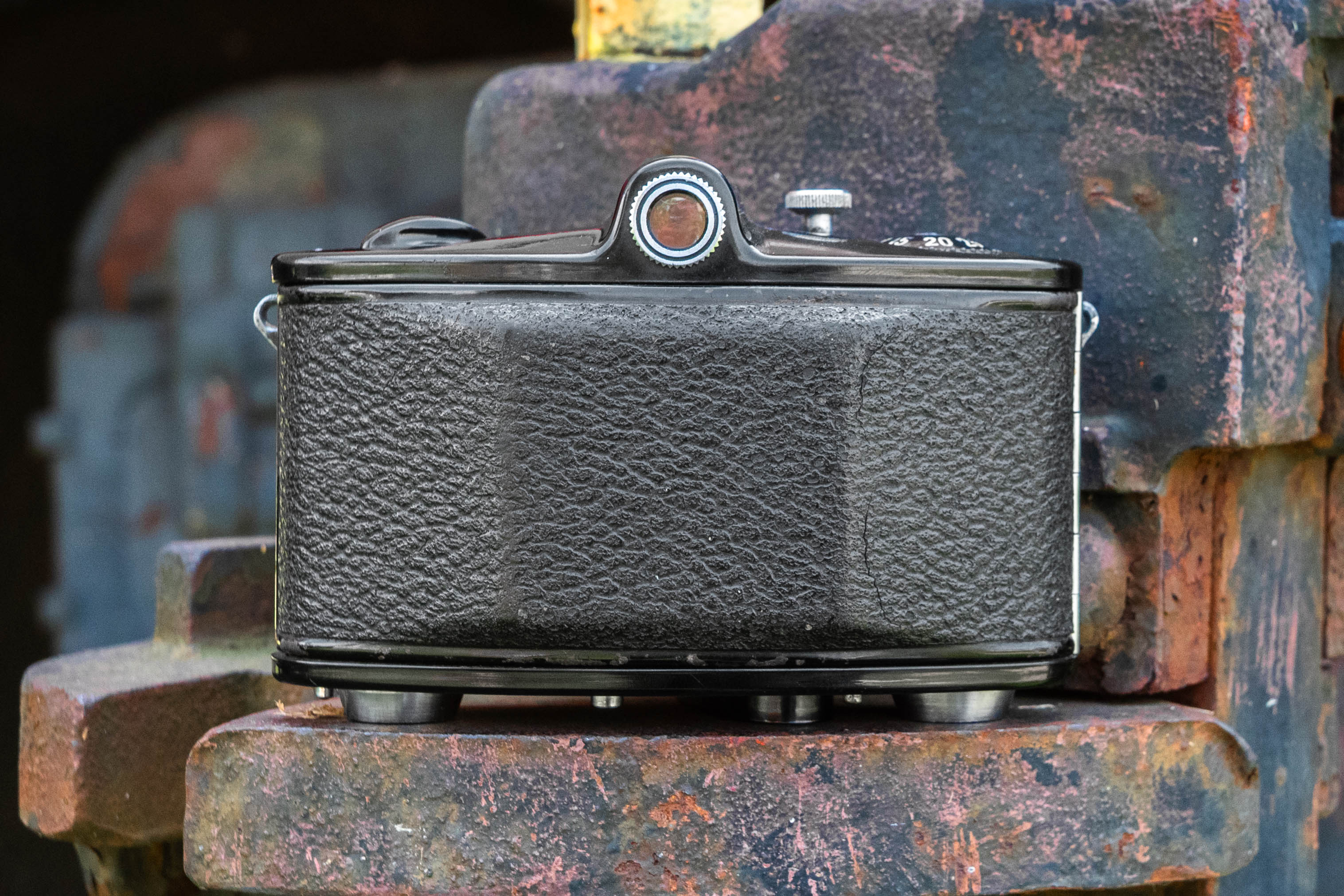
The back has little to see other than a large swath of body covering. The covering itself on mine has cracks in a couple places of the body, but otherwise has not started to peel or chip off. The feel of the covering is very hard and plasticky, but it has a deep pebbled texture which gives the camera good grip. I am uncertain of what this is made of, but it does not appear to be Vulcanite and is definitely not real leather.
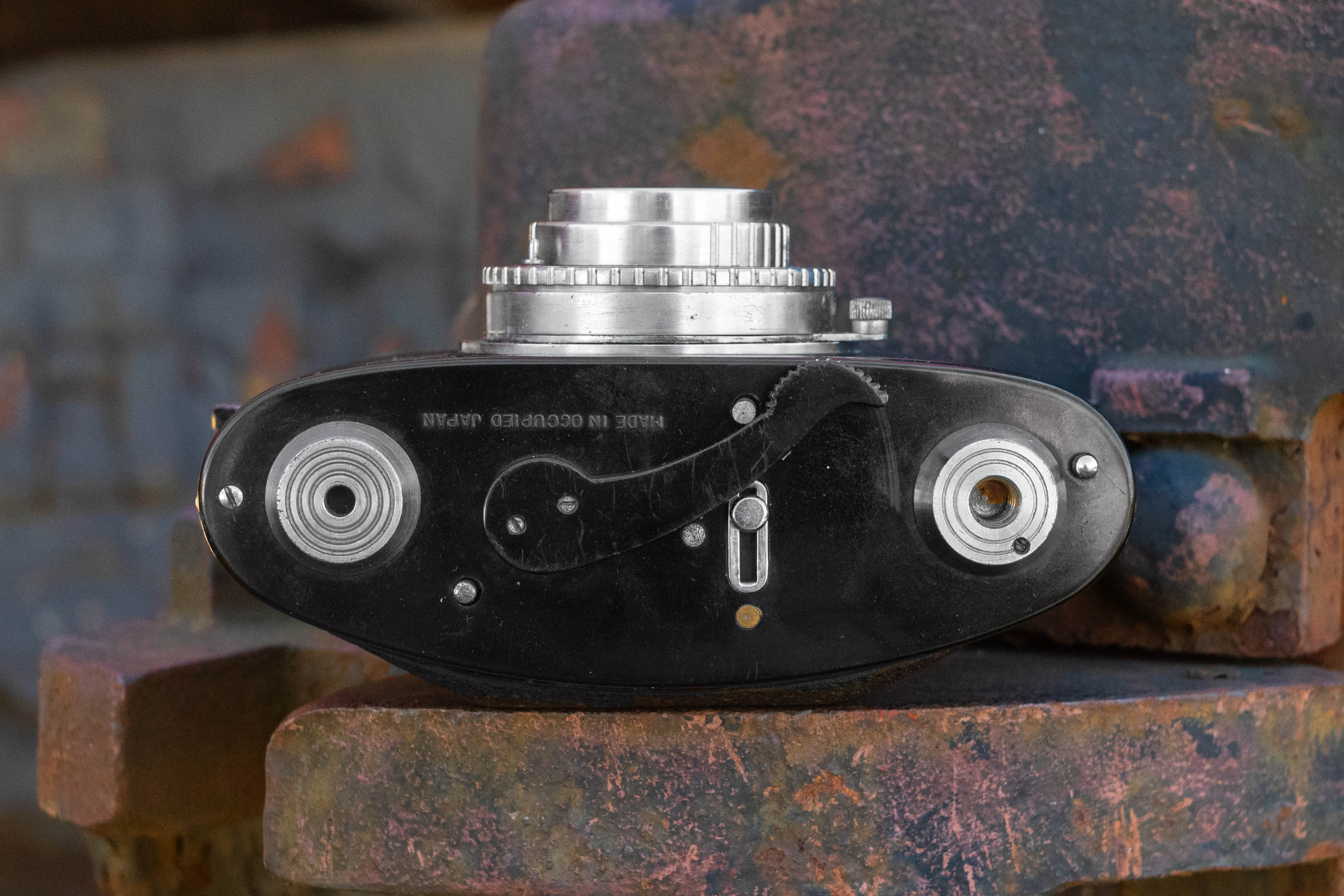
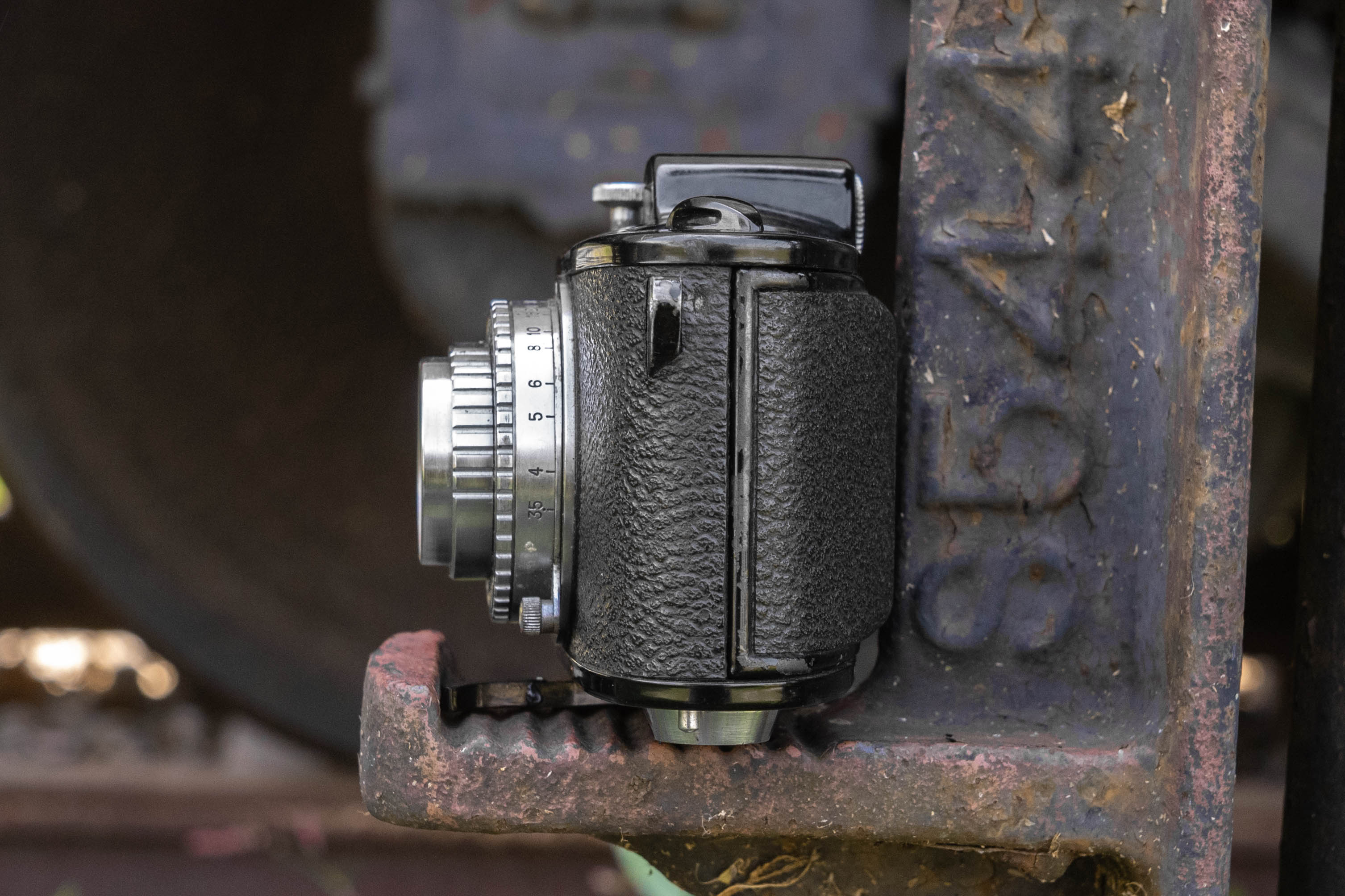
On the bottom we see the Minolta Memo’s prominent film advance lever, which when in use sticks out towards the front of the camera beneath the lens but can also be tucked in a “stowed” position when not in use. The tip of the lever is curved towards the photographer’s left hand and is used by pulling back on the lever to advance the film. The action is quite smooth and easy to do, but in what would become a very misguided decision, this entire handle is made from Bakelite and as such is found broken on many examples. Why such a critical part of the camera that is often torqued during normal use is made from a brittle material like Bakelite is anyone’s guess, but thankfully the one here is still in tact. I would advise anyone trying to use one of these cameras to go very easy on the film advance lever to prevent it from breaking.
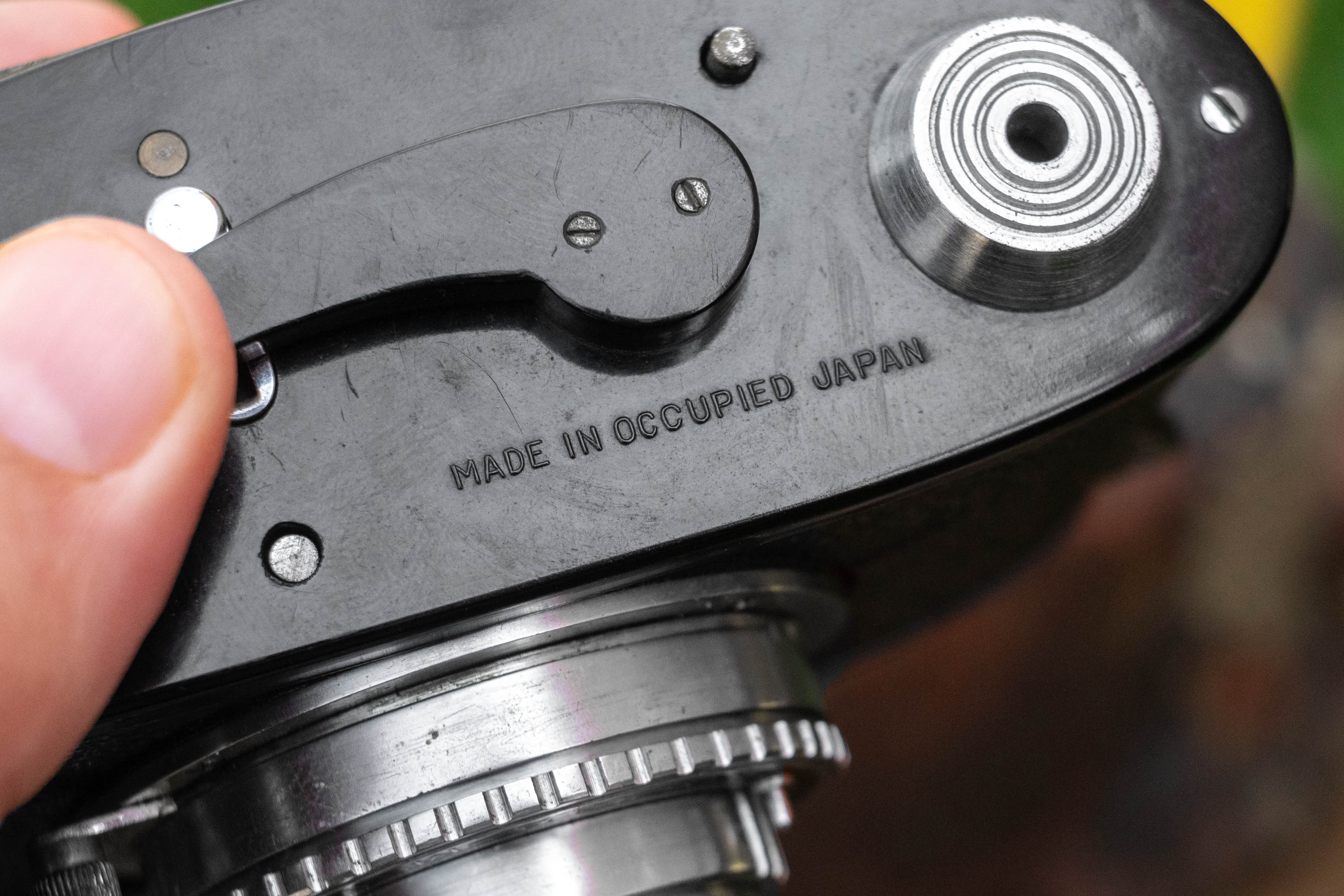
Next to the advance lever is a metal switch that is used to hold the advance lever in a tucked away position when not in use. To use it, fold the advance lever as far as it will go, and then slide this lever forward and a metal pin will pop up holding the lever in the stowed position. I believe this feature is misunderstood by many users of this camera as most images of the camera show the lever in shooting position, which exposes the tip to breakage. When you want to shoot the camera, pull back on this switch and the advance lever will extend out to its shooting position.
Beneath the film advance lever, engraved into the base plate are the words “Made in Occupied Japan” which is consistent with this camera’s late 1940s construction. Both sides of the base have metal feet to help keep the camera balanced on a flat surface. Above and to the left of the metal foot near the film advance lever is a tiny button that when pressed deactivates the film transport for rewinding film at the end of a roll. Finally, next to the metal foot on the side of the camera opposite of the MIOJ words is a small chrome button which is the door release for the film compartment.
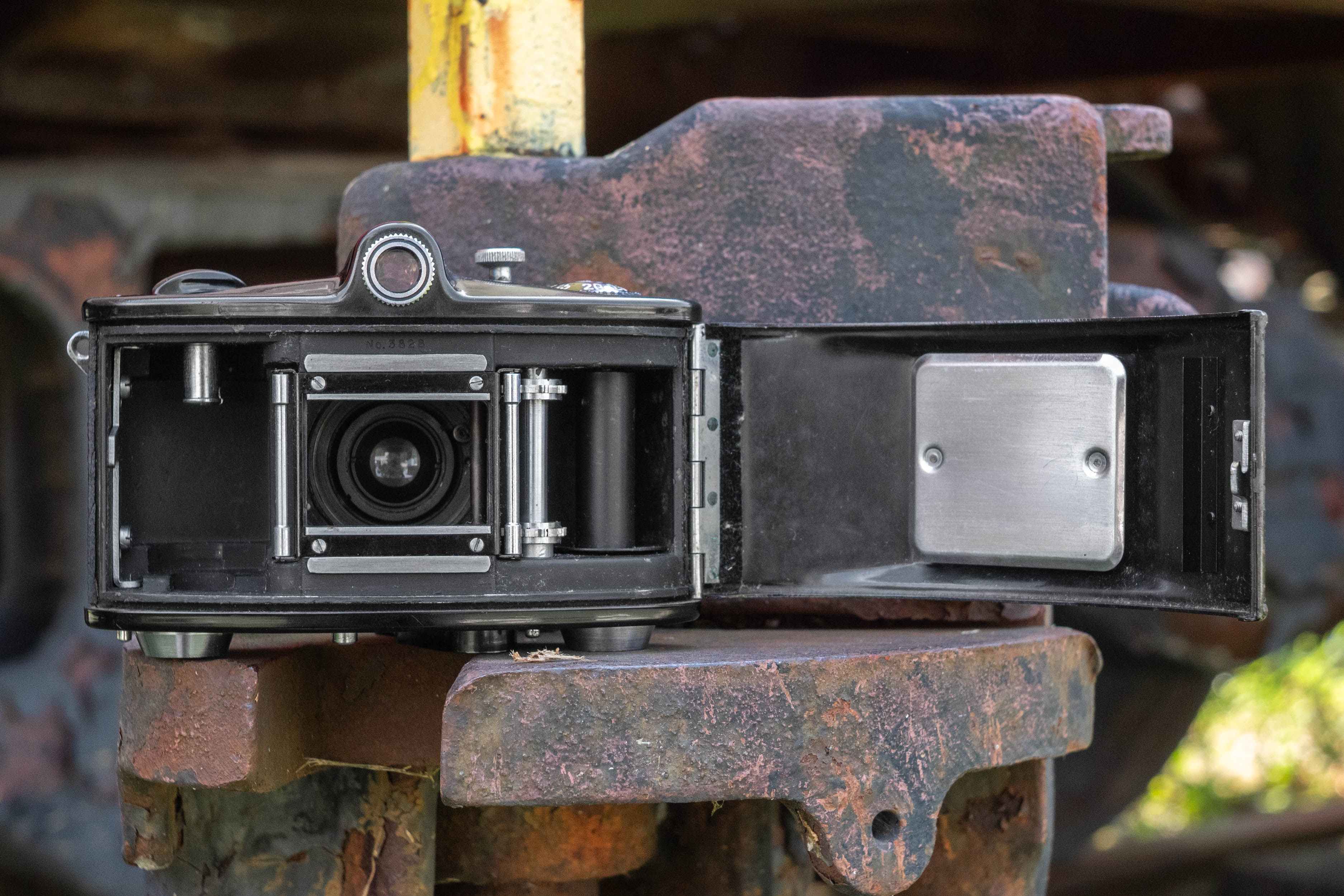
Pressing this button pops open the right hinged film door. Considering the age of this camera, the film compartment looks surprisingly modern. The main part of the compartment is metal with nicely finished film rails above and below the film gate. Flanking the gate are two stainless steel rollers to ease friction while film passes over them. The sprocket shaft and film pressure plate on the inside of the door are also made in shiny stainless steel, further suggesting this camera was as step up from a cheap economic model. Film transports from left to right onto an integrated metal take up spool. When loading in a new roll of film, thread the leader under a metal clip on one side and wind the camera a couple of times. The Minolta Memo predates the use of foam light seals and only has a felt strip on both sides of the door hinge, but nothing else. On this example, the felt strips looked to still be doing their job so I did not mess with them.
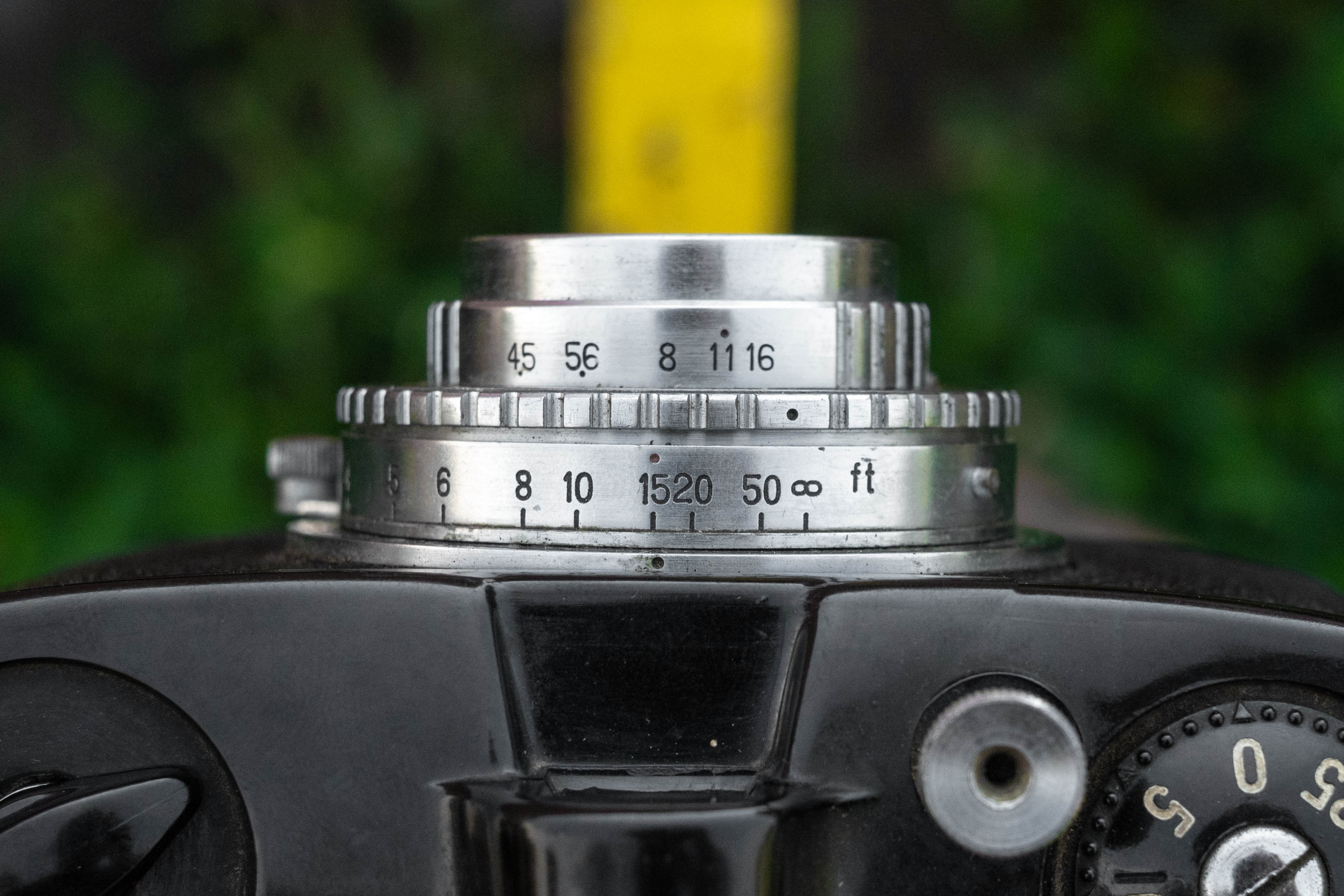
The Minolta Memo has an unusually shaped and thick body which has the side effect of not needing a lot of room for the lens because the flange focal distance is still the same as a narrow body camera with a long lens. This means that focus, aperture, and shutter speed controls have limited space at front of the camera which isn’t always a good thing. Looking down upon the top of the lens and the focus distance ring is located tightly against the body. A metal handle sticking out of the side makes changing focus from 3.5 feet to infinity relatively easy but on this camera was a bit tight. Next is the very thin shutter speed ring which you can only see the shutter speeds from the front. Finally, nearest the front is the aperture ring with f/stops from f/4.5 to f/16. Both the shutter speed and aperture rings have click stops making it easy to feel when you’ve made a change. In addition, dots above the 15 foot distance and f/11 indicate recommended settings for snapshots, if you so choose to use the camera that way.
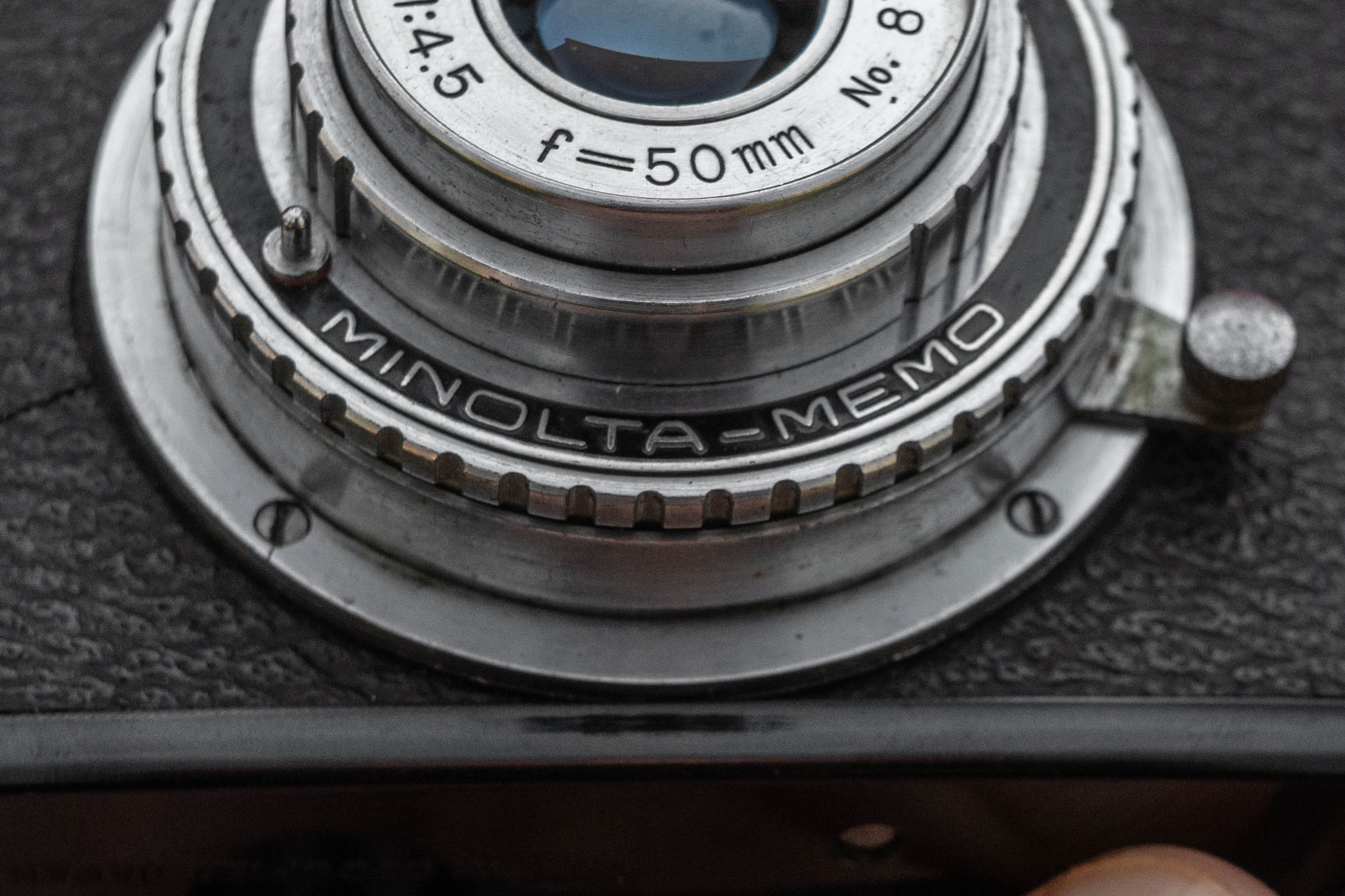
Up front, there’s not much to see other than the lens and shutter. Up top, we see the Konan shutter’s three speeds from 1/25 to 1/100 plus Bulb. The camera’s name “Minolta Memo” is proudly engraved into the shutter ring below the lens and that’s pretty much it. No self timer, no flash sync ports, no lens release. At the very least, the presentation is very nice. The metal has a nice brushed look to it and all of the black painted surfaces look to be high quality. That this 77 year old camera shows no corrosion in the metal suggests that corners were not cut in the raw materials department.
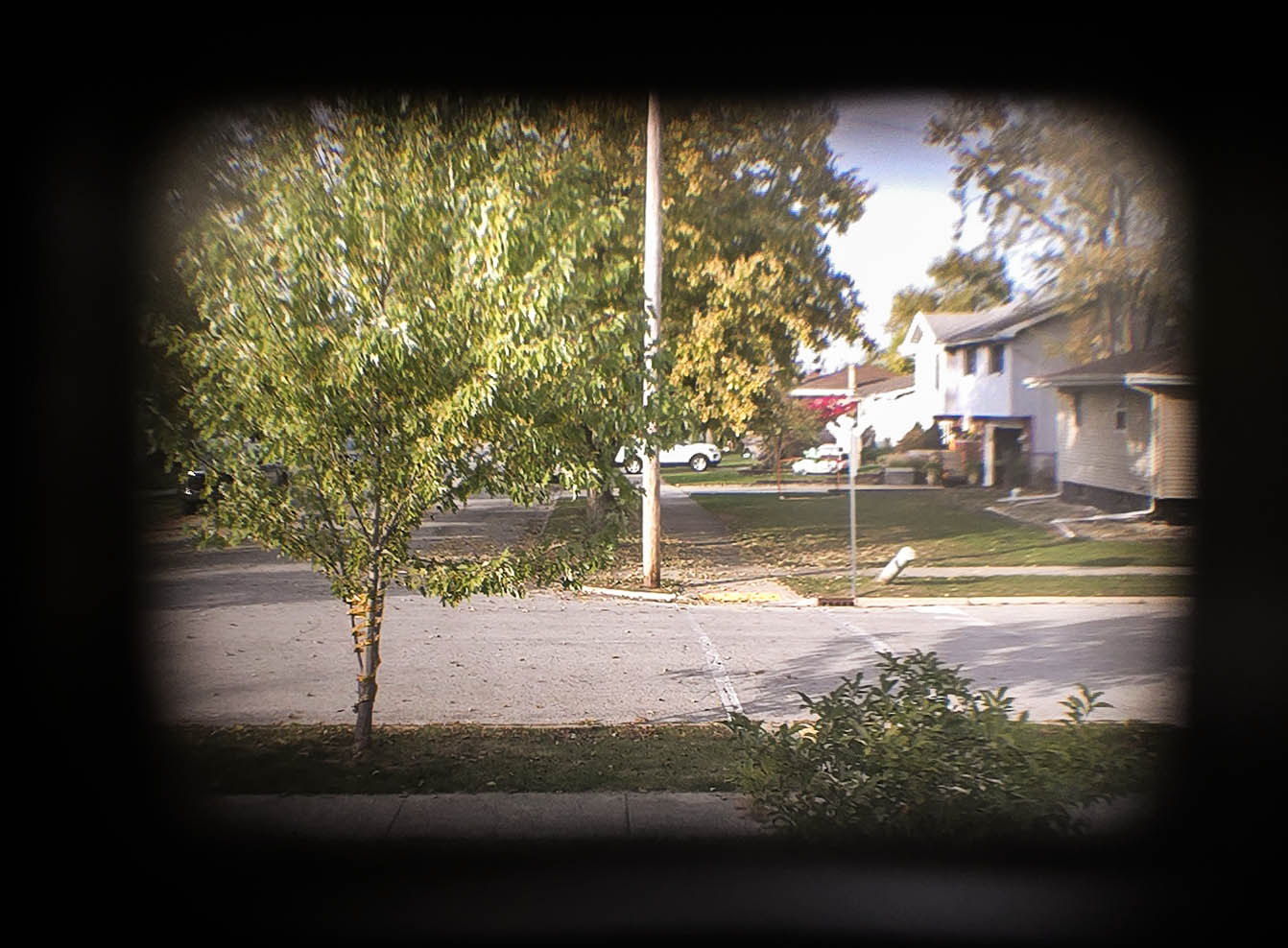
The viewfinder is about as simple as it gets, but with simplicity comes brightness and the Memo’s viewfinder is very bright and surprisingly large for a 1940s camera. I had no issues seeing all four corners of the optical finder while wearing prescription glasses, and without a beamsplitter or other things to deteriorate, there was no haze.
Feeling reasonably confident of the camera’s operation, I wanted to load in some film which would work well with the shutter’s top 1/100 speed and relatively slow f/4.5 lens. Normally, I would have reached for my endless supply (not really) of Kodak TMax, but instead I went with a hand roll of Kodak Plus-X which I had recently shot in my review for the Leica Model B which returned nice shots. I loaded in a roughly 36 exposure roll and carried the camera with me for about a month, being careful not to damage the fragile Bakelite film advance lever.


Having shot my bulk roll of Kodak Plus-X recently, I already knew to expect a low contrast, high midtone film with pronounced grain but sharp detail. When I scanned in the roll however, I saw a level of detail from this film I had never seen before. While the images from the Leica Model B’s Elmar lens were certainly good, I was not prepared for how clinically sharp the meager f/4.5 Rokkor lens rendered images on this film.
Sharpness was incredible corner to corner with minimal softness near the corners and no visible vignetting. Somehow the grain structure of these images looks different than the last roll I shot on this film. At a small size the images look like normal black and white film, but look closer and the detail of each piece of grain gives these images an almost “dot matrix” look to them.
While Rokkor lenses are considered to be “top tier” Japanese optics, I was not prepared for how good this modest f/4.5 triplet was. In addition to incredible detail, that every single image I got from my test roll was correctly in focus suggests it has a wide depth of field as well. Over the years, I’ve gotten good at scale focus, but I’m not THIS good. The Minolta Memo lacks a rangefinder or any type of focus aide, but it clearly doesn’t need it as guess focusing with this camera was very easy. If you have ever had your doubts about scale focus, the Minolta Memo is an excellent starting point for you.
Using the camera was a joy. The chunky thick body fit perfectly in my hands and the design and location of the bottom film advance lever was pure joy to use. My only regret is that knowing how fragile the Bakelite plastic gave me a sense of anxiety each time I had to use the lever. I wish I could have held this camera and confidently guided the lever through its motion without fearing it would snap off at any time. That didn’t actually happen, but I was still extremely careful.
My praise extends beyond the film advance lever as the location of the shutter release, focus lever, and exposure controls were intuitive as well. While the shutter speed and aperture rings are pretty thin and require you to drop the camera from your eye to change, that they both have satisfying click stops at each full stop gave me confidence that I would not accidentally change the settings while out shooting.
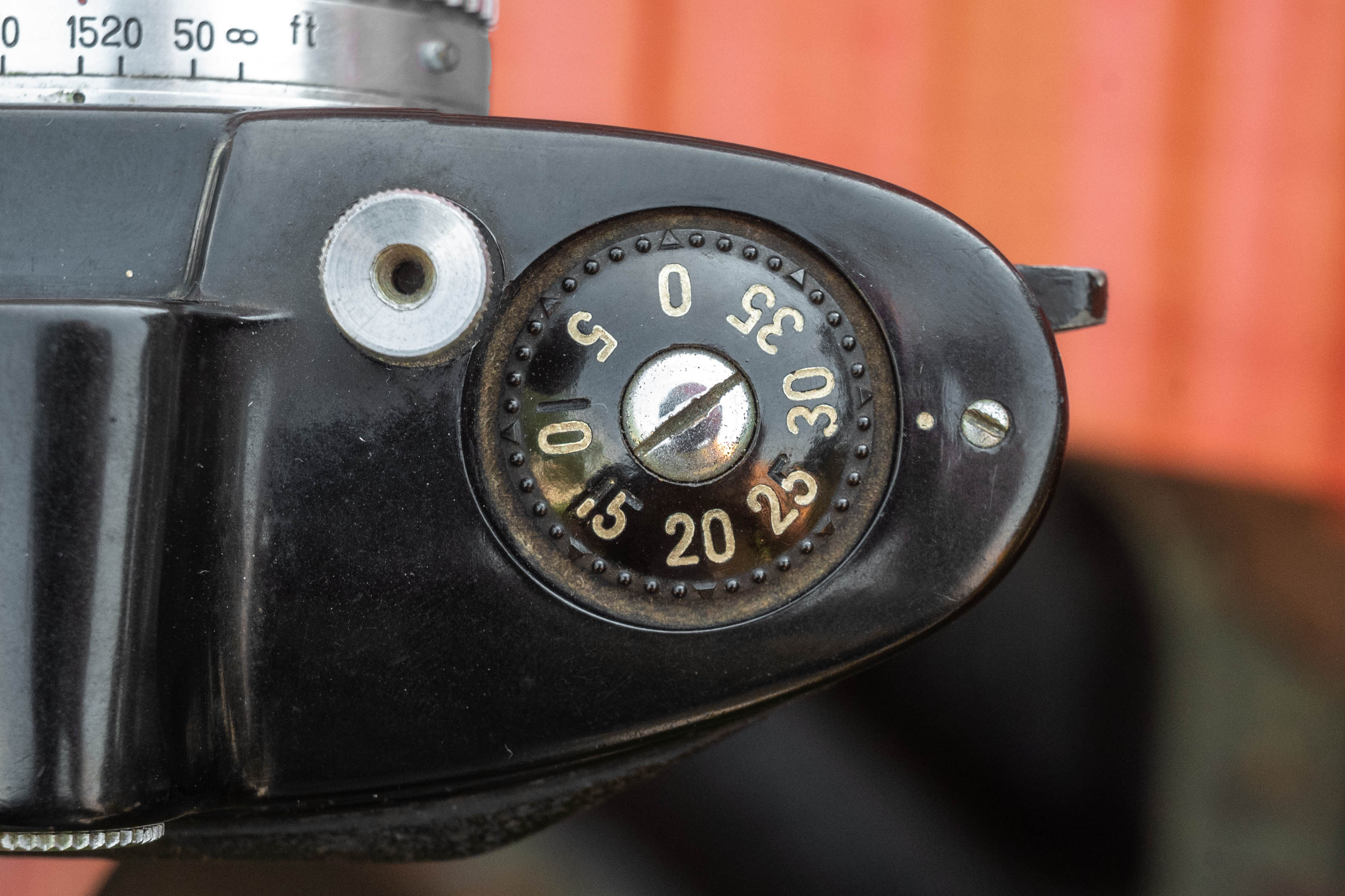
If there was one ergonomic snafu for this camera it is that rewinding film at the end of a roll wasn’t pleasant due to the design of the rewind knob, which is more like a dial that is difficult to grip. Rewinding a full 36 exposure cassette takes way longer than it should as you can only turn the dial maybe half a turn before it slips off your fingers. I would have preferred a more normal knob that can be pulled out, but this is my only nitpick of the camera.
The Minolta Memo was definitely a step in the right direction for Chiyoda Kogaku and I honestly wish they would have stuck with this design a little longer. While the later Minolta A-series cameras were good too, they somehow lack the visual pop that this camera has. It looks like no other Minolta ever made and it works like no other Minolta. The company was on the right track with this model and its a shame that its so hard to find today as I think its a wonderful camera both to look at and use.
Prices for these cameras are a bit on the crazy side, so if you’re GASing for one to add to your collection, be patient. This is a good camera, but not $300 good. Wait for one at a more economical price and make sure the film advance lever isn’t broken off. If you can find this camera in good shape at a price you can live with, definitely pick it up!
Related Posts You Might Enjoy
External Links
https://camera-wiki.org/wiki/Minolta_Memo
http://www.cjs-classic-cameras.co.uk/minolta/minolta.html#memo
https://www.hayatacamera.co.jp/monthlyphoto/201510/ (in Japanese)