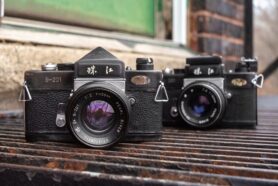
The Pearl River S-201 is a 35mm SLR produced starting in 1974 by the Yongguang Instrument Factory in Sichuan, China, as an evolution of the earlier Seagull DF, itself heavily influenced by Minolta's SR series. Built through a coordinated effort across six Sichuan factories, the S-201 uses the Minolta SR bayonet mount and was notable for being the only Chinese 35mm SLR with an interchangeable viewfinder system, offering both a pentaprism and waist-level finder, an idea likely borrowed from the Nikon F. It featured a cloth focal plane shutter (1–1/1000 plus B), no built-in meter, a mirror lock-up lever, and dual PC flash sync ports, but no hot shoe. Despite steady production and domestic popularity through the 1980s (with later variants like the S-205 adding metering), it's unclear whether the camera was ever officially exported to Western markets.
The author's hands-on experience with two examples (one with a damaged take-up spool, one functional) revealed a camera that feels distinctly behind Japanese contemporaries in fit and finish—rough machining marks, unevenly painted engravings, oxidizing paint, and a mismatched chrome lens-mount ring all point to crude construction. Ergonomically, however, the S-201 was intuitive and functioned well: shutter speeds were accurate, film transport was consistent, and the viewfinder, while a bit dim, was usable. Test shots taken with Lucky SHD 100 film turned out sharp and contrasty with minimal vignetting, only showing slight softness wide open indoors. The two lenses examined (a 58mm and a 50mm f/2, both branded Pearl River) showed notable manufacturing inconsistencies between examples, including opposite rotation directions for focus and aperture rings, suggesting variable sourcing or evolving design standards over the production run.
Overall, the author views the Pearl River S-201 as a solid, if unrefined, mechanical SLR—more akin to a Soviet Zenit in character than a true Minolta clone, despite sharing its mount. While it lacks polish and precision compared to Japanese or German cameras of its era, it performed reliably and produced excellent images, reflecting well on the factory workers who built it despite limited industry experience. The author doesn't see it as a camera they'll shoot often but values it as a meaningful piece of Chinese camera history and an enjoyable one-time shooting experience.
AI-generated summary. May not capture every detail — read the full article below for the complete picture.
This is a Pearl River S-201 (珠江, Zhu Jiang S-201), a 35mm SLR camera produced by the Yongguang Instrument Factory in the Chinese province of Sichuan starting in 1974. The Pearl River S-201 was based on the earlier Seagull DF SLR, but replacing the fixed pentaprism with an interchangeable unit and adding two flash sync ports to the side. The Pearl River S-201 uses the Minolta SR bayonet lens mount and is almost always found in black paint, but chrome and nickel plated versions also exist. In addition, the Pearl River S-201 was produced by three different Chinese factories, all easily identifiable by the first letter of the camera’s serial number but beyond that there are only very subtle cosmetic differences between cameras made by each of the three factories. It was the only Chinese made 35mm SLR with interchangeable viewfinders.

Film Type: 135 (35mm)
Lens: 58mm f/2 Pearl River S-201 coated 6-elements in 4-groups
Lens Mount: Minolta SR Bayonet
Focus: 2 feet / 0.6 meters to Infinity
Viewfinder: Interchangeable SLR Pentaprism and Waist Level Finder
Shutter: Cloth Focal Plane
Speeds: B, 1 – 1/1000 seconds
Exposure Meter: None
Battery: None
Flash Mount: PC Sync FP and X Flash Sync, 1/45 X-Sync
Weight: 950 grams, 668 grams (body only)
Manual: http://www.subclub.org/minchin/pearlriver.pdf
To even start to understand the Chinese camera industry, you need to first look at the Soviet camera industry. Unlike western countries like Germany, England, and the United States in which commercial companies produce goods to be sold and bought by consumers in the interest of making a profit, in both the Soviet Union and China, photographic goods were produced by factories operated, or at least strongly influenced by each country’s government. When you hear about a Kiev or Zorki rangefinder, the Arsenal and KMZ factories who produced them did so at the direction of the government. Usually, someone in a position of authority identified a product that needed to be built, and assigned this task to a specific factory. If a factory was unable to meet the demands of the product it was charged with building, another factory would be assigned to pick up the slack. Most of the time, factories that produced a camera almost certainly produced something completely unrelated at one point in its past, changing directions only when told to do so.
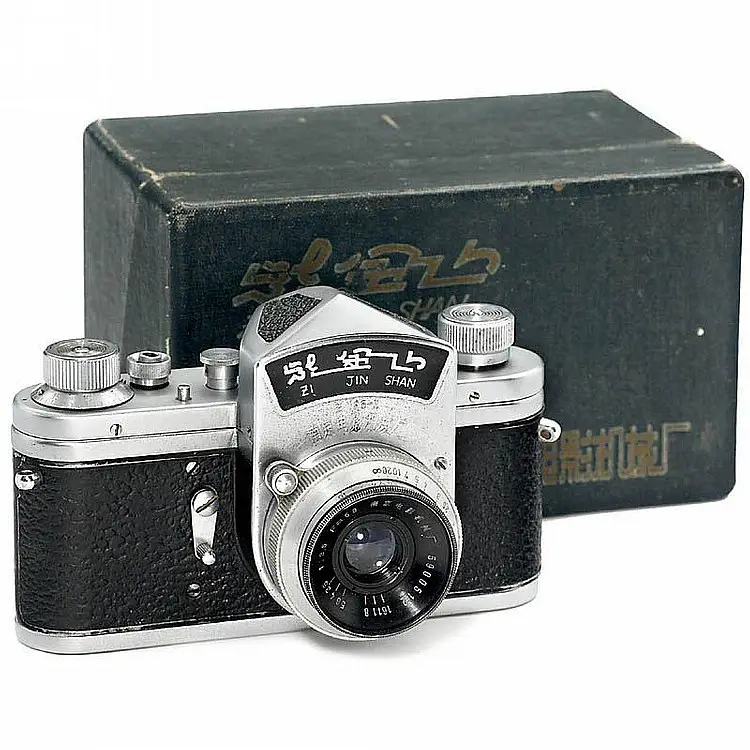
In addition to having a system of government similar to the Soviet Union, the early Chinese camera industry saw a great amount of cooperation with Soviet factories. Many early Chinese cameras were copies of Soviet designs, which themselves were copies of German cameras. Chinese Leica II copies were based off Zorkis and early SLRs were copies of the Zenit SLR. Some other designs like the 35mm Smena and Lubitel twin lens box camera were also produced by Chinese companies.
I have found numerous mentions of Soviet and Chinese cooperation in the early days of the Chinese camera industry, but I have observed that these partnerships did not appear to have lasted long, as the Soviet influence seemed to die out by the early 1960s as Chinese cameras started taking more and more influence from Japanese companies. Models based on the Ricoh Auto Shot and Minolta SLRs became common, many with subtle tweaks differentiating them enough to where they cannot even be considered direct copies.
One way in which the Chinese photographic industry continued to mimic that of the Soviet industry is in the organization of camera factories, rather than commercial entities. Manufacturing plants in Beijing, Shanghai, Tianjin, and others began producing cameras and lenses of nearly every style, from simple point and shoot to advanced SLR designs.
One of the largest camera producers was Shanghai, where at least five different factories would open, all with generic names like Shanghai Factory Nos. 1, 2, and 3. It is not clear exactly which products were produced at which factories, but models like the Shanghai 58-I and II, Seagull 203, and various Shanghai and Seagull branded TLRs were common both in China, and by the late 1960s even saw some export sales to western countries and other emerging markets.
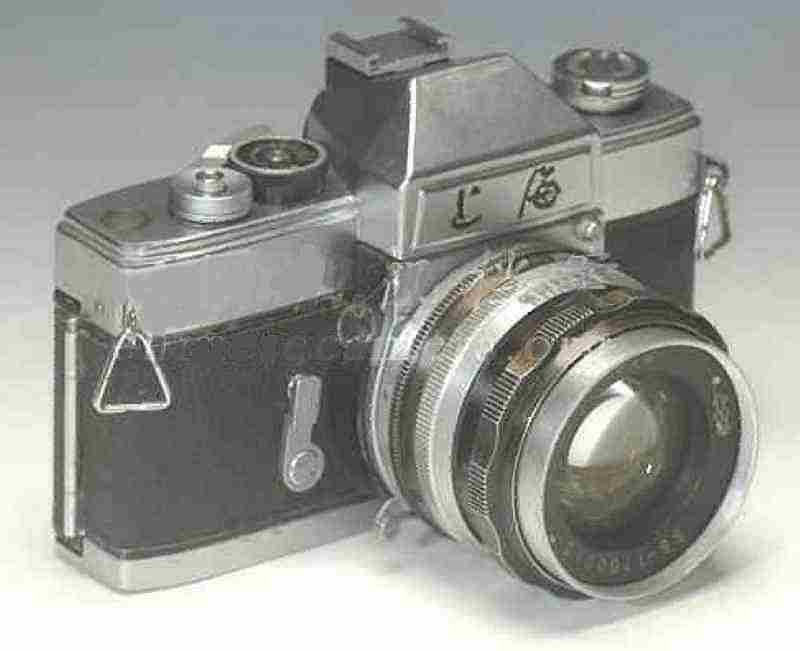
One of the Shanghai factory’s most ambitious cameras was a 35mm SLR called the Seagull DF. The letters DF are included in the first two digits of the camera’s serial number and is said to come from the Chinese word 单反 or Dānfǎn which translates to English as SLR. Work began on the DF as early as 1964 when an unnamed prototype resembling the final product was first shown.
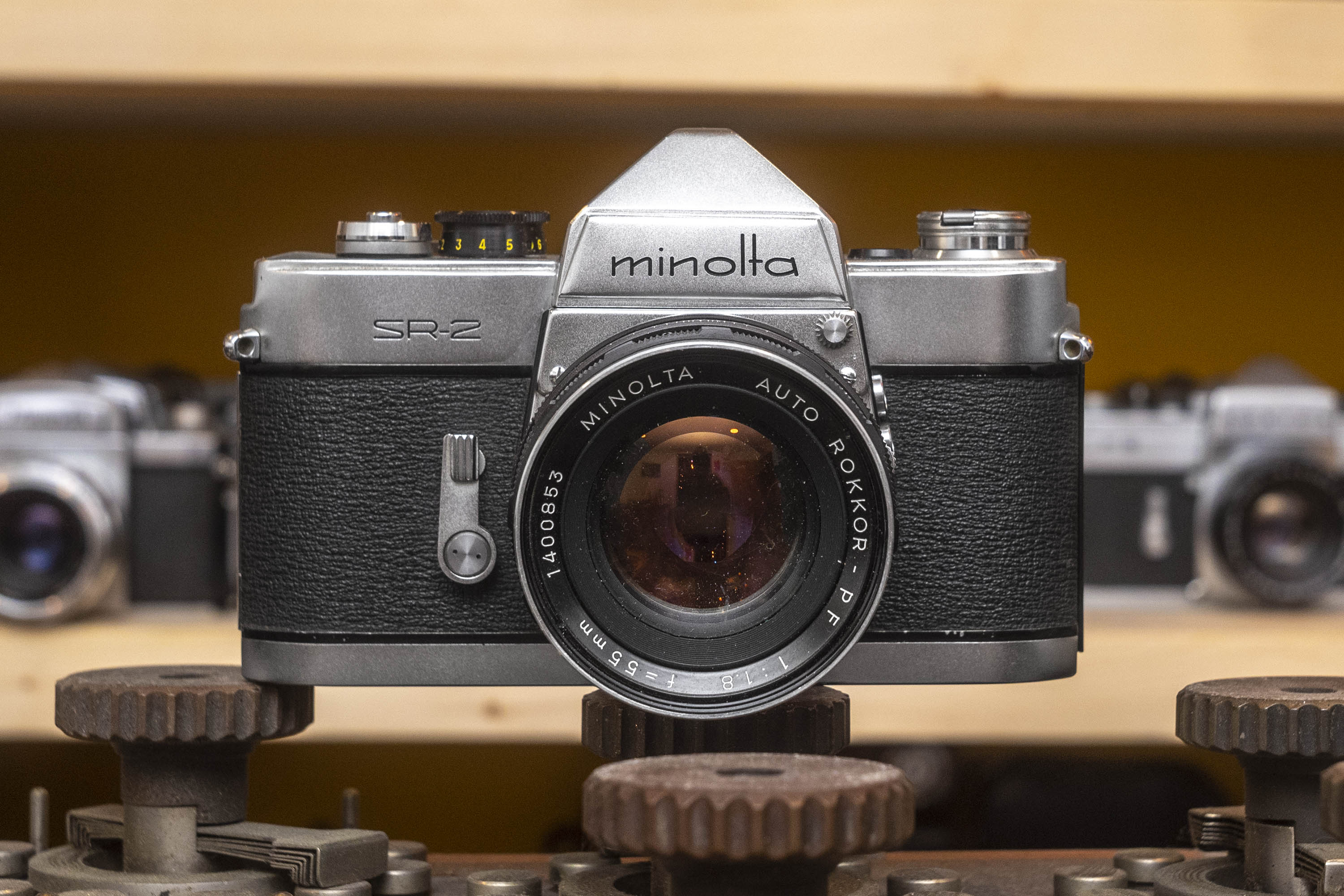
The as yet unnamed SLR took heavy inspiration from the Minolta SR series, namely the SR-2 from 1958. The camera shared the Minolta’s SR bayonet mount, cloth focal plane shutter, and similar body design. In an unverified and poorly translated Chinese language article, the reason for the close resemblance to the Minolta SLR is thought to have been that engineers at the Shanghai factory found the Minolta’s design was the easiest to duplicate. Unlike later cameras in the Minolta SR series however, the new Chinese camera did not come with any sort of light meter, nor did it have a provision for one. Also unlike the Minolta SLR, the Shanghai was equipped with a mirror lock-up device and a provision for a motor drive which was never developed, two things that did not exist on the Minolta cameras.
Shanghai’s new SLR would exist in prototype form until 1966 when the camera went into widespread production and was officially renamed the Seagull DF. The new Seagull camera proved to be a popular seller, not only for its close resemblance to the successful line up of Minolta SLRs, but also its relatively good performance, high quality, and the optics of its 58mm f/2 lens which was a copy of the Carl Zeiss Biotar.
Variations of the Shanghai DF would be very popular in China, staying in production until at least the 1980s, but in February 1973, a decree by the Chinese government to release a more “professional” version of the DF was made, tasking as many as six factories in the Huaying area of the Chinese province of Sichuan to build it. The reason for six factories was that each was responsible for a different part of the camera’s construction.

Initial design work was done at the Mingguang Instrument Factory where over 1300 individual parts were created for the new camera. The inspiration for the interchangeable pentaprism was taken from the Japanese Nikon F, a design that can easily be spotted simply by looking at it. On December 25, 1973, the Mingguang factory presented the first prototype which they called 美多 (Good and More). This original name was never used for the final camera because it was determined to be too expensive to secure a new trademark, so instead 珠江 (Pearl River) was chosen.
Once the new Pearl River camera was ready, the Mingguang factory also handled assembly of some parts of the film transport and final assembly. Between the other five factories, the Huaguang factory produced lenses, the Xingguang factory built the body and pressed the metal needed for the film door, lens cap, and parts of the viewfinder, the Jingguang factory built the shutter, delayed action timer, and other precision parts, and both the Jinguang and Yongguang factories handled final assembly along with the Mingguang factory. The reason for this joint cooperation between multiple factories was to build upon specialties of technicians working in each factory. Although the new camera was built through a group effort in multiple locations, only the factory where final assembly was made would be recorded, as serial numbers for Mingguang, Jingguang, and Yongguang would have the prefixes “M”, “J”, and “Y” in front of the camera’s serial number.

Official production for the Pearl River began in 1974, however final copies trickled out of the factory slowly. From 1975 to 1976 about 50 cameras were finished each year, many of which had improvised and one-off hand made manufactured parts. Mass production of the camera did not happen until 1977 when full assembly lines would be complete. An estimated 700 copies were produced in 1977 with more to come.

In addition to the camera bodies, lenses for the Pearl River S-201 were produced as well. These lenses all shared the Minolta SR mount, so would have worked with other Chinese SLRs like the Panda DF, but since these were actually labeled with the “Pearl River” name on the vanity ring, I’ll refer to them as being for this system.
- 28mm f/2.8
- 35mm f/2.3
- 58mm f/2
- 105mm f/2.5
- 135mm f/2.8
- 45-90mm f/3.5 Zoom
- 80-200mm f/4.5 Zoom
Within China, the Pearl River S-201 received widespread recognition winning several awards for quality and innovation. Starting in 1980, production numbers grew rapidly year over year. By 1985, over 8000 units were finished with 10,000 in 1986. The Pearl River S-201 was popular in China, but was also sold in Hong Kong, Singapore, and in Southeast Asia. I have found inconclusive information whether the camera was exported to western countries. Some sources say they were, but I have never found any promotional material or references of them being sold there. If someone has any evidence of this, please let me know in the comments.
In his book about Chinese cameras, Douglas St. Denny suggests the Pearl River S-201 had a price of 690 RMB yuan, but he does not clarify which year this was, whether that was body only or with a lens, or provide any other source for that price. According to Chinese camera collector Norris Liu, back in 1979, an average middle class monthly wage was between 70 to 80 yuan meaning that if St. Denny’s price was correct, purchasing one of these cameras would have required nearly 80% of one person’s annual wages.
Coming up with any sort of meaningful comparison to 2026 US dollars would be impossible, so I’ll just hypothesize that the camera was on the pricey side for the average Chinese middle class family, but still within reach for someone who really wanted one.

By 1985, the appetite for a more advanced camera resulted in an updated version called the Pearl River S-205 which added a TTL CdS exposure meter and an LED match needle display in the viewfinder. In addition to these features, a redesigned all black plate around the mirror box was created, but the mirror lock up feature was removed.

In 1986, the Japanese company Asahi Optical would outsource production of its popular Pentax K-1000 to a Chinese factory in Hong Kong and as a side effect of that, a simpler version of the Pearl River with a fixed prism called the S-207 began production with a design and specifications similar to that of the Pentax K1000. It is not clear whether this simpler S-207 still used the Minolta SR mount or switched to the Pentax K-mount of the K-1000. Early versions of the Pearl River S-207 featured Chinese characters on the face of the pentaprism, but shortly after a version with English characters was produced, suggesting an attempt was being made to export the camera to English speaking countries. Whether or not this actually happened is unclear.
In the years that would follow, a great deal of SLRs for the domestic and export market would be made in China. With the country’s growing capacity for building things inexpensively, companies like Nikon, Canon, Minolta, and even some German companies subcontracted production to Chinese factories and with home market versions of name brand cameras, unique marques like the Pearl River became less and less common.
Today, China is one of the largest producers of cameras and other photographic gear in the world. The ability for Chinese manufacturers to build things approaching and in some cases, surpassing the quality of Japanese and other camera makers is something that is common today. Although the Pearl River S-201 is largely forgotten by most photographers, its place in the history of Chinese cameras is irrefutable.
My introduction to the Pearl River S-201 came from the collection of Kurt Ingham, who seems to have had an interest in Chinese cameras as he had many. Prior to acquiring this collection, I had seen a few Seagull SLRs and the usual spattering of folding cameras like the Seagull 203 and the Great Wall DF-3 medium format SLR, but I was not aware of any 35mm SLRs with an interchangeable viewfinder system.

That first Pearl River S-201 is the one in this article with the waist level finder, and although it was in physically nice condition and had a working shutter, the take up spool was damaged as if someone had hit it with a hard object, breaking the plastic into many pieces. I made a valiant attempt to see if I could piece it together enough to be able to shoot a test roll, but it was not going to happen. I put that camera on my shelf where it sat for nearly two years before I befriended Chinese camera collector Norris Liu who said he had a way to get Chinese cameras direct from China for reasonable prices, all I’d have to do is be patient. I asked him to look for a working example and a couple of months later, I had this second one with the pentaprism viewfinder in my hands.
The first time you pick up a Pearl River S-201, its heft is immediately apparent. Despite these cameras being produced well into the 1980s, it is clear that the Chinese camera industry was at least a decade behind the Japanese as this all metal and glass SLR has very little plastic (except the plastic take up spool which shattered on my first example). At 950 grams with lens attached, the camera has a very 1960s weight and feel to it.
Beyond its lack of weight saving plastics, the various controls have a feeling of crudeness to them. Whenever someone reviews a precision German camera like a Leica and attempts to compare it to a more run of the mill Japanese camera, they often say something like “German build quality” and the Pearl River S-201 is like that, except in the opposite direction.

Cosmetically, both Pearl Rivers are behind even the most economically priced Japanese cameras as fit and finish on both cameras is average at best, with engravings of the shutter speed numbers on the speed dial and Pearl River lens thin and unevenly painted. The black paint or enamel finish on both bodies is coarse and appears to be oxidizing and fading away. Metal surfaces inside the film compartment have very obvious machining marks suggesting that ultimate precision was not a priority at the time this camera was made. Another strange oddity of the Pearl River S-201 is the chrome plate around the lens mount which does not match the black paint of the rest of the body. The contrast of this plate is so out of place it looks as though it was a replacement part, but every version of this camera I’ve seen has it, so it must have been an intentional part of the design.
Although I acknowledge I am being pretty negative in my initial assessment of the Pearl River S-201, I hesitate to trash the build quality of the camera too much because overall, these two cameras are mostly in good working order. Whatever corners might have been cut in their construction hasn’t rendered the cameras completely inoperable.
The Pearl River S-201 is a completely unique camera which is not a copy of or even based off any single Japanese SLR. If I blur my eyes while looking at it, I see subtle Nikon F influences, especially in the design of the pentaprism viewfinder. It would be easy to look at the Pearl River S-201 and say that because it uses the Minolta SR mount, it must be a copy of a Minolta camera, but that’s not true either. Beyond having a layout which is consistent with a large variety of Japanese SLRs from the era (Minolta included), the Pearl River S-201 should not be referred to as a copy of any one single camera.

Looking at the top plate, a rewind knob with fold out handle is on the right, where it exists on a huge number of other cameras. Below the rewind knob and facing the side of the camera are two round holes which are used to mount an optional accessory shoe. You can see this shoe mounted on the S-201 in this article which has the waist level finder, although it could be swapped between the two. While adding an accessory shoe was probably a worthwhile option, that it doesn’t have a hot shoe connection seems like a missed opportunity.
The center is dominated by the interchangeable viewfinder. On my two S-201s, one has the eye level pentaprism, and the other is the waist level finder. Like most SLRs, the WLF is just a hood, as the camera can be used without it. A button below and to the right of the rewind knob is the release for the viewfinder. Press this while lifting up to remove it.

To the right is the shutter speed dial with speeds from 1 to 1000 plus Bulb and an X-sync setting between 30 and 60. Also on this dial is a film speed dial with only DIN speeds from 9 to 36. To change speeds, lift up on the outer ring of the shutter dial and rotate it. The presence of this setting is strange considering the S-201 lacks any sort of metering, so this would only be used as a reminder. A later variant called the Pearl River S-205 would eventually come with a TTL meter, however this camera would not be released until 1985, more than a decade after the debut of the S-201. Whether this camera was originally supposed to have a meter but was never finished, is unclear. Next, is the film advance lever and cable threaded shutter release in the lever’s axial center. The wind lever has a fairly long 210 degree motion, but thankfully is geared so that several smaller motions can be made to fully advance the film and set the shutter. Finally, on the far right is the automatic resetting exposure counter.

The back of the camera has little to see other than the camera’s serial number which has a letter prefix to indicate which of three factories it was assembled in. Both my S-201s have a “Y” which is for the Yongguang Instrument Factory in the Chinese province of Sichuan. On the right are the words “Made in China” which hints at the possibility that these cameras could have been exported.

The sides and bottom have little to see with the bottom having only a a 1/4″ tripod socket in the center and the rewind release button. At the end of a roll of film, pressing the rewind button had a nice click, clearly indicating that the film transport had been deactivated. Both sides of the camera have forward angled metal strap lugs which help balance the weight of the camera with heavier lenses mounted.

The camera’s left side has two flash sync ports, one for X and the other for FP. On its own, the Pearl River S-201 lacks any kind of flash shoe, but an optional accessory which slips in under the rewind knob adds a floating cold shoe. This works well enough for attaching a flash to the camera, but must be removed each time you need to rewind film.

Opening the rear film door is done by lifting up on the rewind knob and giving it a swift tug. The right hinged film door reveals a typical, although basic film compartment. Film transports from left to right onto an integrated and double slotted take up spool. Inside the film door is a black metal pressure plate covered in small divots to reduce friction as film passes over it. Inside the door hinge is a black fabric light seal which on both cameras seemed to still be doing its job. No other light tight protection is present in the door channels. Beyond this, the only other comments I have about the film compartment is that in many spots you can see rough machining marks which suggest the crude construction of the Pearl River S-201.
Although both my S-201s have a serial number which indicates they were assembled at the same factory, the two lenses I have mounted to them do not. While they both have both the English and Chinese names for “Pearl River” on the vanity ring, the one with the YT serial number has a 58mm focal length and the HG serial number is 50mm. Both lenses have a maximum aperture of f/2. Almost certainly, the 58mm f/2 lens is a copy of, or at least strongly based on the Soviet Helios 44, which itself was based on the Carl Zeiss Biotar, but I am uncertain of the make up of the 50mm lens.

Beyond the focal length, the two lenses have many other cosmetic and functional differences. The version with the YT serial number has a more crude design and was likely built before the HG serial number lens. The YT lens has thin engravings which appear to be of lower quality and somewhat resemble that of a Soviet lens like the Helios. The HG lens however looks to be of higher quality with everything engraved in thick, and well painted numbers. The typeface of the numbers and the coloring strongly resemble that of an Asahi Takumar lens, possibly suggesting the Chinese factory that made this lens built it around the time the Pentax K1000 was being made in Hong Kong. Another difference is in the focus ring which on the YT lens is entirely metal with the HG one having a rubber grip.
Functionally, the YT lens stops down to f/16 and the HG lens has an additional stop down to f/22. The minimum focus distance of the two lenses is different with the YT lens only going to 2 feet / 0.6 meters and the HG going down to 1.55 feet / 0.45 meters. Even stranger, both the aperture and focus rings rotate in completely opposite directions, with the YT lens going left to right from f/2 to f/16 and minimum to infinity focus, whereas the HG lens goes in the opposite direction from f/22 to f/2 and infinity down to minimum focus distance just like Asahi Takumar lenses do.

Up front, the Pearl River S-201 has the Minolta SR bayonet mount, so Rokkor lenses from as far back as the Minolta SR-2 should mount to the camera. I did notice some sample variation between certain lenses suggesting the tolerances of the Chinese camera and its lens isn’t up to the same level as Japanese made lenses so there could be some compatibility issues but for the most part, I believe most Minolta lenses should work OK. Near the 2 o’clock position around the lens mount is the bayonet lens release button, which is similar to where it exists on Minolta cameras. Swapping the lens is as you’d expect, lefty loosey, righty tighty.

On the opposite side, near the 10 o’clock position is a mirror lockup lever which holds the mirror in the up position to reduce vibration due to mirror slap. Finally, on the front of the body, to the left of the lens mount is the mechanical self timer lever. With the self-timer wound up, the shutter release does not activate it, rather a small silver button behind the lever is what triggers the approximate 8-10 second countdown.

I have one each of the pentaprism and waist lever viewfinders on my two Pearl River S-201s and they are mostly the same with the only difference being that the waist level finder has a flip up magnifier for precision focus and that the WLF is a bit brighter. The focus screen has a 45 degree diagonal split image aide with a ground glass collar around it. Outside of the ground class collar is a fine Fresnel pattern which helps boost brightness all the way to the corners. Viewfinder brightness is pretty good, and better than I expected for a mid 1970s Chinese camera, but wouldn’t be up to par with that of the brightest Minolta or Nikon cameras of the same era. Since this camera lacks any sort of metering, there is nothing else to see in the viewfinder.
The Pearl River S-201 is an interesting camera. On one hand, it is a crude and simple all mechanical camera with more in common with a Soviet Zenit than a Minolta SLR, but that it features a lens mount to which a great deal of excellent lenses are compatible with it and it does support interchangeable viewfinders suggest it might be a step up from a true entry level camera. In his book about Chinese cameras, Douglas St. Denny suggests that the Pearl River S-201 used to be very popular in China with them often being found “swinging from the necks of Chinese touring the Great Wall”.
When it came time to load some film into the Pearl River S-201, I could have done what I often do and put in a roll of bulk Kodak TMax 100 of which I still have a ton of, but I felt like shooting a Chinese camera begged to shoot some Chinese film, but without any in my inventory, I made a quick order for some Luckypan SHD 100 from Midwest Photo. If that roll went well and I felt compelled to shoot some color, I also threw into my cart some Lucky C200 color film as well.


The Pearl River S-201 is a Chinese SLR with a vague Japanese design, which uses a Minolta lens mount and a lens which is based off a Soviet design which itself is a copy of the Carl Zeiss Biotar. The first question I had when shooting the camera was how much of that “inspiration” would show through to the final images.

When I finally finished that first roll of Lucky 100 and I got my first look at the images, I realized that the people who built this camera used their inspiration well and put together a pretty capable photographic instrument, because the images turned out great! Every image on that first roll was extremely sharp across the frame with little to no vignetting or softness near the corners. Clarity and contrast were impressively high in all of the images with the lens stopped down for outdoor shooting. A tiny bit of softness crept in when opening up the diaphragm for indoor shots, but nothing you wouldn’t have seen on the original Soviet or German designs. In addition to excellent images, all of the shutter speeds I used were correct without any capping or partially dark images. Even the film transport, which was the problem on the first Pearl River I had, was working correctly as frame spacing was correct throughout the entire roll. I never did shoot that roll of color Lucky film, but if I ever do in this camera, I’ll be sure to come back and update it with the images.

The shooting experience with the Pearl River was good but not perfect. Although I did not experience any issues with the film advance, winding the camera to the next image was a bit tight, but that likely could be a result of dried or stiff lubricants in the camera. In addition, the viewfinder was a tad darker than a contemporary German or Japanese camera would have been, but it wasn’t anything that impeded my ability to see focus.
The camera’s ergonomics are straight out of the late 1960s with no surprises. Picking up the camera did not require me to read the user manual as all of the camera’s controls were exactly where my fingers expected them to be. It is clear that the workers who built this camera did their research and designed a camera that did everything it was supposed to do, without any drama or unnecessary complications.

I have no real cons to the camera other than its tightness, which is almost certainly due to age, and poor finish. Any features it could have had, like perhaps a hot shoe, a wider range of shutter speeds, and maybe some automation would have only made the camera more complex, expensive to build, and prone to problems. For workers in an industry without a great deal of camera making pedigree, the people responsible for creating this camera did a great job.

There are a lot of things that can go wrong shooting old cameras. Whether you can manage to get through an entire roll without problems has little to do with its age or where it was made, rather how well it has been taken care of and how recently it had been serviced. Without any prior knowledge of the history of my two Pearl River S-201s, I can only speculate that these cameras were built well enough to stand the test of more than four decades of time.
When you forget that you have a Chinese camera in your hands and just think of it as an all mechanical manual focus 35mm SLR, the experience was quite good. The worst thing I can say is that the camera was a bit stiff, but there was nothing bad enough to make me hate the experience, or ruin the images I got from it.
I believe that whoever was the target customer for these cameras when they were new, were likely very happy with theirs. Assuming when new and properly lubed, the cameras were a bit smoother in use, but being from a country not regarded by Western collectors as makers of fine precision cameras, the Pearl River S-201 does a pretty good job. I am extremely happy to have had two chances to own a Pearl River S-201 and shoot one of them. I don’t know that its a camera I will come back to often, but I like the history and look of this camera, and am very happy to have one in my collection.
Related Posts You Might Enjoy
External Links
https://camera-wiki.org/wiki/Pearl_River_S-201
https://indodreamin.blogspot.com/2008/03/pearl-river-zhujiang-s-201-camera.html
https://knippsen.blogspot.com/2017/09/pearl-river-s-201-geschichte.html
https://knippsen.blogspot.com/2017/09/zhujiang-pearl-river-s-201.html
https://min.news/en/economy/d80805b44a500f8fbc6ba3a30a3daf5a.html
This is a great review, Mike, and a nice broad analysis of the Chinese camera industry as a whole. Lots of information that was new to me and the images are surprisingly good, given my limited experience with Chinese lenses. Like the Soviet bloc cameras in general, I think there were significant issues with quality control, but if you got a good example, it was pretty darn good! Andy
Interesting review. I noticed on my S-201 copy, that the lens latch is a different design to that on both other Chinese SR mount cameras, as well as, of course, Minolta cameras themselves. It has a notch in the Pearl River lens mount face, Nikon F and Pentax K style. The lenses themselves also have the notch in the bayonet tab normally used by SR mount lenses. So, Pearl River lenses can mount on other SR mount cameras, but other SR mount lenses can mount to the S-201 camera, but, lacking the notch in the mount face, are not locked on the camera while in use. I’m not sure if the same is true for your copy.
I have copies of Seagull DF, Panda and the later Peafowl DF_1, and the S-201. I am fairly certain that all those cameras used the same shutter design, as you point out, a quite good design. I have disassembled and worked on the Seagull and Peafowl models and confirmed this, but not the other two which needed no work done. The shutter can be removed from the camera fully working, just like a Copal or Praktica metal blade shutter could, a quite interesting design feature and one which supports the idea of different parts of the camera being made in different factories.The Seagull shutter I worked on had been stored in a damp place perhaps for decades, but with a little lubrication and a few operations returned to perfect working order right down to the longest opening times. I was quite impressed with it.
The later 50mm F/2 lens looks very similar to a Pentax lens, and can also be found with PK mount on the front of locally badged K-1000 type cameras, with an incredible number of different badge names. Despite the appearance, it is not a Pentax 50mm F/2, 5 element lens made locally, but a 6 element 6/5 design which I think was also designed locally.
Very interesting! So thanks to the Chinese Minolta X1 was not the only Minolta with the interchangeable viewfinder. I would just like to add some historical background. Soviet influence in China died out by the early 1960s not because of influence from Japanese companies but because of the Sino-Soviet split. It started in 1956 and by 1961 both countries were enemies on the verge of the war. During the terrible time of cultural revolution (1966-1977) nobody could have any influence in China as everything was controlled by the state. The Pearl River S-201 was produced by state order in former military factories and could be popular in China only in state propaganda. Just about 50,000 were produced in total and the majority were exported. I guess there are more Pearl Rivers in the US now than in China. The real mass production started with economic freedom and Japanese companies moving complete assembly lines to China around 1990. Minolta transferred the production of its basic model x-300 to China roughly at the same time as Pentax. I own a Chinese made Centon DF-300, which is a rebadged Minolta x-300, but Chinese sold it also as Seagull, Vivitar, Soligor, Kalimar, Carena, Revue, Kinon etc. etc.
Production of the Pentax K1000 originated in Japan, then was moved to Hong Kong, and finally to China about 1990. We who repair these cameras can spot the Chinese-built examples just by looking into the viewfinder: They are very prone to desilvering on the glue line where the two halves of the pentaprism are joined.
Hey Mike, I was able to acquire one of these a couple years ago with the 35mm f/2.3 and 135mm f/2.8 lenses, though unfortunately the 135mm has fungus. By my own research, the majority of Pearl River lenses were adaptations of foreign designs, such as the 105mm and both zoom lenses being heavily based on earlier Nikkor variants, so much so that one could claim they are Minolta SR mount Nikkors! The 35mm wide angle lens, interestingly enough from what Chinese-language sources I could find, was held in the most esteem by the fledgling Chinese camera industry and by the government because it was an entirely new, original domestic design that reflected national optical engineering advancement. One oddball I was able to find, however, is a lens adapter without any official designation that is clearly factory mass-produced, which specifically mounts the 90mm f/3.5 lens of a Great Wall DF to the Chinese SR mount cameras at proper flange focal distance to use as a minor telephoto/portrait lens. Who knew the Chinese were looking for cross-platform compatibility?
An anecdotal story I lost the source of was that the five Sichuan factories were inherently involved in the defense industry, having been built in the 1950s in the Chinese interior to be protected from foreign invasions and bombing. A head technician on the S-201 project had recounted that the Chinese had, in the 1960s, interdicted a shipment of Soviet sniper rifles to North Vietnam at the request of the Vietnamese to reverse-engineer them and produce them under contract for use against the Americans. He recalled that in a matter of only a few weeks, the factories had studied and copied every single part, including the optical scopes, and proceeded to send every rifle to North Vietnam, never to be seen again. Because the proxy conflicts in Southeast Asia were winding down by the early 1970s and Nixon’s detente with the People’s Republic, the Chinese government assigned the S-201 project to these five factories as part of a larger national push to convert major military installations to commercial production, in fact setting an early foundation for the later explosion in electronics production in China. The S-201 is celebrated quite literally as a symbol of China’s transition from a Soviet-influenced martial power to the world’s workshop.
A very cool story Turner! Thank you for sharing, and that would be cool to find one of those Great Wall to Pearl River adapters! I have a Great Wall DF-3 and it uses an M39 mount but with a longer flange distance, so whatever adapter was made, probably wouldn’t be difficult to recreate.
I am Chinese.its the first time I see a pearl river s
205, I don’t think that it’s a real products for selling. I cannot find any information on Cinese internet,It may just is a experimental product. Anyway love your article. I learn a lot.
I am glad you enjoyed the review. It is very possible the S205 was never made for sale and only existed as a prototype. The image I used came from Wang Shiyuan’s camera book so it had to have existed at some point.
There is a enlarged model of the S201 at a pedestrian overpass in present day Chongqing, on the site that Mingguang (the Huaying factory that inherited most of the Pear River business) operated in the 1990s, to commemorate the factory’s legacy. They folded civilian operation in 2000 and went back to their 1960s role as a military supplier.
That is really cool, I’d love to see a photo of that model if anyone has it or knows where it can be seen online.
In fact,the s-201 can match with a specially-made night vision device,which might used for investigation activities.