
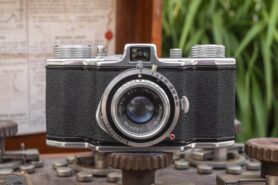
The Dr. Wöhler Favor II is a scale-focus viewfinder camera produced between 1950 and 1957 by Dr. Wöhler, an optics firm in Saarland, West Germany better known for binoculars and microscopes than cameras. Saarland's unique postwar status as a French-protected territory (separate from Germany between 1947 and 1957) meant French companies could manufacture goods there without the steep tariffs applied to German imports, and the Favor II was likely built primarily for export to France. It followed the original 1949 Favor, distinguishing itself with an upgraded Prontor-S shutter (top speed 1/300) and a faster 4.5cm f/2.8 Docar three-element lens, compared to the slower f/3.5 lens on the Favor I. Little is known about the company's history or the identity of "Dr. Wöhler" himself, and surviving examples are quite rare today.
Handling the camera, the author was impressed by its build quality, solid all-metal body, shiny chrome, and well-preserved body covering, along with straightforward ergonomics including a rewind knob, exposure counter, accessory shoe, threaded shutter release, and a simple but bright scale-focus viewfinder. Unfortunately, the specific copy tested had significant problems: the lens suffered from severe haze and apparent coating damage, and the film transport was gritty and inconsistent, requiring the rewind button to be held down manually before advancing film rather than working as described in the manual. Despite these issues, test shots on Kodak TMax 100 suggested that a clean lens would have produced solid center sharpness and decent contrast, with some softness in the corners.
Overall, the author found the shooting experience pleasant despite the mechanical faults, praising the camera's comfortable shape, natural shutter release placement, and well-designed aperture ring linkage. While the Favor II doesn't do much to distinguish itself from other similar mid-century German leaf-shutter cameras beyond its unusual appearance, the author concludes that a properly functioning copy would likely have delivered nice results and represents a solid, if unremarkable, camera of its era.
AI-generated summary. May not capture every detail — read the full article below for the complete picture.
This is a Favor II, a scale focus viewfinder camera produced by Dr. Wöhler Saar in Saarland, West Germany between the years 1950 and 1957. The Favor II is a slight update to the original Favor from 1949 adding an improved shutter and one of two different f/2.8 lenses. The Favor II has a distinct all metal body and features surprisingly good build quality and ergonomics for a simple camera from a company not known for making cameras. Although built in Germany, the region of Saarland where the camera was built was in a French Occupation Zone and as such was a popular export to France.

Film Type: 135 (35mm)
Lens: 4.5cm f/2.8 Dr. Wohler Docar coated 3-elements
Focus: 0.9 meters to Infinity
Viewfinder: Scale Focus Glass Viewfinder
Shutter: Prontor-S Leaf
Speeds: B, 1 – 1/300 seconds
Exposure Meter: None
Battery: None
Flash Mount: Cold shoe and PC Flash Sync
Weight: 440 grams
Manual: https://cameramanuals.org/pdf_files/favor_dr_wohler.pdf
 The Dr. Wöhler Favor II is a camera I more recently came to learn about. Despite reviewing and collecting cameras for over a decade, on occasion things still come along which I’ve never seen before. The first time I saw a Favor, I was enamored with its appearance. This is a camera that doesn’t look like much else out there, and with shiny bits of chrome all over the body along with what seemed like a quality piece of body covering, I was eager to get my hands on one.
It doesn’t take too long to Google “Dr Wohler Favor” and get one of a couple pages that tell you this German camera was made in the early to mid 1950s by a company more well known for making binoculars than cameras. After reading this factually correct, but extremely thin history of the company who made this camera, I wondered who was Dr. Wöhler, what was his first name, why did they get involved in making cameras? Sadly, I don’t have answers to those questions.

More interesting than the company however, was the area in which this camera was built. While I don’t claim to be an expert on World War II, I learned of an area in western Germany called Saarland, which has a higher than usual concentration of French citizens living there. Reading about the history of Saarland, I discovered this was once a contested part of Europe that at various times throughout history has been claimed by both Germany and France. The region’s history goes back to the 1600s and according to Wikipedia, changed hands between emperors and kings of various territories many times. As recently as 1920, the Saarland was classified as a distinct political entity known as the Territory of the Saar Basin. Under British and French rule, a large number of French nationals lived in the Saarland and a variety of industries were setup including a factory in St. Ingbert where various products were made for the French market.
 In 1935, after a referendum vote where over 90% of Saar citizens chose reunification with Germany, the Saarland was returned to the German government where it would remain through World War II. After the war when the Allied Partners were splitting up the Allied Occupation Zone, a special consideration was made for the Saarland to give full control of the region back to France rather than make it part of the official French Occupation Zone under Allied rule.
Between the years of 1947 and 1957, the Saarland was known as an independently governed but French protected territory known as the Saar Protectorate or Protectorat de la Sarre in French. At this same time, many European nations, including France, levied very high taxes and tariffs on German goods, making the cost of them very high in other countries. Since the Saarland wasn’t officially part of Germany, French companies could produce things there and export them back home without paying the stiff penalties.

Perhaps the most famous camera produced in Saarland isn’t a Favor, but one of about 400 Leica cameras made in a factory in Saroptico, St Ingbert between the years 1949 and 1950. These Saarland produced Leica IIIas are built of prewar parts and assembled there for sale in France. A small batch in the serial number of range of 359xxx were produced with an additional engraving which says “Monté en Sarré” making these some of the rarest and most sought after Leica cameras.
Elsewhere in St. Ingbert was another optics firm called Dr. Wöhler, Optische Fabrik, Saarbrücken, who produced a large number of binoculars, microscopes, and other optical instruments around the same time. Perhaps for the same reason Saar Leicas were built for export to France, at the Dr. Wöhler factory, an all new and less expensive camera called the Favor would begin production in late 1948/early 1949. These early models were branded as Dr. Wöhler Kassel and differ from later models as not having an accessory shoe. I am unsure of who Dr. Wöhler was, or even if there was a real person with that name or if it was just made up to make the factory sound more “official”.

Models sold after 1950 were called the Favor I and Favor II but the only difference appears to be the lens and shutter combination. Favor I cameras have a slower f/3.5 Trinar or Citar lens, and the Favor IIs have a faster f/2.8 Docar lens and a shutter with a top 1/300 speed. A third model, which is thought to have been made in 1958 is called the Favor Auto and it replaces the film advance knob with a lever and relocates the accessory shoe to the opposite side of the camera.
According to the English language manual for the Dr. Wöhler Favor II, the camera could be had with both Pontor and Compur-Rapid shutters. A four-element 4.5cm f/2.8 Rectar may have also been available, but in my research for this article, I was unable to find an image of one.

The Dr. Wöhler Favor was almost certainly produced for sale in France to get around high tariffs applied to German imported goods, but that an English language manual does exist suggests it might have been exported elsewhere, but exactly where, I cannot be sure. I sincerely doubt it ever made it to the United States and as a result, I won’t even begin to guess how much this camera might have cost. The ad to the right suggests the retail price for the Favor II was 24.900 Fr, which if I had access to a French camera catalog of the same era, I could compare it to other, more well known cameras, but unfortunately, I do not have that information.
For such an unheard of company who produced three versions of the same basic camera, the Dr. Wöhler Favor was produced for a decently long time. I do not have any idea of production numbers, but it likely wasn’t very high judging by how infrequently they show up for sale. As I write this, an eBay search for Favor cameras produces only 4 for sale in the world. After whatever time the Favor Auto was discontinued, there is no evidence that this company produced any other camera.

The Dr. Wöhler Favor is one of those cameras that I didn’t know existed until recently, and as soon as I saw one, I had to have one. The day the postman delivered the Favor to my doorstop, I eagerly tore into the package to handle the camera for the first time. My first reaction to this camera was that it was a bit chunkier than the pictures online suggested. While I wouldn’t say the camera is heavy, at a weight of 440 grams, the camera does not feel light. The proportions of this camera are short but wide, and perhaps it is this low top plate that suggests a much lighter camera than it really is. In handling the camera, I was impressed with the build quality. The chrome plating on the top and bottom panels is very shiny and well done. The body covering has a nice feel and shows no major signs of peeling, cracking, or otherwise coming off. Finally, all the camera’s main controls turned as they should, and without any excessive grit or resistance. Sadly, the lens was badly hazed with what appeared to have been a complete removal of the front coating. Although the camera appeared to work fine, the condition of the lens would definitely show up in images shot through it.

The Favor looks and feels good and this general good vibe continues with its ergonomics which I found to be pretty straightforward to use. Up top, the camera has rewind and film advance knobs in the usual locations with the film advance knob being slightly larger in diameter. To the right of the rewind knob is the additive exposure counter which shows the number of exposures made on the current roll. The exposure counter must be manually reset after loading in a new roll of film by turning the dial in the direction of the arrow.

Next is the viewfinder hump, and next to that the accessory shoe. Although resembling a traditional cold shoe that would appear on the top of many cameras, the one on the Favor is a bit smaller, so usual accessories will not work. Immediately to the right of the shoe is the rewind release button which deactivates the film transport for rewinding film. Above this button is the shutter release. The shutter release is externally threaded which means it will work with “Leica style” cable releases. In front of the shutter release is a sliding switch for activating “Timed mode”. When combined with the “B” speed on the shutter, the shutter can be opened and with this lever slid to the “T” position will keep the shutter open until you slide this switch away from the “T” setting, at which point the shutter will close.

The sides and back of the camera are pretty bare with little to see, not even strap lugs. The base of the camera has a centrally located 3/8″ tripod socket and a rotating lock for opening the film compartment. A flip and twist of this lock will allow you to remove the back and bottom of the camera.

The film compartment is pretty simple with left to right film transport onto an integrated metal take up spool. To load film, stretch the leader across the film gate and insert the leader into the single slot in the spool and then rotate the spool in the direction of the arrow. Film winds clockwise on the spool which is opposite of how it is in the cassette. The inside of the film door has a small black metal pressure plate with a brushed metal texture. The camera’s serial number is engraved below the film gate and the film compartment has no light seals of any kind, so there is nothing to have to replace.

Looking down atop the lens and shutter are the rest of the camera’s critical settings. Closest to the body is a lever for the diaphragm. A scale is engraved into the metal from f/2.8 to f/16 and a slider moves left and right pointing at whichever f/stop you’ve chosen. All of the f/stops are painted filled in black except f/8 which works with the 4 meter mark on the focus scale for using the camera to shoot “focus free snapshots”. In front of the aperture scale is the shutter cocking lever. The Favor II does not couple the film transport to the shutter, so this step must be done manually before each exposure. Next is the rim set ring around the Prontor-S shutter with speeds from 1 to 1/300 plus Bulb. In front of that is a fixed depth of field scale, once again with f/8 marked in red, and in front of that, the focus scale marked in meters from 0.9 to infinity.

Up front, the Dr. Wöhler Favor has a Prontor-S rim set shutter which works like most leaf shutters of the day in which shutter speeds are changed via a ring around the perimeter of the lens and aperture changed using a small handle on the side. This version of the Favor II model has a higher top 1/300 speed, but all Favor cameras have a decent selection of speeds down to 1 second plus Bulb. The Prontor-S shutter on this camera has a self-timer lever near the 4 o’clock position around the lens. As with all untested mechanical shutters, you should avoid using the self-timer unless you know for sure it works correctly.

The viewfinder on the Dr. Wöhler Favor is of the simple optical type. These types of finders are extremely small, however due to a very small magnification ratio, you can still see all four edges of the composed frame even while wearing prescription glasses. Another benefit to this style of early viewfinder is that with simplicity comes brightness, and a look through this finder will allow you to compose your images in all but the worst light.
Now with a basic familiarity of the camera, it was time to test it out. In the time I played with the Dr. Wöhler Favor, I had some concerns with the film transport. It felt as though the camera behaved okay with nothing loaded in it but as soon as film was in there, the film didn’t feel like it was moving properly. Having fiddled with the camera a bit, I wanted to give it a try, so I loaded up a short 10 exposure roll of Kodak TMax 100 took it out to shoot.


I didn’t need to finish my test roll to realize that my concerns about the film transport were valid. Reading through the manual, it suggests that after pressing the shutter release, you should be able to advance the film to the next exposure, but that never worked. I had to press and hold the rewind button each time before I could advance the film. I watched the rewind knob turning backwards each time I advanced to make sure the film was actually moving, which it was, however the distance traveled was never consistent. In addition, the transport felt gritty and just overall janky. Still, I persisted to see what I could get.

In my initial inspection of the camera, I had noted that the lens was hazed up with possible coating damage, but I didn’t realize exactly how bad it was. After looking at my sample images, it looked like someone had spread petroleum jelly on the lens before shooting. Haze permeated anything resembling highlights and contrast was extremely low. After getting the scans off my Epson V750 flatbed, I opened each image in Adobe Photoshop CC and applied liberal amounts of sliders and the crop tool to try and salvage anything I could from these test images.

Looking at what I can see from the images, center sharpness is as good as any triplet out there. Softness is there in the corners, but exactly how much was difficult to see with the overlapping frames on my test roll. Contrast was also affected by the condition of the lens, but that I was able to pull out as much as I could using simple Photoshop sliders at least suggests a clean lens would have rendered some nice images.
Despite the challenges, I did get a feel for what shooting the Dr. Wöhler Favor II was like, and it was not at all bad. The camera’s unique shape is actually quite nice to hold. The high quality and solid feel of the camera, along with the location of the shutter release felt natural in my hands. Changing exposure and focus on the Prontor shutter was like it is on pretty much every other leaf shutter camera, although the aperture ring has a nice linkage which sticks out to the side of the shutter, allowing more more easier f/stop changes. The location of the self-timer lever was in a location away from other controls which meant I never once accidentally moved it, which can be an issue on some other leaf shutter cameras.
Obviously this camera had issues with the film transport and the condition of the lens, but I can say that with a better copy, this would have been a solid mid century scale focus German camera that probably produced nice results. Aside from the unique appearance, there really isn’t anything else about the Dr. Wöhler Favor that allows it to stand out from hundreds of other similar models coming out at the time, but if this was the type of camera you needed then and it was available at your local photographic retailer, I am certain you would have been happy with your purchase.
Related Posts You Might Enjoy
External Links
https://camera-wiki.org/wiki/Favor_I
https://www.engel-art.ch/favor-dr-w%C3%B6hler/ (in German)
https://www.collection-appareils.fr/x/html/camera-14802-Dr%20W%C3%B6hler_Favor%20II.html
http://www.cjs-classic-cameras.co.uk/other/non-folding.html#favor
https://lilianj.com/article51/wohler-favor-1951 (in French)
https://forum.aphog.com/index.php?thread/49947-zwei-kameras-aus-saarl%C3%A4ndischer-herstellung/ (in German)
Ci joint un extrait du catalogue France photo de 1952 (du site de Sylvain Halgand). Le Dr Wohler n’est pas donné, il coute le prix de 2 Eljy club, et plus qu’un folding correct. Un grand merci pour votre site génial, qui m’a fait acheter bien des appareils!!! Très cordialement
Un lien très utile https://cnum.cnam.fr/pgi/redir.php?ident=M11163 un catalogue très complet de 1952
Le lien de Sylvain Halgand : https://collection-appareils.fr/gestion_catalogue/html_bis/affichage_un_catalogue.php?nom=France%20Photo&annee=1952
Thank you for the link to the Lumiere 1952 catalog. There are some other French cameras in there that I am interested in as well!
Hi Chris,
Nice little camera ! Some time ago, i repaired and tried mine, u can read it here (in french) :
https://lilianj.com/article51/wohler-favor-1951
and the results :
https://lilianj.com/article51/wohler-favor-1951
I never had your advance problem, but as far as i remember, i cleand under the hood with a little napha… maybe yours have some taky old lubricant ?
Anyway, that’s a little funny camera,thx for your test ! 🙂
Lilian J. 🙂
Thanks Lilian! I added the URL to your site to the Links section of this review.
Hi Mike,
Many thanks for adding the link! I hope someone will find it useful. 🙂
Encore un lien d’un excellent site français, qui vous donnera des comparaisons avec des appareils plus courants. Encore un très grand merci pour votre site, dont au fil des ans je n’ai jamais raté une page, et que je relis si besoin!! Très cordialement
https://mes-appareils-photos.fr/Photo_Plait_1953.htm
The link to Lillian J’s website provided by m. Delforge leads to an excellent photo essay on overhauling the Pronto / Prontor shutter. Recommended!