
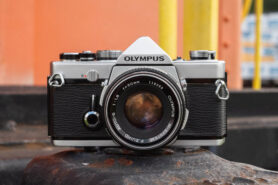
The Olympus M-1 is a 35mm SLR made by Olympus in Japan from July 1972 to February 1973. It was designed by Yoshihisa Maitani, who had earlier created the half-frame Pen (1959) and Pen F SLR (1963). After a full-frame system camera, the modular MDN, proved too costly to produce, Olympus rushed out the M42-mount FTL as a stopgap. The M-1 followed as the most compact and quietest full-system SLR in the world, with nearly 30 lenses promised. Leitz objected to the name because of the Leica M1, so Olympus renamed it the OM-1 for export and later models, though Japanese sales continued as the M-1. The author estimates roughly 52,000 M-1s were made, rather than the often-cited 5,000. Early OM-1s were nearly identical, and later versions added a motor drive coupling, a larger pressure plate, and other small changes.
The camera is fully mechanical, with a 50mm f/1.8 F.Zuiko lens, shutter speeds from B and 1 to 1/1000 second, and a two-cell CdS center-weighted TTL meter with a match needle powered by PX625 mercury batteries. It weighs 680 grams with the lens. Its quirks include a shutter speed collar around the lens mount, a lens release button on the lens itself, a large ASA dial on the top plate, and a hot shoe that is an optional accessory. The author found the build quality excellent and the viewfinder large, bright, and simple, calling it possibly one of the best on a fully mechanical SLR. He shot two rolls, expired Kodak Tech Pan and fresh Kodacolor 100, and found the lens sharp corner to corner with minimal vignetting, with odd color casts blamed on his own development. His only nitpicks were that the big ASA dial wastes space and the shutter release sits slightly cramped for larger hands. He also warns that the original foam light seals have turned to goo on every example and must be replaced before shooting, since the crumbling material can damage the shutter.
The author enjoyed the M-1 as much as any other SLR, and he sees its design legacy in today's OM-System digital cameras. Because the experience is essentially identical to the later OM-1, which is plentiful, affordable, and usually mechanically sound, he recommends the M-1 only to those who value its historical significance.
AI-generated summary. May not capture every detail — read the full article below for the complete picture.
This is an Olympus M-1, a 35mm SLR camera produced by Olympus Optical Company in Japan between July 1972 until February 1973. The Olympus M-1 was a revolutionary camera, designed under the watchful eye of famed camera designer Yoshihisa Maitani. Upon its release, the M-1 was the most compact and quietest full system SLR in the world and featured a variety of lenses, backs, and other accessories to round out the system. Shortly after the M-1’s release, due to a complaint by Ernst Leitz Wetzlar due to that company’s existing Leica M1 model, Olympus voluntarily changed the name of the camera to the Olympus OM-1. Domestic sales of the M-1 were allowed to continue in Japan, but all export sales and future models in the series bore the OM name.
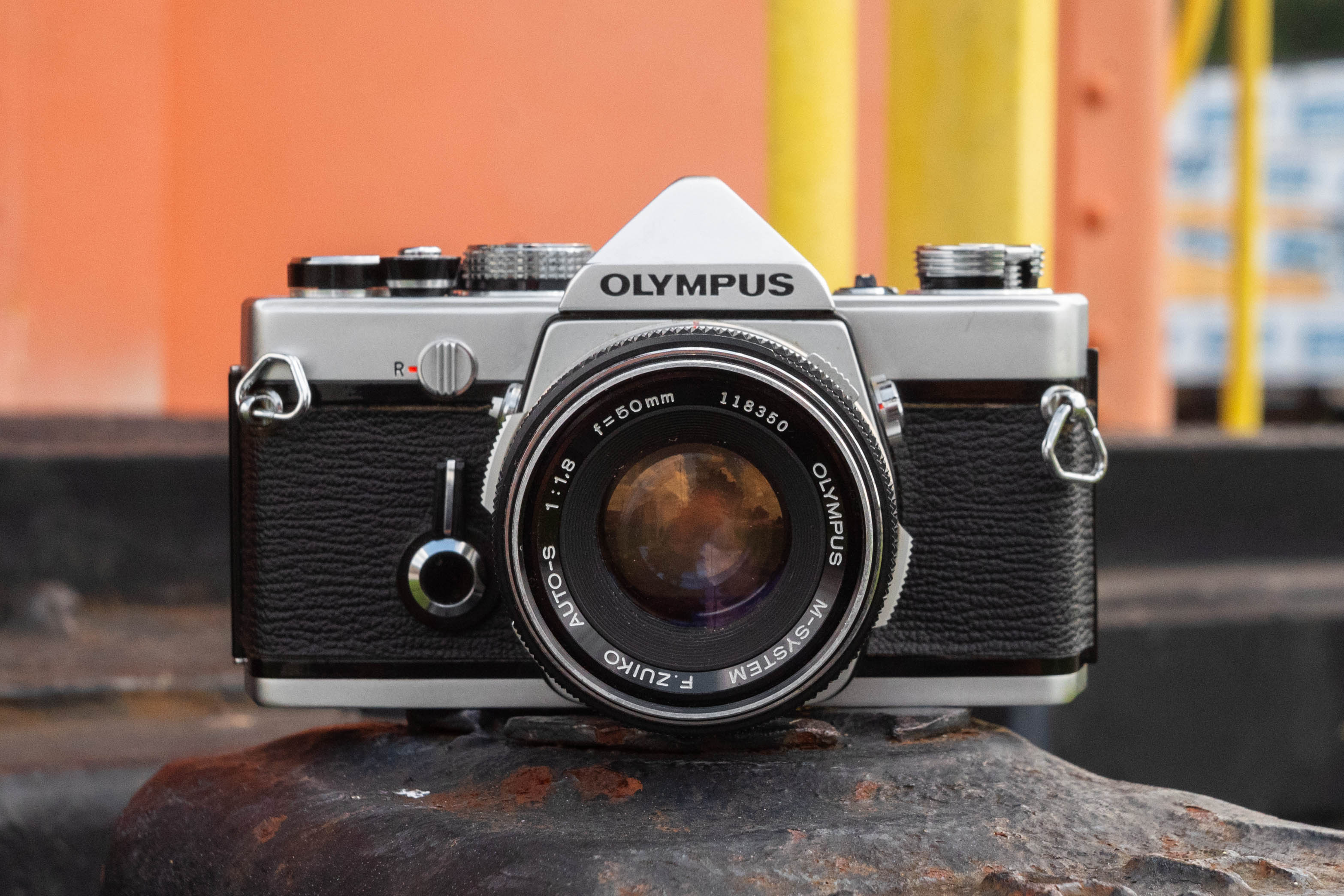
Film Type: 135 (35mm)
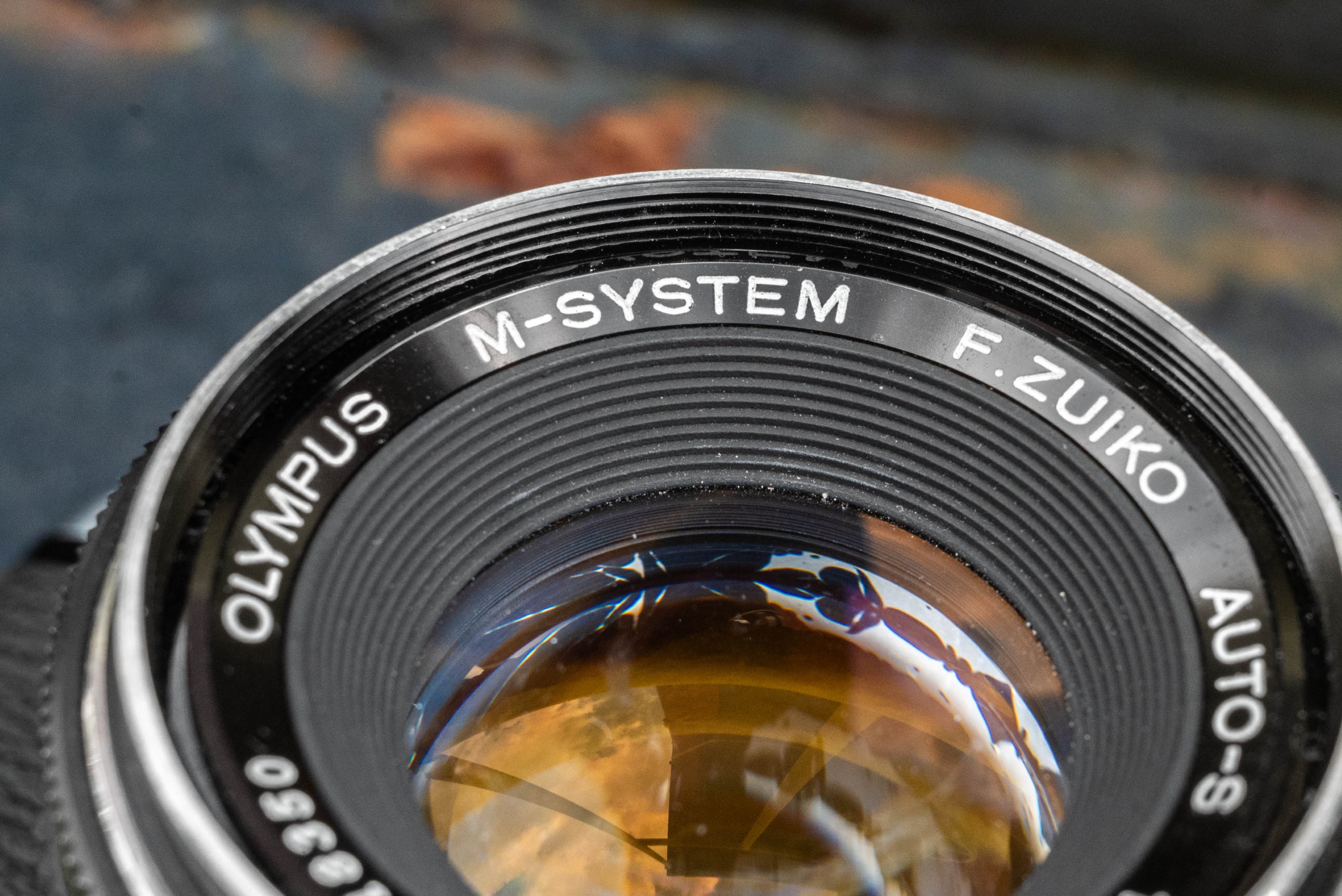
Lens: 50mm f/1.8 Olympus M-System F.Zuiko coated 6-elements in 5-groups
Lens Mount: Olympus M/OM Bayonet
Focus: 1.5 feet / 0.45 meters to Infinity
Viewfinder: Fixed SLR Pentaprism, 97% Field of View, 0.92x Magnification
Shutter: Cloth Focal Plane
Speeds: B, 1 – 1/1000 seconds
Exposure Meter: (2x) TTL Coupled CdS Cells, Center Weighted, w/ viewfinder Match Needle
Battery: 1.35v PX625 Mercury Battery
Flash Mount: Accessory Hot Shoe w/ FP and X Flash Sync, 1/60 X-Sync
Weight: 680 grams, 514 grams (body only)
Manual (in Japanese): https://mikeeckman.com/media/OlympusM1Manual.pdf
Manual (OM-1 in English): https://www.cameramanuals.org/olympus_pdf/olympus_om-1.pdf
Oskar Barnack, August Nagel, Walter Dorwin Teague, and Masahiko Fuketa are all names that come to mind when thinking of influential camera designers of the 20th century. Without them, we may not have Leicas, Retinas, Bantam Specials, or the Nikon F today. While each of these four men have earned their places as great designers, there is another man who is just as deserving to be spoken of with the same level of regard.

All answers are generated using content exclusively from mikeeckman.com. If something is incorrect, then that probably means Mike got it wrong too, please don't make any financial decisions based on anything he's written as he is an enabler.
Yoshihisa Maitani was born January 8, 1933 in Kagawa Prefecture, Shikoku, Japan, and was the youngest son of a rice wine and soy sauce maker. Young Maitani had an interest in cameras, building his own rudimentary design at the age of 10 but when he attended college at Tokyo’s Waseda University, he pursued a degree in mechanical engineering and specialized in automobile engines. While studying in school it is said that Maitani took many photographs with a Leica IIIf which he loved, but found it to be limiting in closeup work. When he would encounter a situation in which the Leica wasn’t ideal for the type of photograph he wanted, he came up with designs of cameras that would meet his needs. In his free time, Maitani designed a unique new camera which he applied a patent for, although had no intention of ever putting it into production.
After college, Maitani got a job working for an automobile company, but a chance encounter by Eiichi Sakurai, a noted camera designer and Director of the camera development division of Olympus Optical Co. Ltd., discovered a patent filed for by Maitani and was so impressed, in 1956, he persuaded him to come work for Olympus.

For the first two years, Maitani worked in the camera design department working on small projects the company already had begun developing, but in 1958 was given his own assignment to design an all new and inexpensive camera that could be built and sold for no more than 6000 yen. This was an ambitious goal as the next cheapest camera in Olympus’s lineup at the time cost 23,000 yen. Other than the targeted price, the only other guideline given to Maitani was that the camera couldn’t be a toy. It had to be a quality camera that lived up to Olympus’s reputation.
Maitani was up to the challenge and approached the design of his new camera from the perspective he shared while shooting with his Leica. He thought the camera should be an extension of the photographer. It should be small and easy to use so that the photographer did not have to bother himself with confusing controls. He thought the camera should be secondary to the photographic process. Early on, the design of the body of the camera was given to a third party industrial designer. Unhappy with the early mock ups of the camera, Maitani took over full design himself.

A second priority to the design and use of the camera would be its lens. Although the targeted price point he was working with suggested a cheap single or double element lens, Maitani wanted something better. He aimed for something comparable to a 4-element Zeiss Tessar. Maitani convinced Olympus lens designer Yoshisada Hayamizu to create an all new compact wide angle lens that would meet both the camera’s quality and financial goals.
Cost was a major factor in designing the camera. Nearly the entire budget was put into its lens, so Maitani had to get creative with the rest of the camera. Things like the wind lever were simplified with a knurled plastic wheel that protruded out of the back of the camera. The body needed to be small and built with clean lines and a lack of clutter. The decision to make the new camera shoot 18x24mm “half frames” was born out of the need to make the camera as compact as possible. A smaller camera meant less parts and less money to build it. As a side benefit, shooting half frames meant a photographer would get double the amount of exposures per roll. Japan’s economy had not completely recovered from the war, and the cost of film and developing was high, so doubling exposures from a single roll would have been a huge benefit.

The decision of releasing a new half frame 35mm camera was very controversial. Although half frame 35mm cameras were common in the early parts of the 20th century, they had fallen out of favor by the end of the war. In 1958 when this camera was being designed, there were no other half frame 35mm cameras being produced anywhere in the world. The success or failure of this new model would largely hinge on whether or not people would accept a new half frame camera.

Over the next several months, Yoshihisa Maitani worked tirelessly on his new camera. He worked overtime at work and even did some of the design at home. Olympus was already a respected Japanese optics company and Maitani was still a relative newcomer so his 6000 yen project was considered low priority within the company. As a result, few people took notice of what he was doing, so he was largely free to do whatever he wanted with little oversight.
By the time Maitani was ready to reveal his camera to senior members of the company, he had built 5 prototypes to show off his progress. Upon seeing the new prototypes, his superiors were hugely impressed with not only the design of the camera, but what Maitani was able to accomplish at such a meager price point. No one at the company took a 6000 yen camera seriously, especially one designed by a junior employee, yet here was a camera with good looks, great ergonomics, and a very capable lens.
When it came time to release the camera in October 1959, the camera was given the name “Pen” as it was supposed to fit in a shirt pocket in the same place where an engineer might keep a pen. Despite excitement generated by the new camera, leadership at Olympus still considered the camera a novelty and refused to built it themselves, instead outsourcing production of the camera to a subsidiary company of Olympus called Sanko Shoji.
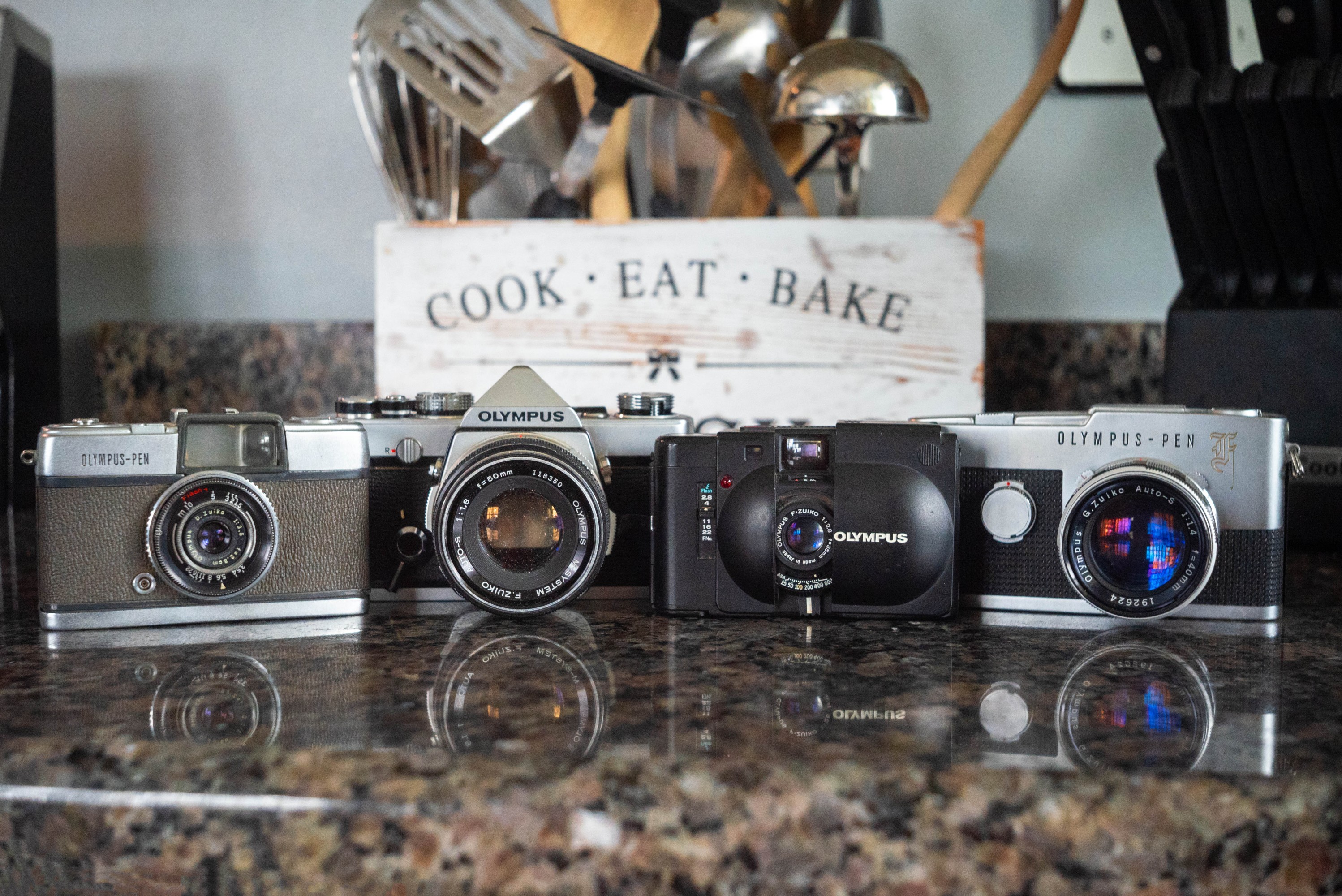
Upon its release, the Pen was an immediate success selling over 30,000 units in the first couple of months of production. Due to the huge demand for the camera, Olympus took over production in early 1960 and started to expand on the Pen product line with more advanced models featuring coupled exposure meters and faster f/1.9 lenses. Strong sales of the Olympus Pen prompted many other Japanese camera makers to produce their own half-frame models. Canon, Mamiya, Minolta, Yashica, and even Nikon made at least one half frame 35mm camera, as did some German companies as well. The success of the Pen series elevated Yoshihisa Maitani within the company and he became known as one of Japan’s most innovative and talented designers.
All answers are generated using content exclusively from mikeeckman.com. If something is incorrect, then that probably means Mike got it wrong too, please don't make any financial decisions based on anything he's written as he is an enabler.
In the early 1960s, 35mm Single Lens Reflex cameras were extremely popular and nearly every Japanese camera maker was releasing their own SLR designs. Nikon, Canon, Minolta, Konica, Yashica, Petri, Mamiya and others all had their own respective models, so it was likely an obvious decision to the management of Olympus that they should start on one too, however they had a problem. The Olympus Pen series was selling so well, it took away resources to develop a new camera. Wanting to get in on the SLR hype, the company was split as to whether to make their first SLR shoot full frame images, or stick with the Pen’s half frame design.

In a lecture given by Maitani at the JCII Camera Museum in Tokyo on Saturday, October 29, 2005, Maitani states that development of a full frame 35mm SLR had started in parallel with a half frame model to be called the Pen F. Maitani himself was focused on the half frame SLR and was not involved with the as yet unnamed full frame camera, only saying that once it made it past the R&D stage, development clashed with the Pen F. As the half frame Olympus Pen series was a hot seller, it was determined that a half frame SLR would take priority and the full frame model was shelved.
As expected, in 1963 the Olympus Pen F was released to great fanfare and the model proved to be very popular, eventually spawning a couple variants like the metered Olympus Pen FT model. Despite the success of the half frame SLR, the appetite for a full frame model only got stronger, and Maitani was eventually convinced to work on a new full frame 35mm SLR.
Yoshihisa Maitani recants that initially he was not interested in making a full frame SLR as he was uninspired by existing models made by other companies, but the Olympus sales division was clamoring for something just like everyone else had. Maitani had the philosophy that something isn’t worth doing unless it can be better or different than what was already available. His mission with the Pen series was to create a camera that minimized space while maximizing quality. He thought that if he were to get involved in a full frame SLR, he would need to bring that mindset to its development.
In late 1967, Maitani and Olympus management came to an understanding that work would begin on a new full frame 35mm SLR that would be different from what anyone else at the time was making. Two years into development of his new system SLR, Maitani showed a prototype of his new camera which was called the Olympus MDN.
The MDN looked unlike any other 35mm camera at the time, sharing a similar design ethos to medium format SLRs like the Hasselblad and Zenza Bronica. The camera had a completely modular design with a removable magazine film back, interchangeable viewfinders, and all new bayonet lens mount. The main body of the camera contained the shutter, reflex mirror, viewfinder screen and nothing else.


The MDN was supposed to be the first in a series of Olympus MD cameras that would use the same lenses and support a wide range of accessories. A simpler model called the MDS (‘S’ was for Simple) would also be developed with a more traditional 35mm SLR body, but supporting the same lenses and could be sold for less money.
When presented to the sales staff at Olympus and at a camera show in 1969, reaction to the new MDN was extremely positive, but almost too positive. Olympus management was so excited, they wanted the camera ready for sale as quickly as possible. Unfortunately, due to the highly proprietary design of the new camera, it was deemed too expensive to produce in large quantities and required further development to reduce costs. As a result, Maitani was ordered to abandoned the MDN, and complete the simpler MDS instead.
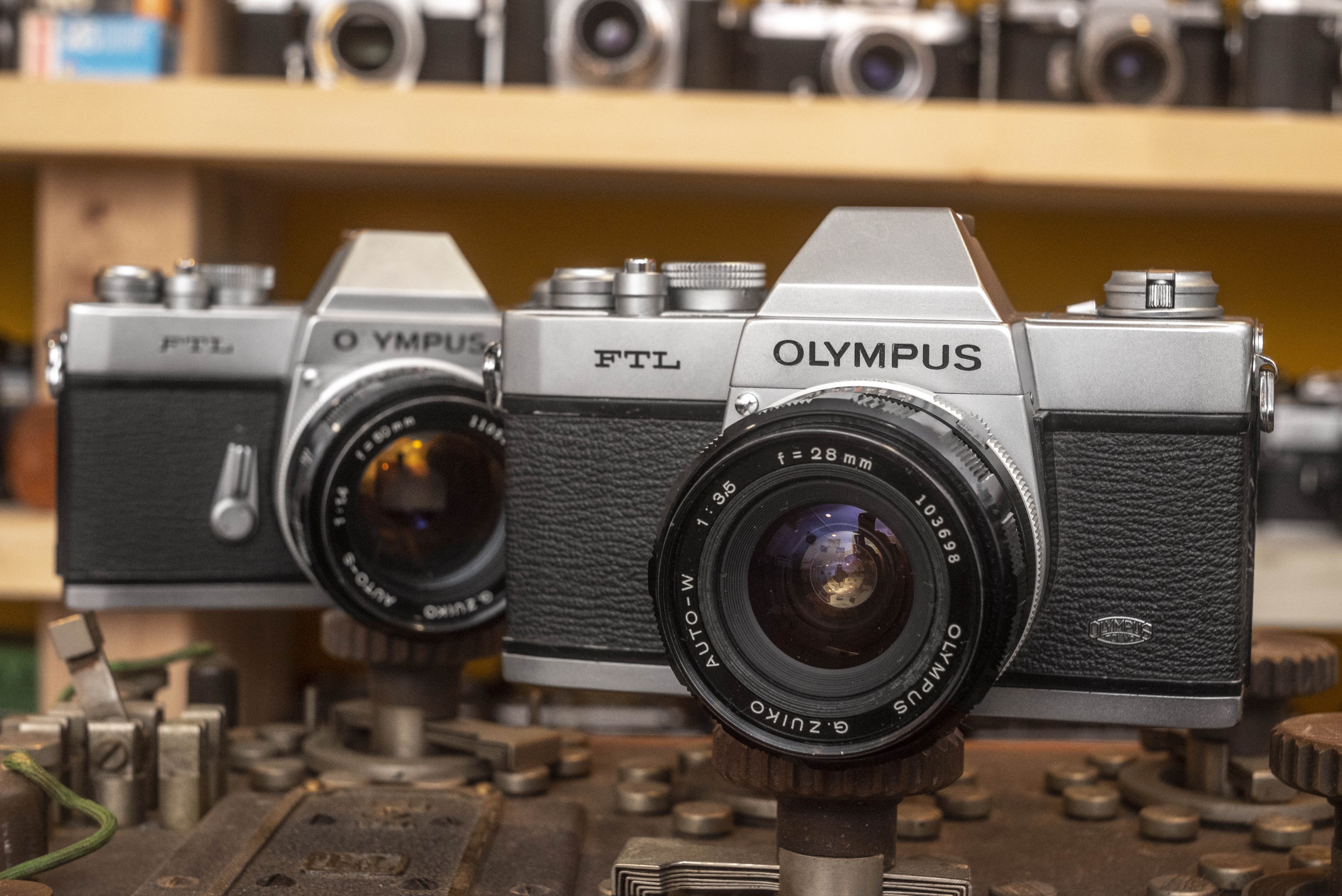
By 1970, now seven years after the release of the Pen F SLR and three years after work began on the MDN, Olympus’s sales staff was getting impatient. Single Lens Reflex cameras were the most popular format of camera in the world, and with film prices dropping, the appeal of more economical half frame cameras was starting to slow. They needed something now. With no release date in sight for Maitani’s new SLR, Olympus purchased an existing 35mm SLR design from an unnamed Japanese manufacturer and rushed to market a new SLR camera called the Olympus FTL.
The Olympus FTL made its public debut in October 1970 at Photokina 1970 and went on sale in July 1971, barely a year after the decision was made to create an alternative to Maitani’s ambitious SLR. Although not an original Olympus design, the Olympus FTL was manufactured by them to their quality standard, and featured the company’s excellent Olympus Zuiko lenses. To maximize compatibility, the camera used the “Universal” M42 screw mount which had been supported by a huge number of other Japanese and German companies.
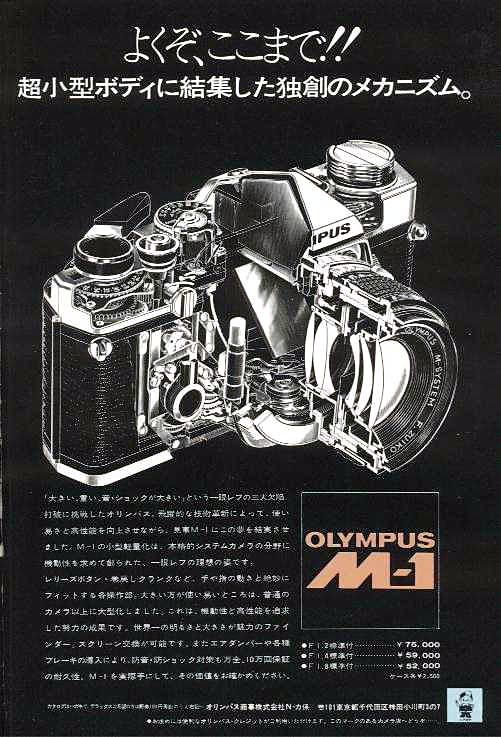
As it turned out, the Olympus FTL was not out long before Maitani’s new SLR, now called the Olympus M-1 was ready for release in July 1972. When shown at that year’s Photokina, the reception was extremely positive, garnering attention for its compact size, quiet operation, long list of features, and promised availability of almost 30 lenses.
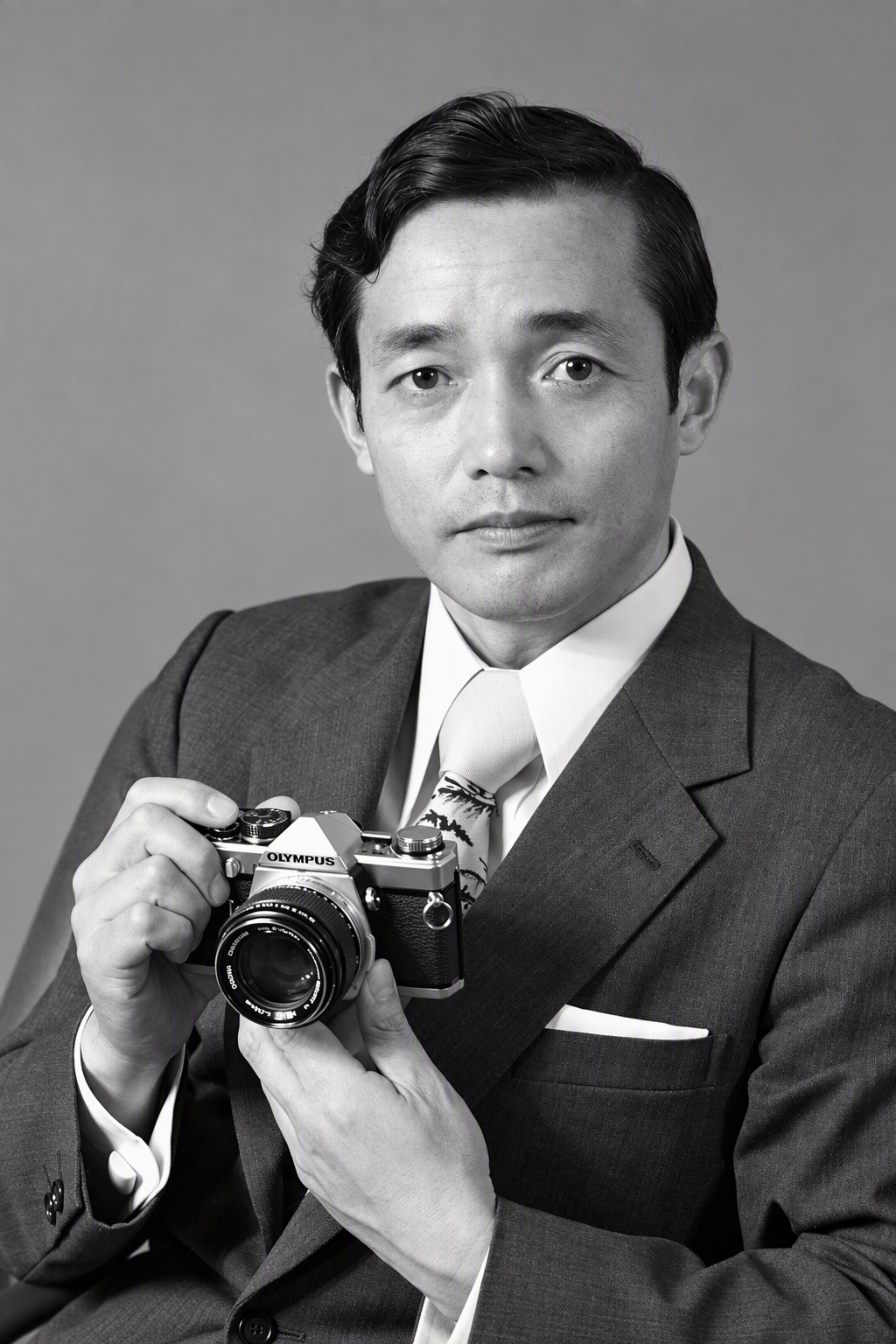
Not everyone was impressed however as Ernst Leitz in Wetzlar objected to the use of the name “M-1” as they already had a camera called the Leica M1. The story goes that a Leitz representative contacted the Olympus people at the Photokina booth expressing their dissatisfaction, but since Leitz didn’t actually own a trademark for the name “M-1”, Olympus was not legally required to change anything. Still, not wanting to cause problems with Leitz, they agreed to change the name of their new camera to OM-1, satisfying Leitz. As a consolation, Leitz didn’t object to Olympus continuing to sell the camera in Japan as the M-1, but with all export models being changed to OM-1.
Using date codes found behind the film pressure plate inside the camera, models with the M-1 label continued to be produced until February 1973, after which all new Olympus SLRs were named the OM-1. Some sources online suggest that as few as 5000 M-1 models were produced, but this number has later been disproven based not only on serial number research, but also that far too many show up for sale today, suggesting the 5000 number is far too low. While no official records have ever been found, a number closer to 52,000 units seems more plausible.
Initially, the change from M-1 to OM-1 was cosmetic as very early OM-1s look and function exactly the same as the M-1, but within two years of its release, the OM-1 saw several changes including the addition of a motor drive provision, larger film pressure plate, changes to the door lock, and a switch from slotted to JIS screws on the inside of the lens mount. The OM-1 would remain in production until 1979 at which point the model was updated to the OM-1n. Since a much larger number of later cameras were made than the earlier ones, a vast majority of those found will lack the earlier design of the M-1
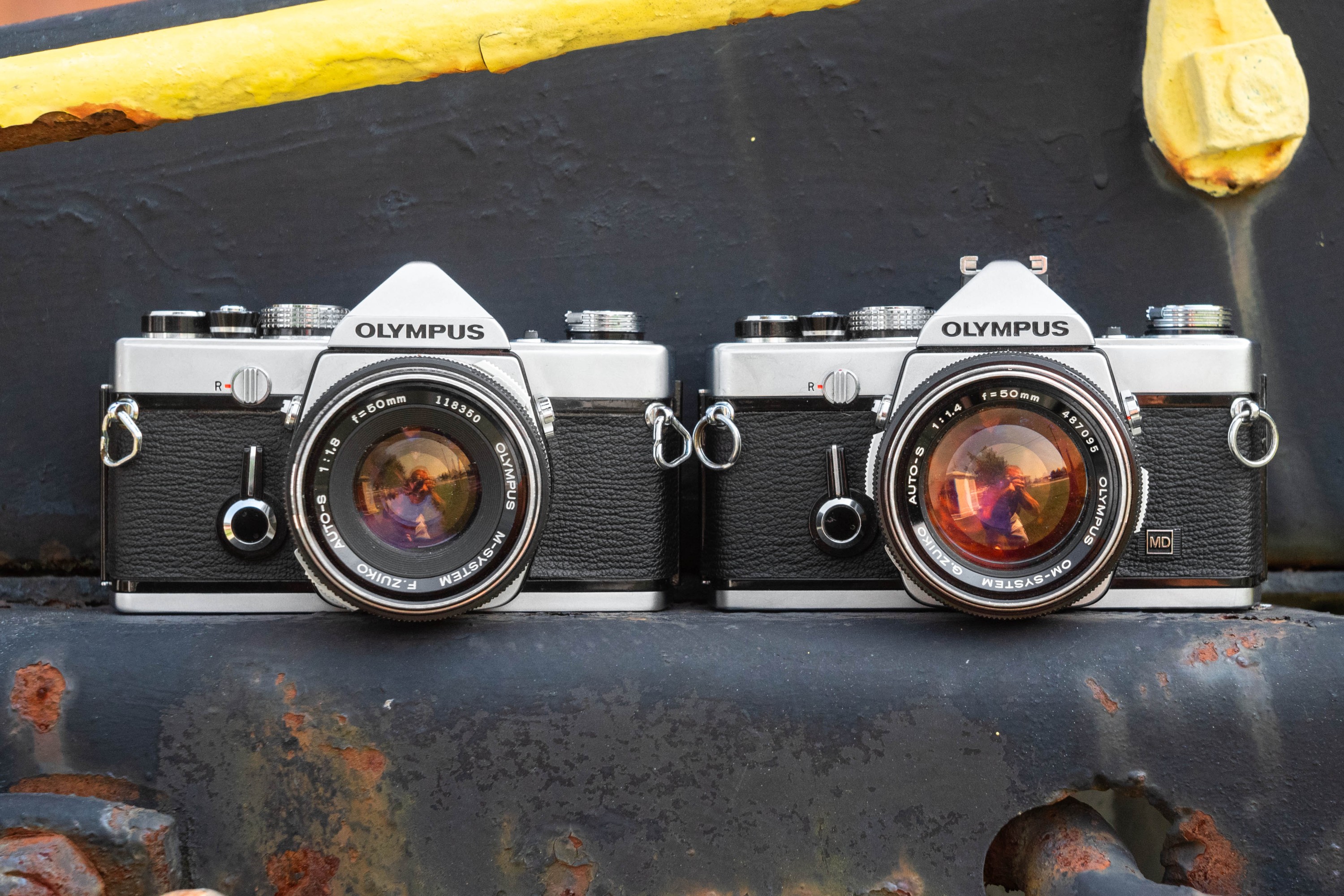
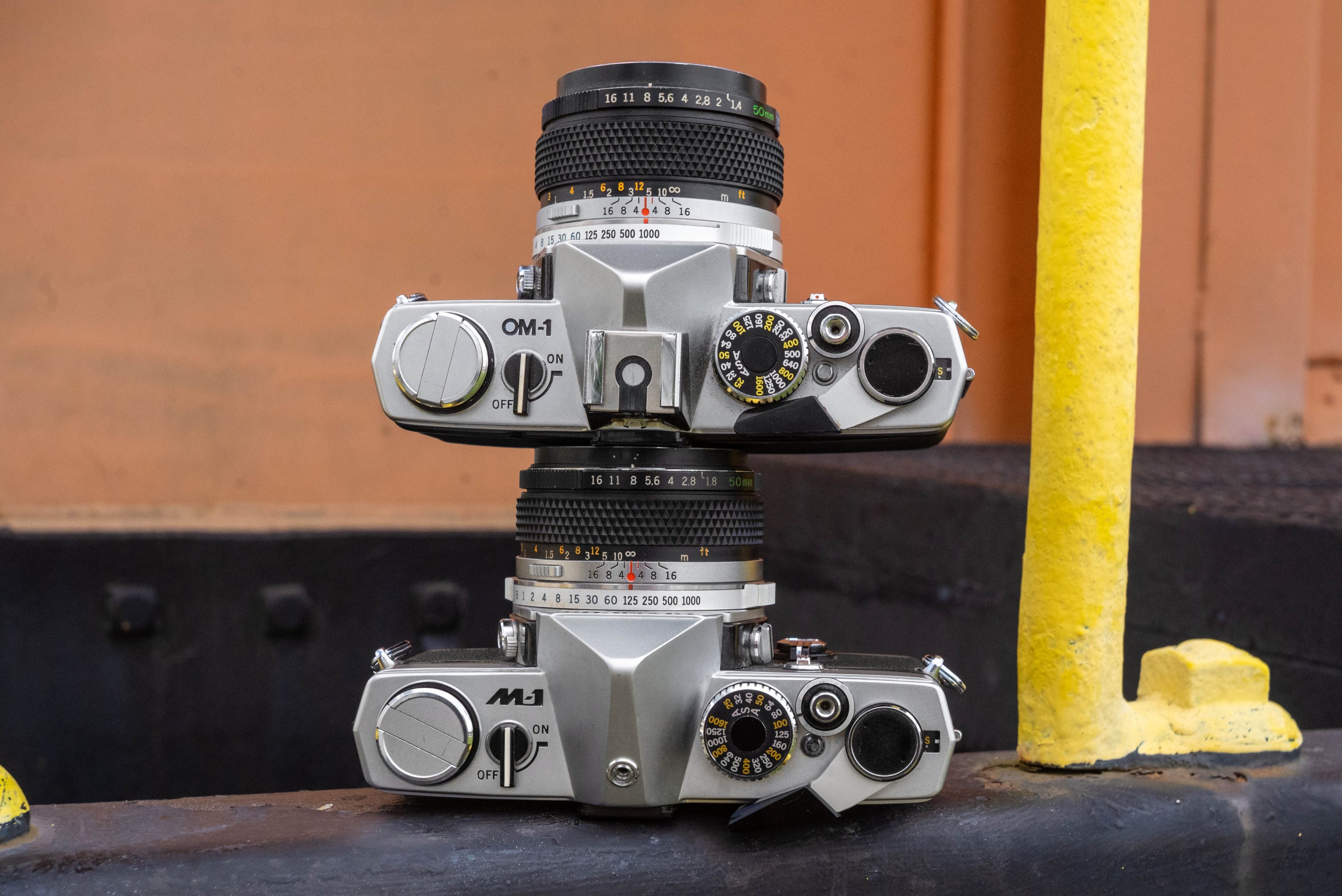
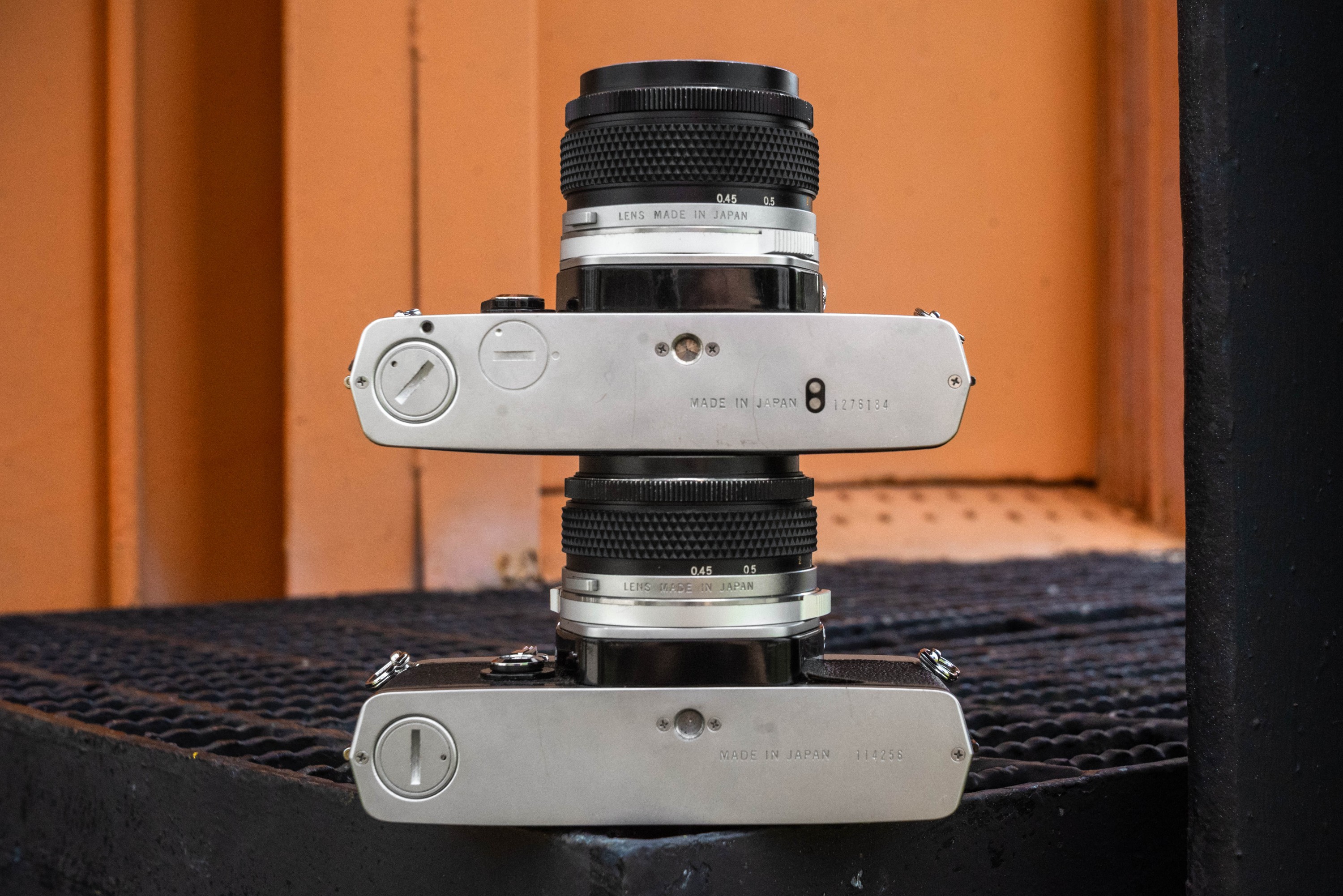
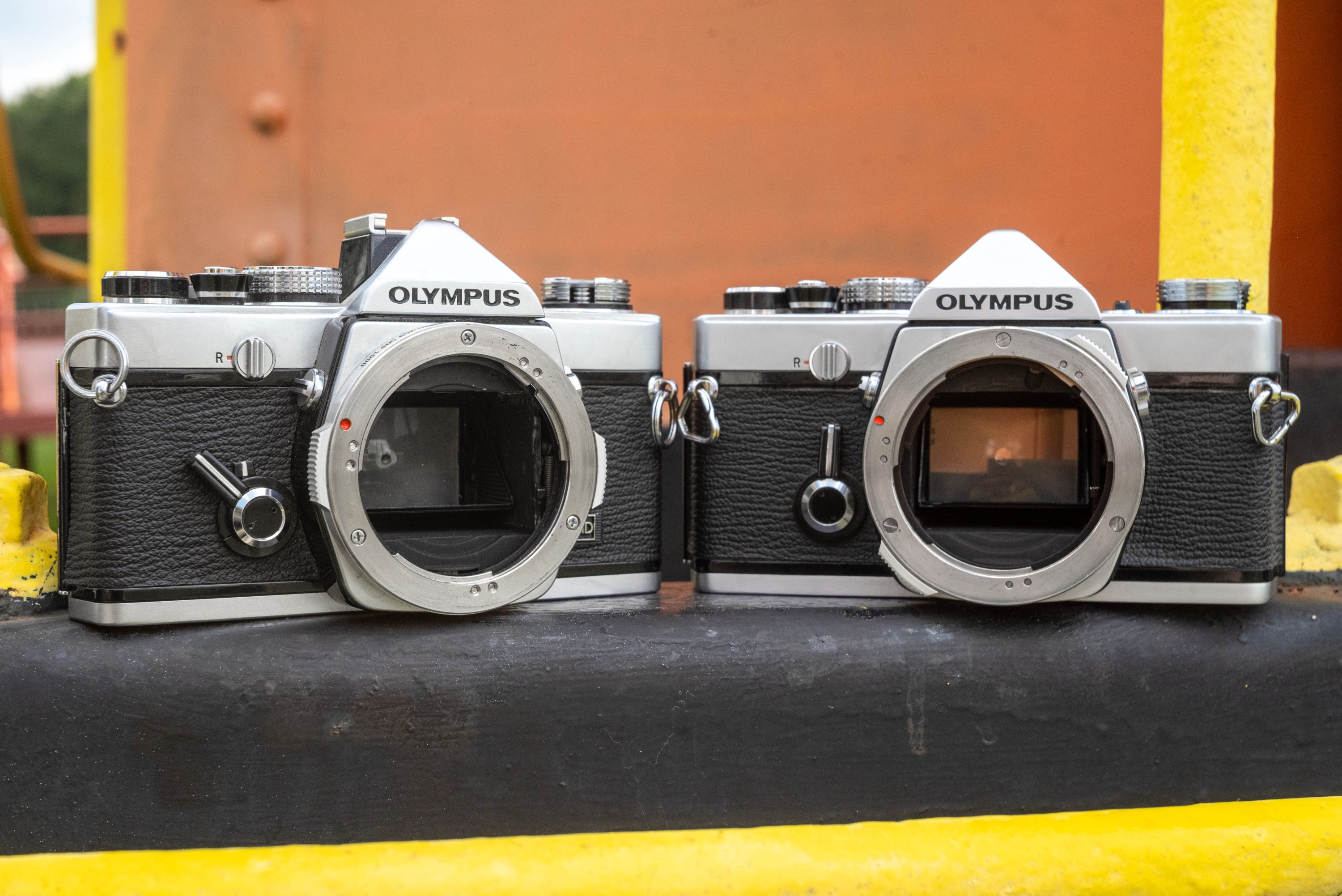
Having shot a variety of Olympus OM cameras, including an OM-1, I was reasonably certain I would know what to expect when picking up the M-1. Although there are some differences, such as the lack of a motor drive coupling, and some differences in the screws, none of the changes add up to a different experience.
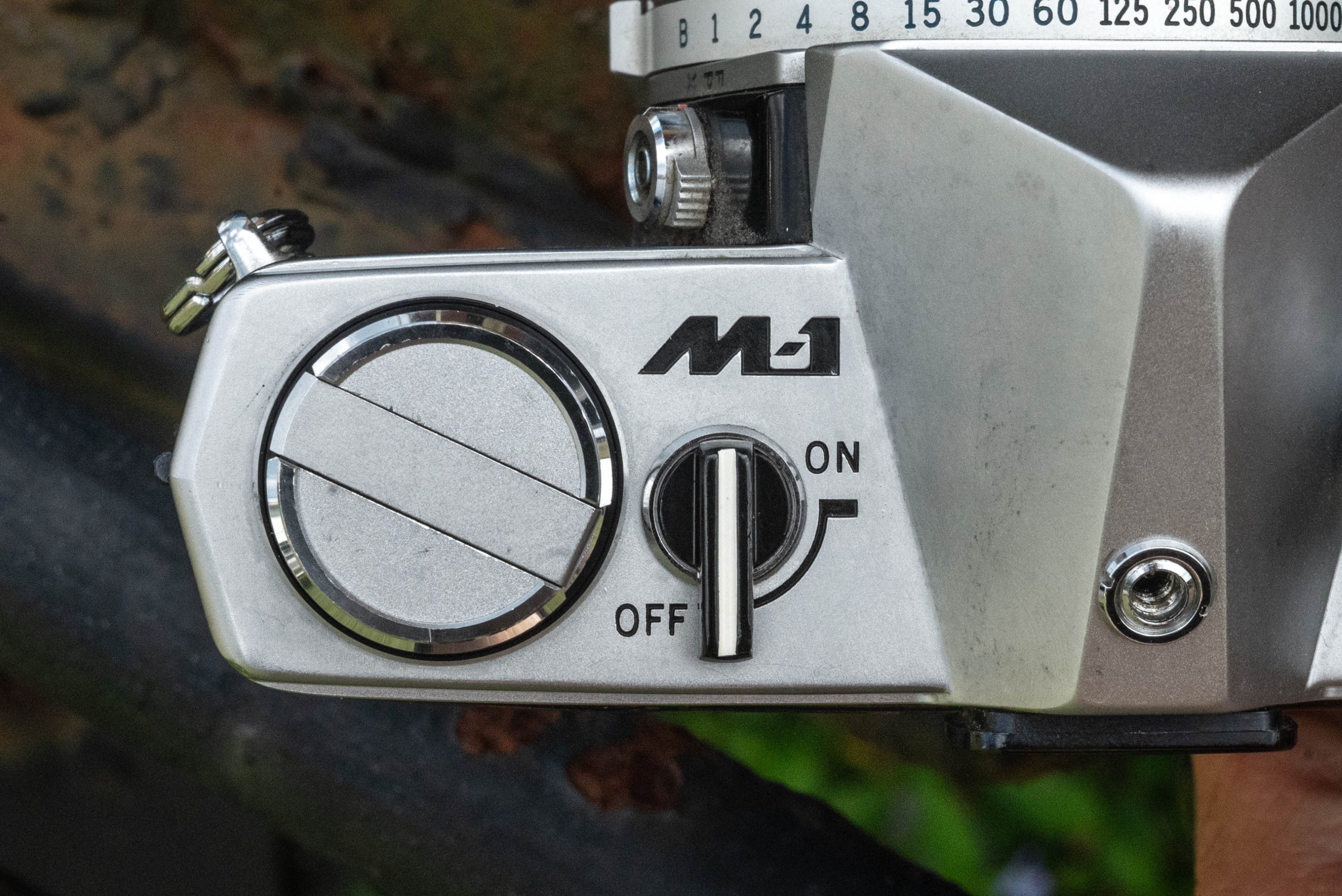
Despite this being an earlier model, the build quality of the compact body is very high. Maitani and his team put a lot of effort into packaging as much camera into as small of a package as they could and they succeeded with aplomb.
If you’ve never handled an M-1 or OM-series camera before, you’ll likely remark at the size of the viewfinder compared to the body. Build quality is excellent, and although the camera isn’t heavy, it still manages to give a sense of a very high build quality, not unlike other much larger and heavier SLRs of the era.
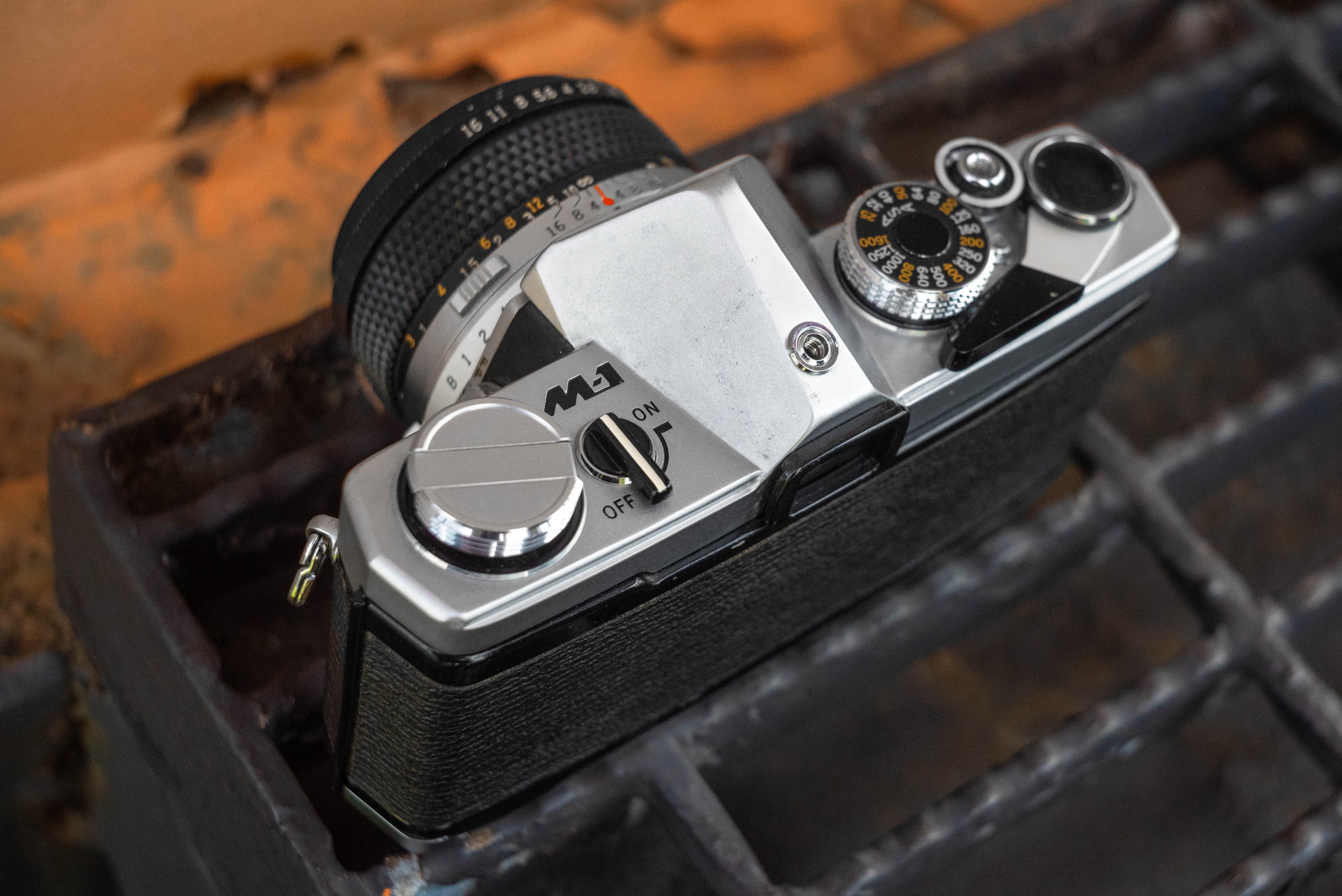
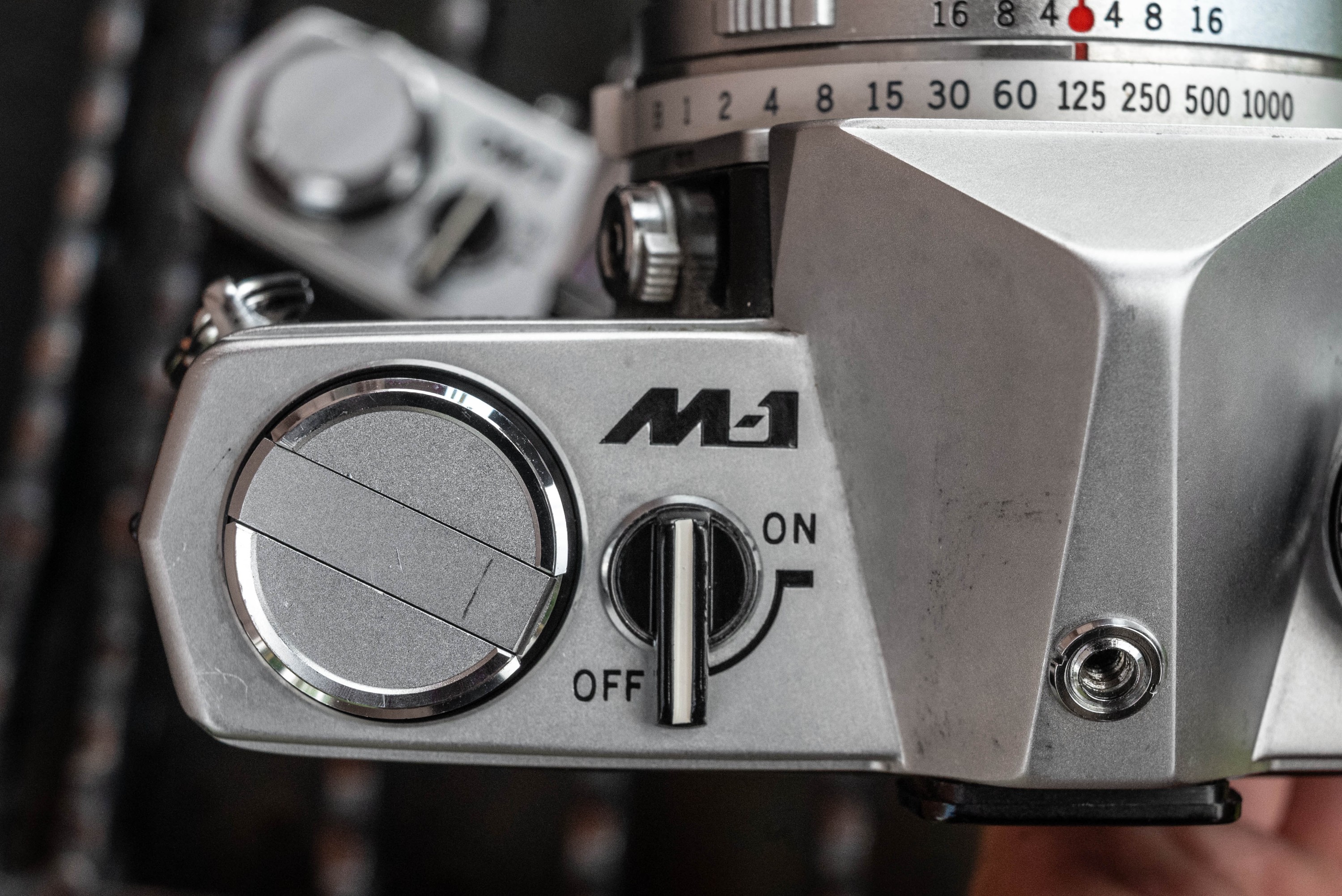
Up top, we start with a pretty standard rewind knob with fold out handle. To its right is the bold M-1 logo and below that is the meter’s power switch. The Olympus M-1 is an entirely mechanical camera, so you can still use it with this switch in the Off position, you just won’t be able to use the exposure meter’s match needle. Above the prism is a small threaded socket which is an attachment point for the optional flash hot shoe which was available for the camera. Without it, your only flash options are the standard PC sync port on the side of the mirror box for FP or X flashes, but if you need a hot shoe, this accessory is needed. I find that with the shoe mounted, it ruins the looks of the camera, so whenever I encounter one of these cameras with it on, I remove it.
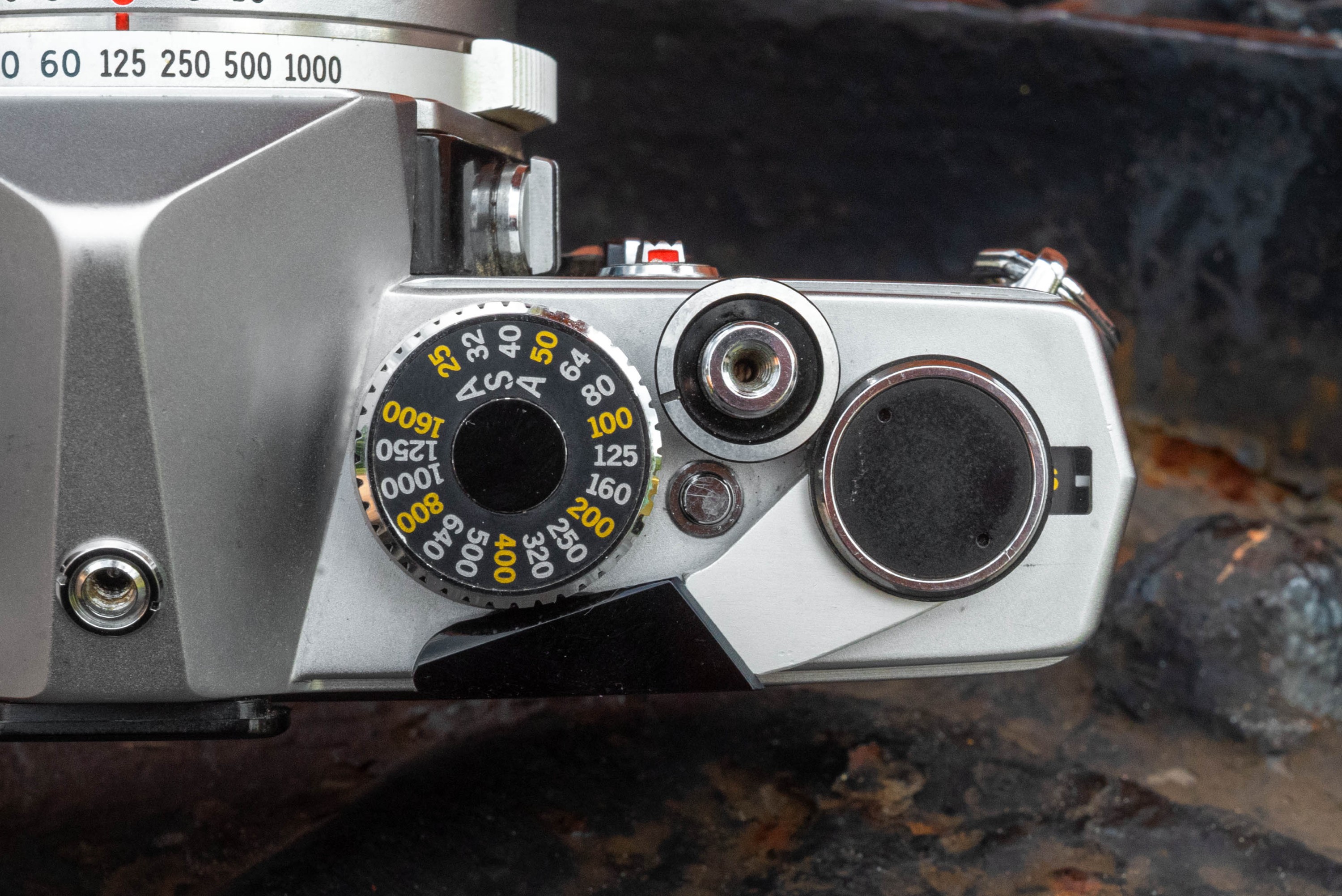
To the right of the prism, where a shutter speed selector would normally be, is the ASA film speed dial. With settings from ASA 25 all the way to 1600, the Olympus M-1 was well prepared for nearly every film available at the time. Next is the cable threaded shutter release, film advance lever, and automatic resetting exposure counter. The location of the shutter release is exactly where your right index finger expects it to be, allowing for a very natural feel to the shooting experience. The film advance lever has a plastic tip, which on many examples of this camera is cracked or missing, but with it there, allows for quick and easy advancements of the film to the next exposure. The exposure counter is additive and counts how many exposures have been shot on the current roll.
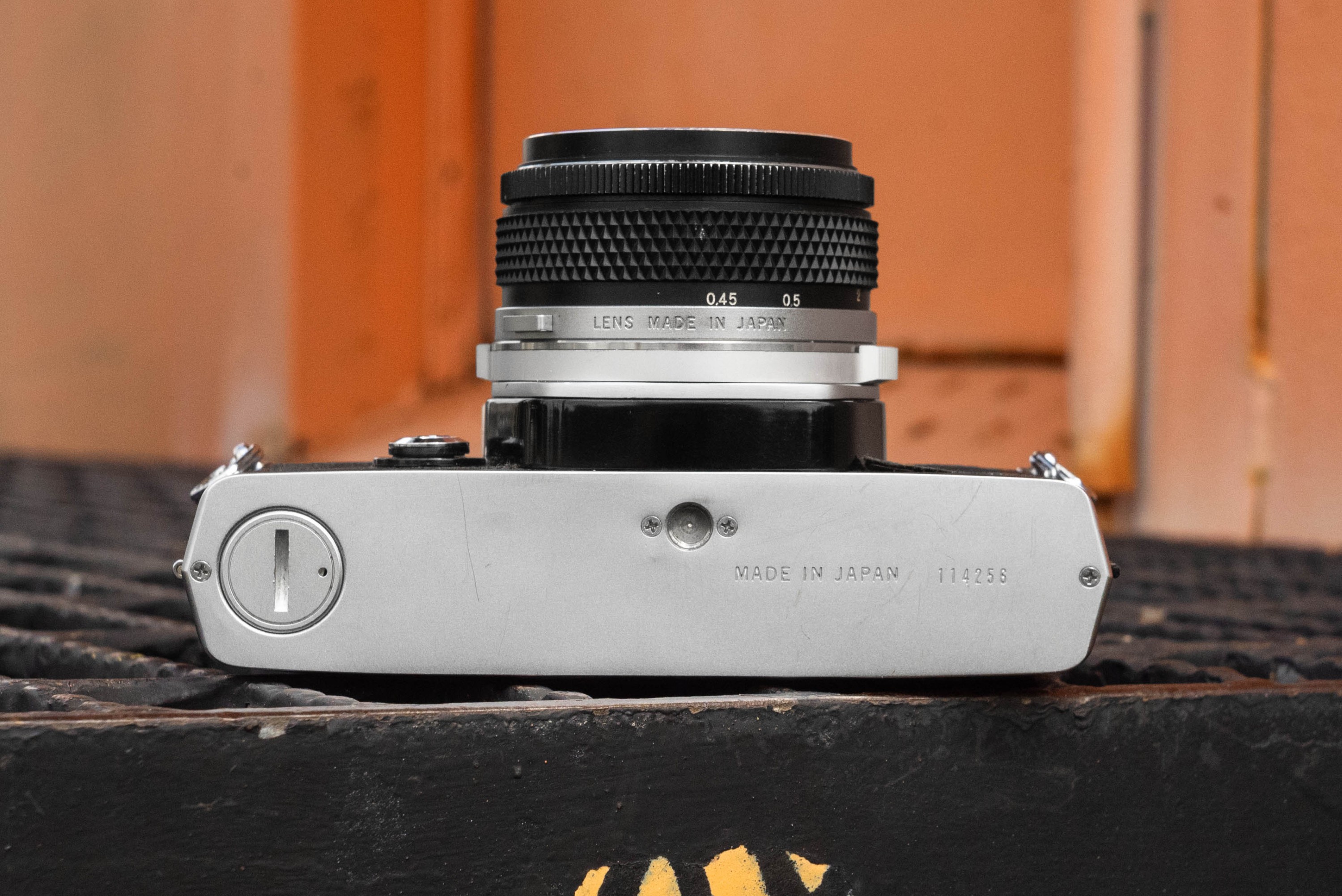
The top plate is a bit cluttered, care of the compact size of the body, but when turning it over, the bottom has little to see. On one side is the circular battery compartment for the two PX625 Mercury cells for the exposure meter, and in the center is a 1/4″ threaded tripod socket. The later OM-1 would have a motor drive coupling on the side opposite of the battery compartment, but that is not present here.
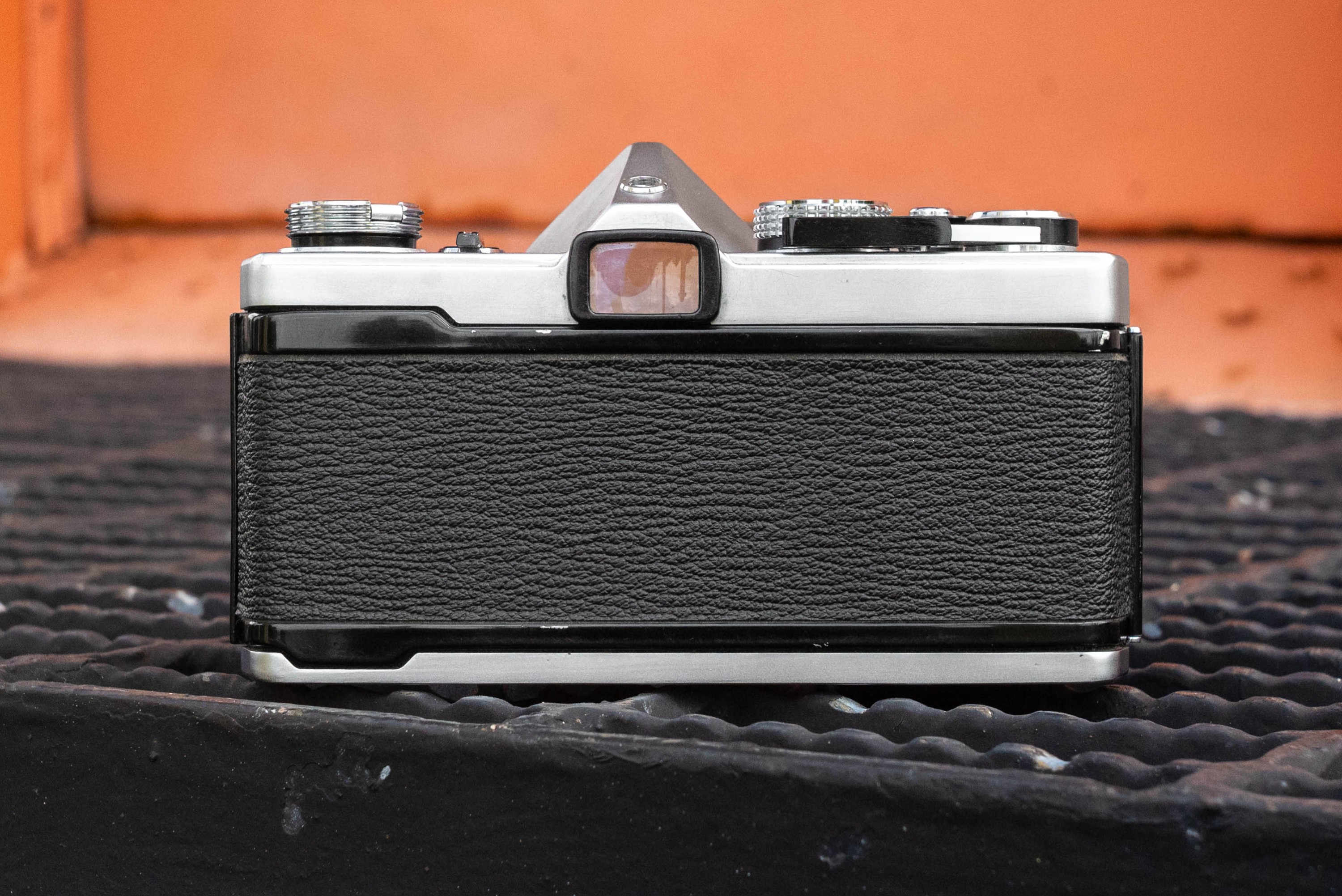
The sides and back have little to see. The Olympus M-1 has forward angled strap lugs which helps keep the camera balanced with heavy lenses mounted, and the rear of the camera is where you see the viewfinder eyepiece. While not measurably larger than those found on other SLRs of the era, combined with the compact size of the body and low profile prism, the eyepiece looks larger than usual and it very pleasant to look through.
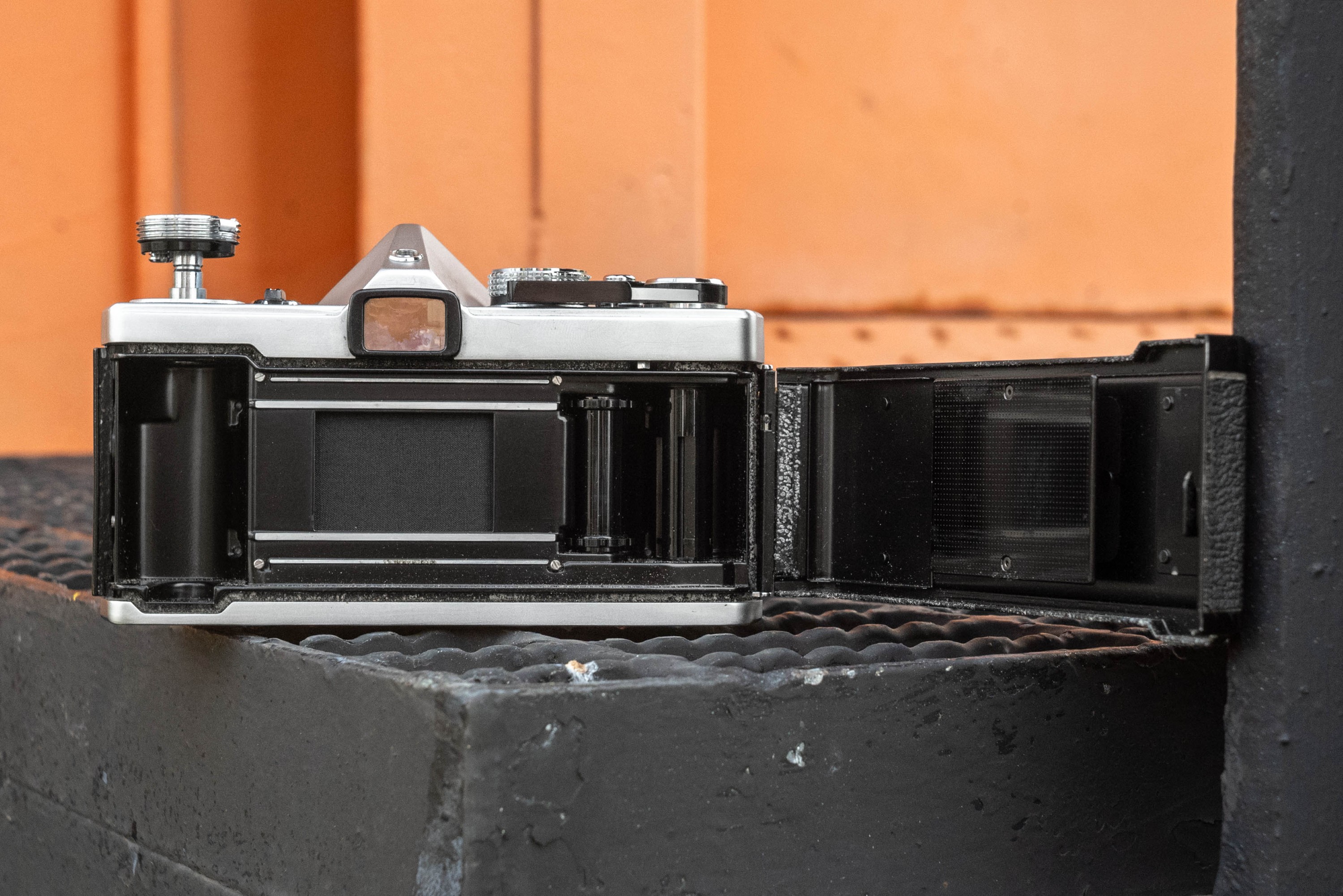
Opening the film compartment is done by lifting up on the rewind knob and giving it a firm upward tug. The right hinged film door opens to reveal a pretty typical film compartment. Film transports from left to right onto a multi-slotted plastic take up spool. Two bare metal rails are above and below the film gate allowing for smoother film transport. Another minor difference between the M-1 and later OM-1 is the size of the film pressure plate. While not small, the one on the M-1 is a tad smaller than the one found on the later camera, but both are covered in small divots which reduce resistance as film passes over it. Foam light seals were originally installed on the door hinge and inside both film channels, which on this, and every other M-1 ever made has already disintegrated into a chalky, sticky mess. Before shooting this camera, you absolutely need to clean the old material out and replace it with something new. Even if you’re not concerned with light leaks from the degraded seals, another risk is that the crumbling material can become loose and get inside the shutter, damaging it.
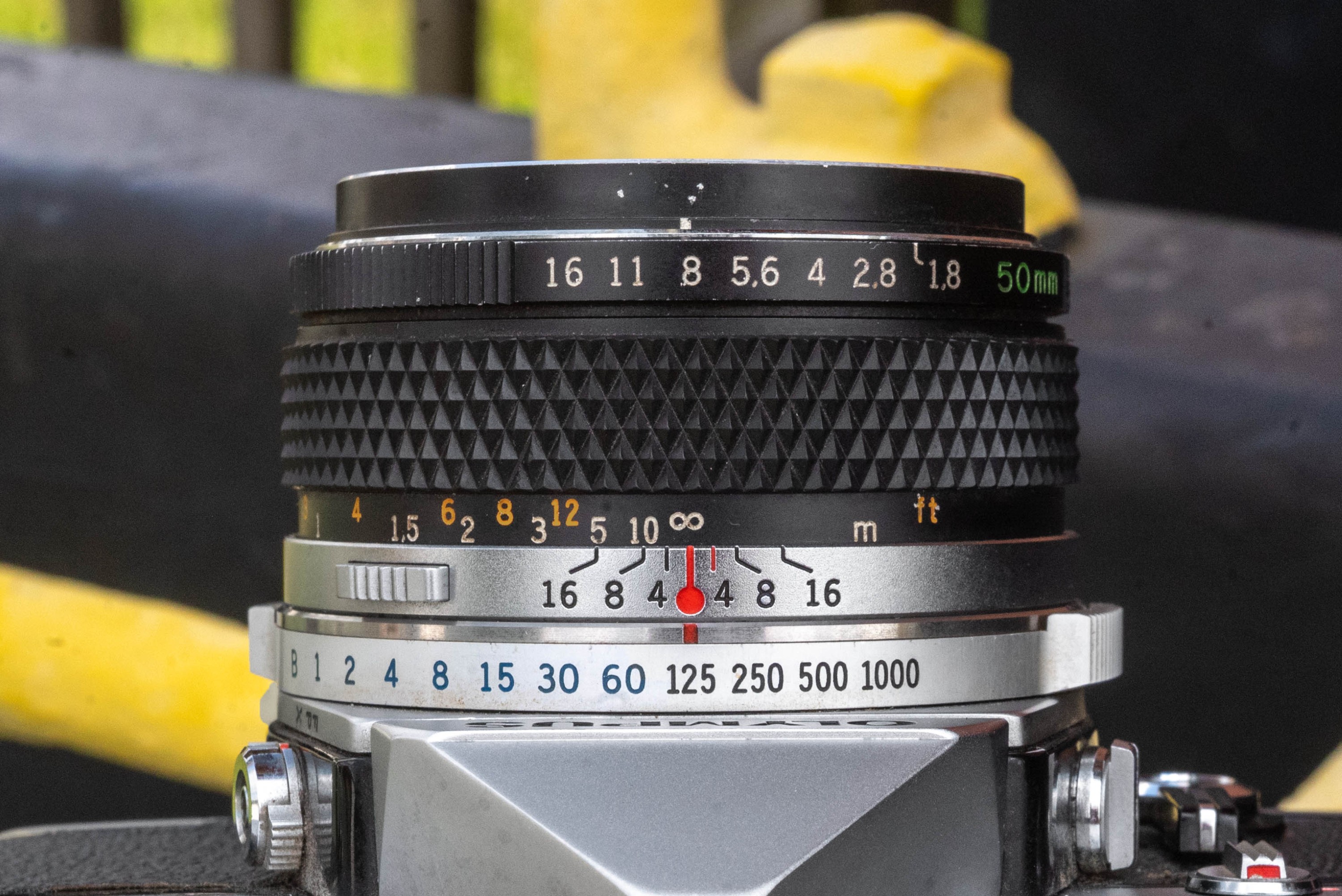
Looking down a top the lens, closest to the body is the M-1’s shutter speed collar which isn’t even part of the lens. This location is similar to that of the Nippon Kogaku Nikkormat whose shutter speed control is in the same location. It is said this was done to simplify the design as less parts are needed to do it this way than using a shutter speed dial on top of the camera. Forward of the shutter speed dial, the M-System lens has a familiar control layout. A fixed depth of field scale is near the back, then is the focus ring, which considering how tiny the 50mm f/1.8 lens is, takes up a good amount of space, then finally is the aperture ring with stops for f/1.8 to f/22. The usefulness of the aperture ring near the front of the lens is less apparent on the OM-1 which lacks auto exposure, but for models like the OM-2 and OM-4 which have aperture priority AE, having the aperture ring farthest from the body makes it easy to locate and change when you want to change your exposure settings.
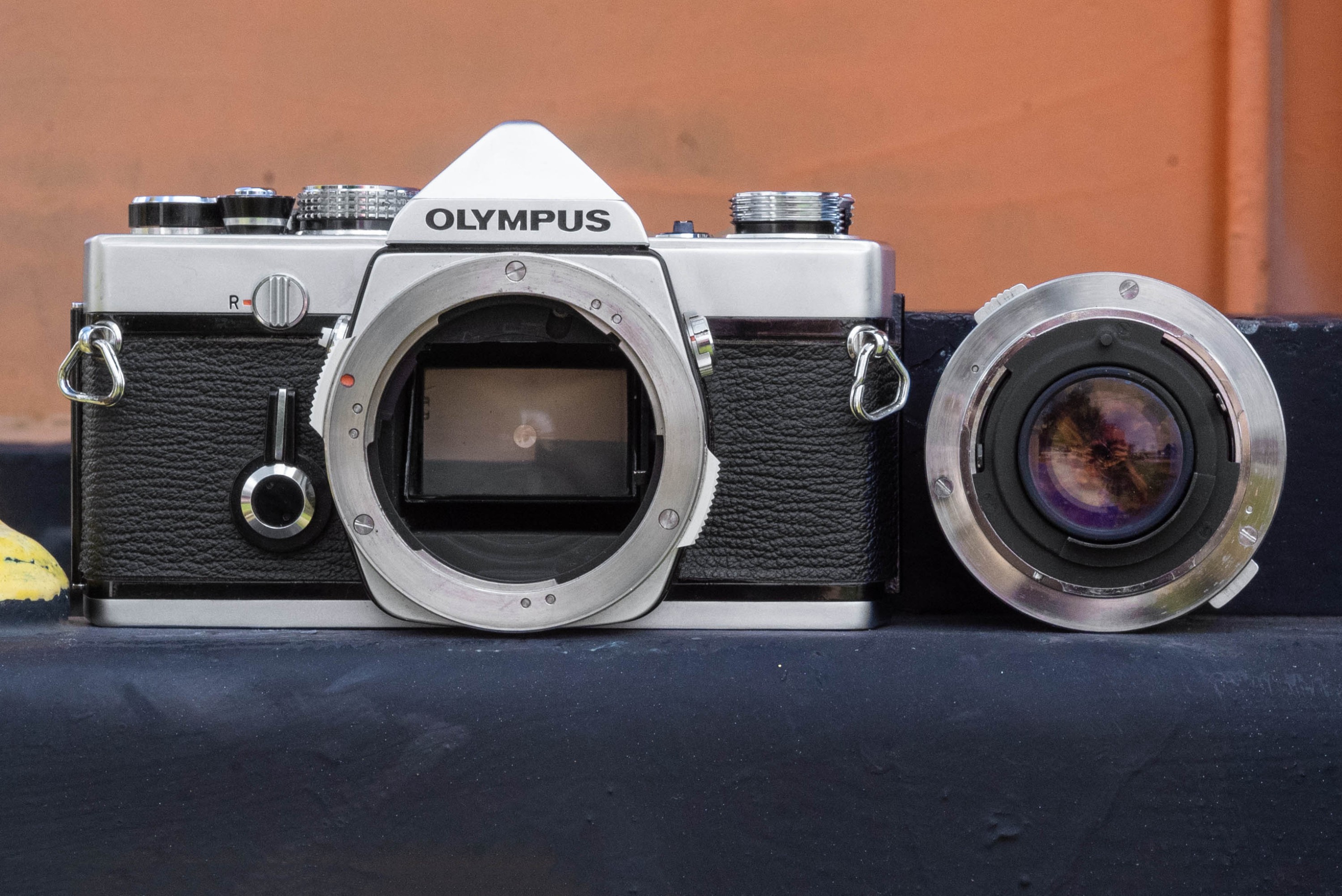
The Olympus M-1’s then new M-mount was a fairly standard three claw bayonet, however the manner in which the lenses lock to the camera is unique. Unlike most cameras in which the lens release is on the body, M-mount lenses have the lens release button on the lens itself, near the 1 o’clock position when looking at the front of the camera. Press this button while rotating the lens counterclockwise and it comes off. A second, similarly styled button is on the opposite side of the lens and while your instinct might be to press both at the same time, this button near the 7 o’clock position is actually the depth of field preview button.
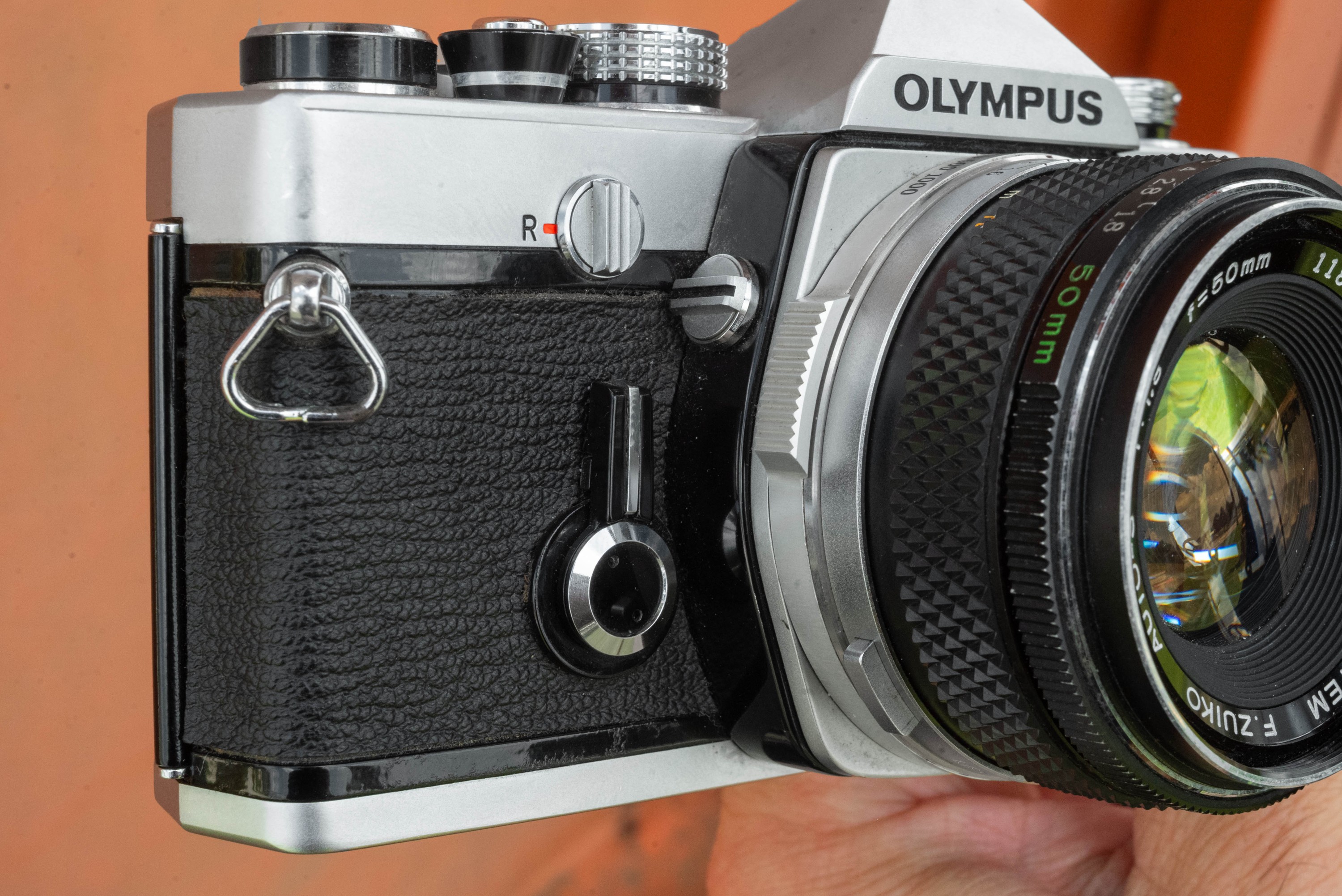
Other controls on the front of the camera, starting on the right side of the mirror box is the PC flash sync port which has a collar around it for choosing FP or X sync. Opposite the flash sync port, on the left side of the mirror box is the mirror lockup switch. This is useful to avoid mirror bounce on long exposures and also for some extremely wide angle lenses which interfere with the operation of the reflex mirror. On the front face of the camera, next to the mirror lockup switch is the film transport switch. With the red mark pointing up, film advances normally, but turn it toward the ‘R’ for when you need to rewind the film. Below the transport switch us the self-timer lever. A full 180 degree turn of the lever activates an approximate 12 second delay which is started via a smaller lever which is normally hidden under the main self-timer lever. The self-timer on the M-1 allows for shorter delays down to 4 seconds. A clever feature is that it can be paused partway through and reset without having to fully complete the self-timer motion.
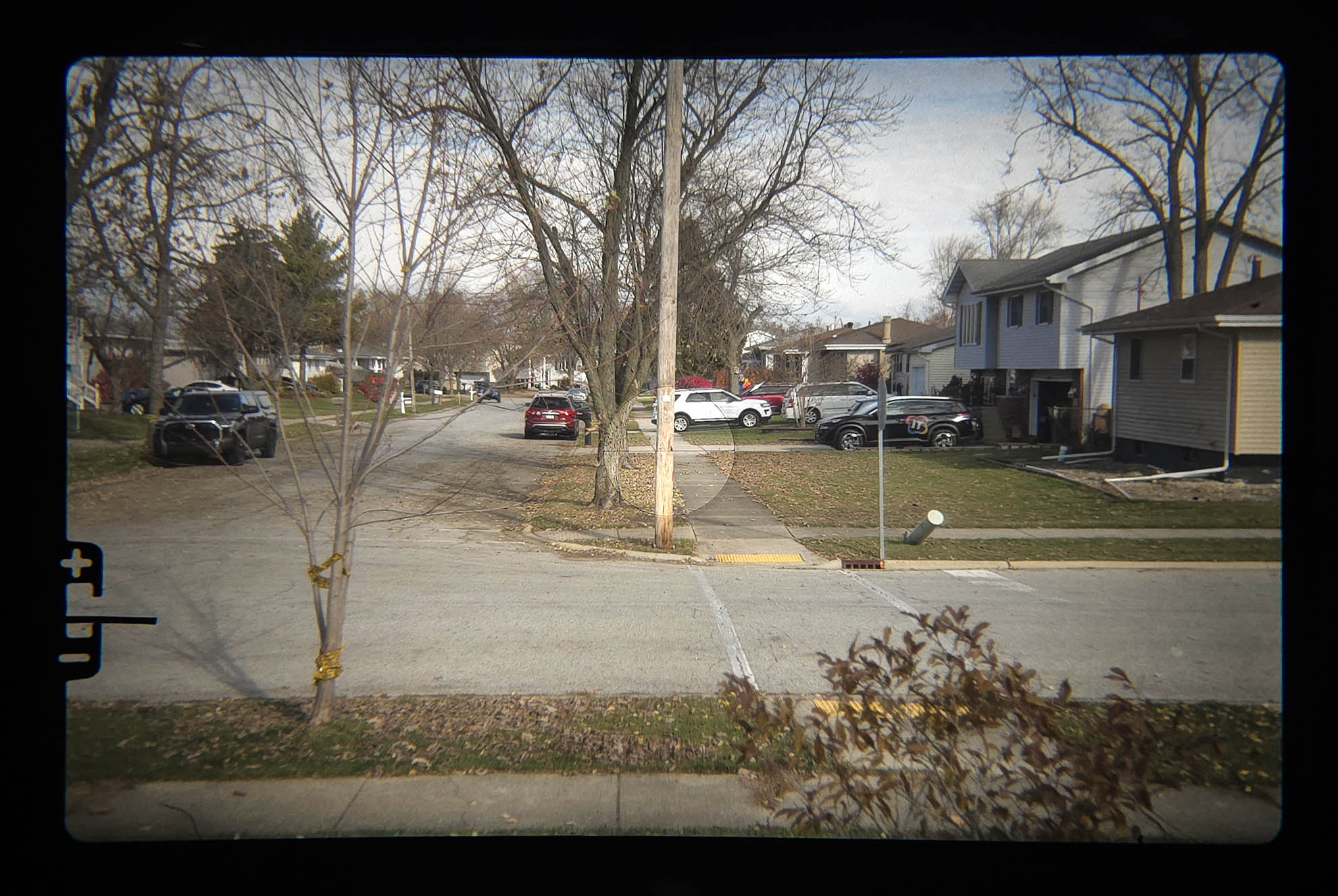
The Olympus M-1’s viewfinder is bright and very large, especially compared to the compact size of the camera. While on par with SLRs from later in the 1970s and into the 80s, the viewfinder brightness is very impressive for a camera released in 1972. A large and easy to use ground glass with a central split image rangefinder make seeing focus very easy. On the left side of the focus screen is the match needle with a + and – to indicate over and under exposure. Although a rather simple viewfinder, considering the camera’s fully manual operation, anything more would only clutter the experience. This excellent combination of size, brightness, and simplicity makes for what I believe to be one of the best SLR viewfinders on a fully mechanical camera, ever made.
Having shot a good number of Olympus OM-series SLRs, I was well prepared for what I should expect with the M-1, still being an early version of a revolutionary camera, I was eager to test it out. I ended up shooting two rolls of film through the camera, the first was a 20+ year expired roll of Kodak Tech Pan which I rated at ASA 50, and a fresh roll of the new Kodacolor 100 which Eastman Kodak recently released.


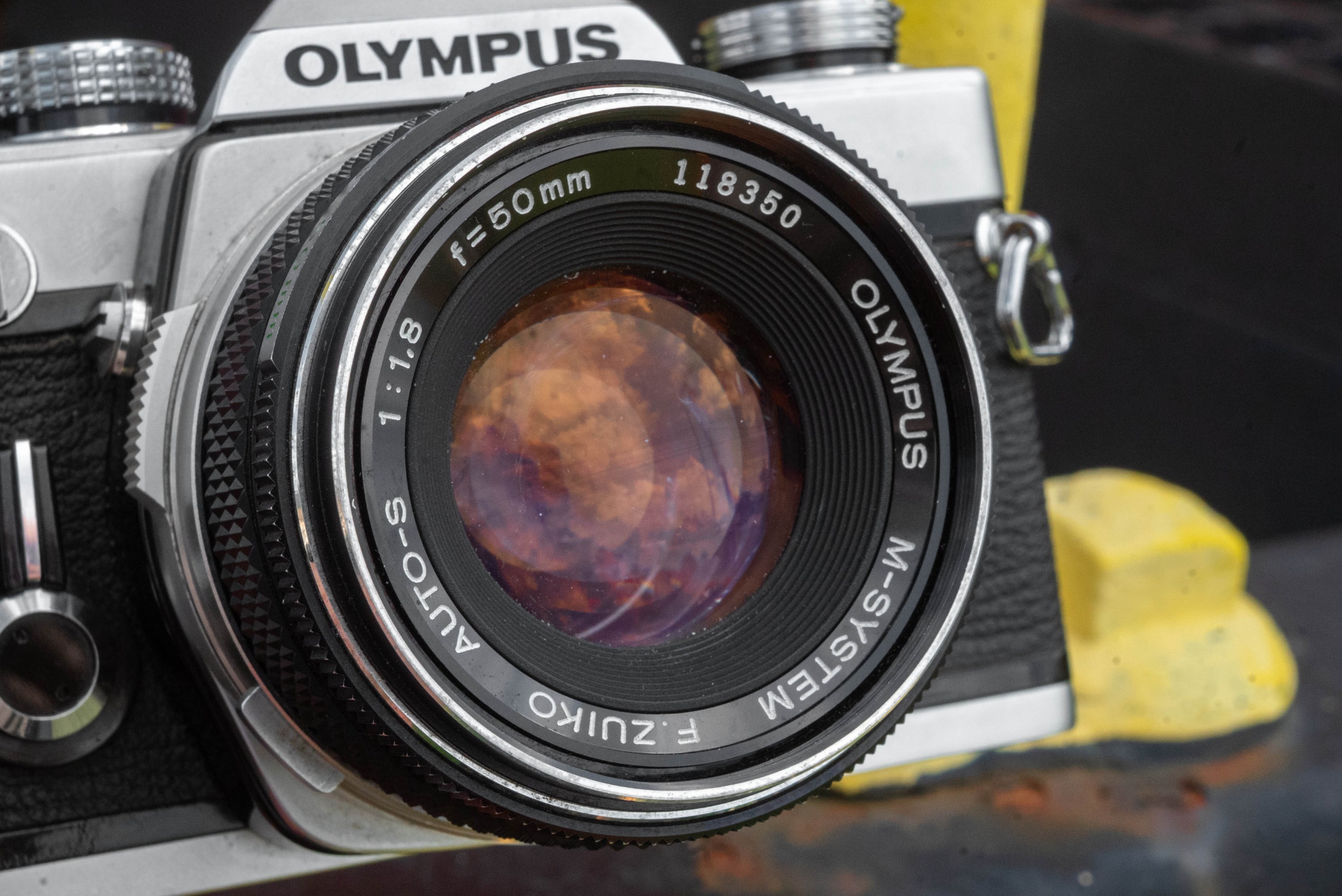
The images I got from the M-System F.Zuiko lens were predictably excellent. By the early 1970s Olympus had already well established itself as an A-tier optics company. Not only had Zuiko lenses appeared on a large number of half-frame Pen, Olympus TLRs, folding Olympus Six, and their one and done rangefinder camera the Olympus Ace, but they also appeared on a great number of cameras by other companies such as Aires, Mamiya, and others.
Sharpness was excellent corner to corner, vignetting and edge softness was barely noticeable and the images were devoid of any optical anomalies associated with lesser lenses. I had some issues with my color film development so I had some strange color casts with the Kodacolor 100 film, but that’s on me, not the camera. Clearly, if I was going to have something to say about using the Olympus M-1, it would have to be more about the experience, rather than the images I got.
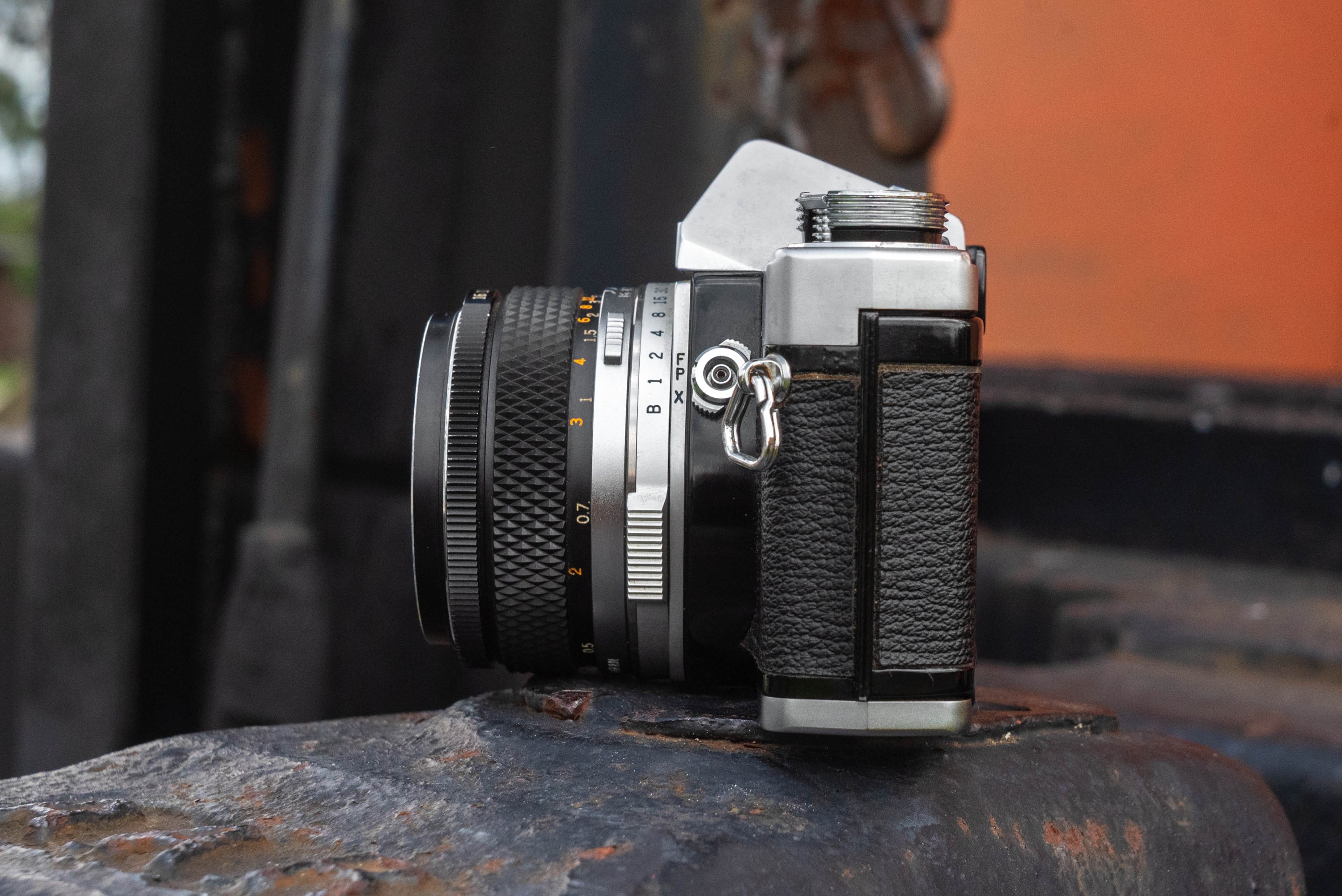
Having previously shot a large number of other OM-series cameras including the OM-1, 2, and 4, I had a pretty good idea of what to expect and despite being the oldest in the series, the M-1 did a great job. If by chance, you’ve never shot one of these cameras before, the things you’ll probably notice are how compact the camera feels. When Maitani was designing this camera, he did everything he could to shave off millimeters here and there, conserving space as much as he did.
In fact, one of the camera’s most controversial design elements, the shutter speed collar around the lens mount instead of a traditional dial on the top plate, is a result of the space saving design. Less parts were needed to control the shutter from around the lens mount than a typical top plate design would have. The shutter dial in this location certainly takes a bit of getting used to, but otherwise isn’t as much of problem as it might first seem.
Another aspect of the camera that surprises most newcomers to the M/OM-system is the unusually large viewfinder, which when compared to the small body seems even larger. Looking through the M-1 eyepiece is a joy. The focus screen and simple metering system take photography down to a very basic level that hits a nice balance of simplicity, while still offering just enough help to a beginner not comfortable with guess focus and Sunny 16 metering.
While shooting, I had no complaints with the Olympus M-1 and even coming up with a nitpick was a challenge, but if I absolutely had to critique one element of the camera’s design is that by relocating the shutter speed dial to the front of the camera, I think using that space for the very large ASA film speed dial was a bit of a waste when you consider you only change the film speed once when loading film. The struggle with designing a compact camera means that you have less room for other controls, and in this case I feel as though perhaps the shutter release could have benefitted from being a little closer to the prism. I didn’t necessarily find the location of the shutter release uncomfortable, but for those with larger hands, its location near the edge of the top plate feels just a tad cramped. Had Maitani settled on a smaller film speed dial, or perhaps located it somewhere else, that space could have been better used for something more important.
Overall, I really enjoyed shooting the M-1 as much as I have any other SLR, and I suspect many other people did as this formed the basis for a long line of OM-series SLRs. Although Olympus no longer makes cameras today, the spirit of the company’s design lives on in OM-System digital cameras which take a lot of design inspiration from this very camera, over half a century later.
If you’re interested in shooting an Olympus M-1, you’ll have an easier time finding a later OM-1 and the experience is exactly the same. OM-1s are plentiful today and easy to find for a reasonable price and usually don’t have any serious mechanical issues. I’d only recommend the M-1 for those interested in its historical significance (like me).
Related Posts You Might Enjoy
External Links
https://camera-wiki.org/wiki/Olympus_OM-1/2/3/4
https://www.mir.com.my/rb/photography/hardwares/classics/olympusom1n2/om1/index.htm
https://web.archive.org/web/20100527071557/http://olympus.dementia.org/M-1/ (Archived)
https://www.brokencamera.club/blog/2017/6/15/olympus-m-1
https://cameralegend.com/category/olympus-m-1-film-camera-review/
https://photoofthelife.blogspot.com/2021/12/olympus-m-1-1972.html