
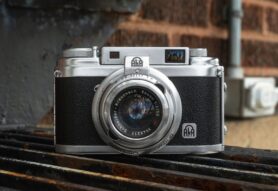
The Akarex III is a 35mm interchangeable-lens rangefinder made by Apparate und Kamerabau GmbH (AkA) of Friedrichshafen, West Germany, produced from 1953 to (reportedly) 1958. AkA, formed in 1946 by brothers Eugene and Max Armbruster, had previously built the Akarette/Akarelle series, cameras notable for dual viewfinders but no true rangefinder. The Akarex line began in 1951 with a modest fixed-lens Akarex I, and the III was AkA's ambitious flagship, distinguished by a genuinely unusual mechanism: the viewfinder and rangefinder were built into each lens module, so swapping lenses swapped the entire optical finder assembly, ensuring the viewfinder always matched the mounted lens's focal length—unlike competitors that required auxiliary finders for non-normal lenses. Only three lenses were made for it, all by Schneider-Kreuznach: a 50mm f/2 Xenon, 35mm f/3.5 Xenagon, and 90mm f/3.5 Tele-Xenar, with a rumored 45mm Westar and a 150mm Tele-Xenar (for a reflex attachment) never confirmed to exist. The body and each lens could be purchased separately, at prices the author converts to roughly $720–$1690 in today's money.
In hands-on use, the author found the Akarex III well-built, dense with brass and glass, and largely conventional in handling—Synchro-Compur leaf shutter, speeds 1–1/500 plus B, coincident-image rangefinder, dual 3/8" and 1/4" tripod mounts, a subtractive exposure counter, and a distinctive squeeze-release film door. Removing the breech-lock ring detaches the lens and viewfinder as a single unit, an experience the author calls genuinely surprising. Comparing the 35mm and 50mm finders showed each displaying an appropriately full-frame image rather than shrinking within a fixed window, though storage of a detached lens/finder unit proved awkward without original packaging. Testing with expired AGFA HDC 400 film and both the 35mm Xenagon and 50mm Xenon lenses produced sharp results with less wide-angle vignetting/softness than expected, though the film's age muted colors.
The author's verdict is that the Akarex III performs well as a typical 1950s German rangefinder but that its signature feature—the swappable finder/lens unit—only pays off if you own multiple lenses, meaning a buyer with just the 50mm gains nothing extra. The author suggests AkA missed an opportunity by not selling the camera as a bundled three-lens kit. The camera's low sales and lack of imitators indicate limited market interest, whether due to cost or waning trust in small manufacturers. Overall, it's deemed a fascinating, well-made curiosity worth seeking out for collectors, offering a genuinely unique mechanical trick, even if it won't necessarily wow photographers with its actual shooting experience.
AI-generated summary. May not capture every detail — read the full article below for the complete picture.
This is an Akarex III, a 35mm rangefinder camera made by Apparate und Kamerabau GmbH in Friedrichshafen, West Germany between the years 1953 and 1958. The Akarex III was a premium interchangeable lens rangefinder camera sold alongside the company’s Akarette/Akarelle cameras, but with one pretty major difference. The Akarex III had a feature not found on many other cameras, in which changing the lens also changed the entire viewfinder and rangefinder unit. Each lens made for the Akarex III contained a couple module that slid on top of the camera. The advantage to this system is that each rangefinder was coupled to the focal length of the lens and accurately framed the correct size image, without the need for multiple frame lines like on pretty much every other interchangeable lens rangefinder camera. Although neat, this added additional complexity and cost to each lens, and meant that only Akarex lenses could be used on Akarex cameras. The rest of the camera was pretty typical of mid 1950s camera design with a Synchro-Compur leaf shutter, and all the other features you’d expect.

Film Type: 135 (35mm)
Lens: 50mm f/2 Schneider-Kreuznach Xenon coated 6-elements in 4-groups + others
Lens Mount: Akarex Breech Lock
Focus: 1 meter to Infinity
Viewfinder: Interchangeable Coincident Image Coupled Rangefinder
Shutter: Synchro-Compur Leaf
Speeds: B, 1 – 1/500 seconds
Exposure Meter: None
Battery: None
Flash Mount: PC Port M and X Flash Sync
Weight: 816 grams, 552 grams (body only)
Manual: https://www.cameramanuals.org/pdf_files/akarex.pdf
In the long list of short lived camera companies is Apparate und Kamerabau GmbH which might perhaps be the most literal name of a camera company because it translates to “apparatus and camera construction”.
 Apparate und Kamerabau GmbH, who is commonly abbreviated as AkA, was formed in Friedrichshafen, West Germany in February 1946 by brothers Eugene and Max Armbruster. The company’s first camera was an attractive interchangeable lens camera called the Akarette from 1947. This black bodied camera shot 24mm x 32mm images and had an interchangeable lens mount with an in body leaf shutter behind it.
Akarettes would be continuously updated, first changing to the more standard 24×36 size, but then later adding additional features such as dual viewfinders, better shutters, and better lenses. The Akarette would be produced until 1954, replaced by the lever wind equipped Akarelle which continued until 1957.
A strange feature of most Akarallle and Akarette cameras is their dual viewfinders which offered two different focal lengths for 50mm and the second for either 75mm or 90mm depending on model. The presence of two windows up front caused some to mistake the cameras for having a rangefinder, a feature they never had.

To supplement their lineup, in 1951 Apparate und Kamerabau would release a new lineup of 35mm rangefinder cameras called the Akarex series. The first model would feature a fixed 45mm f/3.5 Isco-Gõttingen Westar lens and an uncoupled rangefinder. This modestly priced camera sold in 1951 for 149 DM which put it just under the price of the Akarette II with an f/3.5 Schneider Radionar lens.
Perhaps realizing that the company needed a more upscale option, in 1953, the company would release an ambitious interchangeable lens rangefinder camera called the Akarex III which had one additional feature not found on any other camera, the ability to change the viewfinder and rangefinder along with the lens. At the time, the only 35mm rangefinder cameras that supported lenses of different focal lengths required you to mount some type of auxiliary viewfinder to compose an image with a lens other than 50mm. For the Akarex III, the viewfinder and rangefinder would be part of the lens and changed all at once, meaning that no matter what focal length lens you had mounted to your Akarex III, the focal length seen through the viewfinder would always match the lens.
What Happened to the Akarex II? Only Akarex I and III models were ever sold, however an Akarex II was planned to fit between the two models, featuring the same uncoupled rangefinder of the Akarex I but with an interchangeable lens mount. Only two prototypes of the Akarex II are said to exist and it is not clear whether the lens mount was the same as what ended up being on the Akarex III or perhaps something different.
A total of three lenses are known to have been made for the Akarex III, all of which were made by Schneider-Kreuznach:
- Standard – 50mm f/2 Xenon
- Wide – 35mm f/3.5 Xenagon
- Tele – 90mm f/3.5 Tele-Xenar
Rumors of an entry level 45mm f/3.5 Westar lens for the Akarex III exist, but none have ever been seen. In addition, the Akarex III’s manual mentions a 150mm f/5.5 Tele-Xenar lens which would be used with a reflex attachment, but I have also have never seen such a lens or reflex attachment.

The Akarex III was unlike any other camera and it was also sold like no other camera. With the viewfinder and lens being a single unit, the camera body was just a shutter with a film compartment. Like other interchangeable lens cameras, each lens could be purchased separately, but so could the body. This suggests that Apparate und Kamerabau encouraged owners of multiple Akarex lenses to have multiple bodies which to swap lens and viewfinder units with.

In advertisements for the Akarex III and in the short preview from Popular Photography above, the “Body Unit” was sold by itself for $59.50. With the f/2 Xenon lens and the body, the whole package was $139.50, and for the wide angle Xenagon and telephoto Tele-Xenar, prices were $79.50 and $89.95 respectively. When adjusted for inflation, these four prices compare to $720, $1690, $960, and $1090 respectively.
According to my research, the Akarex III was produced from 1953 to 1958, but I have my doubts about that end date. Although no research into production numbers has ever been done, it is my opinion that this was a short lived model which didn’t sell well. While it is plausible that unsold new stock remained available until 1958, I have my doubts that it was made for that long but if anyone has more conclusive evidence either way, please let me know in the comments section below.

During the time it was made, at least one cosmetic revision was made to the camera, which was the design of the film advance lever. Earlier examples have a different design to the strap lugs and the film advance lever has a smooth finish, lacking the bump in the center and the knurled pattern around the edges.
If you’ve never seen an Akarex camera before, you’d be forgiven for thinking it is a run of the mill mid century 35mm rangefinder, and for most of its feature set it is. The camera has all the usual features you’d expect from this class of camera. A fixed lens with some type of leaf shutter, in this case the Synchro-Compur. It supports a range of speeds from 1 to 1/500 plus bulb. It is a coupled coincident image rangefinder, an all metal body, and supports the usual features like flash sync and a self-timer.
Yet, the Akarex III hides a secret that makes it one of the most unique cameras ever made. Although at a glance this looks like an ordinary fixed lens camera, it does have interchangeable lenses, but not only that, with the lenses, the viewfinder comes with it. Loosen the Akarex’s breech lock and remove the lens and the viewfinder comes off too, connected by an angled piece in the middle.

In the era where SLRs were not yet accepted as the de facto 35mm camera for the pro and amateur alike, rangefinders ruled. And while interchangeable lens rangefinders date back to the 1930s, they all had one limitation, which was that the built in viewfinder was only good for one focal length, usually 50mm. If you wanted to mount a wide or telephoto lens to your rangefinder, you had to use some kind of auxiliary viewfinder to see the correct focal length. Even worse, the auxiliary viewfinder was only that, a viewfinder. It did not contain the rangefinder for focusing, so in order to do that, you still had to use the built in rangefinder window, then move your eye to the auxiliary viewfinder to compose.
The engineers at Apparate und Kamerabau GmbH thought, what if we found a way to replace the entire viewfinder and rangefinder each time the lens was changed? I doubt they were the first to think of it, but as far as I know, they were the only ones to actually do it!
To their credit, with everything installed correctly, the Akarex III looks and handles like a typical 1950s German rangefinder camera. The lens, shutter, viewfinder, and rangefinder all work like they should and the camera’s ergonomics feature controls in the usual locations. For how radical of an idea to have an interchangeable lens and viewfinder camera, it did not compromise on controls or have any odd quirks. The Akarex III has a very good build quality with shiny chrome and body covering that is not peeling on my example. It is a dense camera made almost entirely of brass and glass and has no visible plastic anywhere in its construction.

Up top the camera is pretty clean, dominated by the top of the interchangeable viewfinder. I suppose it would be difficult to put controls on the surface of something that is removable. On the left is a small rewind knob that lacks any sort of handle to speed up rewinding. On the right is the film advance lever and the shutter release which is threaded for a cable release. On the back edge of the advance lever is the rewind release button for deactivating the film transport at the end of a roll of film. This location on the actual wind lever is unique and something I’ve never seen on another camera

Flip the camera over and the base has another interesting feature which is dual tripod mounts, one which is 3/8″ which was popular in Europe at the time, and the other 1/4″ which was used in North America and some other countries allowing users to mount this camera to any tripod, regardless of where they were in the world. In the center of the base plate is a film reminder dial with speeds from 11/10 to 24/200 DIN/ASA and the exposure counter. The exposure counter is subtractive, showing the number of exposures remaining on a roll of film. The counter must be manually reset after loading in a new roll of film by pressing in on it and rotating it until it reaches the number of exposures on your new roll of film.

The back and sides of the camera have little to talk about other than the eyepiece for whatever viewfinder/lens you have attached, and a film release door on the camera’s left side. The door release is one of my favorite types, in which you squeeze two posts together to release the lock. This way is both easy enough to do when you want it, but also reduces chances of the door accidentally opening with a more traditional single latch.

The right hinged film door swings open to reveal a fairly typical mid century film compartment. Film transports from left to right onto a double slotted take up spool. Insert the leader into one of the two slots and give it a few rotations to secure it and then you can close the door. One minor difference with the Akarex III compared to many cameras is that the gears for the film transport are above and below the film gate, rather than off to the site on their own shaft. The pressure plate is black painted with horizontal ribs and small dots to help reduce friction as film passes over it. The Akarex III predates the use of any sort of light sealing material, so there is nothing to replace before shooting one today. The camera’s serial number is also located inside the film compartment.

I have two lenses for the Akarex, the 50mm f/2 Schneider Xenon and the Schneider Xenagon 35mm f/3.5 and when looking down upon the top of the lens, the controls are the same. Closest to the front of the lens is the aperture ring which on the Xenon has click stops from f/2 all the way down to f/16. The Xenagon however has a clickless aperture ring and goes from f/3.5 to f/16. Next is the focus ring which on both lenses goes from 1 meter to infinity. The rangefinder coupling is exactly the same on both lenses so the available focus distances do not change. Finally, closest to the body is a fixed depth of field scale, which as you might expect is much wider on the 35mm Xenagon than the 50mm Xenon.

Regardless of which lens is mounted, the Syncho-Compur leaf shutter is part of the body and does not come off with lens like it might with some medium format SLR and TLRs. Shutter speeds are changed via a ring around the shutter with speeds from 1 to 500 plus Bulb. A coupling that exists between the lens and the viewfinder covers part of the top of the shutter, causing the shutter speed scale to be shifted off to the left a bit. This resembles the layout of the Leidolf Lordomat which looks very similar, although for a completely different reason.
Looking at the front of the camera, the only thing that really makes the Akarex stand out from other German cameras is the “L-shaped” coupling between the lens and viewfinder with an engraved AkA logo. The side of the shutter has both the flash sync port and a switch which allows you to choose between M and X sync. In between the shutter and the focus ring is a partial ring circle which wraps around the bottom of the shutter from one side to the other. Because of the rangefinder coupling above the shutter, this ring does not extend a full 360 degrees around the shutter. This ring is the breech lock for the lens mount.

To remove the lens, grip this ring with two fingers and rotate it counterclockwise as far as it will go. Once this ring stops moving, the entire lens and viewfinder come off as one single piece. It is definitely a shocking experience the first time you see this happen as it is just not something you’re used to seeing. With the lens not mounted to the camera, the viewfinder sticks out like an alien appendage, limiting your ability to set the lens down on a flat surface. When this camera came to me, it did not include any original packaging or any sort of lens case, so I imagine when these were new, some kind of storage box was included with each lens to store it when not in use. If you don’t have one of these like I don’t, finding a safe place to store the lens is a challenge.
With the lens and viewfinder removed, an accessory shoe on the main part of the body beneath where the viewfinder goes is visible. You can only access this shoe with the viewfinder off and it likely would have been used for an auxiliary viewfinder or for the rumored 150mm f/5.5 Schneider Tele-Xenar mentioned in the Akarex III’s manual.
With each lens attached, the viewfinder and rangefinder correctly display an image which is consistent with the focal length of the lens. This is advantageous to cameras with multiple display lines as the image doesn’t change size for different focal lengths. Although I do not have a telephoto lens for the Akarex III, the viewfinder with those would still take up the same amount of space as the wide angle lens does, whereas on other cameras, it would be a smaller rectangle using a smaller part of the whole image.

In the composite image above, I show the view through both the 50mm and 35mm viewfinders. In the 35mm viewfinder, I drew a yellow box to estimate the visible area of the 50mm viewfinder. In this image, you’ll see the majority of new information is at the top and right sides of the viewable image, even though I tried to get the rangefinder patch in the same visible area. Whether this affects image framing is unclear. The rangefinder patch has a pink tint which contrasts nicely over the bluish tint of the main image. The overall size of the viewfinder and rangefinder patch are typical of the era. It doesn’t compare to the large and glorious viewfinder of the Leica M3, but it is also a lot better than the squinty finders found on early Kodak Retinas.
The Apparate und Kamerabau Akarex III is a very interesting camera with a feature that can’t be found on any other camera, so when it came time to test it, I wanted to use it to its strengths. For my first test roll, I made it a point to alternate between the 35mm Xenagon and the 50mm Xenon to get a feel for what shooting the camera with different lenses was like. I used a roll of 20 year expired AGFA HDC 400 which has a reputation of holding up very well years after it has expired. I crossed my fingers and set my Sunny 16 meter to ASA 200 and took it out shooting!


As predicted the 20 year old roll of AGFA film showed a bit of color deterioration delivering muted colors that were strong on the yellowish green side, but otherwise looked decent. Certainly, this roll didn’t do the Akarex III justice as a fresh roll would have looked better, but there is still enough here to draw some conclusions.

I can say that the two Schneider lenses performed as well here as they would have on other cameras. Sharpness was excellent, especially those shot with the 50mm Xenon, but even the 35mm Xenagon performed surprisingly well, even in the corners. Mid century wide angle lenses often suffered from strong vignetting and softness near the corners, and while I do see a bit of it, it is nowhere near as bad as I had expected. I suspect that original owners of this camera would have been extremely pleased with the images either of these lenses would have made for them. That the Akarex III uses interchangeable lenses made by a company who also made them for many others results in an experience that’s less about the images and more about the camera itself.

The Akarex III is a well built camera, and as a mid century 35mm German rangefinder, it does its job well. I found the location of the shutter release a bit cramped up against the raised portion of the viewfinder, but otherwise the rest of the camera’s controls were logically located and easy to reach. The inclusion of a film advance lever was a nice addition, especially considering that this was no yet a standard feature in 1953 when this camera would have hit the market. I liked the design of the film door lock, all but guaranteeing the door couldn’t accidentally pop open when out shooting, and I liked that both the 35mm and 50mm lenses had a focus ring with two “ears” which made locating it with the camera to your eye, very easy to do.

By far, the greatest advantage to using the Akarex III is in the interchangeability of the lenses and is one that if you only have the 50mm lens, you lose out on. For a customer in the mid 1950s looking to buy a German rangefinder camera, there is no good reason to consider the Akarex III unless you were someone who regularly swapped lenses. For this reason, I think that Apparate und Kamerabau missed the opportunity to sell this camera with all three lenses as a set. Offering the camera with only a 50mm and then selling other lenses as an extra add on, requires the user to make a second or third purchase to take advantage of the camera’s best feature.
For as unique of a feature the interchangeable lens and viewfinder system was, that the Akarex III sold in small numbers and that no other companies tried something like this, strongly suggests that there was little interest in it. Perhaps the cost of the additional lenses was too much, perhaps by the mid 50s, customers were shying away from small market camera makers like Apparate und Kamerabau, or maybe just that nobody ever looked at a regular rangefinder camera and said “Gee, I wish this came off”.
The market is the best indicator of a camera, or a particular feature, and in this case, it is pretty clear that the market swiped left on the Akarex III. For collectors today however, the Akarex III represents a curious addition to your collection, and one that is worth looking for. It is a neat camera that can do something that no other can, just don’t expect to be blown away when you try to shoot it.
Related Posts You Might Enjoy
External Links
https://camera-wiki.org/wiki/Akarex
http://www.cjs-classic-cameras.co.uk/arette/arette.html#akarex_iii
http://www.3d-historisch.de/AkA/AkA-Kameramodelle.htm (in German)
https://www.collection-appareils.fr/x/html/camera-6329-Aka_Akarex%20III.html (in French)
If you compare the Akarex with the akarelle you will quickly notice that the internals are almost exactly alike. The external separate rangefinder sold for use with the akarelle is exactly the same as rangefinder for the akarex, just uncoupled. AkA made a shoe adapter that slid onto the accessory shoe from the rear even with the lens-rangefinder combo in place. I think I have seen ads for the akarex in American publications from 1958, making it one of the few AkA products sold in North America. The akarex was AkA’s attempt to upscale their product line using the coupled RV and the more expensive compur shutter. I don’t think it worked. The akarette/akarelle cameras were always more versatile.
That is interesting that the internals are so similar to the Akarelle, but it makes sense. AKA was a small company and probably wanted to share as many manufacturing parts as possible. I have seen images of the shoe adapter before but just couldnt find one nice enough to use in the review. In this review, I have a scan of an American Akarex ad from 1957, imported by a New York company literally called the Akarex Corporation.
“What if we found a way to replace the entire viewfinder and rangefinder each time the lens was changed?”
The earliest example I can think of where this was attempted in a coupled rangefinder was – unsurprisingly! – from Leica. The Leica IV, which was being worked on before the war (Leica Society International dates the original plans to 1936, which is surprisingly early!), had a combined RF/VF akin to the Contax, but the back half of the RF/VF module (including the eyepiece) could be removed and replaced with a different component to change the field of view to match different focal lengths.
There’s not a lot of photos or information on the project, but there’s a few photos of prototypes and a “technical drawing” (which looks like a modern CAD sketch-up) here: https://gmpphoto.blogspot.com/2014/10/the-fascinating-world-of-prototype.html
To my eyes that prototype looks like it was built on a IIId or IIIf “chassis”, so if LSI are correct with their dating, it looks like Leitz revisited the idea after the war but shelved it; presumably, the M3 made the project redundant. Still, a very cool idea. I’m not sure how that positioning of the rewind knob would have worked, though!
I have had the Akarex III with all the lenses for about a dozen years and never once have gotten around to shoot it. Always loved it’s “uniqueness” and will have to say with the 90/3.5 Schneider attached it’s a bit of a beast? Solid camera but can understand why not many were ever sold as if you have both accessory lenses and the standard on the camera, it’s a bit of a load. I also have a later Arette BW which also has interchangeable Schneider lenses. It does not have a built in RF and I do use the plain Akameter rangefinder accessory with it. Always was looking for one of the final in the series, the Akarelle Auto SE, which finally had a built in RF and light meter but does not have interchangeable lenses. It seems AkA never got it completely together to offer all three, although an interesting group of cameras.
Thanks for very interesting article. Buy this camera and go looking for any info and find with post.
Rn waiting for my parcel, please tell me, which diameter for filters on 50mm lens? Wanna buy substuff before camera arrive to me.