
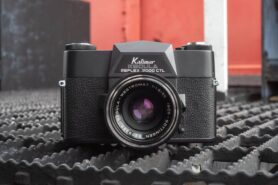
The Kalimar Regula Reflex 2000 CTL was a 35mm SLR produced by Regula-Werk King KG of Bad Liebenzell, West Germany, and sold in the US via Kalimar and elsewhere as the Ringfoto Reflex. It was King's first and only 35mm SLR, designed by Joseph Alphonse Op de Beeck with production shared among several German firms. Despite debuting as a prototype at Photokina 1966, the camera didn't actually reach the market until 1970, likely due to production or mechanical difficulties rather than the often-repeated (but unsubstantiated) claim of a Leitz lawsuit over its resemblance to the Leicaflex. It used the M42 mount, offered TTL stop-down metering, a top shutter speed of 1/2000, and 1/125 flash sync, and sold for around $275 with its 50mm f/1.9 Isco-Göttingen Regula-Westromat lens—competitive with contemporaries like the Nikkormat FTN and Minolta SRT-101. Production likely ended by 1973, with estimates of only 2,500–4,500 units made, making surviving examples rare today.
The author, who had long wanted one as a piece of "Opportunistic GAS," finally acquired a near-mint copy in late 2025 and came away impressed. Highlights include the camera's distinctive matte black finish (compared favorably to Leitz's black chrome finish on the M5/SL2), a bright viewfinder with a sweeping shutter-speed scale and match-needle metering, and surprisingly good ergonomics despite the camera's large, heavy body. The tapered shape of the Westromat lens, which widens toward the front, made the focus and aperture rings easy to distinguish by feel. Minor criticisms included a shutter release placed too close to the camera's edge, an awkwardly positioned self-timer lever, an oddly located exposure counter, and a notably loud shutter, attributed to its advanced high-speed horizontal-travel design.
Overall, the author considers the Regula Reflex 2000 CTL an excellent and historically interesting camera—an unexpectedly strong SLR debut from a company not known for the format. While rare and hard to find in working order, the author highly recommends seeking one out if the opportunity arises.
AI-generated summary. May not capture every detail — read the full article below for the complete picture.
This is a Kalimar Regula Reflex 2000 CTL, a 35mm Single Lens Reflex camera produced by Regula-Werk King KG in Bad Liebenzell, West Germany around the year 1970. This version of the camera was sold in the United States by Kalimar out of St. Louis, Missouri but was also sold in other markets as the Ringfoto Reflex. The Regula Reflex 2000 CTL used the M42 thread mount, but supported TTL metering, a top 1/2000 shutter speed, a fast 1/125 electronic flash sync speed, and a distinct black finish and an overall unique appearance that some say was inspired by the Leitz Leicaflex SL2. Although an attractive camera with a competitive feature set, it did not sell well and was produced for only a short period of time and is difficult to find today.

Film Type: 135 (35mm)
Lens: 50mm f/1.9 Isco-Göttingen Regula-Westromat coated 6-elements in 4-groups
Lens Mount: M42 Thread Mount
Focus: 1.7 feet / 0.5 meters to Infinity
Viewfinder: Fixed SLR Pentaprism
Shutter: Cloth Focal Plane
Speeds: B, 1 – 1/2000 seconds
Exposure Meter: TTL Coupled CdS Cell w/ viewfinder match needle
Battery: 1.35v PX625 Mercury Battery
Flash Mount: Hot shoe and M and X Flash Sync, 1/125 X-Sync
Weight: 925 grams, 725 grams (body only)
Manual (in German): https://mikeeckman.com/media/RegulaReflex2000CTLManual.pdf
 For the purposes of this article, I’ll refer to all name variants of the Kalimar Regula Reflex 2000 CTL simply as the Regula Reflex to keep it easier to type. This is a camera in which there isn’t a lot of information about online. Much of what you can find is usually the same few paragraphs, repeated over and over on many sites which I’ve come to learn is mostly inaccurate. After researching this article, I still don’t have a complete history for the camera, but I’ve been able to piece together enough to tell what I think is a more accurate history.
A quick history about King, was that the company was originally founded in Pforzheim, Germany in 1936 by Pius King. The factory moved to Bad Liebenzell two years later where they produced supplies for the electrical and watchmaking industries. King would not produce its first photographic instrument until 1949 when it was run by Pius King’s son, Herbert King. Many early King cameras were of good quality, starting with simpler scale focus cameras, but later featuring more advanced models with coupled rangefinders and interchangeable lenses.
The company would see moderate success in the mid 20th century, but would not start work on its first Single Lens Reflex until the 1960s after many other manufacturers had already introduced their models. This review is for what would be King’s first and only 35mm SLR, the Regula Reflex.
 Despite being credited to Regula-Werk King KG, the camera was not designed or completely built in house. The person who deserves credit for the design was a man named Joseph Alphonse Op de Beeck from Brussels, Belgium. It is not clear exactly who Op de Beeck was, or the specifics of his relationship with King, but according to a 2012 article written in Photo Deal magazine by Volkmar Kleinfeldt, the manufacture of the camera was a joint effort by a variety of German firms. Parts of the body, the shutter, and slow speed escapements were made by companies called Mahle GmbH and Burger & Söhne in Schönach in the Black Forest. The camera’s electronics and anodized aluminum top plate were built in house by King. Final assembly was also done by King in Bad Liebenzell.
 An early prototype of the camera was revealed at Photokina 1966 as the Regula Reflex CTL. During that show, the brand new West German 35mm SLR was shown with a top 1/2000 shutter speed and a design unlike that of any other SLR of the era. The image to the right comes from the January 1967 issue of Modern Photography in their ‘Photokina 1966’ recap previewing the release of the Regula Reflex CTL. The specs listed for the camera are similar to the final version but list dual CdS meter cells, to which the final version only has one, and it also mentions that an unmetered version of the camera possibly called the Regula Reflex SL would be available, which never happened.
On the Regula Reflex’s camera-wiki page, an oft repeated claim is made that the 1966 prototype was shown with both the ‘Praktica-Pentax’ M42 mount and also with the Nikon F mount. I have my doubts about whether that is true, not only because there are no known images of the camera with a Nikon F mount, that the Modern Photography preview of the camera doesn’t mention it, but also that in order for the same camera to be offered with both the M42 and Nikon F mounts, it would need to be produced with two different flange focal distances. The flange focal distance is the distance between the point at which the lens mates to the mount, and the film plane. Cameras with the M42 mount have a flange focal distance of 45.46mm and the Nikon F is 46.5mm. This minor difference would need to be made up by physically altering the mount on the camera body. Furthermore, I don’t know of any German companies who marketed their cameras to Nikon shooters, it just wasn’t done. Unless Regula-Werk King KG had intended to produce a camera to sell in the Japanese market, it simply makes no sense to offer this camera with a Nikon F mount.
We know for sure that the Regula Reflex made its debut in September 1966, so it stands to reason that it might have gone on sale the next year, or perhaps even in 1968, and that is a leap that some articles make, but it is one that I don’t think is true. In a 2016 post on the site knippsen.blogspot.com, the author expresses his doubts that the camera was released prior to 1970, using a German language magazine article from 1970 announcing the all new Regula Reflex SLR was making its debut.
Further supporting KniPPsen’s theory is that the September 1970 issue of Popular Photography also introduces the Regula Reflex as an all new camera. Author, Bob Schwalberg states that Kalimar would be the US importer, but all images of the camera show the non-Kalimar name plate, suggesting this was a preview copy from Germany.

If a prototype version of the Regula Reflex was ready as early as September 1966, why would it take four more years for it to come out? In yet another often repeated story, Regula-Werk King KG was said to have run into legal trouble with Ernst Leitz over one or multiple aspects of the Regula Reflex’s design. The story goes that parts of the camera’s design were too similar to Leitz’s Leicaflex SLR which was being sold at the same time. It was said that the Regula Reflex’s shutter, which matched the Leicaflex’s top 1/2000 speed, infringed some of Leitz patents which led to the legal battle. Other theories I’ve found online go as far as to say the Regula Reflex’s design was also borrowed from the Leicaflex, a fact that is easily disputed by simply looking at the two cameras.
While a legal battle between two German camera makers is plausible, especially when the two cameras share a premium feature like a 1/2000 shutter speed and TTL metering (the later Leicaflex SL had TTL metering, the earlier model’s meter was body mounted), there simply is no evidence of it. Sites like camera-wiki and novacon.com.br who claim there was a lawsuit, offer no evidence whatsoever.


Perhaps the most conclusive evidence that a lawsuit never existed (or at least never went anywhere) comes from an undated interview with Wilfried Bauser who was the son in law of someone in the King family and was part owner of the company in 1980s who stated that there never was a lawsuit at all.
If a lawsuit between Leitz and Regula-Werk King KG never happened, then what caused the nearly four year delay between the camera’s introduction in 1966 and its first appearances in German and English magazines in 1970? The Photo Deal article shown below suggests that mechanical issues plagued the camera, but doesn’t elaborate on specifically what, or why they took four years to resolve. Unless some kind of official statement from that era is discovered which can paint a more official picture of what was happening, the best guess I can make is based on the entire German camera industry at that time.

The late 1960s and early 70s were a very turbulent time for German camera makers. This was a period of time in which Japanese camera makers began to dominate the optics industry. More and more photographers were gravitating to Japanese brands like Nikon, Canon, Pentax, and Minolta. German camera makers struggled to make competitively featured and priced models that appealed to western photographers. Long time German brands like Voigtländer and Zeiss-Ikon had merged in 1964, and in 1972 would see the end of all Zeiss-Ikon cameras. Kodak AG Stuttgart, makers of the Kodak Retina series, ended SLR production of the Retina Reflex IV in 1967, and even Leitz themselves struggled to make SLRs profitable, eventually striking an agreement in 1972 with Minolta to co-produce future Leica SLRs.

It is entirely possible that Regula-Werk King KG, who was a significantly smaller company with less resources than much larger companies like Zeiss-Ikon and Kodak, struggled to bring their ambitious SLR to the mass market. In addition, the Regula Reflex was a complicated camera with a unique shutter. Had it been released in 1966, it would have been one of the first German SLRs with TTL metering, even the body design was unique among other camera makers and likely required precision machining to create.
My best guess is that four years is how long it took to perfect the assembly and production of the camera, and it simply was not ready until 1970. And since I am guessing, based on how few of these cameras are out there, I would be willing to bet that it was not produced for any longer than 3 years. Perhaps some unsold new stock was available through select distributors after that, but I sincerely doubt it was made for as long as 1976, which is a date thrown around by some of the same sites peddling misinformation about this camera.
I was unable to find any contemporary advertisements or catalogs showing how the US imported Kalimar Regula Reflex 2000 CTL was marketed here, but in the Popular Photography preview article above, it suggests that the camera would have carried a retail price of $275 with the 50mm f/1.9 Westromat lens. According to Modern Photography’s September 1970 SLR directory, a $275 Regula Reflex would have went up against cameras like the Nikkormat FTN and Minolta SRT-101 with comparable lenses, which had retail prices of $279.50 and $275.50 respectively. When adjusted for inflation, these prices compare to around $2280. In the Ringfoto Reflex advertisement above, the price for the camera plus a Cassaron 50/2.8 lens, a Westromat 50/1.9 lens, and a Schneider Xenon 50/1.9 lens were shown as 448DM, 598DM, and 698DM respectively.

When it was sold, several different 50mm lenses were available, depending on which market you were in. Since the Regula Reflex uses the standard M42 lens mount, there wasn’t anything particularly special about the lenses it would have used, although a few were branded with the name “Regula” on the front ring like the Isco-Göttingen Regula-Westromat 50mm f/1.9 lens found on the camera being reviewed in this article. I found no information about lenses of different focal lengths, although I suppose owners could have used any number of existing M42 lenses made by other companies. Here is a list of the other 50mm lenses known to have been sold with the Regula Reflex:
- Schneider-Kreuznach Xenon 50mm f/1.9
- Steinheil Auto-Cassaron 50mm f/2.8
- Isco-Göttingen Iscotar 50mm f/2.8
- Auto Regulon 50mm f/1.8 (made in Japan by Cosina)
One final myth about the Regula Reflex which seems to originate from camera-wiki but doesn’t cite where it came from, was that a more advanced model, supposedly called the ‘K650’ appeared in 1972 which added spot and average metering, shutter priority automatic exposure, and a Nikon F mount. I feel pretty good declaring this as pure fantasy and that it never happened. Earlier, I explained why a Nikon F version of this camera was implausible, but to add dual metering modes plus shutter priority automatic exposure on a low production camera in the early 1970s would have been extremely ambitious.
Although no official end date for production of the Regula Reflex has ever been stated, the camera seemed to disappear by the end of 1973. As for production numbers, the KniPPsen article estimates about 4500 were made but Volkmar Kleinfeldt lists the number lower at 2500 units. Based on the rarity of these cameras today, the lesser number seems more likely to me. An unscientific search of eBay for the Regula Reflex and both the Ringfoto and Kalimar name variants produces only 3 for sale anywhere in the world at the time of this writing.
The following article was originally published in the German magazine, Photo Deal, in their IV/2012 edition. It is a six page article about the Regula Reflex and its variants. The entire article is written in German, so if that is not a language you can read, you can download the original PDF and use a translation service such as Google Translate. The entire article was scanned and published with permission from Rudi Hillebrand.
On the Camerosity Podcast, we often talk about various types of Gear Acquisition Syndrome (GAS for short) and recently we’ve explored the concept of “Opportunistic GAS” which is when you long for something just enough to keep it on the back of your mind, but not strongly enough to go right out and buy one at current prices. Cameras on the Opportunistic GAS list are usually less common models, those with generally high prices, or both. In the case of the Kalimar Regula Reflex 2000 CTL, it was both. I had seen one of these cameras a while back and was struck by its beauty but not its price. I didn’t particularly care for which name variant I found, but I knew that I wanted one not only that worked, but also had a correct lens on it.

The Kalimar Regula Reflex 2000 CTL remained on that list for years, until one day in late 2025, I saw one for sale on the usual site. The price was a bit out of my comfort zone so I placed it on my watch list for a couple weeks and after seeing the camera not sell and get relisted multiple times, I decided to reach out to the seller and see if he’d take a lower price. My offer wasn’t too much lower than what was being asked, but was just enough that I could justify buying it. To my surprise, the seller accepted my offer and shipped me what was described as a fully working, near mint condition camera.
To prepare myself for Regula Reflex’s arrival, I read a few reviews of them online and started to educate myself on they’re history in preparation for writing this article. A common word used to describe the camera is heavy. The Kalimar Regula Reflex 2000 CTL comes from a time just before it was common to see 35mm SLRs shrink in size. That this camera existed in prototype form as early as 1966 suggests that the core mechanics of this camera were designed to work in a body the size of a Nikkormat or Zeiss-Ikon Icarex 35.
The Regula Reflex came in a box with a few other items I had ordered, but even before removing it from its protected bubble wrap shell, it was obvious which one it was. The size of this camera is big, but after holding it for just a few seconds, it became clear that using the camera wouldn’t be a chore as the ergonomics were quite good.
My favorite feature of the camera is the matte black finish which does not look like the typical kind of black enamel you’d see on most other black cameras. The look and feel of the finish resemble that of the black chrome finish that Leitz offered on the Leica M5 and SL2. The finish has no shine or clear coat, but is extremely smooth to the touch, almost bordering on luxurious. Whatever this finish is made of, it was applied well and on my example showed no signs of brassing, wear, or other damage.

The Regula Reflex’s top plate is very clean with a lot of room for only a couple controls. On the left is the fold out rewind knob with combined film speed dial and battery check function. Before using the exposure camera’s meter, you must set your chosen film speed. ASA and DIN options from 3 – 6400 and 6 – 39 are available, which was a wide spread for a camera of this era. The center of the pentaprism has a flash hot shoe with the common central pin for electronic flashes. On the right side is the large diameter shutter speed dial with a cable threaded shutter release in the center. Shutter speeds from 1 to 2000 plus Bulb can be chosen before or after cocking the shutter. While this dial and the shutter release are very large, one mild criticism of the Regula Reflex’s ergonomics is that I feel the shutter release is too close to the edge of the camera, and would have been in a more comfortable location if it was closer to the center of the camera by a little bit.

The base of the camera has a 1/4″ tripod socket centrally located under the mirror box for excellent balance while mounted to a tripod. Next to the tripod socket is the battery door for the PX625 mercury cell. The example on this camera has a clear battery door which looks to have been repaired in the past with some type of glue or epoxy. Based on images of these cameras online, I believe they’re all clear like this one just without the glue. Finally, a large rewind release button is present which deactivates the film transport as you rewind film.

Both sides of the camera have a metal strap lug which is slightly forward angled to improve balance while heavy lenses are mounted to the camera. On the left side is the latch for the film compartment door. Simply press in and down on the little slider to unlock and open the back door. From this side of the camera, you can also see both the M and X flash sync ports on the side of the mirror box.

The back of the camera has a large swath of body covering over the tapered film door. Above it is a round eyepiece for the viewfinder. This eyepiece is threaded and looks to be the same diameter as other camera makers of the day like Nikon and Fuji. To the left of the eyepiece is the automatic resetting exposure counter. This location is a bit strange, but works well enough. Finally, on the right is the film advance lever. The lever on this camera sticks out of the back, rather than being located on the top plate as the tall height of the camera would have made advancing the film a bit of a stretch for most people’s fingers. This location in the back is much more comfortable. A single movement of this lever is about 210 degrees and must be done all in one motion, rather than several small motions.

Opening the film compartment is done by sliding a small latch downward on the camera’s left side. It is not the best implementation of a door latch I’ve seen, but works well enough. The right hinged door swings open to reveal a fairly ordinary film compartment. Film transports from left to right onto a notched integral take up spool. Unlike most take up spools that have either a slit or a clip, the center of the spool has a large notch in which you slide the film leader through and then allow it to wrap around itself. It is a primitive form of a quick load system that works most of the time, but can have a tendency to allow the leader to slip off if you’re not careful. The film gate has horizontal ribs on it, similar to that of the Zeiss-Ikon Icarex and the pressure plate has horizontal bars going across it. The camera’s serial number is stamped inside the film door.

Looking down upon the top of the 50mm f/1.9 Isco-Göttingen Regula-Westromat lens and the shape of the lens immediately jumps out at you. The Westromat lens is narrower nearer the body of the camera and gets larger as you reach the front of the lens. On the lens itself, a ring whcih selects either a Manual or Automatic diaphragm is closest to the body. Next is the aperture ring with click stops from f/1.9 to f/22. A depth of field scale is in front of it and nearest the front is the focus ring with distances marked in feet and meters from 1.7 feet and 0.5 meters to infinity. The benefit to the tapered lens shape is as your hand moves between the aperture and focus rings, the size changes and the larger focus ring is a lot easier to locate than if it had been the same exact size. This was a design element that Mamiya employed with lenses on their Auto XTL, and something I wish more companies did.

The clean lines of the Regula Reflex continue up front with little to see on the front plate of the camera. Flanking the lens at both the 3 and 9 o’clock positions are stop down levers which are also used to take a meter reading. The Regula Reflex uses the M42 mount which natively cannot support open aperture metering without some kind of help. Some manufacturers resolved this limitation by altering the M42 lenses in some way, adding an additional feeler or a post to indicate the exact orientation of the lens when mounted to the body, but others went the route of only taking a reading when the lens is stopped down. The greatest benefit to this system is that the camera would work with any M42 lens with an automatic diaphragm. You would not be limited to proprietary lenses made specifically for this camera.
While yes, this does add an additional step towards getting a reading, it is one that is very fast and easy to due, mainly because of the excellent location of these paddles. It does not matter which side you press, but when you need to take a meter reading using the match needle in the viewfinder, press and hold one of these paddles in while looking through the viewfinder. Beyond that, the Regula Reflex uses a standard M42 thread mount. Lefty loosey and righty tighty!

The viewfinder is large and bright with a large microprism circle in the center with a ground glass collar around it for precision focus. Around the ground glass are concentric Fresnel circles which extend all the way to the corners. This Fresnel pattern greatly improves brightness across the focusing screen, eliminating any darkness in the corners like on earlier SLRs. To the right of the main image is a very large and curved shutter speed scale with numbers from 1 to 2000. In addition to the scale are two red brackets which are controlled by the film speed dial to set upper and lower exposure limits of the meter, then connected to the shutter speed dial is a black match needle bracket that high lights your chosen shutter speed, and finally a black needle which is coupled to the meter and is only activated when one of the two paddles on the front of the camera are pressed in. With the meter active, you want the black needle to point in between the black shutter speed bracket. If the needle points outside of this bracket, then the chosen exposure settings will result in an over or under exposed image.
With a base line level of familiarity with the Regula Reflex, it was time to load in some film. For the first roll of film, I went with a roll of some bulk Jessops Pan 100 S film, which I previously found out is rebadged Ilford 100 film. This film is very similar to my beloved Kodak TMax 100, but with a tiny bit more contrast.


It is clear that the designers of the Regula Reflex were looking to do something different than that of other camera makers. The Regula Reflex is big and chunky, but also smooth and angular. The camera is heavy and feels substantial in your hands, but that everything is so comfortably located, it gives the illusion of a lighter weight and more compact camera than it really is. The viewfinder is excellent and although strange looking, I appreciated the large sweeping shutter speed scale with match needle display on the right. I found this to be useful both when using the meter and when shooting the camera fully manually. Also, perhaps my favorite feature of the camera is that black matte finish. I am unsure of what process was used to apply this finish, but it feels a step above simple enamel as it is incredibly smooth and luxurious feeling.

Ergonomically, everything falls into place where my fingers naturally wanted to find it with the only exception being that on more than one occasion, I mistook the front aperture stop down lever as the shutter release as its location is exactly where you’d expect to find one on a camera with a front shutter release. Another neat ergonomic bonus is that the shape of the Isco-Göttingen Regula-Westromat lens gets wider as your hand moves away from the camera. This allows for the focus and aperture rings to be a different diameter and with two different sizes makes them much easier to locate than if the two rings were the same size and thickness. A small detail for sure, but one that I appreciated.

There is a lot to like about the camera with my only complaints falling firmly in the nitpick category. For those, I wish the shutter release wasn’t so close to the edge. Picking up the camera and looking at where my right index finger naturally falls, I think a more traditional location nearer the prism would have been more comfortable. Even though I didn’t use it, the location of the self-timer lever is a bit odd. On more than one occasion, my left hand grazed across it, and although it didn’t happen, I could see someone triggering the self-timer unintentionally. Finally, I didn’t care for the location of the exposure counter on the back. I can’t explain why, but it just felt unnatural to be there, and I sometimes would forget to check it when loading in a new roll of film.
Beyond that, the only other comments I’d say is that the shutter is one of the loudest of any focal plane SLR I’ve ever shot. I read somewhere that this extra volume is the result of the shutter’s advanced design which is how it was able to hit 1/2000 seconds while still traveling horizontally.
Overall though, the Kalimar Regula Reflex 2000 CTL or whatever name variant you may have, is a wonderful camera, and an impressive SLR debut from a company not known for this style of camera. In fact, I’d go as far as to say, the Regula Reflex is so impressive, that it makes me sad that this company didn’t start sooner as it would have been interesting to see what future iterations (perhaps a 3000 CTL) might have been like. As it is, this is a very interesting and well performing camera. It certainly isn’t common, and even less so in working condition, but if you get a chance to own or shoot one, I definitely recommend it!
Related Posts You Might Enjoy
External Links
https://camera-wiki.org/wiki/Regula_Reflex_2000_CTL
https://knippsen.blogspot.com/2016/02/king-regula-reflex-200-ctl.html
http://www.novacon.com.br/odditycameras/regula.htm
https://www.fotocommunity.de/photo/neu-photo-deal-heft-79-volkmar-kleinfeldt/29081203 (in German)
https://www.fotocommunity.de/forum/analoge-fotografie/regula-reflex—40723 (in German)
https://www.collection-appareils.fr/x/html/appareil-4428-Regula_Reflex%202000%20CTL.html
I have one of these. It came without a lens, so I tried a variety of M42 lenses on it. The camera worked fine with Takumar lenses, but jammed when a Meyer or Pentacon lens from a Praktica was fitted.
My camera is missing the shutter speed ring, and the eyepiece bezel, but the shutter works fine, and the speed is indicated in the viewfinder. I haven’t tried a film in it yet.
This camera has a unique angular design that’s very attractive. Plus the Westromat lens produces (dare I say it) fine bokeh, based on your sample photos. Too bad one has to lay out $900 to get one (the current Ebay price).
Maybe the most expesnsive M42 SLR ever found on ebay.
I have one and I really like it. Similar to Leica R8 or R9 in design.