The Zeiss Biogon stands as one of photography's most legendary wide-angle lens designs, tracing back to 1934 when Ludwig Bertele created the original formula while working for Zeiss-Ikon Dresden. That first version was an 8-element, 5-group lens with a 2.8cm focal length, the widest available for 35mm cameras at the time. World War II halted further development, but in 1951, Bertele, then in Switzerland, reworked the formula for Carl Zeiss Oberkochen, widening the field of view by 10 degrees and adapting the design for a 21mm focal length in 35mm photography. Notably, Bertele only designed the formula rather than building the lens himself, and the same parameters were scaled for other formats, yielding versions like a 38mm for 6x6, 53mm for 6x9, and 75mm for 9x12 images, plus specialty variants including a 60mm f/5.6 built for NASA.
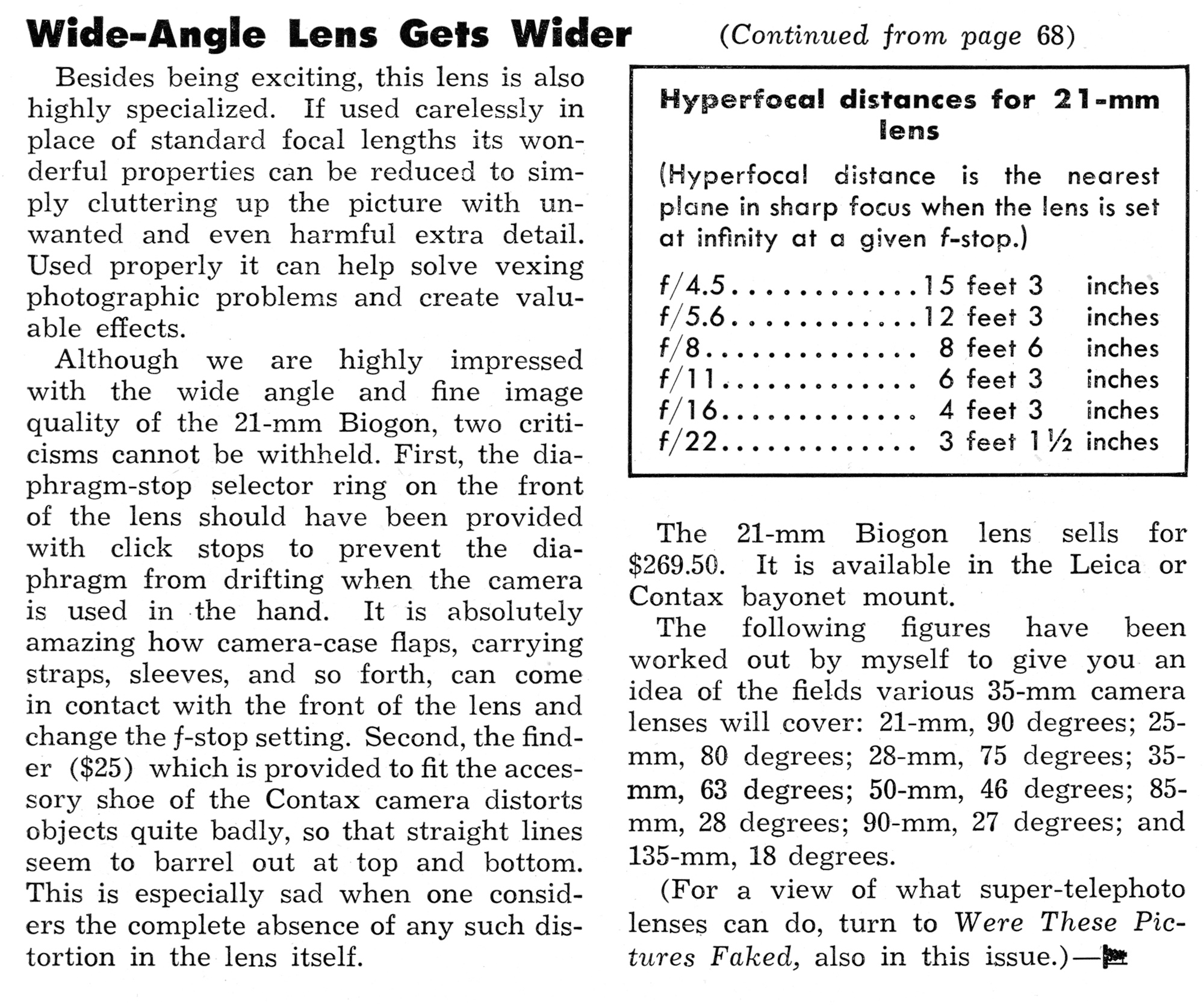
When the 21mm f/4.5 Biogon launched in 1954 for Contax rangefinest and Leica screw mount, it caused a stir in the photography press, with both Modern Photography and Popular Photography publishing features that November. Modern took a playful tone, while Popular offered a more technical review, including a hyperfocal distance chart demonstrating the lens's extraordinary depth of field—so vast that Zeiss only bothered marking distance scales at f/4.5 and f/5.6. Both outlets praised the lens's sharpness across the frame, even wide open, and its freedom from the distortions common in lesser 28mm and 35mm lenses, though they explored the odd perspective distortion that occurs with an unlevel film plane. Popular Photography's Bob Schwalberg even captured what may be an early selfie using the lens at arm's length. Criticisms centered on the aperture ring's lack of click stops, making it easy to bump accidentally, and a poor-quality included auxiliary viewfinder with noticeable barrel distortion.
The Biogon was priced steeply at launch—$269.50, equivalent to roughly $2575 today—though it dropped quickly, with Olden Camera advertising it for $199 new (or $114.25 used) by 1957. The design later found its way into other mounts, including Contarex SLR and Leica M, though in the Contarex the lens's rear element protruded far enough to require the mirror be locked up permanently, necessitating an auxiliary finder for composition. The article's takeaway is that the Biogon was a genuinely groundbreaking lens, unlike anything before it, whose core optical formula—despite changes in speed, mount, and elimination of the protruding rear element—still underpins Biogon lenses sold new today.
AI-generated summary. May not capture every detail — read the full article below for the complete picture.
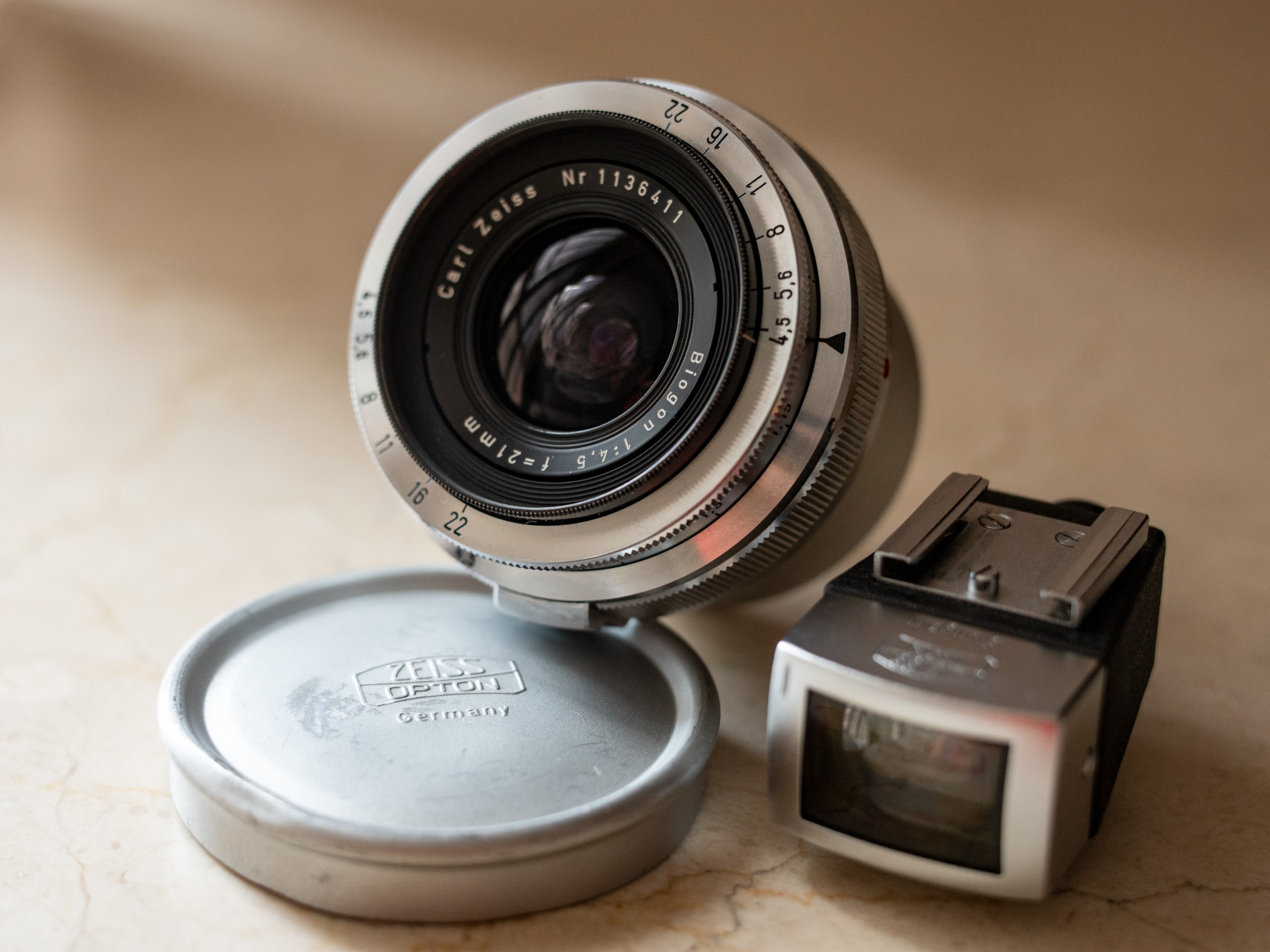
When most people think of a classic wide angle lens, the Zeiss Biogon likely comes up first a large number of times. The first Biogon lenses were released in 1934, and designed by Ludwig Bertele while working for Zeiss-Ikon Dresden. These wide angle lenses had eight elements in five air spaced groups and had a focal length of 2.8cm and were the widest such lenses available for 35mm cameras.
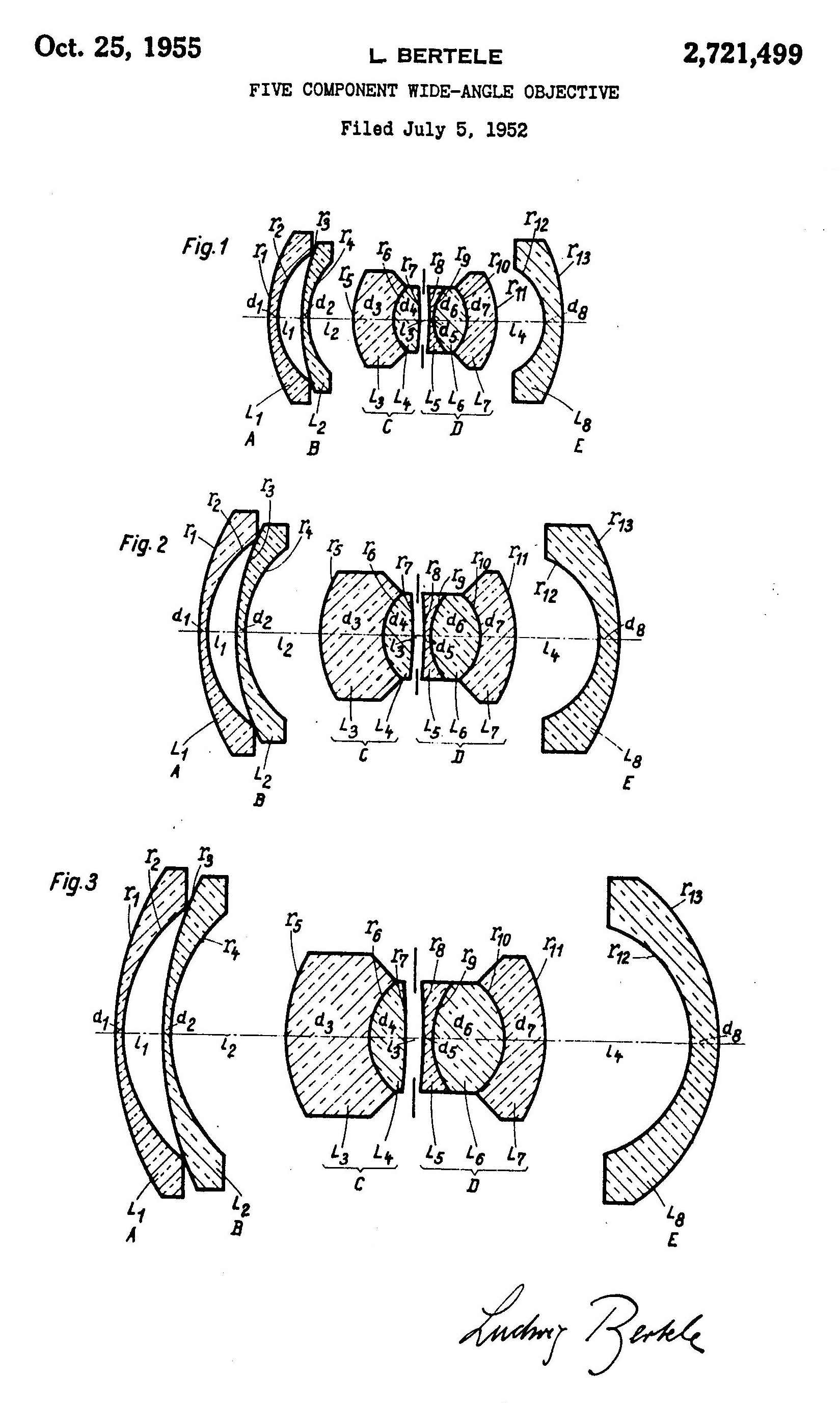
The onset of World War II stunted the further development of even wider lenses. In 1951, now living in Switzerland, Bertele computed an updated Biogon formula for Carl Zeiss Oberkochen that would increase the field of the 2.8cm Biogon by 10 degrees to 2.1cm for 35mm photography.
Bertele did not actually build the lens himself, he merely designed the formula, which could be adapted for different film formats. Using the same exact parameters, this new 21mm Biogon would be 38mm for 6cm x 6cm images, 53mm for 6cm x 9cm, and 75mm for 9cm x 12cm. There were even special variations, including a 38mm f/2.8 prototype and a 60mm f/5.6 developed for NASA.
When the first lenses using this new formula were released in 1954, they were available only in Contax rangefinder and Leica screw mount and had a 21mm focal length with a maximum aperture of f/4.5. This generated a great deal of excitement in the photographic press and by November of 1954, both Modern and Popular Photography had articles to share about this exciting new lens.
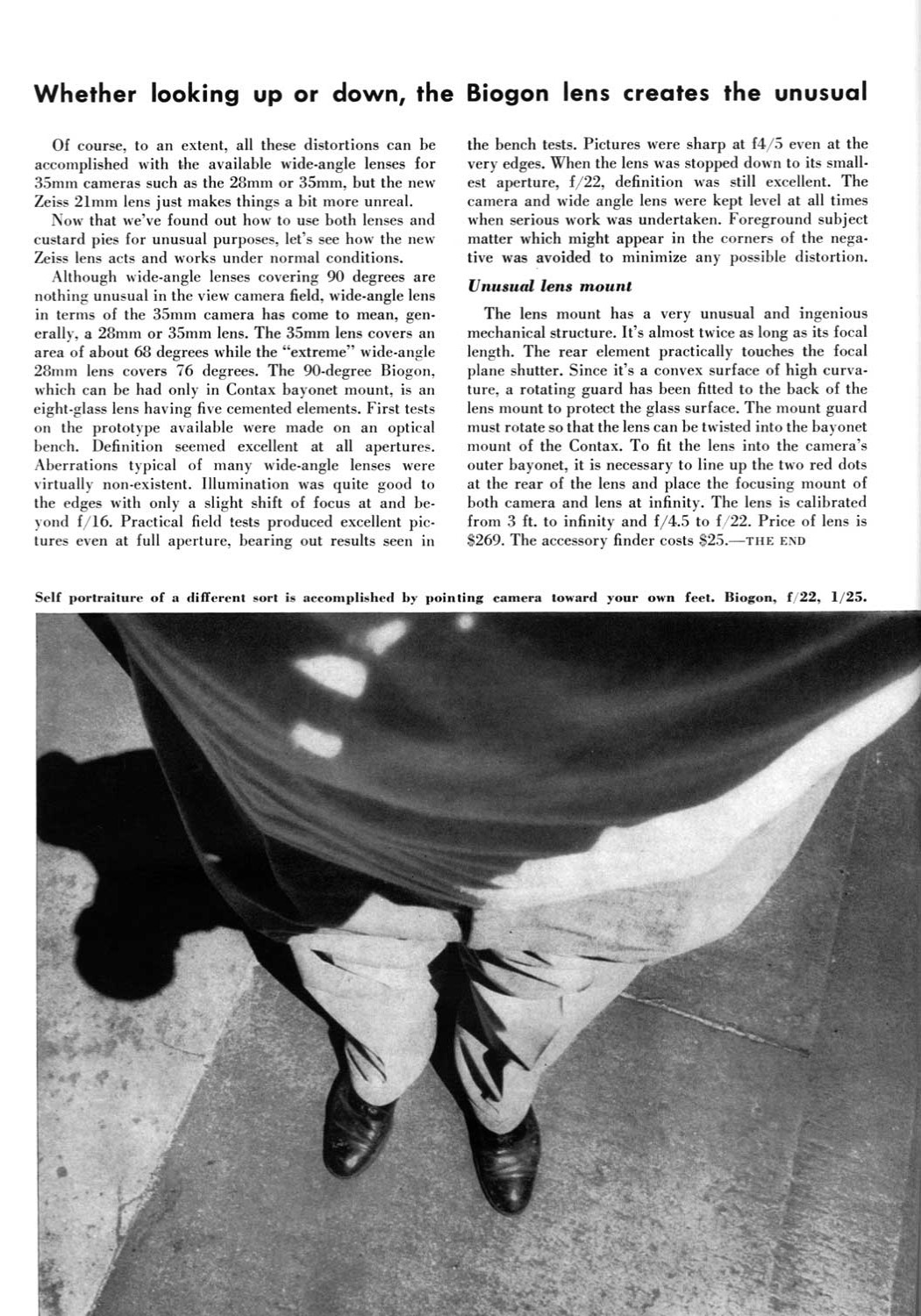
As was often the case, Modern and Popular Photography took different approaches to covering the new 21mm Biogon, with Modern’s being a bit more light hearted, comically suggesting that the Biogon opened up new uses for lenses in the same way throwing a custard pie in someone’s face might have. Popular Photography’s approach was more practical however.
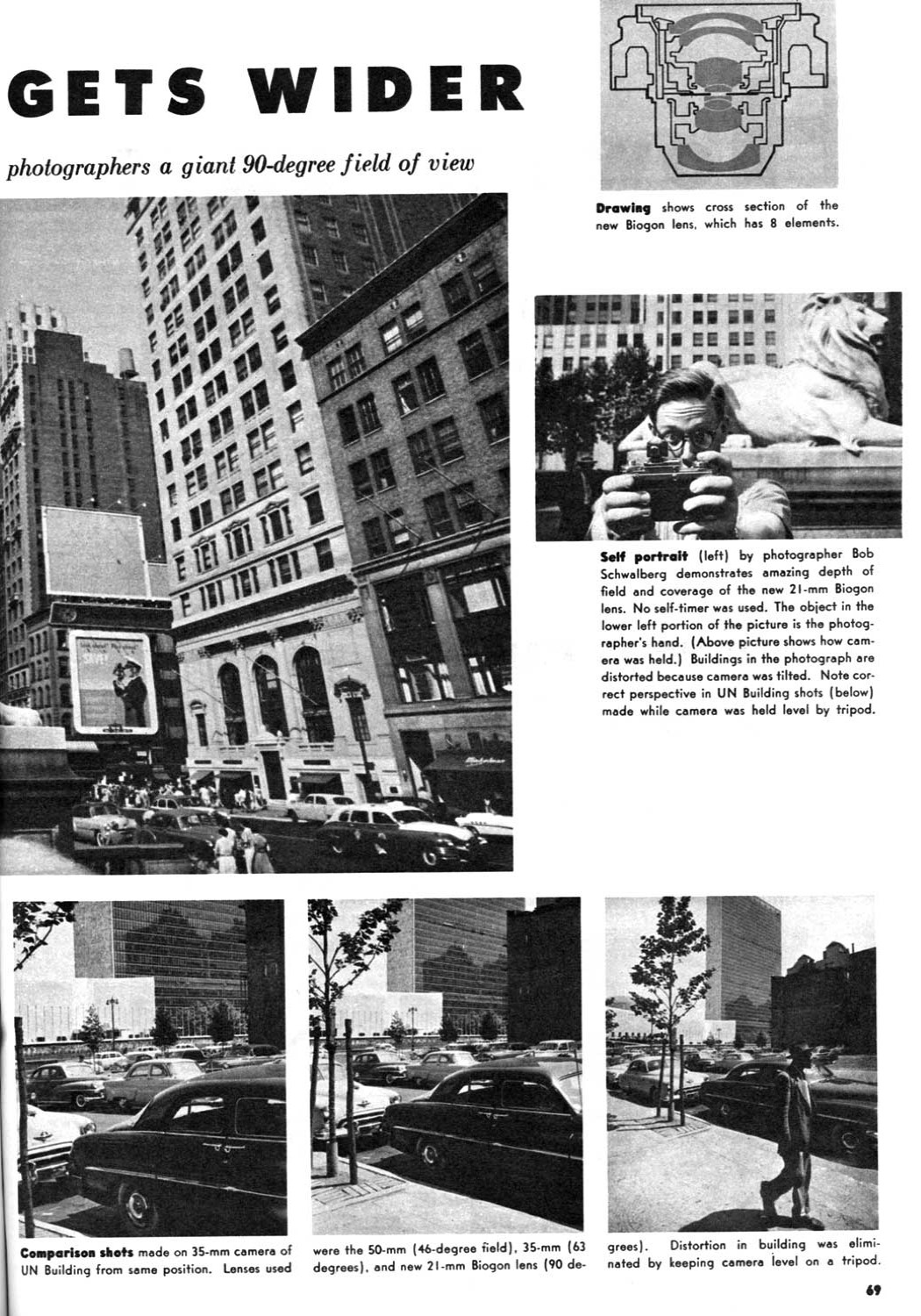
Both articles marveled at the Biogon’s extreme depth of field with Popular’s article including a hyperfocal distance chart showing how little focus movement was required. Sharpness across the frame, even wide open was impressive with little of the distortions seen in lesser 28mm and 35mm wide angle lenses by other companies. A lot of time was spent discussing optical distortion that happens when shooting a wide angle lens without a perfectly level film plane, showing buildings and people awkwardly leaning in towards the center of the image.
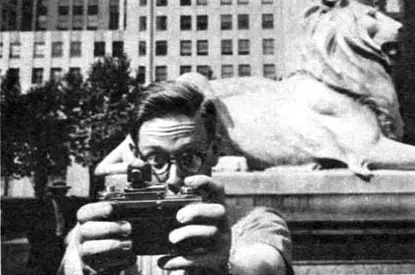
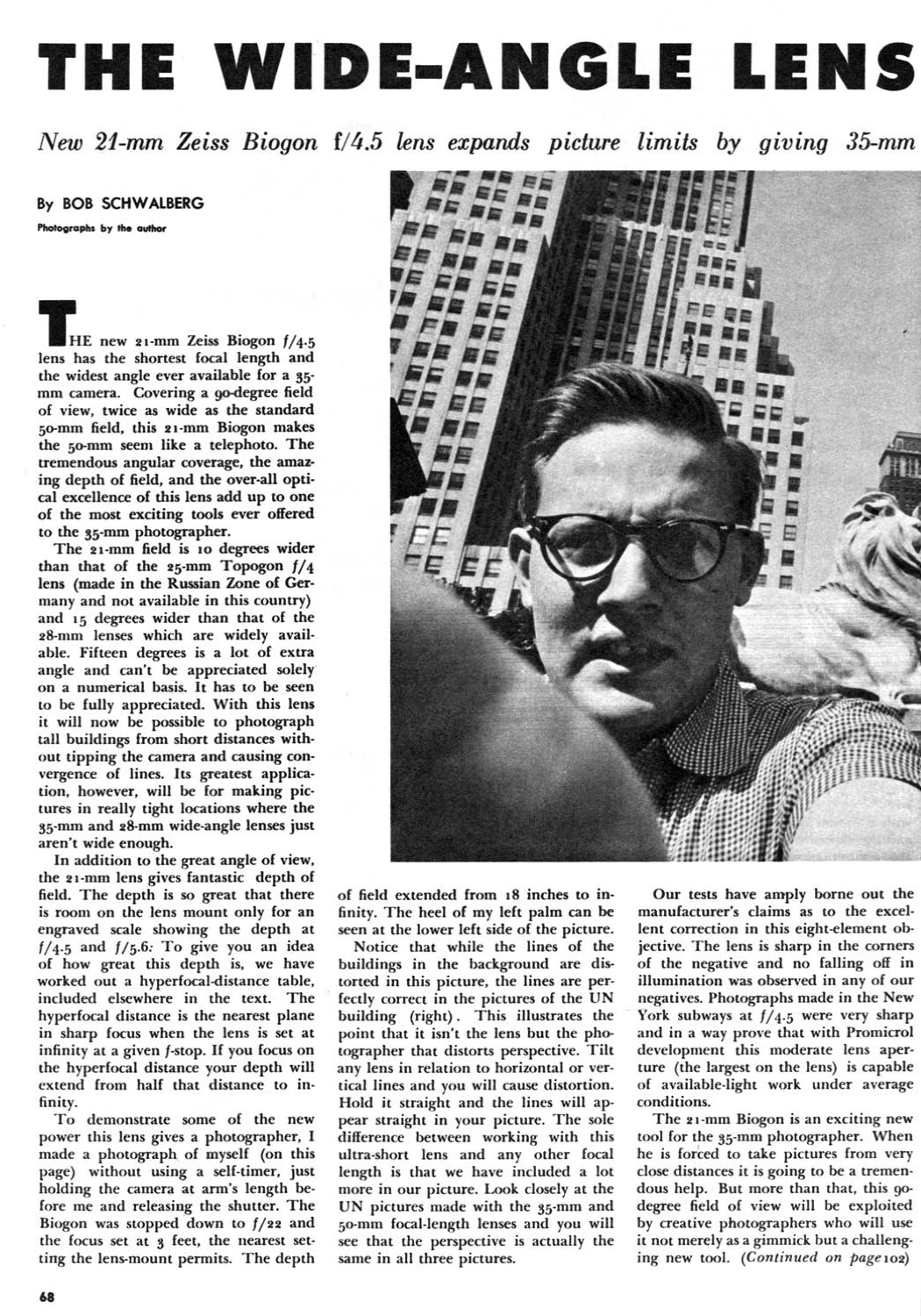
Modern used these distorted effects to creative effect with an image of someone shooting their own feet which gave the illusion that they were extremely tall, like you might see in a circus funhouse mirror. Bob Schwalberg from Popular Photography included what could be the first selfie ever, holding his Contax mounted Biogon at arms length with the lens at f/22 and the focus set to 3 feet and took a perfectly in focus image of himself.
Depth of field on the Biogon is so great that Zeiss only bothered to include a scale on the lens at f/4.5 and f/5.6 as any other setting covered nearly the entire range of focus of the lens.
Both articles heaped a great deal of praise on the Biogon for it’s excellent sharpness across the frame and for which new types of photography would be possible, but the Popular Photography article was critical of two points. The first being that the aperture ring lacked click stops and was too easily changed on accident, and the second being the quality of the included auxiliary viewfinder which they said had excessive barrel distortion that did not accurately reflect what the lens was able to see.
The Biogon was clearly nothing like anyone had seen before it. It was a cutting edge lens with a cutting edge price, as the second article from Popular Photography lists a retail price of the 21mm Biogon at $269.50 which when adjusted for inflation, compares to $2575 today, a monster of a price for a single lens!
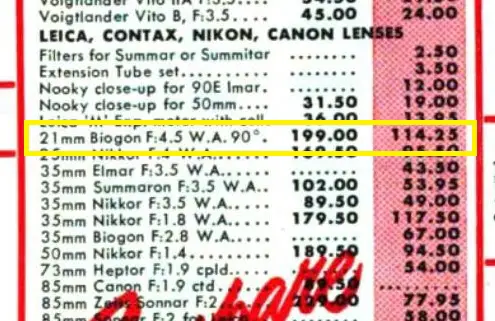
A quick check through some old photo catalogs reveals that the price would quickly come down however, as by May 1957, Olden Camera in New York City would advertise the 21mm f/4.5 for $199.00 new or $114.25 used.
As was the case of any successful lens, the Biogon would later evolve and become available in other mounts like for the Contarex SLR and Leica M mount. When used in an SLR like the Contarex, the Biogon’s rear lens groupings would interfere with the reflex mirror, requiring the mirror to be kept in the up position for the entire time the lens was mounted to the camera. With the mirror up, the viewfinder was blacked out, requiring an auxiliary viewfinder to be attached for composition. Biogons can still be purchased new today from stores like Adorama, and although they have increased in speed, changed mounts, and no longer have the rear protruding element, they are all still based on that original formula created by Ludwig Bertele.
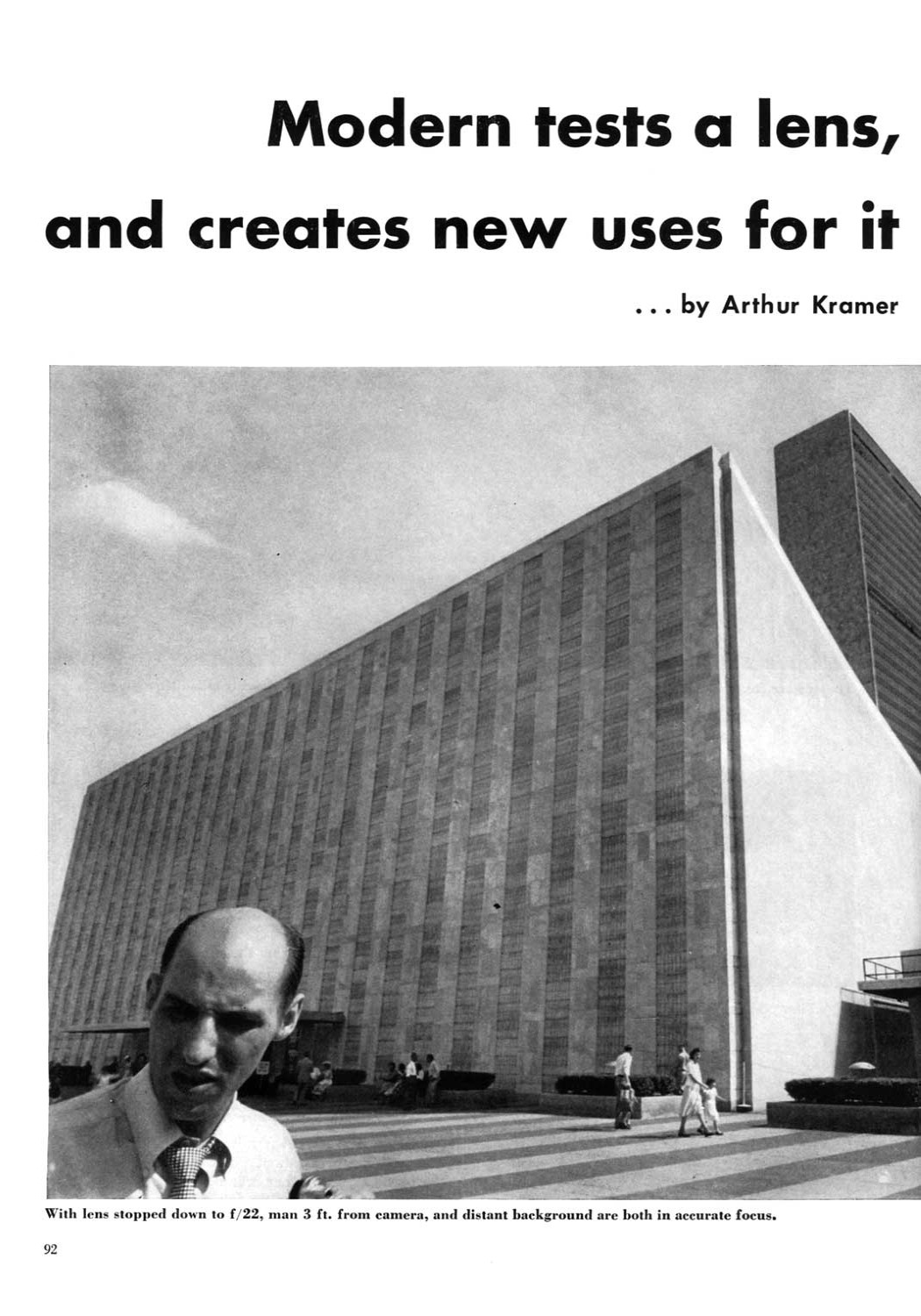
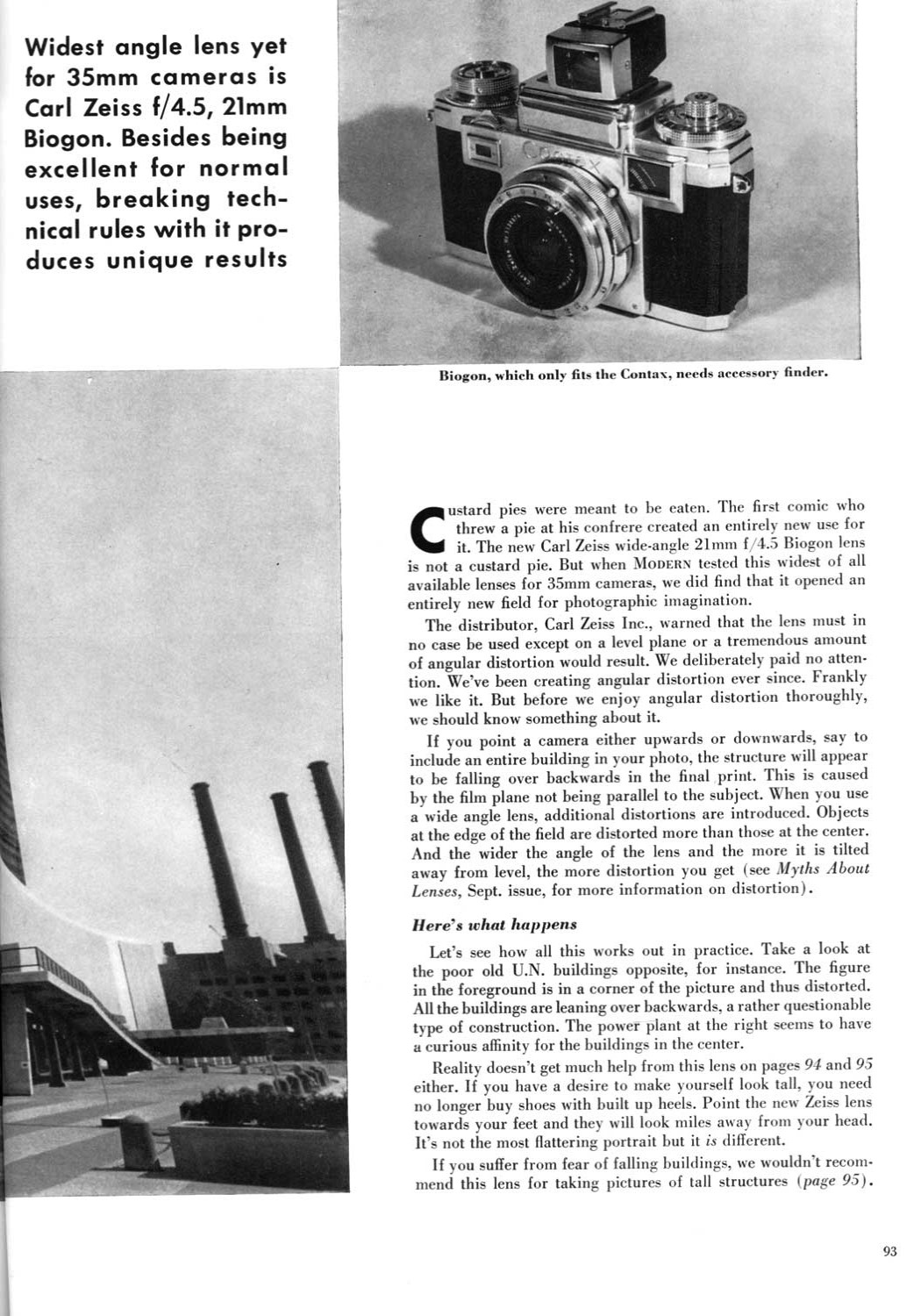
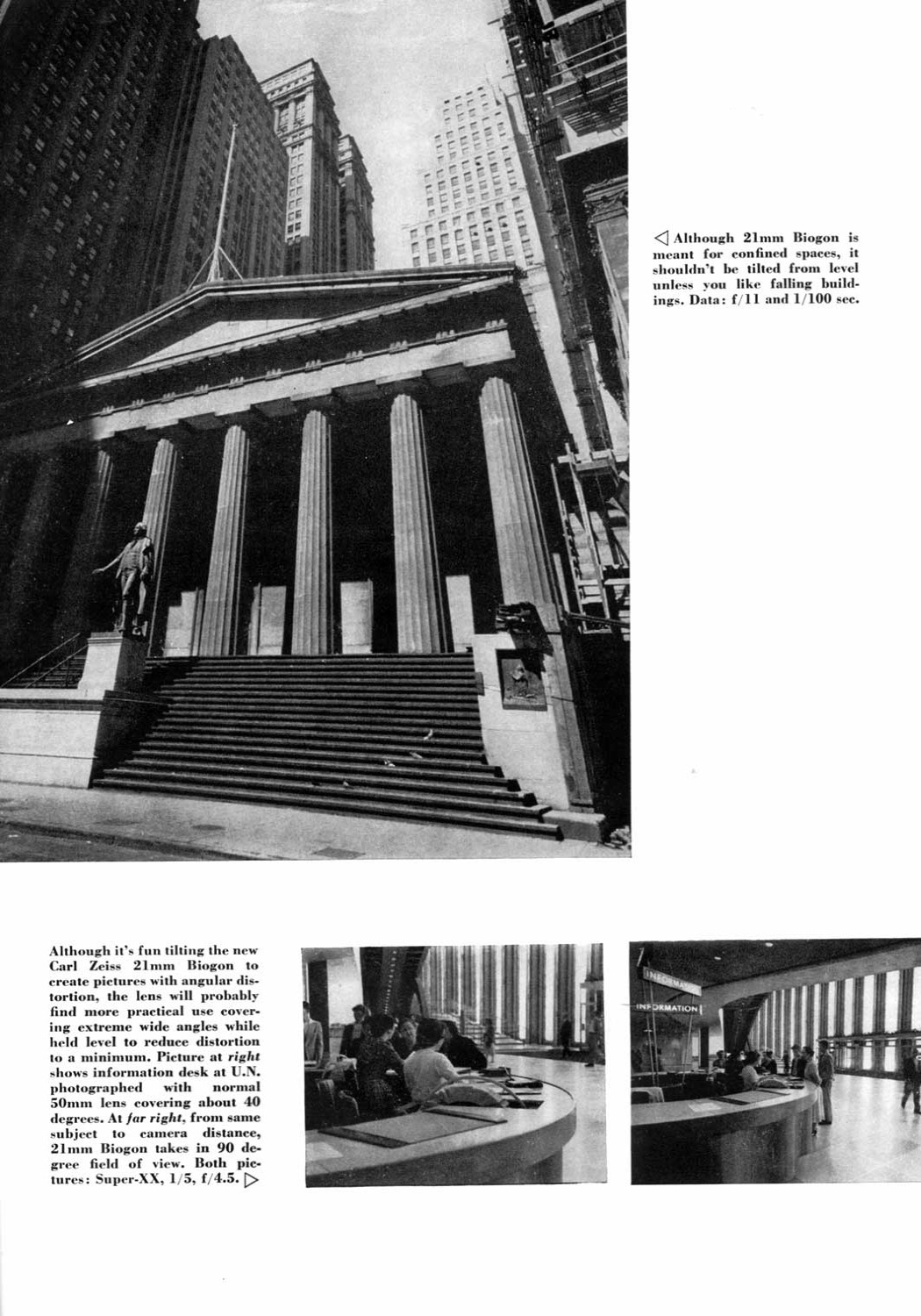
Here is the second article, also from November 1954 from Popular Photography.
All scans used with permission by Marc Bergman, 2020.