

The Pentax Super A, released in 1983 (sold as the Super Program in North America), was Asahi's advanced consumer SLR introduced to showcase the new Ka-mount, an update to the original 1975 K-mount that added electronic contacts allowing the lens and body to communicate for Shutter Priority and full Programmed AE. Positioned as a more consumer-friendly sibling to the professional Pentax LX, it was the first Pentax SLR with LCD displays on both the top plate and in the viewfinder, offered six exposure modes, a top shutter speed of 1/2000, and came with an ergonomic front grip. At launch it retailed with a 50mm f/1.4 lens for an MSRP of $460, though street prices were lower, and it remained in production until 1987 with no direct successor as Pentax moved toward autofocus and plastic-bodied models.
The author, already an owner of several K-mount Pentaxes, stumbled upon the black-bodied Super A on eBay and eventually found a body-only example from a Japanese seller, pairing it with a 50mm f/1.2 SMC Pentax-A lens. Handling-wise, the camera impressed with its light weight and excellent balance even with the large fast lens attached, comparing favorably to a much heavier Nikon F2As/55mm f/1.2 combo. The control layout, however, drew criticism: the mode dial around the shutter release requires pressing a tiny, awkwardly placed lock button to switch modes, and shutter speeds in manual mode are set via small up/down buttons with a cramped LCD readout. The viewfinder, by contrast, was praised as excellent—bright, with a split-image/microprism focusing aid and informative sub-LCDs—performing well even with slower lenses. A test roll of expired Kodak Plus-X 125 suffered from base fog and grain issues unrelated to the camera itself, though the lens and body otherwise performed as expected of any K-mount setup.
The author's overall takeaway is that the Super A is less a scaled-down LX and more a "souped up ME Super," better compared to something like the Nikon FA relative to the F3. Ergonomics, balance, and viewfinder quality were highlighted as major strengths, while the fiddly push-button mode controls were the biggest annoyance, leading the author to leave the camera in Programmed AE for the entire test. The verdict is positive but tempered: it's a fantastic, well-balanced camera worth adding to a Pentax or K-mount collection, but since most users likely just leave it in "P" mode, the extensive feature set may not justify choosing it over a simpler, cheaper ME Super.
AI-generated summary. May not capture every detail — read the full article below for the complete picture.
This is a Pentax Super A, a 35mm SLR camera made by Asahi Optical Co. Ltd in Tokyo, Japan between the years 1983 and 1987. When sold in North America, the Pentax Super A was called the Super Program. The only difference between the two is that the Super A was only available in a black body, and the Super Program chrome. The camera was a highly advanced model supporting six exposure modes including Programmed, Shutter and Aperture Priority AE modes, plus manual exposure and two others. It uses what Asahi called the Pentax Ka mount, in which the original Pentax K bayonet includes electronic connections for expansion with future lenses. It was the first Pentax SLR with a Liquid Crystal Display in both the viewfinder and top plate. The camera is often seen as a more consumer friendly version of the professional level Pentax LX.

Film Type: 135 (35mm)
Lens: 50mm f/1.2 SMC Pentax-A coated 7-elements in 5-groups
Lens Mount: Pentax Ka Bayonet
Focus: 1.45 feet / 0.5 meters to Infinity (Variable Depending on Lens)
Viewfinder: Fixed SLR Pentaprism w/ LCD Display, 92% Field of View, 0.82x Magnification
Shutter: Seiko MFC-E3 Vertically Traveling Metal Blade
Speeds (Automatic): 15 – 1/2000 seconds, step less
Speeds (Manual): B, 15 – 1/2000 seconds
Exposure Meter: TTL GPD Meter w/ top plate LCD and Six Exposure Modes, Programmed, Aperture and Shutter Priority AE, Manual and Others
Battery: (2x) 1.5v LR44/357 Silver Oxide or Alkaline Batteries
Flash Mount: Hot shoe and M and X Flash Sync, 1/125 X-Sync
Weight: 850 grams, 500 grams (body only)
Manual: https://www.cameramanuals.org/pentax_pdf/pentax_super_program.pdf
In 1975, Asahi Optical Co. Ltd released the Pentax K mount, an all new bayonet lens mount which shifted the company away from the venerable M42 “Universal” thread mount which the company had used since 1957 with the release of the very first Pentax camera, and had been used by other manufacturers since the late 1940s.
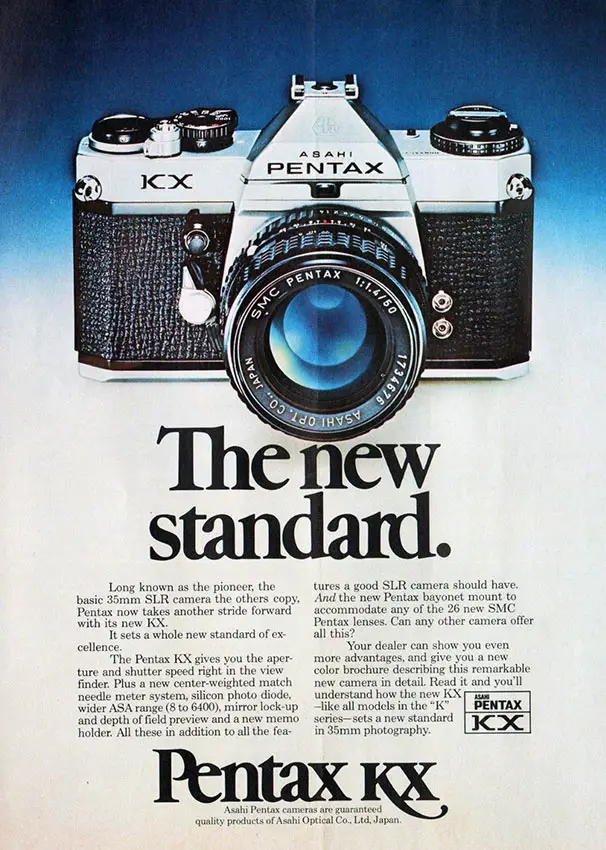
Although the K-mount was considered a modern lens mount, offering two mechanical linkages to transfer aperture information from the lens back to the body, it offered no ability for the body to control the aperture. This wasn’t a big deal in 1975 as the earliest Pentax SLRs lacked auto exposure and only used the mechanical linkages for the match needle system. When the first Pentax cameras like the Pentax ME Super and Pentax LX first offered Automatic Exposure, it was of the Aperture Priority variety in which the user selected an f/stop on the lens, and then the metering system in the camera automatically selected an appropriate shutter speed.
Back then, companies who implemented automatic exposure into their 35mm SLRs chose either Aperture Priority (Nikon, Minolta, Olympus, and others) or Shutter Priority (Konica and Canon). With the release of cameras like the Canon A-1 and Minolta XD11 in the late 1970s, we started to see cameras with more than one automatic aperture mode, but how this was accomplished varied by manufacture.

When the Pentax K-mount was released in 1975, the designers failed to see the imminent need to control both shutter speeds and aperture by both the body and lens, so in 1983, an update to the K-mount called the Ka-mount was released in which the aperture control lever was redesigned and up to six electronic connections between the lens and body were added, allowing the body and lens to communicate with each other (initially all 6 contacts were not used, but later intended for future expansion). In addition, Pentax Ka lenses added an “A” position to the aperture ring which allowed the camera body to detect and control the lens diaphragm for new exposure modes. To be fair, Asahi wasn’t the only company who needed to update their mount, as Minolta updated their SR-mount MC lenses to what they called the MD-mount, Canon updated their FL-mount lenses to FD-mount, and Nippon Kogaku updated their F-mount adding what they called “Ai-S” which all did the same thing.
Asahi’s first camera to support the new Ka lenses was released in 1983 as the Pentax Super A. This new camera supported not only classic AE modes, but Shutter Priority and full Programmed AE in which the metering system controlled all aspects of exposure. In addition, the Super A added a top plate LCD, a full information digital display inside the viewfinder, a top 1/2000 shutter speed, and came with an ergonomic finger grip on the front of the body. Upon its release a total of 14 new lenses using the Ka mount were available. The Pentax Super A was sold in most countries but when sold inside North American was rebranded as the Pentax Super Program. Other than coming in a chrome body, the two cameras were identical.

At the time of its release, the Pentax Super Program had an MSRP of $460 with the SMC Pentax-A 50mm f/1.4 lens but as was the case, actual retail prices were much lower than that. In a July 1983 ad for Frank’s Camera in Los Angeles, CA, the Super Program was offered with the f/1.4 lens for $299 putting it between the Pentax ME Super with 50mm f/2 lens at $148.99 and the Pentax LX body at $399.99. When adjusted for inflation, the MSRP and retail prices of the Super Program compare to around $1500 and $970 respectively.

A year after its release a new model called the Pentax Program A in Japan and Pentax Program Plus in North America which was a scaled down version of the Super A/Super Program lacking that camera’s top plate LCD, dedicated shutter priority mode, and top 1/2000 shutter speed, and having a slower flash sync speed of 1/100. The North America only Program Plus came in a distinct two tone silver body with black prism cover.
The Pentax Super A and Super Program cameras sold reasonably well and were in production until 1987. There was no direct replacement for the model as by that time, Asahi’s midrange lineup started to feature autofocus cameras like the SF-X/SF-1, and the plastic bodied P-series, although I suppose the Pentax P50/P5 would be the closest.

After my review of the Pentax LX back in May 2022, I had thought I was done with Pentax K-mount bodies. In addition to that camera, I own several other K-mount Pentaxes such as the K2, MX, ME, ME Super, and ME-F and while I like them all, apart from the ME-F which doesn’t work, none of them were interesting enough for me to write a review of. Then as these things seem to happen, one day while doomscrolling eBay, I stumbled upon a camera I had never seen before, the Super A. Initially mistaking it for an LX, I quickly realized this was a camera I had somehow been unaware of.
Not able to get it out of my mind, I trawled other auctions looking for the perfect example to buy. I quickly learned the Super A was the non-North American version of the Super Program and that while those were plentiful inside the US, I preferred the look of the black bodied Super A. In addition to wanting to find one in good condition, I wanted to make sure I had one with the hand grip still attached, as many are found with this piece missing.
It took a couple of months, but I finally found a body only in excellent condition from a Japanese seller. As often happens, I received the package from across the Pacific Ocean faster than I can get some packages from within the US. The camera arrived in as good of condition as the images suggested and since it was just the body, I mounted it with a really nice 50mm f/1.2 SMX Pentax-A lens that I had been using on a “lesser Pentax”. I figured it would make a perfect pairing.

With the large f/1.2 lens attached, the lightweight Super A body is incredibly balanced. Comparing this body and lens combination to a Nikon F2As and 55mm f/1.2 Nikkor SC combination in my collection which weighs a massive 1252 grams, the Pentax feels like a compact camera! I mention this only to prove how well Asahi packaged this camera. This is a small, yet mighty camera with an impressive list of features and mounted to it is a very fast lens with world class optics. The camera does not feel cheap despite its increased used of lightweight materials. The heavy f/1.2 lens does not feel front heavy, and while dangling from a neck strap, the camera doesn’t induce excess strain.

The layout of the camera’s controls are very in line with early 1980s SLR design. A shift from knobs to buttons was typical of the era, but hasn’t held up well. A dial surrounding the shutter release is used to unlock the camera (aka turn it in), and choose between Auto and Manual exposure modes, a fixed X-sync mode and Bulb. While this sounds simple enough, a thin gray button on the inner rim of the dial must be pressed to move this dial between various modes. This button is so tiny, that I struggled to press it while turning the dial. I had to awkwardly use my finger nail while jamming the tip of my finger into it, while rotating the dial with two other fingers.

With the camera in manual exposure mode, selecting shutter speeds from 15 to 1/2000 is done using two up and down buttons. A small LCD screen below the shutter release shows you a bare amount of information needed to choose the correct modes. For anyone used to more modern SLRs with huge LCD screens that can show you all of the camera’s settings, the one here feels cramped, but considering the era in which it was made, wasn’t unusual.

Despite a modernization of controls, the Super A is still very much a manual camera, manual focus, manual film advance, and manual rewind. The lack of the additional electronics and motors needed to automate these various features is the camera’s greatest feature as it is the reason the Super A is so compact and easy to hold. While I don’t love the up/down mode buttons, the greatest strength of using this camera is in Programmed or Aperture Priority AE modes.

I’ll save you from my typical analysis of the various other parts of the camera’s body as everything else works as you’d expect it to. The film compartment predates DX and automatic film loading, the film door can be replaced with one of two optional data backs, there’s some electrical contacts on the base plate for an motor drive, and the Pentax Ka mount works as it does on every other K-mount camera.
The viewfinder is as good as any 1980s SLR ever made. It is extremely bright, featuring a split image rangefinder with microprism collar in the center. I swapped out the f/1.2 lens and put on a slower f/2 K-mount lens and didn’t notice much of a decrease in brightness, despite the lens being two stops slower. I was easily able to see all four corners of the focusing screen while wearing prescription glasses, and below the main screen are two rectangular LCD screens which show information such as exposure mode, shutter speed, f/stop, EV compensation, flash mode, and a low battery warning. The LCD is normally backlit using natural light coming through a plastic window at the front of the prism, however if there isn’t enough light to see the display, an illumination button is on the side of the mirror box below the flash sync port which can brighten it up in dark light.


Having a shot a number of K-mount Pentaxes before and fallen in love with the LX, I was eager to see how the Super A would compare. Would this be a more automatic, but equally impressive to the LX, or is the Super A just a glorified ME Super? I loaded in a roll of expired Kodak Plus-X 125 to find out!


In my haste to shoot a roll of film in the Pentax Super A, I chose a roll of expired Kodak Plus-X 125 which I have an abundance of. While I have other films I could have used, I try to vary my film stock so that I’m not always shooting the same films over and over, but perhaps I should. The images from the Plus-X are less than ideal as a result of strong base fog on the film itself. I was able to save most of the images through scanning, there is a noticeable loss of shadow detail in several of the images, and extra grain that wouldn’t have been there on fresh film. Still, the images came out pretty nice, with a gritty feel that perhaps would have suited urban decay or cemeteries, rather than upper Michigan where I shot it.

As for the camera itself, the lens performed as good as it would have on any Pentax K-mount body. Speaking to the fast f/1.2 aperture, I can say that I am not a fan of large aperture lenses. While I generally love the look of the large front elements and heft of the extra glass found on fast primes, I rarely shoot wide open primarily because I am used to shooting outdoors where I don’t need that much light. In the instances where I am indoors and can take advantage of the larger diaphragm, I have never been much of a “bokeh photographer”. Sure, on occasion, a properly framed shot with blurred Christmas lights in the background is neat, but it is just not a type of photograph I shoot often. Beyond that, most vintage fast lenses are too soft wide open for my tastes. The first time I saw someone shoot a Canon f/0.95 “Dream Lens” wide open, I assumed the lens was damaged or that someone had spread petroleum jelly over the front element.

Anyway, back to the Pentax Super A, a realization that came to me while using the camera was that my thought of this being a more automatic alternative to the Pentax LX wasn’t holding up. Sure, this is a more automatic camera than the LX, but it truly is a different camera, and how you use it is different too. For fans of early Nikon SLRs, a good comparison would be the Nikon F3 vs the Nikon FA. In both cases, the pro-level F3 lacks many of the features of the more consumer friendly FA, but they both do an excellent job when used to their strengths.

In my opinion, the Super A is less of a “more automatic LX” and more of a “souped up ME Super”. The Super A handles much more like the company’s consumer cameras, just with extra technology. By far, my biggest complaint was that I did not like the push button modes on the top plate. To be fair, I almost never prefer buttons over dials and knobs, but it is especially poorly executed here. My reluctance to change the camera’s controls resulted in me leaving the Super A in Programmed AE throughout my entire time with the camera, and that’s not a bad thing, just a difference in how I approached using the camera.

The pros to the Pentax Super A are the mostly excellent ergonomics. I had to add the word “mostly” to that previous sentence because I really hated the mode buttons, especially that thin gray lock button that you must press and hold to power on the camera and change exposure modes. Otherwise, the small hand grip on the front is excellent, allowing for more carefree handling of the camera for longer periods of time with less hand fatigue. The location of all the camera’s other primary controls was exactly where my hands expected them to be, and the viewfinder was as good as any in the era. Not only was the focusing screen incredibly bright and easy to see things through, the 1-2 combination of an excellent split image focus aide with microprism collar is perfect for how I shoot manual focus cameras. I didn’t miss focus on a single shot, and the bright viewfinder allowed me to continue using the camera in less than ideal light.
Make no mistake, even if the Pentax Super A doesn’t compare very well to the Pentax LX, it is a fantastic camera to use. If you are a fan of Pentax cameras, or just have a lot of K-mount lenses, this is a great camera to consider adding to your collection. Ergonomics, balance, and performance are all as great as anything out there. The biggest con to the camera, is that its biggest selling point is the long list of features, but you’re probably not going to use most of those features. I suspect that a huge number of users of this camera did what I did, and just left the camera in “P” mode, and at that point, you might as well just saved yourself some money and stuck with the Pentax ME Super.
Related Posts You Might Enjoy
External Links
https://camera-wiki.org/wiki/Pentax_Super_A
https://en.wikipedia.org/wiki/Pentax_Super-A
https://www.35mmc.com/03/07/2020/pentax-super-program-review-by-chris-colten/
https://everythingvintage.uk/vintage-camera/pentax-super-program-super-a-review/