

The Tokiwa Seiki Pentaflex 24x36 is a 1955 Japanese 35mm SLR notable for being the first Japanese SLR with an eye-level viewfinder, predating the Orion Miranda T by about four months. Rather than using a pentaprism like the Miranda, the Pentaflex employs a pentamirror system—a fact the author confirmed firsthand by disassembling the camera, correcting years of online misinformation (including camera-wiki and Wikipedia pages that incorrectly describe it as having an Exakta-style prism or a porroprism). The camera uses a behind-the-lens MSK-Rapid leaf shutter (likely a Japanese copy of the Compur-Rapid) with speeds up to 1/400, an interchangeable bayonet mount for which only two lenses were ever made (a 5cm f/3.5 Tokinon and a rare 8cm f/3.5 Neogon), and no automatic diaphragm, meter, or instant-return mirror. The author also details several related variants, including a lower-cost "Model A" with a top speed of 1/200, and a waist-level-finder version sold under names like Firstflex-35, Soligor-35, Windsorflex-35, and Lafayette-35, each with its own sub-variants in shutter speeds and lens mounts.
Handling three examples sourced from a Texas collection, the author found build quality to be a mixed bag—solidly metal and brass but showing peeling body covering, visible machining marks, a loose lens mount, and a flimsy film door latch that once popped open mid-roll and ruined several frames. The biggest complaint was the pentamirror viewfinder itself: dim, slightly yellow, marred by a visible seam between mirrors, vignetted, and low in magnification, making focusing extremely difficult even in good light. Despite this, a test roll of Kodak Portra 400 yielded generally sharp, well-exposed images with accurate shutter speeds and no significant vignetting, though low-light wide-open shots were soft and many frames needed a contrast boost in post.
Overall, the author views the Pentaflex as an intriguing but flawed transitional camera—ahead of its time in offering an eye-level finder, but let down by poor usability, especially its dark, hard-to-focus viewfinder. The verdict is that while it's a compelling collector's piece worth owning and displaying, the shooting experience is disappointing enough that the author has no plans to shoot it again, concluding it's better suited to a shelf than regular use.
AI-generated summary. May not capture every detail — read the full article below for the complete picture.
This is a Pentaflex 24×36, a 35mm SLR produced by Tokiwa Seiki K.K. in 1955. The Pentaflex was the first Japanese SLR with an eye-level viewfinder, beating the Orion Miranda T by about four months. Unlike the Miranda however, the Pentaflex does not uses a pentaprism, but rather a system of mirrors called a pentamirror. It uses a behind the lens leaf shutter with a top speed of 1/400 and has an interchangeable lens mount to which only two lenses were ever made. The Pentaflex is a primitive camera with crude operation, but when used to its strengths, works as well as any other SLR out there. A version of this camera with a waist level finder instead of the pentamirror was sold under a variety of names such as Soligor 35, Firstflex 35, and Lafayette-35.

Film Type: 135 (35mm)
Lens: 5cm f/3.5 Tokinon Anastigmat coated 3-elements
Lens Mount: Pentaflex Bayonet
Focus: 4 feet to Infinity
Viewfinder: Fixed SLR Pentamirror
Shutter: MSK-Rapid Leaf
Speeds: B, 1 – 1/400 seconds
Exposure Meter: None
Battery: None
Flash Mount: M and X Flash Sync
Weight: 676 grams, 556 grams (body only)
Manual: None
As camera collectors, our hobby often allows us to ponder lots of firsts. What was the first camera to use photographic film, the first 35mm film camera, the first Single Lens Reflex camera, the first SLR with an instant return mirror, the first SLR with a pentaprism, the first SLR with an electronic shutter, etc. Sometimes the first of something is pretty easy to identify if when it came out, it did something that no other camera did.
But what happens when a product is released in very close proximity to another with a feature that’s very similar, but not quite the same? Or what if a product is announced at a trade show with a new feature, but before it has a chance to hit store shelves, someone else releases their product with their version of a similar feature before the earlier model reaches market? These nuances can be frustrating, but they also help making camera collecting fun.
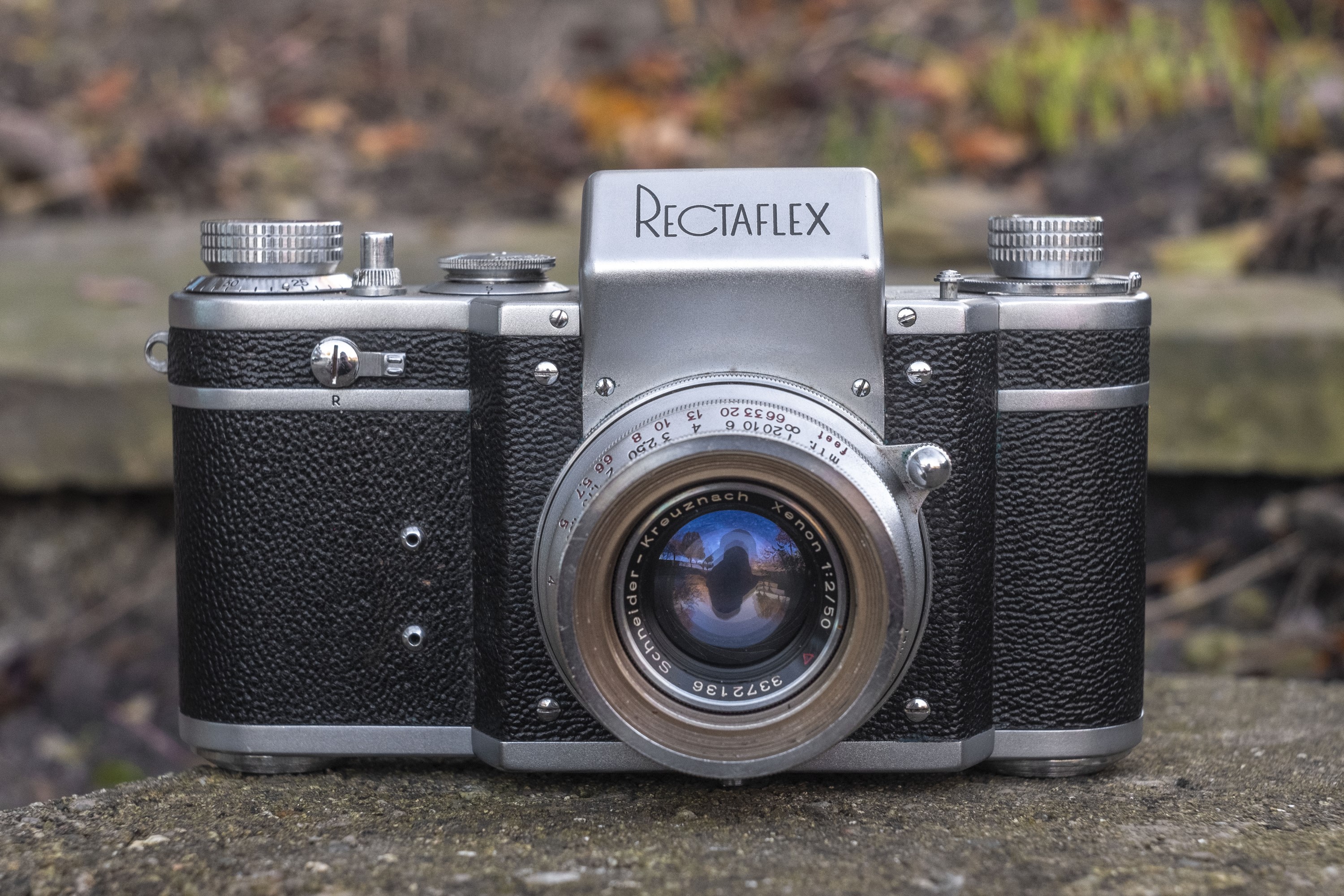
For the “first” in this article, we’ll focus on eye level viewfinders, specifically the first Japanese 35mm SLR with an eye level viewfinder. I make that distinction because there are multiple ways to make an eye level viewfinder. You can use glass lenses, a glass prism, or mirrors to redirect light passing through a lens to your eye. When talking about prisms, the shape and layout of the prism makes a difference too because you can have a pentaprism, or you can have something called a porro prism. If you were curious about the first pentaprism SLR released to market by any company, the best answer is the Italian made Rectaflex, but even then there are those who believe the Zeiss-Ikon Contax S should get that crown as it was in development longer than the Rectaflex and the two cameras came out very close together and the Contax turned out to be far more successful. If you want to go back farther, you can even look at a strange German camera from the mid 1930s called the Beier Beira which wasn’t an SLR at all, but used a type of porro prism finder to help focus the lens, but couldn’t be used to compose the entire image.

In Japan, the camera that gets credit for being the first 35mm SLR with a pentaprism is the Orion Miranda T. Released in August 1955, the Miranda employed the first optical pentaprism in a Japanese made 35mm SLR. Despite this accolade, the Miranda T does not lay claim to being the first Japanese made 35mm SLR with an eye-level viewfinder. If you made it this far into the article, it should come as no surprise that this award must go to a little known camera called the Tokiwa Seiki Pentaflex 24×36.
Only a small number of Pentaflexes were ever made and even less was written about them. Confusing matters more, what little does exist about them online is mostly wrong. There are several articles including the Pentaflex camera-wiki page which incorrectly states that it has a prism similar to that of the Ihagee Exakta Varex, a Wikipedia page about the history of the SLR incorrectly states that the Pentaflex has a porroprism, and finally, this page which first repeats the rumor of an Exakta styled prism, but later suggests that the Pentaflex might actually have a pentamirror rather than a prism.
What is the Exakta connection? A variety of sources online suggest the Pentaflex shares some of its design with the Exakta. Apart from both cameras being 35mm SLRs, the only other similarity I could find is in the typeface of the Pentaflex logo, which does seem to be “Exakta inspired” but after inspecting the lens mount, shutter, viewfinder, and other aspects of the camera, I see no reason to think that any part of this camera is based on anything from the German built Exakta.
All this confusion is understandable, primarily because the prefix “Penta” almost universally is used to refer to a pentaprism (see the Asahi Pentax, the earlier Zeiss-Ikon Pentax prototype, Pentacon, the later Pentacon Pentina and Pentaflex SLRs, Petri Penta, Aires Penta 35, and probably half a dozen more), but also that with so few of these cameras, there was no better source of information and people simply jumped to a conclusion. If only there was someone who had a Pentaflex who could check…
With the realization that I could finally be the person to set the record straight with a nice Pentaflex 24×36 sitting on my desk, I was initially apprehensive about disassembling a rare and valuable camera, but upon seeing four screws flanking the metal plate over the viewfinder, I thought, could it be that easy?
Armed with my precision screwdrivers, I carefully removed the four screws and lifted the plate off the viewfinder, and finally, I was able to answer the question which no one is asking “Does the Tokiwa Seiki Pentaflex 24×36 have a pentaprism, pentamirror, porroprism, or something else”?
As they say in the magic industry, “it’s done with mirrors”.


In the images above, I was able to remove the metal plate covering the viewfinder, along with the rear eyepiece so that I could see inside. If this had been a pentaprism or porro prism camera, a large piece of glass would have been in this open area, but as a pentaMIRROR camera, there are a series of mirrors inside that reflect the light in the same manner as a pentaprism does. Both designs have the advantage of reversing the image so that it appears upright and in the correct orientation, but light bouncing around in an open space between multiple mirrors is less efficient than in a solid piece of glass. Prisms do a better job than mirrors of transmitting light without loss, making the resulting image brighter. You’ll also notice a vertical line is visible in these images which does show up when looking through the eye piece. This vertical line is not due to desilvering like it might be on a prism, rather it is the butt joint between two mirrors at the peak of the viewfinder. When this camera was new, that vertical line was likely always visible.
Most versions of the Pentaflex look like the camera above where it says “24×36” engraved into the front of the prism, however a variant that says “Model A” does exist, which I also had access to. At first, the only obvious difference I could find was that on the front of the camera, the top plate doesn’t extend down as far on the Model A as it does on the 24×36 version and that the Model A lacks strap lugs. Then I noticed that the shutter is not marked MSK Rapid on the Model A, so I checked the shutter speeds, and sure enough, the Model A lacks the top 1/400 shutter speed, topping out at 1/200. This lack of strap lugs and a slower top speed suggest the Model A was a lower cost version of the 24×36 version. Whether Tokiwa Seiki had intended to produce a line of Pentaflex cameras with varying feature is unclear however.

In addition to the two Pentaflex cameras, Tokiwa Seiki also produced a version of this camera with a waist level finder. Between the prism and waist level cameras, the viewfinders are not interchangeable, so there is no way to turn one into the other. The waist level versions can be found with a variety of names, such as Firstflex-35, Soligor-35, Windsorflex-35 and Lafayette-35. Within these cameras, sub-variants with different shutters and lens mounts exist. For the shutter, versions exist with a 3 speed shutter covering 1/25, 1/50, and 1/100, and another with a rim set 4-speed shutter with speeds from 1/25 to 1/200. The version with the 3-speed shutter relocates the cocking lever to the top of the camera, looking like the shutter release but on the opposite side, whereas the 4-speed shutter version has the cocking lever sticking directly out of the shutter. The 3-speed version also has a small plate below the lens which reads “Pat. 6947”. At least one version of the Firstflex-35 can be seen at Chris Sherlock’s website showing that the shutter has slow speeds down to 1 second, extending to 1/200 just like the Pentaflex Model A.

Yet another Firstflex-35 which has a completely different name plate than the one on Chris Sherlock’s website has a four speed shutter with speeds from 1/25 to 1/125 and an approximate 31mm threaded screw mount. In 1958, Tokiwa Seiki would release a completely redesigned Firstflex 35 camera which shares no resemblance to these earlier cameras. The new camera had an all new body, a single speed shutter, and uses the Exakta bayonet lens mount, rather than its own proprietary mount. There was even a Firstflex TLR at one point, but to draw any conclusions to that camera seems silly.

Beyond my discovery of so many variants of nearly the same basic camera, I have little else to tell you about them, or the company’s history. The Tokiwa Seiki Pentaflex was produced in very small numbers, likely for a very short time. I am uncertain if whether it was sold domestically in Japan or for export. My best guess is that this was a Japanese only model, but if it was exported, I do not know if it was sold in the United States, and if so, for how much? I exhausted all of my online and written resources I’ve accumulated over 10 years of writing reviews and came up empty.

In the summer of 2025, I came across not one, but three Pentaflexes in a collection of cameras down in Texas. This led me down the rabbit hole of research that led me to this review. All three of the cameras were in good condition with working shutters, one of them had a stiff lens, but the other two worked fine.
Handling the Pentaflex, my opinion is that the build quality was a mixed bag. Certainly, the camera doesn’t feel cheap as it is made entirely of metal, employing brass in the body and lens construction, the glass in the lens was clear, and of course everything worked, however when you consider what they were up against in the mid 1950s like the Asahi Asahiflex, Orion Miranda T, and Zeiss-Ikon Contax SLR, you also got the sense that these cameras were not made by an A-list company. The top prism is made of a thin metal held on by four visible screws, the body covering was showing signs of peeling on all three cameras, and there were various spots in the body, especially inside the film compartment, where machining marks were visible. Make no mistake, these aren’t cheap cameras, they just don’t compare to the extreme high quality of competing 35mm SLRs from the same era.

The camera’s controls aren’t exactly the same as other SLRs of the era, but are laid out in a way that don’t require access to the camera’s manual to figure out. Up top, we have both the rewind and film advance knobs and the shutter release in the typical locations. A very large and bulbous pentaprism sits perched above the top plate and next to it is an Advance/Rewind switch. The film advance knob also functions as the exposure counter, which is subtractive, showing the number of exposures remaining on the roll of film. Unlike other cameras with subtractive counters like the Kodak Retina, nothing happens when you reach zero, it will just keep going.

The sides, back, and base of the camera are pretty sparse with the only things being an open close door latch on the right side, a 1/4″ tripod socket on the base and forward angled strap lugs on the body. I found the design of the film door latch to be a little flimsy causing the door to easily open when handling the camera. This is something you should pay attention to with film loaded in the camera.

When it comes time to load film, the left hinged door swings open to reveal the film compartment. Although primitive, all of the typical things you’d expect to see in a 35mm camera are here. Film transports from left to right onto an integrated metal take up spool. The spool has only a single clip and rotates clockwise. Attaching the leader is done by sliding the tip beneath the clip as far as it will go and rotating the spool a couple of times. The film pressure plate on the door is black painted metal and is covered with divots to decrease friction as film passes over it. The Pentaflex predates the use of light seals, so you won’t have any degraded foam to clean up.

Looking down upon the top of the Tokinon Anastigmat lens, there is what looks like three rings, however the front two both control the lens aperture and the rear ring controls focus from 4 feet to infinity. A post sticking out of the bottom of the focus ring makes selecting distances easy.
The Pentaflex lacks any sort of automatic diaphragm or even a preset feature, so there is nothing to help you brighten the viewfinder with the camera to your eye. The lens works exactly the same as a rangefinder lens, but on an SLR. This means that as you stop down the lens, the viewfinder gets darker. In very bright sunlight, this isn’t a huge deal, but anything less than the brightest conditions and you must slow down to open the diaphragm, compose and focus your image, then lower the camera from your eye, stop it down, then put it back to your eye and release the shutter, hoping you didn’t change much of your composition. Strangely, camera-wiki’s page on the Pentaflex suggests the lens is a preset design, so perhaps different versions of this lens were made with that feature.

The Pentaflex has an interchangeable lens mount however only two lenses were ever made for the Pentaflex, the standard 5cm and an 8cm f/3.5 Neogon Anastigmat which is incredibly rare. The Pentaflex’s lens mount is a simple bayonet design with a release lever near the 10 o’clock position around the perimeter of the lens. Simply press it in while rotating the lens clockwise and it comes off. On this example, the mount is very loose and while I never thought the lens would fall off, it does wobble while mounted. Strangely, the similar Soligor 35, which was also made by Tokiwa Seiki also has a similar bayonet lens mount and while it appears that they are very similar, I was not able to successfully mount a lens from the Soligor 35 onto the Pentaflex.

Also visible from the front is the MSK-Rapid leaf shutter which is almost certainly a Japanese copy of the German Compur-Rapid leaf shutter. The MSK-Rapid is a rim set design with a ring around the perimeter that is used to change shutter speeds. A rectangular window above the lens mount displays the selected shutter speed from 1 to 400 plus Bulb. The shutter’s cocking lever is located near the 2 o’clock position around the shutter, and a flash sync port at the 4 o’clock position.

Earlier in this article, I reveal the design of the Pentaflex’s viewfinder to be a pentamirror design in which light is redirected up into the prism and bounced around several mirrors and onto a ground glass focusing screen. Unlike a pentaprism in which light is transferred through glass, in a pentamirror, light bounces around in air and each time it changes direction it loses some light transmission. The resulting image is quite a bit darker, and slightly yellow, than even the darkest pentaprisms. This light loss is evident even in bright sunlight and becomes extremely difficult to compose your image in poor lighting. In addition, extreme vignetting is visible in all lighting conditions.

Adding to the difficulty of composing images through the viewfinder is a noticeable vertical seam through the center of the image which is where two mirrors meet. You can easily see the vertical seam in the viewfinder image to the right. I’ve had the chance to look through three different Pentaflexes and all three of them have this seam, suggesting it was there even when new. One final issue with the pentamirror is that the magnification ratio is lower than a typical SLR. While I was never able to find an exact measurement, I would approximate it to be about 0.7 – 0.75x which means the image seen through the viewfinder is smaller than in real life, adding additional challenges for focusing.
The Tokiwa Seiki Pentaflex is a strange camera. It predates the first Japanese pentaprism SLRs, and is one of the earliest central leaf shutter 35mm SLRs I’ve seen. It is clear the designers of this camera were definitely ahead of their time. I always feel that some grace should be given to cameras which came before others featuring things that were cutting edge technology at the time, so can the Pentaflex’s shortcomings be overlooked with good performance? This was the goal I had in mind to find out. After a couple minutes playing with the camera, everything appeared to be working correctly, so I loaded in a roll of Kodak Portra 400 and took it shooting.


I didn’t know what to expect when developing the film from this camera. I suppose as a mid century Japanese SLR, I figured the images would look pretty good, but I was curious to see how some usability issues I encountered while shooting the camera might affect the image.

A majority of the roll turned out quite nice. The 5cm f/3.5 Tokinon Anastigmat triplet delivered images with good sharpness and surprisingly no vignetting near the corners, even in outdoor images where the sky was present. The shutter was in good working order too, as shutter speeds seemed spot on and matched perfectly with what my Sunny 16 meter suggested.
Color accuracy from the coated lens was on par with what I expected from Kodak Portra which tends to deliver somewhat muted colors that shift closely to pastel in some instances, but nothing that I could fault the lens over. Many images showed a slight lack of contrast which I was able to boost in post with a slight bump of the contrast slider. Images in low light where I shot the f/3.5 lens wide open were understandably soft, with the best sharpness coming at f/8 and smaller.

Without a doubt, the biggest issue with many images from this test roll were a direct result of how difficult it was to focus this camera. Compared to a typical pentaprism SLR, the pentamirror setup in the Pentaflex was terrible. Peering through the viewfinder, the image is dark, even in bright light, and when focused correctly, the image just never looked sharp. In addition, the viewfinder appears to have a small magnification ratio, similar to many scale focus cameras in which the viewfinder image is smaller than you’d expect from a full frame SLR, almost as if everything was farther away than it should be. All of these characteristics made for a pretty miserable user experience. I recall about halfway through the roll, I decided to just stick with objects far away and used the viewfinder only for composition and set focus on the lens going by the scale. This at least saved me from having to “hunt” for focus in the dim and soft viewfinder.

Beyond the focus issues, the camera’s small body made it portable and easy to hold. The size and shape reminded me a bit of an Ihagee Exa, except with a top plate shutter release. The small lens did make it difficult to feel the difference between the focus and aperture rings, but while shooting outdoors in good lighting, I didn’t need to mess with the diaphragm much. The lack of an automatic diaphragm is typical of a camera from this era and not having an instant return mirror did slow me down, but only slightly as the location of the cocking lever was perfectly positioned for my left index finger. One final issue is that at least once, the film door latch did come undone and the rear door opened with film in the camera, ruining about five exposures.

The Tokiwa Seiki Pentaflex is an attractive camera whose design and features are equal parts dated but also innovative. That whoever designed this camera had the foresight to offer an eye level viewfinder that is both horizontally and vertically correct was nice, but make no mistake, this is a primitive camera with some pretty significant cons. It is not a surprise to me that this camera sold poorly. I suspect Tokiwa Seiki probably had poor distribution, as did many smaller Japanese companies from the mid 1950s, but I do not think that even with the support of a good worldwide distributor, would the Pentaflex have been a good seller. Not only because of its usability issues, but that significantly better SLRs were just around the corner and would have seriously limited the appeal of this camera.
I didn’t love the shooting experience with the Pentaflex. Although I got pretty good images, the viewfinder is a dealbreaker for me, so it is unlikely I will ever shoot this camera again. I am glad I did it though and was able to share my experience with you all but if you’re considering getting one, make sure you have a good place to display it on your self, as that’s where it belongs. For a collector’s item, the Tokiwa Seiki Pentaflex is a very cool camera and is one I am very happy to add to my collection.
Related Posts You Might Enjoy
External Links
https://camera-wiki.org/wiki/Pentaflex_(Tokiwa_Seiki)
https://www.pentax-slr.com/71760566.html
https://www.leitz-auction.com/en/Tokiwa-Seiki-Pentaflex/AI-30-34303
Dammit. I’ll now have tpo go rethink a couple of pages in my SLR book – https://au.blurb.com/b/11190654-slr-compendium
I think a chapter on the attempts at eye-level which set the field for the prism SLR (Like the Beira II). Now I have t go research the difference between a pentamirror and a porrofinder (as used recently by Olympus). I’d assumed they were the same.