

The Orion Miranda T is a 1955 35mm SLR made by the Orion Camera Company, the forerunner of the Miranda Camera Company, and holds historical significance as the first Japanese SLR to combine a pentaprism with an interchangeable viewfinder, predating both the Topcon R and Nikon F. Orion emerged from postwar Tokyo, founded by former aeronautical engineer Ogihara Akira and colleague Ōtsuka Shintarō, initially producing lens adapters and accessories like the Mirax reflex housing and Focabell bellows before evolving the Mirax's dual bayonet/44mm screw mount into the Miranda T's lens mount. The camera followed a 1954 prototype called the Phoenix and was renamed Miranda due to a trademark conflict. Key specs include a cloth focal plane shutter (B, 1–1/500 sec), no meter, FP/X flash sync, a 41.5mm flange focal distance for lens adaptability, and in this case a rare 7-element Zunow 5cm f/1.9 lens.
The author, a longtime Miranda collector, acquired this particular Orion-branded example (rarer and more valuable than later Miranda-branded T models) through a large collection acquired from fellow collector Jeffrey Felton, and found it freshly CLA'd and fully functional. Shooting it with bulk Ilford-based Jessops 100 film, the author praised the Zunow lens's excellent center sharpness, good contrast, and only minor corner softness, noting vague out-of-focus rendering typical of the era. The camera lacks an instant-return mirror and automatic diaphragm support (the Zunow uses a preset aperture ring instead), and its two-piece shutter speed dial has a quirk where the slow-speed collar can override the chosen fast speed if bumped accidentally. Despite these era-typical limitations, the author found the build quality, ergonomics, and viewfinder (though dimmer than modern finders) to be excellent, comparing favorably to contemporary German cameras like the Exakta and Praktina.
Overall, the author's verdict is highly positive: the Orion Miranda T is deemed an outstanding, surprisingly modern camera for 1955, let down only by the shutter speed dial quirk. While acknowledging its rarity—especially with the Zunow lens—makes it inaccessible to most collectors, the author calls it a rare case of a camera that is both valuable and genuinely enjoyable to shoot, recommending it highly to anyone lucky enough to try one.
AI-generated summary. May not capture every detail — read the full article below for the complete picture.
This is a Miranda T, a 35mm Single Lens Reflex camera made by the Orion Camera Company in Tokyo, Japan starting in 1955. The Orion Miranda T is a historically significant camera for a number of reasons. It was not only the first camera made by what would become the Miranda Camera Company, but it was also the first Japanese SLR with both a pentaprism and interchangeable viewfinder, beating both the Topcon R and Nikon F by a couple of years. Prior to its release, Orion had made a name for themselves with a line of high quality Mirax reflex finders, Focabell bellows units, and a wide variety of accessories for other camera systems. Their release of the Miranda T incorporated the same dual bayonet and screw lens mount from the Mirax viewfinder. It was a high quality camera with excellent ergonomics, and this particular example came standard with a highly sought after 7-element Zunow 5cm f/1.9 lens.
 Film Type: 135 (35mm)
Lens: 5cm f/1.9 Zunow coated 7-elements in 5-groups
Lens Mount: Miranda Bayonet and 44mm Screw Mount
Focus: 16 Inches to Infinity
Viewfinder: Interchangeable SLR Pentaprism
Shutter: Cloth Focal Plane
Speeds: B, 1 – 1/500 seconds
Exposure Meter: None
Battery: None
Flash Mount: FP and X Flash Sync, 1/30 X-Sync
Weight: 852 grams, 625 grams (body only)
Manual: https://mikeeckman.com/media/OrionMirandaManual.pdf

Like many Japanese optics companies, the origins of the Orion Camera Company came out of the ashes of World War II when a large number of unemployed workers needed to find new industries to make their livings in. For Orion, an ex aeronautical engineer at the Imperial University of Tokyo named Ogihara Akira started a small shop repairing photographic equipment and eventually creating new tools and accessories for photographic use. A former co-worker named Ōtsuka Shintarō joined Akira around 1946 and together they started Orion Seiki Sangyō Y.K. The name “Orion” was chosen as Ogihara Akira had an interest in astronomy.
Early Orion products were adapters for Leica screw mount lenses and to use former military use lenses on consumer cameras. The company’s first successful product was a coupler which allowed people to adapt Contax rangefinder lenses onto Leica thread mount cameras. These Orion couplers were never given an official name and were only labeled as “Coupler” on the boxes they came in. Identifying an Orion coupler can be tricky as the company’s name does not appear anywhere on the device. Soon after the Contax couplers were made, a version for Nikon rangefinders was also released. Ones made for the Nikon clearly state it on the coupler, but Contax ones either say “for Contax” or are left blank.
In 1952, a Mirax reflex housing was produced which allowed for both macro and telephoto lenses to be used on Leica, Contax, and Nikon rangefinders. Versions of the coupler were made with both waist level and eye level finders. Later, Orion would produce the Focabell, a bellows unit which could be used on a great number of SLRs and rangefinders, allowing for macro photography. The Focabell could be combined with the Mirax, allowing their use on rangefinder cameras.


A third product made by Orion was a series of lenses called the Orion Supreme. A very small number of 5cm and 3.5cm Supreme lenses were made with the 39mm Leica Thread Mount for direct use on Leica cameras, however the most common Orion Supreme lens was a 10.5cm f/2.8 telephoto lens which came in a variety of versions for use on the Mirax, Focabell, and later, the Miranda camera. A unique feature of the 10.5cm Supreme lens is that it breaks into two halves. The front half contains all the optical glass and diaphragm and is attached directly to the Focabell. The rear half contains a focusing helix and is used when mounted to a Miranda camera. The Orion Supreme lenses were the only lenses made directly by Orion or Miranda as the company would later depend on other manufacturers to produce their lenses.
With the success of their Coupler, Mirax housings and Focabell units, Orion decided it was time to try their hand at making their own camera. When exactly this happened is unclear. One source is the instruction manual for the Miranda dx-3 which says work on an SLR started in 1948, however this seems much too early in my opinion. Another, somewhat easier to believe bit of information is in the history section of the former Miranda Camera collectors society, it was stated that work on the Phoenix took two and a half years to complete which suggests work began sometime in early 1953.

In late 1954, a prototype camera called the Phoenix was presented which contained the first Japanese pentaprism viewfinder. Very little is known about the Phoenix, but from a few pictures found online, it shared the same dual bayonet/44mm threaded lens mount from the Mirax, had a fixed pentaprism, a slow speed dial on the front like a Leica III, and had a flash synchronized shutter. A few images of the Phoenix can be found online, some with Zeiss Tessars and some with Zunow lenses. The image to the right shows a Phoenix with a Tessar, but it is not clear whether this was from another SLR system like the Exakta and adapted to the camera, or if one was made specifically for the Phoenix.
Within a year of the Phoenix, the camera was updated and its name changed to Miranda due to a trademark infringement with another company. Major differences between the Phoenix and the first Miranda is that the slow speed dial was changed to a two piece design on the top plate and in its place the shutter release from the top plate was moved to the front of the camera. The design of the prism changed and was made to be interchangeable and the back was changed to a removable hinged design. It is said that Akira and Shintarō took inspiration from the Exakta and wanted to make a professional system camera that would work with a large number of the company’s accessories.

One thing that didn’t change from the Phoenix was the lens mount. When it was released, the first Miranda shared the same dual lens mount as the Mirax so that it could benefit from accessories already made for that it. The Miranda SLR was designed with a very short 41.5mm flange focal distance so that adapters for other SLR systems could be adapted to it and still be able to focus to infinity. This was of critical importance to the success of the Miranda as its creators were well aware that demand for a Japanese SLR was quite small and they needed every advantage they could manage to entice sales.

Today, this first Miranda camera is known as the Miranda T. This is certainly a result of the letter “T” appearing before the serial number for all examples of the camera, yet neither contemporary advertisements for the camera nor the camera’s user manual refer to it as the Miranda T, rather it was simply called “the Miranda Standard”. I have found no explanation for what the “T” stands for.
Early versions of the Miranda camera were engraved with the name Orion Camera Company, but within a year of the camera’s release, in 1956 the company would change its name to Miranda Camera Company and the engraving on the camera changed to reflect the new name. Although all versions of the early Miranda T are uncommon, the Orion ones are much rarer and fetch significantly higher prices in the collector’s market.

In 1957, an updated model called the Miranda TII was released which increased the top shutter speed from 1/500 to 1/1000. The Miranda TII also had some cosmetic changes, the knobs and shutter speed dials were black instead of chrome and the pentaprism top now had body covering inserts on the sides, rather than being all metal. Like the earlier model, the TII models still have the letter “T” in front of the serial number, and the name TII does not appear anywhere on the camera.
I’ve shot many Miranda cameras before, and consider myself to be a fan of the brand. In my earliest days of collecting cameras, the first time I saw a Miranda SLR, I knew it was something I wanted to own. Over the years, I’ve accumulated a great number of models, far more than I’ve written about. Earlier this year, the oldest Miranda I had was a knob wind Miranda S with a screw mount 50mm f/2.8 Soligor lens on it. Although I’ve never shot it, I liked the way it both felt like a high end, yet inexpensive camera.
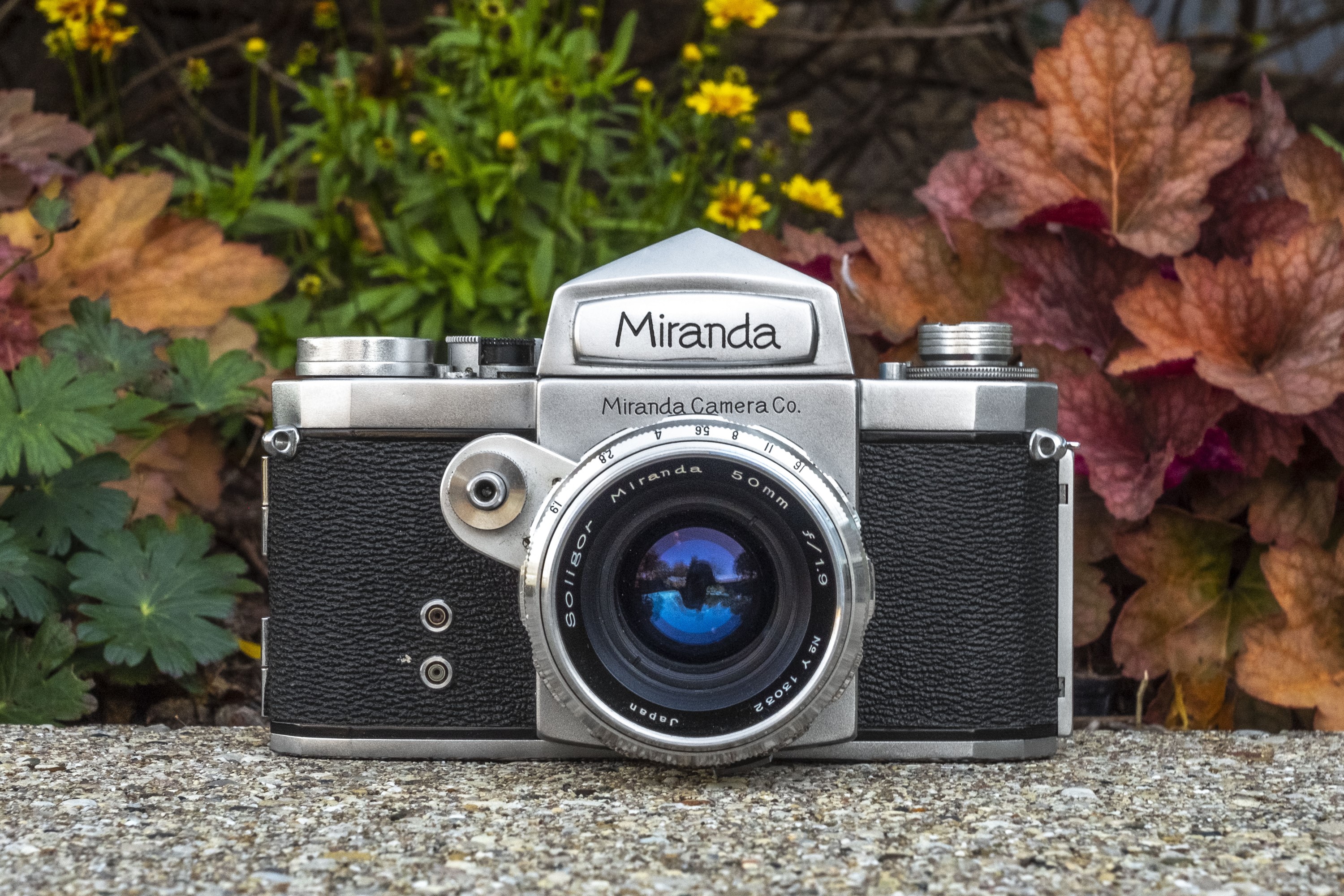
Later models like the Miranda A, D, Automex, and Sensorex have routinely been pleasures to shoot and have consistently delivered great results (when the cameras weren’t malfunctioning, that is). I didn’t have one of every model ever made, but I was happy with my selection, having at least one example from different eras, including the dreadful Miranda dx-3.
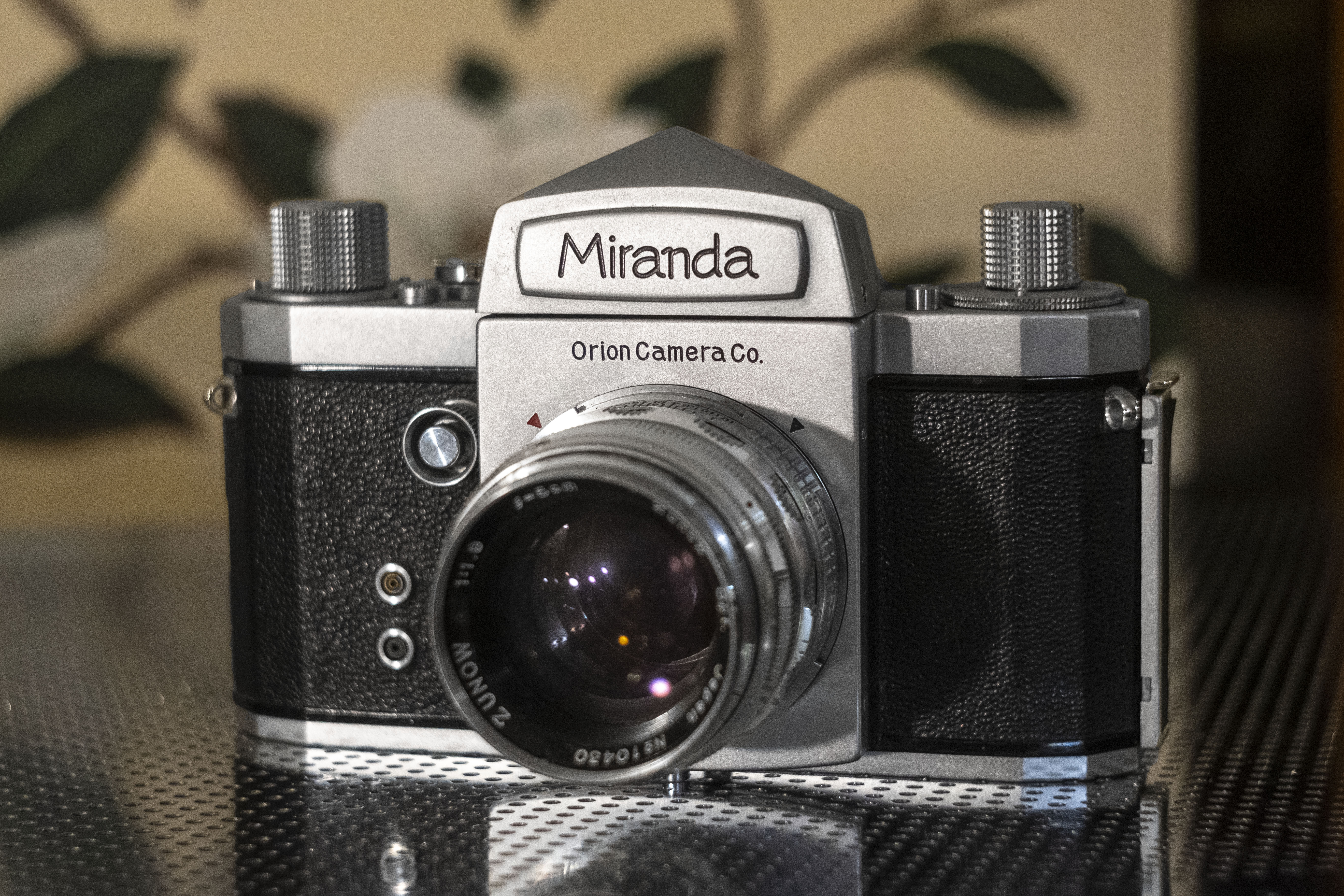
Back in 2021, while visiting the Voncabbage collection, I saw a nice looking Orion Miranda T with a Zunow 5cm f/1.9 lens attached and I was able to hold it for a few minutes., admiring its beauty. Even though I already had a Miranda S, that T just felt different. It felt like it had an indescribable uptick in build quality much like early Asahiflexes just feel a tiny bit “better” than later Pentax Spotmatics. I was well aware of how rare the Miranda Ts are with the Orion logo, not to mention the even rarer Zunow lens, so I was pleased just to have this short opportunity. I never imagined I’d add one to my collection.
In my 10+ years of writing camera reviews and the 4+ years we’ve been doing the Camerosity Podcast, I’ve built up a pretty large “black book” of other collectors, enthusiasts, and historians which has given me opportunities to pick up cameras which most people don’t often see. In the spring of 2025, I was contacted by Miranda collector Jeffrey Felton regarding taking over his collection of Miranda cameras. Jeff said his collection was in a large storage unit in rural Driftwood, Texas and that in order for me to come get it, I would need to arrange my own transportation and all logistics of moving the collection. The task was quite large, involving two cross country flights, multiple nights in a hotel, two rental cars, a moving truck, two 4′ x 8′ U-Haul U-Boxes, and many hours of sorting, lifting, carrying, and transporting everything.

For my efforts, I was given this Orion Miranda T with the Zunow 5cm f/1.9 lens, just like the one I handled in the Voncabbage collection. Even better, is that this example worked perfectly and was said to have been CLAd within the past five years. With such a rare opportunity to shoot an excellent condition Orion Miranda T, I immediately added it to my “to shoot” queue and got it loaded up and ready to go!
Orion, and later Miranda, kept their cameras in a constant state of evolution. Unlike companies like Leitz or Nippon Kogaku who released major updates with several year gaps, Miranda cameras were updated almost annually, sometimes with two different models debuting in the same year. The Model ID page from the defunct mirandacamera.com website (mirror hosted here on mikeeckman.com), lists a total of 35 unique Miranda SLRs, not including the scientific or Cosina made models.
Whenever you have a continuously evolving model lineup, differences between each model are subtle. Comparing this early Orion Miranda T to a Miranda A, the cameras have similar heft, the shutter speed dial operates similarly, the shutter release works the same way, they have identical lens mounts, and the main body and film compartment are basically the same. Yet, something feels different about the Orion. It felt more solid, more dense, more…dare I say, German.


Perhaps early Mirandas had greater quality control, perhaps a less automated, and individually tweaked construction was responsible for tighter tolerances and smoother controls. Perhaps there is no difference at all, and it is all in my head because I want this camera to feel more substantial!

Like all Mirandas, the Orion Miranda T is a very attractive camera. The bright blue lens coating of the Zunow 5cm f/1.9 lens gives the camera a mesmerizing pop of color. The chrome feels thick and shows almost no signs of oxidation. The body covering is entirely in tact and not peeling chipped or cracked, even the viewfinder is clear, without any evidence of the prism desilvering or pieces of dried up foam causing specks to form everywhere.

The top plates of the earliest Mirandas are pretty similar with the two biggest changes being the switch from knobs to levers and a new exposure counter with the Miranda A in 1958. Another cosmetic change from the early Miranda T and later cameras is that the top of the pentaprism is all metal without any body covering.

All knob wind Mirandas with slow speeds use a two piece speed selector on the top plate. Fast speeds from 30 to 500 plus Bulb are selected on the top dial, but a collar below the dial has slow speeds from 1 to 15 on it. The function of this slow speed collar is a bit different from most other cameras with two piece designs in which you need to put the fast dial into a specific position (usually the slowest “fast” speed). On the Mirandas however, the slow speeds override the fast speeds if the collar is turned away from the arrow. This is important to know because you could have your camera set to 250 and if you accidentally bump the slow speed collar away from the red arrow to the 15 position, the slow speed governor will kick in, changing your 1/250th shutter speed to 1/15th.

The other change, which shouldn’t surprise anyone considering the age of the camera, but still might be surprising to those who haven’t used a mid 1950s SLR is that the Miranda lacks both an instant return mirror and support for lenses with automatic diaphragms (these two features were not available until the Mirada B and A, respectively). What that means is the reflex mirror doesn’t come down until you wind the camera, without doing that, the mirror is up, blocking light from entering the viewfinder. When firing the shutter, the mirror flips up like on a modern SLR, but it does not come back down until you wind the camera again. The Zunow lens has a manual diaphragm which works like rangefinder lenses where changes to the aperture ring immediately open and close the lens.
To make things a little easier on the photographer, the Zunow has a preset ring in which you can set the desired f/stop ahead of time (hence the name ‘preset’) and then using a second ring, you can quickly open and close the lens from wide open, down to whatever f/stop you’ve chosen. The advantage to this is that once the lens is preset to something like f/11, you can quickly open the lens up to allow maximum light into the viewfinder, and then quickly stop it down to f/11 without having to lower the camera from your eye to look at the scale again. This is certainly slower than using lenses with automatic diaphragms, but it was the norm for 1955. If preset lenses aren’t to your liking, the Orion Miranda T will work with later automatic Miranda lenses that use the PAD (the external shutter release button which allows the diaphragm to remain open while composing).

Top Plate Shutter Release An interesting, but extremely hard to find accessory for the Miranda T was a top plate shutter release button called the Sketch, which could be screwed into the top plate cable release socket above the shutter speed dial. In the image from the right, you can see this accessory screwed into the socket, giving the photographer a choice of two different shutter releases, one on top, the other on the front.
All early Miranda cameras are knob winds, and in my opinion, using a knob over a film advance lever is hardly an issue. In the late 1950s, a large number of manufacturers started replacing their film advance knobs with levers which they usually called “rapid wind levers”. While it is true that the levers are slightly faster to use, the difference is negligible, as turning a knob is not difficult to do. Another control on the top plate is the viewfinder release button in the upper corner between the rewind knob and pentaprism. Waist level and other precision viewfinders were made for the Miranda system.

The sides of the camera have front angled strap lugs to improve balance when a strap is connected. The camera’s left side has a sliding latch for opening the film compartment.

When the first Miranda T came out in 1955, its lens mount was not new. Orion had been using the same exact mount since 1952 on their Mirax reflex attachments for Leica and Contax rangefinders. The “Mirax” mount was a dual lens mount with both an external bayonet and a internal 44mm threaded mount. I have no proof of this, but perhaps the idea for using a dual lens mount came from the Zeiss-Ikon Contax, whose lens mount is also a dual mount. Whatever the reason, this gave the Mirax, and later Miranda SLRs a great deal of adaptability for lenses made by other companies. Both the Mirax and Miranda were designed with using other people’s lenses in mind.
With the Miranda T, the earliest lenses all used the internal 44mm thread mount. I am far from an expert on every lens ever made for the Miranda SLR, but in my experience, the widespread use of the external bayonet did not start until 1958 with the release of the Miranda A. While this doesn’t prevent later lenses from being used on the Miranda T as the mount is both backward and forward compatible, it is an interesting observation nonetheless. To the naked eye, the Zunow lens looks like it might work on M42 thread mount cameras, but it is just a tad too big.

If being Japan’s first 35mm SLR with a pentaprism isn’t innovative enough, the Miranda was also one of very few 35mm cameras made with interchangeable viewfinders. At the time of its release, only the KW Praktina and Ihagee Exakta Varex/VX supported this feature as neither Tokyo Kogaku nor Nippon Kogaku had released their Topcon and Nikon SLRs yet. Changing the viewfinder requires you to press in on a small sliding button above and to the right of the rewind knob, and then sliding the prism backward. I find that backwards sliding viewfinders are more preferrable to ones that lift straight up like the Exakta and Nikon as there’s less of a chance they can fall off if handled incorrectly.
Viewfinder Compatibility: Although all Miranda SLRs except the dx-3 have interchangeable viewfinders, they are not all compatible. A change was made with the release of the Automex which resulted in earlier viewfinders to no longer be compatible. You may change viewfinders from the original Orion through the Miranda D/DR, and then again from the Automex on except the dx-3.

The view through the pentaprism viewfinder is similar to the waist level finder, except it is horizontally corrected and a bit dimmer. A combination of less advanced focusing screens and the glass used to make the prism decreases brightness while looking through the camera at eye level. It is not bad outdoors in bright light, but indoors or in heavy shade, dark vignetting makes seeing the corners difficult. For this reason, using the preset feature of the Zunow lens so that you can compose your image with the lens wide open is a must.

For the Miranda T being a tiny company’s first effort at making an SLR and the very first Japanese SLR with a pentaprism, the camera is surprisingly modern. Sure, it lacks an instant return mirror, support for automatic diaphragms, the fast and slow shutter speeds are controlled separately, and it uses knobs instead of levers, but so did most other 35mm cameras of the era. For the era in which it was made, the Miranda T was very modern, and with only a few tweaks, the company was able to further enhance its design in future models. The film compartment, rear of the camera, both sides, and the bottom are pretty typical mid century SLR designs. I don’t really need to explain these parts of the camera to you as most anyone reading this article will already be familiar even without ever having seen a Miranda T.
It didn’t take long after acquiring this Miranda T before I was ready to load in some film and shoot with it. While I have a lot of experience with other Miranda SLRs, this was my first time with the highly sought after Zunow 5cm f/1.9 lens. Would it look appreciably brighter or sharper than images shot with Soligor lenses? I wanted to find out. I put the camera through a quick test to see if everything was working and satisfied that everything was in good order, I loaded in a roll of bulk Jessops 100, which is rebranded Ilford 100 film and took it out shooting.


The images shot through the Miranda T came out properly exposed with good frame spacing and no obvious shutter issues. The images from the Zunow lens are quite good as Zunow was already a respected lens maker. Sharpness is excellent in the center and although there is some softening near the corners, it is hardly distracting. I did notice that out of focus details, especially those in the foreground, are somewhat vague and lacking in structure, but that’s more a sign of the era, rather than poor optics.

Zunow was originally founded as Teikoku Kōgaku Kenkyūjo before the war and they made optical glass and lenses for the Japanese military. At least one of their lens designers formerly worked for Nippon Kogaku, but since it was common for Japanese companies to share resources back then, it is plausible that others came over as well. Throughout their entire existence, Miranda never made their own lenses and always relied on optics created for them by other companies and these early Zunows are the most sought after by collectors of any lens made for the system.
Considering their rarity and value, the Zunows must be top performers, right? That was the question I aimed to answer as I was shooting my first roll through the Miranda. Upon looking at the negatives for the first time, I could see that yes, the Zunow 5cm f/1.9 lens is an excellent performer with excellent sharpness corner to corner, excellent details, and excellent contrast. Was it measurably better than perhaps a Zeiss or Nikkor lens of the same era? The jury’s still out.

What is conclusive however, is that images from the Orion Miranda T with the Zunow 5cm f/1.9 lens were very good, and I suspect users of these cameras back in 1955 were very happy. This camera is the oldest Miranda and the second oldest Japanese SLR I’ve ever shot and I can say that it compares favorably to the best cameras of the era. The build quality on the Miranda T is outstanding. From the tactile controls to the balance of the lens and body, I feel comfortable saying this camera compares favorably tot he best German cameras of the era. In fact, considering that German SLRs of the era like the Ihagee Exakta and KW Praktina still had some strange quirks, the Miranda T somehow feels more modern, despite it having a knob film advance, preset lens, and lack of an instant return mirror.

Probably the biggest con to the camera is the design of the slow shutter speed dial. Unlike most other cameras with separate fast and slow speed dials where the slow speeds are only activated when the fast dial is set to the slowest speed, on all Mirandas until the Automex, if you accidentally move the slow speed dial while shooting, you will activate the slow speeds, regardless of which fast speed you’ve selected. Because of this, you should always check the speed before firing your exposure to make sure it hasn’t been set. Beyond that, the Orion Miranda T holds up very well to other cameras of its era, and even some from after.
Overall, the shooting experience was excellent. The viewfinder, while darker than those in modern cameras, did not inhibit me from getting a complete roll of properly exposed images. The ergonomics were excellent. The fact that I had to wind the film using a knob rather than a lever did not slow me down at all. The feel of the camera was excellent, and we already talked about the lens.
Quite simply, the Orion Miranda T is an awesome camera, and one that I wish I could tell you was easier for more people to experience. Sadly, this is a rare camera, especially with the Zunow lens. Most people reading this review may never get the chance to shoot one, but if you do, you’re in for a treat. Sometimes a camera is worth a lot of money because it is rare, but it is not fun to shoot, sometimes fun cameras aren’t worth much because they’re so common, but this is the example of a camera that is both rare and fun to shoot!
Related Posts You Might Enjoy
External Links
https://camera-wiki.org/wiki/Miranda_T_and_TII
https://mikeeckman.com/mirandacamera/_modelinfo/_t/model_t.html
https://www.cameraquest.com/orion.htm
https://www.pentax-slr.com/71760578.html
http://miranda.s32.xrea.com/miranda/MSJ_html/early/early.html (in Japanese)
There was another camera with interchangeable viewfinders marketed before the Miranda – the Praktina.
You and Anton both caught my mistake, and I have changed the wording to include the Praktina. Thanks for catching that!
“At the time of its release, only the Ihagee Exakta Varex/VX supported this feature”
You forgot the Praktina FX from 1953 which has interchangeable viewfinders…