

The Graflex Norita 66 is a 6x6cm medium format SLR made by Norita Kogaku K.K. in Japan starting in 1971, sold in the U.S. under the Graflex name through a distribution deal, though Graflex had no actual role in its manufacture. Its lineage traces back to the Rittreck 6x6, released in 1968 by Musashino Kōki, a Pentacon Six-inspired design that gained a reputation as a solid, affordable alternative to Bronica and Pentax medium format SLRs before Musashino's financial troubles led to Norita Kogaku acquiring its assets in 1969. The rebadged Norita 66 continued to be sold with a notably fast 80mm f/2 Noritar standard lens, along with a range of lenses from 40mm to 240mm (and a rare 400mm), until production ended around 1976, with total output estimated at under 5000 units.
Specification-wise, the Norita 66 uses a cloth focal-plane shutter (1–1/500, X, B), an interchangeable pentaprism viewfinder with waist-level option, a unique breech-lock bayonet mount similar in operation to Canon's FL/FD system, and native support for both 120 and 220 film via a flippable pressure plate—no separate backs required. It weighs 1730 grams with the standard lens. The author, who admits general skepticism toward bulky medium format SLRs like the Pentacon Six, Mamiya M645, and RB67, found the Norita's size and control layout closely mimic a "supersized" 35mm SLR (comparable to a Pentax Spotmatic or Nikkormat), making it intuitive to use. Shooting two rolls of expired Kodak Ektacolor 160 through it produced sharp, well-exposed images despite some base fog and an uneven shutter curtain shadow (attributed to age and lack of servicing), with the Noritar lens proving comparable in sharpness to lenses from major optical manufacturers.
Overall, the author's verdict is highly positive: the Norita 66 impressed them enough to reconsider their dislike of this camera style, praising its familiar ergonomics, easy 120/220 switching, and excellent lens performance. They speculate about what a second-generation model with modern features (auto exposure, TTL metering, motor drive) might have looked like, but note the camera arrived as medium format SLR popularity was already declining. Despite its obscure name, the author recommends the Graflex Norita 66 as a worthwhile option for anyone shopping in this camera category, citing its solid construction, intuitive handling, and strong optical performance.
AI-generated summary. May not capture every detail — read the full article below for the complete picture.
This is a Norita 66, a medium format Single Lens Reflex camera made by Norita Kogaku K.K. starting in 1971 in Tokyo, Japan. The Norita 66 is an evolution of the Rittreck 6×6, a very similar camera which started production in 1968 by a company called Musashino Kōki who went bankrupt the year after the camera’s release. The Norita 66 is very similar to the Rittreck 6×6 and was sold under a variety of export names such as Warner 66 and the Graflex Norita 66 in the United States. The Norita 66 has a traditional 35mm SLR design, but makes 6cm x 6cm exposures on 120 or 220 roll film, It has its own unique bayonet lens mount, allowing use of a variety of interchangeable lenses made for it.

Film Type: 120 / 220 Roll Film (twelve / twenty-four 6cm x 6cm exposures per roll)
Lens: 80mm f/2 Norita Kogaku Noritar coated 6-elements in 4-groups + others
Lens Mount: Norita Breech Lock Bayonet
Focus: 2.9 feet / 0.8 meters to Infinity
Viewfinder: Interchangeable SLR Pentaprism w/ Split Image and Ground Glass Circle
Shutter: Cloth Focal Plane
Speeds: X, B, 1 – 1/500 seconds
Exposure Meter: None (Optional TTL CdS Viewfinder Available)
Battery: None
Flash Mount: PC Port, FP, M, and X S-Sync, 1.40 X-Sync
Weight: 1730 grams / 1284 grams (body only)
Manual: https://www.cameramanuals.org/prof_pdf/norta_66.pdf
Manual (alt version): https://www.cameramanuals.org/prof_pdf/norta_66-2.pdf
Sales Brochure: https://www.cameramanuals.org/prof_pdf/norta_66_pr.pdf
The history of the Graflex Norita 66 is quite confusing and involves no less than four different companies for it even exist. Starting off with the easier part to explain is Graflex. Originally founded as the Folmer & Schwing, in 1905 the company was bought by George Eastman and became part of Kodak in 1907. As part of Kodak, the company produced a line of successful Graflex SLRs, but in 1928, the company was found to be in violation of antitrust laws and Folmer was spun off into its own company which was then called the Folmer Graflex Corporation.
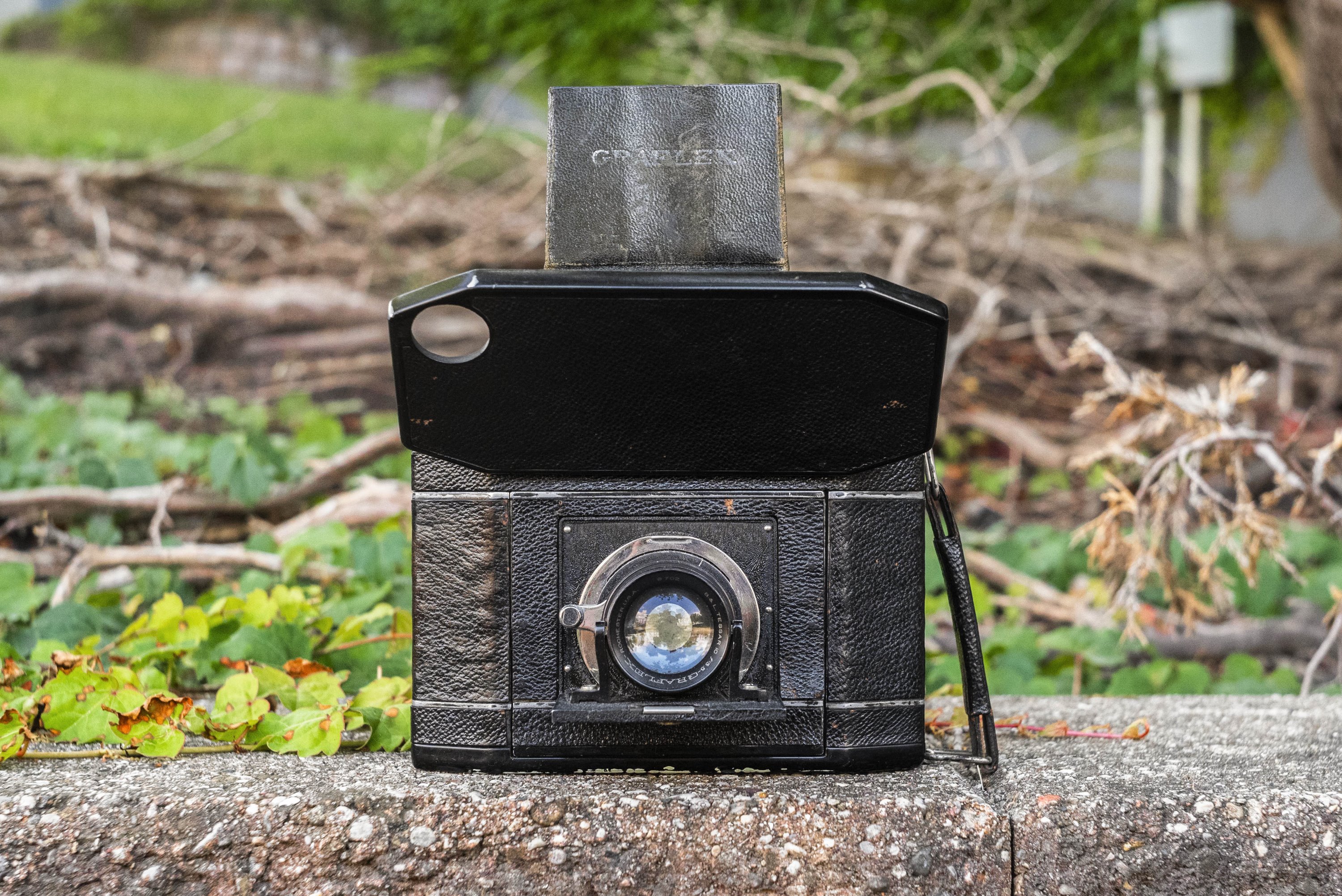
Throughout the mid 20th Century, Folmer Graflex produced a line of very successful press cameras that became iconic examples of mid 20th century professional cameras. If you watch any movie or television show which is set in the mid 20th century and there is a scene in which a professional camera appears, it is almost certainly going to be a Graflex. Another piece of Graflex lore is that a type of flash handle used in the 1960s was purchased by a props department for use as Luke Skywalker’s light saber in the original Star Wars movies.
In 1958, with increasing competition from smaller and more capable Japanese companies, Folmer Graflex was purchased by a company called General Precision and then again in 1968 by the Singer Corporation, a company widely known for their line of sewing machines. By the early 1970s, Graflex had ended all domestic production of cameras but was in the habit of putting their name on cameras made by other companies. Enter the Graflex Norita 66.

The Norita 66 was made in Japan by Norita Kogaku K.K. who was founded in 1951 by an ex employee of Tokyo Kogaku named Norita Toshio. Norita’s primary business was as a supplier for other companies. Their earliest products were binocular lenses and prisms. Eventually they starting producing lenses and prisms for other companies. One such company was Musashino Kōki K.K. who in 1968 produced a medium format single lens reflex called the Rittreck 6×6. The Rittreck 6×6 was an all new design but based heavily on the Pentacon Six SLR from Germany. Versions of the Rittreck 6×6 were sold in export markets as the Warner 66. Both the Rittreck and Warner cameras came standard with an unusually fast 80mm f/2 lens called the Rittron but other lenses from 40mm to 400mm were available.

Upon its release in 1968, the Rittreck 6×6 gained recognition as a less expensive, but equally good as other medium format SLRs such as those made by Bronica and Asahi Pentax. Unfortunately, the complexity and success of the camera and the low price it sold for caused financial problems for Musashino which resulted in the company selling its assets to Norita Kogaku in 1969. Now under ownership of Norita, the Rittreck 6×6 was slightly modified and rebadged as the Norita 66. It went back on sale to export markets in 1971 and in 1972 was sold domestically in Japan. For copies sold in the United States, Norita gained a distribution deal with Graflex and the camera was renamed the Graflex Norita 66 even though Graflex, or their parent company Singer had no role in the camera’s construction.
Lenses and accessories made for the Rittreck 6×6 were adapted to the Norita and continued to be sold until about 1975. In the United States, the Graflex Rittreck 66 retained its positive reputation, continuing to compete with the Pentax 67 and German Pentacon Six.

I was unable to find any period advertisements for the Norita in the United States when it was sold, but it did appear in Modern Photography’s 1974 round of up SLR systems. In that magazine it shows a list price with the 80mm f/2 lens of $650. This was significantly less expensive than other medium format SLRs like the Hasselblad 500 C/M, Asahi Pentax 67, and Rolleiflex SL66 with prices of $995, $1049, and $1290 respectively, but closer to that of the Kowa Six, Bronica S2A, and Mamiya RB67 at $600, $799.50, and $756 respectively, and of course, none of those cameras had a standard lens with a fast f/2 aperture.

During its production, most advertisements showed six lenses from 40mm to 240mm available. A 400mm lens was reportedly available, but made in very small numbers. A single third party zoom lens, the Zoomar Rapid Focus Tele-Zoom 170mm – 320mm f/4 lens was made by Kilfitt and could be ordered with a Norita mount. Finally, a 70mm f/3.5 Noritar was also made which had its own internal leaf shutter, whcih could be used in place of the camera’s focal plane shutter, offering flash synchronization as fast as 1/500 second.
The Graflex Norita 66 was never a huge seller, but it did fill a need for the small niche of photographers who wanted a medium format 6×6 SLR without spending much money. As best as I can tell, the Norita ended production in 1976 and was sold as new old stock for at least another year. I could never find any official production numbers, but this site suggests the number is less than 5000, which feels plausible to me.

The Norita 66 was the last camera made by Norita Kogaku K.K. who continued producing a number of photography and projection related lenses and accessories. The company would exist until 2000 until it became part of Enplas Optics before going out of business in 2005.
Before I get into my thoughts on the Graflex Norita 66, I feel I should disclose that in the past, I have not been too fond of this style of medium format SLRs. I’ve previously used the Pentacon Six TL, Mamiya M645, Pentax 67, and I have an RB67 which I haven’t shot, but do own, and there’s just something about the size and heft of these otherwise wonderful cameras that don’t appeal to me. I remember the first time I used the M645 with an eye level prism, I felt like I was holding a square bowling ball to my face. There’s something about having to stress my forearm muscles while supporting a 3+ pound camera to my eye that just doesn’t feel natural.

Knowing that I am probably in the minority of people who would think this, when I first saw the Graflex Norita 66, I was cautiously intrigued. Of the four cameras I mentioned above, the Pentax 67 has been my favorite, as despite being very heavy, it benefitted from having ergonomics that are nearly identical to a 35mm SLR. If you’ve never handled a Pentax 67 before, picture a Pentax Spotmatic, just a lot larger in every dimension. The Norita feels almost the same way. Another contributing factor to my cautious optimism was the “fast for medium format” 80mm f/2 Noritar lens. Truth be told, I have often wondered why most medium format lenses seem to stop at f/2.8. Why aren’t there faster lenses, I asked myself? With the Norita, I finally get a chance to try one out.

I picked up this Graflex Norita 66 along with two lenses and a spare body in a collection of cameras back in 2023 and was immediately drawn to its fast f/2 lens. The first time I saw it, I remarked at how large the front element was, but then seeing it was faster than the f/2.8 lenses I am used to seeing on medium format cameras, I was very interested in shooting the camera. In the same lot of cameras also came a complete Asahi Pentax 67 set with several lenses. Side by side, both cameras are impressive, but the slightly smaller dimensions of the Norita, plus the faster standard lens drew me to it more.
The build quality of the Norita 66 is impressive. With the standard lens attached, the camera weighs in at 1730 grams (~3.8 lbs) which although substantial for any camera, feels strangely compact compared to some other medium format SLRs. Perhaps the most appealing part of the Norita 66 is that it basically looks like a supersized 35mm SLR. Ergonomically, all of the camera’s critical controls are in the same exact locations as you’d expect to find them on smaller SLRs. For someone who was handed a Norita 66 without any previous knowledge of one, the learning curve to use it, would be very small.
The Graflex Norita 66 is very much like a supersized 35mm SLR. For users of the smaller format, picking up and using the larger camera requires very little in the way of familiarization. Other than the increased size, a lack of a rewind knob is really the only major difference. Up top, the film advance lever, shutter speed dial, shutter release and automatic resetting exposure counter are all in very familiar locations.


The similarities to 35mm SLRs continue on the back, bottom, and the sides. Everything from a circular film reminder dial on the door, to a centrally located 1/4″ tripod socket in the base to a sliding film door latch and strap lugs on the sides round out the familiar look.


Where the Norita 66 differs most from a 35mm camera is in the film compartment, which for obvious reasons uses a completely different type of film. After releasing the latch on the camera’s left side, the right hinged door sings open to reveal the film compartment and large cloth focal plane shutter.

Like all roll film cameras, there are two compartments for a supply and take up spools. Film transports from left to right, and an empty supply spool can become a take up spool simply by moving it from one side to the other. To change the left spool, lift up on the top plate dial to the left of the viewfinder. This releases the inner shaft that will go inside the spool, allowing you to remove the old spool and put a new one in. On the other side a similar step involves folding out a half circle key on the base of the camera, pulling it out and then giving it a quarter turn so that you can replace the spool.

After loading in a new roll of film and attaching the paper leader to the take up spool, you must advance the film until the black START marks on the film’s backing paper lines up with an orange dot above the film gate. In order to freely advance the film without cocking the shutter, a small dial on the right side of the camera must be turned to the “N” position. Once the film is correctly lined up with its START mark, close the film door, making sure it latches, then turn the small dial back to the “D” position and wind the camera until you get to exposure number 1 on the exposure counter.

The Norita 66 supports both 120 format but also the longer 220 format, which gives up twenty-four 6cm x 6cm images per roll. Unlike magazine based SLRs, you do not need to buy a special film back to use 220, you simply need to flip the film pressure plate around. To do this, open the rear door, and compress it into the door using your thumbs, and slide to the right. The pressure plate will release from four posts in the door and come off in your hand. Simply flip it around until you see the number ‘220’ facing upright, and press it into the door in the direction of the arrow to reattach it. After this is done, the last step you must do is to rotate the collar around the base of the knob next to the exposure counter from the 120 to the 220 position. This dial is necessary to make the exposure counter work correctly.

Up front, the interchangeable lens mount is unique to the Rittreck and Norita cameras, but can be used with some Pentacon Six lenses with an adapter. The mount itself is a breech lock bayonet style which looks and operates exactly like the Canon FL/FD lens mount used on Canon’s manual focus 35mm SLRs. With a breech lock system, the lens does not twist when mounting or dismounting. Its orientation stays fixed, and a breech lock collar at the base of the lens rotates around a bayonet on the camera. In this system, only the collar rotates, and as a result, there is no risk of the rear surface of the lens from wearing out with repeated use, possibly causing images to be out of focus.

The pentaprism viewfinder is quite nice, showing a large square image up right and in the correct orientation. This being an interchangeable viewfinder, the prism reflects everything seen on the ground glass which can also be used at waist level.

Removing the prism is done by squeezing together two buttons on the sides of the prism and lifting straight up. The Norita 66 can be shot at waist level with or without a hood. Having the proper waist level hood will help shied the focus screen from ambient light, but it is not a requirement to use. Using the camera with the pentaprism viewfinder adds to the 35mm SLR feel of the camera, but I did prefer the brighter view while using the camera at waist level.
The Norita 66 wasn’t a camera I sought out to find, but after spending some time with it, I grew more fond of its control layout. I haven’t always loved medium format SLRs, but I felt as if there was going to be one camera that might change my mind, it would be this one. It is clear that the combined efforts of Musashino Kōki, Norita Kogaku, and Graflex produced a high quality, thoughtfully laid out, and affordable medium format SLR system, and one that I was excited to shoot.
At the same time I picked up the Norita 66, I also received a 10 pack of ~15 year expired Kodak Ektacolor 160 film. Not really knowing the conditions in which this film has been stored, but seeing that it was in a very well protected box, I thought I should give it a shot. I loaded in a roll of the film and took it out shooting.


For starters, I was impressed that the unknown condition Kodak Ektacolor 160 held up mostly well. When the film came out of the tank, it showed some moderate base fog, but my scanner was able to scan past it, giving me a whole roll of properly exposed, but slightly desaturated images. A more worrying concern is a dark shadow across the right side of every single image, suggesting the shutter curtains are moving unevenly. This is an entirely common problem on any focal plane shutter camera, which hasn’t seen any service in multiple decades. A CLA would easily correct this, and something I may look into in the future.

In reading contemporary reviews of both the Rittreck 6×6 and Norita 66, comments about the sharpness of the Noritar lens were common. This six element design is as good as any similar fast prime lens by an A-list lens maker. This camera and lens may not say “Zeiss”, “Schneider” or “Nippon Kogaku”, but the optical quality of the images it is capable of are easily on par with those shot with any other A-list medium format camera.
I was so impressed with the images from my first roll of film, I decided to shoot another. In hindsight, I wish I had put in some black and white to see how the lens performs with fine shadow detail, but the two rolls of color were good enough to me to confirm that in terms of optical performance, owners of this camera left nothing on the table compared to other, much more expensive medium format SLR systems.

Shooting the Norita 66 was a joy. If you can imagine shooting a Pentax Spotmatic, Minolta SRT-101, or Nikkormat FTn, but just physically larger in every dimension, you’ll have a sense of what this camera is like. Although I didn’t have any issues with the pentaprism viewfinder, and actually liked how normal it made the camera feel, I did appreciate the extra brightness offered by shooting the camera at waist level with the prism removed. I don’t have the waist level hood, but I had no problems without it.
An additional attribute to the Norita 66 that will keep it near the top of cameras I want to shoot is its built in compatibility with 220 film. Many cameras like the Mamiya M645 require dedicated film holders for 120 and 220. Without the correct film holder, shooting the wrong kind of film will cause problems, but with the Norita, a simple flip of the pressure plate allows you to shoot either film. In my time shooting film, I’ve accumulated at least a few rolls of frozen 220 that I want to one day shoot and with how easy the Norita 66 makes it, this camera will likely see some of those rolls.

I’ve never loved breech lock bayonet mounts, but perhaps the lenses on the Norita being larger than those found on Canon’s 35mm SLRs, I didn’t have any difficulty getting them on and off this camera. I appreciate what I can only assume was an intentional decision to make this camera so familiar to others out there. I think that whoever at Musashino Kōki was in charge of the original Rittreck 6×6 realized that they’d have an easier time appealing to customers who were unfamiliar with their brand, if they were at least familiar with the design.
I enjoyed shooting the Norita 66 and wonder what a second generation camera might have been like with features such as automatic exposure, TTL metering, some lighter weight construction materials, and perhaps even a motor drive. We’ll never know though as the Norita 66 was produced at a time when the popularity of medium format SLRs was on the decline. Some companies like Mamiya and Fuji still had success after the Norita, but each of those companies also had the benefit of other lineups of cameras, neither of which Musashino or Norita had.
If you’re in the market for a camera of this style, you have a lot of great options, and the Graflex Norita 66 is definitely one of them. It might have a name you are unfamiliar with, but the construction, ergonomics, and performance will be very familiar to you.
Related Posts You Might Enjoy
External Links
http://camera-wiki.org/wiki/Rittreck_6%C3%976_and_Norita_66
https://www.pentaconsix.com/norita.htm
https://web.archive.org/web/20021120023311/http://medfmt.8k.com/mf/norita.html (archived)
http://www.topgabacho.jp/Topconclub/Norita1.htm (in Japanese)
https://nikomat.org/priv/camera/norita/index.html (in Japanese)
The dark band on the picture is caused by the opening curtain bouncing momentarily in the film aperture, before the closing curtain completes the exposure. Many Noritas suffer from that issue because they lack* a proper mechanism to prevent the bounce. Instead, a piece of foam is glued to the opening curtain, lens side, which eventually degrades. You can see its imprint from the door side when the shutter is cocked. I would suggest gently lifting the mirror and replacing the foam. This fixed the bounce on my body! Although a full CLA would be great of course.
*The NatCam repair guide for the Norita shows a bounce prevention lever in the mechanism but my camera (and others) doesn’t have it. It also clearly shows the piece of foam. Go figure…
That is interesting information, thanks Olivier. I had just assumed it was normal shutter capping. I doubt I’ll ever get this camera fully CLAd, but if I do, I’ll be sure to update this review.