
The Yashica 230-AF is a 35mm autofocus SLR made by Kyocera from 1987 to 1991, marking Yashica's return to interchangeable-lens SLRs after years of focusing on point-and-shoot cameras. Kyocera, which also owned Contax, wanted an autofocus SLR but couldn't wait for Zeiss to develop AF lenses, so it launched an entirely new autofocus system under the more budget-friendly Yashica name, complete with a new three-claw bayonet "AF Mount" and an optional teleconverter allowing some older Contax/Yashica manual lenses to autofocus. The camera launched with nine exposure modes, a "Trap Focus" feature, and a small lineup of lenses and accessories, retailing around $660 with a lens and flash (roughly $1900 adjusted for inflation), and was generally well-reviewed for its speed, accuracy, and lens quality.
Specs include a 6v 2CR5-powered electronic shutter (16–1/2000 sec), a fixed pentaprism viewfinder with 95% coverage and LCD readout, and support for interchangeable focusing screens and a distinctive front-mounted removable CS-110AF flash module rather than a hot-shoe or pop-up unit. The author, drawn initially to the camera's bulky, distinctly "80s" looks (especially with the bulbous flash attached), tested it with the uplevel 13-element 28-85mm f/3.5-4.5 Macro lens and Santa Color 100 film. He found the build quality solid, ergonomics comfortable despite a squishy shutter button and button-heavy controls, autofocus fast and accurate with no notable lag, and the lens output surprisingly excellent—sharp corner to corner with no vignetting, rivaling top lenses from major German or Japanese brands. A vintage dealer's recollection included in the piece confirms the cameras were reliable, accurately focusing (if not fast), and popular with dealers as an affordable alternative to Nikon/Canon lines.
The overall verdict is highly positive: the author considers the Yashica 230-AF a genuinely great camera with strong build quality, excellent lens performance, and surprisingly modern usability for a first-generation AF SLR. His main criticism is aimed at Kyocera's business strategy rather than the camera itself—he finds it baffling that Kyocera treated this successful system as secondary to the manual-focus Contax line, discontinuing the Yashica AF mount after just a few models (ending with the 1993 Yashica 300-Auto) while Contax lingered until a much later, separate AF system in 2001. He speculates that had Kyocera fully committed to the Yashica AF mount across both brands, the system could have been far more successful and longer-lived.
AI-generated summary. May not capture every detail — read the full article below for the complete picture.
This is a Yashica 230-AF, a 35mm SLR made by Kyocera of Japan from 1987 to 1991. The Yashica 230-AF was part of a new lineup of auto focus SLRs produced by Kyocera featuring an all new auto focus lens mount which replaced the manual focus Contax C/Y mount used by Yashica SLRs since 1975. When it was released, the Yashica 230-AF was a very competitively priced autofocus system camera with a long list of features meant to make the technology of autofocus in SLRs down to the masses. The camera had good build quality, support for a variety of good Kyocera lenses, and using an AF convertor, could automatically focus most of the Contax C/Y lenses made at the same time. Although the camera sold well, it failed to gain traction with the photographic community and apart from two followup models released in 1991 and 1993, ended up being a dead end system.

Film Type: 135 (35mm)
Lens: 28-85mm f/3.5-4.5 Macro Yashica Lens multi-coated 13-elements in 9-groups
Lens Mount: Yashica AF Bayonet
Focus: 3 feet / 0.9 meters to Infinity (1.1 feet / 0.33 meters in Macro mode), Auto Focus
Viewfinder: Fixed SLR Pentaprism w/ LCD Display, 95% Field of View, 0.82x Magnification
Shutter: Electronically Controlled Vertically Travelling Focal Plane
Speeds (manual): B, 16 – 1/2000 seconds
Speeds (auto): 16 – 1/2000 seconds, step less
Exposure Meter: (2x) Silicon Photo Diode Calls w/ 9 Exposure Modes, including Programmed, Aperture Priority, and Shutter Priority AE Modes
Battery: 6v 2CR5 Lithium Battery
Flash Mount: Hot Shoe w/ Optional CS-110AF Module, X-Sync 1/90
Weight: 1192 grams, 654 grams (body only)
Manual: https://cameramanuals.org/yashica_pdf/yashica_230-af.pdf
When it comes to the most popular SLRs of the 1980s, a great number of models from most of the world’s top tier camera makers are thought up. Models from Nikon, Canon, Minolta, Pentax, and Contax usually adorn any “best of” list from this decade.
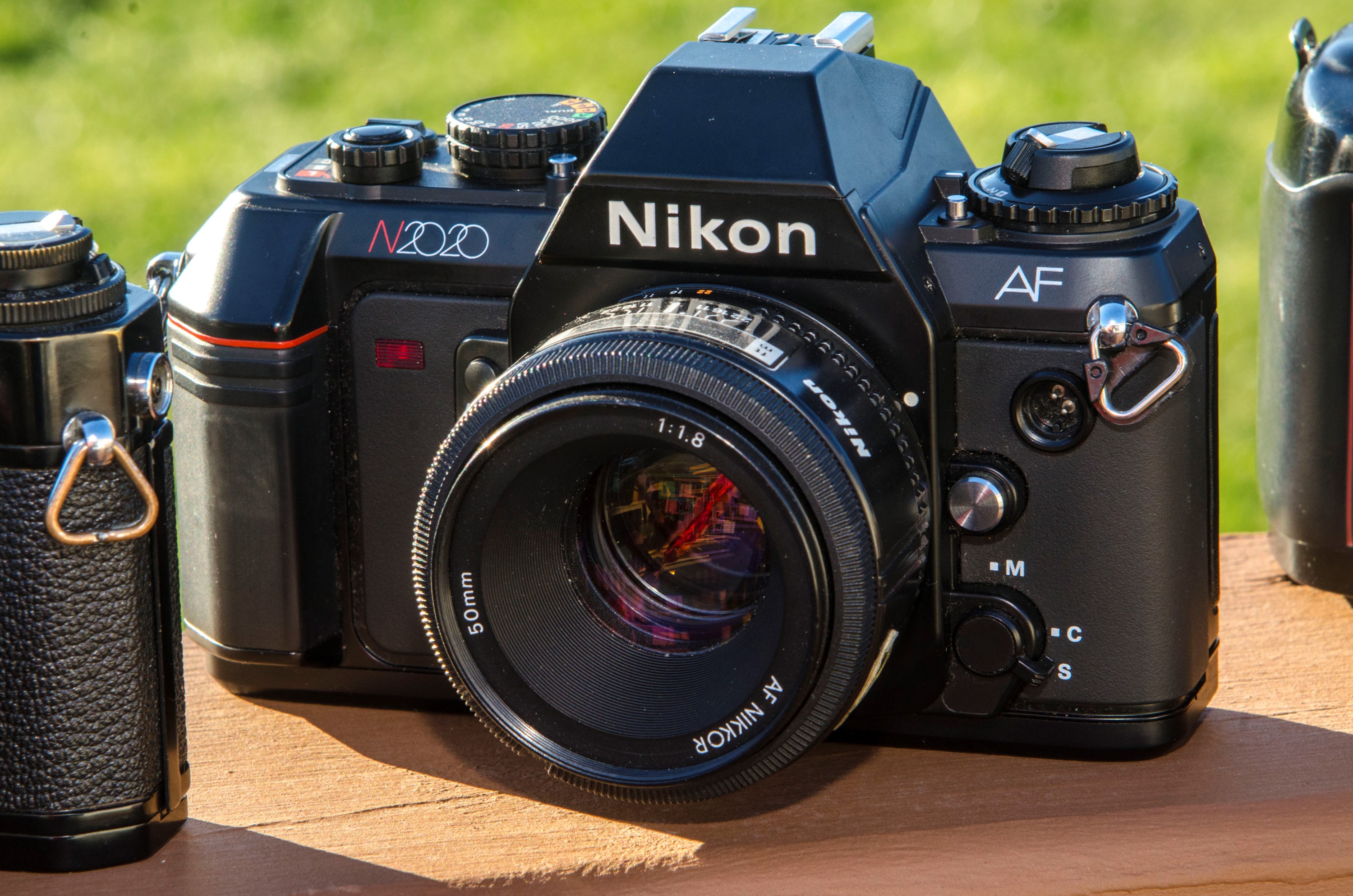
The 1980s was a decade of change for SLRs as the shift from manual to automatic focus happened squarely in the middle of the decade with the release of the Minolta Maxxum 7000. Canon and Nikon followed closely behind with their own AF SLRs, the Canon EOS 650 and Nikon N2020/F-501 but eventually, auto focus models from other Japanese makers like Pentax and Olympus would eventually follow.
Kyocera, makers of the both Yashica and Contax branded cameras found themselves in a bit of quandary. Like everyone else, they wanted to release an autofocus Contax SLR, but Kyocera knew that Contax cameras needed to have Zeiss lenses, and waiting for Carl Zeiss to develop a new autofocus SLR lens lineup would have taken too long, so they decided to release their new SLR under their more economically priced Yashica brand.

The challenge was that by that time, Yashica was no longer a relevant name in 35mm SLR design. Yashica cameras was relegated to primarily point and shoot options with Yashica’s last interchangeable lens SLR being the manual focus Yashica FX-70 Quartz from 1983.
In an effort to stay with the times and have an interchangeable lens autofocus SLR on the market, Kyocera decided to reintroduce a Yashica SLR, but this time with all new autofocus Kyocera/Yashica lens mount. Kyocera’s new lens mount would be a three claw bayonet mount with electronic contacts that communicated things like focus distance and aperture to the body, allowing in body exposure and focus control to work with a new lineup of lenses. For those who invested in the older Contax/Yashica mount, an AF teleconverter could be used with those lenses, giving them autofocus capabilities.
What is the name of the lens mount? Unlike pretty much every other lens maker who labeled their lens mount, Kyocera didn’t make this a priority with some documentation calling it the Kyocera mount, Kyocera/Yashica mount, and inside the Yashica 230-AF manual, simply call it the AF-mount. Looking through the Yashica 230-AF sales brochure below, no name is given to the actual mount, but every single reference to the lenses call them “AF Lenses” so I suppose “Yashica AF Mount” is as good of a name as any.
Kyocera’s first new autofocus Yashica camera was the Yashica 230-AF and it was released in 1987. For a first model in a new series, the camera was nicely equipped with a number of modern conveniences and advanced features such as nine different TTL exposure metering modes including support for spot and center weighted metering, multiple flash modes, and three different focusing modes. Kyocera was very proud of one of their focusing modes, which they called “Trap Focus” in which the camera will only release the shutter when the image in the viewfinder comes into sharp focus. This mode was thought to simplify focus so that a photographer with little experience could easily get crisp images of moving subjects.
In the new mount were a total of five lenses including two primes, two standard zooms and one tele-zoom, plus the 1.6x autofocus teleconverter which worked with some, but not all Contax/Yashica manual focus lenses. In addition to lenses, the Yashica 230-AF was a full system camera with optional accessories such as a data back, four different interchangeable focusing screens, two all new AF flashes, a remote control unit, and a variety of diopters and other viewfinder accessories.
Upon its release, the Yashica 230-AF was well received. It earned positive praise in reviews for its fast and accurate AF, the quality of its lenses, and long list of features. People even liked the optional clip on CS-110AF flash module offering a low profile and streamlined flash which predated in body pop-up flashes which we would become used to in the years to come. A claim in the camera-wiki article for the 230-AF, suggests that Consumer Reports gave the Yashica 230-AF top marks for value in one of their issues. Strangely, I cannot find any evidence of this online, so I am uncertain if it is true.

When equipped with the 50mm f/1.8 AF lens and the CD-110AF flash, the Yashica 230-AF carried a suggested retail price of $660, although actual street prices were likely 25-30% less. When adjusted for inflation, the retail price compares to just under $1900, making it an affordable midlevel SLR package for the enthusiast photographer who wasn’t already invested in some other system.

The Yashica 230-AF saw some success as a couple other models in the series were eventually created including a scaled down and simplified 200-AF model, and in 1991, an upgraded model called the Yashica 270-AF or 230-Super in some markets. The final model in the series was the Yashica 300-Auto which came out in 1993, offering a more modern control layout and an in body pop up flash.
Strangely, despite good performance and a positive reception, Kyocera would discontinue the Yashica lineup of SLRs and lenses around 1994. The company would not release another auto focus SLR until the Contax N1 from 2001, but that was a completely different system with yet another new lens mount. The Contax N-series would see only three models in the series before it too, was discontinued in the mid 2000s.
While researching the Yashica 230-AF for this review, I mentioned it to my friend and former camera dealer, Paul Rybolt and he fondly remembered selling these cameras in his store when they were new. I asked him if he’d like to share some thoughts on this model from that era and this is what he had to say:
Brick and mortar camera stores loved the Yashica 200 and 230AF cameras because it gave them a line that they could make a profit with. Dealers HAD to carry Nikon and Canon because that’s what the customers demanded. But to be competitive with the mass merchandisers dealers had to sell them at or near dealer cost. Lines like Yashica and Ricoh gave the dealer a chance to sell a good quality product at an attractive price point and make a few bucks. We didn’t sell away from Canon or Nikon but could present a package with both a 35-70 lens and a 70-210 lens at a price that was less than the competition. The fact is that they were good cameras. The AF wasn’t fast but it was accurate and the cameras had very few repair problems. The downside to the dealer that it wasn’t a system camera. Once you sold the camera and two lens kit the only thing you could hope for was to get the photofinishing business. This was no different from what we were already doing with the lens/shutter cameras so it wasn’t a big negative for us.
The big companies like Canon and Nikon were not great partners to the local dealers. We were forced to sell cameras and lenses at or near dealer cost and then make a few points on the cash discount and also on any back pocket deals you could make with them. If there was an “Instant Rebate” on something the dealer sold the item below cost and then got a credit from the company for 110% of what they had given the customer. This was a CREDIT which means that you had to buy more from them in order to get your money back. It was diabolical. Fortunately, we had a great relationship with Nikon and they gave us a lot of extra Key City money and other things that made us profitable.
For a brief moment, I had an infatuation with what I considered ugly cameras. The more gnarly the appearance, the more interested in it I was. While I won’t say that the Yashica 230-AF is anywhere close to the ugliest camera ever made, its angled dimensions, model number imprinted into the large hand grip, and bulbous flash (when mounted) give the camera an unmistakeable late 1980s appearance. This is the camera equivalent to “big hair” and neon spandex which was a popular fashion statement at the time.

The first time I saw a Yashica 230-AF, I fixated on the large flash that sits atop the prism, but at the time, I did not realize that the flash was a removable module. In the era the 230-AF was made, few SLRs had built in flashes. While flashes were increasingly common on point and shoot cameras, SLR shooters largely relied on large, but removable speedlights which connect to the camera’s flash hot shoe. In the years following the 1980s, most SLR makers offered pop up flashes which fold down into the top of the prism when not needed. These flashes don’t have the power of the larger speed lights, but could still be used in most instances. Unlike those later cameras, the Yashica 230-AF does not have a pop up flash, but offered a removable CS-110AF flash which slides into the shoe from the front. It is this flash which gives the camera the top heavy shape that drew me to the camera. With the flash removed, the camera takes on a much more normal shape and appearance.

Up top, the Yashica 230-AF eschews traditional knobs and levers for buttons and a large LCD screen. In this regard, the camera has a modern appearance as by this point buttons were the preferred method for SLR controls. On the downside, it usually does mean that a quick refresher of the user manual is a necessity before exploring too far into the camera’s controls. A sliding switch to the left of the prism functions as the power switch, with three options, On, AE-L and LOCK.

In front of the LCD is a sliding mode switch which takes the place of a command dial found on many SLR cameras. This slider is used to cycle between the camera’s various options. In front of the slider, and on top of the hand grip is the large rubber shutter release button. I found this location of the shutter release to be comfortable, however it has a bit of a squishy feel when being pressed and is recessed into the rubber coating making it difficult to locate with the camera to your eye.

The back of the camera is a large swath of hard plastic. While this may not feel as luxurious as the leather or rubber body coverings often found on cameras, there is no chance for it to crack, peel off, or become sticky. Notice the curved bump which functions as a thumb rest for your right thumb. Also, there is a film peep hole on the right to see what kind of film is in the camera.

The sides of the camera have metal strap loops which help balance the camera with heavy lenses attached. The right side of the camera has a large plastic screw which is used to open the battery compartment inside the hand grip. Opening the film back is done by pressing a release button and sliding a lock on the left side of the camera and allowing the right hinged door to swing open.

The film compartment is very modern and supports a quick loading feature in which you extend the leader to a yellow line and closing the back. Although the camera does have a motorized film transport, upon closing the door, you must press the shutter release to ready the film to the first exposure. In addition, at the end of the roll, the camera does not automatically rewind the film, you must manually activate the rewind motor via a button and switch on the bottom of the camera. The Yashica 230-AF uses foam light seals, which on this camera were still in good shape, but should be inspected on any camera before putting any film through it.

Up front, the Yashica 230-AF has a large three claw bayonet mount which was unique to these Kyocera/Yashica auto focus SLRs. No other Yashica or Contax SLRs supported this mount, although some C/Y mount lenses can be adapted. At the 3 o’clock position around the mount is the lens release button. Pressing this and twisting the lens needed to remove it. Below this lens release on the side of the mirror box is a small switch for enabling or disabling AF / MF focus modes.

Back up to the top of the camera is the large CS-110AF flash module which unlike any other SLR I’ve seen, mounts to the camera from the front of the camera, rather than the rear. Electrical contacts under the flash module slide into little holes on the front of the camera and do not make contact with the camera’s hot shoe. Instead, a round button with red edges uses the hot shoe as a mounting point. To remove the flash, you must press in on the round button and twist it with your finger until it pops up. When in the up position, the module slides forward. Installation is the opposite of removal.
Another unfortunate characteristic of the front mounted flash is that the 28-85mm f/3.5-4.5 Macro Yashica lens gets in the way of the flash when trying to remove it, so you must remove the lens first, before you can take the flash off. I do not have any other lenses for this mount, so I cannot comment on if any other lenses interfere with the flash.

The viewfinder is bright and features a spot circle in the center that indicates the area the exposure meter looks at, and a smaller rectangle in the center which indicates the focus area. Because the camera supports auto focus, the standard focus screen isn’t very useful for manual focus, however the focus screens are interchangeable and Yashica made two additional screens, one with a grid pattern and the other with manual focus aides.. The ground glass is optimized for small aperture lenses and looks surprisingly bright using the f/3.5 zoom lens, but won’t significantly get brighter using f/1.8 and faster prime lenses.
Below the ground glass is a backlit LCD full information display. The backlight glows amber and is very easy to see equally in bright sunlight and in dark indoor scenes. The display shows exposure mode, shutter speeds, aperture, and a set of focus up/down arrows. To the left of the LCD is a green focus confirmation LED, which works both in auto and manual focus modes. In the image to the right, there is an obstruction in the viewfinder of my particular camera which partially blocks the LCD. This is a defect in my camera and not typical of the model.
For my test roll in the Yashica, I loaded in a fresh roll of Santa Color 100, which was a crowdfunded film that launched in 2021. It was advertised as an American made film that is spooled in Finland. Although the original stock it is based on was never stated by the creators, it was later revealed that the film this is based off is Kodak Aerocolor IV 2460, a medium-speed, very fine-grain color negative aerial film originally rated at ASA 125. That it was both color and having very fine grain was what interested me most as I tend to like slower films with less grain.


I’ll admit, the initial appeal for me when acquiring and deciding to review this camera were its ungainly and bulbous shape and ergonomics. If there ever was a more “80s” SLR, I haven’t seen it. Yet, this camera is from an era where cameras like the Nikon F-8001/N8008, Minolta Maxxum 7000i, and Canon EOS 650, each of which were extremely good cameras with capable metering and auto focus systems, which were all supported by a long line of some of the best lenses on the market. So while my initial interest in the Yashica 230-AF might have been because of its goofy appearance, I had pretty high expectations for it.
When choosing a camera to pick up, I had wanted to get one with the six element 50mm f/1.8 lens, but that proved to be difficult to find, so I was left with zoom lenses. A majority of Yashica 230-AF camera (and the 270) have the mostly plastic eight element 35-70mm Macro lens, but I waited until I could find the uplevel 13-element 28-85 Macro lens. Not only does this lens have a wider zoom range and more elements, but it has a metal lens mount for better durability and quite frankly, just looks cooler.

Looking at the images from my test roll of film, I was blown away by the incredible sharpness and quality of the images. In previous Yashica branded SLRs, you needed to get the Carl Zeiss lenses for the best optics, and while I am not suggesting that Zeiss had anything to do with this lens, but Kyocera clearly learned something as this 3x zoom lens was as good as anything I’ve seen by any German or Japanese company. Sharpness was excellent corner to corner, there was no noticeable vignetting or softness near the corners, not even at 28mm where it is most likely to occur. Although the Santa Color 100 produces images with muted colors, I felt these were very accurate and not at all a result of anything in the lens. Quite simply, the Yashica AF 28-85mm Macro lens is as good as any zoom lens in this range out there.

Metering and auto focus performance was great. I saw no significant lag when focusing, at least not any worse than 21st century digital or film SLRs I’ve used. The viewfinder was bright and easy to use, although the rear LCD at the bottom was dimming and partially obstructed by something, clearly a result of age.

Ergonomics were good. The large hand grip fits into my “average sized male” hands and was comfortable while out and about. The viewfinder is bright and allowed me to see all four corners, even while wearing prescription glasses. I didn’t love the feel of the squishy rubber shutter release, its location was exactly where my right index finger felt it should be and I had no issues with half or full pressing the shutter release. I did not attempt to use the camera in manual focus mode as it doesn’t really have the focusing screen for that, but the presence of a green focus dot would have made it very easy to do. Like other late 1980s SLRs, the Yashica 230-AF has an over reliance on buttons, so changing AE modes or manually selecting shutter speeds isn’t as nice as a traditional knob or mode dial, but it wasn’t any worse either. I feel as though each of these minor complaints wouldn’t have been shared by the typical late 1980s consumer who might have purchased one of these cameras.

Using the Yashica 230-AF was a pleasurable experience. Perhaps the best compliment I can make about the camera is that for a first attempt Auto Focus SLR from the late 1980s, I was quite surprised at how well everything worked. The build quality of the Yashica body and the 28-85mm lens is quite good and of course the performance of the lens was top notch.
In fact, my biggest complaint about this camera has nothing to do with the camera itself, but is rather directed at Kyocera. The Yashica 230-AF came out at the same time Kyocera was still producing Contax SLRs using the older C/Y mount. I understand that Contax SLR users liked Zeiss lenses and Zeiss didn’t have any AF capable SLR lenses at the time, but it just doesn’t make sense to me why Kyocera continued to invest in both systems when they had such a homerun with the Yashica 230-AF. Earlier in this review, I suggested that this camera came out at the same time as other well regarded AF SLRs by Nikon, Canon, and Minolta. Each of those models sold well and enjoyed much longer success. The Yashica on the other hand, only lasted about 6 years before being discontinued, while Kyocera continued to make manual focus Contax models.
The Yashica 230-AF is a great camera with good build quality, the right amount of features, excellent lenses, and excellent performance. I was stunned at how much I enjoyed using this camera and simply don’t understand Kyocera’s decision to make a terrific new system and keep it sort of as a “second rate” SLR, while investing time and money into a lower selling Contax line, only to reboot that line in 2001 with yet another new autofocus SLR system. Had Kyocera went all in on the new Yashica AF mount for both Yashica and Contax AF lenses and bodies in 1987 and gone toe to toe with other companies, I truly believe the system would have been much more successful, and perhaps extended both the Yashica and Contax brands.
Related Posts You Might Enjoy
External Links
http://camera-wiki.org/wiki/Yashica_230-AF
https://oldcamera.blog/2017/01/25/yashica-230-af-slr-camera/
https://cameragocamera.com/2016/09/10/kyocera-af-230-yashica/
https://everythingvintage.uk/vintage-camera/yashica-230af-slr/
https://yashica.boards.net/thread/730/yashica-230af-super-270af-test
One of my favourite quirks is that the focus distance window and focal length witness mark are not on the top of the lenses, but at an angle, which allows them to be seen whether the camera is held horizontally or vertically, and also seen past the flash.
This review is spot on, though perhaps a touch overly enthusiastic about the Yashicas goofy appearance. Calling it the camera equivalent of big hair and neon spandex is quite the apt description! While the front-mounted flash does give it a distinctive, if slightly top-heavy, late 80s swagger, its hard to argue with the performance. The auto-focus was impressively snappy for its era, the 28-85mm lens is genuinely outstanding, and the overall build quality holds up surprisingly well. Its a shame Kyocera didnt fully commit and perhaps created a rival system to the Contax, as this AF line had potential. Still, a solid piece of gear that proved even budget-conscious consumers wanted capable AF in their SLRs. MIM
The Praktica IV and V have the same tall foreheads, plus a more vintage look.
I found one of these at Goodwill and it came with the standard 50mm f/1.8. I found it quite similar to my Maxxum 50mm f/1.7 lens. While seemingly lamented for its build quality, I actually like the last camera in this system the most, the Yashica 300AF. The dials are a more natural fit for me. I picked up the 24mm and 60mm macro and on the 300, there is a focus limiter for the autofocus to maintain close focusing or distanced focusing which I liked with the macro. Other cameras from similar vintage would hunt with their macros more. Limited lens line up can be supplemented with the C/Y but I do wish there was a faster portrait option. Thanks for the write up!