
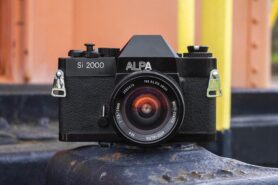
The Alpa Si 2000 is a 35mm SLR made by Chinon Industries between 1977 and 1979 for the Swiss company Pignons S.A., which normally produced high-end, hand-built Alpa cameras. Facing rising costs of competing with increasingly electronic Japanese SLRs, Pignons outsourced this budget-friendly model, basing it on the Chinon CE II Memotron. The Si 2000 kept the Chinon's internals but added a die-cast aluminum top plate for durability, spring-loaded strap lugs, an exposure compensation switch instead of a button, and dropped the FP flash sync port. It used the M42 screw mount and came standard with a 55mm f/1.4 or 50mm f/1.7 Macro Alpa-branded lens, with several other Auto Alpa lenses available from 28mm to 135mm. It featured a silicon-based (SPD) center-weighted TTL meter, aperture-priority AE, a vertically traveling metal focal-plane shutter to 1/2000 sec, and retailed in 1977 for around $563–$579.50. It was succeeded in 1980 by the Si 3000 (based on the Chinon CE-4), which switched to the Pentax K mount, creating a confusing third lens mount within the Alpa lineup.
The author acquired the camera somewhat backwards, finding a rare 24mm f/2.5 Alpa M42 lens first and later hunting for a year to find a matching body for about $70. Handling it side by side with the Chinon CE II Memotron, the Alpa felt slightly more solid despite weighing almost the same. The review spends significant time explaining Chinon/Alpa's method of coupling automatic aperture stop-down to the shutter release itself, which allows aperture-priority AE with virtually any M42 automatic lens without extra buttons, at the cost of an unusually long shutter release throw. Testing the camera on Mackinac Island with Fuji 400 color film and the 24mm lens, the author found the lens remarkably sharp and largely free of vignetting or distortion, and enjoyed the camera's ease of use and generous depth of field, which made focusing almost unnecessary.
Overall, the author found the Si 2000 unexpectedly enjoyable to shoot, calling it possibly the most fun he's had with any Alpa, since it behaves more like a straightforward Japanese point-and-shoot than a quirky traditional Alpa—one reason it's reportedly disliked by hardcore Alpa collectors. The main drawback noted is the long shutter release travel, which could be more troublesome with telephoto lenses. The verdict is enthusiastic: the Si 2000, like the Chinon it's based on, is considered one of the best M42 cameras made, thanks to its excellent balance of broad lens compatibility and simple, reliable aperture-priority AE performance—effectively a joint endorsement for both the Alpa and its Chinon counterpart.
AI-generated summary. May not capture every detail — read the full article below for the complete picture.
This is an Alpa Si 2000, a 35mm Single Lens Reflex camera made by Chinon Industries Inc. between the years 1977 and 1979 for the Swiss manufacturer Pignons S.A. as a cost effective alternative to that company’s high end hand built Alpa cameras. The Alpa Si 2000 is based off the Chinon Memotron CE II but has a couple of changes including a die cast aluminum top plate which was said to be more durable and able to protect the camera’s sensitive electronics better, spring loaded slide on strap lugs, an exposure compensation switch compared to a button on the Chinon, the removal of the FP flash sync port, and a few other cosmetic differences. In addition to changes to the camera, the Si 2000 came standard with a 55mm f/1.4 Alpa branded Chinon lens. The Si 2000 was succeeded by the Si 3000, also made by Chinon and represented the only time that Alpa cameras were outsourced to another company.

Film Type: 135 (35mm)
Lens: 24mm f/2.5 Auto-Alpa Multi-Coated 10-elements in 9-groups
Lens Mount: M42 Thread Mount
Focus: 10 inches / 0.25 meters to Infinity
Viewfinder: Fixed SLR Pentaprism, 92% Field of View
Shutter: Vertically Traveling Focal Plane Metal Blade
Speeds (Auto): 2 – 1/2000 seconds, step less
Speeds (Manual): B, X, 1 – 1/2000 seconds
Exposure Meter: (2x) Silicon Blue Cell Center Weighted TTL w/ Aperture Priority AE
Battery: 6v 4LR44 / 544 Silver Oxide Battery
Flash Mount: Hot shoe and M and X Flash Sync, 1/90 X-Sync
Weight: 1026 grams, 766 grams (body only)
Manual: https://cameramanuals.org/alpa/alpa_si_2000.pdf
In 1976, Pignons released an updated model in their Alpa 11 series called the Alpa 11si. The new letters in the model name ‘si” indicated a switch from CdS to a Silicon based exposure meter. Silicone photo diodes, or SPDs for short were much more responsive than the older CdS meters and could return a reading almost instantaneously. These new types of meters also used less power and allowed for a greater range of sensitivity.

The new Alpa 11si was introduced at Photokina in September 1976 to great fanfare. But in addition to this new model, Alpa also announced another new camera, an all new Japanese made camera called the Alpa Si 2000. Like the new 11si, the Si 2000 would feature a SPD meter, but it added an advanced vertically traveling focal plane shutter with top 1/2000 shutter speed, aperture priority automatic exposure, and support for a new number of M42 “Universal Mount” lenses. Alpa’s announcement of a Japanese made Alpa was certainly controversial as until then, Alpa cameras were the epitome of luxury, hand built precision devices made in Switzerland.

The problem with high end cameras is they always come with high end prices, and by the mid 1970s, with 35mm SLRs featuring increasingly electronic dependent cameras with advanced features, selling expensive mechanical SLRs was becoming more and more difficult for Pignons to do. Whether the Alpa Si 2000 was intended to be a stepping stone to more expensive Alpas is anyone’s guess but by having a less expensive camera featuring a prominent brand name certainly opened the door to more sales.
The Alpa Si 2000 is based off the Chinon CE II Memotron, but is not simply a rebadged camera as Pignons made a few changes to the camera. Most strikingly is that the Alpa has a unique diecast aluminum top plate. The plate’s material was changed because it was deemed to be better able to protect the camera’s sensitive electronics compared to the thin brass plate of the original camera. The Chinon’s standard strap lugs were also replaced with sliding latch lugs which were consistent with Alpa’s other cameras. An exposure lock button on the side of the Chinon’s mirror box was changed to a sliding switch which made it marginally easier to activate. Although the Chinon had PC ports for both FP and X flash sync, the Alpa omitted the FP port as it was deemed that not enough people would use it. The camera also has a variety of other minor cosmetic changes, but internally was the same.
The final change was that the Alpa would feature a couple of new M42 lenses developed specifically for the camera. Standard lenses were a 55mm f/1.4 Auto Alpa or a 50mm f/1.7 Macro Alpa. A total of five new Auto Alpa lenses ranging from 28mm to 135mm were also available, but the camera was compatible with nearly every M42 lens that was out there.

The Alpa Si 2000 was released in 1977 and carried retail prices of $579.50 for the camera with the f/1.7 Macro lens and $563 with the f/1.4 lens. These prices when adjusted for inflation compare to around $3100 and $3000 today, making them quite an investment, but they were roughly half of what the Swiss made Alpa 11si fetched. As with all cameras from this era, actual street prices were roughly 25% lower than retail.

It is not clear how successful the Alpa Si 2000 was, but a good hint is that in 1980, Alpa would release a follow up model, called the Si 3000, also based on a Chinon camera, but this time the CE-4. The CE-4 was a technically more advanced camera and came with an electronically timed Seiko shutter and also had aperture priority automatic exposure. It was physically smaller and used more weight saving materials, lowering its weight, but the biggest change was that it moved from the M42 screw mount to the Pentax K mount. While this was probably a step in the right direction for Chinon, it was a strange choice for Alpa. For the Si 2000 to have a different mount from every other Swiss made Alpa camera was one thing, but for anyone who might have bought into the Si 2000 and purchased a couple lenses, would have had to buy into yet another lens mount if they wanted to upgrade to the Si 3000. Sure adapters were made, but still, for there to now be three different Alpa lens mounts was almost certainly an unpopular decision.
I have no idea of how many Si 2000 and Si 3000s were sold. I can assume enough of the Si 2000s were sold for them to want to consider the Si 3000, but based on an unscientific eBay search of Si 2000 and Si 3000 models, I found more than 3 times as many Si 2000s as Si 3000s at least suggesting the later versions are harder to find.
Alpa would continue making their 11 series until at leas 1989, several years after the either of the Si models were sold suggesting that the Japanese Alpas didn’t have the sales boost that the company likely hoped for. I don’t consider myself an Alpa collector, nor even an enthusiast as I haven’t even liked all of the Alpas I’ve tried to use, but I do respect their history and legacy. Based on information you can find about the Si 2000 online, many Alpa collectors have turned their backs on the Si cameras, not considering them real cameras. While they certainly are “real” cameras, I can see their point as they were a curious experiment, with a design unlike any other model the company had made and it used two dead end (for Alpa) lens mounts.
I came across this Alpa Si 2000 through a strange series of coincidences. The first part of my Si 2000 journey came as a result of Kurt Ingham’s collection where I went through two storage units of cameras. Somewhere while digging through his collection, I came across a box of miscellaneous camera parts. There were flashes, adapters, caps, straps and some lenses in there. As I dug through the box, a black screw mount lens caught my eye. I didn’t recognize the lens, but noticed it had a very strong goldish hue to the front lens group. I looked farther and noticed it was a 24mm f/2.5 Alpa lens. A screw mount Alpa, I thought? Having researched Chinon cameras before, I remembered that there was once a screw mount Alpa. I took the lens home and did some research and read up on the two Si models. Having the lens, but not a body is not a good combination for someone with camera GAS and if you’ve made it this far into this article, you probably know what happened next. I can’t have a lens without a body!

So my search began for an Alpa Si 2000 body. Working in my favor is that I only needed a body, and body only cameras are usually much cheaper than those with lenses, and while that was true, this is still an Alpa camera, so I was struggling to find a body in nice enough condition at a price I was comfortable with. It would actually take me a year of searching until I found this nice body for around $70 and I picked it up!
I have previously reviewed the Chinon CE II Memotron which this camera is based off and while that was a well made and sturdy camera, somehow, the Alpa felt even more solid. Perhaps the unique die cast top plate adds rigidity to the camera, or maybe it was a placebo effect because, you know….it is an Alpa! In attempt to be scientific, I weighed the bodies of both the Chinon CE II Memotron and Alpa Si 2000 with no lens, film, or battery and the Alpa came in at 756 grams, a mere 8 grams heavier than the Chinon.
Since the Alpa Si 2000 is so similar to the Chinon CE II Memotron, a camera I’ve previously reviewed, I won’t spend as much time covering its features, but I do want to bring up one thing, which is how the shutter release works on this camera, more specifically, how long you need to press it for.

When Chinon created the first Memotron camera, it was their first attempt at Automatic Exposure on a screw mount camera. In the early 1970s, a variety of companies including Asahi Pentax, Yashica, and Ricoh were also coming out with AE M42 SLRs. Auto exposure on a screw mount by itself isn’t an issue, but the combination of AE and having an automatic diaphragm is. You see, in order for an exposure meter located inside of a camera to accurately set either the shutter speeds or lens aperture to give an accurate exposure, it has to know how much light is going to pass through a lens and expose the film.

When using a lens with an automatic diaphragm, which by the 1970s was pretty much all of them, the diaphragm is always wide open until the exact moment of exposure. For an SLR to be able to predict the amount of light that will hit the lens, it needs to know what the chosen f/stop is on a lens before it calculates the exposure. This requires some kind of communication between the body and lens. Early AE systems used a mechanical linkage like the “bunny ears” on Nikon F mount lenses, or the mechanical pins inside of a Canon FL/FD mount lens. Later lenses switched to electronic communication via pins that are inside of the lens mount. This is easy to do on cameras with a bayonet mount because the lens firmly attaches to the body in a very precise way, every single time.

With a screw mount lens, there is a little bit of wiggle room in how tight the lens can be mounted to the camera. Plus, not all M42 cameras mount their lenses in the same orientation. For there to be a mechanical linkage between an M42 lens and an M42 body with AE, the meter needs to know EXACTLY what f/stop you’ve chosen, and any variance in how the lens is mounted to the body, will throw off the exposure. Although I am talking about AE M42 cameras, this same challenge exists with any M42 camera with open aperture metering.
How each of the different companies tackled this problem varied wildly, some required you to manually stop down, before the metering system could be activated. This was a simple workaround that worked with every single M42 ever made, but has the side effect of darkening the viewfinder as you are reducing the amount of light that the lens will allow to pass through the viewfinder. In the case of the Yashica Electro AX, they combined the act of stopping down the lens with the film advance. With the camera not advanced, the aperture was wide open, and the metering system was off. As soon as you advanced the film and cocked the shutter, the lens would automatically stop down and activate the meter, but it would darken the viewfinder. If you wanted to brighten the viewfinder with the camera to your eye, you could momentarily press a button to open it back up again, but the metering system was now off again. Once again, an advantage to this is that the Electro AX offers AE on pretty much every M42 lens out there.

Other companies like Asahi Pentax, Fuji, and Ricoh revised the M42 mount adding a post or some kind of divot that when the lens was screwed on all the way, would lock it into a very specific position. These cameras usually had a lens release button like bayonet lenses did, which required you to press it to remove the lens since it was locked into position. This eliminated the need to manually stop down the lens before pressing the shutter release as the body always knew exactly what the position of the aperture lever was, however because this system only worked with new lenses specifically designed for these models, it meant that you could not use just any M42 lens and meter open. Each of these models usually offered the ability to still manually stop down the diaphragm to maintain compatibility with older lenses, but it brings back the problem of both adding an additional step and also darkening the viewfinder.

Chinon, and therefore Alpa, took the approach of requiring you to manually stop down the lens before making the exposure, but instead of coupling it to a button on the camera or the film advance like in the Yashica Electro AX, they coupled it to the physical shutter release. This means that the shutter release button performs both the functions of first stopping down the lens and then firing the shutter. In theory, this worked well, except it required that the shutter release have a really long throw. The amount of distance you have to press down on the shutter release button is longer than on any other SLR out there. It also means that there is no way to preview the correct exposure (through LEDs or a needle) without having to partially press the shutter release.

In practice, this actually works well most of the time. Since the Chinon and Alpa Si 2000 use aperture priority, as long as you are shooting in light that is within the range of shutter speeds the camera offers for whatever f/stop you’ve chosen, the camera is probably going to get a proper exposure. If you accidentally leave the lens at f/1.8 and try to shoot ISO 1600 speed film in bright sunlight, however, you’re going to have problems, but hopefully you have enough common sense to not allow that to happen.

Comparing Chinon and Alpa’s methods to all of the other solutions, in my opinion, this was the best compromise as it works with most M42 lenses, as long as it has the automatic aperture pin. You don’t have to fumble around with a dedicated stop down button or lever, and most of the time, you can shoot the camera without thinking too much about what the meter is doing. Just set the lens to an f/stop close to what you think makes the most sense, and let the camera decide everything else.

Although I like this method, I won’t go as far as to declare it better than anyone elses, because by the time these companies were coming up with these systems, the M42 lens mount was already on borrowed time. By the mid 1970s, most companies had already switched over to bayonet mounts which didn’t need any workarounds, and for those who didn’t, they were about to.
The Chinon CE II Memotron and Alpa Si 2000 do have some differences, but none of them would have a dramatic impact in regular use of the camera. I’ve previously covered in my review of the Memotron how the camera works, so rather than retype all that here, you can just check out that review (or the Alpa Si 2000 manual linked above) for more specifics.
When it came the Alpa Si 2000’s turn in the queue to get some film loaded into it, I had a trip planned to Mackinac Island in northern Michigan. It was going to be a warm spring day, so I loaded in some fresh Fuji 400 color film and crossed my fingers that the sun would actually be out to capture the beautiful foliage that dominates the island this time of year.


Earlier in this article, I explain that I came across the Alpa 24mm f/2.5 lens first and had to acquire a body second, which is a bit backwards for how most people acquire SLRs. Usually you’d find these cameras with some kind of “nifty fifty” kit lens and then upgrade later with some kind of cool wide or telephoto lens. But to start with a 24mm lens isn’t the typical order for how these things go, but with an affinity for wide angle lenses, it added to the appeal of using this camera. While 24mm isn’t anything special on a modern digital camera, for film cameras, it is wide!

This isn’t any ordinary wide angle lens, it took Chinon, or whoever they contacted to build the lens, a total of 10 elements in 9 groups for this formula to work, and the results are impressive. With even some of the best wide angle lenses, vignetting, sharpness fall off, and various types of barrel or pincushion distortion are common, yet looking at the sample images, little to none of these anomalies are present. If I stare at images with the sky, maybe I can see a very tiny loss of brightness in the corners, and if I pixel peek the corners of images with fine detail such as tree leaves, I guess I can see some imperfections, but when looking at images outside of a lab, as they were intended, boy do they hold up. While it might have been more of an accurate “test” to shoot the Alpa Si 2000 with a kit 50mm lens, shooting it with this 24mm lens was FAR more interesting.
The Alpa’s viewfinder is very good and I have no doubt that with a fast 50mm lens, the focusing screen would be as bright as any contemporary SLR of the era, but with the 24mm wide angle lens, having such extreme depth of field, I didn’t need much brightness to compose my images. With the exception of my mirror selfie, every other image in the gallery above was taken without any care for focus. I set the focus ring to somewhere slightly below infinity, framed my image and then pressed the shutter release.

I’ve already detailed the differences between the Alpa and the Chinon it was based on, but there are far more differences between the Si 2000 and every other Alpa that came before it. Even if you knew nothing of the history of Alpa or Chinon, that these cameras were not made by the same people is very obvious. The Alpa Si 2000 is clearly a Japanese camera. Not only in its looks but its function. Where Alpas are well known for their quirks and unique features which require a refresher of the user manual before picking up, the Si 2000 is a camera that can be picked up and shot without any previous experience.
This is both good and bad. Good in the sense that this camera can be used to make good images pretty quickly, but that it lacks any of the DNA or uniqueness of the entire Alpa brand is likely why most Alpa users and collectors shunned the camera. The Alpa has a microprism circle in the center of the viewfinder, but it is not necessary for casual shooting. Combined with the excellent Auto Exposure system and the extreme depth of field afforded by the lens, this camera/lens combination resulted in an extremely good point and shoot camera.

Shooting the Alpa Si 2000 with this lens was a joy. In fact, I might go as far as to say its the most fun I’ve ever had shooting an Alpa camera, as I haven’t always enjoyed the experience with “real” Alpas. I shot the entire test roll in Automatic mode and kept the lens aperture at something appropriate for outdoor scenes. By far, the biggest nitpick of the camera is the long throw of the shutter release, which I explained above why this is, but it is something that in some instances can get in the way. I suspect that it might be more of an issue with a telephoto lens where body shake is more of a concern, as holding the camera as steady as possible while trying to move the shutter release such a long distance might cause some anxiety, but for my uses, it wasn’t an issue.

I suppose if I wanted to be extremely thorough, I could find any number of 50mm M42 lenses I have in my collection and take the Alpa Si 2000 for another spin, but I don’t think I’ll do that. The 24mm Alpa lens is a perfect match for this camera both in looks and performance, and I doubt I’ll ever separate the two. I thoroughly enjoyed shooting the camera and I loved the images I got from it, so I won’t mess with a winning formula.
The Alpa Si 2000, like the Chinon CE II Memotron it is based on, is one of the best M42 cameras ever made. Chinon’s implementation of AE with screw mount lenses has the best balance of compatibility and performance. That you can get Aperture Priority AE from pretty much any Automatic M42 lens ever made is a huge selling point, and that it works without any extra buttons or switches is icing on the cake. I realize that most people reading this article aren’t likely to run out and buy this Alpa, but consider this a secondary endorsement for the Chinon it is based off as it will perform identically. Whether you choose the Alpa or the Chinon, both cameras are winners!
Related Posts You Might Enjoy
External Links
https://camera-wiki.org/wiki/Alpa_Si_2000
https://kosmofoto.com/2025/05/m42-camera-guide-alpa-si-2000/
https://www.cambridgeincolour.com/forums/thread16651.htm
https://www.youtube.com/watch?v=N2Q1qEf2ues (in Italian, use English subtitles)
Praktica found a unique way (for the time) of providing full open metering on an m42 lens mount camera. Outside the lens mounting screw, but on the lens mount, are three long contacts. The lenses used with the cameras have 3 button contacts on their back. This allows a set of resistors in the lens to indicate the aperture setting to the meter. Praktica introduced this in the LLC, in 1969, and it was fitted to other of their higher spec. cameras, like the VLC. I bought an LLC, new, in 1973.
I’ve reviewed the VLC3 previously and you’re right, it is one of many options companies came up with to improve communication between camera and lens using the M42 mount, but it still requires special lenses. Without those electrical contacts, the camera is not capable of AE.
I believe that Alpa 24mm lens was part of a run of lenses that Tamron made for Chinon. May have also been sold as Tamron “F” System. The conical styling was an interesting touch.