
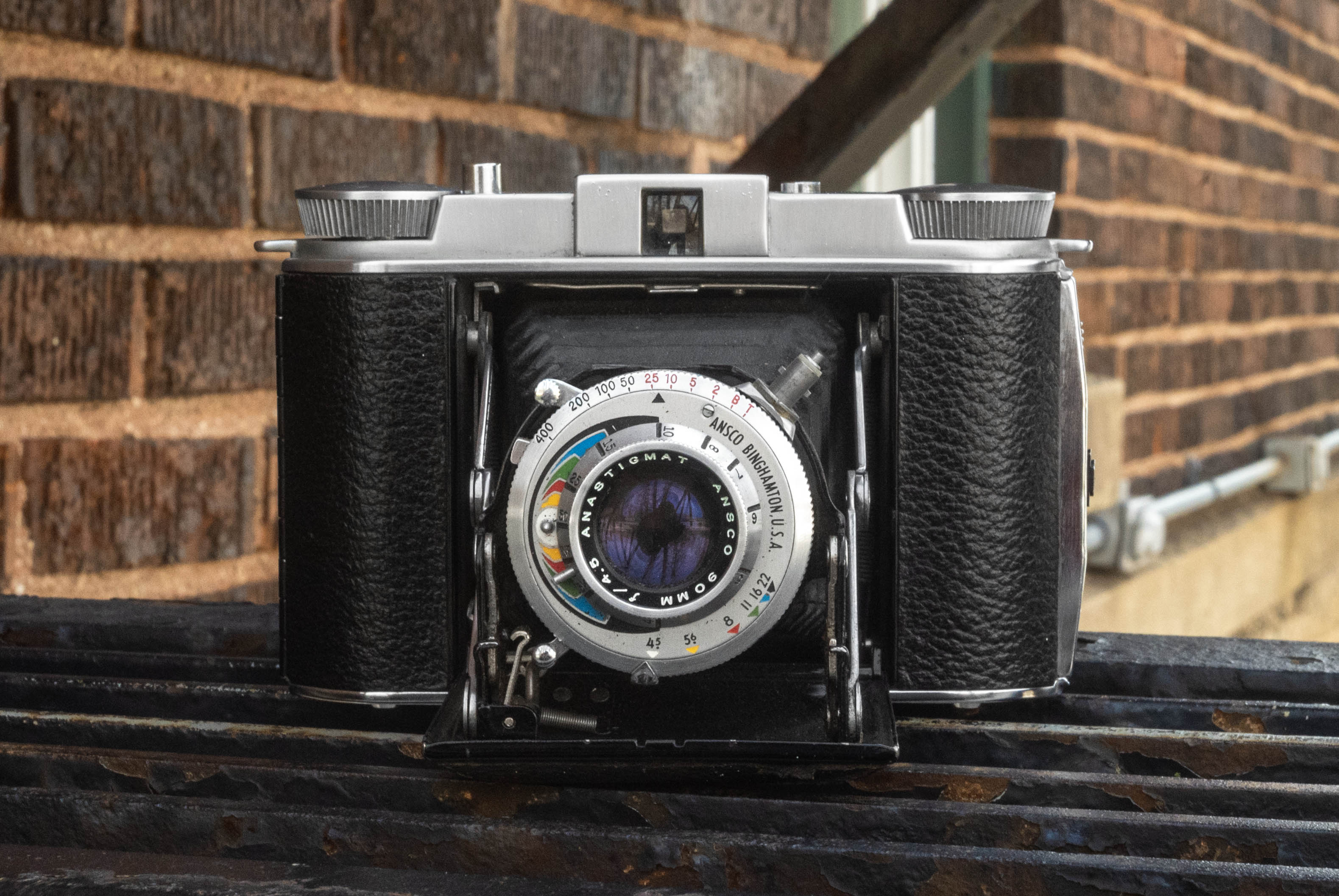
This is an ANSCO Titan, a folding medium format camera made by ANSCO of Binghamton, New York starting in 1948. The ANSCO Titan was an upmarket version of the ANSCO Speedex, featuring an all metal body, an upgraded lens, upgraded flash synchronized shutter with top 1/400 speed, and a unique color coded zone focusing system not available on the company’s other cameras. Despite its upmarket features, the ANSCO Titan was still a simple camera, but carried a high price tag which limited its appeal.
 Film Type: 120 Roll Film (twelve 6cm x 6cm exposures per roll)
Lens: 90mm f/4.5 ANSCO Anastigmat coated 3-elements in 3-groups
Focus: 3.5 feet to Infinity
Viewfinder: Scale Focus Optical Finder
Shutter: ANSCO Leaf
Speeds: T, B, 1/2 – 1/400 seconds
Exposure Meter: None
Battery: None
Flash Mount: ASA Flashbulb Sync Port
Weight: 624 grams
Manual: https://www.cameramanuals.org/agfa_ansco/ansco_titan_20.pdf
 The existence of the ANSCO Titan is a result of a specific set of circumstances that only occurred during a short window of time following World War II. Prior to the war, Germany was the undisputed king of camera and optical design. Everything from prescription eye glasses to military use binoculars and scopes to photographic cameras were either built by, or inspired by German optical companies. Zeiss, Voigtländer, Leitz, and Franke & Heidecke made the best and most sought after products.
With Germany’s defeat in World War II, large portions of Germany’s manufacturing capabilities were destroyed or heavily damaged, their economy was in ruins, and pressures through foreign tariffs and other penalties levied upon German goods meant that acquiring new cameras and lenses after the war was either impossible or extremely expensive.
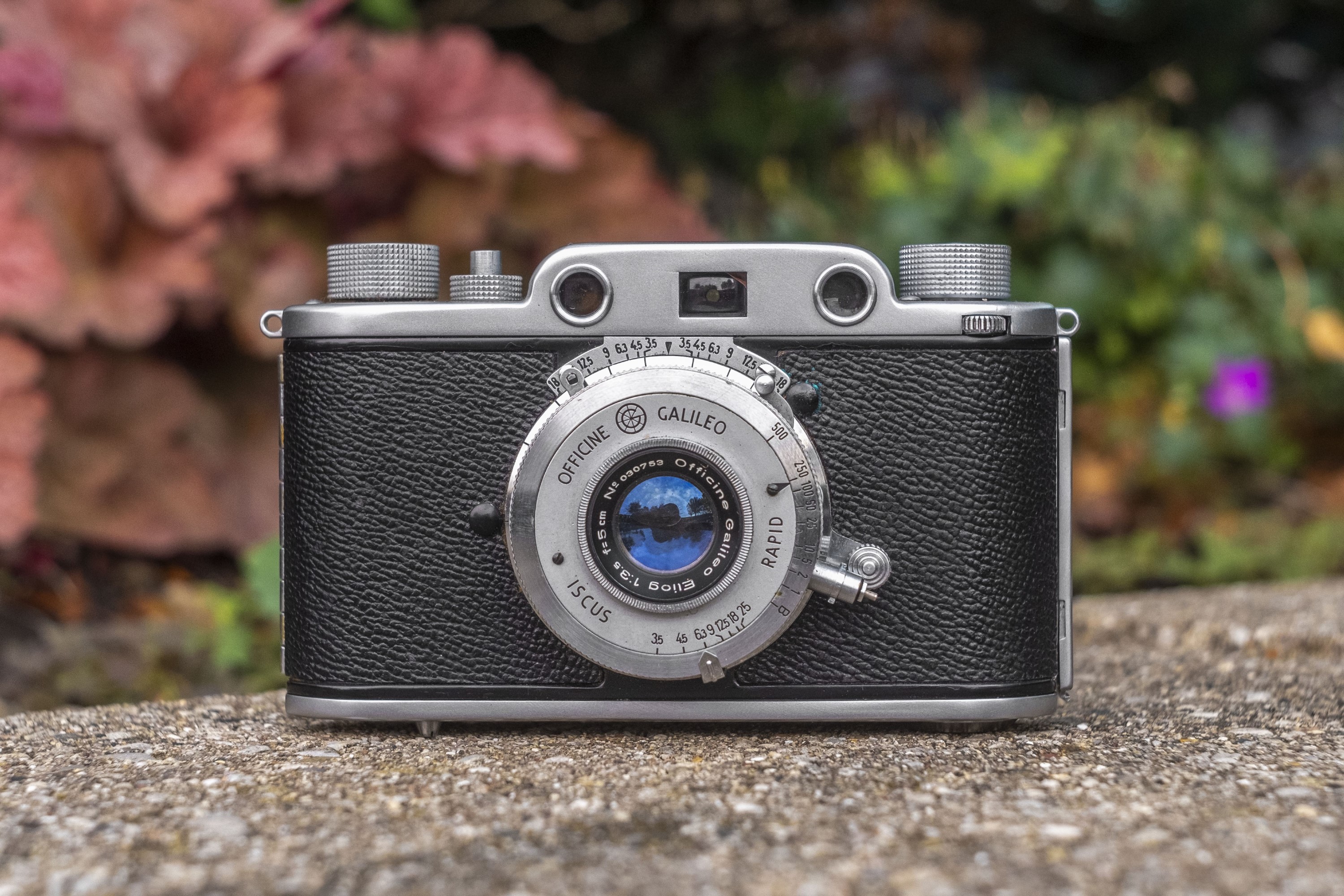
With only a few exceptions, Germany didn’t have much of a camera industry through the end of the 1940s. A lack of new products was felt all over the world and in an effort to fill the void, a large number of new companies setup shop in countries like Italy, France, Japan, and the United States. Companies who previously built motorcycles, medical equipment, and celluloid film tried their hand at making cameras.
Many of these companies produced simple and inexpensive cameras, but some like Eastman Kodak and ANSCO who already had experience making photographic products, moved their newest models up market. Kodak released models like the Medalist, Chevron, and Ektra, for ANSCO, the company attempted to fill the void of 6×6 Twin Lens Reflexes and folding cameras by releasing to “upgraded” cameras, the ANSCO Automatic Reflex and the ANSCO Titan. The ANSCO Automatic Reflex was an ambitious TLR with the best lens and shutter the company could find. The build quality approached that of the Rolleiflex and other German TLRs, but because it was built in the USA, cost significantly less than trying to import new old stock products from Germany.
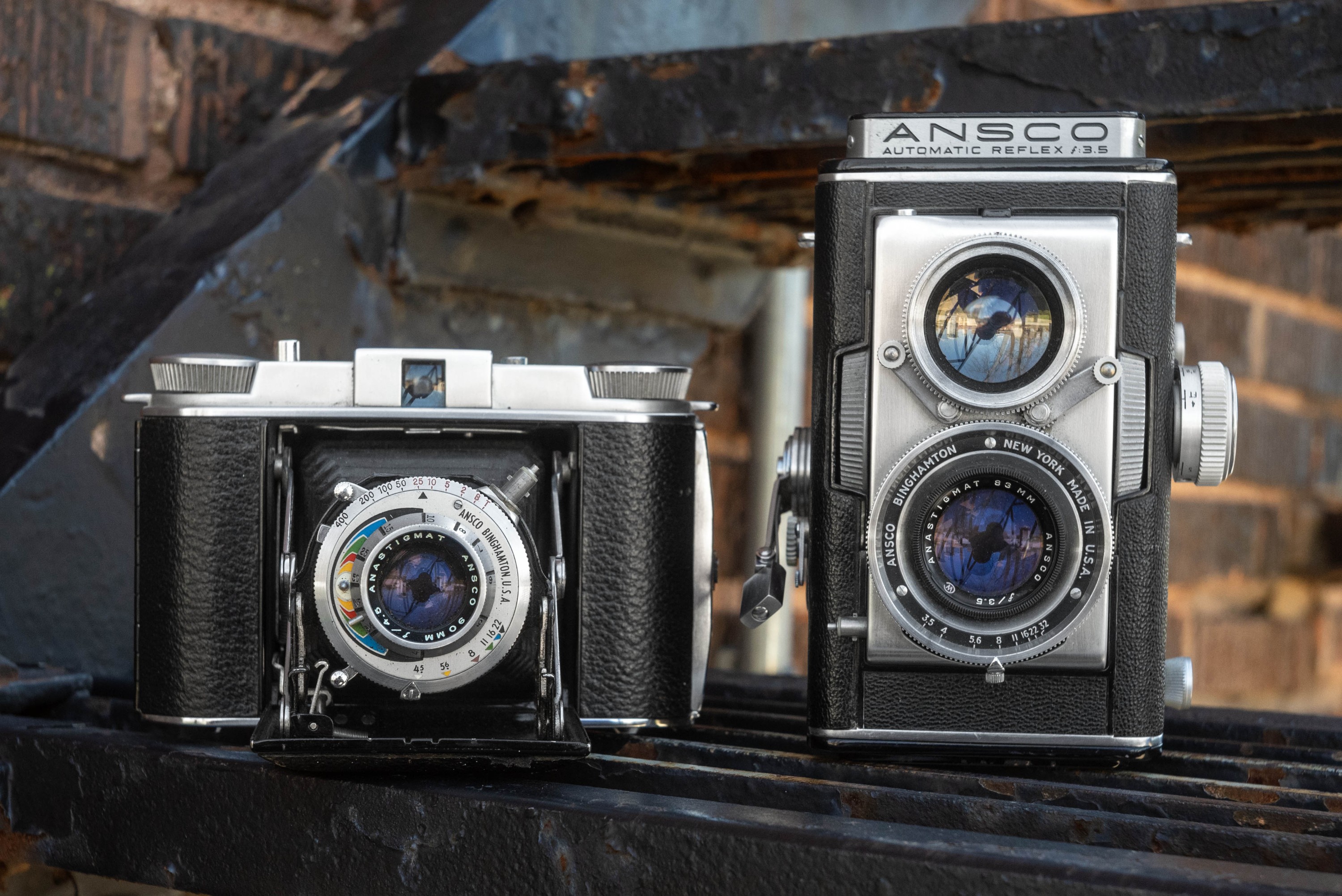
While the ANSCO Automatic Reflex was an all new design which wasn’t based off any previous model, the ANSCO was heavily based on the company’s prewar ANSCO Speedex. Upgrades to the new camera were an all new brushed metal top plate, genuine leather body covering, an upgraded lens, flash synchronized shutter, and a clever color coded focusing scale which was thought to make guess focusing easier for the user.
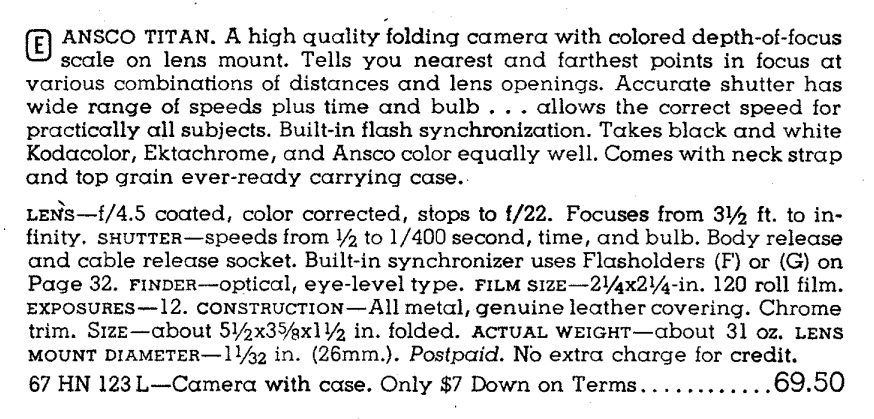
For the privilege of owning this “premium” American folding camera, ANSCO charged a premium price. According to the 1948 Montgomery Ward catalog, the initial offering for the ANSCO Titan was $96.86 which when adjusted for inflation, compares to just under $1300 today. This was an astounding amount of money to ask for a camera which wasn’t a whole lot different than other simple 6×6 cameras which at the time sold for one third to one half the price. Realizing their ambitious pricing, the 1949 Montgomery Ward catalog shows the Titan at a reduced price of $69.50 which has an inflation adjusted price of about $950…still high, but better.
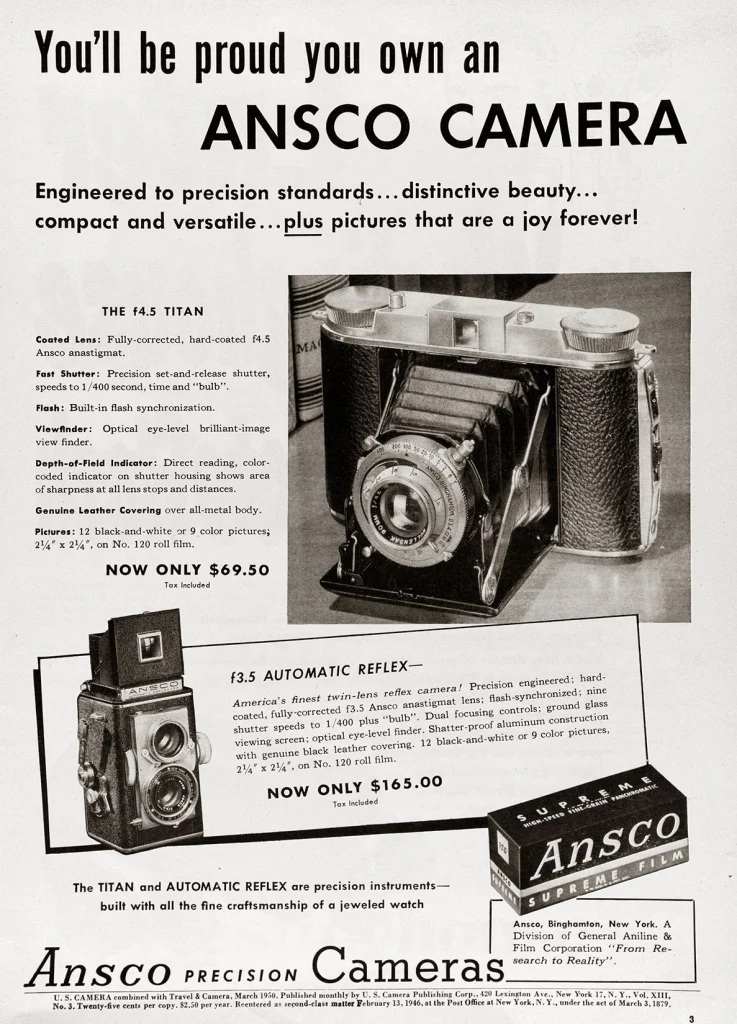
If you were a photographer who demanded a compact medium format camera that could fit in your pocket with a premium build quality and good lens, the ANSCO Titan was your only option.
Unfortunately for ANSCO, both the Titan and the Automatic Reflex TLR suffered similar fates as within 2 years of both camera’s releases, many German factories resumed production and international governments eased sanctions on German build goods, making high end Zeiss folders and Rolleiflex TLRs available again and due to a lack of a premium brand perception and a feature set, which was underwhelming, any demand that existed for the ANSCO Titan vanished. I found no information about how long the camera was made or how many were built, but based on how few show up for sale on eBay and other auction sites, my best guess is ‘not long, and not many’.
Still, the ANSCO Titan is a good looking camera with some worthwhile upgrades to the simple Speedex models the company was known for, and when found in good condition, should be capable of decent images, so for anyone looking for a less known model made by an American company during a very short period of time when the United States made premium cameras, it is an interesting addition to any collection.
The addition of the ANSCO Titan to my collection was a sort of full circle moment. Back in the earliest days of this site in early 2015, I picked up an ANSCO B2 Commander, a blinged up version of a folding ANSCO Speedex camera. That B2 Commander was an introduction to folding 6×6 cameras and also was one of my earliest repair successes as the shutter was so simple on that camera, I was able to open it up, clean it, and get it back together in working order before shooting it. I remember the first time I saw the results from the camera and was blown away at what medium format could do, especially on such a simple camera.
For this review, I dug out that old ANSCO B2 Commander to reflect not only upon the differences between the two cameras, but how my collection has evolved from 2015 to today.
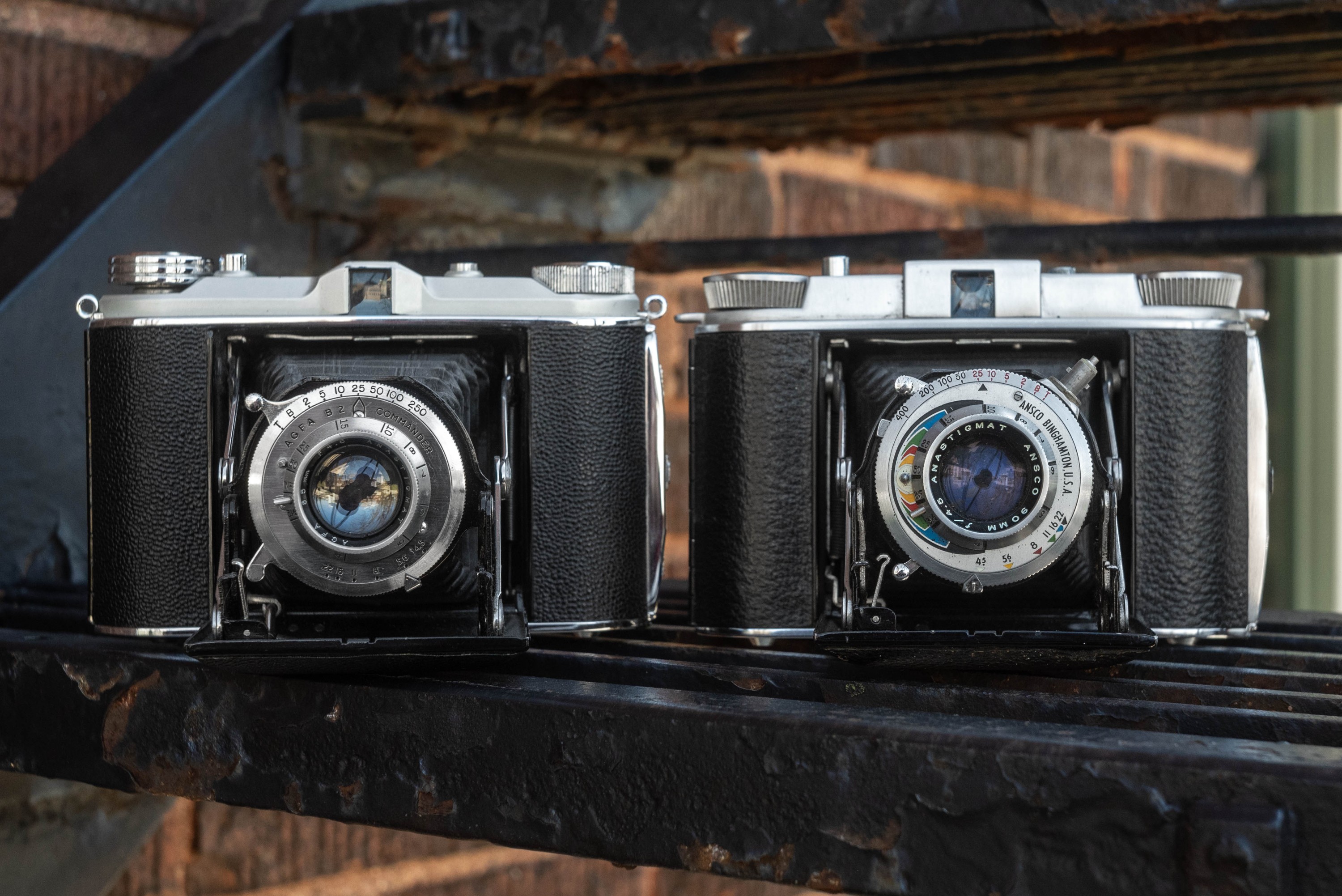
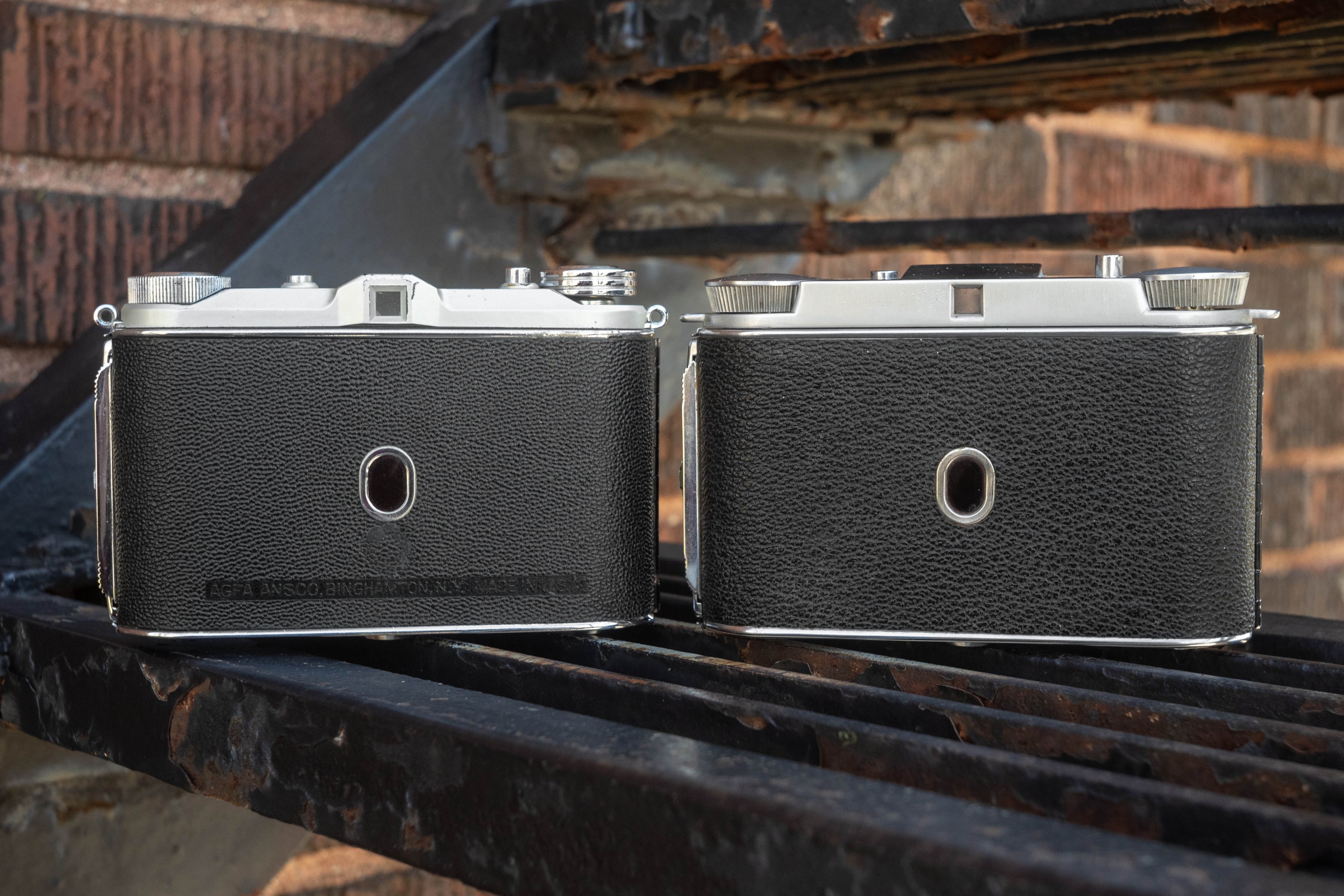
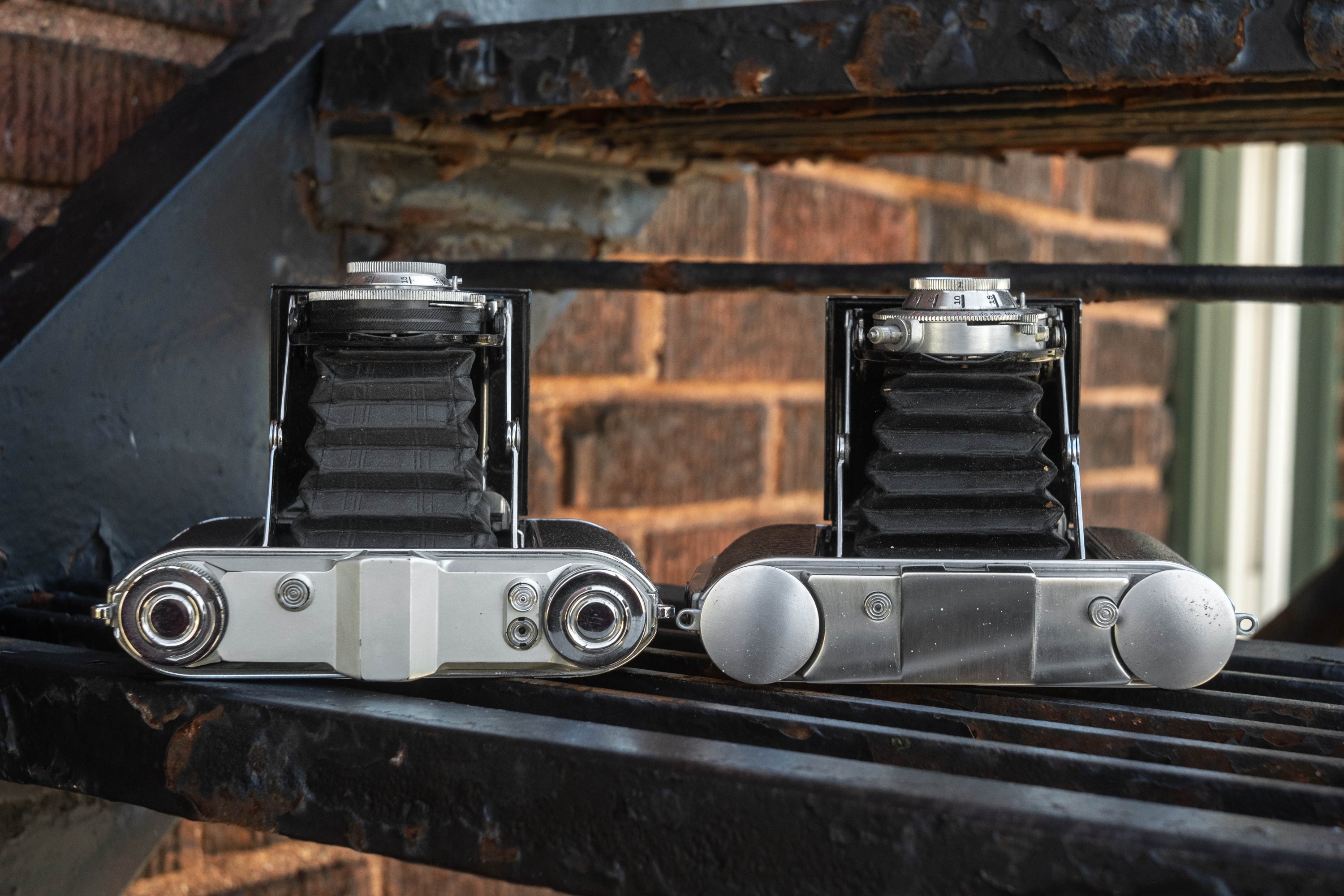
The ANSCO Titan isn’t exactly the same as that B2 Commander, but they both share similar form factors, specifications, and of course were both made in Binghamton by ANSCO. I had been aware of the Titan for quite some time, but even in the United States, they are difficult to come by, especially in good working order. This generation of camera is almost always in poor condition with rotted bellows, scratched lenses, and non functioning shutters.
By far, the biggest difference is in the construction and weight of the two. Where the B2 Commander has a plastic top plate and other weight saving materials, the Titan is entirely metal. At a weight of 624 grams, I was surprised to see that it wasn’t a whole lot heavier than the 596 gram weight of the B2 Commander, but in the hand just feels like a more stout camera. The Titan’s build quality is good with a brushed metal top plate and knobs, and it has a real leather body covering compared to the lesser ANSCO which has a sort of plasticky synthetic covering.
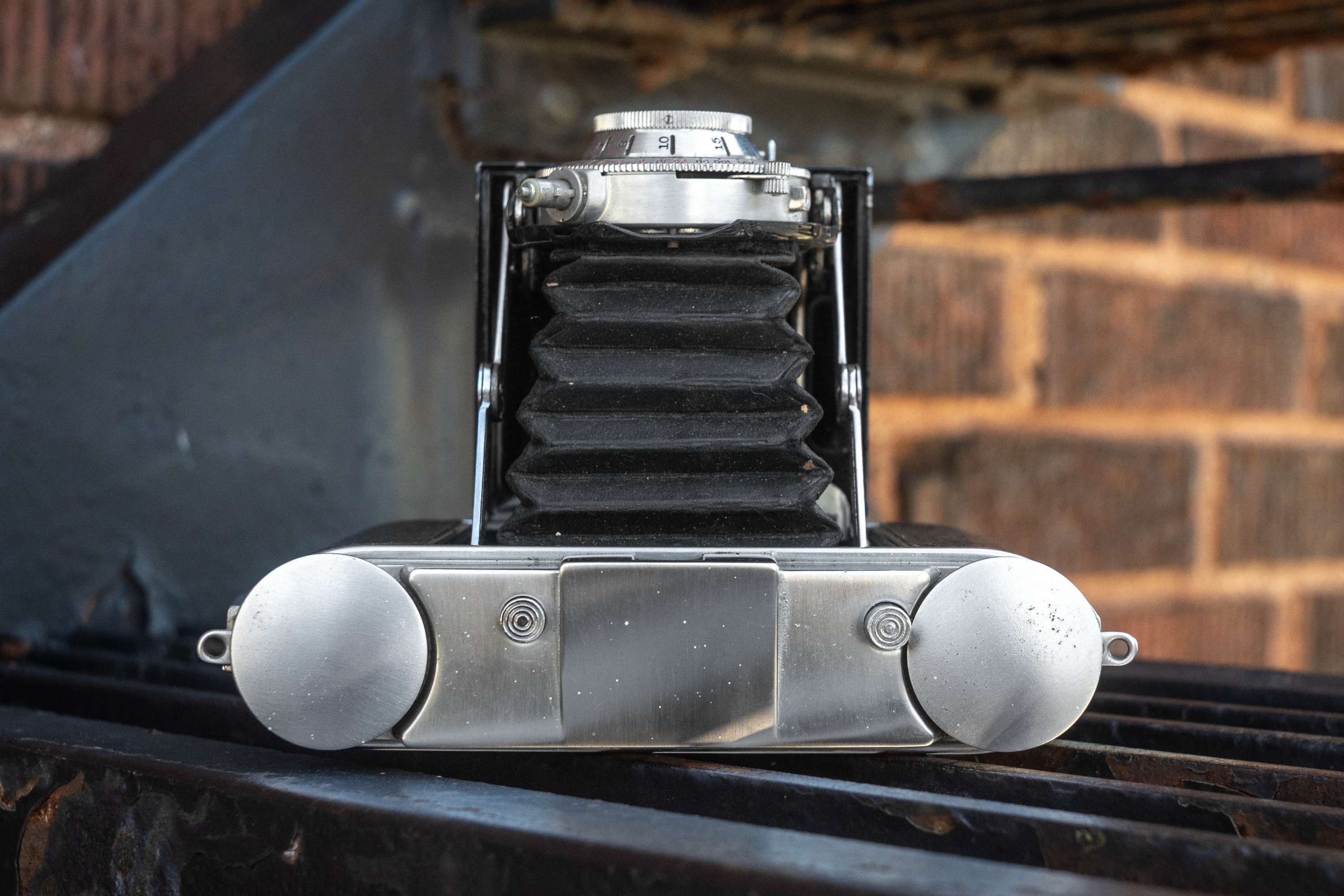
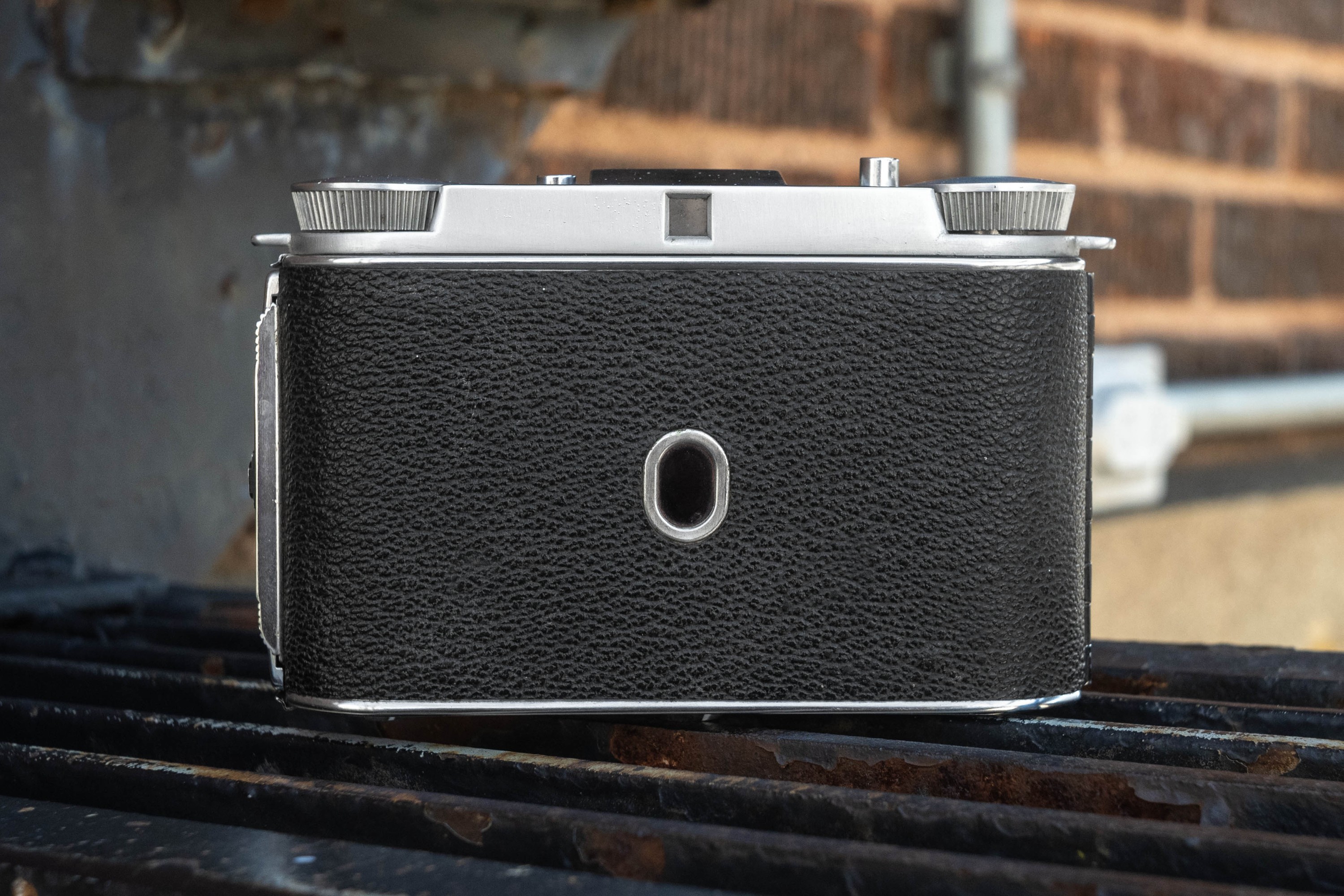
Up top, the brushed metal plate has no writing on it which gives it a very clean look. Very large and symmetrical knobs appear on both sides of the top plate. The presence of two knobs on a roll film camera is interesting since you cannot rewind medium format film. The left knob is used for film advance, but the right knob serves no purpose other than being able to be pulled up to make removing the supply spool in the film compartment, easier. In addition to the two knobs a small round button to the left of the viewfinder is the door release for opening the front of the camera, and the slightly taller button on the right is the shutter release.
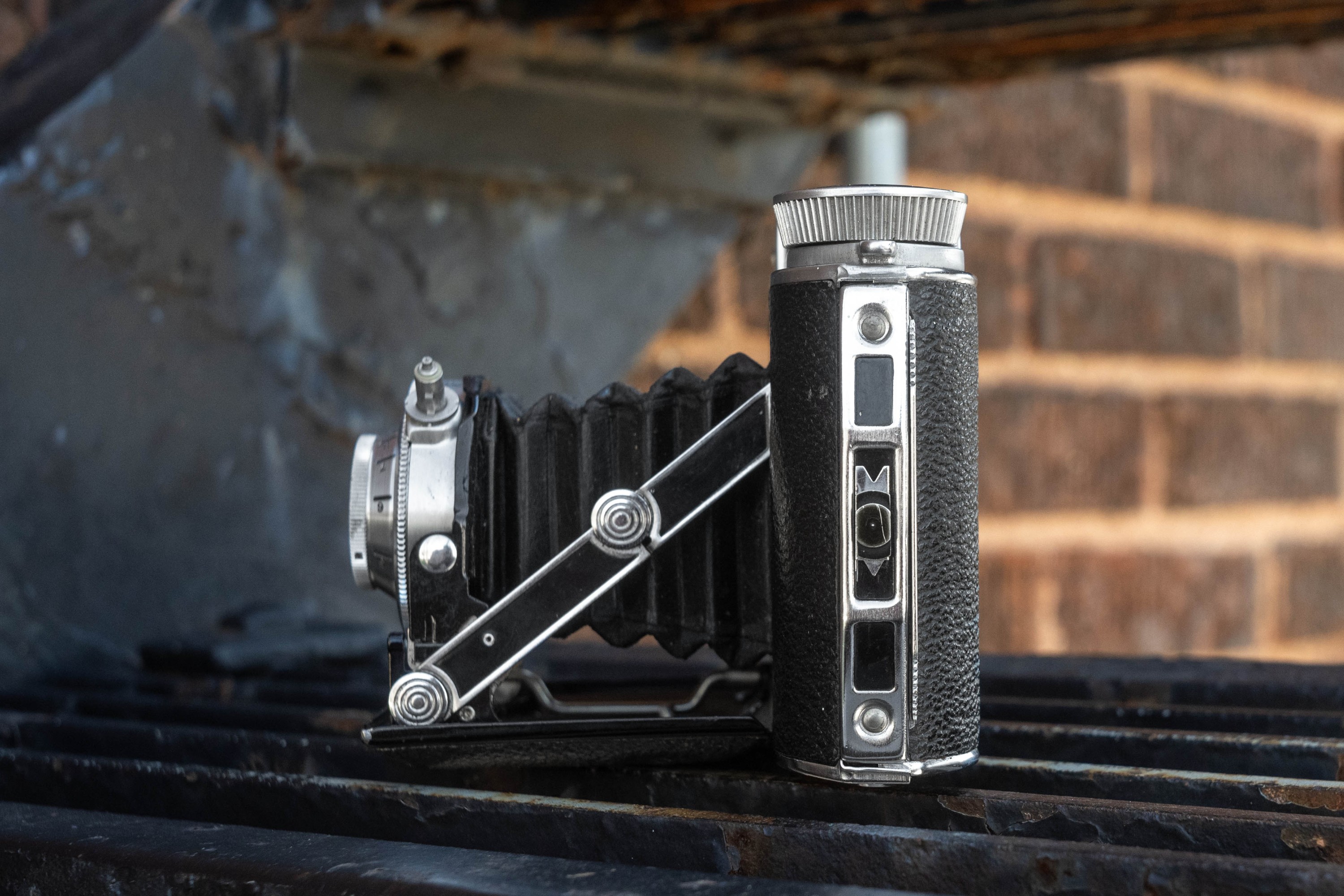
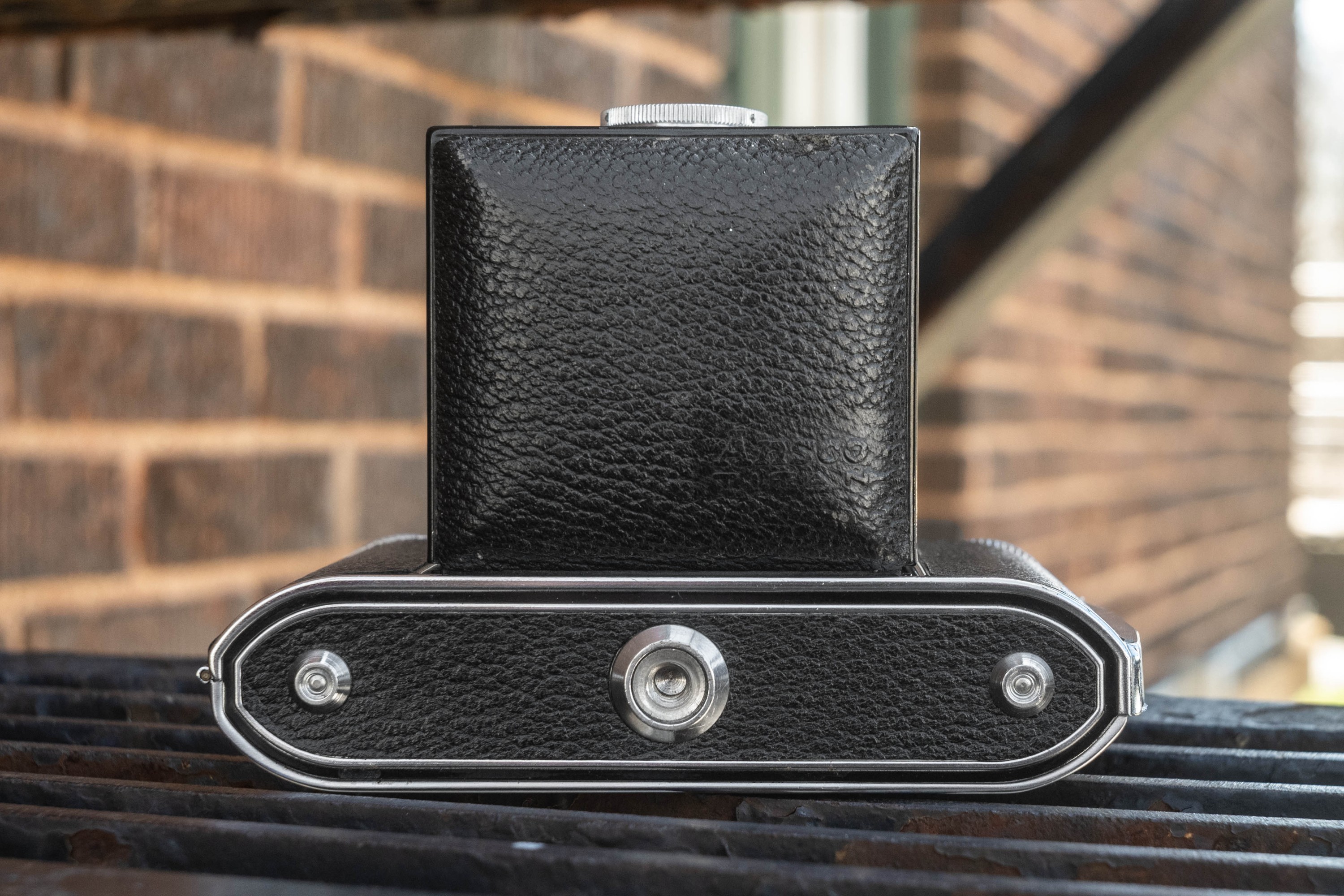
The back, bottom, and sides of the camera have little to see other than a 1/4″ tripod socket on the back, an oval red window on the back for reading exposure numbers on the film backing paper and metal strap loops on each side for a neck strap. The film door release on the left side of the camera, using an arrow shaped slider which releases the lock. Unlike the AGFA B2 Commander, which has embossed writing in the body covering telling you it was made by ANSCO in Binghamton, the Titan has no such embossment.
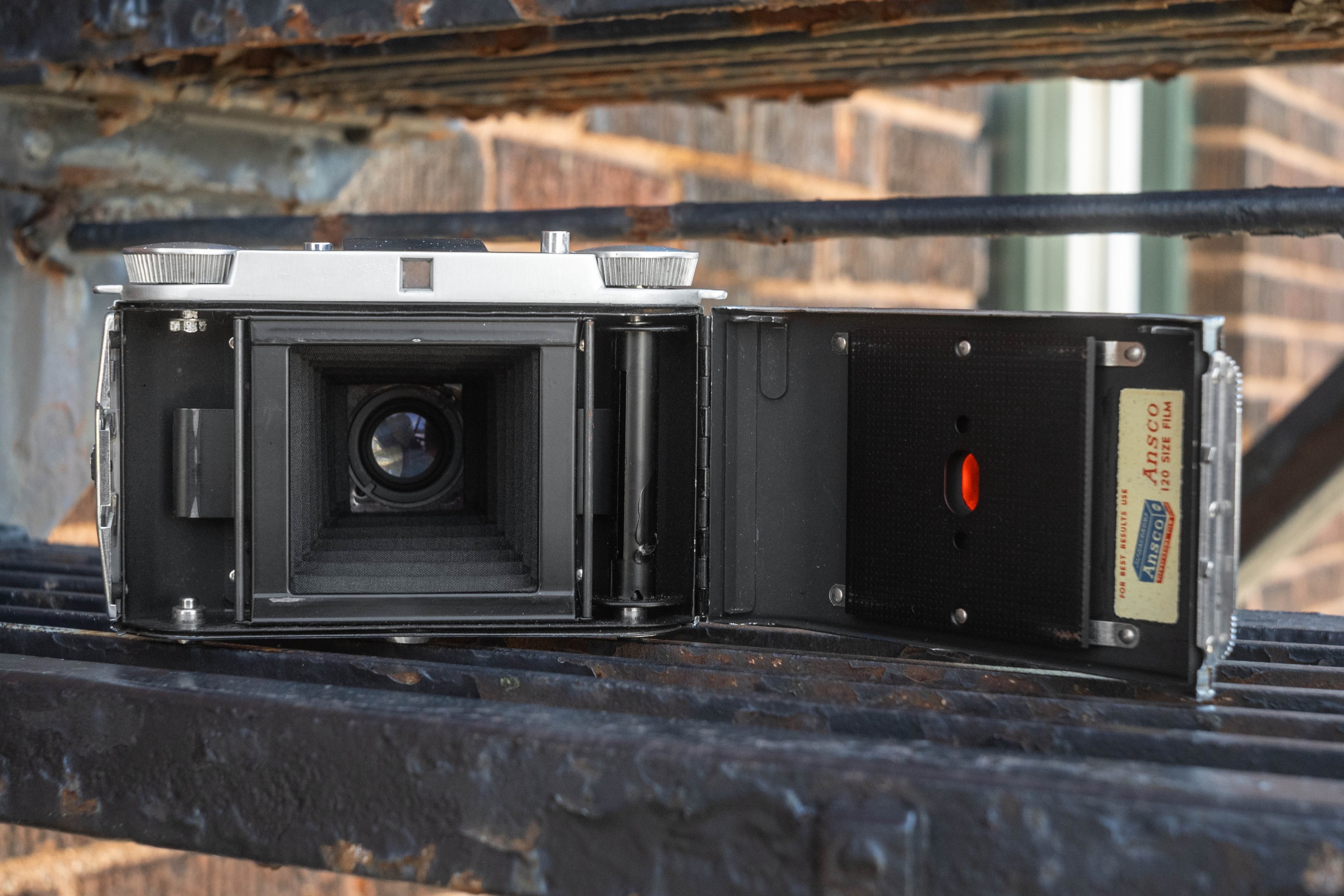
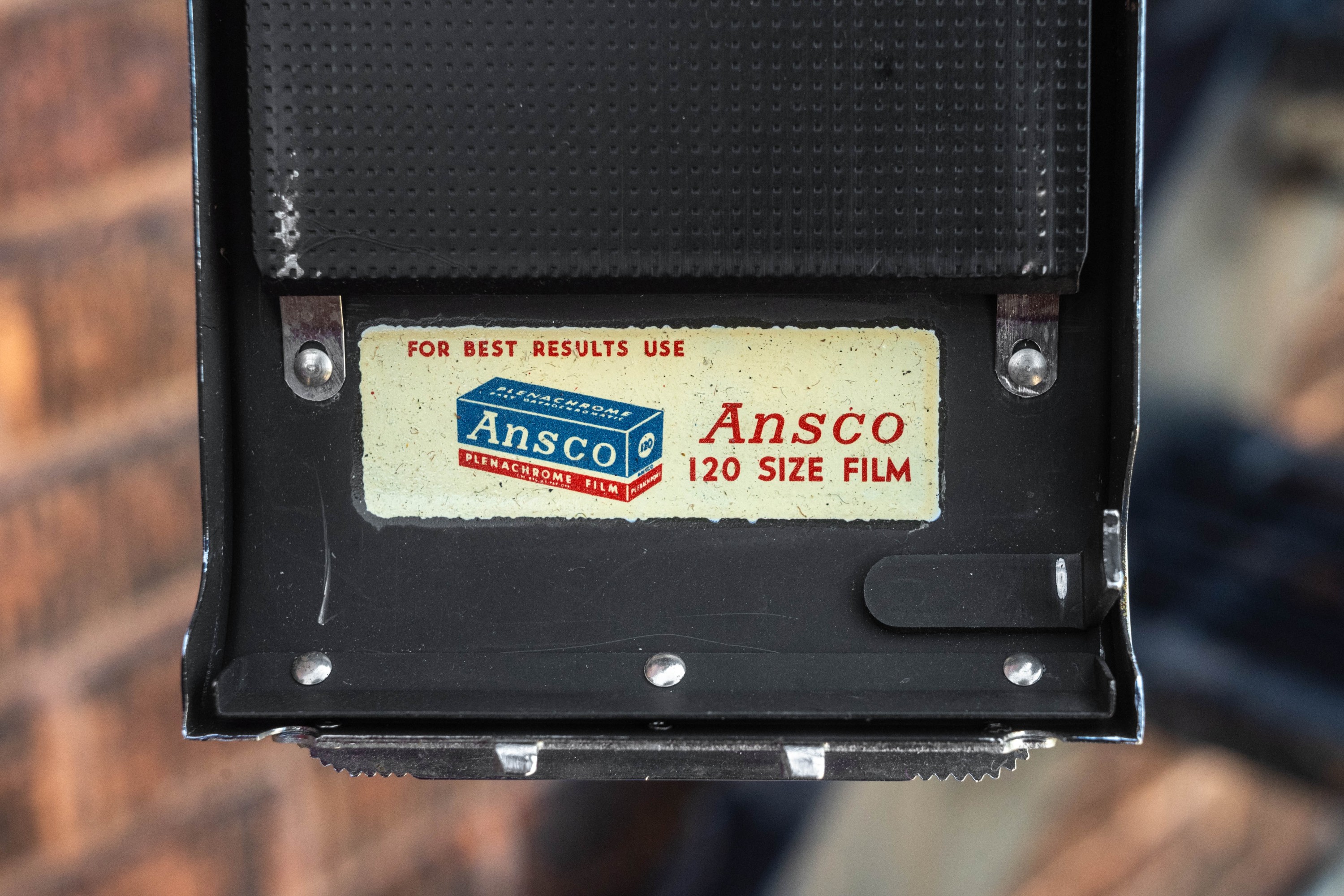
After sliding the film door lock down, the right hinged rear door swings open to reveal an ordinary roll film compartment. Unlike many other 6×6 folding cameras of the era, the ANSCO Titan doesn’t have swing out spool holders or the option to use a mask to shoot smaller images. Film transports from right to left onto standard 120 spools. Inside the door is black metal film pressure plate covered in divots to reduce friction as film passes over it. Next to the plate is a sticker reminding you to use Ansco 120 size film.
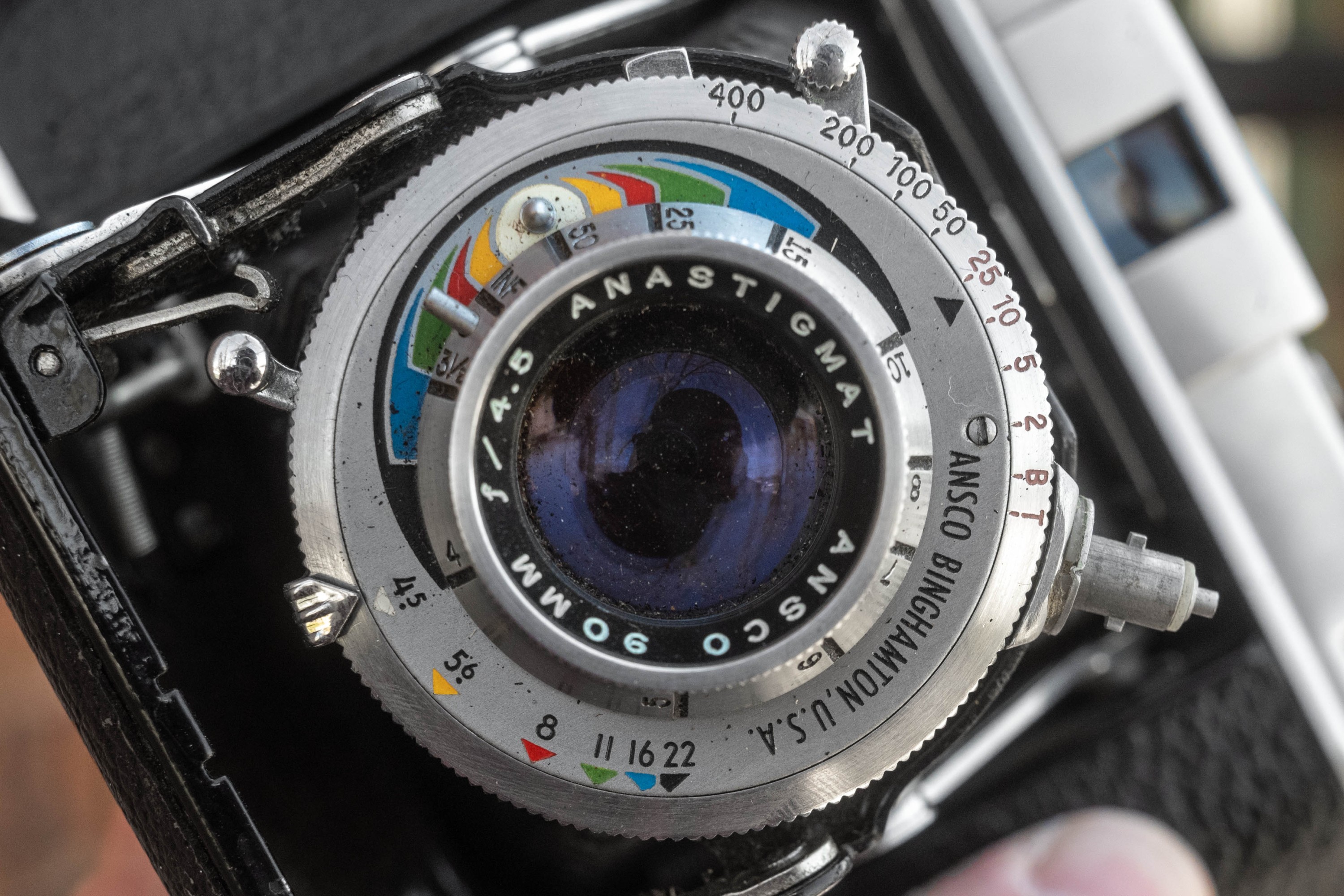
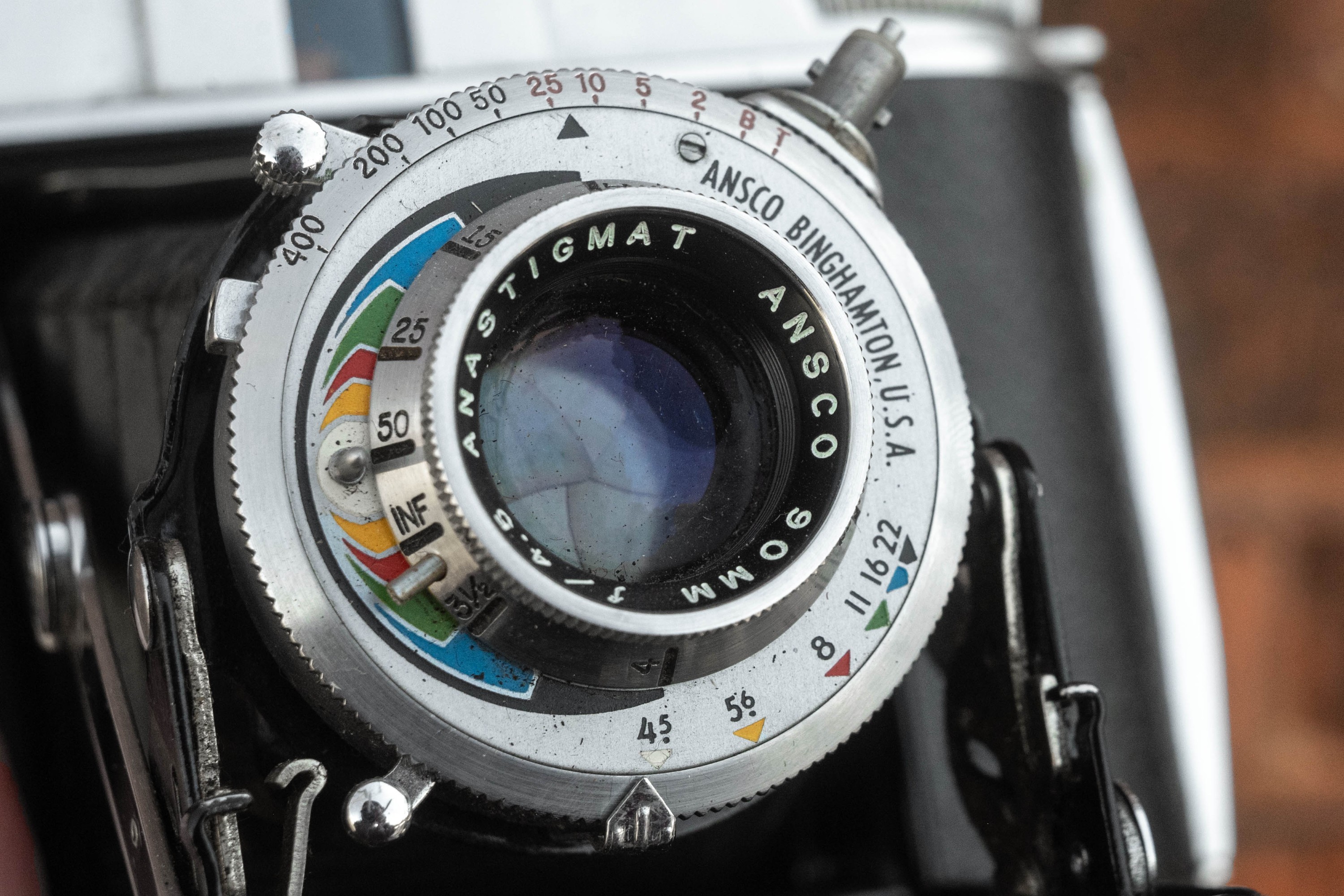
Up front the shutter resembles a German rim set Compur or Prontor, but isn’t labeled by whoever made it. Typically, many American cameras featured Wollensak shutters, but I am not certain of who made this one. Shutter speeds from 1/2 to 1/400 plus B and T are selectable, but are in a backwards order from the typical German shutter. Near the 11 o’clock position around the shutter is the cocking lever, which is not coupled to the film transport, so must be cocked before every shot. The ANSCO Titan lacks double exposure prevention, so you can keep cocking and firing the shutter as many times as you like. Below the cocking lever is a threaded hole for a cable release which would come in handy when using either the T or B modes. Near the 1 o’clock position around the shutter is the ASA flash sync port. The Titan’s user manual only offers flash settings for flashbulbs, so it is unlikely to work correctly with electronic flashes.
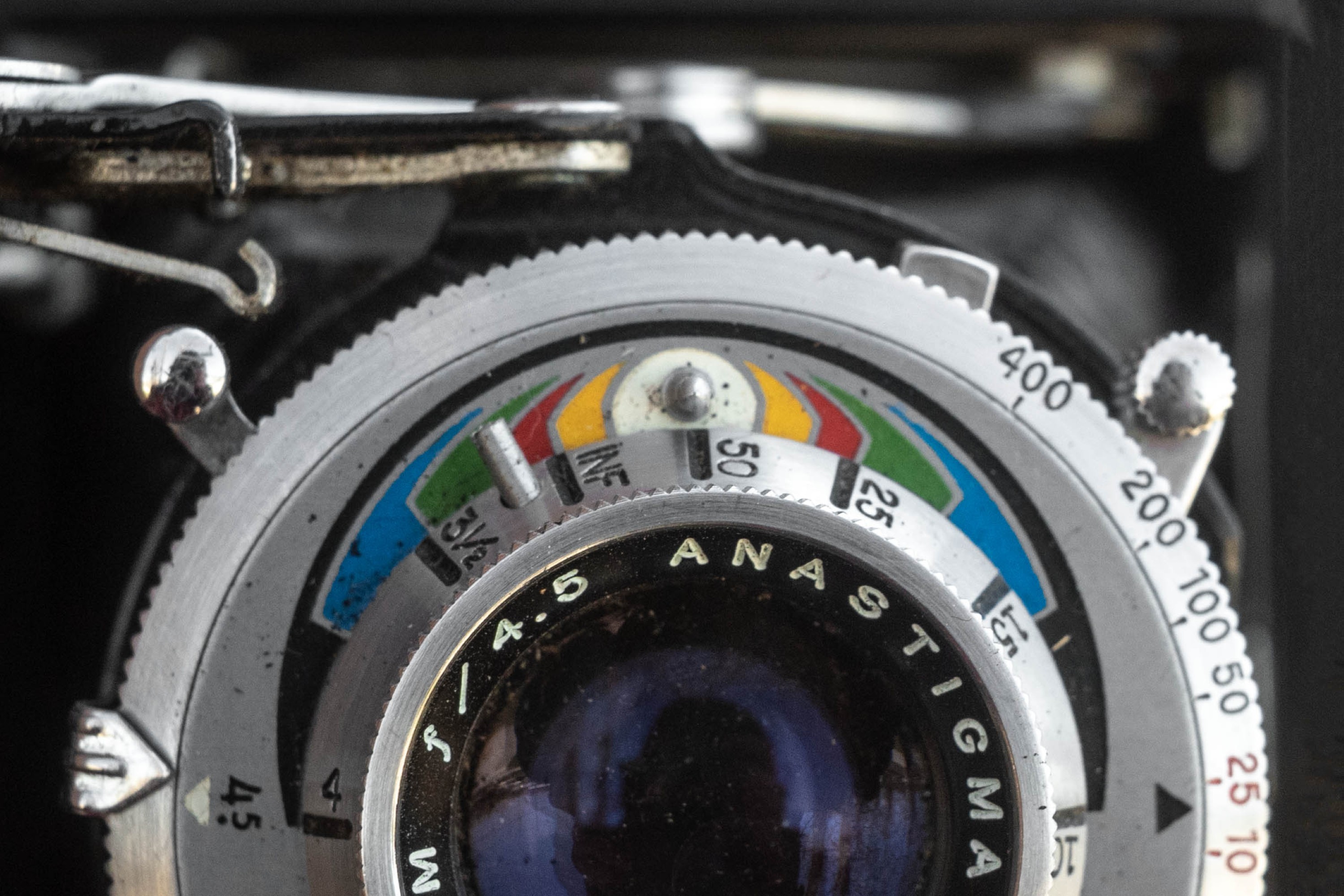
An interesting feature of the ANSCO Titan is what the company called multi-colored zone focusing. This is done using a color coded depth of field scale which matches an equivalent color arrow next to f/stops of f/4.5 through f/22 printed on the face of the shutter. How it works is that by choosing an equivalent f/stop, you’d match the color next to the f/stop with marks on the depth of field scale. Although it sounds neat and looks pretty, this is really just how Depth of Field scales work. With any given f/stop, a range of focus distances will be of acceptable sharpness. ANSCO just found a way to make it more colorful, but it is really no different than on any other camera.

The viewfinder is a straight through optical square with no frame lines or any indicator of exposure. The finder isn’t large, but is big enough that I was able to see all four edges of the viewfinder while wearing prescription glasses.
After handling the ANSCO Titan, it was clear this was an upmarket version of simpler ANSCO folding cameras, but after reflecting on the upgrades, I couldn’t help but feel underwhelmed. Upgrades including a brushed metal top plate, leather body covering, some colorful paint on the depth of field scale, and a flashbulb only synced shutter won’t really excite too many people. But something that has been proven on this site over and over again is that a camera is often more than the sum of its parts. Maybe the ANSCO Titan is not much different from a simple ANSCO Speedex, but that could all change after shooting it. Maybe something about the design of the camera or the 90mm ANSCO Anastigmat would point to a massively superior camera. The only way I would find out would be to load in some film, so that’s what I did!
For my test roll through the Titan, I shot a slightly expired roll of Kentmere 400. The time in which I was shooting the camera was very overcast and I had intended on taking the camera to a night baseball game at Wrigley Field in Chicago, so I thought that the faster speed film would suit where I would be shooting the camera.


You’d think I would have learned my lesson. After shooting countless cameras for the purposes of a review, how I can still manage to go through a whole roll of film on a folding camera without checking the bellows for light leaks is something I’ll never understand. Sometimes you can skip a thorough “functionality” check before testing a camera and get away with it, but that’s not what happened here as my test roll was riddles with light leaks, streaks, and whole sections of images blown out from direct light hitting the emulsion while loaded in the camera. Amazingly, not every image was ruined, and in some cases, the light leaks added a cool effect to the photos, but overall, my test roll was a disappointment.
Having less and less time lately to test cameras, I decided that even with the compromised images, my experience actually shooting the camera, combined with what I could see in the images, I decided to forego a second roll and just get this review out.
I can see that the Wollensak lens performed well. Sharpness wasn’t through the roof, but I didn’t expect that from the early post war Wollensak triplet. The deep blue coating likely would have done a good job with color accuracy had I shot color film, but on the black and while Kentmere, it did fine. In mages where corners were visible, I noticed a normal amount of softness but surprisingly very little vignetting, suggesting that on a perfectly working example, the Ansco Titan would have been a capable shooter whose images would have likely pleased original owners of these cameras, but probably not been up to the standard of a top tier Zeiss Super Ikonta or Voigtländer Bessa 6×6.
In use, the ANSCO Titan works like many other cameras of its era. For those familiar with mid century folding cameras with leaf shutters, that you have to manually cock the shutter before pressing the shutter release is business as usual, but for the uninitiated, it may seem archaic and slow. In addition, the camera lacks a rangefinder or any sort of focus aide which means you have to either use an auxiliary device or rely on zone focusing and that can make the camera even more unappealing to the beginner, but these were all just how things worked back then. For me, the experience of shooting the Titan was good, with the camera feeling sturdy in my hands and I had no issues with any of the control locations or operation.
Although the ANSCO Titan is an uncommon camera, that it’s not much different from other simple 6×6 folding cameras of the era is a reminder that you don’t need to spend a lot of money to get into medium format. I often hear of people who are new to film that say they want to try medium format but find the prices of Hasselblads and Mamiya 6s too expensive, but for me, I think cameras like the ANSCO Titan or Speedex offer you 90% the quality and experience at 10% the cost. If you are one of these people wanting to see what photography on larger negatives (or positives) look like, you’re not missing out on too much by using a camera like this (assuming it doesn’t have light leaks).
As for the Titan itself, this was a camera positioned as a premium American alternative to expensive German folders whose supply was interrupted in the aftermath of World War II. Along with the Titan was the very nice and very good ANSCO Automatic Reflex 3.5 TLR which did an adequate job of filling the void left by cameras like the Rolleiflex, but the same can’t be said about the Titan.
Yes, the brushed metal top plate looks very nice, the camera has a sturdy all metal build, and the lens does a decent job of making good images, but the upgrades over the company’s existing Speedex line and other inexpensive 6×6 folders leaves a bit to be desired. For a premium 6×6 camera, features like a rangefinder, a faster f/3.5 or even f/2.8 lens would have been nice, as would dual film format capabilities or perhaps even an automatic frame counter. But that didn’t happen, and we’re left with nothing more than a blinged out camera with a colorful shutter.
Related Posts You Might Enjoy
External Links
https://camera-wiki.org/wiki/Ansco_Titan
https://www.35mmc.com/15/09/2025/ansco-titan-a-stylish-6×6-120-folder/
https://18cameras18months.blogspot.com/2017/09/ansco-titan-20.html