
This is an Argus CC, a 35mm scale focus camera made by Argus in Ann Arbor, Michigan, USA between the years 1940 and 1942. The name “CC” is short for “Color Camera” and was named as such as it was designed specifically to shoot Kodak’s new Kodachrome color slide film. The Argus CC is an upgraded Argus A3 with a removable uncoupled selenium exposure meter on the top plate. Both the Argus A3 and CC were marketed at the same time and have so many similarities that they share the same instruction manual. Both the Argus CC and A3 have a die case aluminum metal body, which is unlike the company’s other A and C-series cameras that were largely made of Bakelite. It features a four speed leaf shutter and an f/4 Argus Anastigmat lens but little else.

Film Type: 135 (35mm)
Lens: 50mm f/4 Argus Anastigmat coated 3-elements in 2-groups
Focus: 1.25 feet to Infinity
Viewfinder: Scale Focus Optical Viewfinder
Shutter: Argus Ilex Leaf
Speeds: T, B, 1/25 – 1/150 seconds
Exposure Meter: Uncoupled Selenium Cell w/ top plate Argus Light System Display
Battery: None
Flash Mount: None
Weight: 658 grams
Manual: https://www.pacificrimcamera.com/rl/02456/02456.pdf
Based in Ann Arbor, MI, Argus was founded in 1931 as the International Radio Corporation. Back then, IRC made a variety of different radios, some of which had pioneering designs. IRC’s products included the Kadette which was the first mass produced radio to run on both AC and DC electricity. Although it looked to be made of wood, it was actually built using Bakelite plastic which reduced both its cost and weight. The Kadette sold extremely well and allowed IRC to release other Kadette products like the Kadette Jr, which was the world’s first pocket radio, and the Kadette Clockette which was one of the world’s first clock radios.
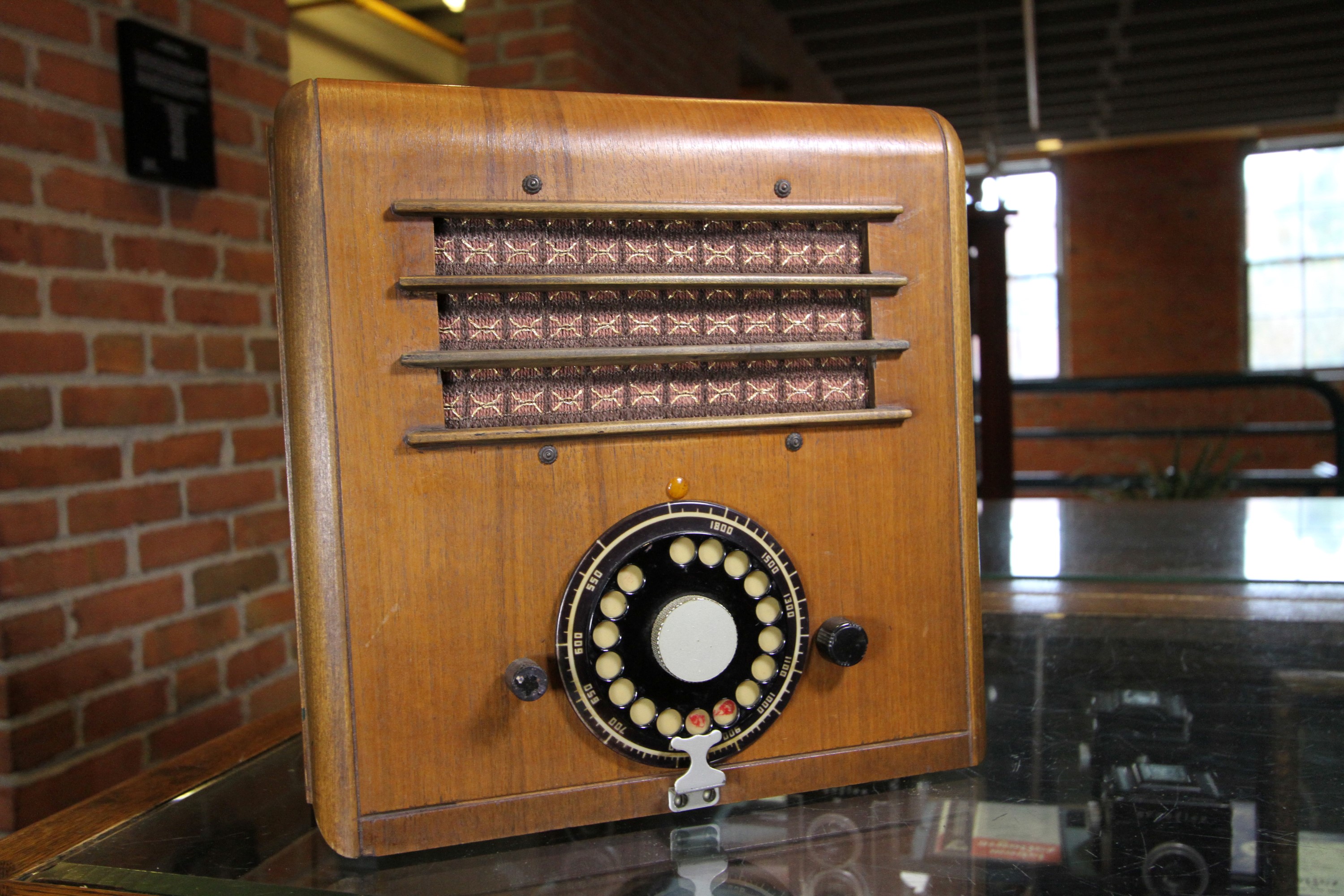
By the mid 1930s, IRC’s radio business was so successful in that it was the only company in Ann Arbor which could pay dividends to its share holders during the Great Depression. Nearby Detroit was heavily hit by the recession, so in the entire state of Michigan, IRC was one of the few financial bright spots.
As the depression dragged on and with increased competition from other radio manufacturers who were able to make similarly inexpensive radios, the company saw the need to diversify its product offerings.
Utilizing the company’s success with Bakelite and electronics, the company released the Argus Model A camera in 1936 to immediate success. Like its radio division, the Argus Model A utilized Bakelite in its construction and it was affordable enough to compete in a price range that didn’t have a lot of competition. The price of the Argus A was $10 (some sites say $12.50) which meant it could be afforded by the average lower to middle class family.
The Model A was very popular and quickly spawned several variants, some with more capable shutters and others with exposure meters. Although the design of all A-series variants were very similar, the specs were slightly different between them all. None of the Argus A-series cameras had the model number visible on the outside of the camera, however the model number was a prefix or suffix of the serial number inside the film compartment on all models except the Model A.

In 1938, with radio sales continuing to stagnate, International Radio Corporation released the Argus C, a 35mm rangefinder camera with an all new body made of die cast metal and Bakelite. The Argus C would see several quick changes to its design, the first which upgraded the uncoupled rangefinder to a coupled design and the second adding flash contacts to the side of the camera. With both features, the camera was known as the Argus C3 and would go on to become the longest produced and one of the most successful American cameras of all time.

In 1940, as the company continued to look for new markets, they released two new cameras called the A3 and the CC (short for Color Camera) which were the first Argus cameras to be made entirely of metal without any use of Bakelite. More importantly, the A3 and CC cameras targeted the increasingly popular use of color side film. Both models would feature an exposure meter to help with the sometimes limited exposure latitude of slide film. The A3 used an older style extinction meter which was similar to those used on earlier A-series cameras, but the CC would come with a removable selenium exposure meter which was more accurate and offered a far wider range of exposure measurement.
The Argus A3 and CC were produced for only a very short time while a large part of the world was focused on the war in Europe, so the camera didn’t receive much attention in the press. In my research for this article, I was unable to find any sort of contemporary review or magazine article about the camera, and the only reference to it was this short text blurb below from the 1942 Peerless Camera Catalog in which the A3 and CC were both sold for $12.95 and $21.50 each. When adjusted for inflation, these prices compare to about $250 and $430 in 2026 dollars, respectively. Certainly not a high price, but probably a little more than the average American family was willing to spend while their country was at war.


During the war, a black enameled unmetered version of the A3 was offered as the “US Army Camera”. Images of this camera appeared in Argus’s 1942-43 annual report suggesting these were wartime production cameras. Exactly how many were made is unclear, as only two examples are known to exist, one of which is in the collection of Joe Horvat.
When camera production resumed after the war, neither the Argus A3 or CC were continued. Instead, a single prewar A2 model was retained along with the addition of a completely redesigned Argus A-Four in 1953.

I really thought I was done reviewing Argus cameras after I wrote a comprehensive five part article on their entire C-series, plus the non-C C-Series cameras like the Argus C33, Argus C4 Geiss, the Argus C44R and a few of their other rangefinder cameras like the Argus A-Four, the Argus Autronic II and the German made Argus V-100. That’s a whole lot of Arguses!
Unlike other Argus cameras of the era, there is little to no plastic on this camera. A large amount of the camera’s body, including the top and bottom plates, lens mount and lens are all made of metal giving the camera a bit of heft. Weighing in at 658 grams, it certainly isn’t heavy, but at a size that is substantially smaller than a C3, it weighs almost as much.
Despite its all metal construction, the camera shares more in common with the earlier Bakelite A-series as it features a collapsible lens and an Ilex leaf shutter which are both straight out of the company’s 1930s offerings. The presence of the uncoupled selenium meter gave the camera a much wider exposure range than the extinction meters found on the A3 and other A-series cameras, making this model much more capable of shooting Kodak’s Kodachrome color slide film, which required precise exposure measurement.
The camera feels nice in the hands with a rounded body reminiscent of a Barnack Leica, and although the shutter release is located on the side of the shutter, its location is in easy reach of the photographer’s right finger. The collapsible lens is unlike that of earlier A-series cameras in that it has a lock to prevent it from accidentally popping out when not in use. The focus scale closest to the body has a CLOSE position beyond infinity that when you turn the lens to that position while pressing it back into the body, it stays there and will not come out again until you turn the focus ring away from the CLOSE position.


Up top, we see the rounded edges of the body, with the rewind and film advance knobs on opposite sides. Only the rewind knob has a flip up handle to make rewinding easier, but the advance knob is just a solid piece of metal. Above and to the left of the advance knob is the shutter release, and the only other thing to see on the top plate is the large Argus exposure meter.
The light meter uses a selenium cell, but the display on top uses some sort of proprietary Argus light value system rather than the more standard EV or LV system. On the display are numbers 0 to 22, which correspond to a rather complicated rotary exposure calculator on the back of the camera. This style of exposure calculator was common in the 1930s and appeared on other American cameras such as the Univex Mercury CC and some Detrola and Perfex cameras.

At first glance, the exposure calculator looks complicated, but I found it to be fairly straight forward. The first step is to tell it whether you’re using any sort of filters over the lens and adjust the inner ring to whatever filter factor applies. Assuming you have no filter, set this to Normal. Next, turn the entire center wheel so that the Film Speed numbers match up with whatever speed film you have loaded and what the exposure value the meter is indicating. The Film Speed scale does not show ASA film speeds, rather it uses the Weston film speed scale which was popular at the time. Weston film speeds are similar to the ASA scale but not exactly the same. For example, Weston 8 is ASA 10 (Kodak Kodachrome), Weston 24 is ASA 32 (Later Kodak Pan-X), and Weston 100 is ASA 125 (Kodak Plus-X).
After lining up the Weston film speed with whatever number is on the meter, look on the opposite site of the wheel where the aperture f/stops are printed, and choose a shutter speed that lines up with any f/stop in the range of f/4 to f/16. For example, let’s say you have Weston 100 (ASA 125) film in the camera, and the meter is indicating an exposure number of 10, then the calculator says that any combination of 1/100 @ f/6.3, 1/60 @ f/8, 1/30 @ f/11 or 1/15 @ f/16 would produce a properly exposed image. If no shutter speeds line up with any of the shutter speeds, then either you are beyond the range of what the camera and your chosen film can properly expose, or perhaps you aren’t using the calculator correctly. It is also worth noting that the exposure calculator shows far more aperture f/stops and shutter speeds than the camera is physically capable of.

Assuming you get the hang of using this meter, and wish to use it away from the camera, or on a different camera, it is removable. To remove the meter, you must first press it from behind toward the front of the camera, then tilt it forward a smidge, then pull back on it. This releases a clip underneath the meter. Installation is the opposite of removal.

There is nothing to see on the sides of the camera, not even strap lugs, and the base has only the door lock for the film compartment and a 1/4″ tripod socket. Opening the back of the camera requires you to fold up the half-circle handle and rotate it in the direction of the arrow.
The Argus A3 and CC share the same internal body and film compartment, so most aspects of the two cameras are the same. For some strange reason, these two cameras are the only 35mm Argus cameras which support a cassette to cassette film transport. You can still use a regular take up spool and rewind your film at the end of a roll, but if you so chose to load cassette to cassette, you can.

The film compartment is very basic, offering left to right film transport onto removeable spools. The Argus A3 and CC are the only Argus models designed for cassette to cassette film transport. If you have an original metal spool, do not lose it. If not, you can load film from cassette to cassette or use the plastic inner core of a 35mm cassette as your take up spool, you’ll just need to tape the leader to the spool. The film pressure plate is made of shiny chrome, which I always think is a terrible idea for those shooting slide film as the light passing to the film plane could potentially pass through the film, reflect off the mirror-like surface of the plate and then re-expose the film a second time, but perhaps this is a worry that only exists in my mind. The Argus CC predates the use of light seals in the film compartment, there will be no crumbling seals for you to contend with.

Up front, the Ilex shutter has both shutter speeds and aperture f/stops indicated above and below the glass lens. As previously mentioned, the Argus CC meter shows far more combinations than the camera is physically capable. Only four shutter speeds from 1/25 to 1/150 plus B and T are available, as are f/stops from f/4 to f/16. Focusing the lens is done using a handle which sticks out of the side of the lens. This handle is also what’s used to lock the lens while it is collapsed. Finally, the shutter release sticks out of the shutter slightly above the 9 o’clock position. A threaded hole for a shutter release cable is below the main shutter release for use in either B or T modes. The Ilex shutter on the Argus CC is a self-cocking design so there is no need to manually cock the shutter before pressing the shutter release.

The viewfinder is a basic straight through optical design. No frame lines or any other functions of the camera are visible while looking through here. The glass in the viewfinder has a magnification ratio less than 1, which reduces the image size so that the entire image can easily be seen even while wearing glasses. I do not know what the magnification ratio is, but my best guess would be somewhere between 0.6x and 0.7x. On the plus side, the simple and “somewhat large for the era” viewfinder is bright and easy to compose images through.
For my test roll of film in the Argus CC, I went with some expired Kodak Plus-X 125 as the days in which I was shooting it were gloomy and I wanted something a bit faster than films like Kodak Panatomic X or many of my slower black and white films. I also had a trip planned to Michigan during this test so some of the images below saw the Argus CC return to its home state for the first time in probably decades.


The images from the Argus CC are good, perhaps even really good if you judge them by the standards of an inexpensive camera made in the early 1940s. That it is based on a camera with roots dating to the first Argus A-series cameras from the mid 1930s is necessary to really get a feel for the camera’s performance. Even with the camera’s “flagship” feature, which is the uncoupled selenium exposure meter, this is still a basic camera even by camera collector standards.

But that doesn’t make it a bad camera. The Argus CC was the right camera for the time it was made. For someone who could only afford a $25 camera, but wanted an improved meter to help them shoot properly exposed Kodachrome slides, the Argus CC was the perfect camera and looking at the images in the gallery above, I’d say it did a pretty good job!
Image sharpness was good in the middle with softness and vignetting creeping in near the corners. I double exposed a couple images and also sometimes struggled to frame my image, but these types of challenges are par for cameras of this era and something that would get better with repeated use. I generally liked the quality of images I got from this test roll and think that in more capable hands, you could eek out some pretty decent looking “snapshot” Kodachrome slides.

While I understand that the exposure meter is this camera’s signature feature, I didn’t use it during my test roll even though it did respond to light. I wasn’t confident in its accuracy, and Kodak Plus-X has a pretty wide latitude, so I wasn’t concerned with nailing perfect exposure. To those used to cameras featuring 6+ element sub f/2 lenses, I didn’t find the Argus CC’s maximum f/4 aperture or four speed shutter limiting, as once again, a wide range of speeds or diaphragm openings weren’t necessary with how I was using the camera. I don’t think the meter is necessarily complicated to use, however I question offering such wide ranges of exposure latitude on a camera with such a limited shutter and slow lens.
Taking into account the era in which it was made and the price it sold for, I really can’t come up with any cons for the camera. I quite liked shooting the Argus CC and if I had one negative thing to say, it is unfortunate that Argus did not continue down with this style of camera. I quite liked the feel of the curved body, the availability for cassette to cassette transport, and a removable meter are all pretty cool features. I wonder if a second or third model in the series, perhaps with a rangefinder and more capable combination of lens and shutter might have been a hit!
The Argus CC is an attractive camera with a distinct war time look. There are many people who are infatuated with the American industrial design of this period, so if this era of American cameras is appealing to you, the Argus CC makes a great addition to any collection or camera bag. The ergonomics are good, the lens is good, and there is little to get in your way, except perhaps your inexperience with this camera. These aren’t common cameras, as few were made, but they also don’t fetch high prices on the used market, so if you have an opportunity to pick up a nice looking Argus CC, or even the Argus A3 for that matter, I definitely recommend it.
Related Posts You Might Enjoy
External Links
https://camera-wiki.org/wiki/Argus_CC
https://www.arguscg.org/reference/unique.shtml
https://www.web4homes.com/argus
https://besetbylight.com/blog/argus-a3-vintage-camera-review-with-photos
I’ve got an Argus CC. The most amazing feature of my example is that the selenium meter is still accurate after 86 years. One important reason the camera uses the Weston scale is that ASA exposure ratings didn’t come out until 1948. If you haven’t reviewed the Argus 21 Markfinder (1947), you need to. It was the first camera to have frame lines in the viewfinder, using technology developed during the war for gun sights.
A minor correction, if I may: the Weston scale at this point was two “notches” out of step with the ASA ratings most people are familiar with, so 100 ASA is actually 64 Weston, not 80 Weston.
The Weston scale was revised upwards with the release of the Weston III in 1956 to the one-notch difference you mention here (100 ASA = 80 Weston), and while the Weston scale was dropped on the Weston meters in favour of “ASA” labelling from the Weston IV onwards, they’re actually still using the same scale from the Weston III – which is why the later models with direct EV readings don’t quite seem to line up correctly. I think this is one reason why you often hear they’re losing sensitivity – people are just using the wrong film speed setting!
(Yes, I have too many Weston meters)
“I wonder if a second or third model in the series, perhaps with a rangefinder and more capable combination of lens and shutter might have been a hit!”
That’s basically what the postwar Markfinder, C Four & C-44 are. They completely redesigned the mechanism in the middle and the top housing, but the basic body casting and the back were carried over from the A3/CC. The light meter calculator is the reason for the circular trim piece on the back of a Markfinder or early C Four.
I manage the Argus Collector Group survey for these and there are odd gaps in the serial numbers that make it difficult to determine the total production but my best guess puts it around 40,000 cameras. It looks like the A3 outsold the CC about 60/40.