

The Canon A-1, produced by Canon from 1978 to 1985, was a groundbreaking 35mm SLR and the first camera with a microprocessor-controlled programmed automatic exposure mode. Positioned as an advanced-amateur alternative to Canon's professional F-1, it offered six exposure modes—including Program, Shutter Priority (Tv), Aperture Priority (Av), and stopped-down metering for older FL lenses—plus a distinctive 7-segment red LED viewfinder display. Released for $611–$680 depending on lens, it competed with cameras like the Nikon FE and Olympus OM-2N, and its success helped popularize Canon's new bayonet-style "New FD" lens mount, introduced about a year later, which replaced the older breech-lock system.
The author's review copy arrived in near-mint cosmetic condition but suffered from the infamous "Canon squeal" and badly degraded light seals, requiring a professional CLA from Allen Wade of Cameraworks before it could be tested. Once serviced, the camera performed flawlessly—clean viewfinder, working LED display, and accurate shutter speeds. Handling-wise, the author found the A-1 "busy" and initially confusing, with exposure modes selected via a somewhat awkward combination of switches and a small front-mounted thumb wheel rather than a single dial. The removable finger grip was praised for comfort but criticized for blocking battery access and being easy to lose. The viewfinder's retro LED display was a highlight, though it couldn't show both manual and metered settings simultaneously in full manual mode, unlike some rivals. A test roll of Fuji 200 using the 50mm f/1.4 and a 35mm f/2 lens produced excellent results, reflecting the quality of the optics and metering system.
Overall, the author considers the A-1 a genuinely capable, good-looking camera that produces great images and holds nostalgic technological appeal, but not a favorite—criticizing Canon's choice to prioritize cutting-edge electronics over practical upgrades like a faster top shutter speed (still capped at 1/1000) or quicker flash sync (1/60). The reviewer suggests this may explain why the simpler, cheaper AE-1 Program later overtook the A-1 in popularity. The verdict: a well-built, historically significant, and enjoyable camera, but one that ultimately lands as "good, but not great," destined to spend more time on the shelf than in regular rotation.
AI-generated summary. May not capture every detail — read the full article below for the complete picture.
This is a Canon A-1, a 35mm SLR camera made by Canon Inc. between the years of 1978 and 1985. The Canon A-1 was one of the most advanced SLRs its era with a long list of features making it an enticing alternative to the company’s pro-level Canon F-1. The Canon A-1 was the first 35mm SLR with a microprocessor controlled programmed automatic exposure mode, allowing the camera to choose any combination of shutter speed and aperture for any given scene. In addition to a programmed exposure mode, it offered five other exposure modes including a special stopped down mode which allowed it to work with older FL mount lenses while still offering automatic exposure. The Canon A-1 was a very popular camera, staying in production for seven years and only fell out of favor when auto focus SLRs hit the market.

Film Type: 135 (35mm)
Lens: 50mm f/1.4 Canon Lens FD coated 7-elements in 6-groups + others
Lens Mount: Canon FD Breech Lock Bayonet
Focus: 1.5 feet / 0.45 meters to Infinity
Viewfinder: Fixed SLR Pentaprism, 95.3% Field of View, 0.83x Magnification
Shutter: Electronically Controlled Cloth Focal Plane
Speeds (manual): B, 30 – 1/1000 seconds
Speeds (auto): 30 – 1/1000 seconds, step less
Exposure Meter: (3) Coupled LSI Silicon Cells w/ Full Programmed, Aperture Priority, and Shutter Priority AE
Battery: 6v 4LR44/PX28 Silver Oxide Battery
Flash Mount: Hot shoe and PC Port M and X Flash Sync, 1/60 X-Sync
Weight: 878 grams, 650 grams (body only)
Manual: https://www.cameramanuals.org/canon_pdf/canon_a1.pdf
A theme that was common at the dawn of the electronic age was that camera manufacturers were reluctant to put the newest technology in their best cameras. While high specifications in premium models was common in other areas of the consumer electronics market, photographers who would shell out large sums of money for pro-level cameras like the Nikon F2 or Canon F-1 valued reliability above anything else, and adding things in like electronic shutters, automatic exposure, and LED displays simply were not what the pros wanted.
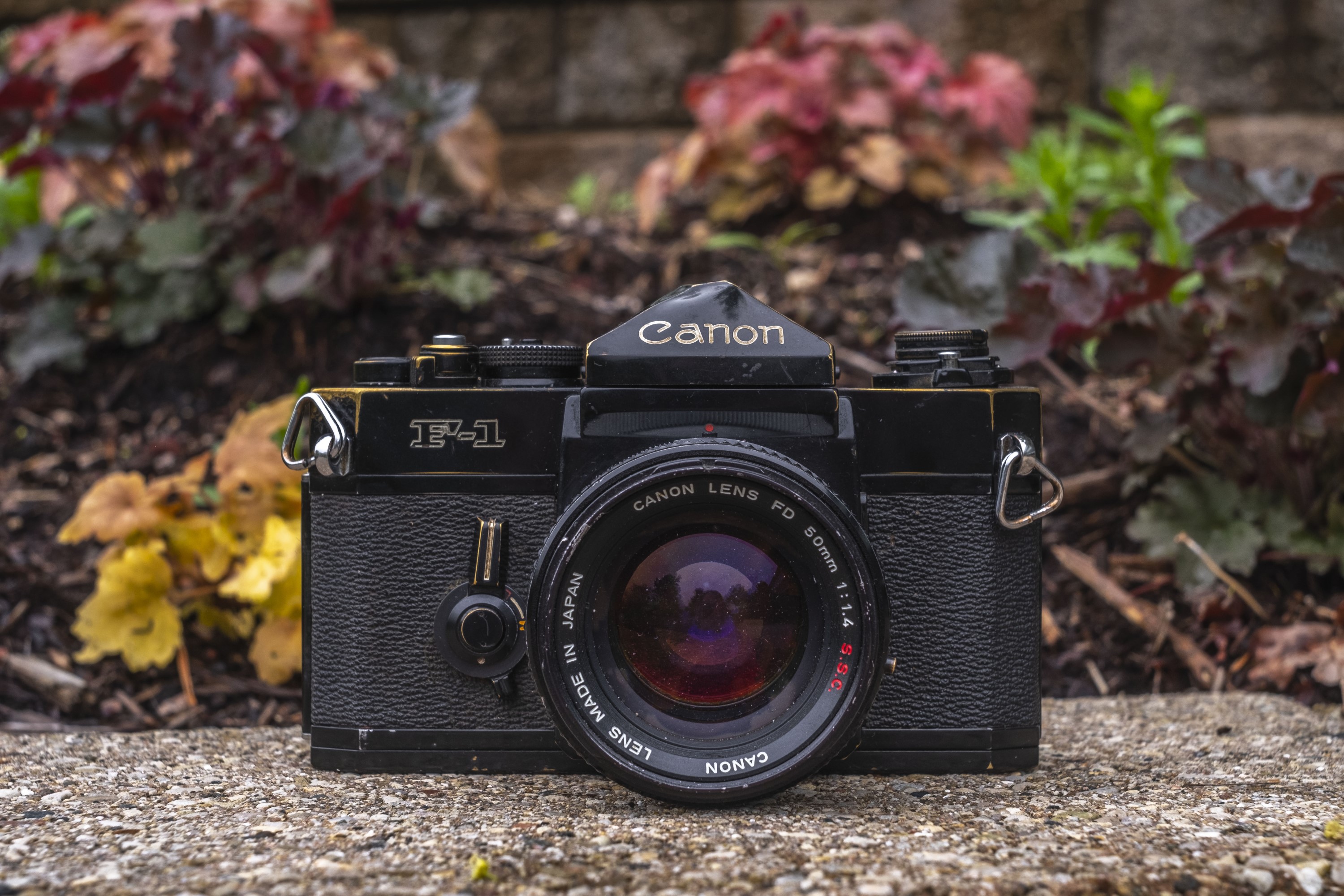
For those who loved technology and wanted the latest “whizz-bang” features, there was usually a step down model that cost as much as, sometimes even more than that same company’s pro level camera, offering the latest in camera design. For Nikon, models like the EL and FA added automatic exposure and electronic shutters before the F3 ever had it, Minolta offered the auto focus Maxxum 7000 before the higher spec 9000 model to test the waters first, and Canon gave one of the longest feature lists to a camera called the Canon A-1 featuring things far before any pro-level Canon ever had it.

The Canon A-1 was the third model released in Canon’s A-series of electronic SLRs, coming after the AE-1 and AT-1, but before the AV-1, AE-1 Program, and AL-1. Of the six cameras, it was the only one capable of six different exposure modes (including full Programmed AE), and the only with a 7-segment LED display in the viewfinder. When it was released in April 1978, the Canon A-1 was the most advanced 35mm SLR camera on the market. The only company who had something that came close was Minolta with the XD7 / XD11.
When released, the Canon A-1 sold with an f/1.8 or f/1.4 lens for $611 and $680 respectively. When adjusted for inflation, these prices compare to $2900 and $3200 respectively. The Canon A-1’s price put it in competition with other cameras like the Olympus OM-2N, Asahi Pentax K2 DMD, and Nikon FE all equipped with 50mm f/1.4 lenses for $672, $688.26, and $706.50 respectively. (All prices taken from Modern Photography’s December 1979 year end roundup of the 47 best cameras from that year.)
Contemporary reviews of the Canon A-1 praised its many exposure modes and long list of features, including the soft touch shutter release and “calculator type LED display” in such a lightweight body. By far, the most common complaint was the lack of a top 1/2000 shutter speed. Topping out at 1/1000 was seen in 1978 as acceptable for consumer grade cameras, but for a flagship advanced amateur camera like Canon promised the A-1 would be, the lack of anything faster was a disappointment.
Another feature which had people excited a year after the Canon A-1s release which had nothing to do with the actual camera, was Canon’s switch to the “New FD-Mount” an update to the company’s long standing breech lock R/FL/FD mount in which a lock ring is replaced by a more traditional bayonet lens mount. The new-FD mount lenses came standard with the Canon A-1 and were fully backwards compatible with every Canon SLR that preceded it. In addition, older lenses were compatible too, although they may not be able to take advantage of all the A-1s many exposure metering modes.
Correction: In the original version of this article, I incorrectly stated that the “New FD” lenses were introduced at the same time as the Canon A-1. Site reader paul1513, pointed out that the “New FD” lenses came out about a year after the Canon A-1. One of the first appearances of lenses with the updated mount appeared in the July 1979 issue of Modern Photography. It was incorrect for me to say that the new lenses were available at the same as the Canon A-1s release, but they appeared shortly after, and would have been sold together after that point.


This was the second Canon A-1 I’ve come across, the first being an inoperable one at the very beginning of my time collecting cameras. Since then, I’ve handled a variety of Canon A-series cameras including at least half a dozen AE-1s. For one reason or another, I’ve often been underwhelmed with most of the A-series so I wasn’t terribly motivated to seek out any more from the series to review. Sure, I knew the A-1 supported multiple AE modes and it has that cool red 7-segment LED display in the viewfinder, but a combination of timing and that nearly all A-1s I’ve come across suffer from the infamous “Canon squeal”, I never felt compelled enough to give one a second chance.

As often happens, sometimes when selecting what I want to review next, I don’t select a camera, but rather one selects me as I just so happened to come across a beautiful condition Canon A-1 in what looked like near new condition. As is often the case, the less a camera has been used throughout its life, the more likely it is to develop problems. This Canon A-1, despite looking great, squealed louder than any Canon I’ve ever handled. It was downright brutal! In addition, the foam light seals had degraded worse than I’ve seen on other 1970s or 80s cameras and had the consistency of sticky tar.
I thought that if there was a chance I could get this camera working, it might be a good example for a review due to its otherwise excellent condition. Armed with a box full of Q-tips, wooden toothpicks, some rubbing alcohol and acetone (just in case) I got to work scraping the old light seal and mirror bumper material and I replaced it with a home made kit of my own. For the squeal, I sent the camera to Allen Wade from Cameraworks and he gave it a thorough cleaning. If you listen to Episode 89 of the Camerosity Podcast, we discuss a variety of wholly incorrect ways to fix the “Canon squeal” on the A-1 and AE-1 and rest assured, I sent this camera to a pro and had it cleaned and lubed the right way.
As I had hoped, when the A-1 came back, it was perfect. The camera was in beautiful shape, the viewfinder was clean, the LED display worked, the shutter worked at all speeds, and as far as I could tell, the camera was in working order so I bumped it in the queue for my next roll of film.

The Canon A-1 only came in black, which was likely a nod to its “semi professional” price. Like other A-series cameras, the internal body is aluminum, covered in acrylonitrile-butadiene-styrene (ABS) plastic which not only keeps weight down, but was thought to wear better than enamel painted brass like on earlier cameras. The camera comes with a removable finger grip on the right side, which makes handling the camera a joy. The grip must be removed to access the battery compartment whose location is unfortunately located behind a cheap plastic door which has a bad reputation for breaking. Thankfully, the battery is an easy to find 4LR44 / PX28 6v battery meaning that replacements are still easy to find today. When changing the battery, be sure not to lose the finger grip as many Canon A-1s are found today with this grip missing.
The entire camera is electronic, using a microprocessor controlled shutter and metering system. This amount of technology gave the A-1 unparalleled accuracy, but had the negative side effect of being entirely dependent on the battery. Unlike contemporary cameras made by Canon’s chief competitor Nikon, the A-1 lacked any ability to work, even at a single shutter speed, with a dead battery.

Handling the Canon A-1, the best way I can describe it, is “busy”. There is hardly a blank spot anywhere on the camera’s top plate as every millimeter is occupied by some type of control. It is probably appropriate that the Canon A-1 was typically sold to photography enthusiasts, because its cluttered layout would have certainly intimidated beginners. Even with the experience I have with film cameras, a brief reference to the owners manual was required for me to feel comfortable in using it.
One thing I’ve never liked about Canon is that their choice of how they describe exposure modes is different from pretty much everyone else. Where companies like Nikon, Minolta, and others use the letters P, S, A, M to describe Program, Shutter Priority, Aperture Priority, and Manual exposure modes, Canon uses “P” for Program AE, but they use “Tv” for Shutter Priority and “Av” for Aperture Priority, and on the A-1 there is no direct setting for manual exposure mode. Further adding to the confusion is that these four exposure modes are not selected via a single dial or button like on most cameras. You can’t even see both shutter speeds and aperture values at the same time as switching between the two requires you to move a switch between the Av and Tv positions.


In the two images above, the left image shows the camera in either Shutter Priority or Manual Exposure modes. The image on the right shows the camera in Aperture Priority mode. Further complicating matters, how you use the different modes depends on which lens you have mounted to the camera and how the aperture ring is set.
- For any of the three P, Tv, or Av exposure modes, your lens must be set to the green “A” or “o” mark on the aperture selector.
- Programmed AE is chosen with the exposure mode set to Tv, and the shutter speed dial set to P. AE is still possible using older FL lenses, but must be done in stopped down mode.
- Shutter Priority AE is chosen with the exposure mode set to Tv and the shutter speed at any manual setting.
- Aperture Priority AE is chosen with the exposure mode set to Av, and a new scale replaces the shutter speed scale with an aperture scale, which you then choose in the same way you change shutter speeds.
- Finally, for manual exposure, turn the aperture ring on your lens away from the “A” mark to choose an f/stop, then set the exposure mode selector to Tv and choose your shutter speed.

Whichever mode the metering system is in, shutter speeds and f/stops are changed by a small wheel on the front of the camera. Below this wheel is a sliding cover which protects the wheel from accidental changes. To change the setting, this cover must be in the down position and then the wheel can be spun using a side to side motion of your front index finger. While this mimics shutter speed dials which overhang the front edge of the top plate, like on cameras such as the Canon EF and Leica M5, I found this dial on the A-1 to be a bit more of a struggle to use. Its location is a bit cramped so close to the edge of the prism, and often required me to momentarily lower the camera from my eye to locate it. I suspect that with repeated use, owners of these cameras would have gotten used to the location, but it is not something that immediately jumps out at you the first time you handle the Canon A-1. I feel like this dial could have been improved if it was larger in diameter and thickness, and more towards the A-1 logo.

Before I continue, I should point out that Canon was treading new ground with the A-1. As the first 35mm SLR with both aperture and shutter priority auto exposure, along with a full programmed mode, they had to figure out a way to select between these modes using traditional knobs and levers, as LCD screens and mode select buttons were not in common use at the time. For that reason, I won’t completely hate on the A-1’s controls, but it does take some getting used to.
At the risk of sounding overly negative, there is one thing that I absolutely love about the Canon A-1 and that is its viewfinder, or more specifically, the 7-segment LED display in the viewfinder. Using a technology that I remember from my youth which was commonly used in early calculators and hand held video games, the A-1’s LED display is gloriously retro in the coolest way possible. For those of you who are at least my age or older, peering through the eyepiece and seeing the red display light up will definitely bring back some nostalgia.


The display is below the main viewfinder window and features a total of six 7-segment red LEDs plus an additional LED for a decimal point. The first four digits are used to display shutter speeds from 1000 down to the slowest speed of 30 seconds, which is indicated as the number ’30’ with a quotation mark to its right. When setting the shutter to Bulb mode, the four digits cleverly spell out the word bulb in all lowercase letters. The final two digits are used to display f/stops from 32 down to 1.2. The display is not infinitely variable and will only show settings in half stop increments. A red letter “M” would appear on the far right whenever the camera was in full manual mode to show what was selected, rather than what the meter was recommending. The display had an auto brightness feature in which the the LEDs would automatically dim in low light so as not to overpower the viewfinder, and increase in brightness when more light came in.

The use of red LEDs was necessitated by the technology at the time as it was the only color which could be made at an affordable rate, but also due to practicality as red light is less likely to interfere with the camera’s built in exposure meter. Reading the display is surprisingly modern, yet when owners of the Canon A-1 first saw it in 1978 when the camera was first released, likely thought it was very futuristic. It is funny how the passage of time can cause the same feature to appear both futuristic and retro depending on who was looking at it.
The focusing screen is on par with that of premium 35mm SLRs of the same era. The A-1’s focusing screen can be changed between seven that were available. The standard screen is called the Type E and features a split image focus aide in the center, surrounded by a microprism collar and a laser etched pattern which allows for maximum brightness, even in lower light. Other versions without any focus aides, grid lines, or just a microprism dot were available if you needed them.

Opening the Canon A-1 is typical to other cameras of the era in which an upward tug on the rewind knob unlocks the rear door. The right hinged door reveals a rather ordinary film compartment. The Canon A-1 predates the use of DX coding or automatic film loading. Canon has always been innovative in simplifying the film loading experience, and for the A-1, the non removable take up spool is multi-slotted, making it very easy to attach the leader when loading in a new roll of film. The A-1 uses foam light seals, which on this example were degraded, so they should be replaced to prevent light leaks from ruining your film.

A feature which I very much appreciated with this combination of lens and body reviewed here was the updated “New FD mount” which was released a year after the A-1’s 1978 release but became standard on all models sold after that point. With these updated lenses, Canon improved lens coatings and support for Automatic exposure modes, including changing the automatic setting from a lower case ‘o’ to a more recognizable capital “A” on the aperture ring.

Perhaps the most significant change was abandoning the controversial breech lock that had been a staple of Canon SLR lenses since the first Canonflex of 1959 in which the lens mount does not rotate while mounting or dismounting the lens. Instead, a metal ring rotates to attach the lens, securing the lens to the body. Canon’s logic with the breech lock was that no surface of the lens would wear away as it rotated against the lens mount. This in theory would eliminate a loss of focus accuracy as lens mount material could be worn away after repeated use. In practice however, this never happened as any meaningful loss of material would take an absurd number of lens changes.

With the new FD mount, the original bayonet mount of the FD and earlier FL and R-mount lenses is retained for backward compatibility, but instead of a breech lock, the bayonet secured the lens to the body in the same manner as other mounts by Nikon, Minolta, and others. While it is not fair to call the New FD mount a feature of the A-1, that most A-1s sold after 1979 came with a New FD lens as standard, ties the two features together. I never thought that the old breech locks were especially difficult to use, they were different and sometimes took an extra second or two to line up before you could mount a new lens, but I see the new bayonet mount as a nice upgrade.
Beyond the exposure modes and viewfinder, the rest of the Canon A-1 is pretty typical for the era it was made. One of the most popular cameras of this era was the Canon AE-1 which the A-1 is effectively an upgraded version of. Canon was wise not to significantly alter the design or ergonomics of the more expensive A-1 compared to the earlier AE-1 as it made it an attractive upgrade option.
Earlier in this review, I mentioned receiving the Canon A-1 with the notorious squeak which I wanted to get resolved before I used it, so I sent it to Allen Wade at Cameraowrks and after receiving it back, I was eager to put a roll through my “de-squeaked” Canon A-1 so I loaded up a fresh roll of Fuji 200 and took it out in very early spring when the first signs of color was returning to the world. For my test roll, I split between the 50mm f/1.4 lens seen in this article and the Canon SSC 35mm f/2 wide angle lens which you can see in the mirror selfie below.


Predictably, the Canon A-1 produced great results. This was a high end camera with a top tier lens from one of the most respected Japanese camera makers. As I do in reviews of similar cameras by companies like Nikon, Minolta, or Leitz, I say that my comments are less about the results and more about the process of using the camera. Did the Canon A-1 do anything that significantly improved or hindered my ability to make great photos?

Starting with the good, the Canon A-1 has an excellent feel in your hands. Although the outer body is plastic, the insides are metal, giving it a level of reassuring heft. Unlike pro cameras like the Canon F-1 and Nikon F2 which were available upon the A-1’s release, this camera is considerably more compact and easier to handle. The small finger grip was an excellent addition and something that makes shooting the A-1 a joy. I don’t like that you have to remove the grip to change the battery as this increases the chance for it to get lost, however. I would have preferred Canon come up with a solution similar to what Nippon Kogaku did in 1980 with the release of the Nikon F3 where the battery compartment was somewhere else and the finger grip was a permanent part of the body.

The Canon’s viewfinder is extremely cool and the retro red LEDs are easy to see, however they are limited in what they can display. In any Program mode, it shows exposure settings that the camera will choose, and in both shutter and aperture priority, it will show the setting it recommends along with your manually selected option. In full manual mode, it shows only what you’ve selected, however there is no way to see what the meter is recommending, like on other electronic cameras like the Nikon EL2 or the Minolta XD11 which can both display manually selected and recommended settings. This was probably a minor issue considering the A-1 was probably used exclusively in one of the Automatic modes, probably 99% of the time, but for the person who likes to use manual everything, the A-1 may not be the ideal Canon for you.

Having access to multiple metering modes is convenient and likely the biggest selling point of the camera, however I think at least a few people might have been turned off by the top 1/1000 shutter speed or the slow 1/60 X-sync speed. That companies like Nikon, Minolta, Konica and others (and Canon themselves with the Canon EF) were using vertically traveling Copal Square shutters at the time, and that top 1/2000 shutter speeds date back to the 1960s, I feel that by not having a more modern shutter was a missed opportunity for the camera.
I can’t help but shake the feeling that while Canon tried hard to put a lot of cool technology into the Canon A-1, perhaps some of their priorities were misguided. If the point of the A-1 was to be a “premium A-series camera” and one that was an alternative to their professional level F-1, they should have prioritized premium features rather than cutting edge technology. This likely didn’t bother deep pocketed casual photographers who wanted a state of the art camera, but for someone who might have wanted a less expensive backup to the F-1, they might have been disappointed.
Quite simply, the Canon A-1 is a good camera that will not get in the way from making great photos, but it is not my favorite Canon camera, or even my favorite Canon A-series camera. It is good, but not great. I am certain that not everyone will agree with me, as the Canon A-1 proved itself to be a popular model, and stayed in production for seven years, however I think that with the release of the updated Canon AE-1 Program in 1981, customers preferred the less expensive camera. Although the Canon AE-1 Program did not share the same list of features as the A-1, it had a better combination of what people wanted.
I like the Canon A-1 and am happy to have spent the money to get it CLAd. This is a beautiful camera with some cool features and it makes great images, but for the reasons mentioned above, it will likely sit on the shelf longer than other models.
Related Posts You Might Enjoy
External Links
http://camera-wiki.org/wiki/Canon_A-1
https://en.wikipedia.org/wiki/Canon_A-1
https://global.canon/en/c-museum/product/film100.html
https://www.mir.com.my/rb/photography/companies/canon/fdresources/SLRs/a1/html/index.htm
https://casualphotophile.com/2015/04/20/canon-a-1-camera-review/
https://yourphotographybuddy.com/the-canon-a-1-review-everything-you-need-to-know/
https://www.fogdog-photography.com/fogdog-blog/2022/5/3/boomerang-cameras-the-canon-a-1
Hi Mike: I’m a camera collector with a special weakness for Canons of types. I’m here in Massachusetts and a member of the Photographic Historical Society of New England (https://phsne.org). My only quibble about the A-1 review is the battery issue. Canon knew what they were doing when they built the ‘A’ series using 6v alkaline batteries for the millions of AE-1 et al. I’m pretty certain the A-1 used 6v, not 1.5v. Say “Hi” to my college mentor Paul Rybolt when next I get to watch Camerosity!
Good catch Ryck! I had the voltage correct in the specs at the beginning but had a brain fart later on down. I have corrected my mistake.
My Grandfather bought one the year they came out to replace his Exakta Varex IIA, and I learned to photograph with it so it always seemed natural to me. When I started trying out other manual and even auto exposure cameras I was frustrated with how different they all were from my A-1. Always gets perfect exposure on slide film, I like having the option for Tv priority, and it does everything my DSLRs could do – PSAM and auto flash. Also as a child of the 80’s I think the styling is just about perfect.
Hi Mike:
I wrote the Wikipedia article on the Canon A-1 twenty years ago. (I haven’t checked to see if it’s been edited beyond recognition.)
The Canon A-1 35mm SLR was not released at the same time as the Canon FDn lens mount. Herbert Keppler introduced the A-1 in his SLR Notebook column in Modern Photography magazine’s May 1978 issue (along with the Nikon FE). Modern Photography announced the FDn (New FD) mount in their July 1979 issue.
MODERN’s July 1978 test of the Canon A-1 shows a Canon SC 50mm f/1.8 lens in FD breech-mount with silver chrome breech-lock tightening ring. MODERN’s August 1979 test of the Canon AV-1 is their first with a Canon 50mm f/1.8 lens in FDn pseudo-bayonet mount, and devoted a few column-inches describing the new mount. It also stated that Canon was in the middle of the FD to FDn mount changeover.
hope this helps
paul1513
Paul, thank you for the feedback and for the supporting evidence, I definitely missed that. I will make corrections to the article and credit you.
Hi Mike,
In manual mode the red LEDs in my A-1 show from left to right: the selected shutter speed, the metering system’s recommended aperture, A small cap letter M.
The description of the manual mode display in the review is different than this. It states that the LEDs on the reviewed camera show selected shutter speed and selected aperture with no info coming from the meter.