
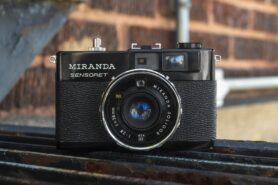
The Miranda Sensoret, released in July 1972, was the only rangefinder camera ever made by the Miranda Camera Company, a Tokyo-based firm otherwise exclusively known for SLRs. It arrived after Miranda's 1968 purchase by US distributor Allied Impex Corporation and the retirement of founder Ogihara Akira, suggesting a shift toward volume sales in the growing compact fixed-lens rangefinder market dominated by Canon, Minolta, and Yashica. The camera was built around Seikosha's new compact, modular Seiko ESF electronic shutter, the same shutter used in contemporaries like the Fujica GER, Minolta Hi-Matic E, and Olympus EC/EC2. It came in chrome and black finishes (chrome more common, with several color body coverings also made), sold in the US for $129.95 (or with flash and auxiliary lenses for $20 more), and roughly 80,000 were produced before Miranda's 1976 collapse.
Specs-wise, the Sensoret featured a 38mm f/2.8 Miranda Soligor 4-element lens, a stepless Seiko ESF shutter (2–1/800 sec), coupled CdS programmed autoexposure, and a coincident-image rangefinder with an exposure-ready lamp, powered by two now-obsolete RM640 mercury batteries. The author tested two black examples from a Miranda collector's estate, complete with decades-old but still-functional mercury batteries, and found the build quality solid, with metal top/bottom plates and well-applied finishes. Notable quirks included an aperture scale that only appears in the viewfinder when a flash is mounted, a very short focus-ring throw, an EV compensation slider, and a lack of automatic parallax correction. A test roll of Kodak TMax 100 produced sharp, well-exposed images with no vignetting, confirming the Soligor lens's strong reputation and the meter's continued accuracy even on decades-old batteries.
The author's verdict is largely positive: despite typical limitations of 1970s compact electronic rangefinders (cramped controls, twitchy short-throw focusing, plastic/electronics prone to failure, and a viewfinder that felt basic even for its era), the Sensoret delivered excellent image quality and reliable automatic exposure for an entry-level, easy-to-use snapshot camera. Though scarce and hard to service today, the author believes original owners were likely very satisfied, and considers the camera a genuinely good, if overlooked, entry in Miranda's history before the company's demise.
AI-generated summary. May not capture every detail — read the full article below for the complete picture.
This is a Miranda Sensoret, a 35mm rangefinder camera made by the Miranda Camera Company in Tokyo, Japan and was released in July 1972. The Sensoret was the only rangefinder camera made by Miranda, a company exclusively known for SLR cameras. The Sensoret was a compact rangefinder camera with fully automatic exposure, offering manual focus, but little other manual control. It competed against other entry level automatic rangefinder cameras made by Canon, Minolta, Yashica, and Konica. It can be found in both chrome and black bodies, although the chrome ones are more common. The Miranda Sensoret was produced for a short period and sold poorly, as a result finding working copies today is difficult.

Film Type: 135 (35mm)
Lens: 38mm f/2.8 Miranda Soligor coated 4-elements in 3-groups
Focus: 3 feet / 0.9 meters to Infinity
Viewfinder: Coincident Image Coupled Rangefinder w/ Exposure Ready Lamp, 0.5x Magnification
Shutter: Seiko ESF Electronic Shutter
Speeds: 2 – 1/800 seconds, step less
Exposure Meter: Coupled CdS Cell w/ Programmed AE
Battery: (2x) 1.4v RM640 Mercury Batteries
Flash Mount: Hot shoe w/ PC X-Sync
Weight: 338 grams
Manual: https://www.cameramanuals.org/miranda_pdf/miranda_sensoret.pdf
 Of all the Miranda cameras I’ve looked at on this site, they all shared one thing in common, they were all SLRs. Unlike many Japanese camera makers whose start into the camera industry was with some kind of rangefinder, Miranda (previously called Orion Camera Company) jumped straight into SLRs with the release of the Orion Miranda T in 1955. It would not be until 1972 when the company would release their first, and only rangefinder, the Miranda Sensoret.
Why would a company with nearly two decades of SLR making experience decide to produce a rangefinder camera? To be honest, I don’t know. I’ve scoured the Internet, including many archived websites on the Wayback Machine, old magazines, and even asked the only Miranda collector I know, and there isn’t a clear answer. The best guess I can make is that the company was desperate for sales and thought they could make some money on a cheap and (relatively) easy to produce camera.

To get a sense of what the creators of the Sensoret might have been thinking, you’ll need to understand where the company was at the time. The original Miranda Camera Company was purchased by its US distributor, Allied Impex Corporation in 1968. In addition to a change of ownership, Miranda’s president and company founder, Ogihara Akira had retired around this same time further suggesting a change in direction for the company.
It stands to reason that with increasing competition from other Japanese camera makers, Allied Impex Corporation was more interested in volume sales, rather than that of fully featured SLR systems as had been the case with earlier Miranda models. While the market had greatly shifted away from interchangeable lens rangefinders to SLRs, compact fixed lens models were still popular and sold well by companies like Canon, Minolta, and Yashica.
Around this same time, the Japanese shutter company Seikosha had released an all new electronic shutter called the Seiko ESF. This new shutter was not only very compact, but it was fully electronic and modular, meaning that it could be easily adapted into a variety of camera bodies. Allied Impex Corporation likely saw this as an opportunity to jump into the compact rangefinder market by building a camera around the new Seiko shutter.

If you look at the Miranda Sensoret and think its design looks familiar, that is because it shares the Seiko ESF shutter and electronics from the Fujica GER, Minolta Hi-Matic E, Olympus EC/EC2, and other similar cameras of the same era. The camera-wiki page for the Miranda Sensoret claims the Konica C35 also uses this shutter, but as best as I can tell, all versions of Konica’s compact rangefinder used Copal shutters.

The Sensoret had a fully automatic exposure system and relied entirely on two mercury batteries. Without power, the camera would not work, not even at a single shutter speed. This likely wasn’t seen as much of a con however, as many cameras of that era had also become entirely electronics dependent. The Sensoret was available in black and chrome bodies. The chrome versions could also be found with six different colored body coverings. The standard was black, but versions with red, blue, beige, gray, and green could also be found. A version sold as the Soligor Sensoret was also reportedly available, but I was unable to find a single image of one anywhere online, so either this camera was produced in incredibly low numbers, or not at all. If you have an image of a Soligor Sensoret, please let me know in the comments section below, or send me an email.

The Miranda Sensoret was primarily sold in the United States, but versions sold in the domestic Japanese market also exist. In the US, the retail price was $129.95, but a “kit” version including the camera, an electronic EF-1 flash unit, and two auxiliary wide angle and telephoto lenses were also available for $20 more. The two auxiliary lenses screwed into the 49mm filter ring and multiplied the focal length by 0.8x and 1.3x and came with a finder that slides into the accessory shoe. Wrapping up the package was Miranda’s 3-year warranty which they included with all their new cameras from this era.

The Sensoret was not only Miranda’s first rangefinder, but it was their first foray into a class of economically priced cameras, yet it competed well in its class. With the Seiko ESF shutter, programmed auto exposure system and a good Tessar style 4-element Soligor lens, the Miranda Sensoret was an easy to use camera that produced excellent images.
In a field test report from the May 1975 issue of Modern Photography, the Sensoret went through a full battery of tests and came out with quite a few positive comments. Fit and finish were rated as good, the metering system never varied by more than 0.5EV, and the 38mm Soligor lens’s performance was rated good to excellent with the best performance happening at f/4 and smaller. Final comments were that the Miranda Sensoret was an excellent camera for snapshots and could also be seen as a “notebook” camera for professional photographers.
The Miranda Sensoret was a surprisingly good camera for the era in which it was made, and despite being Miranda’s only rangefinder, it proved that the company could succeed in the entry level market. Sadly, economic troubles, mismanagement from Allied Impex Corporation, and disastrous performance from the company’s final SLR, the Miranda dx-3 resulted in the company going out of business in 1976. With it, any plans for a Sensoret II or some other kind of consumer friendly point and shoot died. According to estimates, around 80,000 Sensorets were made, a majority of which were sold in the United States. While not a common camera to find today, they regularly show up for sale on eBay and other online marketplaces.

This Sensoret came to me in a large collection of cameras previously owned by Miranda collector Jeff Felton. A majority of the Sensoret cameras owned by Jeff were chrome versions but there were two black ones and included with them was paperwork that these cameras had been CLAd within the past 10 years. Amazingly, also included in the package were two blister packs of never before used RM640 mercury batteries. I inspected the batteries and noticed no leakage and after connecting them to my multi-meter, I was amazed to see that they were still outputting the correct voltage!

I had seen these Sensorets before, but with my previous poor experiences with later Miranda SLRs, I never made much of an effort to acquire one. Now that I had not only two good looking and supposedly perfect working examples in my hands, I was intrigued. The Miranda Sensoret might have been an economically priced camera targeted at a market the company had no experience with, but the build quality was quite good. Both the top and bottom plates are metal and the chrome plated and black enamel finishes of both cameras felt well applied and consistent with other Japanese and German cameras of the same era. I already knew that Soligor lenses were capable of great images, but I was intrigued at how well the rest of the camera worked.

Being mostly automatic, there aren’t a lot of controls on the camera. The top plate has a pretty typical rewind knob with folding handle, flash hot shoe, automatic resetting exposure counter, and the cable threaded shutter release with lock collar. The camera’s serial number and an “MC” logo is also present here. An interesting feature of the hot shoe which I did not immediately notice is that only when a flash is mounted, a small pin in the shoe is pressed, and an aperture scale will appear in the viewfinder. This is not present without anything in the shoe. If you don’t have a flash handy, you can make this scale appear by looking for the pin under the right rail and pressing down on it with a small screwdriver.

The base of the camera has a 1/4″ tripod socket, rewind release button and a plastic door covering the battery compartment. The Miranda Sensoret uses two 1.35v RM640 mercury batteries which are no longer made today. Although some modern alkaline equivalents have been made, these are some of the more difficult batteries to find today. Alternatively, two SR44 batteries can be substituted with an adapter to make them fit into the larger opening for the original batteries. I was lucky enough to find a pack of unopened mercury batteries which despite being probably 30 years old, still had enough of a charge to power the camera.

The sides of the camera have metal strap lugs on both sides, and a PC flash sync port on the left side. Around back the only thing you’ll see is the rear facing film advance lever. The lever has a relatively short 140 degree throw to completely advance the film and cock the shutter. The film door is opened by lifting up on the rewind knob and giving it a swift upward tug.

The right hinged door swings open to a typical film compartment for a 1970s rangefinder. Film transports from left to right onto a multi-slotted integrated take up spool. Simply stretch the film leader across the film gate and insert the tip into one of the many slots and start advancing the film lever to secure the film to the roll. After advancing the film a couple of times, close the door and continue advancing until you reach the first exposure. The Sensoret does have foam light seals, which on all the cameras I’ve handled, were degraded and sticky, so should be replaced before shooting film in the camera.

Looking down at the top of the lens, you won’t find some of the usual controls you’d expect here like a shutter speed selector or an aperture ring. While technically, the ring closest to the body does control the aperture, it is not indicated which f/stop you are selecting. In its place is a flash GN scale with two sets of numbers, one in green for meters and the other in orange for feet. In front of it is the focus ring with focus distances from 3 ft / 0.9 m to Infinity. Like many 1970s rangefinders, the focus throw on this camera is incredibly short, with a movement from minimum to infinity focus requiring around 1/8th of a turn.

Up front, there are a couple interesting things to see. Around the glass lens inside the 49mm filter ring is a plastic dial which when rotated, selects the ASA film speed seen through a small window below the lens from speeds 25 to 800. A separate slider which flanks the lens on both sides selects from one of three EV compensation settings. The default is “N” which means no compensation, 2x which is +1EV and 1/2x which is -1EV. Although a minor feature, this was an unusual feature to have on this generation of fully automatic 35mm rangefinders. Outside of the lens filter ring, there is nothing else to see on the front of the camera.

The main viewfinder is tinted blue with yellowish frame lines, a rectangular rangefinder patch, and when a flash is mounted, an aperture scale projected in yellow. The difference between the yellow rangefinder patch and blue viewfinder give good enough contrast to easily see to focus in all but the worst light. The frame lines do not automatically correct for parallax, but feature close focus marks along their top and left sides. On the far right of the viewfinder, in a separate area which overlaps some of the visible area is a yellow bulb which lights when the shutter release is half pressed if the camera has sufficient battery power. This light also stays on during the duration of the shutter firing at slow speeds. Since the Miranda Sensoret is entirely battery dependent and will not work without power, half pressing the shutter release and looking for this yellow light effectively works like a battery check.
A neat feature of the Sensoret’s viewfinder which is only evident when you have something in the flash shoe is that an aperture scale will appear near the bottom of the viewable area. I didn’t notice this at first as I don’t typically use flashes, but this particular Sensoret still had the clear plastic shoe cover installed, which triggers the scale to appear. This scale is coupled to the focus wheel and changes as you choose distances. This is mainly useful for flash photography where over a certain distance the flash is no longer useful. I can’t think of a way to make this useful without a flash, but it does look neat.
Feeling thrilled that the Sensoret appeared to be working, but apprehensive for how long the nearly 30 year old mercury batteries would last, I wanted to get out and shoot a roll of film in the camera as soon as possible. I quickly loaded up a bulk roll of Kodak TMax 100 and took it out shooting.


For the entirety of their existence, the Miranda Camera Company only ever made one lens, and it was an extremely rare one called the Orion Supreme back in its Focabell and Mirax viewfinder days. As a maker of SLR cameras and eventually this one rangefinder, Miranda relied primarily on Soligor branded lenses, which were made by a variety of companies. It is often difficult to know exactly who made which Soligor lenses, but as a general rule, they were all pretty good.
So while we may never know for sure who made the 38mm f/2.8 Miranda Soligor lens on the Miranda Sensoret, I can happily proclaim, it must have been someone who knew what they were doing as the images from my test roll came out fantastic. Images were sharp across the frame and exhibited no vignetting and only the tiniest bit of softness in the corners. The black and white images from my test roll of TMax 100 looked as good here as any other camera I’ve ever shot, and although I never got around to shooting color, I see no reason to think that the trend wouldn’t have continued.

In addition to the quality images that the lens made, I was also ecstatic to see that the metering system, powered by 30 year old batteries using outlawed technology also worked well. With no control of exposure beyond the EV dial on the front, I let the camera do its thing, and all of my images from those taken in bright sunlight, to heavy shade, and even a couple indoor photos, came out properly exposed. Images shot in lower light with the lens wider open were understandably soft, but still very usable.
There is not a con to this camera that isn’t also true of nearly every camera from this generation of compact 35mm rangefinders made by Minolta, Konica, Olympus and others. While the size of the body is very small, offering great portability, the controls are a tad cramped, especially around the lens. It is probably a good thing that the lens doesn’t also have a shutter speed dial or a proper aperture dial as they’d have to be very thin and difficult to move with the camera to your eye. I also don’t love the extremely short throw of the focus ring. Compared to earlier cameras in which the lens can rotate close to 360 degrees from minimum to infinity, the one here rotates just short of 45 degrees, which is fast, but is difficult to get a precise movement while looking through the rangefinder. Tiny movements of your wrist cause the split image to rapidly shift from left to right, so if you are in low light, or attempting to focus on a moving object, it is a challenge.

Other considerations of 1970s compact rangefinders is an increased use of plastic and electronics, which can often fail. Although the two Sensorets I received from Jeff were in perfect working order, I know that many are not. These cameras come from an era where longevity was no longer a priority, and if you were to attempt to get a Miranda Sensoret fixed today, there are few, if any technicians who are willing to work on them. Finally, while the viewfinder is of decent size and shows good contrast, the lack of automatic parallax correction, the protrusion of a bright yellow bulb from the side and the lack of a full information finder would have seemed like a discount option, even by 1970s standards.
Overall though, this was an economically priced camera with an excellent lens that was intended to be quick and easy to use, and there is nothing about my experience that suggests it didn’t live up to what it was intended to do. I do not know anyone who ever bought one of these when they were new, but I believe that original owners of the Miranda Sensoret were probably very pleased with their purchase and were likely rewarded with many photo books of family memories, vacations, birthdays, and holidays. That maybe they’re hard to find in working condition over half a century after they were built, is hardly a con.
Related Posts You Might Enjoy
External Links
https://camera-wiki.org/wiki/Miranda_Sensoret
https://mikeeckman.com/mirandacamera/_modelinfo/_sensoret/sensoret.html
https://everythingvintage.uk/vintage-camera/miranda-sensoret-camera/
https://asminhascamaras.blogspot.com/2017/10/miranda-sensoret-1972.html
https://web.archive.org/web/20021021051459/http://www.246.ne.jp/~honmage/MSJ_html/afterAIC/ret.html (archived, in Japanese)
Having working in camera stores in the 1970s, I remember this camera, and wasn’t a big fan, but thought the optics were pretty good. A great review of a camera well off peoples radar.
Your summary is pretty spot on. While my example worked great, the frequency of how often these cameras are found inoperable suggests that they weren’t that well built, but when they do work, the lens is very good!
Hi Mike, Thanks for all the cool info. I have been testing my Miranda lenses using a Nikon Z* with a Miranda adapter. I have 19 50mm lenses (2.8,1.9,1.8,1.4) and they all produce excellent images. Even the old totally manual lenses that came on my “S” knob wind Mirandas. The one loser was a 50mm 2.8 Auto Miranda I got on eBay years ago from the UK. It doesn’t appear to have been messed with or dropped, it just makes awful images. I will be testing more lenses in the near future.
I am an old member of the Miranda Collectors Society and used to meet up with the originator, Tom Surovek, at shows before his passing years ago.