
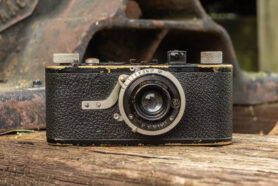
The Leica Model B, produced by Ernst Leitz from 1926 to 1941, is a rare oddity in the Leica lineup—the only Leica ever fitted with a Compur leaf shutter rather than a focal plane shutter. Built on the body of the Leica Model A but with the shutter removed and replaced by a Compur leaf shutter housing a Leitz Elmar 5cm f/3.5 lens, it earned the nickname "Compur Leica." Only about 1,650 were made across two versions (dial-set and rim-set shutters), making it one of the rarest Leicas. While popular belief holds it was created for better flash sync, the article cites Paul-Henry van Hasbroeck's research suggesting the more likely reasons were cost savings (it sold for roughly a third less than the Model A), access to slower shutter speeds down to 1 second, or shared parts with Leitz's photomicrographic cameras.
The author, testing a 1929 example (serial 13183) borrowed from fellow collector Paul Rybolt, found the well-worn but authenticated camera fully functional, with a smooth-firing shutter, clear haze-free viewfinder, and lightly worn lens. Handling it revealed a distinctly different experience from other Leicas: the shutter isn't cocked by film advance, there's no double-exposure prevention, and the shutter release moves position depending on focus distance, giving it a strangely "disconnected," almost cobbled-together feel compared to the precision of other Leica models the author has used. Despite this, a test roll of Kodak Plus-X 125 produced excellent, properly exposed and sharply focused images with the soft "glow" typical of uncoated prewar lenses, impressing the author given the camera's near-century of use and simple scale-focus system.
The overall verdict is one of surprised admiration: the Model B represents photography stripped to its most basic mechanical form, essentially a high-quality Brownie-like experience with full manual control and shutter speed range. The author feels it isn't a camera for those who value Leica's usual seamless engineering, but is great fun for anyone who appreciates quirky, bare-bones photographic tools. Given its rarity and high collector value, the author doesn't expect to ever own one, but describes the chance to shoot this example as a real treat.
AI-generated summary. May not capture every detail — read the full article below for the complete picture.
This is a Leica Model B, a 35mm camera made by Ernst Leitz GmbH of Wetzlar, Germany between the years 1926 and 1941. The Leica Model B was the second model in the Leica series and is the only Leica camera ever made which uses a Compur leaf shutter. Two versions of the Leica Model B were produced, the first with a dial set Compur shutter and the second starting in 1928 with a rim set Compur shutter. The usage of this shutter has earned this camera the nickname the “Compur Leica”. Although these cameras could be ordered from the factory over a span of about 15 years, only about 1650 were ever made, making them one of the rarest Leicas.

Film Type: 135 (35mm)
Lens: 5cm f/3.5 Leitz Elmar uncoated 4-elements in 3-groups
Focus: 3 meters to Infinity
Viewfinder: Scale Focus Optical Finder
Shutter: Compur Leaf
Speeds: T, B, 1 – 1/300 seconds
Exposure Meter: None
Battery: None
Flash Mount: None
Weight: 378 grams
Manual: None
A Leica with a leaf shutter? What kind of abomination is this?
If you’re looking at this review and are curious about what sort of masochist would desecrate a poor first generation Leica, rest not, this is no Franken-kamera, what you are looking at is a genuine product of Ernst Leitz in their earliest days as a camera manufacturer. The Leica Model B was the body of a Leica Model A with the focal plane shutter removed and the lens replaced with a Compur leaf shutter with embedded Leitz Elmar 5cm f/3.5 lens.

A common myth about the reason for the Leica Model B to be produced was for improved flash sync performance. The belief stems from the fact that the focal plane shutter on the earlier Model A had a very slow sync speed of about 1/20 seconds which is insufficient for many types of flash photography. The use of a leaf shutter expanded the sync speed all the way to the upper limit of the shutter, which on this model was 1/300 of a second.

Although this explanation is plausible, in his book Leica: A History Illustrating every Model and Accessory by Paul-Henry van Hasbroeck, the author clearly states that it is not clear exactly why this model was produced. Van Hasbroeck offers three possible explanations, none of which mention flash sync.
The first, which I believe is the most logical was that the Leica Model B was cheaper to produce and sell. At the time of its release, a Leica Model B had a retail price of about 1/3 less than that of a Leica Model A. In his book, he lists an unnamed UK retailer who sold the Leica Model A for £22 and the Model B for £15.
His second explanation was that the Model A lacked slow speeds below 1/20 and that with the Compur shutter, speeds down to 1 second plus T and B were possible.
His final explanation was that at the time of the Model B’s release, Ernst Leitz also offered two photomicrographic cameras called the Kafilmca and Mifilmca which were equipped with leaf shutters whose date of production coincides with the Model B and perhaps using some of those parts to produce a leaf shutter camera just seemed like the right thing to do.
Not only is flash sync not mentioned in van Hasbroeck’s book, but that the camera offers no ability to connect a flash unit to it nor did Leitz ever offer any sort of in-house flash unit further provides doubt that this reason was explicitly considered. Certainly, through clever use of aftermarket flash guns and dual shutter release cables, shooting flash photography with a Leica Model B was possible, however it is doubtful this was a primary consideration for its creation or that many original owners of these cameras used it for that purpose.

Two versions of the Leica Model B were made, one with a dial set Compur shutter produced between 1926 and 1928 and one with a rim set Compur shutter. Despite two distinct versions being produced, Ernst Leitz did not differentiate the two, they were both sold as the Model B or unofficially as “Leica-Camera with Compur Shutter”.

In the December 1930 issue of American Photography magazine, an ad for Chicago’s Central Camera showed both the Leica Roll Film Camera and the Leica Camera with Compur Shutter for sale in a package including the camera, a Leitz FODIS accessory rangefinder and leather case for $108 and $89.40 respectively. The nearly $20 difference isn’t quite the 1/3rd less price quoted in Paul-Henry van Hasbroeck’s book, but it does confirm the leaf shutter camera was sold at a modest discount. When adjusted for inflation, both camera packages compare to $2240 and $1850 today.
Production numbers for both styles of camera are very low with numbers for the dial and rim set versions estimated at 638 and 969 respectively. Records suggest that although the rim set Model B was available as late as 1941, a majority of production happened between 1926 and 1931 with a spattering of new cameras produced using left over parts over the course of the next 10 years. The specific camera reviewed in this article is serial number 13183 which tells us it was produced in 1929.
This particular camera came from a private collection near Cincinnati, Ohio and was purchased by fellow Camerosity Podcast host, Paul Rybolt. Since Paul is always “wheeling and dealing”, he had this camera sold to a new collector before he even had it in his hands, but not willing to risk passing up the chance for me to play with such a rare camera, I convinced Paul to send it to me first and let me have a go at it, before it went to its new home. After consulting with its new owner, we all agreed that the camera would make a pitstop at Mike Eckman dot Com headquarters for a week while I played with and shot a roll through it.
As you can see from the photos, the camera is in heavily worn condition with huge pieces of the original enamel flaking off. Initially, I had some concerns with the locations of the missing paint seeming to be located around the Ernst Leitz logo and the camera’s serial number, but after sending multiple high resolution pictures to Dan Tamarkin of Tamarkin Camera in Chicago, he assured me that everything checks out for this to be a genuine Leica Model B.

Although the camera was far from being in mint cosmetic condition, it worked perfectly. The nearly 100 year old Compur shutter still fired at all speeds with ease, the viewfinder was clear and free of haze, and the lens showed only very mild signs of wear suggesting that whoever owned this camera over the years, used it a lot, but also took very good care of it.

The many reasons the thread mount Leicas were so successful were a combination of performance, value, and ease of use. The earliest Leicas set the standard for how a 35mm rangefinder should look and work, and when the era of SLRs began, many early SLRs took their design cues from the rangefinders that came before it. Whether you picked up a 1920s Leica Model D or a late 1950s Leica IIIg, the control layouts were similar enough to where you wouldn’t need to spend much time to familiarize yourself with the camera.
The Leica Model B is an exception to that rule for a variety of reasons. The use of a Compur leaf shutter instead of the focal plane shutters featured in every other Leica ever made is largely responsible for the differences in this model compared to all others. The lack of a shutter speed dial and traditional shutter release on the top plate clears up some space, offering an uncluttered appearance.

On the left, things start out ordinary enough with a film rewind knob. When you’ve reached the end of a roll of film, move the film transport lever next to the film advance knob to the R position and turn the rewind knob in the direction of the arrow to pull it back into the cassette. Next is the optical viewfinder tube and accessory shoe which resemble those found on the early rangefinder-less Leicas.
Next to the accessory shoe is the large exposure counter which is unique to this model. With exposure numbers from 0 to 39, this counter is a relic from before Kodak’s standardized Type 135 cassette which set the practical limit to 36 exposures. In the center of the counter is a brass arrow which rotates as film is advanced through the camera.

In place of a traditional shutter release is a large domed button which is used to deactivate the film transport lock which engages after advancing the film the correct amount in between exposures. Since the film transport on the Leica Model B is not coupled to the shutter, the camera body has no idea whether or not an exposure has been made, so to avoid the chance that a user could continually keep advancing film well beyond each exposure and wasting film, the film transport automatically locks after the sprocket shaft in the film compartment counts off eight perforations. This is the exact amount of film that must be advanced to properly space 36mm wide images on a full frame 35mm camera. After making an exposure on the camera, you must momentarily press and hold this button and then rotate the film advance knob to release this lock and advance the film. As soon as you start to feel the advance knob move, you must release this button, or else you will advance too much film in between exposures. As strange as this might sound to someone unfamiliar with this camera, these types of film transport locks were very common on 35mm cameras of the era such as the Argus C3, Certo Dollina, and Wirgin Edinex.

The sides of the Model B look the same as other screw mount Leicas, of course the exception being that there is a leaf shutter mounted to the barrel. Early Leicas did not have strap lugs for attaching a neck strap. To carry the camera around your neck, the strap on the original leather case was used. The right side has a small round pin which helps secure the base of the camera to the body when installed.

Around back we see the small round eyepiece for the viewfinder, and a large swath of body covering. In the center is a round plug which was included on all early Leica models A through C which allowed technicians to inspect and calibrate the lens. The fixed lens models A and B and the early model Cs did not use a 28.8mm flange focal distance which became standard for all Leicas and Leica copies. When the cameras were being built (or later repaired), it was necessary to shim each lens so that it would properly focus on the focal plane and since the cameras did not have removable backs, this inspection window was added to the body. Once the lens was calibrated, a plug filled this hole and in most cases never needed to be removed again.

The bottom of the camera has both the half-circle rotating lock which is used both to open and close reloadable metal cassettes, but also to unlock the base for access to the film compartment. Earlier when I sent images of this camera to Dan Tamarkin, he noted that the tripod socket on this camera is the smaller 1/4″ size instead of the 3/8″ size typically found on early Leicas. He wasn’t sure if this was a factory upgrade or if someone had swapped the base of this camera with that from a later model, but it is an interesting quirk of this particular camera.

Remove the bottom and the Model B looks like any other bottom loading Leica. The one here is a bit more crude than later Leicas, but pretty much looks the same. With the bottom off and the lens facing up, the supply cassette goes on the right and the take up spool on the left. This camera still had its original brass film cassette which is a pretty rare accessory to have, but even without it, any reloadable Leica cassette or even a modern 35mm cassette will work.

The take up spool on this camera is the earlier solid metal design, but later ones with pop up shafts can be used as they are easier to get in and out. Loading film into a bottom loading Leica is different from back loaders, and depending on who you ask range in difficulty to “not that big of a deal” to “the worst thing in the world”. I’m in the former group as once you’ve done it once or twice, it isn’t that bad. The most important thing to remember is to first trim the film leader to around 10cm, or roughly the distance between the take up and supply spools. After trimming, securely attach the tip of the leader to the take up spool, and then slide both the take up spool and film cassette into both sides of the camera at the same time, paying attention so that the film leader slides between the film gate and the back of the camera. If you’ve never done this before, I highly recommend using a practice roll of film, but I really don’t find this to be as difficult of a task as some people suggest. With the film securely loaded in the camera, you should be able to advance the film using the knob on top and seeing it transport with little resistance. If things seem to be getting caught on something or there is too much resistance, just pull it all out and start over. With the film properly loaded, attach the bottom and secure the lock.

The lens and shutter are collapsible like on the Model A and later Leicas with collapsible lenses, but what you’ll see when looking down upon the Compur shutter and lens varies because the entire shutter and lens assembly rotate as you focus the lens. Sometimes the cocking lever and shutter release will be near the top, other times it will be on the side, it just depends. The good news is that there’s really nothing to see on the “top” of the shutter as none of the controls are there.

Leicas Model A and B are distinct in that they have a “hockey stick” shaped piece of metal screwed into the front of the camera. This functions as the infinity lock for the lens helix. When the lens is focused to infinity, the focus handle hits the edge of the hockey stick and prevents it from going further. Focus distances are engraved around the outer ring around the shutter. This Model B has distances marked in feet, rather than meters, suggesting it was produced for export to the United States, or other countries still using the imperial system. Also visible from this angle, in between the two shutter levers are a threaded cable release socket and the Compur shutter’s serial number.

This is a later Leica Model B with the rim set Compur shutter. Shutter speeds are chosen using the brass ring around the perimeter. Speeds from 1 to 1/300 plus T and B are available. On Compur shutters form this era, the shutter does not need to be cocked to use the T or B modes, only the instant modes. Another interesting feature of this shutter is a decorative wavy pattern engraved into the shutter speed ring. I’ve seen this design on other Compur shutters from this era, but I am uncertain of what it means, or if it serves some other purpose.

The optical viewfinder is a simple straight through design, but with simplicity comes brightness, and the one on this camera was crystal clear and a joy to look through. While many users prefer the rangefinder models, the advantage of a simple viewfinder is that there are no beam splitters or extra pieces of glass to reflect away a portion of light. In addition, the simplicity reduces the number of surfaces haze can form on. Although tiny, I had no issue seeing all four edges of the visible area while wearing prescription glasses.
I had only about a week to spend with the Leica Model B before I had to send it back so I wanted to get out and shoot it quickly. For what would be my only roll of film shot through the camera, I chose a bulk roll of Kodak Plus-X 125 which I had acquired some years back. While Kodak TMax 100 is my “go to” test film, I chose the Plus-X as it has a bit more pronounced grain and less contrast than the TMax, which I thought would suit the 97 year old camera well. I wanted to duplicate results as closely as possible to what an original owner of one of these cameras might have received.


When Paul sent me this camera and I told him I wanted to shoot a roll of film through it, he said “good luck”. He said he had his doubts it would work or return anything resembling decent images. Still, he was intrigued and as I finished my test roll, was about as eager as I was to see what it was capable of.
As I took the film out of my Paterson tank and I could already see a whole roll of (mostly) properly exposed and focused shots with good frame spacing, I was excited. As the images started to appear on my monitor while scanning them in, my excitement turned to elation.

Looking at the images, sharpness is excellent across the frame, showing similar detail to that of later Elmars and Elmar-clones like the Soviet Industar. Contrast was a bit low, which is typical of prewar uncoated lenses which people usually describe as having a “glow” to them. Further adding to the low contrast look was the Plus-X film which isn’t known for being a high contrast film. Had I shot something like Rollei RPX 25 or some other near-IR black and white film, I bet the images would have had more pop.
What surprised me the most was how well I was able to frame the images and get everything properly in focus. Scale focus is always a crap shoot, but considering this is a 97 year old camera and if at any point in the last near-century, it had been dropped, the hollow lens tube could have come out of alignment with the focal plane. This very rough looking and well used camera clearly has seen a lot of use, yet every functional aspect of it was still working well, and that was imminently impressive to me.

I’ve shot many Leicas before, from an original Leica Model A all the way to the digital Leica M8, I’ve shot several thread mount and M-series Leica rangefinders, the original Leicaflex SLR, an R4 and an R8 SLR, and even the Japanese built Leica CL and although each of them are different from each other, they all share a similar high-quality precision feel to them. The Leica Model B was very different from those, not because it felt cheap, but it felt really disconnected. Looking at it, you would be forgiven if you thought this was some kind of misguided abomination where someone grafted a leaf shutter onto some spare Leica parts, which to be honest, isn’t that far off from the truth.

Within the first few moments of handling the camera, it is very apparent that the shutter is completely disconnected from the rest of the camera similar to an early 20th century folding Kodak camera. Advancing the film does not cock the shutter as this must be done in a separate step, there is no double exposure prevention, so you could very easily keep shooting multiple images over the same piece of film if you’re not careful, the shutter release changes position depending on what distance the lens is focused to, sometimes it is on the side, sometimes it is on top. The whole experience feels thrown together, yet somehow, it worked!

After shooting the Leica Model B, what struck me the most is that it breaks down photography into the most basic form. When people used to shooting digital pick up a film camera, they often say that they like film because it slows them down, but the Leica Model B slows it down to the max (or would it be the minimum?) This is the 35mm equivalent of shooting a Kodak Brownie box camera, yet you still have a high quality full focusing lens and a full range of shutter speeds at your disposal. That may or may not be to your liking however. If you like shooting Leicas because of how well everything works together, this may not be the camera for you, if however you appreciate quirkiness at its most basic form, the Leica Model B is a lot of fun!
The Leica Model B was a short lived camera that scratched a certain itch for a more cost effective 35mm camera in the 1920s and early 1930s. The fact that no other leaf shutter or cost-effective Leicas were ever produced beyond this one model isn’t because it wasn’t a good camera, but rather that Ernst Leitz quickly found their niche for the Leica, and they decided to focus on the mid to upper end of the market rather than a cheap and simple to use model. These are rare cameras and almost nobody in the world is crazy enough to want to shoot one, and had the prices for these cameras not been well into the realm of “unobtanium” I would have happily added this to my collection, but that is not likely to ever happen. I was extremely happy to have the opportunity to shoot this camera and to whoever bought this camera from Paul, you’re in for a treat. I am definitely jealous of you!
Related Posts You Might Enjoy
External Links
https://wiki.l-camera-forum.com/leica-wiki.en/index.php/Compur_Leica_(model_B)
https://www.pacificrimcamera.com/pp/leicab.htm
Mike, it sounds like you had a lot of fun. I enjoyed reading about a camera that more likely than not I will never touch. Appreciated.
I was really impressed with the old Leica. Sometimes the cameras that you have the least hope for, end up being the most fun!
You found a perfect backdrop for your beauty photos … nice work!
Thanks Roger, I am always trying to find new backdrops that look good with old cameras placed in front of them. The one I used for a long time that was a retaining wall in front of some plants was at my old office, but my company moved out of there and tore the building down so it no longer exists.